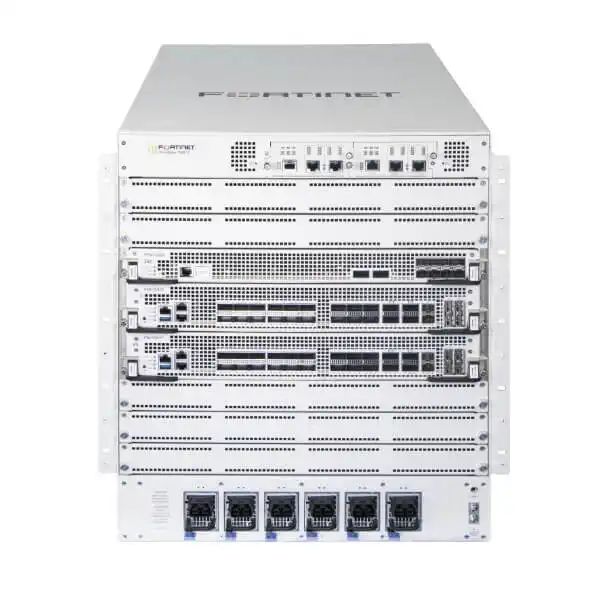
FortiGate 7081F in Uganda
A modular 12U next-generation firewall for hyperscale data centers, large enterprises, carriers, and hybrid infrastructure requiring multi-hundred-gigabit security inspection.
The 7081F is engineered for environments where the security platform must keep pace with very high east-west and north-south traffic volumes, encrypted applications, large VPN estates, and high-speed data-center fabrics. FourTeck can help Uganda buyers review the chassis, processor-module count, interface mix, FortiGuard services, power plan, optics, and redundancy requirements before a purchase decision is made.
A firewall platform built for traffic volumes that overwhelm conventional edge appliances
The FortiGate 7081F belongs to Fortinet’s 7000F family of high-end chassis firewalls. It is intended for organizations that cannot treat security inspection as a small edge function because the firewall itself sits in the path of enormous amounts of business-critical traffic. Typical candidates include large private data centers, telecommunications networks, internet-facing service platforms, research environments, government infrastructure, financial-services cores, and enterprises consolidating multiple security functions onto fewer high-capacity systems.
Fortinet’s current 7000F data sheet lists the 7081F at up to 1.89 Tbps of IPv4 firewall throughput for 1518-byte UDP traffic, 330 Gbps NGFW throughput, 312 Gbps threat-protection throughput, 405 Gbps IPS throughput, 324 Gbps SSL inspection, and 378 Gbps IPsec VPN throughput under the vendor’s defined test conditions. Those figures are useful for initial sizing, but they are not interchangeable. A data center carrying heavily encrypted application traffic, for example, should give more weight to SSL inspection and threat-protection performance than to raw packet-forwarding throughput.
The platform uses a modular eight-slot chassis architecture. Fortinet documents support for configurations with multiple Fortinet Processor Modules and high-density network interfaces. This makes the system attractive when the security boundary must evolve with the data-center fabric rather than forcing a forklift replacement each time bandwidth increases. The architecture also supports very high-speed Ethernet connectivity, including 400GE, 100GE, 40GE, 25GE, and 10GE options depending on the selected modules and port types.
The operational value is not simply speed. FortiOS combines firewall policy, segmentation, VPN, application control, intrusion prevention, and other security capabilities within the Fortinet ecosystem. Large environments can use this common operating model to align data-center controls with other FortiGate deployments and, where appropriate, broader Fortinet Security Fabric components. Licensing and services still require careful planning because different FortiGuard bundles, support levels, and contract terms change both functionality and commercial scope.
Why enterprises choose a modular high-capacity security chassis
Keep security inspection aligned with backbone speeds
The 7081F is designed for environments in which firewalling, IPS, and application security must operate at hundreds of gigabits per second. This helps architects avoid choosing between strong inspection and acceptable application performance when upgrading to 100GE or 400GE fabrics.
Scale within a chassis instead of multiplying standalone appliances
The modular architecture allows the platform to be built around processor and interface requirements. For data centers with defined growth plans, that can simplify rack layout, policy operations, and interconnect design compared with treating every capacity increase as a separate appliance project.
Protect large encrypted environments
Fortinet publishes 324 Gbps of SSL-inspection throughput and 288,000 SSL-inspection connections per second under its test methodology. Those capabilities matter as business applications, APIs, SaaS traffic, and internet services increasingly use encryption that must be inspected according to policy.
Support very large connection tables
The published capacity includes up to 600 million concurrent TCP sessions and 5.4 million new TCP sessions per second. Large internet services, carrier environments, and highly virtualized data centers may value this headroom where connection scale is as important as aggregate bandwidth.
Build resilient security boundaries
Fortinet lists Active-Passive and FortiGate Session Life Support Protocol based Active-Active options, with clustering also supported. The resilience design should still be validated against your failure domains, maintenance plan, session-state requirements, and upstream/downstream routing behavior.
Unify networking and security operations
FortiOS provides a common policy and management foundation across FortiGate appliances. For organizations already using Fortinet, the 7081F can extend a familiar operating model into the data-center core rather than introducing a completely separate security stack.
The defining characteristic is not one headline throughput figure; it is the combination of scale, modularity, and security-service capacity.
The 7081F is designed for buyers who need a firewall to behave like part of the data-center fabric. That means supporting dense high-speed interfaces, huge connection counts, substantial encrypted-traffic inspection, and advanced security services while preserving an operational model that can be integrated with the rest of the enterprise security estate.
Published for IPv4 1518-byte UDP traffic; real deployments should size to the enabled inspection profile.
A more relevant reference point for designs using multiple security services concurrently.
Supports modern high-speed data-center interconnect strategies through the appropriate interface modules.
Virtual Domains can help segment administrative and security contexts; maximums depend on Fortinet platform limits and design.
FortiGate 7081F published platform specifications
| Specification | Published value / guidance |
|---|---|
| IPv4 firewall throughput | 1.89 / 1.88 / 1.129 Tbps for 1518 / 512 / 64-byte UDP packets |
| Firewall latency | 7.5 μs for 64-byte UDP |
| Concurrent TCP sessions | 600 million |
| New TCP sessions per second | 5.4 million |
| IPS throughput | 405 Gbps, enterprise mix |
| NGFW throughput | 330 Gbps |
| Threat protection throughput | 312 Gbps |
| SSL inspection throughput | 324 Gbps |
| SSL inspection CPS | 288,000 under Fortinet’s IPS / average HTTPS test profile |
| IPsec VPN throughput | 378 Gbps at 512-byte packets |
| Gateway-to-gateway IPsec tunnels | 40,000 |
| Client-to-gateway IPsec tunnels | 260,000 |
| SSL-VPN throughput | 13.5 Gbps |
| Recommended max concurrent SSL-VPN users | 30,000 tunnel-mode users |
| Virtual Domains | 10 default / 500 maximum |
| High-speed interfaces | Configuration dependent: hardware-accelerated 400GE QSFP-DD, 100GE QSFP28, 40GE QSFP+, 25GE SFP28, and 10GE SFP+ options |
| Onboard storage | 4 × 4 TB SSD |
| Included transceivers | 4 × 10GE SFP+ SR |
| High availability | Active-Active (FGSP), Active-Passive, clustering |
| Chassis dimensions | 543.9 × 440 × 675.5 mm; 12U class chassis |
| Weight | 165.68 kg / 365.26 lb |
| AC input | 200 to 277 VAC, 50/60 Hz |
| DC input | -48V to -60V DC |
| Power consumption | Configuration dependent; Fortinet lists approximately 6.1 to 7.37 kW average/maximum depending on variant |
| Operating temperature | 0°C to 40°C |
The figures above come from Fortinet’s published 7000F series data sheet and are measured under vendor-defined conditions. Production performance depends on traffic mix, packet sizes, enabled security services, policy complexity, processor-module count, interface modules, software version, and architecture. For procurement, the most influential numbers are typically threat-protection throughput, SSL-inspection throughput, new-session rate, and the interface mix required to connect the firewall to switching, routing, internet, and service-provider networks.
Power planning is equally important. A chassis in this class is not a simple 1U appliance that can be added to an arbitrary rack without infrastructure review. Buyers should confirm rack depth and loading, available power feeds, PDU capacity, electrical phase and voltage design, cooling headroom, maintenance clearances, optics, fiber type, and upstream port compatibility. When a high-availability pair is planned, these requirements effectively become part of the site architecture rather than a minor accessory list.
Five questions that determine the right 7081F design
01 What traffic must be protected?
Separate raw routing or firewall volume from inspected application traffic. Record average and peak throughput, packet-rate behavior, internet traffic, east-west data-center traffic, encrypted percentage, IPS usage, application control, and any deep inspection requirements. A 100 Gbps uplink does not mean you only need 100 Gbps of firewall capacity; redundancy, traffic direction, burst behavior, and enabled services can change the sizing substantially.
02 How large is the session and VPN estate?
Large consumer-facing platforms, carrier networks, and shared-service data centers can create millions of short-lived sessions. Remote-access and site-to-site VPN designs introduce a different set of constraints. Provide expected concurrent sessions, peak new connections per second, number of IPsec tunnels, and whether SSL-VPN is part of the design. These details help determine whether the published capacity aligns with the real workload.
03 Which interfaces must connect to the existing network?
Document the exact switch and router ports, media type, link speeds, breakout needs, redundancy method, and transceiver standards. The 7081F platform can support extremely high interface density, but the correct interface modules and optics must be chosen. A procurement list that says only “400G firewall” is incomplete if it does not identify QSFP-DD standards, fiber requirements, breakout behavior, and peer-device compatibility.
04 What growth and licensing horizon is expected?
Estimate at least the near-term bandwidth increase, new applications, cloud connectivity, segmentation plans, and security services that may be enabled later. FortiCare and FortiGuard subscriptions can be purchased in different bundles and contract lengths. The chosen service package should match the required protection features and operating model rather than being selected only by price.
05 What are the installation and resilience expectations?
Confirm whether the design is single chassis, active-passive, active-active, or part of a larger cluster; how maintenance windows are handled; and which power feeds and cooling systems are available. For Uganda projects, also identify site readiness, delivery constraints, rack location, installation responsibilities, and any deadline tied to a data-center migration or network cutover.
Where a 7081F-class firewall earns its place
Large enterprise data-center perimeter
An enterprise with multiple 100GE internet or WAN connections may need a security platform that can inspect traffic without forcing network teams to underuse available bandwidth. The 7081F fits when the project includes large application estates, public-facing services, extensive SSL inspection, and enterprise security subscriptions. The configuration should be matched to peak inspected throughput and the number of high-speed interfaces rather than the nominal WAN circuit alone.
Service-provider and carrier security edge
Telecommunications operators often deal with high session-creation rates, enormous concurrent-session tables, and dense interfaces. Fortinet’s published session capacity and multi-terabit raw firewall performance make the platform relevant to carrier-style deployments, provided the design validates exact traffic behavior, CGNAT or routing requirements, high availability, and operational integration.
Hybrid-cloud interconnect security
Organizations operating private data centers alongside multiple public clouds may use a high-capacity firewall to inspect traffic between core environments, internet exchanges, and dedicated cloud links. The advantage is a consistent policy engine at a high-speed aggregation point. Interface compatibility, routing architecture, segmentation, and encrypted traffic patterns should be documented before sizing.
High-volume segmentation and shared services
A large organization may need to separate business units, regulated environments, application tiers, or customer networks without deploying a physical firewall for every boundary. Fortinet supports Virtual Domains on the 7081F, which can help build isolated administrative or policy contexts. The maximum VDOM count is only one consideration; administrators should also assess policy scale, logging, routing, operational ownership, and change-control boundaries.
Security processing at data-center scale
Traditional firewall sizing can be misleading because a device may forward packets quickly while slowing significantly once content inspection is enabled. The 7081F is designed around dedicated Fortinet security-processing hardware so that networking and security functions can be accelerated in hardware rather than relying entirely on general-purpose CPUs. Fortinet describes its NP7 network processor as handling functions such as IPv4, IPv6, multicast, GRE, IPsec decryption, and VXLAN acceleration, while the CP9 content processor offloads resource-intensive inspection tasks.
For a buyer, the architecture matters because modern traffic is rarely “just firewall traffic.” Large web applications generate encrypted sessions, microservices multiply east-west connections, users access SaaS platforms, and organizations enable intrusion prevention, application control, URL filtering, anti-malware capabilities, and other services. The specification that best represents the design is therefore often the one closest to the intended inspection stack, not the largest number on the data sheet.
Capacity planning should include headroom. If an environment expects 150 Gbps of fully inspected traffic today, a design that can only achieve that throughput under ideal conditions may leave little room for growth, firmware changes, new services, or traffic bursts. A more robust approach measures the current workload, sets a realistic growth horizon, identifies which FortiGuard services will remain enabled, and sizes the platform around that operating state. FourTeck can use these inputs to help structure a bill of materials and a vendor-aligned sizing conversation.
Modularity for high-speed fabric integration
The 7081F is a chassis system rather than a fixed-port appliance. This distinction affects procurement, deployment, and lifecycle planning. Processor modules determine how much security processing is available, while interface modules determine the physical connectivity presented to the network. Fortinet’s published platform information includes hardware-accelerated 400GE, 100GE, 40GE, 25GE, and 10GE connectivity options, with actual port counts dependent on the selected modules.
Capability 01 — High-speed interfaces
Supports data-center links that would otherwise require aggregation across many lower-speed ports.
Capability 02 — Modular processing
Allows the chassis design to be aligned with current and future inspection requirements.
Capability 03 — Redundant platform design
Works with enterprise HA strategies where maintenance and component resilience are major concerns.
Modularity also creates a buying risk: a chassis name alone does not fully define the system. Two quotes for “FortiGate 7081F” may differ because one includes a particular processor-module count, different interface modules, different optics, a different support term, or a different FortiGuard service bundle. Procurement teams should compare bills of materials line by line rather than assuming that the same chassis label means the same functional system.
For Uganda deployments, it is useful to finalize the physical network design before ordering. Confirm each peer switch or router, exact port type, required optics, fiber standard, breakout cabling, redundant path, rack position, and power feed. This reduces the risk of receiving a security platform that is technically correct but cannot be connected or powered as expected on installation day.
Licensing, FortiGuard services, and operational ownership
The hardware platform provides the processing foundation, but many buyers choose FortiGate because of the security services that run on it. FortiGuard service bundles can include capabilities such as intrusion prevention, application control, web and DNS security, malware protection, and other services depending on the selected package and current Fortinet offering. FortiCare support is also available in different levels and terms. These commercial components should be treated as part of the architecture, not as an afterthought.
A common purchasing mistake is to compare hardware-only pricing with a quote that includes years of advanced security services and support. Another is to buy a broad subscription bundle without verifying which services the security team plans to enable. The best procurement decision maps each subscription line to a real security policy, operational workflow, compliance requirement, or support expectation.
Buyer decision checklist
- Confirm the FortiGuard bundle and the exact services included in the current vendor offering.
- Choose a contract term that fits budget planning and technology lifecycle expectations.
- Confirm FortiCare support level, replacement terms, and entitlement handling before purchase.
- Plan centralized logging, monitoring, and management integration.
- Document who will own firewall policy, firmware, certificates, VPNs, and subscriptions after deployment.
For a high-end data-center firewall, operational readiness is as important as hardware sizing. Security teams should have a patching process, backup and recovery approach, certificate lifecycle plan, change-control workflow, and documented responsibilities for FortiOS administration. FourTeck can help buyers clarify the commercial and configuration questions before the order is finalized, while the customer’s technical team or appointed integrator should validate the final deployment architecture.
What buyers should check before purchase
| Risk | What to confirm | Why it matters | What to share with FourTeck |
|---|---|---|---|
| Wrong chassis configuration | Processor modules, interface modules, AC/DC variant | The model name alone does not define final performance or connectivity. | Target throughput, port map, power preference. |
| Optics mismatch | QSFP-DD/QSFP28/SFP28/SFP+ standards, fiber type, breakout needs | A high-capacity firewall is unusable if the physical links do not match the existing fabric. | Peer switch/router models and exact interfaces. |
| Under-sized inspection | Threat protection, SSL inspection, IPS, VPN load | Raw firewall throughput can overstate usable capacity for security-heavy workloads. | Traffic mix, encrypted percentage, services to enable. |
| Incomplete subscription scope | FortiGuard bundle, FortiCare term, required features | Commercial scope affects security functionality and lifecycle cost. | Required services and support duration. |
Other practical checks include rack depth, floor loading, rack-unit availability, cooling, electrical feeds, PDU capacity, cable management, logging architecture, management interfaces, HA synchronization, migration sequence, policy conversion, and the maintenance window. Buyers replacing an older firewall should also ask whether a like-for-like policy migration is desirable or whether the project should be used to clean up obsolete rules and segmentation assumptions.
Warranty expectations should be documented precisely. Do not rely on a generic statement such as “includes warranty” without reviewing the actual FortiCare support entitlement, term, replacement service, regional applicability, and conditions. Availability can also vary by configuration and project quantity, so large orders should be planned against the required deployment date rather than assuming immediate stock.
Planning a FortiGate 7081F project in Uganda
FourTeck can assist organizations in Uganda with product selection, configuration review, quotation, and delivery coordination for this high-end Fortinet firewall platform. Availability should be confirmed against the exact chassis variant, processor-module count, interface modules, optics, FortiGuard services, FortiCare term, and project quantity. Because the 7081F is a modular data-center system, a reliable quote begins with a complete bill of materials rather than a chassis-only request.
For Kampala projects, buyers should also review site readiness before finalizing the order. This includes rack space, AC or DC power architecture, redundancy, cooling, cable paths, fiber standards, and network maintenance windows. FourTeck can help align the commercial request with these technical inputs and can provide guidance on what information to prepare for warranty and support discussions. Delivery timing is configuration dependent and should be confirmed for the specific order.
Project teams should provide the target deployment date, quantity, preferred support duration, and any requirement for phased delivery. For critical infrastructure, it is sensible to complete technical validation before placing the purchase order so that the hardware, subscriptions, and accessories arrive as a coherent system rather than as disconnected line items.
Uganda location coverage
FourTeck can coordinate enquiries and project supply requirements for organizations in Kampala and can also support procurement planning for customers in Entebbe, Jinja, Mbarara, and Gulu. The practical delivery approach depends on the final configuration, project quantity, destination, and customer schedule, so location should be included in the quote request from the beginning.
East Africa and wider regional project support
Organizations managing infrastructure across more than one country often need consistent firewall standards, shared subscription terms, and a repeatable bill of materials. FourTeck can discuss project requirements originating in Uganda and, where relevant, coordinate enquiries through its regional web presence for Kenya, selected East Africa markets, wider Africa, the UAE, and Kuwait. Regional availability, delivery arrangements, tax treatment, and support processes can differ by market and should be confirmed for each destination.
For multi-country deployments, prepare a country-by-country quantity list, required configuration, local power assumptions, preferred support term, and target installation sequence. Standardizing the technical design can reduce operational complexity, but it should not override differences in connectivity, data-center standards, or regulatory requirements. A core 7081F design may therefore remain common while optics, power, subscriptions, or migration schedules vary by site.
Useful starting points include FourTeck Uganda, FourTeck Kenya, FourTeck Africa, FourTeck UAE, and FourTeck Kuwait.
Related Fortinet and firewall categories to consider
For product-specific alternatives and a current bill of materials, use the FourTeck Uganda contact page. A suitable alternative should be chosen by workload and architecture, not by model hierarchy alone. In many cases, the decisive differences are inspected throughput, interface density, rack and power requirements, clustering strategy, and subscription scope.
Procurement support for a complex firewall purchase
01. Selection guidance: FourTeck can help translate traffic, security-service, interface, and resilience requirements into the correct product class before a quotation is prepared.
02. Configuration review: Modular FortiGate systems require attention to processor modules, interface modules, optics, AC or DC power, and high-availability architecture.
03. Quote assistance: Buyers can provide a requirement list, preferred FortiGuard services, FortiCare term, quantity, and delivery location so the commercial response matches the intended deployment.
04. Business IT context: Firewall choices interact with switching, routing, fiber, power, racks, VPN design, logging, and migration planning. Reviewing those dependencies reduces avoidable procurement errors.
05. Project and quantity planning: Larger deployments may require staged delivery or multiple identical configurations. Sharing the rollout sequence early helps structure the request more clearly.
06. Alternative matching: If the 7081F is too large, too small, or unsuitable for the physical environment, FourTeck can help identify a more appropriate FortiGate model or architecture for review.
FortiGate 7081F buyer questions
01. What is the FortiGate 7081F primarily used for?
It is a high-end next-generation firewall for very large data centers, enterprise cores, service-provider networks, and hybrid infrastructure. Its design emphasizes multi-hundred-gigabit security inspection, high session capacity, VPN scale, modular high-speed interfaces, and integration with Fortinet security services. It is usually considered when conventional branch or campus appliances do not provide enough throughput, interface density, or connection scale.
02. How much firewall throughput does the 7081F provide?
Fortinet publishes up to 1.89 Tbps of IPv4 firewall throughput for 1518-byte UDP packets, with lower figures for smaller packet sizes. Buyers should not use this number alone for sizing. Fortinet also publishes 330 Gbps NGFW throughput, 312 Gbps threat protection, 405 Gbps IPS, and 324 Gbps SSL inspection, which may better represent real security workloads.
03. Does the FortiGate 7081F support 400GE connections?
Yes. Fortinet’s 7000F series data sheet lists hardware-accelerated 400GE QSFP-DD connectivity for the 7081F platform, together with 100GE, 40GE, 25GE, and 10GE options. Exact port counts depend on the installed interface modules. Buyers should confirm the required optics, fiber type, breakout behavior, and peer-device compatibility before ordering.
04. Is the 7081F a fixed appliance or a modular chassis?
It is a modular chassis platform. Fortinet describes the 7081F as an eight-slot chassis that can be configured with processor and interface modules. This means two quotations can differ substantially even when both say “7081F.” Procurement teams should compare processor modules, interface modules, power variant, transceivers, subscriptions, and support terms rather than only the chassis model.
05. What power and rack planning is required?
The platform is a large 12U-class chassis weighing about 165.68 kg. Fortinet lists 200–277 VAC input for AC models and -48V to -60V DC for DC variants, with multi-kilowatt power consumption depending on configuration. Buyers should confirm rack loading, depth, power feeds, PDU capacity, cooling, electrical redundancy, and maintenance access before installation.
06. Which FortiGuard or support subscription should I choose?
The correct subscription depends on the security services your organization intends to use and the support level required. Fortinet offers different FortiGuard service bundles and FortiCare terms. Before ordering, map the required IPS, application security, malware protection, web or DNS security, and other services to the current Fortinet bundle descriptions, then align the contract term with your lifecycle plan.
07. Can the 7081F be deployed in high availability?
Yes. Fortinet lists Active-Passive, Active-Active using FGSP, and clustering options for the 7081F platform. The right design depends on failure domains, routing architecture, maintenance strategy, session-state requirements, and capacity under failover. A pair should be sized so that the surviving system can carry the required protected traffic during maintenance or a fault.
08. How can I request a FortiGate 7081F quote in Uganda?
Send FourTeck your expected throughput, encrypted-traffic percentage, required security services, interface speeds, HA design, AC or DC preference, optics list, FortiGuard bundle, FortiCare term, quantity, delivery location, and target deployment date. FourTeck can then review the request and prepare a configuration-oriented quotation. Availability and lead time should be confirmed for the exact bill of materials.
Prepare a complete 7081F requirement before you request pricing
A useful quote should reflect the firewall’s real job in your network. Share the expected inspected throughput, interface map, high-availability plan, power preference, security-service requirements, support term, and deployment schedule. FourTeck can use those details to help structure the configuration and identify questions that should be resolved before purchase.
- Traffic and SSL-inspection target
- Required 10/25/40/100/400GE interfaces and optics
- HA or clustering requirement
- AC or DC power and rack environment
- FortiGuard and FortiCare term
- Quantity, Uganda destination, and target installation date

Reviews
There are no reviews yet.