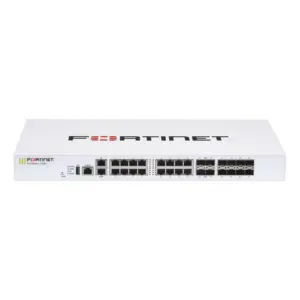
Fortinet FortiADC 4000G High-Performance Application Delivery Controller
The Fortinet FortiADC 4000G is a hardware-accelerated application delivery controller built for organizations that need to keep large application estates responsive, available and securely published while traffic volumes and encrypted sessions continue to grow. In a modern enterprise data center, the application delivery layer is expected to do considerably more than distribute connections. It must steer traffic intelligently, preserve service during server or site failures, process encrypted sessions efficiently, enforce application-aware policies and give operations teams a practical control point between users and business services. FortiADC 4000G addresses that requirement at a scale suited to large enterprises, financial institutions, service providers, government platforms, education networks and other environments where application availability is directly tied to operational continuity.
For Uganda procurement projects, the 4000G is especially relevant when existing load balancers are reaching throughput limits, SSL processing is consuming server resources, application estates are being consolidated, or a new primary and disaster-recovery architecture requires global traffic distribution. Fortinet’s current ordering information identifies the 4000G as a hardware-accelerated appliance delivering up to 150 Gbps Layer 4/Layer 7 performance and 90 Gbps SSL throughput, with eight 40G QSFP and two 100G QSFP28 interfaces. Those characteristics position it for high-bandwidth aggregation rather than branch-level delivery.
FourTeck supports the buying process by translating the intended topology into an orderable bill of materials. That includes validating appliance quantity, high-availability design, optics and cabling, subscription or support requirements, rack and power considerations and implementation expectations. Procurement teams should size the platform around real application behavior rather than relying on a single headline throughput figure: concurrent connections, new connection rates, SSL key sizes, security functions, traffic mix and redundancy architecture all influence practical capacity.
Instant Specifications & Procurement Fact Rail
FortiADC 4000G
Large enterprise / data center
Up to 150 Gbps
Up to 90 Gbps
8 × 40G QSFP, 2 × 100G QSFP28
Quote-based; confirm stock and lead time
These figures provide a fast qualification point, but a complete procurement decision should also account for application count, expected traffic peaks, SSL transaction profile, persistence requirements, global server load balancing, web application protection policies and failover design. Hardware, service entitlements and compatible optical modules should be verified as one solution rather than ordered independently. Regional warranty and replacement options depend on the selected Fortinet support entitlement and final supply terms, so the quotation should state the applicable coverage explicitly.
Operational Product Architecture & Overview
FortiADC sits in front of application servers and services, accepting client connections and making policy-driven decisions about where those connections should be delivered. At Layer 4 it can distribute transport traffic efficiently; at Layer 7 it can make decisions with application context. This architecture allows back-end resources to be presented as resilient virtual services instead of exposing individual servers directly. When a server becomes unhealthy, traffic can be directed toward healthy resources. When capacity is expanded, new servers can be incorporated into a pool without forcing users to understand the underlying infrastructure change.
The 4000G is designed for environments where this function must operate at substantial bandwidth. High-speed 40G and 100G connectivity allows the appliance to integrate into modern data-center switching fabrics without forcing the ADC layer to become an obvious link-speed bottleneck. The published 150 Gbps L4/L7 and 90 Gbps SSL figures are important for projects with encrypted portals, APIs, digital banking services, government platforms, enterprise resource systems and other workloads in which TLS processing represents a significant portion of traffic.
SSL offload is particularly valuable because cryptographic processing can otherwise consume application-server resources that should be reserved for business logic. Centralizing certificate and traffic handling at the delivery tier can simplify operational control, although certificate governance, cipher policies and key-management procedures must still follow the organization’s security standards. FortiADC also provides global server load balancing capabilities, allowing organizations with more than one site to direct users toward appropriate service locations and design around site-level failures.
The platform combines application delivery with integrated protection functions. Fortinet describes FortiADC capabilities including WAF, DDoS-related protections, IPS, web filtering, geographic and reputation controls, authentication and Security Fabric integration. The exact functions and service entitlements used in a deployment should be confirmed during licensing design. This matters because two organizations purchasing the same hardware can have very different operational requirements: one may primarily need fast local load balancing and SSL processing, while another may depend on application protection, global distribution and governed remote access.
Common procurement triggers include aging ADC appliances, rapid growth in encrypted sessions, consolidation of multiple application farms, new active/standby data centers, modernization of online customer services and a requirement to standardize operations within a Fortinet environment. The 4000G should therefore be evaluated as part of the full application path—upstream firewalls and routers, switching capacity, server NICs, certificates, DNS, monitoring, logging and disaster-recovery procedures—not as an isolated box.
Enterprise Business Outcomes & Value Analysis
The business case should be built around avoided downtime, application response targets, server utilization, operational effort and growth capacity rather than appliance cost alone. A correctly sized ADC may allow application teams to absorb demand growth without proportionally increasing server resources, while a resilient pair can reduce the business impact of individual component failures. Conversely, undersizing the ADC tier or omitting redundancy can move the bottleneck rather than solve it. FourTeck can help procurement and engineering teams align the technical configuration with the expected service level and budget.
Key Hardware & Software Highlights
| Capability | Architecture | Operational Outcome |
|---|---|---|
| High-speed switching connectivity | 40G QSFP and 100G QSFP28 interfaces | Supports integration into high-bandwidth data-center fabrics. |
| SSL processing | Hardware-accelerated appliance architecture | Reduces cryptographic workload placed directly on application servers. |
| L4-L7 traffic management | Load balancing, reverse proxy and scripting capabilities | Enables policy-based distribution across server pools. |
| Global delivery | GSLB | Supports multi-site application availability strategies. |
| Application protection | WAF and additional security functions subject to configuration/services | Adds application-aware controls at the delivery tier. |
The practical value of these capabilities comes from their combination. High-speed interfaces alone do not create resilient applications; they must be paired with suitable health monitors, load-balancing methods, persistence behavior and failover logic. Likewise, security functions should be introduced with testing so that policies protect applications without breaking legitimate workflows. A staging plan should document virtual IPs, pools, certificates, DNS dependencies, upstream routing and rollback procedures before production migration.
Technical Specifications Ledger
| Specification | FortiADC 4000G Procurement Reference |
|---|---|
| Product Type | Hardware application delivery controller |
| L4/L7 Performance | Up to 150 Gbps |
| SSL Throughput | Up to 90 Gbps |
| 40G Interfaces | 8 × 40G QSFP |
| 100G Interfaces | 2 × 100G QSFP28 |
| Traffic Management | Layer 4–7 load balancing and scripting |
| Global Server Load Balancing | Supported |
| Deployment Position | Enterprise/data-center application delivery tier |
Performance values are maximum published figures and real results vary with traffic characteristics and system configuration. Detailed physical, environmental, power, transceiver, compliance and lifecycle information should be validated against the exact Fortinet hardware documentation and ordering guide applicable at the time of quotation. This is particularly important for rack planning and UPS sizing. Procurement should not assume specifications from a similarly named FortiADC F-series or FortiGate model apply to the FortiADC 4000G.
For optical connectivity, confirm whether the project requires short-range, long-range, single-mode or multimode links and whether the corresponding switches use QSFP/QSFP28 ports, breakouts or adapters. Cable length, fiber plant, connector type and supported transceiver combinations should be reviewed before shipment. A 100G-capable ADC connected through incorrectly selected optics can delay deployment even when the appliance itself is available.
Configuration & Sizing Worksheet
- Estimate workload and scale. Record current and peak inbound/outbound application bandwidth, concurrent connections, new connections per second, SSL share, certificate/key requirements and anticipated growth. Separate average traffic from burst traffic and include planned applications that are not yet live.
- Map the application estate. List virtual services, back-end server pools, health checks, persistence requirements, DNS records, public addresses, NAT dependencies and any applications requiring special headers or source-IP preservation.
- Define resilience. Decide whether a single appliance is acceptable or whether the service requires an HA pair. For critical banking, government and enterprise portals, redundant design is usually the more appropriate baseline. Also determine whether disaster recovery requires GSLB between sites.
- Validate rack, power and environment. Confirm available rack units, rail clearance, front/rear airflow, UPS capacity, redundant power feeds and PDU connector compatibility using the exact hardware installation guide for the quoted unit.
- Plan high-speed cabling. Determine which 40G and 100G ports will connect to each switch, whether links are redundant, and which approved optics or DAC/AOC assemblies are required.
- Review licensing and services. Match required functions—application delivery, security services, support, replacement objectives and update access—to the current Fortinet offering. Avoid assuming that a feature visible in product literature is automatically included in every commercial bundle.
- Prepare the quote checklist. Include appliance quantity, HA requirement, desired support term, optics, rack accessories, target delivery location, preferred currency, implementation scope and any pre-configuration requirement.
Sizing should include a safety margin. If a design operates near the maximum published figure on day one, normal traffic growth or additional security inspection can quickly create another capacity problem. Equally, oversizing without understanding the workload can consume budget that would be better invested in redundancy, support or upstream network improvements. FourTeck can review the stated requirements and help structure the quotation around the actual deployment.
Deployment Scenarios & Industry Use Cases
Large Enterprise and Multi-Site Networks
A large organization may place FortiADC 4000G in front of ERP systems, customer portals, collaboration services, APIs and private-cloud workloads. Local load balancing distributes sessions across application nodes, while GSLB can support traffic steering between primary and recovery sites. This architecture is useful when applications must remain reachable through planned maintenance or isolated component failures.
Financial and Banking Institutions
Digital banking and payment environments generate highly transactional encrypted traffic and have strict availability expectations. The ADC layer can distribute requests across service clusters, offload cryptographic processing and provide health-based failover. Procurement teams should validate compliance requirements, logging, certificate custody, segmentation, change control and support response objectives before deployment.
Educational and Campus Networks
Universities and large education groups increasingly centralize student portals, learning platforms, identity services and administrative applications. Demand can be highly seasonal, with sharp peaks around admissions, registration, examinations and results publication. A scalable ADC architecture can help spread those bursts across multiple application servers and preserve a consistent service address as back-end capacity changes.
Government and Defense Procurement
Government platforms may serve citizen services, internal applications, shared infrastructure or agency portals. Designs commonly require documented resilience, controlled administrative access, support coverage and clear hardware provenance. For sensitive deployments, exact configuration, firmware, management access, logging destinations, rack placement and supply-chain requirements should be agreed before staging. Product suitability for any specific classified or regulated environment must be determined by the responsible authority and applicable standards.
Technical Deep Dive: Processing, Acceleration & Delivery Architecture
An application delivery controller operates at a point where very large numbers of short and long-lived sessions converge. Its workload therefore differs from a conventional server. It must accept connections, apply policy, maintain state, select destinations, perform health-aware forwarding and frequently terminate or re-establish encrypted sessions. Hardware acceleration is valuable because it allows these repetitive high-volume functions to be processed efficiently while leaving software resources available for richer policy logic.
For the FortiADC 4000G, the published 150 Gbps L4/L7 and 90 Gbps SSL class should be interpreted as an architectural sizing indicator, not a guarantee that every combination of policies and traffic will deliver the same number. SSL cipher selection, key size, connection reuse, HTTP behavior, scripting, inspection and security functions influence actual performance. A proof of concept or representative traffic test is appropriate when an application has unusually demanding characteristics.
The 40G and 100G interface mix is also significant. It gives network architects flexibility to build redundant high-bandwidth uplinks and server-side connections. Before finalizing topology, confirm switch port availability and whether links will use LAGs, separate fabrics or routed designs. The ADC should be sized together with switching and firewall capacity so that application delivery does not merely expose a bottleneck elsewhere in the path.
Technical Deep Dive: Software Ecosystem, Firmware Security & Operational Control
FortiADC provides a software control plane for virtual servers, pools, health checks, certificates, routing, security policies and monitoring. In a mature deployment, these objects should be treated as controlled infrastructure configuration. Naming conventions, configuration backups, administrative roles, maintenance windows and rollback procedures are important because a policy change at the ADC can affect many applications simultaneously.
Integration with the broader Fortinet Security Fabric can be valuable for organizations already operating Fortinet technologies, but cross-vendor environments are also common. The key design question is not whether every component shares a brand; it is whether routing, VLANs, MTU, link negotiation, certificate handling, DNS and monitoring interfaces are compatible and documented. Firmware should be selected according to Fortinet support guidance and organizational change policy. Pre-shipment staging can include an agreed firmware baseline, but production upgrades should still follow backup, compatibility review and rollback planning.
Security subscriptions and support services require particular attention at procurement. Buyers should identify which capabilities are mandatory at launch and which are optional. The quote should show the term and entitlement clearly so that renewal planning is predictable. Where application protection is being introduced for the first time, policy tuning should be scheduled because aggressive controls can affect legitimate transactions if deployed without observation and testing.
Technical Deep Dive: High Availability, Redundancy & Disaster Recovery
A high-performance ADC can become a critical dependency if it is deployed as a single appliance. For business-critical services, architects commonly evaluate an HA pair so that maintenance or a device fault does not automatically interrupt application delivery. Redundancy should extend beyond the appliances: use independent switch paths, power feeds and upstream dependencies where service objectives justify the cost.
Disaster recovery adds a second dimension. Local HA protects against device-level failures, while GSLB can participate in directing users between geographically separate sites. A sound DR plan defines what constitutes site failure, how health is measured, how DNS behavior affects failover time and whether application data is actually available at the alternate site. An ADC cannot compensate for a database or storage tier that has not been replicated correctly.
Operational testing is essential. Failover should be exercised during commissioning and periodically thereafter. Teams should verify session behavior, monitoring alerts, DNS propagation, certificate consistency and application health after a simulated failure. Documenting these tests gives procurement and operations teams evidence that the redundancy investment is delivering the intended outcome.
Pre-Purchase Buyer Gap Checklist
What costs exist beyond the appliance? Budget may need to include Fortinet support or subscription services, optics, fiber/DAC cabling, redundant appliance quantity, rack accessories, professional services and freight. Ask for a complete bill of materials rather than comparing bare appliance prices.
Is every advertised capability included? Product families can be offered with different bundles and service entitlements. Confirm the exact commercial package and renewal term in writing.
Will it fit the existing rack and power design? Validate physical dimensions, rail depth, airflow direction, power supply characteristics, PDU connectors and UPS headroom against the installation documentation for the exact unit.
Are the switch ports compatible? The 4000G uses high-speed QSFP/QSFP28 connectivity. Confirm transceiver type, fiber mode, connector, distance and switch compatibility. Include spare optics where operational policy requires them.
Can it coexist with other vendors? ADC deployments can operate in heterogeneous networks, but interoperability depends on standard networking design and validated physical interfaces. Check routing, VLAN tagging, MTU, LACP if used, DNS integration, logging and monitoring.
What happens during hardware failure? Determine whether the support level provides an RMA response consistent with the business requirement and whether local spares or an HA pair are needed to bridge replacement time.
How much capacity headroom is enough? Use peak rather than average traffic and account for growth, encryption and policy complexity. Critical infrastructure should not be designed to run continuously at its theoretical ceiling.
How will migration be executed? Prepare virtual service mappings, certificates, DNS changes, maintenance windows, test cases and rollback steps before cutover. Complex migrations may justify a staged application-by-application approach.
Uganda Procurement, Delivery & Project Logistics
FourTeck can prepare FortiADC 4000G quotations for Uganda projects based on the required hardware quantity, service term, optics and implementation scope. Because enterprise ADC projects often involve high-value hardware and specific licensing, procurement is best handled against a validated bill of materials. The quotation process should identify the delivery location, required currency, organization details, tax or documentation needs and target deployment date.
Lead times vary with distributor inventory, manufacturing availability, selected accessories and freight route. Stock status should therefore be confirmed at quotation or order stage rather than assumed from a generic product listing. For time-sensitive migrations, state the required installation date so alternative supply routes or staged delivery options can be considered where available.
Technical pre-configuration can be discussed before shipment. Typical preparation may include firmware baseline review, management addressing, interface planning, initial virtual-service templates or configuration validation, depending on the agreed scope. Customer-specific certificates, passwords and sensitive configuration should be exchanged only through approved secure processes.
Local Coverage Matrix
Projects in Kampala commonly include corporate headquarters, data centers, banks and government institutions requiring resilient application delivery. Entebbe deployments can support enterprise, hospitality, aviation-adjacent and institutional infrastructure. Jinja projects may serve industrial, education and distributed enterprise sites, while Mbarara and Gulu are important regional hubs for organizations extending centralized applications to users outside the capital. Delivery feasibility, site access, installation timing and on-site service requirements should be stated during quotation so logistics can be planned accurately.
Cross-Border & Regional Supply Chains
Enterprise projects may involve procurement teams, data centers and finance departments in different countries. FourTeck supports regional coordination through Uganda, Kenya, African markets, UAE and Kuwait. Cross-border sourcing should account for destination-specific freight, import procedures, documentation, warranty route and project schedule.
For multi-country rollouts, standardizing the bill of materials can simplify support and spares planning. However, power accessories, regulatory requirements and delivery lead times may differ by destination. A central procurement specification should therefore be paired with a country-level logistics review before purchase orders are released.
Related Infrastructure & Internal Links
A FortiADC deployment is usually part of a broader application-delivery architecture. Review the FourTeck Uganda enterprise infrastructure portfolio for compatible data-center switching, Fortinet security platforms, optical connectivity, rack infrastructure, UPS systems and network accessories. Projects may also require FortiGate firewalls upstream, management and analytics platforms, server switching, 40G/100G transceivers, fiber assemblies and redundant power infrastructure. Ask FourTeck to validate related components as a single bill of materials to reduce interface and accessory mismatches.
FourTeck Technical Service Capabilities
FourTeck can support engineering validation before the order is finalized. This begins with the intended topology and application requirements, then checks appliance quantity, interfaces, optics, redundancy and commercial services against the proposed design. Bill-of-materials verification is particularly important for high-speed data-center equipment because a missing transceiver, incompatible cable or omitted support entitlement can delay commissioning even when the core appliance has arrived.
Where agreed, staging can include hardware inspection, firmware baseline review and configuration preparation before shipment. The scope should be documented so responsibilities are clear between FourTeck, the customer network team and any third-party integrator. Post-sales assistance can cover configuration questions, deployment coordination and vendor support escalation according to the purchased services.
For production changes, FourTeck recommends maintaining configuration backups, approved change windows and rollback procedures. High-availability and disaster-recovery behavior should be tested rather than assumed. The objective is not simply to deliver hardware but to help the procurement team receive a configuration that aligns with the technical design and can be supported through its operational lifecycle.
Extended Technical FAQ
1. What is FortiADC 4000G primarily used for?
It is a high-capacity application delivery controller used to distribute and manage application traffic across server resources. Typical functions include Layer 4–7 load balancing, reverse proxy services, SSL processing, global server load balancing and application protection capabilities. It is suited to data centers and large enterprises where application availability and encrypted traffic volumes justify a dedicated high-performance delivery tier. The exact configuration depends on application protocols, traffic profile, security requirements and whether the organization uses one site or multiple data centers.
2. What published performance should buyers use for initial sizing?
Fortinet’s current ordering information lists FortiADC 4000G at up to 150 Gbps L4/L7 performance and 90 Gbps SSL throughput. These values are useful for initial model comparison, but production sizing should not rely on them alone. Connection rates, concurrent sessions, SSL behavior, scripting and enabled protection functions can change effective capacity. Buyers should provide peak traffic data and expected growth, then retain operating headroom. A representative test is advisable for unusually transaction-heavy or policy-intensive applications.
3. Which high-speed interfaces are available?
Fortinet lists eight 40G QSFP and two 100G QSFP28 interfaces for the 4000G. Before ordering, map every intended link to the upstream and downstream switches and identify the required optics or cable assemblies. QSFP and QSFP28 describe form factors and speeds, but the actual connection also depends on optical standard, fiber type, connector, distance and switch support. FourTeck can include compatible connectivity components in the project bill of materials after the physical topology is provided.
4. Does FortiADC 4000G support global server load balancing?
Yes, Fortinet identifies GSLB as a supported FortiADC capability. GSLB is useful when applications are hosted at more than one site and users must be directed according to service health or deployment policy. It should be designed together with DNS behavior, application data replication and disaster-recovery procedures. GSLB can redirect users, but it cannot make an alternate site operational if the application, database or storage layer there is not ready. End-to-end failover testing is therefore essential.
5. Are security functions included or separately licensed?
FortiADC supports integrated application security capabilities, and Fortinet offers commercial bundles and services across the product family. The exact entitlement can vary with the selected offer and term, so buyers should request a quote that explicitly identifies included services, support duration and renewal requirements. This avoids comparing a bare hardware price with a fully supported security bundle. If WAF, IPS, web filtering or other protection functions are mandatory, list them in the procurement requirement so the correct commercial package can be validated.
6. Should FortiADC 4000G be deployed as a redundant pair?
For business-critical applications, redundancy is generally worth evaluating because a single ADC can otherwise become a single point in the service path. An HA design can support maintenance and appliance-level fault tolerance, but resilience should also cover switch paths, power feeds and upstream services. The required architecture depends on the organization’s recovery objectives and budget. When requesting a quote, specify whether the application is considered mission-critical and whether the design includes a secondary data center so the appliance quantity and accessories can be planned correctly.
7. Can it operate with switches and firewalls from other vendors?
Application delivery controllers are commonly deployed in mixed-vendor networks. Successful interoperability depends on standards-based connectivity and correct design rather than every component carrying the same brand. Confirm Ethernet speed, optics, VLANs, routing, MTU, link aggregation if used, DNS dependencies and monitoring protocols. Where the organization also uses Fortinet products, Security Fabric integration may provide additional operational benefits. In either case, the proposed topology should be reviewed before purchasing optics and high-speed cabling.
8. What warranty and replacement planning is recommended?
Fortinet offers support and priority RMA options across the FortiADC family. The exact replacement objective and regional terms depend on the support entitlement and commercial availability. Procurement teams should align the selected service with the business impact of an appliance failure. A fast RMA service is valuable, but it is not identical to local high availability: if an application cannot tolerate the time required to diagnose and replace hardware, an HA pair or local spare strategy may still be necessary.
9. Can FourTeck assist with configuration and migration?
Configuration support can be scoped around the project requirements. Useful pre-deployment information includes current virtual servers, pools, health monitors, persistence methods, certificates, VLANs, routes, DNS records and application test cases. Migration from an existing ADC should also document current behavior rather than copying configuration blindly, because syntax and feature behavior differ between platforms. A staged migration with validation and rollback steps is generally safer for environments hosting multiple critical applications.
10. What information is needed for an accurate Uganda quotation?
Provide the model request, appliance quantity, whether HA is required, desired support or subscription term, delivery city, expected 40G/100G connectivity, required optics, implementation scope and target deployment date. If sizing is not finalized, also provide current peak bandwidth, SSL traffic percentage, application count and expected growth. FourTeck can then structure a project-specific bill of materials rather than quoting only the chassis. Final price, availability, lead time and warranty terms should be confirmed on the formal quotation because these commercial factors can change.
Plan Your FortiADC 4000G Procurement
For a reliable FortiADC 4000G deployment in Uganda, begin with the complete application path: workload, SSL demand, high-availability requirement, switch interfaces, optics, support entitlement, rack environment and disaster-recovery objectives. FourTeck can review these requirements and prepare a bill of materials for procurement. A project-specific quotation provides a clearer basis for approval than a chassis-only estimate because it can include the accessories and services needed to place the platform into production.
Send the intended delivery location, required quantity and deployment overview. If detailed traffic data is available, include it so the proposed configuration can be checked against expected demand. Final commercial terms, stock, lead time and warranty coverage will be stated against the current supply position.