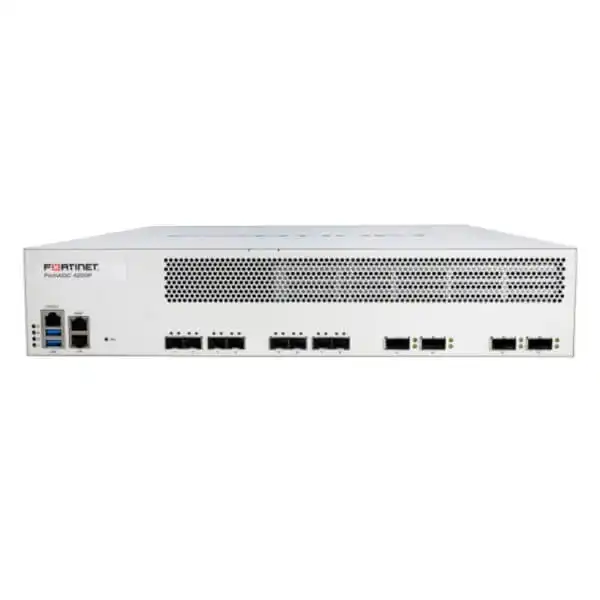
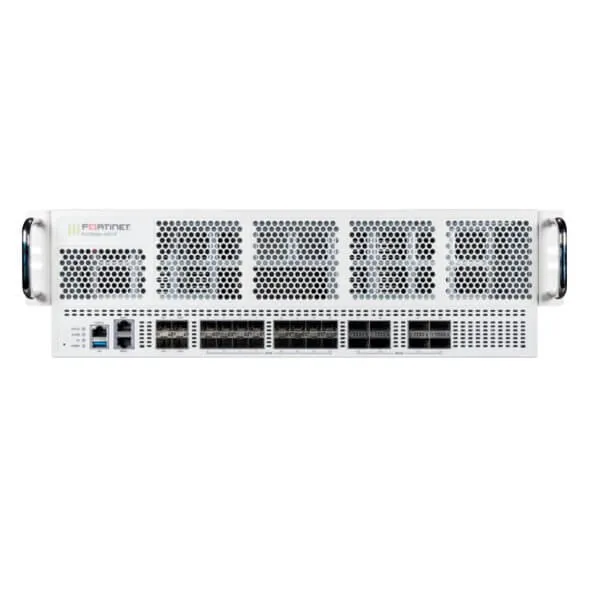
FortiGate 4200F in Uganda
A 3RU high-capacity next-generation firewall for enterprise data centers, large-scale segmentation, secure WAN and hybrid infrastructure.
The FortiGate 4200F combines FortiOS security functions with purpose-built NP7 and CP9 processing, high-speed 25 GE and 100 GE interfaces, and scale designed for environments where inspection throughput, session capacity and network segmentation are central design constraints. FourTeck can assist Uganda buyers with sizing, licensing, optics, high-availability planning and quote preparation.
Built for security at very high network scale
The FortiGate 4200F is designed for organizations that need to apply firewalling, intrusion prevention, application control, VPN, segmentation and other security functions without forcing a high-capacity network into a low-throughput security architecture. Its role is not simply to sit at an internet edge. It can also be used where east-west data center traffic, inter-zone policy enforcement, secure SD-WAN, remote access aggregation or service-provider scale demands a firewall platform with large session capacity and high-speed interfaces.
Fortinet’s current datasheet lists up to 52 Gbps IPS throughput, 47 Gbps NGFW throughput and 45 Gbps threat protection throughput for enterprise traffic-mix testing. The appliance also supports up to 800 Gbps IPv4 firewall throughput with large packets and provides 8 hardware-accelerated 100 GE QSFP28 or 40 GE QSFP+ slots plus 16 hardware-accelerated 25 GE SFP28, 10 GE SFP+ or GE SFP slots. These figures show why the platform is considered for large data centers and network cores, but they should not be treated as a universal sizing number. Actual performance varies with policy complexity, enabled services, traffic patterns, cipher suites and system configuration.
The 4200F is especially relevant to IT teams that are consolidating several network-security functions into a single FortiOS platform. That can simplify policy consistency across perimeter, internal segmentation and WAN use cases, while still allowing dedicated management through FortiManager when centralized control is required. Buyers should determine in advance which FortiGuard services, FortiCare level and term, optics and high-availability design are needed, because these choices can change the commercial scope substantially.
FourTeck can help Uganda procurement and technical teams translate design requirements into an orderable configuration. A useful request should include expected inspected throughput, session scale, internet and data-center circuit speeds, interface media, HA requirement, VPN demand, proposed FortiGuard bundle, support term and quantity. This reduces the risk of buying an appliance that is powerful enough in raw throughput but incomplete for the intended security policy or physical topology.
Operational outcomes that matter in large networks
Maintain security inspection on high-bandwidth paths
The enterprise-mix figures are intended to help teams assess security throughput with services enabled, rather than relying only on raw firewall numbers. This is particularly important when traffic crosses multiple high-speed links and inspection must remain active during peaks.
Segment at the speed of the data center
Multiple 100 GE and 25 GE interfaces give architects flexibility to place policy enforcement closer to high-capacity network zones. Fortinet also documents VXLAN support, which is relevant where physical and virtual segmentation need to coexist.
Support large VPN and session populations
The platform is specified for very large concurrent session and VPN tunnel counts. That makes it suitable for central sites where remote access, branch tunnels, inter-site encryption and high connection rates must be absorbed without distributing the load across many smaller firewalls.
Unify networking and security operations
FortiOS brings firewall policy, SD-WAN, VPN, segmentation and security services into one operating environment. For enterprises already standardizing on Fortinet, this can simplify operational procedures and make centralized policy with FortiManager easier to maintain.
Design for resilient operation
Fortinet supports active-active, active-passive and clustering high-availability configurations. The chassis also uses dual redundant power supplies and hot-swappable fan trays, allowing infrastructure teams to plan around maintenance and component failure scenarios.
Preserve growth headroom
High port density, large policy scale, substantial session capacity and up to 500 virtual domains give architects room to consolidate security zones or support multi-tenant structures. The right design still depends on real workload growth, not headline maximums.
A firewall platform where interface density and inspected performance are both first-class design criteria
The standout characteristic of this platform is the combination of large enterprise security throughput with a front panel built for modern data-center link speeds. That matters when a security appliance must be inserted into 25 GE or 100 GE paths without forcing extra aggregation layers solely to match interface types.
Enterprise traffic-mix IPS throughput, configuration dependent.
Measured with firewall, IPS and application control enabled.
Measured with firewall, IPS, application control and malware protection.
Hardware-accelerated QSFP28/40 GE QSFP+ slots.
FortiGate 4200F technical specifications
| Specification | FG-4200F | Buyer note |
|---|---|---|
| IPS throughput | Up to 52 Gbps | Enterprise mix; configuration dependent |
| NGFW throughput | Up to 47 Gbps | Firewall, IPS and application control enabled |
| Threat protection | Up to 45 Gbps | Includes malware protection in test mix |
| IPv4 firewall throughput | 800 / 788 / 400 Gbps | 1518 / 512 / 64 byte UDP |
| Firewall latency | 3.02 microseconds | 64-byte UDP test |
| Concurrent TCP sessions | 210 million / 450 million* | Higher figure requires Hyperscale Firewall License |
| New TCP sessions/sec | 1 million / 7 million* | Higher figure requires Hyperscale Firewall License |
| IPsec VPN throughput | Up to 210 Gbps | 512-byte AES256-SHA256 test |
| Gateway IPsec tunnels | 40,000 | Plan routing and operations as well as tunnel count |
| SSL inspection throughput | Up to 50 Gbps | Average HTTPS sessions across cipher suites |
| 100/40 GE slots | 8 × QSFP28/QSFP+ | Hardware accelerated |
| 25/10/1 GE data slots | 16 × SFP28/SFP+/SFP | Hardware accelerated |
| HA slots | 2 × 25/10/1 GE | Dedicated HA interface group |
| Management | 2 × GE RJ45, USB, console | FortiOS; optional centralized FortiManager |
| Onboard storage | None | FG-4201F has 2 × 1.92 TB SSD |
| Virtual domains | 10 default / 500 maximum | Licensing and design should be reviewed |
| HA modes | Active-active, active-passive, clustering | Topology dependent |
| Form factor | 3RU rack mount | 132.5 × 437 × 664.8 mm |
| AC power | 100–240 V AC, 50/60 Hz | Dual 1+1 redundant hot-swappable PSU |
| Operating temperature | 0°C to 40°C | Confirm data-center environment |
*License note: Fortinet states that the higher hyperscale session figures require the Hyperscale Firewall License. Performance figures are published as up to values and vary with system configuration.
The most important procurement figures are usually the enterprise-mix security throughputs, SSL inspection performance, session creation rate, port types and the exact power variant. Raw firewall throughput can look impressive but does not represent a deployment with full security services enabled. If encrypted traffic inspection is a major part of policy, the SSL inspection figure should be considered together with cipher profile, certificate strategy and CPU-intensive security functions.
Port planning also deserves careful attention. A chassis with 100 GE interfaces may still require specific QSFP28 optics, breakouts, DAC/AOC cabling or network-side transceivers. The appliance includes two SR 10 GE SFP+ transceivers according to the datasheet, but the complete optical bill of materials should be defined from the actual switch and router interfaces. Power architecture must also be matched to the site: AC and DC variants exist, and the rack, airflow and heat-load plan should be reviewed before final approval.
Five questions that define the right 4200F purchase
01 — What traffic actually needs security inspection?
Separate internet bandwidth from inspected east-west traffic, VPN traffic and internal segmentation flows. A firewall that sees 10 Gbps of internet traffic can still process far more total traffic if it is also enforcing policy between data-center zones. Define normal, peak and projected inspected throughput and identify which services will be active. This determines whether NGFW, threat-protection or SSL inspection numbers are the most useful sizing reference.
02 — How large is the session and connection profile?
High-velocity applications, carrier environments, NAT-heavy services and large remote-access populations can stress new-session rates even when throughput remains moderate. Share estimated concurrent sessions, connections per second, VPN tunnel counts and SSL-VPN user expectations. If the design depends on the hyperscale session figures, the required perpetual license must be included in the scope.
03 — Which interfaces and neighboring devices must connect?
Map every intended link: 100 GE, 40 GE, 25 GE, 10 GE or 1 GE, including switch model, optic type, reach and connector. This determines QSFP28, SFP28, SFP+, breakout and cabling requirements. Also identify whether HA and management ports need dedicated switching.
04 — What growth, logging and license model is expected?
Decide whether the no-storage FG-4200F is appropriate or whether the FG-4201F with dual SSD storage is better suited. Define FortiGuard security services, FortiCare term, virtual-domain requirements, centralized FortiManager or FortiAnalyzer plans, and whether the project should leave headroom for additional zones and circuits.
05 — What installation and support constraints apply?
Confirm AC or DC power, available rack units, front-to-back airflow, environmental conditions, HA placement, change windows and delivery schedule. For Uganda projects, also state the installation location and quantity so delivery coordination can be planned realistically.
Where the platform can make operational sense
Enterprise data-center perimeter
A large organization connecting high-capacity internet, cloud or inter-site services may need policy enforcement at 25 GE or 100 GE while maintaining intrusion prevention and application visibility. The 4200F can fit this role when its inspected throughput aligns with the real traffic mix. Buyers should confirm optics, routing design, HA topology and the security-service bundle rather than treating the appliance as a simple router replacement.
Internal segmentation between critical zones
Financial systems, research networks, server farms, operational technology and shared platforms often require strong east-west segmentation. Multiple high-speed interfaces and hardware-accelerated VXLAN support make the series relevant when segmentation must be inserted into large network fabrics. The design should define which flows require Layer 4 enforcement, deeper inspection or separate virtual domains.
Secure WAN hub and VPN aggregation
Organizations with many branches or large encrypted inter-site links can use the platform as a central VPN and SD-WAN security point. Fortinet publishes up to 210 Gbps IPsec throughput and very high tunnel counts. Routing scale, policy management, key exchange behavior and actual packet sizes should still be validated against the planned topology.
Service-provider or multi-tenant security
Up to 500 virtual domains and high session capacity can support architectures that require logical separation between tenants, departments or service domains. This use case depends strongly on operational design, administrative boundaries, logging, license scope and centralized management, so the commercial configuration should be built from the tenant model rather than from appliance throughput alone.
NP7 and CP9 acceleration: why the architecture matters
Fortinet’s hardware design uses purpose-built security processing units rather than relying only on general-purpose CPU resources for packet forwarding and content inspection. The 4200F series uses NP7 network processors for high-speed network functions and CP9 content processors for resource-intensive inspection tasks. Fortinet’s hardware-acceleration documentation shows four NP7 processors in the 4200F and 4201F architecture, with front-panel data interfaces connected through the integrated switch fabric for supported offload paths.
For the buyer, the practical value is not the processor name itself. It is the ability to keep high-volume forwarding, session setup, VPN, VXLAN and inspection tasks from competing for the same generic compute resources in exactly the same way they might on a software-centric architecture. This is one reason the platform can combine high raw firewall performance with substantial security inspection figures.
However, acceleration does not mean every traffic pattern is automatically offloaded or that every security feature performs identically. Policy features, encapsulation, traffic direction, logging and software version can affect the fast path. The right procurement process therefore considers the intended policy set and deployment architecture, not just the ASIC specification. For complex migrations, validate required features against the FortiOS release and hardware-acceleration documentation before final design approval.
100 GE connectivity for core and data-center placement
The appliance provides eight hardware-accelerated 100 GE QSFP28 or 40 GE QSFP+ slots. It also provides sixteen hardware-accelerated 25 GE SFP28, 10 GE SFP+ or GE SFP data slots, plus dedicated HA and AUX interface groups. This gives network architects several ways to insert the firewall into modern high-bandwidth designs without building the entire topology around lower-speed interfaces.
Capability 01: 100 GE links can be used for core, spine, aggregation or high-capacity WAN handoffs where supported optics and neighboring hardware match.
Capability 02: 25 GE and 10 GE ports allow dense connectivity to distribution switches, routers, load balancers and service networks.
Capability 03: Fortinet documents breakout support for the high-speed architecture, which can add flexibility where the network design needs more lower-speed logical links.
The procurement risk is optical compatibility. The firewall port count is only one part of the bill of materials. Buyers should specify fiber type, distance, connector, optic standard and switch-side compatibility for every link. FourTeck can review the port map before the quote is finalized so the security appliance and transceivers are scoped together.
Licensing, services and the difference between appliance capacity and usable security
A complete FortiGate project is normally more than the hardware appliance. FortiGuard services provide security functions such as intrusion prevention, web and DNS security, malware protection and other threat-intelligence-driven capabilities. FortiCare adds support services, while centralized platforms such as FortiManager and FortiAnalyzer may be part of a larger operational model. The exact mix depends on the organization and selected bundle.
The 4200F also has a specific Hyperscale Firewall License that Fortinet describes as unlocking additional hardware-accelerated CGNAT capabilities and higher session setup and session scale. Buyers should not assume those hyperscale figures are included in the base appliance. If the design relies on the starred 450 million concurrent-session or 7 million new-session-per-second figures, the feature license must be part of the commercial discussion.
Buyer decision checklist
Confirm the required FortiGuard bundle and term; choose the FortiCare support level; decide whether the Hyperscale Firewall License is necessary; define centralized management and logging needs; choose FG-4200F or FG-4201F based on onboard storage requirements; and confirm whether AC or DC power is required.
What buyers should check before purchase
| Risk | What to confirm | Why it matters | What to share with FourTeck |
|---|---|---|---|
| Wrong model variant | FG-4200F vs FG-4201F; AC vs DC | Storage and power architecture differ | Power type, logging plan, exact part number |
| Undersized inspection | NGFW, threat and SSL inspection load | Raw firewall throughput is not the same as inspected throughput | Peak traffic and enabled services |
| Missing optics or licenses | QSFP/SFP type, FortiGuard, FortiCare, hyperscale feature | The appliance alone may not complete the solution | Port map, cable reach, service term |
| HA and facility mismatch | Rack units, airflow, power, HA mode | Physical deployment can block an otherwise correct technical selection | Rack/power details and resilience requirement |
A high-end firewall purchase should be treated as a system design decision. The appliance, subscription, support, optics, cabling, rack, power, logging and management components all need to agree with the intended architecture. The safest approach is to lock the technical bill of materials before commercial approval, especially for multi-unit HA projects where small omissions are multiplied across both nodes.
Planning a FortiGate 4200F deployment in Uganda
FourTeck can assist organizations in Uganda with configuration review, quotation, project quantity planning and delivery coordination for the Fortinet high-end firewall range. Because the 4200F is an enterprise platform with several licensing, power and service combinations, availability can vary by exact part number, support term and quantity. A request should therefore identify the full project scope rather than relying on a generic appliance-only inquiry.
For Kampala projects, FourTeck can review whether the required configuration includes an HA pair, optics, FortiGuard services, FortiCare, centralized management or installation accessories. Warranty guidance is based on the selected vendor support and commercial terms; buyers should ask for those terms to be shown explicitly on the quotation. Lead time and delivery are not assumed and should be confirmed for the requested configuration.
For larger deployments, provide expected procurement dates, site count and whether phased delivery is required. This allows the quote process to separate core appliance requirements from optional services and accessories, giving procurement teams a clearer comparison between configurations.
Uganda location coverage
FourTeck can coordinate product enquiries and project quotations for customers in Kampala and can also support requirements associated with Entebbe, Jinja, Mbarara and Gulu. Delivery scope, timing and any site-specific logistics should be confirmed against the final quotation rather than assumed from the product page.
Regional sourcing for multi-country projects
Organizations planning the same Fortinet architecture across several countries may need a consistent bill of materials, license term and support model even when local logistics differ. FourTeck can help structure enquiries for Uganda, Kenya and selected East Africa markets so technical teams can work from one configuration baseline while procurement verifies the commercial terms for each destination.
Regional project enquiries can also be coordinated through FourTeck’s wider Africa and Middle East channels where relevant, including selected Africa markets, the UAE and Kuwait. This should not be read as a promise of local stock, branch presence or identical delivery time in every country. Availability, tax treatment, freight, support and warranty handling must be confirmed for each destination.
For a multi-country deployment, send one master technical specification plus a site-by-site quantity and location schedule. That approach reduces configuration drift and helps prevent a branch or data-center site from receiving a different license or transceiver set than the approved standard.
Related Fortinet options to review
Practical assistance around the buying decision
01. Product selection guidance — help distinguish the FG-4200F from related FortiGate platforms and identify where the requested workload fits.
02. Configuration review — align power variant, HA, optics, subscriptions, support and management requirements before the bill of materials is approved.
03. Quote assistance — structure a project quotation around the exact part numbers and quantities rather than a vague firewall request.
04. Uganda delivery coordination — confirm logistics for the stated project destination and quantity when the quotation is prepared.
05. Warranty and support guidance — show the selected FortiCare and commercial support terms clearly so procurement knows what is included.
06. Alternative matching — if the 4200F is not the correct performance or budget tier, FourTeck can help review suitable Fortinet alternatives without forcing the project into the wrong platform.
FortiGate 4200F buying questions
01. What is the FortiGate 4200F mainly used for?
It is a high-end next-generation firewall for large enterprise and service-provider environments. Typical roles include data-center perimeter security, high-speed internal segmentation, secure SD-WAN hubs, VPN aggregation and other deployments that need substantial session scale and 25 GE or 100 GE connectivity. The exact fit depends on the inspected traffic profile and the security services enabled.
02. What is the difference between FG-4200F and FG-4201F?
The main published hardware difference is onboard storage. The FG-4200F has no onboard storage, while the FG-4201F includes two 1.92 TB SSDs. Both are in the same 4200F series and share the high-speed interface and security-performance platform. Choose between them based on logging, storage and operational design requirements.
03. Does the 4200F support 100 Gigabit Ethernet?
Yes. Fortinet specifies eight hardware-accelerated 100 GE QSFP28 or 40 GE QSFP+ slots. It also includes multiple 25 GE SFP28, 10 GE SFP+ and GE SFP-capable slots. Transceiver compatibility, fiber type, distance and switch-side optics must still be checked for the exact deployment.
04. Which performance number should I use for sizing?
Use the figure that most closely matches the security workload. For full security inspection, threat-protection or NGFW throughput is usually more relevant than raw firewall throughput. If encrypted traffic inspection is heavy, SSL inspection performance matters as well. Always leave capacity headroom for peaks, growth and feature changes.
05. Are FortiGuard and FortiCare included with the appliance?
They depend on the selected SKU or bundle. FortiGuard security services and FortiCare support are normally quoted according to the required service package and term. Buyers should request the exact bundle code and renewal period on the quotation so the commercial scope is clear.
06. When is the Hyperscale Firewall License required?
Fortinet states that the higher published concurrent-session and new-session-per-second figures marked with an asterisk require the Hyperscale Firewall License. The license also enables hardware acceleration for certain CGNAT functions. If those features are part of the design, include the license in the bill of materials from the beginning.
07. Can the 4200F be deployed as a high-availability pair?
Yes. Fortinet lists active-active, active-passive and clustering high-availability configurations. A complete HA design should include duplicate appliances, matching subscriptions, dedicated HA connectivity, power, transceivers and a tested failover plan. The surrounding switches and routing design also need to support the chosen HA mode.
08. Is the FortiGate 4200F available in Uganda?
FourTeck can provide configuration and quotation assistance for Uganda projects. Availability varies by exact part number, license bundle, support term and quantity, so it should be confirmed for the requested configuration. Share the project location, required quantity and target schedule to receive the most useful response.
09. What information should I send for a quote?
Provide the required quantity, FG-4200F or FG-4201F preference, AC or DC power, expected inspected throughput, WAN and data-center port speeds, HA requirement, FortiGuard bundle, FortiCare term, optic types, centralized management needs and delivery destination. This allows the quote to reflect the full solution rather than only the base appliance.
Build the right Fortinet high-end firewall configuration before you order
Send FourTeck your inspected traffic target, interface plan, HA requirement, power type, support term, FortiGuard bundle and quantity. The team can help turn those requirements into a clearer bill of materials and Uganda quotation.
Useful details: throughput target, 100/25/10 GE port count, optic reach, VPN scale, FG-4200F or FG-4201F, AC/DC, HA, licenses, support term, quantity and delivery location.

Reviews
There are no reviews yet.