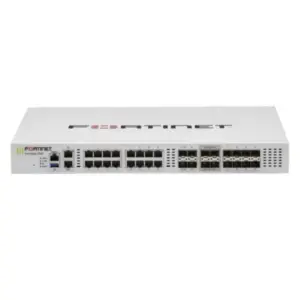
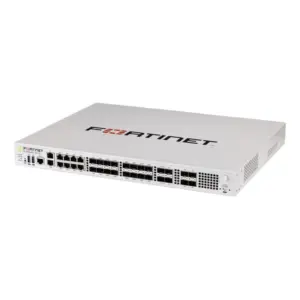
Fortinet FortiGate 80F in Uganda
A compact next-generation firewall and secure SD-WAN appliance for branch offices and distributed business networks.
The FG-80F brings FortiOS security, routing, VPN and SD-WAN functions into a desktop platform designed for organisations that need substantial encrypted and inspected traffic performance at the edge. Its selection should be based on real traffic mix, security subscriptions, VPN demand and interface requirements rather than headline firewall throughput alone.
Fortinet
FG-80F
NGFW / Secure SD-WAN
Up to 900 Mbps
FortiOS
Quote dependent
Where the FortiGate 80F fits in a business network
The FortiGate 80F is an entry-to-midrange branch firewall designed to converge network security and WAN functions in one appliance. Fortinet positions the 80F family for distributed enterprise sites where organisations want next-generation firewall controls, secure SD-WAN, virtual private networking, segmentation and policy enforcement without deploying a much larger chassis. It is powered by FortiOS and Fortinet’s purpose-built system-on-chip architecture, allowing networking and security functions to run on the same platform.
For a Uganda business, the useful question is not simply whether the device can pass internet traffic. The purchasing decision is whether it has enough inspected throughput, session capacity, VPN headroom and interface flexibility for the site’s real operating pattern. A company with a 200 Mbps internet circuit but full SSL inspection, intrusion prevention, application control and extensive site-to-site VPN usage can create a very different workload from a company with the same broadband speed using basic firewall policies. That is why the enterprise-mix figures are more meaningful during sizing than the maximum firewall number alone.
The base FG-80F provides six Gigabit Ethernet internal ports, two Gigabit Ethernet FortiLink ports by default and two shared RJ45/SFP WAN media pairs, giving buyers flexibility when choosing copper or fibre presentation for WAN connectivity. It also includes a USB 3.0 port and RJ45 console connection. The model supports high-availability configurations including active-active and active-passive designs, subject to matching units, licensing and deployment planning.
Security subscriptions are an important part of the purchase. The appliance can be bought as hardware or in bundles that add FortiCare support and FortiGuard security services for defined terms. The correct bundle depends on the organisation’s requirements for intrusion prevention, malware protection, web and application controls, threat intelligence and support coverage. Buyers should therefore compare complete solution terms rather than hardware-only pricing.
Practical outcomes for branch and distributed networks
Security and WAN control in one operating system
FortiOS combines firewall policy, VPN, SD-WAN, routing, segmentation and security inspection. This can reduce the number of separate edge platforms a branch team must configure and monitor. For IT managers supporting multiple Uganda sites, one consistent policy model can simplify change control and make branch rollout more repeatable.
Useful security throughput for a compact appliance
Fortinet rates the 80F at up to 1.4 Gbps IPS throughput, 1 Gbps NGFW throughput and 900 Mbps threat protection using defined enterprise traffic mixes. These figures make the model attractive where a branch needs substantial inspection but does not require a large rack-mounted firewall. The highlighted value is headroom for enabled controls, not simply raw packet forwarding.
Fast encrypted connectivity between sites
Published IPsec VPN throughput is up to 6.5 Gbps with Fortinet’s specified AES256-SHA256 test. For businesses linking offices, cloud gateways or data-centre resources, this gives useful capacity for encrypted site-to-site traffic. The actual design should still account for policy inspection, internet circuit limits and tunnel count.
Flexible branch connectivity
Two shared RJ45/SFP media pairs allow WAN connections to be presented over copper or compatible optical transceivers, while internal Gigabit Ethernet ports serve local infrastructure. This is useful where a site may receive fibre handoff from one provider and Ethernet from another, or where WAN design could change during a contract term.
Capacity for session-heavy business applications
The platform supports up to 1.5 million concurrent TCP sessions and up to 45,000 new sessions per second under Fortinet’s test conditions. This is relevant for modern offices where many endpoints, SaaS applications, browsers, mobile devices and cloud connections create large numbers of simultaneous flows even when bandwidth use is moderate.
High-availability options for critical sites
Fortinet lists active-active, active-passive and clustering high-availability configurations for the 80F family. A paired deployment can reduce a single-device failure risk for important branches, but buyers should plan matching hardware generation, firmware, licenses, cabling and power carefully before ordering a second unit.
The 80F is strongest when networking and security must be designed together.
Rather than treating the firewall as a simple internet gate, the platform is designed to become the branch policy point for application control, intrusion prevention, encrypted connectivity, WAN path selection, segmentation and integration with the wider Fortinet Security Fabric. That matters most when IT teams want operational consistency across several locations.
IPv4 firewall throughput for 1518 / 512 / 64-byte UDP packets, published as maximum test values.
Enterprise-mix intrusion-prevention throughput with logging enabled under Fortinet test conditions.
Measured with firewall, IPS and application control enabled using Fortinet’s defined enterprise mix.
Measured with firewall, IPS, application control and malware protection enabled.
FortiGate 80F technical specification reference
| Specification | FG-80F | Buyer note |
|---|---|---|
| Product type | Next-generation firewall / secure SD-WAN appliance | Branch and distributed enterprise use |
| IPv4 firewall throughput | Up to 10 / 10 / 7 Gbps (1518 / 512 / 64-byte UDP) | Raw firewall figure; not the same as full security inspection |
| IPS throughput | Up to 1.4 Gbps | Enterprise traffic mix, logging enabled |
| NGFW throughput | Up to 1 Gbps | Firewall, IPS and application control enabled |
| Threat protection throughput | Up to 900 Mbps | Firewall, IPS, application control and malware protection enabled |
| IPsec VPN throughput | Up to 6.5 Gbps | Fortinet test uses AES256-SHA256 |
| SSL-VPN throughput | Up to 950 Mbps | Actual remote-access design is configuration dependent |
| Recommended concurrent SSL-VPN users | 200 tunnel-mode users | Published recommended maximum |
| Concurrent TCP sessions | Up to 1.5 million | Useful for session-dense sites |
| New TCP sessions per second | Up to 45,000 | Important for busy transactional environments |
| Firewall policies | 5,000 | Policy design should remain manageable |
| Gateway-to-gateway IPsec tunnels | 200 | Confirm topology for large hub deployments |
| Client-to-gateway IPsec tunnels | 2,500 | Remote-access policy can affect practical scale |
| SSL inspection throughput | Up to 715 Mbps | Average HTTPS sessions, IPS test basis |
| Internal interfaces | 6 × GE RJ45 internal + 2 × GE RJ45 FortiLink by default | Port roles can be configured to match deployment |
| WAN shared media | 2 × GE RJ45/SFP shared media pairs | Choose compatible copper or optical handoff |
| USB / console | 1 × USB 3.0, 1 × RJ45 console | Useful for administration and supported accessories |
| FortiSwitch support | Up to 24 | Design depends on FortiLink topology |
| FortiAP support | Up to 96 total / 48 tunnel | Wireless design and FortiOS version matter |
| Virtual domains | 10 default / 10 maximum | Useful for administrative segmentation |
| High availability | Active-active, active-passive, clustering | Plan matching units, power, licenses and firmware |
| Internal storage | Not included on base FG-80F | FG-81F variants add 128 GB SSD |
| PoE | Not included on base FG-80F | Select 80F-POE/81F-POE variant when PoE is required |
These figures should be read as sizing inputs rather than promises of identical field performance. Fortinet notes that published performance values are “up to” figures and vary with system configuration. A procurement team should pay particular attention to the 900 Mbps threat-protection figure, the 715 Mbps SSL inspection figure and the 1 Gbps NGFW figure if the site will enable multiple security profiles. The 10 Gbps firewall figure remains useful for basic routing and policy forwarding, but it is not the right number for estimating traffic that will be deeply inspected. Interface planning is equally important: the 80F offers Gigabit-class ports, so a design that needs multi-gigabit LAN or WAN interfaces should be evaluated against newer models. Buyers should also verify whether local storage or PoE is required, because those functions belong to different 80F-family variants. Finally, the FortiCare and FortiGuard term should be selected as part of the initial purchase plan rather than treated as an afterthought.
Five questions to answer before requesting a quotation
01 — What traffic will actually be inspected?
List internet bandwidth, inter-branch traffic, cloud application use, SSL inspection requirements, intrusion prevention and malware controls. If most traffic will pass through multiple security engines, size against NGFW or threat-protection capacity rather than the headline firewall number. A branch with 500 Mbps of encrypted SaaS traffic can be more demanding than one with a faster link but minimal inspection.
02 — How many users, devices and sessions must the firewall support?
User count alone is not enough. Include phones, printers, access points, cameras, servers, guest devices and IoT equipment because each endpoint can open many simultaneous connections. The FG-80F’s 1.5 million concurrent session rating offers useful headroom, but new-session rate and policy complexity matter in very active environments.
03 — How will it connect to the existing network?
Confirm ISP handoff type, router or modem design, VLANs, switch infrastructure, transceiver requirements and whether FortiLink will be used with FortiSwitch. The shared RJ45/SFP WAN pairs are flexible, but buyers should specify the actual media they expect to connect. If rack mounting is required, verify the appropriate mounting accessory because the appliance is a desktop platform.
04 — What growth, license and expansion needs are expected?
Consider additional sites, second internet circuits, VPN expansion, more aggressive inspection, zero-trust access plans and a possible future move to higher-speed WAN links. Also choose a FortiGuard security package and FortiCare support term that match organisational policy. Buying only enough capacity for current traffic can create an early refresh if growth is already planned.
05 — What installation, support and project expectations apply?
Decide whether the unit will replace an existing firewall, join a high-availability pair, be deployed at a new branch or become part of a wider SD-WAN rollout. Note preferred delivery location, quantity, target deployment date and any required professional configuration. Warranty and support expectations should be aligned to the selected FortiCare entitlement.
Provide FourTeck with: number of users and devices; internet speeds; ISP handoff types; number of sites; VPN requirements; desired FortiGuard service level; FortiCare term; PoE or local-storage needs; high-availability requirement; rack or wall mounting preference; quantity; Uganda delivery location; and any planned network upgrade within the next three years.
Deployment scenarios where the 80F makes practical sense
Multi-site professional services branch
A legal, accounting, consulting or engineering office may need secure internet access, encrypted connectivity to headquarters and consistent control over SaaS applications. The 80F can serve as the branch policy point while using IPsec VPN or secure SD-WAN for WAN connectivity. The key configuration question is whether sustained inspected traffic sits comfortably below its NGFW and threat-protection figures. Where voice and video traffic are important, SD-WAN policy can also be planned around link quality and failover priorities.
Education or training site
Schools, colleges and training centres often combine staff systems, student access, guest devices and cloud services on the same internet connection. A well-designed FortiGate deployment can segment those groups, enforce security policies and integrate with managed switches and access points. The buyer should confirm user concurrency, wireless design, content-control requirements and whether FortiGuard services needed for the intended policies are included in the selected bundle.
Retail or distributed operations office
Retail administration, regional outlets or service branches may need secure access to central applications while also supporting local internet breakout. The 80F’s SD-WAN and IPsec capabilities make it suitable for a branch architecture that uses two WAN links for resilience. Network planners should document payment systems, guest networks, CCTV traffic and remote management paths so that sensitive business traffic is segmented correctly rather than placed on a flat LAN.
Growing SME headquarters
A medium-sized business that has outgrown a basic router can use the 80F to introduce stronger application visibility, intrusion prevention, VPN, segmentation and policy control. The main buying decision is future headroom. If the organisation expects much faster internet, large numbers of remote users or heavy SSL inspection over the next few years, a higher model may be a better long-term fit even if the 80F meets today’s baseline.
Security performance must be matched to the policy set
The most important technical distinction on the FG-80F is the gap between raw firewall forwarding and security-inspected throughput. Fortinet publishes up to 10 Gbps firewall throughput for large and medium UDP packets, 7 Gbps for 64-byte UDP packets, 1.4 Gbps IPS throughput, 1 Gbps NGFW throughput and 900 Mbps threat-protection throughput. These are not contradictory numbers. They describe different combinations of security processing.
In practical procurement, that means a business should begin with the controls it plans to enable. If policy requires intrusion prevention and application control on most outbound traffic, the 1 Gbps NGFW figure is more relevant than 10 Gbps. If malware protection is added to that combination, the 900 Mbps threat-protection figure becomes a better reference. If broad SSL inspection is also required, the published 715 Mbps SSL inspection result provides another important indicator. Real performance varies with traffic profile, cipher suites, logging, firmware and policy configuration.
This distinction can prevent a common sizing mistake: buying a firewall because its maximum throughput exceeds the ISP circuit while ignoring the effect of inspection. A 1 Gbps internet link does not automatically mean a 10 Gbps-rated firewall has enormous security headroom. The correct question is how much of that link will be inspected and which security services will be active. FourTeck can review those requirements before the quote so the selected model is aligned to the security policy rather than a single marketing number.
Secure SD-WAN and VPN for the branch edge
Fortinet designed the 80F family around converged networking and security, which makes it particularly useful where branch connectivity is more complex than a single internet circuit. FortiOS can apply SD-WAN policies, routing decisions and security inspection from the same appliance. That allows a business to use multiple WAN links, steer traffic according to application or link health, and protect the same flows with firewall and security profiles.
Capability 01 — IPsec VPN up to 6.5 Gbps. Useful for encrypted site-to-site connectivity, subject to Fortinet’s test basis and overall configuration.
Capability 02 — Two shared RJ45/SFP WAN media pairs. Supports practical choice between copper and compatible fibre presentation when building primary and backup WAN paths.
Capability 03 — FortiOS SD-WAN policy. Allows network and security policy to be coordinated rather than administered as unrelated edge functions.
For Uganda businesses with more than one ISP or with several branches, this architecture can simplify the edge design. It can also improve application continuity when failover is configured correctly. However, successful SD-WAN depends on good policy design: define which traffic should prefer each circuit, how link quality is measured, what happens during degradation, and how session persistence should work. The firewall should not be expected to compensate for an underperforming ISP without a deliberate routing and failover plan.
Interface choice, FortiLink and expansion decisions
The base FG-80F has eight Gigabit Ethernet RJ45 interfaces arranged as six internal ports and two FortiLink ports by default, plus two shared RJ45/SFP WAN media pairs. This layout is well suited to branch deployments where access switches carry most endpoint connections and the firewall provides VLAN gateways, WAN termination, policy enforcement and FortiLink management. The shared-media pairs can support either copper or suitable SFP connectivity, but the paired nature means buyers should plan the exact port use rather than assume every physical connector is simultaneously independent.
FortiLink is especially relevant in a Fortinet-managed access design. Fortinet lists support for up to 24 FortiSwitch devices and up to 96 FortiAPs in total, with up to 48 tunnel-mode FortiAPs. Those maxima are platform capabilities rather than universal design targets; practical deployments should account for traffic, controller functions, firmware and operational complexity. If the network will use a large number of switches or access points, a topology review is recommended before treating the published maximum as the desired operating scale.
Buyers also need to distinguish the 80F family variants. The base FG-80F does not include internal storage or PoE. The FG-81F adds a 128 GB SSD, while PoE variants add powered Ethernet ports. If local logging retention, PoE for access points or phones, integrated DSL, Wi-Fi or cellular connectivity is required, the correct family variant should be selected rather than adding assumptions to the base model.
Buyer decision checklist
Confirm whether the WAN arrives as RJ45 Ethernet or fibre; whether FortiLink will manage switches; whether PoE is required; whether local storage is required; whether rack mounting is needed; whether two independent power sources are planned; and whether the organisation expects interface speeds above 1 Gbps during the intended product life.
What buyers should check before purchase
| Risk | What to confirm | Why it matters | What to share with FourTeck |
|---|---|---|---|
| Wrong family variant | Base 80F, 81F storage model, PoE, bypass or other variant | Storage and PoE differ by model | Required ports, storage and powered devices |
| Insufficient inspected throughput | IPS, NGFW, threat protection and SSL inspection demand | Security services lower the relevant performance ceiling | Circuit speeds and enabled security profiles |
| License mismatch | FortiGuard bundle and FortiCare term | Services and support depend on entitlement | Security features and preferred subscription period |
| Interface mismatch | Copper/fibre WAN, SFP type, LAN speed and rack needs | Physical connectivity can block deployment | ISP handoff and existing switch details |
| High-availability mismatch | Matching hardware generation, firmware and subscriptions | HA pairs need careful compatibility planning | Existing unit serial/model details and desired HA mode |
| Growth beyond 1 GbE edge | Future ISP and LAN upgrade path | 80F interfaces are Gigabit-class | Expected bandwidth over three to five years |
A careful procurement check is particularly important when the firewall will be installed into an existing network. Accessories such as SFP transceivers, rack-mount kits, secondary power adapters, compatible cables and support subscriptions may need to be included in the project scope. For replacement projects, capture the old firewall’s WAN addresses, VLANs, VPN peers, authentication dependencies and application publishing requirements before migration. For high-availability projects, verify hardware generation compatibility and current Fortinet guidance. Availability and delivery should also be confirmed at quotation time rather than assumed from an online listing.
Planning a FortiGate 80F purchase in Uganda
FourTeck can assist Uganda organisations with configuration review, quotation and delivery coordination for the FG-80F and related Fortinet security products. Availability can change by hardware variant, subscription bundle and project quantity, so the most reliable buying process is to request a current quote based on the exact required SKU. This avoids confusion between hardware-only listings, FortiCare support terms and FortiGuard protection bundles.
For Kampala-based projects, buyers can share their preferred delivery point, deployment schedule and network requirements when requesting a quote. FourTeck can also help review whether the base 80F, a storage-enabled 81F, a PoE variant or a higher-performance FortiGate is more appropriate. Where warranty or support expectations are important, the applicable FortiCare term should be included in the configuration review. Delivery timing, quantity planning and commercial terms are confirmed at quotation stage rather than assumed.
One procurement route for multiple Uganda locations
Business buyers can coordinate Fortinet firewall requirements through FourTeck for projects in Kampala as well as locations such as Entebbe, Jinja, Mbarara and Gulu. The useful approach is to combine site requirements into one bill of materials where possible: appliance model, subscription term, quantity, mounting accessories, transceivers, power needs and preferred delivery destination. This is especially helpful for multi-branch deployments because it keeps configuration choices consistent while still allowing site-specific WAN and user requirements to be documented. Delivery coverage, lead time and project logistics should be confirmed on the quotation for the exact locations involved.
East Africa and regional project coordination
Organisations running a regional network may want the same firewall family across Uganda, Kenya and selected East Africa markets to simplify templates, support procedures and spare planning. FourTeck’s regional web presence can help buyers begin that conversation while keeping each country’s commercial and delivery requirements separate. For broader projects, selected Africa markets, the UAE and Kuwait may also be relevant depending on the organisation’s footprint.
Regional standardisation does not mean every branch should receive an identical firewall. A small office may fit an 80F while a larger hub requires more inspected throughput, higher interface speeds or greater VPN scale. The best regional design uses a consistent FortiOS architecture with model selection based on each site’s workload. Buyers can review Uganda requirements through FourTeck Uganda, Kenya requirements through FourTeck Kenya, broader Africa enquiries through FourTeck Africa, and Gulf-region needs through FourTeck UAE or FourTeck Kuwait.
Adjacent Fortinet choices to compare during sizing
Procurement support around the appliance, not just the model number
01 Product selection guidance. FourTeck can compare the 80F against nearby FortiGate options using security throughput, interface speed, VPN scale and growth requirements instead of selecting only by product-family position.
02 Configuration review. The quote can reflect the correct variant, FortiGuard protection bundle, FortiCare term, rack or wall-mount needs, SFP modules, secondary power adapter and other relevant accessories.
03 Business IT understanding. Buyers can discuss actual branch topology, ISP design, VLANs, remote users, application mix and multi-site requirements so the hardware choice reflects operational reality.
04 Uganda delivery coordination. Delivery arrangements and project quantities can be planned at quotation stage for the required Uganda destination without implying stock or lead times before they are confirmed.
05 Warranty and support guidance. FortiCare entitlement can be reviewed as part of the purchase so support expectations align with the selected commercial bundle and term.
06 Alternative model matching. If the 80F does not provide enough headroom or includes capabilities the site does not need, FourTeck can propose a more suitable FortiGate path before the order is finalised.
FortiGate 80F buying questions
01. What is the FortiGate 80F mainly used for?
The 80F is mainly used as a branch or mid-sized business next-generation firewall and secure SD-WAN appliance. It can enforce firewall policy, run intrusion prevention and application control, support IPsec and SSL VPN, segment networks and manage WAN connectivity through FortiOS. It is especially useful where a business wants security and networking functions on the same edge platform rather than maintaining separate firewall and SD-WAN systems.
02. Is 10 Gbps the real security throughput of the 80F?
No. The 10 Gbps figure is the published maximum IPv4 firewall throughput for certain packet sizes. Fortinet separately publishes up to 1.4 Gbps IPS, 1 Gbps NGFW, 900 Mbps threat protection and 715 Mbps SSL inspection throughput. For a business that plans to enable multiple security profiles, those inspected-traffic figures are more relevant for sizing than raw firewall forwarding alone.
03. Does the base FG-80F include PoE or internal storage?
The base FG-80F does not include PoE ports or internal SSD storage. Fortinet offers related family variants for those requirements. The FG-81F includes a 128 GB SSD, and PoE variants add powered Ethernet ports. Buyers should confirm the exact part number before ordering because these capabilities are determined by the hardware variant and cannot be assumed from the general 80F family name.
04. How many VPN users or tunnels can the 80F support?
Fortinet publishes up to 200 gateway-to-gateway IPsec tunnels, 2,500 client-to-gateway IPsec tunnels and a recommended maximum of 200 concurrent SSL-VPN tunnel-mode users for the 80F. These are platform figures, not guaranteed user-experience numbers. Practical capacity depends on encryption, authentication, inspection, traffic volume, endpoint behaviour and the FortiOS configuration used in the deployment.
05. Can the 80F be used with two internet providers?
Yes. The platform is designed for secure SD-WAN and provides two shared RJ45/SFP WAN media pairs, making dual-WAN branch designs practical. FortiOS can use performance-based path selection and failover policies. The deployment should still define how each ISP is presented, whether addresses are static or dynamic, which applications prefer each link and what should happen during latency, packet loss or complete circuit failure.
06. What FortiGuard subscription should be selected?
The right FortiGuard bundle depends on the security functions required by the organisation. Buyers should identify whether they need intrusion prevention, malware protection, web security, application controls, DNS security and other FortiGuard services, then select a bundle that covers those requirements for the preferred term. FortiCare support should also be considered. FourTeck can help map feature requirements to a current bundle during quotation.
07. Is the FortiGate 80F suitable for high availability?
Fortinet lists active-active, active-passive and clustering high-availability configurations for the 80F family. A resilient pair can be appropriate for branches where firewall downtime would significantly affect operations. Buyers should ensure the appliances are compatible, align firmware and subscriptions, plan dedicated HA connectivity and provide suitable power. For existing installations, hardware-generation compatibility should be checked before adding a second unit.
08. What information is needed for a Uganda quotation?
Provide the expected quantity, delivery location, number of users and devices, internet speeds, WAN handoff type, security services, VPN requirements, FortiCare term and whether PoE, local storage, rack mounting or high availability is required. Sharing the current firewall model and planned growth can also help. This information lets FourTeck quote the correct part number and avoid mixing hardware-only and security-service bundle pricing.
09. When should a buyer consider a higher FortiGate model?
Consider a higher model when sustained inspected traffic approaches the 80F’s NGFW, threat-protection or SSL-inspection limits, when future WAN links will exceed Gigabit interface speeds, or when a larger VPN, switch or access-point deployment needs more headroom. Growth should be included in the sizing exercise. A model that is comfortable today but saturated after the next bandwidth upgrade may create unnecessary replacement cost.
10. Is availability in Uganda guaranteed?
No. Availability varies by exact FortiGate variant, subscription bundle, quantity and current supply conditions. FourTeck can provide a current quotation and coordinate Uganda delivery once the required configuration is identified. Buyers should not assume that an online listing represents local stock, a particular FortiGuard bundle or a fixed lead time. Requesting the exact SKU is the safest way to compare commercial options.
Build the quote around your branch workload
For an accurate FortiGate 80F quotation, share the WAN circuit speeds, expected users and devices, security services, VPN design, required hardware variant, support term, quantity and Uganda delivery location. FourTeck can use those details to confirm whether the 80F is the right fit or whether another FortiGate model offers better headroom.
Useful details to send: internet bandwidth, ISP handoff, FortiGuard services, FortiCare term, PoE/storage requirement, high-availability plan, SFP needs, quantity and target site.