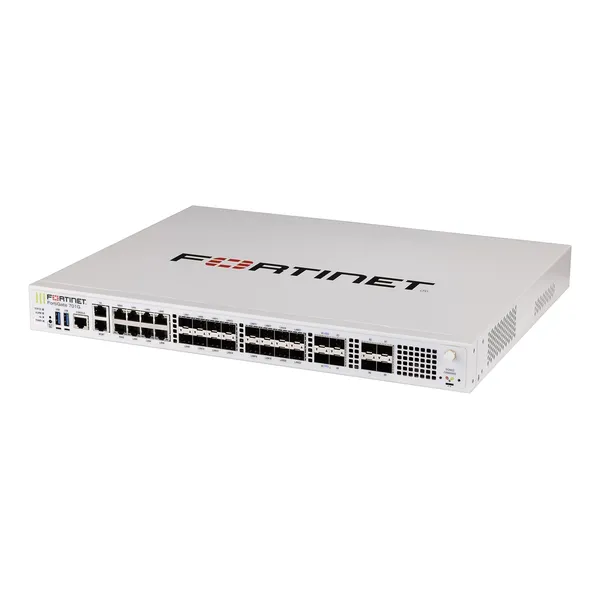
FortiGate 700G Uganda
A high-performance enterprise next-generation firewall built for modern campus, data-centre edge and distributed network security.
FortiGate 700G combines accelerated firewalling, encrypted-traffic handling, secure SD-WAN, VPN and FortiGuard security services through the FortiOS platform. It is aimed at organisations that need substantial inspected throughput and flexible high-speed interfaces while keeping networking and security under one operational framework.
Fortinet
FortiGate 700G
Enterprise NGFW
Campus & enterprise edge
FortiOS / Security Fabric
Configuration dependent
What the FortiGate 700G is designed to do
The FortiGate 700G is a high-performance next-generation firewall in Fortinet’s enterprise security portfolio. Its role is to sit at a major security boundary—such as a campus perimeter, large office core, regional hub or data-centre edge—and enforce security policy while moving substantial amounts of traffic. Unlike a basic stateful firewall, it is intended to combine network control with application visibility, intrusion prevention, malware protection, encrypted-traffic inspection, secure remote connectivity and software-defined wide-area networking functions when the appropriate services and policies are enabled.
Fortinet positions the 700G series for modern campus networks and distributed enterprises. The platform uses Fortinet purpose-built processors and FortiOS to accelerate security and networking tasks that can become computationally demanding at scale. That matters to organisations with multi-gigabit internet links, many branch VPNs, large numbers of simultaneous sessions, or traffic that must be inspected rather than simply passed through.
Selection should therefore begin with the actual protected workload. A 10 Gbps or 25 Gbps interface does not automatically mean every security function can run at that line rate, and a quoted firewall-throughput figure should not be treated as an inspected-traffic guarantee. Buyers should identify expected application mix, encrypted traffic percentage, VPN usage, security profiles, logging destination, high-availability design and projected growth. These inputs determine whether the 700G is appropriately sized and which service bundle is needed.
For Uganda organisations, the appliance can fit private-sector headquarters, banks and financial institutions, universities, healthcare groups, government networks, service providers and regional enterprises that have outgrown lower-capacity branch firewalls. FourTeck can assist with model validation, interface planning, transceiver and cable requirements, FortiGuard subscription selection, high-availability design inputs and quote preparation. Commercial availability, license term and delivery schedule should be confirmed for the exact bill of materials rather than assumed from the base hardware model.
Operational outcomes for enterprise security teams
01
High-capacity perimeter enforcement
Fortinet publishes up to 164 Gbps firewall throughput for the 700G series under its stated test methodology. This gives architects substantial headroom for large routing and policy workloads, while inspected-traffic requirements must still be sized against the relevant security-performance figure.
02
Threat protection at enterprise speed
Fortinet lists 26 Gbps threat-protection performance for the series. For organisations moving from simple firewalling to layered inspection, this is one of the most relevant sizing numbers because it reflects multiple security functions operating together under Fortinet’s test conditions.
03
Strong encrypted-site connectivity
Published IPsec VPN throughput reaches 55 Gbps. This can support hub-and-spoke WAN designs, data-centre interconnect requirements and encrypted regional connectivity, subject to tunnel scale, cipher choices, traffic profile and policy configuration.
04
Flexible high-speed interfaces
The 700G platform offers interface options spanning multi-gigabit copper and fiber connectivity, including 25GE-class uplinks. This lets network teams integrate the firewall into modern core and aggregation designs without relying only on legacy 1GE connectivity.
05
Converged networking and security operations
FortiOS brings firewall policy, secure SD-WAN, VPN, segmentation, zero-trust network access capabilities and security-service integration into one operating environment. The result can be fewer separate control planes for teams already standardising on Fortinet.
06
Security Fabric integration
The firewall can participate in Fortinet Security Fabric architectures, allowing broader visibility and coordinated policy across supported Fortinet products. The practical value depends on the surrounding environment and selected management and security services.
Designed for security throughput where campus traffic is already measured in tens of gigabits
The defining point of this platform is not a single firewall number; it is the combination of high raw forwarding capacity, meaningful threat-inspection performance, encrypted connectivity and modern interface density in an enterprise appliance. Fortinet’s NP7 and security-processing architecture are intended to offload common networking and security tasks from general-purpose processing, while FortiOS provides the operational layer used to build policy, segmentation and secure connectivity.
- 164 Gbps published firewall throughput under Fortinet test conditions.
- 55 Gbps published IPsec VPN throughput.
- 26 Gbps published threat-protection performance.
- High-speed interfaces including 25GE SFP28 and 10GE SFP+ options.
- FortiOS for converged security and networking functions.
- FortiGuard security-service capabilities vary by selected subscription.
FortiGate 700G specification ledger
| Specification | Published / configuration note |
|---|---|
| Product class | Enterprise next-generation firewall |
| Firewall throughput | Up to 164 Gbps, Fortinet published figure |
| IPsec VPN throughput | Up to 55 Gbps, Fortinet published figure |
| Threat protection | Up to 26 Gbps under Fortinet stated test conditions |
| Concurrent sessions | Platform figures vary by published reference and operating context; confirm current datasheet for exact sizing |
| Hardware acceleration | Fortinet NP7 / security processing architecture; exact hardware revision should be confirmed at quotation |
| High-speed fiber interfaces | 4 x 25GE SFP28 and 4 x 10GE SFP+ commonly listed for FG-700G hardware configuration |
| 1GE fiber interfaces | 16 x 1GE SFP slots |
| Multi-gigabit copper | 8 x 5G BASE-T RJ45 ports |
| Management / HA ports | Dedicated management and high-availability connectivity; confirm exact port assignment in current hardware guide |
| Power | Dual AC power supplies on standard FG-700G hardware; deployment power planning required |
| Operating system | FortiOS |
| Security services | Based on selected FortiGuard license bundle and term |
| Deployment | Rack-based enterprise environment; optics, cables and accessories configuration dependent |
The most important numbers for procurement are the ones that match the intended workload. If the design depends mainly on high-speed routing and stateful firewalling, raw firewall throughput is useful. If the objective is intrusion prevention, malware inspection, application control and logging across internet traffic, the threat-protection figure is a better starting point. For encrypted branch connectivity, IPsec throughput, tunnel scale and failover design matter. SSL inspection may introduce a different performance requirement again, particularly where a large proportion of traffic is encrypted.
Interface planning should be completed at the same time as performance sizing. The firewall may need 25GE uplinks to a campus core, 10GE connections to server or distribution networks, multi-gigabit copper links, or 1GE fiber for legacy segments. SFP, SFP+ and SFP28 transceivers are not interchangeable simply because the physical cages look similar, so the bill of materials should identify speed, fiber type, distance, connector and switch compatibility. Power, rack space, high-availability cabling and license term should also be confirmed before the order is finalised.
Five questions that shape the correct 700G deployment
01 What traffic will the firewall actually inspect?
List internet bandwidth, east-west traffic that crosses security zones, application mix, encrypted-traffic percentage and the FortiGuard services that will be enabled. This separates a simple forwarding requirement from a true threat-inspection requirement and helps avoid basing the decision on the largest published number.
02 What user, device and session scale is expected?
Campus networks can contain thousands of endpoints, guest devices, IP phones, cameras, servers and transient wireless clients. Session count and new-session rate can become important even when average bandwidth looks modest. Share peak user counts, device estimates and known high-connection applications.
03 Which switches, routers and circuits must connect?
Document every handoff speed and media type. A 25GE fiber uplink needs the correct optics and compatible switch-side interface; a 5GBASE-T copper link has different cabling and distance considerations. Include ISP handoffs, core switches, WAN routers, out-of-band management and HA links.
04 What security services and growth path are required?
FortiGuard bundles determine which subscription services are available and the support term. Growth planning should consider faster internet circuits, added branch VPNs, new segmentation policies, cloud connectivity and the possibility of enabling deeper inspection later. A platform that is comfortable today should still have practical headroom for the planned refresh cycle.
05 What are the installation and support expectations?
Confirm whether the project requires a standalone appliance or HA pair, rack preparation, optics, patching, power redundancy, configuration migration, support entitlement and scheduled rollout coordination. These details change the quote even when the base firewall model remains the same.
Where the platform can make architectural sense
Large corporate campus perimeter
A headquarters campus with multiple access buildings, high-density Wi-Fi, collaboration traffic, SaaS use and private application access may need far more than basic edge filtering. The 700G can serve as a high-capacity perimeter platform where internet and inter-zone traffic must be inspected, segmented and logged. The design should validate peak inspected throughput, redundancy and the speed of core-switch uplinks. A high-availability pair may be appropriate where perimeter downtime would interrupt business operations.
Regional enterprise hub
Organisations with multiple Uganda branches or East African sites may aggregate encrypted branch traffic into a central location. Published IPsec performance makes the platform relevant to hub designs with many tunnels and substantial aggregate throughput. Architects should still calculate tunnel count, routing architecture, SD-WAN policy, internet breakout strategy and the impact of security inspection on decrypted or locally terminated traffic.
Data-centre or private-cloud edge
Where a private data centre hosts ERP, databases, web services or virtualised applications, a 700G can be considered for north-south security at the data-centre boundary or selected segmentation points. Interface speed and inspected throughput should be matched to server-farm traffic. East-west microsegmentation inside a highly virtualised environment may require additional architectural components rather than assuming one perimeter appliance will handle every security boundary.
University or large education network
Universities can create unusual security loads because thousands of unmanaged or semi-managed devices connect across wired and wireless networks. The firewall may need to support high session counts, guest access, research traffic, application controls and multiple network zones. The design should identify which traffic must traverse the firewall, which is handled locally within the switching fabric, and how identity, DNS and endpoint controls integrate with the broader security policy.
Financial, healthcare or public-sector network
Organisations handling sensitive business data often require segmentation, strong logging, controlled remote access and layered threat inspection. The 700G can provide the network-security enforcement point, but product selection is only one part of the control framework. Buyers should define retention, authentication, endpoint integration, administrative separation and change-management requirements alongside firewall sizing and subscription choices.
Accelerated security performance
Enterprise firewalls are asked to do several jobs simultaneously: maintain session state, enforce policy, inspect application traffic, identify malicious patterns, decrypt selected encrypted sessions, establish VPNs, perform routing decisions and export logs. As those functions accumulate, general-purpose processing can become a limiting factor. Fortinet’s design approach uses purpose-built silicon to accelerate key networking and security workloads, which is central to how the FortiGate family reaches high throughput while applying security services.
For a buyer, the architectural lesson is to avoid treating every performance figure as interchangeable. The 164 Gbps firewall number represents a different workload from the 26 Gbps threat-protection figure. A real deployment may sit somewhere between these modes and can vary with packet size, enabled features, policy complexity and traffic composition. Capacity planning should use conservative assumptions for the services that will actually run in production.
The 700G is attractive when an organisation wants enough headroom to inspect multi-gigabit traffic without immediately moving into a much larger chassis platform. That does not remove the need for measurement. Existing firewall utilisation, internet peak graphs, application visibility reports and VPN statistics provide far better sizing inputs than nominal circuit capacity alone.
High-speed connectivity and secure network convergence
Modern campus cores increasingly use 10GE and 25GE uplinks, while access and distribution layers may mix 1GE fiber with 2.5G or 5G copper. The FortiGate 700G interface set is designed for this mixed environment, allowing the appliance to connect to high-speed core switches while retaining lower-speed interfaces for management, WAN handoffs or segmented networks.
This flexibility matters during upgrades. A business may begin with 10GE uplinks and later move selected paths to 25GE without replacing the firewall solely because interface speed has changed. It can also simplify HA cabling and management when the deployment is planned around dedicated interfaces rather than consuming production data ports for every control function.
25GE-class uplinks
Suitable for high-speed campus core or aggregation connectivity when matching optics are selected.
10GE and 1GE fiber
Supports mixed-generation networks and segmented deployments without forcing every connection to the same speed.
Multi-gigabit copper
Useful where 5GBASE-T handoffs are required and cabling standards support the chosen speed and distance.
FortiOS, subscriptions and the security-services decision
Hardware capacity only becomes useful when the software and subscriptions align with the organisation’s risk requirements. FortiOS provides the common operating environment for firewall policy, routing, VPN, SD-WAN, segmentation and integration with supported Fortinet products. FortiGuard services add threat intelligence and security capabilities according to the selected package and subscription term.
The purchase decision should therefore distinguish the base appliance from the security outcome required. Some organisations primarily need a high-performance firewall and VPN gateway. Others expect advanced malware protection, web filtering, DNS security, intrusion prevention, application control and broader enterprise protection services. Bundles differ in included services and term, so the quote should list the exact SKU rather than only the model family.
Support entitlement is equally important. Firmware lifecycle, technical support access and hardware service expectations should be considered before installation, particularly for a perimeter device that may become a single operational dependency.
Buyer decision checklist
- Which FortiGuard services must be enabled on day one?
- Is the term one, three, five years or another available option?
- Does the organisation require central management or analytics components?
- Will the firewall join an existing Fortinet Security Fabric?
- Is HA required, and are two identical licenses/appliances budgeted where applicable?
- Are migration, policy cleanup and post-deployment support part of the project scope?
What buyers should check before purchase
| Risk | What to confirm | Why it matters | Share with FourTeck |
|---|---|---|---|
| Wrong performance metric | Inspected traffic and enabled services | Raw firewall speed can overstate real security capacity | Peak bandwidth and security profiles |
| Interface mismatch | Switch ports, optics, fiber type and speeds | Prevents unusable transceivers and link-speed conflicts | Connected switch models and distances |
| Incomplete licensing | FortiGuard bundle and term | Required security services may depend on subscription | Required controls and preferred term |
| No resilience plan | HA architecture, power and cabling | Perimeter failure can interrupt many services | Uptime objective and rack/power layout |
| Growth underestimated | Circuit upgrades, branches and new security services | Future inspection load can exceed initial assumptions | Three-year network roadmap |
A correct order is more than the FG-700G chassis. It may include two appliances for HA, FortiGuard subscriptions, support, SFP/SFP+/SFP28 optics, fiber patch cords, copper cabling, rack accessories, console access, and services for migration or configuration. Project buyers should also confirm lead time and warranty/service expectations for the selected SKU before scheduling a cutover.
Planning a FortiGate 700G deployment in Uganda
FourTeck can assist Uganda buyers with configuration review, quotation, licensing options, accessory planning and delivery coordination for enterprise firewall projects. Availability can vary by hardware SKU, subscription bundle, support term and quantity, so procurement teams should request a current project quotation rather than assuming the appliance or a particular bundle is immediately available.
For Kampala projects, FourTeck can help convert design requirements into a clear bill of materials covering the firewall, FortiGuard services, support term, optics and related components. Where a customer is replacing an older firewall, providing the current model, interface use, VPN count and recent utilisation data makes the selection process more reliable. Warranty guidance and service expectations should be confirmed against the chosen commercial package at quotation stage.
For multi-site projects, quantity planning is especially important because all appliances, licenses and optics may need to arrive in a coordinated deployment window. FourTeck can also discuss alternative FortiGate capacities where the 700G is either larger than required or does not provide enough future headroom.
Uganda location coverage
FourTeck can coordinate product enquiries and project planning for organisations in Kampala and for deployments elsewhere in Uganda. Customers preparing installations in Entebbe, Jinja, Mbarara or Gulu can use the same central quotation process to confirm the required FortiGate hardware, subscriptions, optics, quantities and delivery details. Coverage should be treated as project coordination rather than a guarantee of local branch stock, immediate dispatch or fixed delivery time.
East Africa and regional availability
Organisations operating across Uganda and Kenya, or across selected East Africa markets, may prefer to standardise firewall models, security subscriptions and support terms. FourTeck’s regional web presence can help procurement teams coordinate enquiries across Uganda, Kenya and broader Africa requirements. Regional availability, logistics and warranty handling should be confirmed per destination and project rather than inferred from one country quotation.
For organisations with procurement links to the Gulf, FourTeck also operates regional web channels for the UAE and Kuwait. A cross-border project should define the delivery country, end-user location, quantity, subscription term and desired support coverage for each site so that commercial requirements can be reviewed accurately.
Build the firewall shortlist around required capacity
FortiGate enterprise firewalls
Best for buyers comparing Fortinet capacities above and below the 700G. Review the wider FortiGate category on the FourTeck Uganda technology catalogue and request model-specific guidance.
FortiGate 400G class
A possible lower-capacity path where inspected throughput and session requirements do not justify the 700G. Ask FourTeck to compare current Fortinet sizing options through the Uganda firewall quotation desk.
FortiGate 900G class
A higher-capacity alternative for larger campuses, aggregation points or heavier inspection loads. Model selection should be based on measured workload and future growth rather than hierarchy alone.
Fortinet management and analytics
Central policy, logging and analytics requirements may justify additional Fortinet platforms. Include these needs when requesting a solution quotation so they are not treated as an afterthought.
Fortinet-compatible transceivers and cabling
Optics should match firewall port type, switch compatibility, fiber media and link distance. FourTeck can include suitable accessories in a consolidated FortiGate project quote.
Procurement assistance beyond the hardware model
01 Product selection guidance. FourTeck can help map internet bandwidth, protected traffic, interface speed, VPN scale and growth expectations to an appropriate FortiGate capacity.
02 Configuration review. A bill of materials can be checked for appliance count, HA needs, subscription bundle, support term, optics and cabling.
03 Quote assistance. Project quantities and selected subscription terms can be consolidated into a commercial quotation for procurement review.
04 Business IT context. Firewall selection can be discussed alongside switching, WAN, wireless, server and security requirements rather than as an isolated box purchase.
05 Uganda delivery coordination. Delivery planning can be reviewed for the stated project location and quantity, with availability confirmed against the selected configuration.
06 Alternative model matching. If the 700G is not the right capacity, FourTeck can help compare adjacent FortiGate options based on the same workload assumptions.
FortiGate 700G buyer questions
01. What is the FortiGate 700G mainly used for?
It is designed as a high-performance next-generation firewall for modern campus, enterprise edge and distributed-network environments. Typical roles include internet perimeter security, regional VPN aggregation, secure SD-WAN, segmentation and application-aware threat inspection. The best fit depends on inspected traffic, user and session scale, interface requirements and the security services the organisation intends to enable.
02. Is 164 Gbps the security throughput I should size against?
No. Fortinet’s 164 Gbps figure is a firewall-throughput metric under its published test conditions. When intrusion prevention, malware inspection, application control and logging are enabled, a threat-protection metric is more relevant; Fortinet publishes up to 26 Gbps for the 700G series. Real performance depends on traffic profile, packet size, policy, encryption and enabled features.
03. Does the base appliance include every FortiGuard security service?
No. FortiGuard capabilities and support entitlement depend on the selected license bundle and subscription term. Buyers should define required services—such as IPS, malware protection, web or DNS controls, and other enterprise security functions—then request the exact commercial SKU. FourTeck can help compare available bundle options and terms for the planned deployment.
04. Can FortiGate 700G be deployed as a high-availability pair?
FortiGate platforms support high-availability designs, and the 700G is suitable for enterprise deployments where firewall resilience is important. The project should define HA mode, upstream and downstream switch design, dedicated HA links, power diversity and license/support requirements for both appliances. FourTeck can include the required quantity and accessories in the quotation.
05. Which optics are required for the 25GE ports?
The answer depends on link distance, fiber type, connector, switch-side compatibility and the specific SFP28 optic supported for the design. Do not assume that an existing SFP+ optic is automatically suitable for a 25GE SFP28 requirement. Share the connected switch model and cable distance so suitable transceivers can be identified before ordering.
06. Is the FortiGate 700G suitable for branch offices?
It can be used in a large regional site, but it is generally positioned above typical small-branch requirements. A branch with modest bandwidth may be better served by a smaller FortiGate, while a regional hub aggregating many branches could justify the 700G. Sizing should be based on the actual traffic and security workload rather than office labels alone.
07. How should we prepare for an upgrade from an older firewall?
Collect current interface mappings, VLANs, routing tables, VPN definitions, security policies, address objects, authentication dependencies, logging destinations and recent utilisation data. Identify obsolete rules rather than blindly copying them. The target design should also review optics, link speeds, HA, power and subscription changes. Migration effort is separate from the hardware purchase and should be planned explicitly.
08. Is FortiGate 700G available in Uganda?
FourTeck can provide quotation and procurement assistance for Uganda projects, but availability varies by exact hardware SKU, license bundle, term and quantity. Request a current quote with the desired configuration and delivery location. This avoids relying on generic online stock indicators that may not reflect the required subscription or project timeline.
09. What information should we send for a quote?
Send the expected internet and inter-site bandwidth, peak inspected throughput if known, user/device estimate, VPN requirements, interface speeds, connected switch models, HA requirement, desired security services, preferred support term, quantity and delivery location. If replacing an existing firewall, include its model and current utilisation. These details help FourTeck prepare a more accurate bill of materials.
10. What alternatives should be considered if 700G is not the right size?
Fortinet offers lower- and higher-capacity FortiGate models, including enterprise platforms around the 400G and 900G classes. The correct alternative depends on threat-inspection throughput, VPN load, interface density, growth and budget. Rather than choosing by model number alone, compare the same workload assumptions across candidate appliances and select the capacity that leaves sensible operational headroom.
Prepare the FortiGate 700G bill of materials before you order
Share your expected protected bandwidth, interface map, VPN requirements, HA plan, FortiGuard service needs, subscription term and Uganda delivery location. FourTeck can use those details to review the configuration and prepare a project quotation that includes the required firewall hardware and relevant accessories.
- WAN and inspected-traffic requirement
- Switch models and link speeds
- HA or standalone deployment
- Security-service bundle and term
- Quantity and delivery location

Reviews
There are no reviews yet.