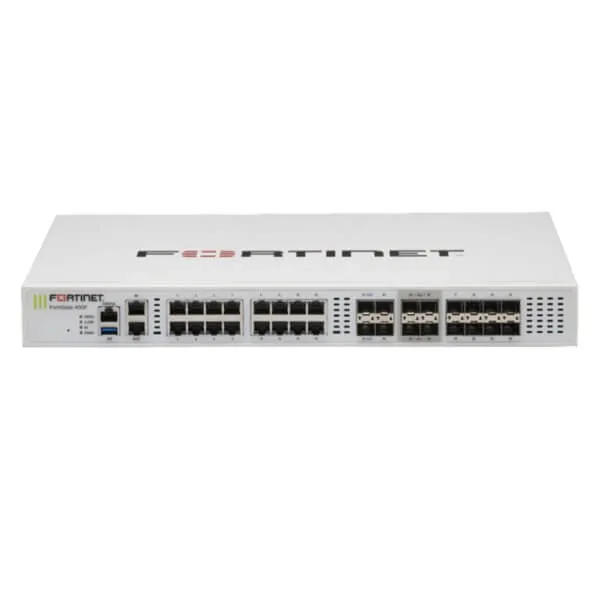
FortiGate 400F Uganda
A 1U enterprise next-generation firewall for high-capacity security inspection, secure SD-WAN, segmentation, VPN connectivity and controlled access at campus, data-centre edge and larger branch environments.
Fortinet positions the 400F series for organizations that need deep visibility and accelerated security processing without separating networking and security into disconnected platforms. Selection should be based on inspected traffic, interface requirements, subscription services and resilience design rather than raw firewall throughput alone.
Fortinet
FG-400F
Enterprise NGFW
1U rack mount
FortiOS
Quote dependent
Where the FortiGate 400F fits in a serious business network
The FortiGate 400F is designed for organizations that have outgrown entry and branch-class firewalls but do not want security controls to become a bottleneck as traffic, applications and connected sites grow. It combines routing, firewalling, intrusion prevention, application control, secure SD-WAN, VPN, segmentation and other FortiOS capabilities in a single security platform. Its role is commonly at the internet edge, campus boundary, aggregation point or other location where a large amount of business traffic must be inspected and policy decisions must be applied consistently.
Fortinet publishes enterprise-mix performance figures of 12 Gbps for IPS, 10 Gbps for NGFW and 9 Gbps for threat protection. These figures are more useful for procurement planning than the highest raw firewall number because most real deployments enable multiple security functions. The 400F also provides a substantial physical interface set: 18 Gigabit Ethernet RJ45 ports including dedicated management and high-availability connections, eight 1GbE SFP slots and eight 10GbE SFP+ slots. Four of the 10GbE SFP+ interfaces are ultra-low-latency ports connected directly to the NP7 path.
The appliance is powered by Fortinet’s NP7 network processor and CP9 content processor. That hardware acceleration is important when a security platform must move substantial traffic while performing packet processing and security functions. It does not remove the need for careful sizing. Application mix, encrypted traffic percentage, VPN demands, logging, inspection depth, WAN links and future bandwidth should all be understood before committing to a configuration.
For Uganda organizations, the 400F can make sense for headquarters networks, larger campuses, service providers, regulated businesses, universities, government environments and distributed enterprises that consolidate multiple security and WAN functions. FourTeck can assist with BOM preparation, service bundle selection, optic requirements, HA planning and quote coordination so the appliance is matched to the actual deployment rather than purchased as an isolated chassis.
Business outcomes supported by the platform
01
Protect higher-bandwidth business traffic
With 12 Gbps IPS, 10 Gbps NGFW and 9 Gbps threat-protection figures, the platform provides capacity for demanding security inspection. This can help organizations upgrade internet links or consolidate sites without immediately forcing security to become the slowest component.
02
Converge networking and security
FortiOS combines security policy, routing, SD-WAN and segmentation. For IT teams, that can reduce the number of separate tools required at the edge and make policy changes easier to coordinate across connectivity and security requirements.
03
Use copper and fiber where each makes sense
The combination of GE RJ45, GE SFP and 10GE SFP+ interfaces gives designers flexibility for access, WAN, core and aggregation links. This matters when an existing rack includes mixed media or when migration to higher-speed fiber will happen in stages.
04
Build resilient edge designs
Dual AC power supplies are built into the appliance, and FortiOS supports high-availability designs. Organizations can reduce single points of failure by planning redundant power feeds, links and paired firewalls where business continuity requirements justify the investment.
05
Control encrypted and remote connectivity
The platform supports IPsec VPN and SSL inspection as part of its security architecture. Buyers should size around real encrypted workloads, but the 400F class is intended for networks where remote sites, users and encrypted application traffic are substantial.
06
Create a foundation for policy growth
A larger platform can provide headroom for additional segments, applications, tunnels and services. The commercial value is not simply speed; it is avoiding a premature replacement because the network becomes more complex during the intended lifecycle.
A security platform designed around accelerated inspection and flexible enterprise connectivity.
The strongest reason to shortlist this model is the balance between multi-gigabit security performance and physical interface density. It is not simply a fast packet-forwarding appliance. Fortinet combines specialized silicon, FortiOS networking functions and FortiGuard security services so organizations can apply policy, inspect threats and steer WAN traffic from the same platform.
Enterprise-mix intrusion-prevention throughput; practical capacity depends on enabled features and traffic.
Useful benchmark when application control and IPS are part of the security policy.
Fortinet’s published enterprise-mix figure for a broader set of security services.
High-speed fiber connectivity, including four ultra-low-latency interfaces in the architecture.
FortiGate 400F specification ledger
| Specification | FortiGate 400F | Buyer relevance |
|---|---|---|
| Product type | Next-generation firewall | Converged security and networking platform |
| Firewall throughput | 79.5 / 78.5 / 70 Gbps (1518/512/64 byte UDP) | Raw packet-forwarding benchmark, not the sole sizing figure |
| IPsec VPN throughput | 55 Gbps | Relevant to site-to-site encrypted connectivity |
| IPS throughput | 12 Gbps | Key metric where intrusion prevention is widely enabled |
| NGFW throughput | 10 Gbps | Useful for application control plus IPS scenarios |
| Threat protection throughput | 9 Gbps | Broader inspection planning figure |
| Concurrent sessions | 7.8 million | Important for dense client and application environments |
| New sessions per second | 500,000 | Useful where connection churn is high |
| GE RJ45 interfaces | 18 total: 16 data, 1 MGMT, 1 HA | Supports copper connectivity and dedicated administration/HA |
| GE SFP slots | 8 | Fiber or compatible SFP connectivity |
| 10GE SFP+ slots | 8 total; four standard plus four ultra-low-latency | High-speed core, WAN or aggregation links |
| Acceleration | NP7 and CP9 SPU | Hardware-accelerated packet and content processing |
| Onboard storage | None on FG-400F | Consider FG-401F where onboard SSD storage is required |
| Power supplies | Dual AC | Supports redundant power-feed planning |
| Form factor | 1U rack mount | Fits standard enterprise rack deployments |
| Security services | Based on selected FortiGuard/FortiCare package | Subscription choice affects protection scope, support and lifecycle cost |
The most consequential numbers for most buyers are the inspected-throughput figures, interface mix and session capacity. A 10 Gbps internet circuit does not automatically mean that a 10 Gbps NGFW rating is sufficient because internal east-west flows, VPN traffic, bursts, future circuits and security-policy complexity all influence load. Conversely, buying solely from the raw 79.5 Gbps firewall figure can overstate the performance available once inspection services are enabled. The practical design should map traffic classes to security functions and leave headroom for growth.
Interface planning deserves equal attention. Eight 10GbE SFP+ slots allow fast fiber connections, but the exact optics and cable type must match the switches, routers or service handoffs on the other side. Fortinet documentation identifies X5 through X8 as ultra-low-latency interfaces; these bypass the integrated switch fabric for the lower-latency path. Buyers with latency-sensitive designs should confirm which ports will carry which traffic before the rack is cabled.
Five questions to answer before requesting a quote
- 01 — What traffic must actually be inspected?
Document current internet bandwidth, inter-site traffic, data-centre flows and expected growth. Then identify where IPS, application control, web filtering, malware protection and SSL inspection will be enabled. This determines whether the 400F’s inspected performance provides comfortable headroom or whether a different platform class is more appropriate. - 02 — How many users, devices, sessions and VPNs will the firewall handle?
User count is only a starting point. Modern devices create many simultaneous sessions, cloud applications increase connection churn and distributed organizations may maintain many site-to-site tunnels. Capture peak use rather than average use so the design does not become constrained during busy periods. - 03 — Which copper, fiber and 10GbE connections are required?
List every WAN, LAN, DMZ, core and HA connection. Record whether each uses RJ45, 1GbE SFP or 10GbE SFP+, and note the optic type or distance where known. This step identifies required transceivers and helps prevent mismatches with existing switches or carrier equipment. - 04 — Which licenses, services and growth options are needed?
FortiGate hardware can be purchased with different FortiCare and FortiGuard service packages and terms. Determine the protection functions, support expectations and renewal horizon needed by the organization. Also decide whether onboard storage is necessary; if it is, the 401F variant may be more suitable. - 05 — What availability, installation and support model does the project require?
Clarify whether a single appliance is acceptable or whether high availability is required, where each power supply will connect, who will configure migration, what maintenance window is available and which documentation must be handed over after installation.
Use cases where the 400F class can make practical sense
Headquarters internet edge
A larger corporate office may have multiple high-speed ISP circuits, public services, remote users, cloud applications and segmented internal networks. The 400F provides 10GbE uplink options and multi-gigabit security inspection for this type of edge. The configuration should be checked against expected SSL inspection, VPN traffic and the number of security services enabled.
Campus security and segmentation
Universities, hospitals, government campuses and multi-building enterprises can have thousands of endpoints and many logical zones. The high session capacity and broad interface mix are useful where the firewall must enforce policy between user groups, server networks, internet paths and managed infrastructure. VLAN design and routing architecture should be reviewed before deployment.
Secure SD-WAN hub
A distributed company can use FortiOS SD-WAN to steer branch traffic across multiple WAN paths while applying security policy. At a central hub, the platform may terminate many VPN connections and process aggregated application traffic. Buyers should document tunnel counts, bandwidth patterns and failover expectations so hub capacity is sized for normal and degraded-path conditions.
Data-centre or private-cloud edge
The appliance can sit between internet, WAN, DMZ and internal service zones where 10GbE links are useful. Ultra-low-latency interfaces offer an architectural option for selected traffic paths. The decision should consider east-west inspection, server connection rates, log retention strategy and whether an external FortiAnalyzer platform is part of the design.
NP7 and CP9 acceleration: why specialized silicon matters
The 400F is not built around general-purpose CPU processing alone. Fortinet uses a Network Processor 7 (NP7) and Content Processor 9 (CP9) to accelerate network and security workloads. In practical terms, this architecture helps the appliance process high packet rates and security functions while maintaining the throughput expected of its class. For buyers, the significance is not the chip name itself; it is the ability to consolidate firewalling, routing, VPN and inspection functions without treating each one as an entirely separate hardware platform.
Fortinet documentation shows that the front-panel data ports connect to the NP7 through specific internal paths. Ports X5 through X8 are ultra-low-latency 10GbE SFP+ interfaces connected directly to one NP7 interface rather than through the integrated switch fabric. Where a design includes latency-sensitive east-west or north-south traffic, using those interfaces deliberately can be valuable. This is a technical design point that should be planned before migration, because lower-latency behavior depends on traffic entering and leaving through those specific ports.
Hardware acceleration also reinforces why configuration matters. Features and traffic that can be offloaded benefit most from the specialized path. Network designers should therefore review policy structure, interface use, routing and inspection requirements rather than assuming every packet follows the same processing path. A well-designed configuration can make better use of the platform’s architecture and keep troubleshooting simpler after go-live.
FortiOS security, SD-WAN and zero-trust access in one control plane
Fortinet’s product positioning for the 400F emphasizes converged networking and security. FortiOS provides the common operating environment for firewall policy, routing, segmentation, secure SD-WAN and security services. For IT teams, this matters because WAN-path decisions and security controls can be coordinated rather than managed as unrelated edge functions. A branch or campus can use application awareness to make path decisions while still applying security policy to the traffic.
Universal zero-trust network access is also part of Fortinet’s broader architecture. The objective is to validate user and device access to applications rather than relying only on network location. Organizations evaluating this capability should review identity sources, endpoint posture, authentication and application publishing requirements so the operational design is clear. Hardware purchase alone does not define the complete zero-trust deployment.
Application-aware path selection and WAN control integrated with firewall policy.
Policy boundaries can be applied between users, servers, sites and services.
Security coverage depends on the selected subscription and service bundle.
Interface density, resilient power and the difference between 400F and 401F
The physical design is one of the strongest practical reasons to evaluate the platform. Eighteen GE RJ45 ports provide copper connectivity, while eight GE SFP and eight 10GE SFP+ slots allow fiber and higher-speed uplinks. A network team can therefore connect ISP handoffs, core switches, server zones, DMZs and dedicated management links without immediately adding external media-conversion devices. The exact layout should still be planned around redundancy and switch design rather than filling ports opportunistically.
Dual AC power supplies are standard on the FG-400F ordering description. To gain resilience from them, each supply should connect to an appropriately designed power path; simply having two supplies does not protect against a shared upstream power failure. Organizations with UPS-backed racks should confirm available outlets, PDU design, power budgeting and cable routing. High-availability firewall pairs add another layer of resilience but also increase rack space, licensing and connection requirements.
A common buying detail is the distinction between FG-400F and FG-401F. The 401F variant adds onboard SSD storage, whereas the 400F is listed without onboard storage. Buyers that need local logging or storage-oriented functions should determine whether the 401F or an external logging architecture is appropriate. This is exactly the type of model-suffix decision that should be resolved before purchase.
Decision checklist
- Confirm every required RJ45, SFP and SFP+ connection.
- Match optic type and fiber distance to connected equipment.
- Decide whether X5-X8 ultra-low-latency ports are required for specific paths.
- Confirm dual-power connection design.
- Choose 400F or 401F based on onboard-storage requirements.
- Determine whether a second appliance is required for high availability.
What buyers should check before purchase
Risk: wrong performance assumption
Confirm: inspected throughput, encrypted traffic and growth.
Why: raw firewall throughput is not the same as threat-protection capacity.
Share with FourTeck: bandwidth, enabled services and peak traffic.
Risk: interface mismatch
Confirm: copper, SFP, SFP+, optic and cable requirements.
Why: a correct firewall can still be unusable if the handoff media is wrong.
Share: switch models, carrier handoff and fiber type.
Risk: incomplete service bundle
Confirm: FortiGuard and FortiCare services and term.
Why: protection functions and support expectations depend on the selected package.
Share: required security services and renewal horizon.
Risk: missing resilience components
Confirm: HA, redundant links and power paths.
Why: availability depends on the whole design, not just dual power supplies.
Share: outage tolerance, rack topology and failover requirement.
Other checks include rack depth and airflow planning, console access, management-network addressing, migration method, policy conversion, logging destination and responsibility for post-installation validation. Buyers should also confirm whether the project requires spare optics, patch leads, rack accessories or professional implementation services. If the appliance is replacing an older FortiGate, export and review the existing configuration rather than assuming every feature and object can be carried forward unchanged.
Commercially, clarify whether the quote is hardware-only or includes subscriptions and support. FortiGate service bundles can materially change lifecycle cost and protection scope, so comparing quotes only on the chassis line can be misleading. FourTeck can help normalize the requested BOM so procurement teams compare equivalent configurations.
Planning a Fortinet firewall purchase in Uganda
FourTeck can support Uganda organizations with model selection, configuration review, quotation and delivery coordination for Fortinet firewall projects. Availability can change by hardware revision, service bundle, license term, project quantity and distributor supply, so current lead time should be confirmed at quotation stage rather than assumed from a generic product listing.
For Kampala deployments, buyers can share the existing firewall model, internet links, expected inspected throughput, required security services, interface schedule and high-availability objective. FourTeck can use this information to check whether the 400F is the right capacity class and whether the BOM needs transceivers, subscriptions, a matching secondary appliance or other supporting components.
Warranty and support should be reviewed against the exact FortiCare package and commercial terms quoted for the project. For phased rollouts, include the expected quantity and site schedule so sourcing and delivery planning can be aligned with installation windows. Contact FourTeck Uganda for current FortiGate 400F options.
Uganda location coverage for business projects
FourTeck can coordinate business-technology quotations and project supply requirements for customers in Kampala and, subject to the specific order and delivery arrangement, organizations in Entebbe, Jinja, Mbarara and Gulu. For firewall projects outside Kampala, provide the destination, quantity, preferred deployment date and any site-access constraints when requesting the quotation. This helps separate product sourcing from the practical logistics of getting equipment to the intended installation point.
East Africa and regional project coordination
Organizations with operations across Uganda and Kenya, or broader East Africa environments, often benefit from standardizing firewall policy and hardware families across locations. A consistent FortiGate architecture can simplify configuration templates, support procedures and spare strategy, but each site should still be sized for its own bandwidth and user profile.
FourTeck’s regional web presence can support enquiries through FourTeck Uganda, FourTeck Kenya and FourTeck Africa. For organizations whose procurement spans the Gulf as well as Africa, relevant enquiries can also reference FourTeck UAE or FourTeck Kuwait. Regional availability, warranty handling, delivery method and commercial terms should always be confirmed for the exact destination rather than inferred from another market.
For multi-country projects, provide a site list, expected quantities, desired service term and whether each location will use independent internet breakout or centralized VPN hubs. This makes it easier to determine whether every site needs the same appliance or whether a mixed FortiGate portfolio is the more sensible design.
Related Fortinet and firewall procurement paths
Procurement help that starts before the purchase order
01 — Product selection guidance. FourTeck can review whether the 400F’s inspected throughput, session capacity and interface set align with the intended workload, helping buyers avoid choosing only from a model number or raw firewall benchmark.
02 — Configuration review. The team can work from an interface schedule, WAN plan, HA requirement and service list to identify the hardware and subscription components needed for the requested BOM.
03 — Quote assistance. Business and project buyers can request quantity-based quotations that separate the appliance, service bundle and accessories clearly, making internal procurement review easier.
04 — Uganda delivery coordination. Delivery arrangements can be discussed around the actual destination and project schedule instead of assuming a generic stock or dispatch promise.
05 — Alternative product matching. If requirements point to onboard storage, a different throughput tier or another interface profile, FourTeck can help identify a more appropriate FortiGate path rather than forcing the original model into the project.
FortiGate 400F buyer questions
01. What is the FortiGate 400F primarily used for?
It is a next-generation firewall for enterprise and larger distributed networks that need high-capacity security inspection, secure SD-WAN, VPN, segmentation and policy control. It is typically considered for headquarters, campuses, larger branches, data-centre edges and aggregation roles. The right use depends on inspected traffic and design requirements, not simply employee count.
02. What security performance does Fortinet publish for the 400F?
Fortinet lists 12 Gbps IPS throughput, 10 Gbps NGFW throughput and 9 Gbps threat-protection throughput using its enterprise traffic mix methodology. Raw firewall throughput is higher, but procurement sizing should normally use the figures closest to the security services you intend to enable. Leave capacity for traffic growth and failover scenarios.
03. How many network interfaces does the FG-400F provide?
The appliance has 18 GE RJ45 interfaces including dedicated management and HA ports, eight GE SFP slots and eight 10GE SFP+ slots. Fortinet documents four of the 10GbE ports as ultra-low-latency interfaces. Exact transceivers are a separate requirement and should be matched to fiber type, distance and connected equipment.
04. Does the FortiGate 400F include onboard SSD storage?
No. Fortinet’s ordering information distinguishes the FG-400F from the FG-401F: the 401F variant includes onboard SSD storage, while the 400F does not. If local storage is important for your logging or operational design, discuss whether the 401F or an external logging platform is the better fit before ordering.
05. Do I need FortiGuard or FortiCare services with the appliance?
The required service package depends on the security capabilities and support level your organization intends to use. Different FortiGuard and FortiCare bundles and terms can be quoted with the hardware. Buyers should define threat-protection functions, support expectations and subscription duration so they compare equivalent lifecycle costs rather than hardware-only prices.
06. Can the 400F be deployed as a high-availability pair?
FortiOS supports high-availability designs, and the appliance includes a dedicated HA interface and dual power supplies. A resilient implementation still requires a complete design covering a second matching appliance, licenses or services as applicable, redundant switch links, power feeds and failover testing. Share your outage tolerance and topology with FourTeck when requesting the BOM.
07. Is the FortiGate 400F suitable for a 10 Gbps internet connection?
Potentially, but the answer depends on which security functions are enabled and how much traffic must be inspected. Fortinet lists 10 Gbps NGFW and 9 Gbps threat-protection throughput, so a fully utilized 10 Gbps circuit can require careful headroom analysis. SSL inspection, VPNs, internal traffic and future growth should all be included in sizing.
08. What information should I provide for a Uganda quote?
Provide the appliance quantity, deployment location, WAN bandwidth, expected inspected throughput, FortiGuard/FortiCare term, HA requirement, VPN needs, required SFP/SFP+ optics and preferred deployment window. If the firewall replaces an existing unit, include that model and a summary of current interfaces and services. This makes BOM preparation more accurate.
09. How is Uganda availability confirmed?
Availability should be checked at quotation stage because supply can vary by exact hardware, service bundle, quantity and timing. FourTeck does not need to assume ready stock to prepare a useful proposal. Contact the Uganda team with your required configuration and destination, and current sourcing and delivery options can be coordinated for the project.
10. What should I consider if the 400F is not the exact fit?
Look at the reason for the mismatch. If onboard storage is required, the 401F is a logical adjacent model. If inspected throughput needs are lower or higher, another FortiGate performance tier may be more economical or provide better growth headroom. Interface density, session scale, subscription requirements and lifecycle plans should guide the alternative.
Build the FortiGate 400F BOM around your actual network.
Send FourTeck your bandwidth, security-service requirements, interface schedule, HA design, quantity and deployment location. The team can help align the appliance, subscriptions and accessories with the project and prepare a current Uganda quotation.
- WAN bandwidth and expected inspected traffic
- FortiGuard/FortiCare service requirement and term
- RJ45, SFP and SFP+ interface needs
- Single appliance or HA pair
- Quantity, delivery destination and project schedule

Reviews
There are no reviews yet.