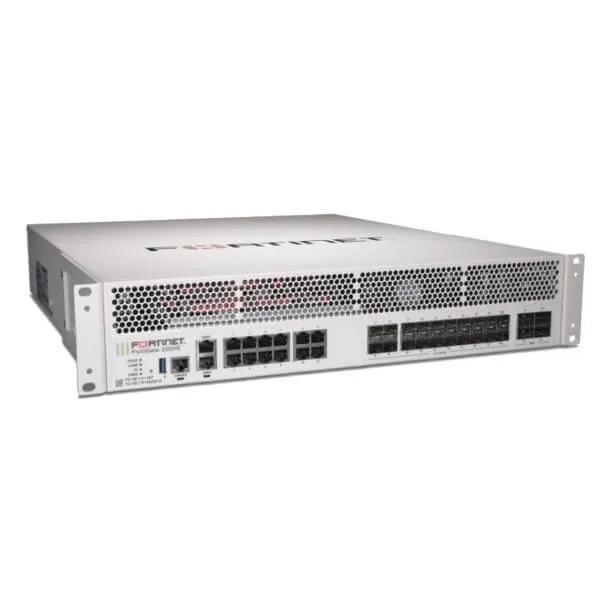
FortiGate 2200E in Uganda
A high-capacity 2RU next-generation firewall for data-center edges, internal segmentation, secure WAN and hybrid enterprise networks.
The 2200E combines FortiOS with purpose-built Fortinet security processors and a dense mix of 1, 10, 25 and 40 Gigabit Ethernet interfaces. For Uganda buyers, the key selection task is not simply choosing the chassis: it is matching inspected throughput, port optics, VPN scale, FortiGuard subscriptions, high-availability design and future network growth to the actual project.
What the FortiGate 2200E is designed to do
The FortiGate 2200E is an enterprise security appliance built for network positions where large traffic volumes, high session counts and dense high-speed connectivity meet. It is appropriate for organizations that need a next-generation firewall at the data-center edge, between important internal zones, at a high-capacity WAN boundary or as part of a broader Fortinet Security Fabric deployment. Rather than treating routing, segmentation and threat inspection as separate appliances, FortiOS brings those functions into one operating environment, while Fortinet’s purpose-built processors accelerate packet forwarding and security inspection.
Official specifications show why the model belongs in large environments. Firewall throughput is rated up to 158 Gbps for large packets, IPS throughput up to 21.8 Gbps, NGFW throughput up to 13.5 Gbps and threat-protection throughput up to 11 Gbps. It also supports very large concurrent-session and VPN figures. Those numbers should be interpreted as design limits under Fortinet test conditions, not guaranteed application performance. Production results depend on packet size, enabled profiles, encryption, logging, SSL inspection, traffic composition and architecture.
Connectivity is equally important. The chassis includes twelve hardware-accelerated GE RJ45 ports, eighteen hardware-accelerated 25GE SFP28/10GE SFP+/GE SFP slots, two equivalent HA slots, four 40GE QSFP+ slots, two GE management ports, USB and console. This mixture gives network architects room to connect legacy copper segments while also building high-speed aggregation, uplinks, redundant paths and segmentation boundaries.
The main buying question is therefore whether your expected inspected traffic, interface plan and subscription set align with the 2200E. FourTeck can assist Uganda customers by reviewing these requirements before quotation, especially where a project includes high availability, a specific FortiGuard bundle, new transceivers, migration from another firewall or multi-site integration.
Why organizations select this class of firewall
High security throughput for busy enterprise links
The appliance is designed to sustain substantial traffic while applying advanced inspection. Its published IPS, NGFW and threat-protection figures give architects separate reference points for different security profiles. That distinction helps prevent undersizing when a network moves from basic stateful inspection to deeper controls.
Dense 25GbE and 40GbE connectivity simplifies core designs
A broad mix of accelerated fiber and copper interfaces allows the firewall to sit directly between high-speed network zones without forcing every link through an external media-conversion layer. This is valuable for data-center segmentation, redundant uplinks and environments transitioning from 10GbE to 25GbE or 40GbE.
Large session and VPN capacity supports scale
Fortinet lists up to 24 million concurrent TCP sessions, 500,000 new TCP sessions per second and high IPsec VPN scale. These capacities make the platform suitable for networks with many clients, servers, applications, remote locations or service-provider connections, provided the complete solution is sized around actual traffic and security policy complexity.
Hardware acceleration protects user experience
The 2200E uses Fortinet NP6 network processors and CP9 content processors. Network processing offloads forwarding, VPN and related packet work, while content processors accelerate resource-intensive inspection functions such as SSL decryption and pattern matching. This architecture is intended to reduce the performance penalty associated with advanced security tasks.
FortiOS unifies networking and security policy
A common operating system lets teams administer firewall rules, segmentation, VPN, SD-WAN functions, application control and security services in one platform. This can simplify operational workflows compared with managing several independent appliances, particularly when integrated with FortiManager or other Fortinet Security Fabric components.
High-availability options support resilient design
The appliance supports active-active, active-passive and clustering configurations, and has dual hot-swappable AC power supplies for 1+1 redundancy. Resilience still depends on a complete design that includes dual power paths, switches, carriers and cabling, so HA should be planned as a system rather than as a firewall-only feature.
A firewall built around the combination of inspected performance, interface density and centralized policy control
What distinguishes this model is not a single headline number. Its value comes from the ability to combine very high packet-processing capacity with security inspection, encrypted traffic handling and a front panel suited to data-center switching speeds. Fortinet’s architecture uses dedicated security processors, while FortiOS provides a consistent policy framework for firewalling, segmentation, VPN and security services.
FortiGate 2200E specification ledger
| Specification | FortiGate 2200E |
|---|---|
| Firewall throughput | Up to 158 / 155 / 100 Gbps for 1518 / 512 / 64-byte UDP |
| IPS throughput | Up to 21.8 Gbps |
| NGFW throughput | Up to 13.5 Gbps |
| Threat protection throughput | Up to 11 Gbps |
| SSL inspection throughput | Up to 17 Gbps; 2.5 million concurrent SSL inspection sessions |
| IPsec VPN throughput | Up to 98 Gbps (512-byte test, AES256-SHA256) |
| Concurrent TCP sessions | Up to 24 million |
| New TCP sessions per second | Up to 500,000 |
| Firewall policies | Up to 100,000 |
| GE RJ45 data ports | 12 hardware-accelerated ports |
| 25GE / 10GE / GE fiber slots | 18 hardware-accelerated SFP28/SFP+/SFP slots plus 2 HA slots |
| 40GE slots | 4 hardware-accelerated QSFP+ slots |
| Management / console | 2 GE RJ45 management ports, 1 console, 1 USB |
| Onboard storage | None on 2200E; 2201E is the storage variant |
| Included transceivers | 2 × SFP+ SR 10GE |
| High availability | Active-active, active-passive, clustering |
| Form factor | 2RU rack mount, 443 × 556 × 88.9 mm |
| Power | 100–240V AC, 50/60 Hz; dual hot-swappable AC PSU for 1+1 redundancy |
| Power consumption | Approx. 408 W average / 571 W maximum |
| Operating temperature | 0°C to 40°C |
The specification that most often changes the buying decision is inspected throughput. A 20 Gbps internet circuit does not automatically mean a firewall rated above 20 Gbps is sufficient, because security services can reduce the sustainable rate. Engineers should estimate peak bidirectional traffic, encrypted-session ratio, expected growth, VPN load and east-west traffic that will cross segmentation boundaries. Port planning is the second major issue. The 2200E has many 25GbE-capable slots, but Fortinet documentation notes grouped interface-speed behavior for certain SFP28 interfaces, so the intended link speeds should be mapped before optics are ordered. The third issue is service licensing. IPS, malware protection, URL/DNS controls, advanced threat services and cloud functions depend on the selected FortiGuard/FortiCare package and FortiOS support status. A quote should therefore identify the exact bundle term instead of treating the hardware chassis as the complete security solution.
Five questions to answer before requesting a quote
- Workload and inspection: What peak traffic will cross the firewall, and which controls must be enabled? IPS, application control, malware scanning and SSL inspection each change the practical capacity requirement. State whether traffic is primarily internet-bound, data-center east-west, VPN, cloud or a mixture.
- Scale: How many users, devices, sites, tunnels and concurrent sessions are expected? A branch consolidation project has different sizing risks from a data-center segmentation project, even if both use the same aggregate WAN bandwidth.
- Compatibility: Which switches, routers, carriers and transceivers will connect to the firewall? Specify copper versus fiber, 1/10/25/40GbE speeds, connector types, single-mode or multimode requirements and any existing optics that you expect to reuse.
- Growth and subscriptions: Which FortiGuard services are required, for what term, and how much traffic growth should be reserved? The right appliance is one that supports today’s security policy while leaving practical headroom for tomorrow’s applications and sites.
- Deployment and support: Will the firewall run as a single device or an HA pair? Confirm rack space, power feeds, airflow, logging platform, migration requirements, delivery destination, support expectations and the people responsible for implementation.
Where the 2200E can make operational sense
Enterprise data-center edge
A large organization connecting server networks to internet, cloud and partner networks may need substantial stateful throughput plus deeper inspection. The 40GbE and 25GbE interfaces support high-speed upstream and internal links, while FortiOS can enforce application, IPS, VPN and segmentation policies. The design should account for encrypted traffic and failover capacity, especially if an HA pair must sustain the full production load during maintenance or failure.
Internal segmentation firewall
Organizations separating server tiers, departments, regulated systems or operational technology can place a high-throughput firewall between trusted zones rather than relying only on VLAN boundaries. The platform’s session scale and high-speed fiber ports are useful when east-west traffic is heavy. For this role, policy complexity, application visibility, latency sensitivity and link design can matter more than internet-circuit speed.
Secure WAN and multi-site aggregation
A head office or data center terminating many IPsec tunnels can use the appliance as a high-capacity secure WAN hub. Fortinet publishes up to 98 Gbps IPsec throughput and large gateway-to-gateway tunnel capacity. Actual architecture should consider routing, SD-WAN policy, carrier diversity, tunnel encryption settings, logging and the traffic that remains after one HA member or carrier path is unavailable.
Service-provider or large institutional perimeter
Environments with very large numbers of connections, many security policies and high packet rates can benefit from purpose-built processing and a dense interface layout. The model’s 24-million-session capacity and 150 Mpps firewall packet-processing figure illustrate the scale it targets. Deployment teams should still test application behavior and ensure management, monitoring and incident-response processes can handle the same scale.
Hardware acceleration changes how security performance is delivered
The FortiGate 2200E uses four NP6 network processors in its fast-path architecture, with the front-panel data interfaces connected through an integrated switch fabric. Fortinet’s documentation explains that supported traffic between data interfaces can be offloaded by the NP6 processors rather than forcing every packet through a general-purpose CPU path. This matters in high-capacity deployments because firewalling, VPN encapsulation, traffic shaping and other packet operations can otherwise compete heavily for CPU resources.
The appliance also uses CP9 content processors. These co-processors accelerate resource-intensive security functions such as SSL/TLS decryption, pattern matching, IPS pre-scan and antivirus processing. For a buyer, the practical outcome is not that every workload will automatically reach the maximum published figure; it is that the platform has dedicated hardware designed to sustain more inspection with lower processing overhead than an architecture dependent entirely on general CPU execution.
This is especially relevant as more traffic becomes encrypted. SSL inspection can reveal malicious activity hidden in HTTPS, but decryption and re-encryption are computationally expensive. The 2200E’s published SSL inspection throughput of up to 17 Gbps is therefore a more useful sizing reference for heavily encrypted environments than the 158 Gbps stateful firewall headline. Procurement teams should ask application owners which encrypted services can be inspected, confirm certificate and privacy policies, and model the proportion of traffic that will actually traverse deep inspection.
High-speed connectivity for segmentation and aggregation
The front-panel mix is one of the 2200E’s most product-specific advantages. It combines twelve GE copper data ports with eighteen 25GE SFP28/10GE SFP+/GE SFP slots, two additional high-speed HA slots and four 40GE QSFP+ interfaces. This allows architects to build a firewall boundary into a high-speed switching design without reducing every connection to a single interface type.
25GbE density
Useful for modern server, leaf-spine and aggregation environments where 10GbE no longer offers enough headroom.
40GbE uplinks
Provide high-capacity paths for core switching, inter-zone traffic or consolidated upstream connectivity.
GE copper retained
Allows management, legacy network segments and lower-speed connections to coexist with the fiber fabric.
One important design detail is interface grouping. Fortinet documentation notes that changing certain SFP28 interface speeds can affect other interfaces in the same group. For projects mixing 1, 10 and 25GbE links, the port map should therefore be finalized before transceivers and cabling are purchased. This is exactly the kind of detail that a pre-quote configuration review can catch.
Security services and license selection are part of the appliance design
The physical firewall provides the FortiOS platform and hardware acceleration, but many advanced protection capabilities depend on FortiGuard and FortiCare subscriptions. Fortinet offers multiple service bundles and a-la-carte options that can include IPS, anti-malware, URL and DNS filtering, inline malware prevention, data-loss prevention, attack-surface services, OT security and cloud-management functions. The exact combination depends on the current Fortinet portfolio and selected term.
For procurement teams, this means two quotes for the same chassis can represent materially different security outcomes. A hardware-only price should not be compared directly with a one-year or multi-year security bundle. Likewise, renewal obligations should be planned as part of lifecycle cost rather than treated as an unexpected later expense.
Buyer decision checklist
- Identify which FortiGuard security services are mandatory for policy and compliance.
- Choose the required support level and subscription term.
- Confirm whether centralized management, cloud logging or FortiAnalyzer integration is part of the project.
- Check FortiOS support and lifecycle requirements for the intended deployment period.
- Include required optics, rack infrastructure and HA quantities in the same bill of materials.
What buyers should check before purchase
Buyers should also confirm lifecycle expectations. The 2200E is an established E-series model and some resellers identify it as an end-of-life product, while Fortinet still publishes current documentation for the series. Before a new long-term deployment, confirm current Fortinet ordering, support and software lifecycle status for the exact SKU and compare it with current-generation replacement paths. FourTeck can help align the requested model with the project’s support horizon rather than assuming that physical availability alone makes a platform the right choice.
Planning a FortiGate 2200E deployment in Uganda
Availability can vary by appliance SKU, subscription bundle, contract term and product lifecycle. FourTeck can prepare a project quote after reviewing the required configuration rather than assuming one universal package fits every buyer. For Kampala deployments, the review can include firewall quantity, FortiGuard and FortiCare terms, transceiver requirements, high-availability architecture, rack and power considerations, migration scope and delivery coordination.
Warranty and support should be tied to the exact Fortinet service selected on the quote. If your organization has a policy requiring a particular support response level, renewal period or software-maintenance horizon, include that requirement at the start. Projects involving multiple appliances, staged deployment or a future migration path should also state expected quantities and timing so the bill of materials can be planned consistently.
Coverage within Uganda
FourTeck can assist business and institutional buyers planning Fortinet projects in Kampala as well as deployments requiring delivery coordination to Entebbe, Jinja, Mbarara and Gulu. The practical focus is on configuration accuracy, project quantity, destination planning and the commercial terms shown on the final quote. For remote or multi-site rollouts, provide the site list and required appliance counts so that the proposal can distinguish central-firewall requirements from branch or secondary-site needs.
East Africa and regional procurement
Organizations with networks spanning Uganda and Kenya, or broader selected East Africa markets, may need consistent firewall policy, license terms and hardware standards across several countries. FourTeck can support regional quote planning where appropriate, including coordination through the Uganda, Kenya and Africa FourTeck sites. For buyers with procurement links to the UAE or Kuwait, regional FourTeck channels can also be relevant depending on project structure. Local stock, delivery time, branch presence and warranty handling should not be assumed; these items must be confirmed for the specific order and destination.
Useful regional links include FourTeck Uganda, FourTeck Kenya, FourTeck Africa, FourTeck UAE and FourTeck Kuwait.
Related Fortinet paths to consider
Practical support around the purchase decision
01 — Product selection guidance. FourTeck can help compare the requested firewall against the traffic, inspection, port and lifecycle requirements of the project before a quote is finalized.
02 — Configuration review. The team can structure a bill of materials that considers the appliance, FortiGuard/FortiCare terms, transceivers, HA quantities and related deployment items instead of treating the firewall as an isolated box.
03 — Quote assistance. Business, education, government and enterprise buyers can provide project requirements and receive a commercial quotation based on the selected configuration and current availability.
04 — Uganda delivery coordination. Delivery planning can be discussed for the named destination and project quantity without assuming a universal lead time or stock position.
05 — Warranty and support guidance. Buyers can align their required support level with the specific Fortinet service and term included in the quote.
06 — Alternative product matching. If lifecycle, capacity or availability makes the 2200E unsuitable, a current FortiGate alternative can be reviewed against the same project requirements.
FortiGate 2200E buyer questions
01. What is the FortiGate 2200E mainly used for?
It is an enterprise next-generation firewall intended for high-capacity environments such as data-center edges, internal segmentation, secure WAN aggregation and large institutional or service-provider networks. Its dense 25GbE and 40GbE connectivity, large session capacity and dedicated security processors make it more appropriate for demanding network boundaries than for small branch deployments.
02. How much threat-protection performance does it provide?
Fortinet publishes up to 11 Gbps threat-protection throughput for the series with firewall, IPS, application control and malware protection enabled under its test methodology. It also lists up to 13.5 Gbps NGFW and 21.8 Gbps IPS throughput. Real-world throughput is configuration dependent, so sizing should use the security services and traffic mix expected in production.
03. Does the 2200E support 25GbE and 40GbE?
Yes. The chassis provides eighteen hardware-accelerated 25GE SFP28/10GE SFP+/GE SFP slots, two additional high-speed HA slots and four hardware-accelerated 40GE QSFP+ slots. Buyers should confirm transceiver type, fiber specification, distance and interface grouping before ordering optics, especially when mixing different link speeds.
04. Can it be deployed as a high-availability pair?
Yes. Fortinet lists active-active, active-passive and clustering options, and the appliance has dual hot-swappable AC power supplies for 1+1 redundancy. A resilient design should also include upstream switch, carrier and power-path redundancy. For quote preparation, specify whether both HA units need identical licenses, optics and support terms.
05. Does it require FortiGuard subscriptions?
The appliance can run FortiOS firewall and networking functions, but many advanced security services are delivered through FortiGuard and FortiCare offerings. The exact bundle determines capabilities such as IPS updates, anti-malware, web/DNS controls, advanced threat services and support. Confirm the required bundle and term on the quotation rather than assuming all services are included with the hardware.
06. What information is needed for a Uganda quote?
Provide current and expected WAN or inter-zone bandwidth, security services to be enabled, encrypted-traffic ratio, number of sites and VPNs, required port speeds, switch models, optics requirements, HA preference, subscription term, project quantity and delivery destination. These details allow FourTeck to prepare a configuration-oriented quote rather than a generic chassis price.
07. Is the FortiGate 2200E still suitable for a new long-term project?
That should be checked against current Fortinet lifecycle and ordering information. The 2200E remains documented by Fortinet, but it is an established E-series platform and some channels classify it as end-of-life. A new deployment should compare current support horizon, software requirements and availability with newer FortiGate alternatives before committing to a multi-year architecture.
08. What is the difference between 2200E and 2201E?
The principal published hardware difference is onboard storage. The FortiGate 2200E lists no onboard storage, while the 2201E lists two 1 TB SSDs. Core interface and performance figures are otherwise shown together in the same series datasheet. Choose the exact model according to logging and local-storage requirements as well as availability and support considerations.
09. Can FourTeck help select a newer FortiGate alternative?
Yes. If the 2200E is not the best match because of lifecycle, capacity, support period or current availability, FourTeck can review the same bandwidth, inspection, interface and HA requirements against other FortiGate models. The objective is to preserve the technical requirements of the project rather than simply substitute the nearest model number.
Build the firewall quote around your actual traffic and security policy
Send FourTeck your bandwidth, inspection requirements, interface speeds, VPN scale, HA plan, subscription term and Uganda delivery location. The team can review the requested FortiGate 2200E configuration, identify missing optics or services, and prepare a project quotation based on current options.
- Peak and expected bandwidth
- Required FortiGuard services
- 10/25/40GbE port and optics plan
- Single appliance or HA pair
- License term, quantity and destination

Reviews
There are no reviews yet.