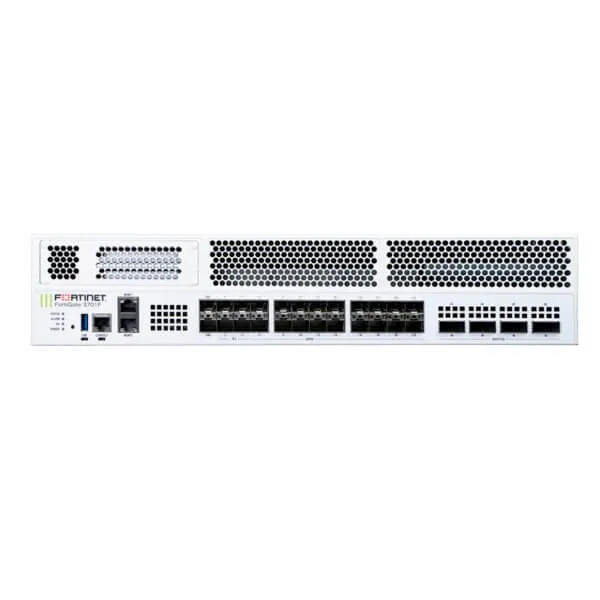
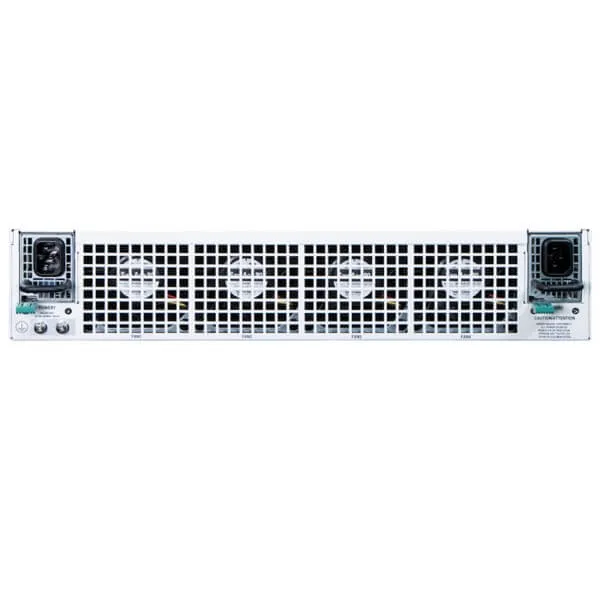
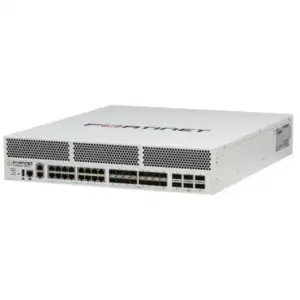
FortiGate 3700F in Uganda
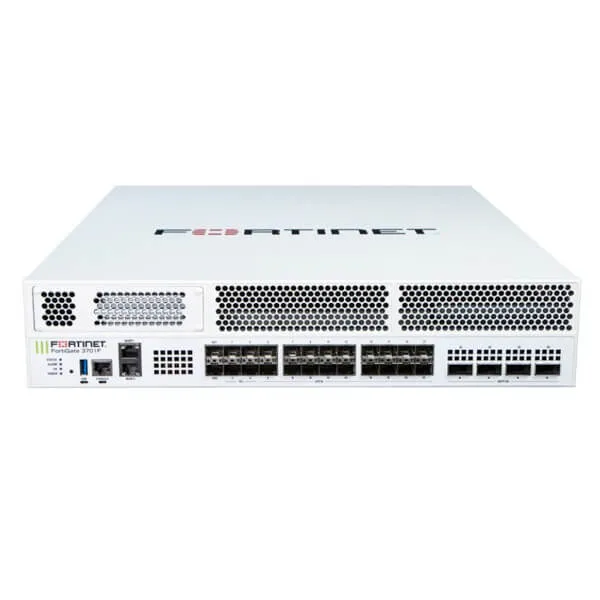
A 2RU next-generation firewall built for very high-throughput data center, hybrid-cloud and large enterprise security.
Fortinet positions the 3700F Series for security-driven networking where organizations need to inspect large traffic volumes without turning the security layer into a network bottleneck. The platform combines FortiOS, dedicated NP7 and CP9 security processors, high-density multi-speed interfaces and support for advanced FortiGuard services. FourTeck can help Uganda buyers map expected traffic, encrypted-session load, optics, high-availability requirements, subscriptions and support choices into a practical bill of materials before a quote is prepared.
High-capacity security for networks that cannot tolerate a weak inspection point
The FortiGate 3700F is designed for organizations that have moved beyond conventional enterprise firewall scale. It belongs in environments where east-west data center traffic, north-south internet flows, private cloud links, large VPN populations or multi-cloud connections create sustained throughput requirements that would overwhelm smaller appliances. Fortinet lists the model among its high-end data center firewalls and publishes up to 75 Gbps threat protection throughput, which places it firmly in infrastructure where security controls and network capacity must be planned together.
Its business role is broader than packet filtering. FortiOS brings firewall policy, intrusion prevention, application control, VPN, segmentation, Secure SD-WAN and zero-trust network access capabilities into one operating platform. Organizations can therefore use the appliance as a policy enforcement point between data center zones, internet edges, high-capacity campuses, carrier-facing networks or hybrid cloud connections. The value comes from combining network forwarding and security inspection under one operational framework rather than inserting a separate security appliance for every control.
Hardware acceleration is central to the design. Fortinet documents NP7 network processors for high-speed packet handling and CP9 content processors for resource-intensive inspection tasks such as SSL decryption, application identification, IPS pre-processing and antivirus processing. For buyers, this architecture matters because the amount of encrypted traffic being inspected can be just as important as raw firewall throughput. A specification exercise should therefore distinguish between simple forwarding, IPsec VPN traffic, SSL inspection, intrusion prevention and full threat-protection workloads.
The interface set is also unusually flexible. Four 400 GE-capable QSFP-DD ports can operate at multiple high speeds, while additional SFP56 and SFP28 ports cover 50 GE, 25 GE and 10 GE designs. Four ultra-low-latency SFP28 ports are provided for applications where minimizing packet-processing delay is important. This mix makes the platform relevant to modern spine-and-leaf data center fabrics, high-speed aggregation points and networks undergoing a staged migration from 10 or 25 Gigabit Ethernet toward 100, 200 or 400 Gigabit Ethernet.
Selection still requires care. The FG-3700F itself does not include onboard SSD storage; the closely related FG-3701F includes two 1.92 TB SSDs. Transceiver choice, fiber type, breakout design, power capacity, rack depth, airflow, licensing and support must all be checked before purchase. FourTeck can help Uganda IT teams turn these variables into a quote that matches the intended deployment rather than treating the firewall as a one-line hardware purchase.
Why this platform can change the way a large network is secured
01
Inspection capacity that matches serious data center traffic
Published figures reach 86 Gbps IPS, 80 Gbps NGFW and 75 Gbps threat protection throughput. These are measured values under Fortinet-defined test conditions and should not be treated as guaranteed application throughput, but they give architects a meaningful basis for sizing a security layer that must inspect substantial volumes of traffic.
02
High-speed connectivity without a forced one-speed design
The port set spans multiple Ethernet rates, including 400, 200, 100, 50, 40, 25, 10 and 1 GE depending on interface type and configuration. This helps infrastructure teams integrate the firewall into current switching while leaving room for faster uplinks as network demand grows.
03
Hardware acceleration for security-heavy workloads
NP7 and CP9 processors offload network and content-security tasks that would otherwise compete for general-purpose CPU resources. The practical benefit is architectural headroom for encryption, inspection, VPN, VXLAN and session handling in environments where security controls must remain responsive under sustained load.
04
Segmentation with security enforcement closer to critical assets
Fortinet supports dynamic segmentation and VXLAN-related use cases on the platform. For large enterprises this can make the firewall part of an east-west security design, reducing dependence on a single internet-edge policy and creating stronger control around sensitive systems, application tiers and administrative zones.
05
Large-scale VPN and remote connectivity capacity
Fortinet specifies up to 160 Gbps IPsec VPN throughput, 40,000 gateway-to-gateway tunnels and a recommended maximum of 30,000 concurrent SSL-VPN tunnel-mode users. Actual designs still need realistic cryptography, authentication and policy assumptions, but the platform is engineered for substantial secure-connectivity demands.
06
Resilient deployment choices
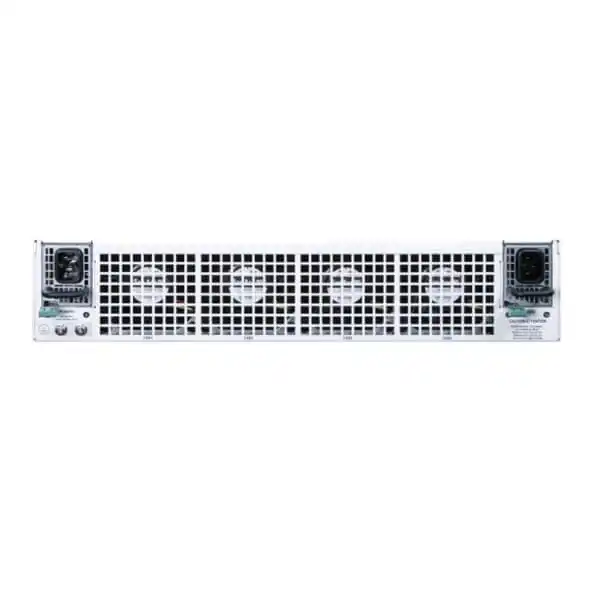
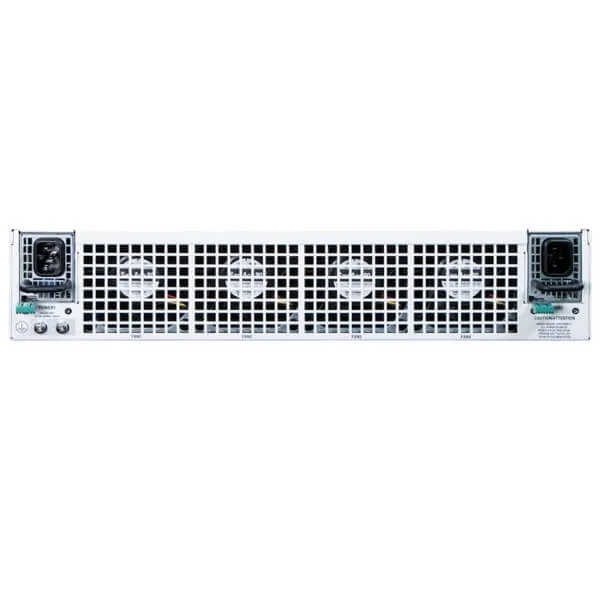
Active-active, active-passive and clustering options are supported, and the appliance ships with dual hot-swappable AC power supplies for 1+1 redundancy. This allows infrastructure teams to design around component or node failure instead of treating the firewall as a single point of failure.
The defining characteristic is not one headline speed; it is the combination of inspection, interfaces and operational scale.
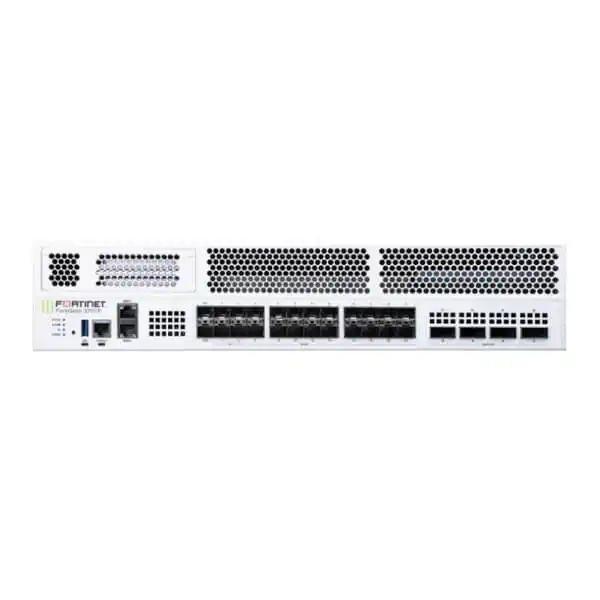
A high-end firewall becomes useful when its packet processing, security inspection and physical connectivity are balanced. Here, Fortinet combines dedicated security processors with four 400 GE-capable ports, eighteen multi-rate SFP56 data ports, four ultra-low-latency SFP28 ports, two HA ports and separate management interfaces. That gives network architects enough physical flexibility to design routed edges, data center segmentation, aggregation or high-capacity interconnects without immediately requiring external media conversion.
Capability: Up to 140 million concurrent TCP sessions. What it enables: very large connection tables for dense application and user environments. Configuration note: real capacity depends on enabled features and traffic profile.
Capability: Up to 55 Gbps SSL inspection throughput under Fortinet’s stated test basis. What it enables: security visibility into substantial encrypted traffic. Configuration note: cipher suites, session sizes and policies materially affect results.
Capability: Four ultra-low-latency ports with published firewall latency as low as 1.45 microseconds on those ports. What it enables: security enforcement where latency is operationally sensitive. Configuration note: traffic must enter and exit through the designated ULL interfaces to realize that data path.
FortiGate 3700F technical specifications
| Specification | Published value / guidance |
|---|---|
| Model SKU | FG-3700F |
| Product class | High-end next-generation firewall for data center and large-scale enterprise use |
| IPS throughput | Up to 86 Gbps |
| NGFW throughput | Up to 80 Gbps |
| Threat protection throughput | Up to 75 Gbps |
| IPv4 firewall throughput | Up to 589 / 589 / 420 Gbps for 1518 / 512 / 64-byte UDP packets |
| Firewall packet rate | Up to 630 Mpps |
| Concurrent TCP sessions | Up to 140 million |
| New TCP sessions per second | Up to 930,000 |
| IPsec VPN throughput | Up to 160 Gbps, 512-byte AES256-SHA256 test basis |
| SSL inspection throughput | Up to 55 Gbps, IPS average HTTPS test basis |
| 400/200/100/40 GE ports | 4 × hardware-accelerated QSFP-DD/QSFP56/QSFP28/QSFP+ ports |
| 50/25/10/1 GE data ports | 18 × hardware-accelerated SFP56/SFP28/SFP+/SFP ports |
| Ultra-low-latency ports | 4 × 25/10/1 GE SFP28/SFP+/SFP ULL ports |
| HA ports | 2 × 50/25/10/1 GE multi-rate HA1/HA2 ports |
| Management ports | 2 × 10GE/GE RJ45 |
| Included transceivers | 2 × SFP+ SR 10 GE |
| Onboard storage | None on FG-3700F; FG-3701F includes 2 × 1.92 TB SSD |
| High availability | Active-active, active-passive and clustering |
| Form factor | 2RU rack mount |
| Dimensions | 88.9 × 443 × 607.1 mm |
| Weight | 21.4 kg |
| AC power | 100–240 VAC, 50/60 Hz; dual hot-swappable AC PSUs for 1+1 redundancy |
| Power consumption | 590 W average / 1140 W maximum for FG-3700F |
| Operating temperature | 0°C to 40°C |
| Security services | FortiGuard services and bundles based on selected subscription |
The most important numbers are not necessarily the largest ones. Raw firewall throughput reflects packet forwarding and is useful for understanding the forwarding ceiling, but most buyers deploy a firewall because they intend to inspect traffic. IPS, NGFW, threat protection and SSL inspection values therefore deserve more attention during sizing. If the organization expects extensive TLS decryption, the encrypted traffic mix, certificate policy and application behavior can become the decisive inputs.
Port choice is equally important. A 400 GE-capable interface does not mean every deployment needs 400 GE optics. The multi-rate nature of the ports lets designers select media and speeds that suit the present fabric. However, transceiver compatibility, breakout support, fiber type and the design of upstream switches must be documented. In a high-availability pair, duplicate optics and cabling are normally part of the project plan. Power and cooling should also be checked against the published 1140 W maximum consumption and front-to-back airflow requirement.
Five questions to answer before the bill of materials is finalized
01 — What traffic must be inspected?
Start with the real workload rather than the internet circuit label. Document average and peak north-south traffic, expected east-west segmentation flows, encrypted traffic percentage, IPS policy coverage, application control, malware inspection and VPN requirements. A design with 30 Gbps of plain routed traffic is very different from one with 30 Gbps of TLS traffic undergoing deep inspection. This answer determines whether the appliance has sufficient security headroom and whether a smaller or larger FortiGate class should be evaluated.
02 — How many connections, tunnels and users are expected?
Large environments can exhaust session capacity or session setup rate before they exhaust bandwidth. Application architectures with microservices, proxies, large web farms, carrier-scale NAT or many remote users can generate unusually high connection counts. Share concurrent session estimates, peak new connections per second, site-to-site VPN counts and remote-access requirements. These figures help validate whether the published capacities match the operational profile.
03 — How will the firewall connect to the existing network?
List upstream and downstream switch models, interface speeds, media types, fiber standards and redundancy topology. The 3700F offers a wide variety of port speeds, but the correct optics still have to be selected. Confirm whether the design uses native 400 GE, 100 GE, 50 GE, 25 GE or 10 GE links, whether breakout cables are needed and whether any ULL interfaces will be reserved for latency-sensitive paths.
04 — Which services and management functions are required?
Hardware is only one part of a modern NGFW deployment. FortiGuard bundles can include services such as IPS, anti-malware, web and DNS filtering, advanced threat capabilities and other protections depending on the bundle. FortiCare support levels and FortiManager or FortiAnalyzer options may also be part of the project. Specify the desired security controls, subscription term, centralized-management approach and log-retention expectations so the quote is complete rather than hardware-only.
05 — What are the resilience, rack, power and delivery expectations?
Confirm whether the firewall will be deployed as a single appliance or HA pair, which rack and power feeds are available, whether the site can support front-to-back airflow and whether spare optics or power components are required. The device is 2RU and about 607 mm deep, so rack depth and cable management should be checked. Uganda project timing and quantities should also be shared early because availability varies by exact SKU, subscription and accessory mix.
Where the platform earns its place
Large enterprise data center edge
A financial institution, telecom, government platform, university backbone or large commercial enterprise may have multiple high-speed internet or private WAN connections terminating at a data center. In this scenario the firewall must enforce application-aware policy while sustaining substantial throughput. The 3700F fits when the traffic scale, connection count and interface speeds justify a high-end appliance. The design should still validate SSL inspection load and duplicate interfaces for an HA pair.
Hybrid cloud interconnect security
Organizations moving workloads between private infrastructure and cloud platforms often need a security control point for high-capacity interconnects. The multi-speed high-bandwidth interfaces can suit this role, while FortiOS provides consistent policy capabilities across network environments. The project should document whether traffic arrives through internet VPN, private cloud connectivity, carrier Ethernet or another transport because those choices affect ports, encryption and routing design.
Data center segmentation
A large environment may use the appliance internally to separate production, development, database, user, management or regulated zones. This creates significant east-west traffic that conventional perimeter-only sizing can miss. Fortinet’s VXLAN and segmentation capabilities can support this architectural direction. The buyer should estimate internal flows and failure-domain requirements rather than sizing only from internet bandwidth.
High-scale VPN aggregation
Enterprises with many branches, business partners, cloud networks or remote users may need a central IPsec and SSL-VPN termination platform. Published VPN capacities make the platform relevant to these deployments, while the high session scale provides additional headroom. Authentication systems, cryptographic standards, tunnel topology and remote-access policy must be included in the design because they influence performance and operations.
NP7 and CP9 acceleration: why architecture matters more than a headline throughput number
Fortinet uses dedicated security processing units to divide work that would otherwise accumulate on a general-purpose processor. In the 3700F Series, NP7 network processors handle high-speed network functions and accelerated session processing, while CP9 content processors offload security inspection work. Fortinet’s hardware acceleration documentation describes NP7 support for high-performance VPN, VXLAN termination, accelerated session setup and ultra-low latency. CP9 is used to accelerate tasks such as SSL decryption, pattern matching, IPS pre-processing and antivirus operations.
The buyer benefit is not that every packet bypasses software logic. It is that common and computationally intensive functions can be handled in purpose-built silicon while FortiOS coordinates policy and security features. This is especially relevant in data centers where large connection volumes and encrypted traffic can create a performance penalty on firewalls that depend heavily on general-purpose CPU resources. The architecture helps maintain security inspection as traffic grows, but sizing should still be based on the specific mix of enabled controls.
The ultra-low-latency path is another example of architecture affecting deployment choices. Fortinet documents that front-panel interfaces 1 to 4 connect directly to one NP7 rather than traversing the integrated switch fabric. Traffic entering and exiting through these ULL ports can therefore achieve lower latency than traffic that takes the broader switching path. This is valuable for latency-sensitive applications, but it only matters if the cabling plan intentionally uses those interfaces for the relevant path.
Interface density for data center transitions
The physical interface design supports more than one generation of network speed, which is useful when a data center is modernizing in phases. Four QSFP-DD-class ports can support 400 GE and lower high-speed modes, while SFP56 and SFP28 interfaces cover common 50 GE, 25 GE and 10 GE designs. This means the appliance can sit between current and next-generation switching without forcing every connected system to move to the same speed on day one. It also gives architects options for separating external, internal, HA and low-latency paths.
Four 400 GE-capable ports: suited to very high-capacity uplinks and modern data center fabrics when supported by the connected switches and optics.
Eighteen multi-rate SFP56 data ports: useful for a mix of 50, 25, 10 and 1 GE connectivity based on compatible modules and network design.
Four ULL SFP28 ports: provide a dedicated lower-latency path for applications where delay sensitivity justifies intentional port placement.
The procurement implication is straightforward: the firewall cannot be ordered responsibly without an interface schedule. Each logical link should have a defined speed, connector, fiber type, transceiver and redundant mate. For HA deployments, quantities often double. The two included 10 GE short-range SFP+ transceivers are useful but will not cover a complex high-speed design. FourTeck can review the port map before quotation so missing optics do not delay installation.
Licensing, FortiGuard services and centralized operations
The appliance becomes a complete security platform through the combination of FortiOS, FortiGuard services and operational tools selected for the project. Fortinet offers security bundles and individual services covering areas such as intrusion prevention, anti-malware, application control, web and DNS security, zero-day protection, data protection and specialized OT capabilities. The exact feature set depends on the chosen bundle and FortiOS release, so the subscription line items are a design decision rather than an administrative afterthought.
For larger estates, FortiManager can provide centralized configuration, policy and device management. FortiAnalyzer options can support logging and analytics requirements. These tools are particularly relevant when the 3700F is one component within a wider Fortinet environment because consistent policy, change control and visibility become more important as device count grows. Buyers should decide whether management will remain local on the appliance or whether centralized operations are part of the architecture.
Buyer decision checklist
□ Which FortiGuard bundle or individual services are required for the intended policies?
□ What subscription term aligns with the project’s budget and lifecycle?
□ Is FortiCare Premium or another support level required?
□ Will FortiManager or FortiAnalyzer be used, and how many devices or log volumes must they cover?
□ Are migration services, configuration conversion or operational support part of the deployment plan?
What buyers should check before purchase
Risk: selecting the wrong 3700F-series variant
Confirm: whether local onboard storage is needed. Why it matters: FG-3700F has no onboard SSD, while FG-3701F includes two 1.92 TB SSDs. Share with FourTeck: logging architecture, retention approach and whether an external FortiAnalyzer platform will be used.
Risk: incomplete optics and cabling
Confirm: every link speed, transceiver type, fiber run and breakout requirement. Why it matters: high-speed interfaces are only useful when they match the connected switch and media. Share with FourTeck: port map, switch models, required distances and HA quantities.
Risk: underestimating encrypted inspection
Confirm: expected TLS inspection ratio, application mix and security services. Why it matters: SSL inspection has different performance characteristics from plain firewall forwarding. Share with FourTeck: peak traffic, encryption percentage and policies that must decrypt traffic.
Risk: hardware-only quotation for a subscription-dependent deployment
Confirm: required FortiGuard services, FortiCare and term. Why it matters: security capabilities and ongoing threat intelligence depend on the selected services. Share with FourTeck: required controls, support expectations and preferred renewal horizon.
Risk: overlooking rack, power and resilience details
Confirm: 2RU space, rack depth, dual AC feeds, cooling, airflow and HA topology. Why it matters: a high-end firewall is part of the data center physical design. Share with FourTeck: site power standard, rack dimensions, redundancy target and project delivery schedule.
Procurement support for Uganda projects
FourTeck can support Uganda organizations that need a correctly scoped Fortinet high-end firewall rather than a generic hardware quote. Availability varies by appliance SKU, subscription term, transceiver combination, accessory requirements and project quantity. For this class of equipment, confirming the complete bill of materials is usually more useful than discussing the chassis in isolation. FourTeck can review the required firewall model, HA quantity, optics, FortiGuard subscriptions, FortiCare support, management components and project timing before preparing a quotation.
For Kampala-based data centers or enterprise IT teams, the review can include interface planning, rack and power information, deployment quantities and required delivery coordination. Warranty and support guidance should be tied to the selected FortiCare service rather than assumed from the hardware alone. Buyers planning a phased network refresh can also ask for alternative FortiGate models where the expected inspection workload or interface requirements do not justify this platform.
One coordinated approach for Kampala and major Uganda project locations
FourTeck can coordinate quotations and project requirements for organizations in Kampala as well as buyers planning deployments in Entebbe, Jinja, Mbarara and Gulu. The appropriate process is to confirm the technical specification, quantity and delivery requirement first, because high-end firewall projects may include multiple appliances, optics, subscriptions and associated management components. Location does not change the technical suitability of the platform, but it can influence delivery coordination, installation planning and the timing of project milestones.
Regional sourcing for multi-country infrastructure programs
Organizations operating beyond Uganda may need consistent firewall standards across several sites or data centers. FourTeck can help structure requests that cover Uganda, Kenya and selected East Africa or wider Africa markets, while regional FourTeck channels can also support requirements associated with the UAE or Kuwait where relevant. Availability, commercial terms, delivery arrangements and support expectations must be confirmed for each market rather than assumed to be identical.
For multi-country programs, provide a site-by-site quantity, required subscription term, interface plan and deployment window. Standardizing the appliance is useful only when each location has comparable traffic and connectivity requirements; smaller sites may need a different FortiGate model. Regional links: FourTeck Kenya, FourTeck Africa, FourTeck UAE and FourTeck Kuwait.
Alternative paths and adjacent Fortinet choices
The right related product depends on whether the buyer needs more inspection throughput, less capacity, local storage or a different generation of Fortinet hardware. These links provide useful catalogue paths; exact models should be confirmed against the workload rather than selected by model number alone.
FortiGate data center firewalls: for buyers comparing high-end Fortinet platforms by threat-protection throughput and interfaces — browse FourTeck Uganda enterprise security solutions.
FortiGate 3500F class: suitable where the required security throughput is lower and interface requirements differ — ask FourTeck Uganda for Fortinet model comparisons.
FortiGate 3800G class: a newer high-end direction for projects requiring substantially greater published threat-protection performance — request a current-generation FortiGate comparison.
FortiManager: centralized management for larger Fortinet estates — include FortiManager sizing in your quote request.
FortiAnalyzer: logging and analytics options for security operations — discuss log retention and analysis requirements.
Procurement is easier when the technical questions are answered first
01. Product selection guidance. FourTeck can compare the requested platform with adjacent FortiGate models so the chosen appliance aligns with actual inspection throughput, connection scale and port requirements.
02. Configuration review. High-end firewalls frequently require a detailed interface and accessory schedule. Reviewing optics, HA quantities, subscriptions and management requirements reduces the risk of a quote that is technically incomplete.
03. Quote assistance. Buyers can provide their traffic, security-service and project details once, allowing the quotation to reflect a practical deployment rather than a bare chassis SKU.
04. Uganda delivery coordination. Project quantities and deployment locations can be incorporated into planning while keeping availability statements tied to the actual requested configuration.
05. Alternative product matching. If the 3700F is oversized, undersized or unavailable for the target project window, FourTeck can help identify a suitable Fortinet alternative based on the same workload criteria.
Questions enterprise buyers ask before specifying the platform
01. What is the FortiGate 3700F mainly used for?
It is a high-end next-generation firewall designed for large data centers, hybrid IT environments, large enterprise cores and other networks with very high traffic volumes. Typical uses include internet-edge security, data center segmentation, high-capacity VPN aggregation and protection of high-speed cloud or private-network interconnects. The model is most appropriate when inspection throughput, session scale and port speeds exceed the practical requirements of mid-range firewalls.
02. How much threat-protection performance does it provide?
Fortinet publishes up to 75 Gbps threat protection throughput for the 3700F Series, with up to 80 Gbps NGFW throughput and 86 Gbps IPS throughput. These figures use Fortinet-defined enterprise traffic mixes and enabled security features, so they should be treated as sizing references rather than guaranteed application speeds. Real performance varies with configuration, traffic profile, encryption, policy complexity and software version.
03. Does the FG-3700F include onboard SSD storage?
No. Fortinet’s current specification table shows no onboard storage for the FG-3700F. The related FG-3701F includes two 1.92 TB SSDs. Buyers who need local log storage should evaluate the 3701F or plan an external logging architecture such as FortiAnalyzer, depending on retention and operational requirements. This is one of the most important model differences to confirm before ordering.
04. Which high-speed interfaces are available?
The appliance provides four 400 GE-capable QSFP-DD-class ports, eighteen multi-rate SFP56 data ports, four SFP28 ultra-low-latency ports, two dedicated multi-rate HA ports and two 10GE/GE RJ45 management ports. The exact operating speeds depend on the interface and compatible module. A port-by-port optics and cabling schedule should be prepared before quotation, especially for HA pairs and breakout designs.
05. Can it be deployed in high availability?
Yes. Fortinet lists active-active, active-passive and clustering as supported high-availability configurations. The hardware also includes dual hot-swappable AC power supplies for 1+1 power redundancy. A production HA design normally requires two appliances plus duplicated network links, optics and power feeds. Buyers should also plan session synchronization, failover testing and upstream/downstream network behavior rather than treating HA as a hardware-only purchase.
06. Are FortiGuard subscriptions required?
The hardware can perform core FortiOS networking and firewall functions, but many advanced security services depend on selected FortiGuard subscriptions. Available bundles can cover intrusion prevention, anti-malware, web and DNS security, application protection, advanced threat services and other functions. The exact package should be selected according to the policies the organization intends to enforce and the desired subscription term.
07. What should we send FourTeck for an accurate Uganda quote?
Provide the required quantity, whether an HA pair is planned, peak traffic, estimated encrypted-traffic percentage, desired security services, VPN scale, port speeds, optics requirements, subscription term, management/logging preference and delivery location. If you already have switch models or a network diagram, include them. This information helps FourTeck build a more complete bill of materials and identify missing transceivers, subscriptions or adjacent components.
08. Is the FortiGate 3700F available in Kampala?
Availability depends on the exact appliance, service bundle, accessories and project quantity. FourTeck can review the requested configuration and provide a current quotation for Kampala and Uganda projects without assuming stock status in advance. High-end firewall purchases often include optics and multi-year security subscriptions, so it is best to confirm the complete configuration before planning a deployment date.
09. When should a different FortiGate model be considered?
A different model may be more suitable when the required inspection throughput, session count or port density is materially lower or higher, when onboard storage is needed, or when the project prefers a newer hardware generation. The correct alternative should be chosen from measured requirements rather than model-number progression alone. FourTeck can compare adjacent FortiGate options using the same traffic and connectivity assumptions supplied for the 3700F.
Prepare the right Fortinet configuration before you request pricing
For a useful quote, share the expected traffic load, inspection features, port speeds, high-availability requirement, subscription term, optics, centralized-management needs, quantity and Uganda delivery location. FourTeck can use those details to review the configuration and identify whether the FG-3700F or another FortiGate model is the better technical fit.

Reviews
There are no reviews yet.