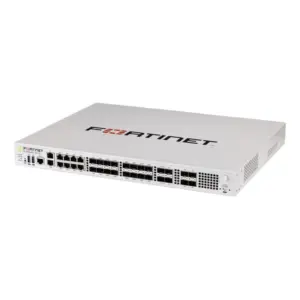
Fortinet FortiGate 200G in Uganda
A high-performance 1U next-generation firewall for campus edges, enterprise internet gateways, secure SD-WAN and segmented hybrid networks.
The 200G combines FortiOS policy control, Fortinet ASIC acceleration, multi-gigabit interfaces and optional FortiGuard security services. It is designed for buyers who need to protect substantial north-south traffic while also consolidating WAN routing, encrypted site connectivity, application visibility and zero-trust access functions. Licensing, inspection load, port use and deployment scale should be reviewed before purchase because those decisions have a direct effect on the final solution.
A security and networking platform for a demanding enterprise edge
The FortiGate 200G is designed for organizations that have moved beyond simple perimeter filtering and now need a firewall to participate actively in network design. It can serve as an internet security gateway, secure SD-WAN edge, segmentation point, VPN concentrator and policy enforcement platform. This matters in modern campuses where internet traffic, cloud applications, remote connectivity, wireless access and internal east-west movement all place different demands on the same security boundary.
Fortinet positions the 200G series around FortiOS, its operating system for converged networking and security. That gives administrators a common policy framework for firewall controls, application visibility, VPNs, SD-WAN, segmentation and supported FortiGuard security functions. Fortinet also uses dedicated security processing hardware in the platform to accelerate traffic handling. For a buyer, the practical value is not simply a headline throughput number: the appliance can consolidate several network-edge functions while still providing the interface variety expected in a modern rack deployment.
The FG-200G is especially relevant where organizations are upgrading from one-gigabit access designs toward multi-gigabit wireless, faster uplinks or more demanding internet services. Its mix of GE RJ45, GE SFP, 5GE RJ45 and 10GE SFP+ ports provides flexibility for handoffs from service providers, distribution switches and server-side or campus aggregation links. The exact topology should be planned because physical port count, media type and transceiver needs can influence total project cost.
Security service selection is equally important. Hardware alone provides the FortiGate platform, but many advanced threat-prevention functions depend on the FortiGuard subscription chosen for the deployment. Buyers should decide whether they need features such as advanced malware protection, web or DNS filtering, intrusion prevention and other subscription-based services, and for how long those services should be licensed. FourTeck can help Uganda organizations build a bill of materials that aligns the appliance, service bundle and support term with the intended operating model.
Business outcomes tied to how the 200G is actually deployed
Protect higher-bandwidth services without designing around a 1GbE bottleneck
The platform includes multi-gigabit and 10-gigabit interface choices, allowing the firewall to sit comfortably in environments where access points, switching and ISP links have outgrown legacy edge speeds. That gives infrastructure teams more freedom to modernize LAN and WAN capacity without immediately replacing the firewall.
Consolidate security and WAN decisions in FortiOS
Secure SD-WAN, VPN, routing, segmentation and firewall policy can be coordinated in one FortiOS environment. For organizations with a lean network team, this can reduce the operational friction of managing separate appliances for each edge function and can make policy changes easier to govern.
Support encrypted branch and remote connectivity
Fortinet publishes high IPsec VPN throughput for the model. That makes it suitable for site-to-site encryption between offices, data centers and cloud-connected locations where encrypted traffic is a major part of the network design.
Apply more granular access and segmentation policies
FortiOS and Fortinet Security Fabric capabilities allow the appliance to participate in network segmentation and zero-trust access strategies. This is useful when an organization needs to separate departments, guest traffic, servers, operational systems or higher-risk device groups rather than treat the internal network as one trusted zone.
Scale security services with a clear subscription plan
FortiGuard bundles let buyers choose the security service scope and term that fits their risk profile. Treating subscriptions as part of the original design avoids the common problem of buying capable hardware while leaving required inspection or threat-intelligence services unlicensed.
Create a clearer upgrade path for a growing campus
The combination of faster physical interfaces and substantial published throughput makes the appliance a practical step for organizations expecting user, application and wireless traffic growth. Capacity planning should still be based on inspected traffic and future service use rather than raw port speed alone.
The 200G stands out by combining high-speed edge connectivity with purpose-built security processing
For procurement teams, the distinguishing point is the balance of interface flexibility, FortiOS feature breadth and security acceleration in a compact rack appliance.
FortiGate 200G specification ledger
| Specification | Published / confirmed detail | Buyer note |
|---|---|---|
| Product type | Next-generation firewall appliance | Enterprise / campus edge |
| Firewall throughput | Up to 39 / 39 / 26.5 Gbps for 1518 / 512 / 64-byte UDP | Vendor test methodology applies |
| IPsec VPN throughput | Up to 36 Gbps | 512-byte packet test basis |
| IPS throughput | Up to 9 Gbps | Enterprise mix |
| NGFW throughput | Up to 7 Gbps | Enterprise mix and vendor test conditions |
| Threat protection throughput | Up to 6 Gbps | Useful sizing reference for inspected traffic |
| Copper interfaces | 10 x GE RJ45 including management, HA and switch ports; 8 x 5GE RJ45 | Confirm final port assignment and cabling |
| Fiber / SFP interfaces | 4 x GE SFP slots; 8 x 10GE SFP+ slots | Transceivers are project dependent |
| Security processors | NP7Lite and CP10 hardware acceleration; Fortinet SP5 platform architecture | Purpose-built acceleration for FortiGate workloads |
| Operating system | FortiOS | Version and supported features should be checked at deployment |
| Security services | FortiGuard services available by subscription | Bundle and term are configuration dependent |
| Form factor | 1U rack-mount appliance | Check rack depth, airflow and power planning |
The most important specification for a real purchase is usually not the maximum stateful firewall figure. Organizations intending to run intrusion prevention, application control, web inspection and other security profiles should focus on the vendor’s inspected-throughput measures and then apply design headroom for traffic growth. Likewise, a 10GE interface does not mean every security workload will sustain 10 Gbps under every policy combination. Packet size, session behavior, encryption, SSL inspection, security-service configuration and software version can all affect observed performance.
Interface planning is the second major decision. The 200G provides a useful blend of copper and optical ports, but buyers should map WAN circuits, redundant uplinks, HA connectivity, switch trunks and management interfaces before selecting optics or cabling. A project that uses 10GE fiber uplinks will require appropriate SFP+ modules and compatible fiber, while 5GE copper connections need switching and cabling capable of supporting the intended multi-gigabit rate. FourTeck can review this port map before quotation so that the appliance is supplied as part of a workable deployment rather than as an isolated box.
Five questions to answer before requesting a FortiGate 200G quote
01 — What traffic and security workload must the firewall inspect?
Start with peak internet usage, expected east-west segmentation traffic, cloud application demand and the security profiles that will be active. An organization running basic stateful policies has a different performance profile from one using IPS, application control, antivirus, DNS security and deep SSL inspection simultaneously. This answer determines whether the 200G provides comfortable headroom or whether another FortiGate size is more appropriate.
02 — How many users, devices, sessions and VPN connections will the environment generate?
User count alone is not enough. A campus with hundreds of laptops, phones, IoT devices, access points and guest users can create many more sessions than its employee count suggests. Add site-to-site VPNs, remote access and cloud connectivity to the estimate. The goal is to design for actual concurrency and growth rather than the current office headcount.
03 — Which networks, switches, ISP handoffs and media types must connect?
Document whether each link is RJ45 copper, GE fiber, 5GE copper or 10GE SFP+. Note VLAN trunks, dual ISP requirements, HA links and management access. This avoids surprises such as ordering the firewall without the transceivers, patch leads or compatible upstream interfaces needed for installation.
04 — Which FortiGuard services, support level and subscription term are required?
Advanced security services and support are commonly purchased as bundles with FortiGate hardware. The right package depends on the risk profile, compliance needs, security operations model and budget cycle. One-, three- and five-year commercial bundles may exist, but current options should be confirmed at quote time.
05 — What are the installation, lifecycle and project expectations?
Tell FourTeck whether the requirement is a single appliance, a high-availability pair, a campus refresh or part of a multi-site rollout. Include rack constraints, preferred support term, target deployment date, quantity and any need for migration planning. Those details change the bill of materials and can influence recommended alternatives if a specific configuration is not available.
Where the 200G can make operational sense
Multi-building campus internet edge
A university, corporate campus or government complex may aggregate traffic from many access switches, wireless users, guest networks and internal services through a common security edge. The 200G offers higher-speed interfaces and substantial inspected-security performance for this kind of concentration point. The design should account for peak wireless demand, VLAN segmentation, internet bandwidth and whether SSL inspection will be used broadly.
Distributed enterprise using secure SD-WAN
An organization with branch offices can use FortiGate appliances to combine WAN path control and security policy. At headquarters or a regional hub, the 200G can provide the capacity needed to terminate multiple encrypted links while applying application-aware policy. Buyers should define the number of sites, circuit sizes and routing model before settling on the hub-and-spoke architecture.
High-capacity perimeter refresh
A business replacing an older firewall may have faster internet, more cloud traffic and more encrypted sessions than when the previous appliance was purchased. Moving to a platform with 5GE and 10GE connectivity can remove physical interface constraints, while FortiOS provides modern security and networking functions. Migration planning should include policy cleanup, object conversion, VPN recreation and testing.
Segmentation between sensitive network zones
Financial, healthcare, education and public-sector networks often need stronger separation between user groups, servers, guests, IoT or specialized systems. The firewall can enforce inter-zone policy and add inspection between selected segments. The sizing exercise must include internal traffic that traverses the firewall, not just internet traffic, because east-west inspection can materially increase total workload.
Throughput numbers only become useful when they match the security policy
Fortinet publishes several performance figures for the FG-200G because different processing tasks place different demands on the appliance. Stateful firewall throughput reflects packet forwarding under specified test conditions, while intrusion prevention, NGFW and threat-protection measurements introduce progressively more inspection. For a procurement team, this distinction is essential. A design based only on the 39 Gbps firewall figure could be misleading if the organization expects most internet traffic to pass through multiple advanced security profiles.
A more disciplined approach begins by identifying how much traffic will actually be inspected and which services will be active. For example, a campus may have a 5 Gbps internet service today but expect future growth, two WAN providers, frequent cloud use and encrypted application traffic. If the security policy includes IPS, application control and threat-prevention services, the 6 Gbps threat-protection and 7 Gbps NGFW figures become more relevant planning references than raw firewall throughput. Additional headroom is still advisable for bursts, future traffic and software changes.
VPN traffic should be considered separately. Fortinet lists 36 Gbps IPsec VPN throughput under its test basis, making the appliance attractive for encrypted inter-site connectivity, but real deployments may combine VPN encryption and security inspection. The architecture should therefore be reviewed as a system rather than by adding published maximums together. FourTeck can help translate circuit speeds, traffic flows and security policies into a more realistic appliance-sizing conversation.
Multi-gigabit interfaces make the firewall easier to place in a modern campus topology
The 200G is not limited to a bank of one-gigabit ports. Its published interface mix includes 5GE RJ45 and 10GE SFP+ connectivity alongside GE copper and fiber. That matters as Wi-Fi 6E and Wi-Fi 7 access points, aggregation switches and higher-speed internet circuits increase bandwidth expectations at the edge. A firewall that cannot physically connect at the required rate becomes a design constraint even if its processor could handle more traffic.
Useful for multi-gigabit copper handoffs and modern access-layer designs where 1GbE is no longer enough.
Supports high-speed fiber or DAC-style uplinks to compatible switches and aggregation infrastructure.
Allows the edge design to combine copper WAN handoffs, fiber trunks and dedicated management or HA connections.
Port planning should be completed before ordering optics. Confirm whether each fiber run is single-mode or multimode, what distance it must cover, what transceiver standard the upstream switch expects and whether redundant paths are required. The hardware is flexible, but the deployment succeeds only when the physical layer is specified correctly.
Subscriptions determine how much of the security stack you can put to work
FortiGate hardware and FortiOS provide the platform, but many advanced threat-prevention capabilities are tied to FortiGuard service subscriptions and FortiCare support. Buyers should treat those services as part of the product configuration rather than as a later add-on. The correct bundle depends on the organization’s security operations, compliance requirements, threat exposure and renewal preference.
Fortinet offers multiple service bundles and contract terms in the market. The names and included services can evolve, so current bundle content should be confirmed during quotation rather than assumed from an older deployment. Organizations may require intrusion prevention, malware protection, application control, web or DNS security, data-loss controls, cloud sandboxing or broader enterprise services. The project team should map those requirements to the current FortiGuard portfolio and verify the intended FortiCare support level.
□ Which security services must be active on day one?
□ Is a one-, three- or five-year term preferred?
□ Does the organization need 24×7 support coverage or a specific FortiCare level?
□ Will central logging, analytics or management platforms be part of the design?
□ Is this a new deployment, renewal, replacement or HA expansion?
What buyers should check before purchase
| Risk | What to confirm | Why it matters | What to share with FourTeck |
|---|---|---|---|
| Under-sizing | Inspected peak traffic, VPN load, session growth | Advanced inspection reduces usable throughput compared with raw firewall figures | Circuit speeds, user/device counts, security profiles |
| Wrong interface plan | Copper/fiber type, 5GE/10GE needs, optics | Missing optics or incompatible media can delay deployment | Switch models, ISP handoffs, fiber type and distance |
| Incomplete licensing | FortiGuard bundle and FortiCare term | Required security services may depend on an active subscription | Security feature list and preferred term |
| Project mismatch | HA, rack, power, migration and quantity needs | The correct bill of materials extends beyond the firewall chassis | Topology, current device, rollout schedule and site count |
A second common risk is assuming that every FortiGate 200G commercial bundle is equivalent. Hardware-only SKUs and bundles with different FortiCare or FortiGuard terms can carry very different prices and service entitlements. Procurement documents should identify the exact requested SKU or, when the requirement is outcome-based, clearly state the services and term so the quotation can be matched correctly. Buyers planning a high-availability pair should also confirm whether both appliances require equivalent service coverage and whether the design needs additional optics or links between units.
Migration deserves attention too. If the 200G replaces another firewall, the technical team should review existing policies, address objects, NAT rules, VPNs, authentication dependencies and routing behavior before cutover. A like-for-like configuration copy can preserve unnecessary rules or old assumptions. A controlled migration gives the organization an opportunity to simplify policy and validate that the new appliance is sized and connected for the network it will actually protect.
Planning a Fortinet firewall deployment in Uganda
FourTeck supports Uganda business buyers with product selection, configuration review, quotation and delivery coordination for enterprise IT projects. Availability of the FortiGate 200G, specific service bundles, support terms and accessories can vary, so the recommended approach is to request a current quote based on the exact deployment rather than assume a fixed commercial package. For Kampala projects, provide the required quantity, preferred subscription term and target deployment date so the team can confirm current options.
For projects outside the capital, FourTeck can coordinate requirements based on the customer’s delivery location and implementation plan. Organizations in Kampala, Entebbe, Jinja, Mbarara and Gulu can use the same central quotation process, with city details treated as logistics information rather than as a different product offering. Warranty guidance can also be discussed during the quotation stage so buyers understand the applicable manufacturer or support-service terms for the selected SKU.
Regional procurement for multi-country IT programs
Organizations managing infrastructure across several countries may prefer a common Fortinet architecture and a coordinated bill of materials. FourTeck can discuss requirements for Uganda and, where relevant, connect the same project conversation with regional FourTeck resources for Kenya, selected East Africa markets, wider Africa requirements, the UAE or Kuwait. This is useful for groups that want consistent firewall models, service terms and configuration standards across branches while still handling local delivery and commercial details separately.
Regional supply should not be interpreted as guaranteed local stock or a fixed delivery timeline. Product availability, import requirements, service entitlement and logistics can differ by market. The practical step is to define the countries, quantities, target dates and support expectations at the start of the procurement process. Buyers can review the FourTeck Uganda site, FourTeck Kenya, FourTeck Africa, FourTeck UAE and FourTeck Kuwait when a project spans those markets.
Related Fortinet options to discuss during sizing
These alternatives are not interchangeable without sizing. The 120G may suit a lighter workload, while the 400G offers a higher performance tier for larger or more inspection-intensive environments. FortiSwitch and FortiAP products are complementary rather than substitutes. For a current product match, use the FourTeck Uganda contact page and provide your current topology and expected traffic.
Practical assistance around the firewall, not just the part number
01 Product selection guidance helps confirm whether the 200G is appropriately sized for the actual inspected workload.
02 Configuration review can identify required FortiGuard services, FortiCare terms, optics, cabling and HA needs before the quote is finalized.
03 Quote assistance gives procurement teams a clearer bill of materials for approval, budgeting and vendor comparison.
04 Uganda delivery coordination allows site, project quantity and logistics requirements to be discussed in one commercial process.
05 Alternative matching is useful if the required capacity changes or a different FortiGate model provides a better technical fit.
06 Warranty and support guidance helps buyers understand the service implications of the exact SKU and subscription term being quoted.
FortiGate 200G buyer questions
01. What is the FortiGate 200G mainly used for?
It is a next-generation firewall for enterprise and campus environments that need high-capacity perimeter security, secure SD-WAN, VPN connectivity, segmentation and FortiOS-based policy control. It is commonly considered when internet or internal traffic has outgrown smaller firewall platforms, especially where 5GE or 10GE interfaces and advanced inspection are part of the design.
02. How much threat-protection performance does Fortinet publish for the model?
Fortinet publishes up to 6 Gbps threat-protection throughput for the FG-200G under its stated enterprise-mix test conditions. It also lists 7 Gbps NGFW throughput and 9 Gbps IPS throughput. These figures are more useful than raw firewall throughput when sizing a deployment that will run multiple security services, but actual performance still depends on traffic and policy.
03. Does the appliance support 10-gigabit connections?
Yes. The published interface set includes eight 10GE SFP+ slots, along with 5GE RJ45, GE SFP and GE RJ45 interfaces. Buyers should confirm transceiver type, fiber standard, distance and switch compatibility before ordering. The presence of a 10GE port should also be considered separately from the throughput expected when advanced security inspection is enabled.
04. Are FortiGuard security services included with every FG-200G?
Not necessarily. FortiGate appliances are sold in different commercial configurations, including hardware-only and bundles with FortiCare and FortiGuard services for defined terms. The exact services depend on the SKU being quoted. Tell FourTeck which security functions and support term you require so the commercial bundle can be matched to the project rather than assumed.
05. Can the 200G be used for secure SD-WAN?
Yes. FortiOS provides secure SD-WAN capabilities alongside firewall and security functions. This can be useful for organizations with multiple WAN circuits or branch links that want centralized path selection and security policy. A correct design should document circuit types, routing, application priorities, failover expectations and the number of sites that will connect to the hub.
06. Is the FortiGate 200G suitable for a high-availability pair?
FortiGate platforms support HA deployment patterns, but the final design should be validated for the intended FortiOS version, topology and service coverage. A pair also changes the bill of materials because both appliances, links, power feeds, optics and service entitlements may need to be considered. Share the desired HA mode and rack topology during quotation.
07. What information should I send for an Uganda quote?
Provide the number of appliances, internet bandwidth, expected security services, VPN requirements, preferred support and subscription term, HA requirement, copper or fiber interfaces, optics needs and delivery location. If this is a replacement project, include the current firewall model and major pain points. That information helps FourTeck build a more accurate configuration and identify alternatives where necessary.
08. Is a listed online appliance price the same as the final project cost?
No. Hardware-only pricing can differ significantly from bundles that include FortiCare and FortiGuard services for one, three or five years. Project cost may also include optics, cabling, redundant units, delivery and implementation-related items. FourTeck recommends requesting a current quote for the exact SKU and service term instead of using a generic online appliance price as the budget total.
09. When should a buyer consider another FortiGate model?
Consider a smaller model if the expected inspected workload and interface requirements are comfortably below the 200G class, or a larger model if growth, segmentation or security inspection requires more headroom. The choice should be based on measured traffic, security policies, VPN demand, interfaces and lifecycle expectations. FourTeck can compare the requirement with nearby FortiGate tiers during sizing.
Build the right 200G configuration before the purchase order
Send FourTeck your internet speed, number of sites, security-service requirements, preferred support term, interface map, HA requirement and delivery location. The team can use those details to prepare a current Uganda quotation and flag any optics, subscriptions or alternative FortiGate sizing that should be considered.
Share: traffic profile • VPN scale • security bundle • port media • HA plan • quantity • target deployment date.