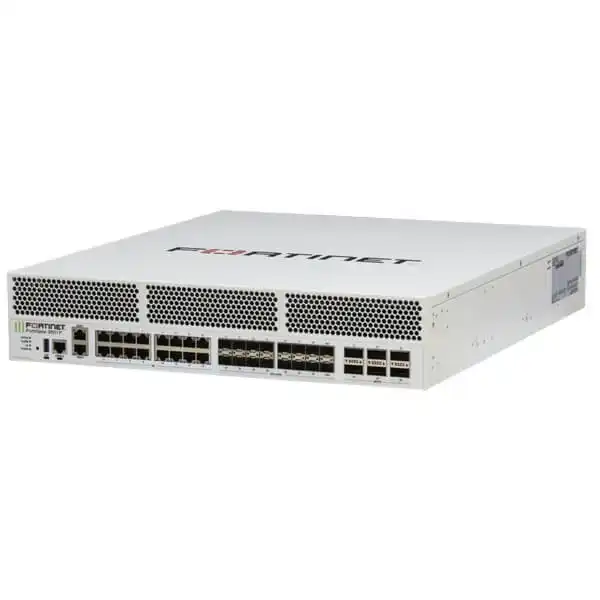
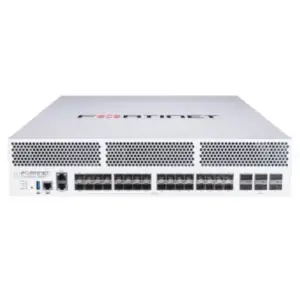
FortiGate 3000F Uganda
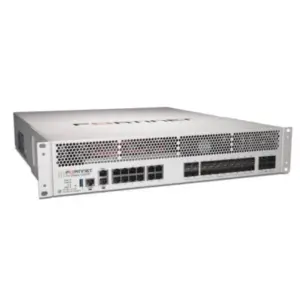
A 2RU high-performance next-generation firewall for large data centers, campus cores, hybrid IT environments and high-capacity secure network edges.
The FortiGate 3000F combines FortiOS with NP7 and CP9 security processors to deliver high-speed firewalling, encrypted-traffic inspection, segmentation, Secure SD-WAN, VPN and integrated FortiGuard security services. It is intended for organizations that need substantial connection scale and fast interfaces without treating security as a separate bottleneck.
Fortinet
FG-3000F
High-end NGFW
Up to 33 Gbps
2RU rack mount
FortiOS / FortiManager options
High-capacity security for complex enterprise traffic
The FortiGate 3000F is designed for networks where security infrastructure must inspect large traffic volumes while also supporting dense, fast connectivity. In a typical deployment, that can mean a data-center perimeter, a campus aggregation point, an internet edge carrying many application flows, a segmentation boundary between critical zones, or a hybrid environment joining on-premises services with remote sites and cloud resources. The appliance is not simply a packet-filtering firewall. FortiOS brings firewall policy, routing, virtual private networking, Secure SD-WAN, segmentation, application control, intrusion prevention, encrypted-traffic inspection and broader Security Fabric integration into one operating environment.
Fortinet specifies 36 Gbps IPS throughput, 34 Gbps NGFW throughput and 33 Gbps threat-protection throughput for the 3000F series under its published enterprise traffic-mix tests. Raw IPv4 firewall throughput reaches up to 397 Gbps with large packets, while the platform supports very high session counts and new-session rates. Those figures are useful for technical planning, but they should not be treated as a substitute for workload analysis. Actual results vary with policy complexity, enabled inspections, packet size, encryption, logging, software release and the selected FortiGuard services.
The port mix is a major reason to consider this platform for dense enterprise designs. The FG-3000F provides six hardware-accelerated 100 GE QSFP28 / 40 GE QSFP+ slots, sixteen 25 GE SFP28 / 10 GE SFP+ / GE SFP slots including two HA ports, and sixteen hardware-accelerated multigigabit RJ45 data ports, plus two 10 GE / GE RJ45 management ports. This flexibility can reduce the need for intermediate devices solely to match interface speeds.
Uganda buyers should approach the 3000F as a project component rather than a standalone commodity. The correct quote depends on whether the requirement includes only appliance hardware, a FortiCare support level, FortiGuard bundles, centralized management, optical transceivers, HA pairs, rack and power planning, migration services or hyperscale licensing. FourTeck can help translate the network design into a more complete bill of materials before pricing is finalized.
Why the platform matters operationally
01
Keep inspection capacity aligned with fast links
The appliance pairs very high firewall performance with 33 Gbps published threat-protection throughput. For data centers with multi-gigabit internet, inter-site and core connections, this helps keep advanced policy enforcement closer to line-speed expectations than platforms sized mainly for branch traffic.
02
Reduce design friction with a broad interface mix
100 GE, 40 GE, 25 GE, 10 GE and multigigabit RJ45 options allow the firewall to connect directly into different parts of a high-performance network. That can simplify migrations where old and new switching layers coexist during a staged upgrade.
03
Converge networking and security policy
FortiOS supports firewalling, routing, Secure SD-WAN, VPN and ZTNA enforcement in the same platform. Teams can design policy around users, applications and network zones rather than operating unrelated appliances for each function.
04
Inspect encrypted traffic at enterprise scale
Fortinet publishes up to 29 Gbps SSL inspection throughput for IPS and an average HTTPS mix. CP9 acceleration is designed to offload resource-intensive decryption and inspection work, which matters as a growing share of application traffic uses TLS.
05
Build segmentation into the security architecture
The platform supports dynamic segmentation and VXLAN-related functions, helping organizations separate business units, workloads, users or trust zones. The business value is reduced lateral exposure and cleaner policy boundaries when networks grow.
06
Plan resilience with redundant power and HA
The AC model includes dual hot-swappable power supplies for 1+1 redundancy, and FortiGate supports active-active, active-passive and clustering approaches. Resilience still requires correct upstream and downstream network design, not just a second firewall.
Built for places where traffic density, security depth and interface speed meet.
The defining characteristic of this firewall is not a single headline number. It is the combination of dedicated security processors, high-capacity connectivity and FortiOS functions that allow a data-center or large campus design to consolidate multiple security and networking responsibilities while retaining room for growth.
NP7 + CP9 acceleration
Dedicated processors accelerate forwarding, session setup, VPN, SSL inspection and content security functions.
100 GE-ready connectivity
Six QSFP28/QSFP+ slots support 100 GE or 40 GE uplink designs.
High connection scale
Up to 70 million concurrent TCP sessions by default, with higher figures requiring the hyperscale license.
FortiGuard service options
Security bundles can add IPS, anti-malware, web/DNS filtering, inline malware prevention, DLP and other services based on subscription.
FortiGate 3000F technical reference
| Specification | FG-3000F detail | Buyer relevance |
|---|---|---|
| IPS throughput | Up to 36 Gbps | Estimate inspected traffic headroom. |
| NGFW throughput | Up to 34 Gbps | Measured with firewall, IPS and application control. |
| Threat protection | Up to 33 Gbps | Useful planning figure when multiple security engines are enabled. |
| IPv4 firewall | 397 / 389 / 221 Gbps (1518 / 512 / 64 byte UDP) | Shows packet-size sensitivity of raw forwarding. |
| Concurrent TCP sessions | 70 million / 230 million with hyperscale license | Critical for large user, service-provider or NAT-heavy environments. |
| New TCP sessions/second | 870,000 / 3 million with hyperscale license | Important for highly dynamic application traffic. |
| IPsec VPN throughput | Up to 105 Gbps (512 byte, AES256-SHA256 test) | Supports high-capacity encrypted site interconnection. |
| SSL inspection | Up to 29 Gbps (IPS, average HTTPS) | Relevant when decrypting and inspecting TLS traffic. |
| 100/40 GE slots | 6 × QSFP28 / QSFP+ | Core and data-center uplink flexibility. |
| 25/10/1 GE fiber slots | 16 total, including 2 HA slots | Supports mixed-speed fiber environments. |
| Multigigabit RJ45 data ports | 16 × 10/5/2.5/1 GE | Useful for copper-connected systems and transitional designs. |
| Management ports | 2 × 10 GE / GE RJ45 | Allows dedicated administration paths. |
| Onboard storage | None on FG-3000F; 2 × 960 GB SSD on FG-3001F | Choose the sibling model if local SSD storage is required. |
| Dimensions | 88.9 × 443 × 556 mm | Confirm rack depth and cable clearance. |
| Form factor | 2RU rack mount | Reserve two rack units per appliance. |
| Weight | 16.9 kg | Relevant to rack handling and installation. |
| Power | 100–240V AC, 50/60 Hz; dual hot-swappable AC PSUs | Plan A/B feeds and UPS capacity where required. |
| Power consumption | 425 W average / 680 W maximum | Include in rack power and cooling calculations. |
| Operating temperature | 0°C to 40°C | Data-center environmental planning. |
| High availability | Active-active, active-passive, clustering | Supports resilient architecture when designed correctly. |
The three numbers buyers should examine together are threat-protection throughput, connection scale and interface speed. A firewall with 100 GE ports is not automatically able to inspect 100 Gbps of traffic with every security feature enabled. Fortinet’s published 33 Gbps threat-protection figure is therefore more useful for many real production designs than the maximum raw firewall figure. Connection counts also matter for service-provider networks, large public services, dense application environments and NAT-heavy deployments, because many short-lived sessions can stress a platform differently from a smaller number of large flows.
The interface plan should be completed before ordering optics. The six QSFP28/QSFP+ slots and sixteen SFP28/SFP+ capable slots create substantial flexibility, but the exact transceiver type, fiber standard, distance and switch compatibility still have to be matched. Fortinet lists two SFP+ SR 10 GE transceivers as included; other optics should be confirmed separately. If local disk is required for a specific logging or storage workflow, compare FG-3000F with FG-3001F rather than assuming both models have SSDs. Performance values are published as “up to” results and vary with system configuration, so production sizing should include suitable headroom.
Five questions that shape the correct 3000F order
- Workload and security policy: What traffic must cross the firewall, and which controls will be enabled? Deep SSL inspection, IPS, malware protection and application control change the realistic throughput target. Share peak and average traffic rather than only ISP circuit speed.
- Connection and VPN scale: How many concurrent users, devices, applications, IPsec tunnels and new sessions are expected? This determines whether default capacity is sufficient and whether hyperscale features are relevant.
- Existing infrastructure compatibility: Which switches, routers, carriers and fiber standards connect to the firewall? Record required port speeds, transceiver form factors, link distances and whether copper multigigabit connections are needed.
- Growth and service term: Is the design expected to add sites, cloud connectivity, segmentation zones, FortiAPs, FortiSwitches or more inspection? Choose FortiGuard and FortiCare terms with the expected operating horizon in mind.
- Installation and continuity: Will the appliance run as a single unit or an HA pair? Confirm rack space, A/B power, UPS sizing, cooling, change-window requirements, migration assistance, delivery location and support expectations before the final quote.
Deployment stories where this platform makes sense
Enterprise data-center perimeter
A large organization may run high-speed internet circuits, private WAN connections and public-facing applications through one protected edge. The 3000F offers the port density and inspection performance needed to consolidate those flows while preserving policy separation. Before purchase, map the ISP handoffs, application traffic, SSL inspection policy and required HA topology.
Campus core segmentation
Universities, hospitals, government campuses and large corporate estates often need security between internal zones, not only at the internet boundary. The platform can be positioned to enforce policies between user, server, management, guest or operational segments. East-west traffic volume and switch uplink speeds should be measured carefully so segmentation does not create an artificial bottleneck.
High-capacity hybrid WAN edge
Organizations operating many branches and cloud connections can use FortiOS routing, IPsec and Secure SD-WAN functions alongside security inspection. The benefit is a more unified WAN and security policy model. Buyers should document carrier diversity, tunnel count, path-performance requirements and centralized-management needs.
Service-provider or large NAT environment
High session counts, accelerated NAT and optional hyperscale licensing can make the platform relevant where the firewall processes a very large number of connections. That does not mean every service-provider design needs the hyperscale license. The expected concurrent sessions, session setup rate and CGNAT functions should be validated against the exact FortiOS feature set.
Dedicated processors and inspected throughput
Enterprise firewall sizing can become misleading when a design focuses only on raw port speed. The 3000F uses Fortinet’s NP7 network processors and CP9 content processors to accelerate different parts of the workload. NP7 works in line with FortiOS to accelerate firewall processing, VPN, VXLAN, logging and high-volume session handling. CP9 acts as a co-processor for compute-intensive security tasks such as SSL decryption, IPS pre-scan and pattern matching.
The practical value is seen in the gap between simple forwarding and security-enabled performance. Fortinet publishes up to 397 Gbps IPv4 firewall throughput with large packets, but 33 Gbps for its threat-protection test that includes firewall, IPS, application control and malware protection with logging enabled. A buyer who expects 25 Gbps of internet traffic with most flows subjected to deep inspection should therefore size from security-enabled figures and build operational headroom rather than assuming the 100 GE interfaces imply 100 Gbps of full inspection.
This distinction is especially important in financial services, cloud-connected enterprises and public-sector networks where encrypted applications dominate. SSL inspection introduces additional processing and operational requirements, including certificate deployment, policy exceptions and privacy considerations. The platform’s published SSL inspection throughput of up to 29 Gbps provides a useful technical reference, but the production number will depend on cipher suites, session profile, policy and FortiOS version.
High-speed connectivity without a narrow uplink plan
The hardware interface mix is one of the strongest product-specific reasons to shortlist this platform. Six 100 GE QSFP28 / 40 GE QSFP+ slots can serve high-capacity uplinks or core connections, while the sixteen SFP28/SFP+ capable slots support 25 GE, 10 GE or 1 GE fiber designs. Sixteen multigigabit RJ45 data ports provide 10, 5, 2.5 and 1 GE copper options.
Capability line 01: six hardware-accelerated 100/40 GE slots for high-bandwidth network edges and core interconnects.
Capability line 02: sixteen 25/10/1 GE fiber slots, including two dedicated HA slots, for mixed-generation infrastructure.
Capability line 03: sixteen 10/5/2.5/1 GE RJ45 data ports plus two separate 10GE/GE management ports.
This flexibility can reduce transition risk when an organization is upgrading switches in phases. The procurement caution is optical compatibility: port form factor does not define the required optic by itself. Confirm multimode or single-mode fiber, connector type, distance, switch-side transceiver and supported Fortinet part numbers for each link.
Security services, licensing and operational control
The appliance supports a wide set of FortiOS security functions, but many advanced threat-intelligence and protection capabilities are delivered through FortiGuard subscriptions. Fortinet publishes bundle options such as Enterprise Protection, Unified Threat Protection, Advanced Threat Protection and SD-WAN-focused services. The right choice depends on which controls the organization intends to operate and how long it wants the subscription and support term to run.
Examples of service functions available within the portfolio include intrusion prevention, anti-malware, URL and DNS filtering, video filtering, AI-based inline malware prevention, data loss prevention, attack-surface services and OT security. Availability of individual functions depends on bundle, software version and licensing. FortiCare support is also an important part of the lifecycle because the security appliance depends on ongoing firmware, support access and operational maintenance.
Centralized environments may also evaluate FortiManager for common policy and device management. This is particularly relevant when the 3000F becomes part of a wider Fortinet Security Fabric rather than a standalone firewall. Teams planning migration from older platforms should include configuration conversion, testing, rollback and policy cleanup in the project schedule.
Buyer decision checklist:
- Which FortiGuard services are required on day one?
- What support response and contract term are appropriate?
- Is centralized FortiManager management already available?
- Will the deployment need the hyperscale firewall license?
- Does the project require migration or policy-conversion assistance?
What buyers should check before purchase
A further procurement risk is treating redundancy as a simple “buy two” decision. High availability works best when the complete path is resilient: separate power feeds where possible, redundant upstream and downstream switching, suitable link aggregation or routing, synchronized configurations and a tested failover procedure. Also check rack depth, cable management, airflow direction, available cooling and the operational change window. For projects with quantities, phased delivery or replacement deadlines, share the schedule early so availability and support terms can be aligned with implementation rather than handled as afterthoughts.
Procurement support for Uganda projects
Availability of the FortiGate 3000F, its license bundles, optics and support terms can vary by project timing and selected configuration. FourTeck can help Uganda buyers verify the required model, review the bill of materials, prepare a formal quotation and coordinate delivery planning. For enterprise rollouts, the useful starting point is a technical requirement rather than a bare model request: expected traffic, security services, HA design, interface list, installation location and support term all influence the final recommendation.
Warranty and support expectations should be tied to the selected FortiCare service rather than assumed from hardware alone. If the firewall is replacing an existing security appliance, include migration timing, current policies, public IP addressing, VPN dependencies and rollback requirements in the discussion. This creates a more realistic implementation plan and reduces the chance that a missing optic, license or support entitlement delays the change window.
Coverage across Uganda
FourTeck can coordinate product enquiries and project quotations for organizations in Kampala and for customers planning deployments in Entebbe, Jinja, Mbarara and Gulu. The practical delivery and implementation details depend on order size, configuration, destination and project schedule, so they should be confirmed during quotation. For multi-site projects, sharing all deployment locations at once helps align appliance quantities, optics, support terms and staging requirements.
East Africa and wider regional planning
Organizations operating across borders can also discuss coordinated requirements for Uganda, Kenya and selected East Africa or Africa markets. Regional projects often benefit from standardizing firewall models, FortiOS baselines, FortiGuard service bundles and support terms, while still adapting interfaces and delivery plans to each site. FourTeck’s regional web presence includes FourTeck Kenya, FourTeck Africa, FourTeck UAE and FourTeck Kuwait. These links support regional enquiry routing; they do not imply local stock or identical delivery conditions in every market.
Related Fortinet and firewall buying paths
Fortinet high-end firewalls: review the wider FortiGate range on FourTeck Uganda when the 3000F is above or below the required inspected throughput.
FortiGate 2600F class: a possible lower-capacity path where threat-protection and connection requirements are lower; request model comparison through FourTeck product selection support.
FortiGate 3500F class: a possible higher-capacity path where threat-protection demand materially exceeds 3000F planning limits.
FortiManager and FortiAnalyzer: consider centralized management and logging platforms when the firewall will be part of a multi-device Security Fabric deployment.
Technical buying assistance before the purchase order
01. Product-selection guidance helps determine whether the 3000F class matches the protected throughput, interface plan and connection scale.
02. Configuration review can identify missing FortiGuard services, FortiCare support, optics, HA components or power considerations before quotation.
03. Quote assistance gives procurement teams one structured bill of materials instead of comparing hardware-only and bundle prices that are not equivalent.
04. Business IT context matters when deployment includes data-center switching, VPN, branch connectivity, rack power, migration or security-policy dependencies.
05. Uganda delivery coordination can be discussed around the project location, quantity, configuration and required schedule without assuming immediate stock.
06. Alternative-product matching is available when a technical requirement reveals that another FortiGate model or configuration is a better fit.
FortiGate 3000F buyer questions
01. What is the FortiGate 3000F mainly used for?
It is a high-end next-generation firewall intended for large enterprise, data-center, campus, hybrid IT and high-capacity WAN-edge environments. It is most appropriate where organizations need substantial security-inspection throughput, very high session scale and fast 25/40/100 GE connectivity. Final suitability depends on the enabled security services, traffic profile and resilience design.
02. How much threat-protection throughput does it provide?
Fortinet publishes up to 33 Gbps threat-protection throughput for the 3000F series using an enterprise traffic mix with firewall, IPS, application control and malware protection enabled, with logging. This is an “up to” laboratory figure. Real production performance varies with packet size, encryption, policy complexity, services, logging and configuration.
03. Does the FG-3000F include local SSD storage?
No. Fortinet’s specification table lists no onboard storage for the FG-3000F, while the FG-3001F variant includes two 960 GB SSDs. If local storage is part of the logging or operational design, compare these variants before ordering rather than assuming the chassis models are identical.
04. Which FortiGuard license should be selected?
The correct bundle depends on required controls and support expectations. Fortinet offers several bundle families with different combinations of IPS, anti-malware, web and DNS security, advanced threat prevention, data protection, SD-WAN services and FortiCare. Provide the security-policy requirements and preferred term so the quote can be built around actual functions rather than the bundle name alone.
05. Can the 3000F be deployed in high availability?
Yes. Fortinet lists active-active, active-passive and clustering options, and the appliance provides dedicated HA ports. A resilient deployment should also consider redundant switches, links, power feeds, routing and failover testing. Purchasing two firewalls without designing the surrounding network does not by itself guarantee end-to-end availability.
06. What optical transceivers are needed?
That is configuration dependent. The firewall supports QSFP28/QSFP+ and SFP28/SFP+ interface families at multiple speeds, but the correct optic depends on speed, fiber type, distance and the device at the other end of the link. Fortinet lists two 10 GE SFP+ SR transceivers as included; additional optics should be specified per port map.
07. Is the hyperscale firewall license required?
Not for every deployment. The optional perpetual hyperscale license unlocks higher accelerated scale for specific functions such as CGNAT, hardware session setup, logging and NAT. Fortinet’s table shows higher session and session-creation figures with this license. Confirm the required connection scale and CGNAT use case before adding it.
08. What information should be sent for a Uganda quote?
Send the required quantity, current firewall or network design, peak traffic, security services, VPN count, interface speeds, optics, HA requirement, preferred support term, rack power details and delivery location. For a replacement project, include the desired migration window and any dependencies such as public IPs, site-to-site tunnels and existing Fortinet management systems.
09. Does the 3000F support Secure SD-WAN and ZTNA?
Yes. Fortinet positions Secure SD-WAN and integrated Zero Trust Network Access enforcement as capabilities of FortiOS on FortiGate. The exact deployment design, licensing and endpoint or identity components depend on the use case. These functions are valuable when an enterprise wants consistent network and security policy across distributed locations.
10. How should a buyer compare the 3000F with another FortiGate model?
Compare security-enabled throughput first, then concurrent sessions, new-session rate, VPN requirements, interface types, HA design, power, storage needs and expected growth. A smaller model may be more economical for lower traffic, while a larger model may provide safer headroom for heavier inspection. FourTeck can help map those requirements to the appropriate FortiGate class.
Prepare a FortiGate 3000F project quote with the right components
Send FourTeck your expected inspected throughput, interface map, HA requirement, FortiGuard services, FortiCare term, deployment location and project quantity. The team can use those details to structure a quote around the required appliance configuration instead of a hardware-only price that may omit essential services or optics.
- Traffic and user scale
- WAN, VPN and segmentation requirements
- Port speeds and transceiver types
- Support and subscription term
- Quantity, installation location and project timing
Reviews
There are no reviews yet.