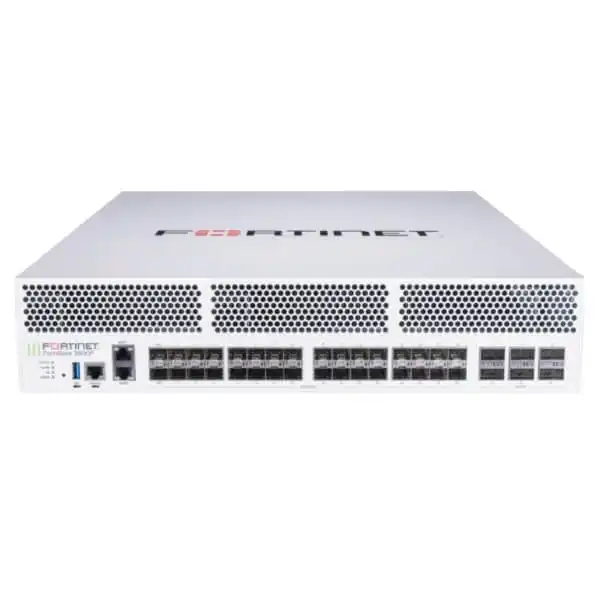
FortiGate 3500F Uganda
A 2RU high-performance Fortinet next-generation firewall for hybrid data centers, enterprise cores, high-speed segmentation, and large secure network edges.
FortiGate 3500F is designed for organizations that must combine very high packet-processing capacity with deep security services, encrypted-traffic inspection, scalable VPN, and dense 25GE/100GE connectivity. FourTeck can help procurement and IT teams in Uganda validate the appliance, subscription, optics, power, and high-availability requirements before a commercial quote is prepared.
High-throughput security for hybrid data-center traffic
The FortiGate 3500F is a high-end network security appliance intended for environments where ordinary branch or campus firewalls cannot provide enough inspected throughput, interface density, or session scale. It combines Fortinet’s FortiOS software with dedicated NP7 network processors and CP9 content processors. This matters because large data centers do not simply forward large volumes of traffic; they increasingly need to inspect encrypted application traffic, segment internal zones, terminate high-capacity VPNs, enforce application policy, and connect infrastructure at 25GE, 40GE, or 100GE speeds.
For a Ugandan enterprise, financial institution, telecom environment, large public-sector network, cloud-hosting operation, or regional business with concentrated infrastructure in Kampala, the appliance can serve at the north-south perimeter, between major data-center zones, at a hybrid-cloud edge, or as part of a secure data-center interconnect. The exact role should be decided from measured traffic rather than a generic device count. A network carrying a small number of very large flows behaves differently from a network with millions of short sessions, high TLS inspection demand, or a large remote-access population.
The platform provides six hardware-accelerated 100GE QSFP28/40GE QSFP+ slots and thirty-two hardware-accelerated 25GE SFP28/10GE SFP+/GE SFP slots, plus two RJ45 management ports. That port mix is especially important in data-center procurement because the firewall can be inserted into high-speed switching fabrics without immediately forcing a downgrade to lower-speed links. Fortinet also includes two short-range 10GE SFP+ transceivers, while other optics and direct-attach cables should be selected according to reach, fiber type, switch interfaces, and rack layout.
Security capability is subscription dependent. The hardware supports the FortiOS platform and FortiGuard services, but the final service bundle determines which advanced protections and update services are available. A purchase plan should therefore match hardware capacity with the intended security profile, FortiCare service level, deployment term, and operational model. FourTeck can help collect these details and structure the quote around a realistic design rather than simply listing the base appliance.
Why enterprises select this class of firewall
Protect high-speed network paths without designing around a low-capacity inspection point
Published firewall throughput reaches 595 Gbps for large packets, while enterprise security metrics include 72 Gbps IPS and 63 Gbps threat protection. This allows architects to consider deep inspection on data-center links where a smaller firewall could become the limiting component.
Preserve visibility into encrypted application traffic
TLS inspection is increasingly important because malicious payloads and command traffic can hide inside encrypted sessions. The 3500F is engineered with CP9 acceleration for SSL and security processing, with Fortinet publishing 63 Gbps SSL inspection throughput under its stated test profile.
Connect directly to modern core and data-center switching
The mix of 100GE/40GE and 25GE/10GE/GE interfaces offers flexibility for high-bandwidth uplinks, inter-zone links, aggregation paths, and migration projects where old and new link speeds may coexist.
Support very large VPN and session environments
Fortinet publishes 165 Gbps IPsec VPN throughput, 40,000 gateway-to-gateway IPsec tunnels, and a recommended maximum of 30,000 concurrent SSL-VPN users in tunnel mode. Those figures make the platform relevant to large distributed or inter-site deployments, subject to actual policy and traffic design.
Design for continuity with redundant power and HA options
The appliance ships with dual hot-swappable AC power supplies for 1+1 redundancy and supports active-active, active-passive, and clustering high-availability configurations. A resilient design still requires correct upstream/downstream switching, cabling, power feeds, and failover testing.
Consolidate policy, segmentation, VPN and security services
FortiOS brings firewalling, IPS, application control, VPN, segmentation, ZTNA enforcement and other functions into one operating environment. Consolidation can reduce tool sprawl, but only when licensing, operations, logging and change-management processes are planned at the same time as the hardware.
Built around high-speed interfaces, security processors and enterprise-scale policy enforcement
The defining value of this model is not one headline throughput number. It is the combination of high port density, NP7 accelerated forwarding, CP9 accelerated content inspection, FortiOS policy control, large session capacity, VPN scale and subscription-based FortiGuard security services. For procurement teams, those elements need to be evaluated together because selecting the right appliance without selecting the right optics, licenses, service term, power design and redundancy architecture can still produce an incomplete project.
FortiGate 3500F technical specifications
| Specification | Published value | Buyer note |
|---|---|---|
| Firewall throughput | 595 / 590 / 420 Gbps (1518 / 512 / 64-byte UDP) | Raw forwarding performance; not a substitute for inspected-traffic sizing. |
| Firewall latency | 2.98 μs (64-byte UDP) | Lab figure under vendor test conditions. |
| IPS throughput | 72 Gbps | Enterprise traffic mix. |
| NGFW throughput | 65 Gbps | Firewall, IPS and Application Control enabled. |
| Threat protection | 63 Gbps | Firewall, IPS, Application Control and Malware Protection enabled. |
| SSL inspection | 63 Gbps; 60,000 CPS; 15 million concurrent sessions | Measured using average HTTPS sessions and stated cipher suites. |
| IPsec VPN | 165 Gbps; 40,000 gateway-to-gateway tunnels | Useful for large site or data-center interconnect designs. |
| SSL-VPN | 16 Gbps; recommended max 30,000 concurrent tunnel-mode users | Remote-access architecture and licensing should be reviewed. |
| Concurrent TCP sessions | 140 million / 348 million with applicable hyperscale licensing | Hyperscale value requires the corresponding license. |
| 100GE / 40GE slots | 6 × QSFP28 / QSFP+ | Hardware accelerated. |
| 25GE / 10GE / GE slots | 32 × SFP28 / SFP+ / SFP | Hardware accelerated. |
| Management interfaces | 2 × 10GE/GE RJ45 management ports; console; USB client/server | Separate management architecture is recommended for critical deployments. |
| Onboard storage | None on FG-3500F; 2 × 1.92 TB SSD on FG-3501F | Choose the correct variant if local storage is a requirement. |
| High availability | Active-active, active-passive, clustering | Requires full topology and failover planning. |
| Form factor | 2RU rack mount, 89 × 443 × 556 mm | Allow rack depth, airflow and service clearance. |
| Weight | 19.9 kg | Plan safe rack installation and rail support. |
| Power | 100–240V AC, 50/60Hz; dual hot-swappable PSUs | Use independent feeds where the site supports them. |
| Power consumption | 760 W average / 1174 W maximum | Include UPS, PDU and cooling capacity in the project plan. |
| Operating temperature | 0°C to 40°C | Data-center cooling and airflow must remain within limits. |
The figures that usually influence a purchase most are inspected throughput, interface type, SSL inspection demand, VPN capacity, session scale, power and the planned security bundle. Raw firewall throughput is useful for understanding the platform’s forwarding ceiling, but enterprise deployments normally enable multiple services. A more practical sizing exercise starts with peak and sustained traffic, the percentage of traffic that will be decrypted, the expected application mix, east-west versus north-south flows, tunnel counts, and planned growth. Optics are another significant procurement item: 25GE and 100GE links require the correct transceivers or direct-attach cables on both the firewall and the connected switch. Finally, buyers should distinguish FG-3500F from FG-3501F when onboard SSD storage is relevant.
Five questions to answer before requesting a quote
01 — What traffic must the firewall inspect?
Document peak throughput, normal throughput, packet profile, application mix and how much traffic will use SSL/TLS inspection. This is the foundation of model selection because a firewall that appears oversized on raw forwarding can become appropriately sized once IPS, malware prevention, application control, decryption and logging are enabled.
02 — What interface speeds and session scale are required?
List every 1GE, 10GE, 25GE, 40GE and 100GE connection, including expected link aggregation and HA interfaces. Also estimate concurrent sessions and new sessions per second. This determines whether the 3500F’s interface density and session capacity match the topology and whether specific optics or cables need to be included.
03 — How will it connect to the existing network?
Confirm switch models, routing protocols, VLAN design, VRFs or virtual domains, physical media, fiber type, transceiver standards and management access. Compatibility questions are often where otherwise-correct hardware orders fail, especially when a high-speed optic, patch lead, rack depth or power connector was omitted from the bill of materials.
04 — Which security services, licenses and growth options are needed?
Determine whether the deployment requires advanced threat protection, web and DNS security, malware prevention, hyperscale features, FortiCare support, central management, logging, sandboxing, ZTNA, SD-WAN functions or other services. The appliance and the subscription must be budgeted as one operational solution. Multi-year service terms can also materially change project cost.
05 — What continuity, delivery and support expectations apply?
State whether one appliance or an HA pair is needed, how power redundancy will be arranged, whether implementation assistance is expected, what project date is targeted, and whether procurement depends on a particular service term. Availability and delivery should be confirmed at quotation stage rather than assumed from a generic web listing.
Where the platform can make operational sense
Hybrid data-center perimeter
An organization may keep critical systems on premises while connecting to cloud and hosted platforms. The firewall can sit at a high-capacity perimeter where inspection, VPN, segmentation and policy enforcement are needed across mixed application traffic. Buyers should size encrypted traffic and cloud interconnect bandwidth carefully rather than relying on the nominal ISP circuit alone.
Internal data-center segmentation
Large environments often need stronger controls between application, database, user, management and third-party zones. Dense 25GE interfaces and large session capacity make the model relevant when segmentation must occur without constraining high-speed east-west traffic. The design should include failure domains, asymmetric routing checks and policy ownership.
Regional VPN concentration
A business with many sites can use a high-end FortiGate as a centralized IPsec termination platform. Published IPsec throughput and tunnel scale are substantial, but actual requirements depend on encryption profile, traffic direction, SD-WAN design, failover topology and the bandwidth of the connected core.
Large secure internet edge
Organizations with multiple high-speed internet circuits, public-facing applications and significant outbound traffic may need an edge firewall that can combine filtering, IPS, application control, TLS inspection and policy enforcement at scale. Logging architecture and DDoS strategy should also be considered as separate design topics.
NP7 and CP9 acceleration for data-center security workloads
Fortinet’s architecture places dedicated security processing units alongside the general CPU. In the 3500F family, NP7 processors accelerate high-volume network functions while CP9 processors offload resource-intensive content and SSL processing. Fortinet documentation describes three NP7 processors connected to the integrated switch fabric, enabling supported traffic between front-panel data interfaces to be offloaded. This hardware design is one reason the platform can publish very high packet-forwarding and inspected-throughput figures.
For buyers, the important point is not simply that ASICs exist. It is that a high-end firewall must perform multiple tasks at once: route packets, maintain state, apply policies, inspect signatures, classify applications, decrypt and re-encrypt TLS sessions, encapsulate VPN traffic, and generate logs. Hardware acceleration can reduce the chance that one of those functions becomes the dominant bottleneck under a correctly designed workload. However, performance still varies with packet size, feature combination, traffic profile and configuration.
During procurement, ask the network and security teams to define a representative traffic model. Include application traffic, encrypted percentage, internet edge traffic, internal segmentation traffic, backup flows and expected growth. This creates a defensible basis for deciding whether the 3500F is appropriately sized and whether an HA pair should be planned from the start.
High-density 25GE and 100GE connectivity
The appliance provides six 100GE QSFP28/40GE QSFP+ slots and thirty-two 25GE SFP28/10GE SFP+/GE SFP slots. That interface flexibility gives architects room to connect core switches, data-center fabrics, internet edges, inter-zone links and migration paths without relying on a separate speed-conversion layer. Interface choice still requires exact optic and media planning.
Licensing, resilience and lifecycle planning
A high-end firewall purchase is incomplete when it only names the appliance. The security service bundle determines which FortiGuard capabilities are licensed, while FortiCare determines the support entitlement. Some hyperscale capacity also depends on a specific license. In addition, organizations commonly deploy this class of firewall in pairs because the protected services are too important to rely on a single chassis.
Power and rack planning are equally practical. The 2RU chassis uses dual hot-swappable AC supplies, with 760 W average and 1174 W maximum consumption published for the FG-3500F. The data center should have suitable rack depth, front-to-back airflow, UPS/PDU capacity and ideally independent power feeds. Cooling calculations should include the vendor’s published heat dissipation rather than treating the firewall like a low-power branch appliance.
Buyer decision checklist
- Confirm FG-3500F versus FG-3501F if onboard SSD storage matters.
- Select FortiGuard services according to the actual security policy.
- Select FortiCare term and support level according to operational requirements.
- Decide whether the production design requires active-passive, active-active or clustering.
- Include optics, DACs, rack accessories, power distribution and spare strategy.
- Plan logging, backup, change control, software lifecycle and maintenance windows.
What to confirm before purchase
Other practical checks include rack depth, air flow, project quantity, replacement-model strategy, firmware compatibility with the wider Fortinet estate, and the operational ownership of security policies. If the appliance will replace an existing firewall, provide current utilization and configuration summaries so that the migration is based on measured requirements rather than nameplate capacity alone.
Availability and project coordination
FortiGate availability in Uganda can vary by appliance, service bundle, optics, quantity and current supply position. FourTeck can help customers in Kampala review the technical bill of materials, prepare a current quotation, coordinate delivery planning and discuss the warranty or support entitlement attached to the selected FortiCare option. This is especially important for high-end firewall projects because the hardware, licenses and interconnect components may be sourced as separate line items.
For projects, share the planned deployment date early enough to allow configuration review and procurement coordination. FourTeck can also help compare a requested 3500F configuration with other FortiGate capacities when measured requirements indicate that a different model may fit better. Any commercial availability, lead time or warranty handling should be confirmed in the actual quotation rather than inferred from generic online information.
Uganda location coverage
FourTeck can support product enquiries and project planning for organizations operating in Kampala and for customers coordinating deployments to Entebbe, Jinja, Mbarara and Gulu. The practical process is the same: confirm the exact hardware model, security services, accessories, quantity and delivery location before quotation. For multi-site rollouts, provide a site list and whether appliances will be shipped centrally or allocated by location so the bill of materials can be prepared consistently.
East Africa and regional procurement
Organizations with regional operations can also use FourTeck’s country and regional channels when projects extend beyond Uganda. Procurement may involve Uganda, Kenya, selected East Africa markets, broader Africa requirements, or coordination with teams in the UAE and Kuwait. Regional supply should not be assumed to mean identical stock, pricing, support terms or delivery times in every market. Each location can have its own tax, logistics, service and lead-time considerations.
For a multi-country Fortinet project, a useful first step is a single technical standard that defines approved appliance models, subscription terms, optics, HA topology, firmware baseline and management approach. The commercial request can then be split by delivery country. Visit FourTeck Uganda, FourTeck Kenya, FourTeck Africa, FourTeck UAE or FourTeck Kuwait according to the project region.
Related products and alternative capacity paths
Practical assistance around the product, not just the appliance SKU
01. Product selection guidance helps match the firewall family and model to measured bandwidth, inspection and growth requirements.
02. Configuration review helps identify licenses, optics, cables, HA quantities and infrastructure dependencies before quotation.
03. Quote assistance gives procurement teams a structured commercial document based on the agreed bill of materials rather than an ambiguous base-product request.
04. Uganda delivery coordination can be discussed for the required project location after current availability is checked.
05. Warranty and support guidance helps buyers understand the selected FortiCare term and what entitlement is attached to the quoted configuration.
06. Alternative model matching can be useful when the requested device is over-sized, under-sized, unavailable, or not the best fit for the planned interface and traffic profile.
FortiGate 3500F buyer questions
01. What is the FortiGate 3500F mainly used for?
It is a high-end next-generation firewall for large enterprise and data-center environments. Typical roles include secure internet edge, hybrid data-center perimeter, high-speed internal segmentation, VPN concentration and data-center interconnect security. It is most appropriate where substantial inspected throughput, large session counts, and 25GE or 100GE connectivity are real requirements.
02. What is the published threat-protection throughput?
Fortinet publishes 63 Gbps threat-protection throughput for the 3500F series under its stated enterprise traffic mix and feature test. Fortinet defines that measurement with firewall, IPS, application control and malware protection enabled. Real deployment results vary with traffic patterns, policy design, packet sizes, TLS inspection, logging and software configuration.
03. Does the 3500F support 100 Gigabit Ethernet?
Yes. The appliance provides six hardware-accelerated slots supporting 100GE QSFP28 or 40GE QSFP+ connectivity. It also provides thirty-two slots supporting 25GE SFP28, 10GE SFP+ or GE SFP. The correct optic, fiber type, reach and switch-side compatibility must be confirmed before the bill of materials is finalized.
04. What is the difference between FG-3500F and FG-3501F?
The most visible hardware difference in the current Fortinet datasheet is onboard storage. FG-3500F is listed without onboard storage, while FG-3501F includes two 1.92 TB SSDs. The main interface and performance figures are otherwise presented together for the series. Buyers who require local storage should confirm the correct variant at quotation stage.
05. Are FortiGuard and FortiCare included automatically?
The base appliance and service entitlements should be treated as separate procurement decisions. Fortinet offers multiple FortiGuard security bundles and FortiCare support options, and the selected term changes the final configuration and commercial value. FourTeck can help prepare a quote that includes the appropriate security and support package for the intended operating model.
06. Can the FortiGate 3500F be deployed in high availability?
Yes. Fortinet lists active-active, active-passive and clustering high-availability configurations. For a production HA design, buyers should plan two appropriately licensed appliances plus redundant switching paths, power feeds and compatible optics. Failover behavior, session handling, routing and maintenance procedures should be documented and tested as part of implementation.
07. What power and rack planning is required?
The FG-3500F is a 2RU rack-mount appliance measuring 89 × 443 × 556 mm and weighing about 19.9 kg. Fortinet publishes 760 W average and 1174 W maximum power consumption, with dual hot-swappable AC supplies. Rack depth, rails, PDU capacity, UPS sizing, front-to-back airflow and cooling should all be checked before installation.
08. Is the FortiGate 3500F available in Uganda?
FourTeck can quote the FortiGate 3500F for Uganda, subject to the requested appliance, licenses, accessories, quantity and current supply conditions. Availability should be confirmed when the quote is prepared. Share the deployment location, required delivery schedule and complete technical configuration so procurement can be coordinated against the actual project.
09. What information should I send for a quote?
Provide expected peak and inspected throughput, current and future link speeds, required 25GE or 100GE optics, VPN scale, TLS inspection requirements, preferred FortiGuard services, FortiCare term, HA topology, appliance quantity and deployment location. If replacing an existing firewall, include current utilization and major enabled services because those figures improve sizing accuracy.
10. When should a buyer consider another FortiGate model?
Consider another model when measured requirements are materially below or above the 3500F’s intended capacity, when a different port mix is needed, or when the project requires a storage characteristic found in another variant. Model selection should be driven by inspected throughput, sessions, interfaces, VPN, licensing and growth rather than model numbering alone.
Prepare a complete FortiGate 3500F project quote
Send FourTeck the expected traffic profile, required security services, interface speeds, optics, VPN scale, HA preference, quantity and target deployment location. The team can use those details to review the bill of materials and prepare a current Uganda quotation.
- Peak and inspected throughput
- 25GE/40GE/100GE connectivity and optic requirements
- FortiGuard and FortiCare term
- Single appliance or HA pair
- Quantity, location and target project date

Reviews
There are no reviews yet.