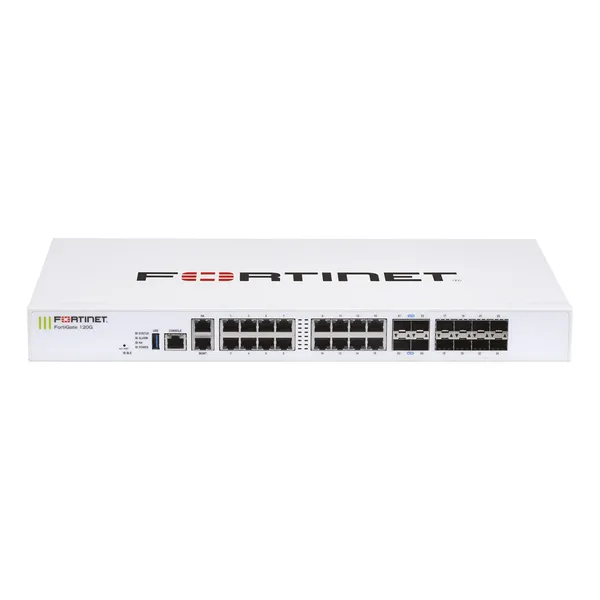
FortiGate 120G in Uganda
A 1RU next-generation firewall for organisations that need fast perimeter security, secure SD-WAN, VPN connectivity and flexible copper, fibre and 10GbE interfaces.
The FortiGate 120G sits in Fortinet’s current G-series portfolio for larger branch, head-office and distributed-enterprise edge roles. It combines SP5 hardware acceleration with FortiOS security and networking functions, giving IT teams a single platform for firewalling, segmentation, encrypted traffic inspection, secure access and WAN control. FourTeck can help Uganda buyers match the appliance, FortiGuard service bundle, optics, cabling and deployment approach to actual traffic and security requirements.
Fortinet
FortiGate 120G
NGFW / Secure SD-WAN
1RU rack mount
Diskless model
Configuration dependent
A security platform for busy business edges
The 120G is built for organisations that want firewall enforcement and network control to live in the same appliance rather than be assembled from unrelated point products. FortiOS provides firewall policies, routing, SD-WAN, virtual private network functions, segmentation and integration with Fortinet’s broader Security Fabric. FortiGuard subscriptions can add threat intelligence and inspection services, with the exact capabilities depending on the selected bundle and term.
That architecture is useful where an office edge must handle more than simple internet access. A headquarters may need separate employee, guest, server, voice and management networks. A multi-site business may need encrypted links between branches and central systems. An education buyer may need application control and web protection alongside reliable access to cloud platforms. A project environment may need several ISP circuits, route control, internal segmentation and secure administrator access. In these situations the firewall becomes an operational control point as well as a security boundary.
Interface flexibility is one of the model’s defining strengths. Fortinet lists 16 hardware-accelerated GE RJ45 switch ports, two accelerated GE RJ45 ports dedicated to management and high availability, eight GE SFP slots and four 10GE SFP+ slots that operate as FortiLink by default. This mix lets a design combine copper handoffs, fibre circuits, switch uplinks and faster internal connections without immediately adding a separate media-conversion layer. It also means that optics, cabling type and transceiver compatibility should be planned during procurement rather than after the appliance arrives.
The 120G is the diskless member of the pair. Fortinet’s 121G variant adds a 480 GB onboard SSD, so logging architecture is an important buying decision. If local storage is required, the 121G may be more appropriate. If logs will be sent to FortiAnalyzer, FortiGate Cloud or another supported logging design, the diskless 120G may fit well. FourTeck can help Uganda buyers review this distinction together with security-service licensing, WAN bandwidth, expected growth, rack power, high availability and accessory needs before a quote is prepared.
What the platform can improve when correctly sized
01
Keep security inspection aligned with faster WAN links
Fortinet publishes 5.3 Gbps IPS, 3.1 Gbps NGFW and 2.8 Gbps threat-protection throughput for the platform using its defined enterprise traffic mixes. These figures are more useful for security sizing than the raw firewall number when inspection services will be active. For buyers upgrading from 1Gbps internet or consolidating several circuits, this provides meaningful headroom when the actual policy set is planned carefully.
02
Use copper and fibre without a restrictive edge layout
The combination of RJ45, SFP and SFP+ interfaces allows a design to accommodate typical ISP handoffs, fibre runs, distribution switches and 10GbE uplinks. That flexibility can simplify refresh projects because the firewall can sit between existing access infrastructure and newer high-speed core links. The practical benefit is architectural freedom, provided the correct supported optics and cabling are selected.
03
Consolidate secure SD-WAN and firewall policy
FortiOS can combine route selection, WAN monitoring and security enforcement on the same platform. For multi-site organisations, that means application-aware path decisions and branch connectivity can be administered alongside firewall rules rather than through entirely separate operational stacks. The result can be simpler troubleshooting and more consistent policy when deployment standards are defined centrally.
04
Support substantial encrypted site connectivity
Published IPsec VPN throughput is 35 Gbps under Fortinet’s stated test conditions, with support figures that include up to 2,000 gateway-to-gateway tunnels and up to 16,000 client-to-gateway IPsec tunnels. Real deployments should still be designed around encryption settings, policy complexity and traffic mix, but the platform gives growing organisations room for branch and remote-access architectures.
05
Create resilient firewall pairs
Fortinet supports active-active, active-passive and clustering high-availability modes on the series. A properly designed pair can reduce dependence on a single firewall appliance at critical business locations. High availability requires duplicate hardware, appropriate interface mapping and a clear failover design, so it should be included in the initial bill of materials rather than added as an afterthought.
06
Coordinate FortiSwitch and FortiAP environments
Fortinet publishes support for up to 32 FortiSwitch units and up to 128 FortiAP access points in total, including up to 64 in tunnel mode, subject to design and software considerations. This makes the firewall relevant to organisations that want the edge appliance to participate in broader Fortinet LAN management. Actual supported designs should be checked against current FortiOS and deployment guidance.
Its value is the balance between inspection performance, interface density and FortiOS control.
The Fortinet FortiGate 120G is not simply a faster internet gateway. Its practical advantage is that a single 1RU appliance can combine multi-gigabit security inspection, a broad port mix, VPN, secure SD-WAN, segmentation and Fortinet ecosystem integration. That combination is especially relevant when an organisation is replacing an older firewall at the same time that it is upgrading ISP bandwidth, introducing 10GbE switching, adding branches or formalising network segmentation.
FortiGate 120G technical specifications
| Specification | Published value / guidance |
|---|---|
| Hardware-accelerated GE RJ45 switch ports | 16 |
| GE RJ45 management / HA ports | 2 total: 1 × MGMT and 1 × HA |
| GE SFP slots | 8 |
| 10GE SFP+ slots | 4, FortiLink by default |
| USB / console | 1 × USB, 1 × RJ45 console |
| Internal storage | None on 120G; 121G provides 1 × 480 GB SSD |
| Firewall throughput | 39 / 39 / 28 Gbps for 1518 / 512 / 64 byte UDP packets |
| Firewall latency | 3.17 μs for 64-byte UDP packets |
| Firewall packets per second | 42 Mpps |
| Concurrent TCP sessions | 3 million |
| New TCP sessions per second | 140,000 |
| IPS throughput | 5.3 Gbps, enterprise mix |
| NGFW throughput | 3.1 Gbps, enterprise mix |
| Threat-protection throughput | 2.8 Gbps, enterprise mix |
| IPsec VPN throughput | 35 Gbps at 512-byte packet size |
| Gateway-to-gateway IPsec tunnels | Up to 2,000 |
| Client-to-gateway IPsec tunnels | Up to 16,000 |
| SSL-VPN throughput | 1.5 Gbps |
| Concurrent SSL-VPN users | 500 recommended maximum in tunnel mode |
| SSL inspection throughput | 3 Gbps using IPS, average HTTPS profile |
| Application control throughput | 6.7 Gbps, HTTP 64K |
| Virtual domains | 10 default / 10 maximum |
| FortiSwitch support | Up to 32 |
| FortiAP support | Up to 128 total / 64 tunnel mode |
| High availability | Active-active, active-passive, clustering |
| Form factor | 1RU rack mount |
| Dimensions | 44 × 432 × 254 mm |
| Weight | 5.52 kg |
| Power supplies | Dual AC power supplies |
The most important numbers are rarely the largest ones in the table. Raw firewall throughput represents packet forwarding under specific test conditions, but most business deployments enable inspection. For that reason, IPS, NGFW, threat-protection and SSL-inspection figures should be compared with expected peak traffic after allowing room for growth. A 2Gbps internet service, for example, may fit differently depending on how much traffic is decrypted and inspected, whether east-west segmentation crosses the firewall, and whether VPN traffic shares the same appliance.
Interfaces are the second major decision factor. The four 10GE SFP+ slots provide a path to higher-speed switching or fibre aggregation, while the eight 1GbE SFP slots and 16 RJ45 switch ports offer flexibility for different handoffs. Buyers should identify the physical media, connector type, distance and switch compatibility for every fibre link before ordering transceivers. Finally, local storage is absent on this model. Organisations that specifically want internal SSD storage should consider the 121G and assess how log retention will be handled.
Five questions to answer before a quotation
01 What traffic must be secured?
Provide current and planned WAN speeds, internal routed traffic that may cross security zones, and a rough split between general web traffic, cloud applications, voice, file transfer and server access. This determines whether sizing should be anchored to IPS, NGFW, SSL inspection or VPN performance rather than raw firewall throughput.
02 How many users, branches and sessions are expected?
A branch hub supporting many remote sites behaves differently from a single-office internet edge. Share the user population, remote-access count, branch count, typical concurrency and anticipated growth. Tunnel count, session capacity and policy scale can influence whether this model provides appropriate operational headroom.
03 Which existing systems must connect?
List ISP handoff types, switches, fibre standards, VLAN design, routing protocols, authentication systems and any Fortinet products already deployed. This helps identify transceivers, SFP+ direct-attach cables, interface allocation and migration requirements before the final bill of materials is produced.
04 Which security subscriptions and logging design are required?
FortiGuard functionality is subscription dependent. Buyers should decide whether they need a Unified Threat Protection, Enterprise Protection or another current Fortinet service bundle and term. Because the 120G has no onboard SSD, also define whether logs will be sent to FortiAnalyzer, FortiGate Cloud or another supported destination.
05 What resilience and project support are expected?
Confirm whether the site needs a high-availability pair, redundant ISP links, dual power paths, rack accessories, installation coordination, migration planning or quantity supply for multiple locations. These choices can materially change the hardware and service scope even when the base firewall model remains the same.
Where the 120G can make practical sense
Head-office internet edge
A medium or larger organisation may use the appliance to protect a headquarters with multiple VLANs, cloud-heavy workloads and faster internet circuits. The 10GbE SFP+ interfaces can connect to a distribution or core layer while GE ports handle other routed or WAN connections. The important sizing step is to compare expected inspected traffic with NGFW and threat-protection figures, especially if SSL inspection is enabled broadly.
Multi-branch SD-WAN hub
A business with distributed sites can use FortiOS secure SD-WAN and IPsec capabilities to centralise branch connectivity and policy. The platform’s tunnel scale and VPN performance support substantial designs, but the real recommendation should account for branch count, active tunnels, WAN bandwidth, routing behaviour and whether data traverses the hub or uses local breakout at each branch.
Education or campus edge
Schools, colleges and training organisations often need to separate staff, students, guests, servers and administrative systems while controlling web and application traffic. The firewall can provide segmentation and security services at the perimeter, with FortiAP and FortiSwitch integration available for compatible Fortinet environments. Capacity planning should reflect concurrent devices, encrypted traffic and peak periods rather than nominal enrolment alone.
Business refresh with 10GbE switching
When an organisation upgrades switching before replacing its firewall, older 1GbE-only security appliances can become a bottleneck. Four SFP+ slots give the 120G a practical path into 10GbE distribution designs. Buyers still need to confirm whether the required transceivers are supported, whether links will use fibre or DAC, and how much traffic will actually be inspected between internal zones.
Inspection performance is the real sizing conversation
Firewall datasheets contain many throughput figures because different security functions consume different resources and use different test methodologies. That distinction is central to evaluating this platform. Fortinet lists 39/39/28 Gbps raw firewall throughput across common packet sizes, but the published enterprise-mix figures are 5.3 Gbps for intrusion prevention, 3.1 Gbps for NGFW and 2.8 Gbps for threat protection. SSL inspection is listed at 3 Gbps under the specified IPS average-HTTPS profile.
For a buyer, this means a 2Gbps WAN circuit is not simply compared with 39 Gbps. If most user traffic is encrypted and the organisation intends to perform deep inspection, the relevant planning figure is closer to the SSL-inspection and threat-protection envelope. If only selected flows are decrypted, or if much of the traffic is handled differently, the capacity picture changes again. Internal segmentation can also add traffic that does not appear in the internet bandwidth number.
Growth headroom matters. A firewall may remain in service while internet circuits, cloud usage and user populations increase. Procurement should therefore consider the expected three- to five-year traffic profile, not only today’s speed. High-availability pairs do not necessarily double all useful capacity in every mode, so resilience should not be treated as a simple performance multiplier.
Connectivity designed for mixed copper, fibre and 10GbE environments
The port layout makes the appliance suitable for transition projects where existing WAN handoffs and access networks coexist with newer fibre and 10GbE infrastructure. It provides enough physical variety to avoid forcing every link through one media type, but that flexibility only pays off when interface allocation is planned deliberately.
Useful for copper-based routed, LAN or service connections where 1GbE is sufficient.
Provide optical flexibility for 1GbE fibre handoffs, inter-building links or provider connections using compatible transceivers.
Allow high-speed uplinks, switch integration and fibre or DAC choices based on the deployment design.
Before ordering, document each link’s speed, fibre type, connector, distance and peer device. A transceiver that fits physically is not automatically the right operational choice. Fortinet lists optional SX, LX, copper and multiple 10GbE transceiver options plus passive direct-attach cables; the correct component depends on the connected equipment and cabling plant.
Diskless hardware makes logging architecture a purchase decision
The base 120G does not include internal storage. That is not inherently a disadvantage, but it changes how an organisation should plan logs, reporting and historical investigation. Fortinet’s companion 121G model includes a 480 GB onboard SSD, making it the direct variant to consider when local storage is specifically required.
Many enterprise deployments already centralise logs using FortiAnalyzer, cloud-based services or another supported logging architecture. In that case, the diskless appliance can fit naturally. Other organisations may expect local retention without having designed an external logging platform. Those buyers should clarify retention requirements before purchase so that the model choice supports the intended operational workflow.
Buyer decision checklist
- Do you require logs to remain on the firewall itself?
- Will FortiAnalyzer, FortiGate Cloud or another approved destination store logs?
- How long must events be retained for operational or policy reasons?
- Does the team require local reporting during a temporary external logging outage?
- Would the 121G’s onboard SSD simplify the intended design?
- Which subscription and support term should be aligned with the hardware purchase?
What buyers should check before purchase
| Risk | What to confirm | Why it matters | What to share with FourTeck |
|---|---|---|---|
| Under-sizing inspection | Peak encrypted and inspected traffic | Raw firewall speed can overstate usable security headroom | WAN speeds, SSL policy, traffic growth |
| Wrong storage variant | Local log-retention requirement | 120G is diskless; 121G includes SSD | Logging platform and retention expectation |
| Optics mismatch | SFP/SFP+ type, fibre, distance and peer port | Incorrect transceivers can stop links from coming up | Cable type, distance, switch/ISP details |
| Incomplete subscription scope | FortiGuard bundle, term and support coverage | Security services and renewal costs are configuration dependent | Required controls and preferred 1/3/5-year term |
Additional checks should include rack depth, power-feed design, planned HA topology, migration windows, route and VLAN complexity, user authentication integration, remote-access method and any requirement for central management. Project quantities can also affect the right procurement approach because a multi-site standard may need consistent optics, firmware planning and licensing across every location. FourTeck can use these details to prepare a cleaner bill of materials and reduce the chance of a missing component during implementation.
Planning a Fortinet firewall project in Uganda
FourTeck can assist organisations in Uganda with model selection, configuration review, quote preparation and delivery coordination for the FortiGate 120G and related Fortinet security products. Availability can vary by hardware version, FortiGuard bundle, subscription term, transceiver requirement and project quantity, so the practical first step is to provide the intended deployment details rather than assume a fixed configuration.
For Kampala-based businesses, a useful quote request should include the WAN services being protected, expected user and branch counts, whether high availability is needed, the required security bundle and the fibre or copper interfaces connecting to existing equipment. FourTeck can also help clarify the difference between the diskless 120G and storage-equipped 121G, identify compatible accessory requirements and discuss warranty or support options based on the selected Fortinet offering. Delivery timing and supply should be confirmed at quotation stage rather than inferred from a generic product listing.
Uganda project coverage
FourTeck can coordinate enquiries for organisations working in Kampala and for projects requiring supply planning to other Ugandan locations. Buyers in Entebbe, Jinja, Mbarara and Gulu can use the same configuration-led quotation process: define the site role, internet capacity, security services, interface needs, subscription term and quantity so the proposed bill of materials reflects the actual deployment. For multi-location rollouts, standardising the firewall configuration, optics and service bundle can simplify procurement and later operations.
East Africa and wider regional project enquiries
Organisations operating across more than one country may need a consistent firewall standard rather than a one-site purchase. FourTeck can discuss regional project requirements involving Uganda, Kenya and selected East Africa or Africa markets, with configuration and commercial details confirmed for each project. This can be useful for groups that want consistent Fortinet models, subscription terms, optics and deployment documentation across branches.
Regional links are available for FourTeck Uganda, FourTeck Kenya, FourTeck Africa, FourTeck UAE and FourTeck Kuwait. These links provide regional contact routes; they should not be interpreted as a guarantee of local stock, delivery time or identical commercial terms in every market.
Useful paths when comparing the final configuration
Procurement assistance that starts with the deployment
01
02
03
04
05
FortiGate 120G buyer questions
01. What is the FortiGate 120G mainly used for?
It is a next-generation firewall for securing business internet edges, branch hubs and segmented networks. It combines firewalling, VPN, secure SD-WAN, routing and Fortinet security services in a 1RU appliance. The model is best evaluated for organisations that need multi-gigabit inspection performance and a flexible mix of RJ45, SFP and SFP+ interfaces rather than a basic small-office gateway.
02. What is the difference between FortiGate 120G and 121G?
The key hardware difference is local storage. Fortinet lists the 120G without internal storage, while the 121G includes a 480 GB SSD. Buyers who require onboard log retention should assess the 121G. Organisations already sending logs to a central platform may prefer the diskless model. Performance and interface requirements should still be checked for the intended deployment.
03. Does the 120G support 10GbE connectivity?
Yes. Fortinet specifies four 10GE SFP+ slots, configured for FortiLink by default. These can support high-speed fibre or compatible direct-attach connections depending on the deployment. Buyers should identify the peer device, cable distance, fibre type and required transceiver before ordering because SFP+ accessories are not interchangeable across every optical or copper scenario.
04. Is the published 39 Gbps firewall throughput the number to use for sizing?
Not by itself. The 39 Gbps figure is raw firewall throughput under stated test conditions. Fortinet separately lists 5.3 Gbps IPS, 3.1 Gbps NGFW, 2.8 Gbps threat protection and 3 Gbps SSL inspection for defined traffic profiles. If security services and decryption will be enabled, those inspection-oriented figures are usually more relevant to procurement planning.
05. Which FortiGuard subscription should I buy?
The appropriate bundle depends on the controls, support level and term required by your organisation. Fortinet offers multiple security-service bundles, and the exact contents can change over time. Share the required features, compliance needs, preferred support coverage and desired one-, three- or five-year planning horizon with FourTeck so the quotation uses a current and suitable bundle.
06. Can the firewall be deployed as a high-availability pair?
Yes. Fortinet lists active-active, active-passive and clustering high-availability modes for the series. A resilient design normally requires two equivalent appliances, appropriate HA links, matched interface planning and a clear upstream/downstream network design. High availability should be included in the project scope from the beginning because it changes hardware quantity, cabling, power and migration planning.
07. Can it manage FortiSwitch and FortiAP devices?
Fortinet publishes support figures of up to 32 FortiSwitch units and up to 128 FortiAPs in total, including up to 64 access points in tunnel mode. Actual design limits can depend on software version, topology and features in use. If the firewall will act as part of a managed LAN or wireless architecture, provide the exact switch and access-point counts during sizing.
08. What information should I send for a Uganda quote?
Provide current and future internet bandwidth, user count, branch count, expected VPN users, security-service requirements, logging preference, fibre/copper interface needs, high-availability requirement, preferred subscription term and project quantity. If optics are required, include fibre type, distance and the equipment at the opposite end of each link. These details help FourTeck prepare a more accurate configuration.
09. Is the FortiGate 120G available in Uganda?
FourTeck can handle Uganda enquiries and prepare quotations for the model and related Fortinet solutions. Availability can vary with hardware, subscription bundle, term, transceiver requirements and quantity, so current supply should be confirmed during the quotation process. FourTeck can also help review whether the 120G, 121G or another FortiGate model better matches the planned deployment.
Prepare the firewall around your traffic, interfaces and security policy
A useful quote starts with deployment facts. Share your WAN bandwidth, user and branch counts, expected inspected traffic, required FortiGuard services, logging approach, VPN scale, fibre or copper links, high-availability preference and subscription term. FourTeck can use that information to review the FortiGate 120G configuration and identify any required optics, accessories or alternative model path.
- Current and planned WAN speed
- Number of sites and remote users
- Security inspection and SSL-decryption requirements
- Required SFP/SFP+ optics or DAC cables
- FortiGuard bundle and preferred term
- Standalone or high-availability deployment

Reviews
There are no reviews yet.