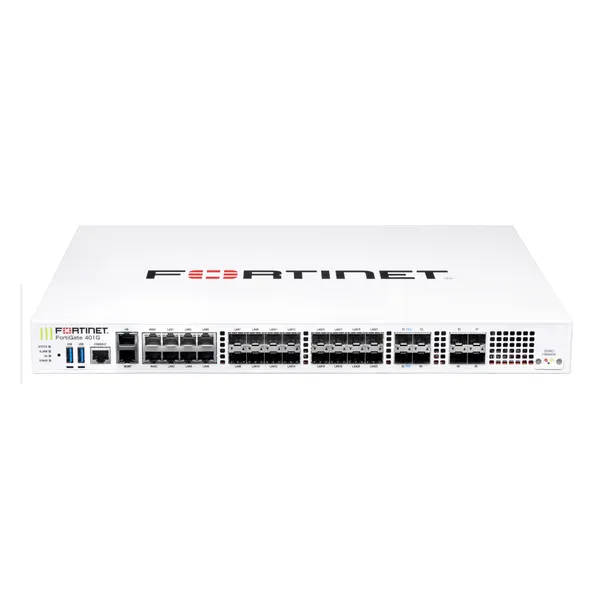
FortiGate 400G in Uganda
A high-capacity Fortinet next-generation firewall for enterprise perimeter protection, segmentation, secure connectivity and policy enforcement.
The 400G is aimed at organizations that need substantially more session scale and security throughput than branch-class appliances while retaining the operational model of FortiOS. FourTeck can help Uganda buyers translate internet capacity, east-west traffic, VPN demand, interface requirements and subscription choices into an appropriate bill of materials.
Fortinet
FG-400G
Enterprise NGFW
Up to 164 Gbps
13 Gbps
Contact for current options
Security capacity for larger enterprise networks
The FortiGate 400G is positioned as a high-performance next-generation firewall for organizations that need to protect busy internet edges, inter-site connectivity, large user populations and segmented internal networks. Fortinet publishes firewall throughput of 164/163/145 Gbps for 1518/512/64-byte UDP traffic, 55 Gbps of IPsec VPN throughput, 16 Gbps of IPS throughput in its current product matrix, 14 Gbps of NGFW throughput and 13 Gbps of threat-protection throughput. Those figures make the appliance relevant to buyers whose security requirement is no longer adequately described by a simple internet bandwidth number.
In a real business design, the firewall may inspect traffic between users and cloud applications, protect public-facing services, terminate site-to-site VPNs, enforce segmentation between departments or server zones, and support policy control across distributed sites. The appliance can therefore become part of the operational backbone rather than merely a perimeter gateway. That raises the importance of correct sizing. A design that looks comfortable when measured only against raw firewall capacity can become constrained when deep inspection, intrusion prevention, application control, malware protection, logging or encrypted traffic inspection are added.
Fortinet’s wider architecture uses FortiOS to converge networking and security functions, with FortiGuard services providing security intelligence and FortiManager and FortiAnalyzer available for centralized administration and analytics. This can be useful to organizations that want a consistent policy model across multiple FortiGate appliances or a broader Fortinet Security Fabric deployment.
For Uganda buyers, FourTeck can assist by reviewing the intended WAN links, protected networks, security services, number of sites, VPN profile, interface media and support term. This is particularly important for procurement teams that need a complete bill of materials rather than only the firewall chassis. Transceivers, subscriptions, support coverage, rack requirements, redundant connectivity and high-availability planning may all affect the final project scope.
What the 400G can change operationally
01
Preserve headroom for fast network edges
Published firewall throughput reaches 164 Gbps, giving architects room to accommodate high-speed uplinks, large east-west flows or aggregated traffic. The business value is not just speed: sufficient headroom helps avoid making the security gateway the obvious choke point when applications, cloud usage and user counts grow.
02
Protect traffic while maintaining useful security performance
Threat-protection throughput is published at 13 Gbps and NGFW throughput at 14 Gbps. These are more meaningful figures for networks that enable several inspection functions simultaneously. Properly sizing around inspected workloads helps IT teams enforce stronger policy without purchasing solely on raw forwarding numbers.
03
Support large connection populations
Fortinet lists 28 million concurrent sessions for the platform. High session capacity matters in environments with many users, cloud services, IoT devices, application servers or high-connection workloads because the firewall must maintain state efficiently as connection counts fluctuate.
04
Build encrypted site connectivity at scale
Up to 55 Gbps IPsec VPN throughput gives network designers substantial capacity for site-to-site encryption and remote connectivity architectures. The practical advantage is the ability to consolidate secure links through a central enterprise edge while still leaving performance margin for policy enforcement.
05
Use one operating model across networking and security
FortiOS provides a common control plane for firewall policy, routing, VPN, SD-WAN and security services. For IT teams already using Fortinet, this can simplify skills, templates and operational procedures compared with managing separate products for each function.
06
Design for redundancy and planned maintenance
Enterprise firewall deployments frequently use high-availability pairs, redundant power, diverse uplinks and redundant switching paths. The 400G can fit that architecture, but buyers should plan optics, cabling, interface allocation and subscription coverage for both units rather than treating HA as a last-minute add-on.
A firewall platform designed for performance and security convergence
What distinguishes this model is the combination of high raw firewall capacity, double-digit inspected-security throughput, large session scale and FortiOS integration. For buyers, that means one appliance can be evaluated for several roles at once: internet edge, segmentation gateway, VPN concentrator, secure SD-WAN hub and policy enforcement point.
Capability: 164/163/145 Gbps firewall throughput. Enables: high-capacity forwarding across mixed packet sizes. Configuration note: inspected traffic should be sized using security-throughput figures, not firewall-only results.
Capability: 55 Gbps IPsec VPN throughput. Enables: encrypted site-to-site and hub connectivity. Configuration note: tunnel count, cipher use and real traffic mix affect practical design.
Capability: 14 Gbps NGFW and 13 Gbps threat protection. Enables: policy enforcement with inspection services. Configuration note: service subscriptions and enabled inspection features determine the final security posture.
Capability: 28 million concurrent sessions. Enables: large user and device populations. Configuration note: session rate and application behavior should be reviewed alongside concurrent-session capacity.
FortiGate 400G specification ledger
| Specification | Published / planning value |
|---|---|
| Brand / model | Fortinet FortiGate FG-400G |
| Product type | Next-generation firewall appliance |
| Firewall throughput | 164 / 163 / 145 Gbps (1518 / 512 / 64-byte UDP) |
| IPsec VPN throughput | 55 Gbps |
| IPS throughput | 16 Gbps in Fortinet current product matrix; performance definitions may vary by publication revision |
| NGFW throughput | 14 Gbps |
| Threat protection throughput | 13 Gbps |
| Concurrent sessions | 28 million |
| Management | FortiOS; centralized management and analytics available through Fortinet platform tools |
| Security services | FortiGuard service capabilities based on selected subscription |
| Interfaces | High-speed copper and fiber connectivity; confirm exact port map against the current Fortinet datasheet before final BOM |
| High availability | Supported; design and accessory requirements are configuration dependent |
| Form factor / power | Rack-mount enterprise appliance; confirm current mechanical and power values for the selected regional SKU |
| Licensing / support | Based on selected FortiGuard and FortiCare bundle and term |
For procurement, the most important figures are usually the security throughput numbers, not the headline firewall rate. A 20 Gbps internet edge, for example, may still require careful sizing if a high proportion of sessions will receive intrusion prevention, application control, malware inspection or encrypted traffic inspection. Conversely, a network with very high east-west forwarding but limited deep inspection may be constrained by a different metric. The 28-million-session figure is also relevant to organizations with many users, endpoints, cloud applications or IoT devices, because connection density can become a sizing factor independent of bandwidth.
Interface selection deserves equal attention. The firewall must connect cleanly to carrier handoffs, core switches, DMZ networks, high-availability peers and management infrastructure. Optical transceiver type, fiber standard, copper speed, breakout requirements and switch-side capabilities should be documented before ordering. FourTeck can review these details with the buyer so the quote includes the appliance, subscription term and practical connectivity items needed for deployment.
Five questions to answer before selecting the final configuration
01 — What traffic must be protected?
Document internet bandwidth, private WAN links, data-center flows and any east-west traffic that will traverse the firewall. Then identify which traffic requires IPS, application control, anti-malware services or encrypted inspection. This changes the sizing basis because raw firewall throughput and inspected-security throughput are different metrics.
02 — How many users, devices, sessions and VPN connections are expected?
User count alone is not enough. A busy campus, call center, cloud-heavy office or IoT environment can create far more sessions per person than a traditional office. Include remote users, branch tunnels, application servers and anticipated session growth so the design can be checked against session capacity and VPN requirements.
03 — What must the firewall connect to?
List carrier handoff speeds, core-switch ports, fiber standards, transceiver types, VLAN trunks, routing protocols, HA connections and management networks. Compatibility at the physical and logical layers prevents a situation where the appliance arrives but cannot be integrated without additional optics, adapters or switch changes.
04 — What security subscriptions and growth path are required?
FortiGuard services and FortiCare support are selected by bundle and term. Buyers should decide which protections are required by policy, compliance or operational risk, and whether the organization prefers one-, three- or five-year planning. A longer project horizon may change the commercial comparison and renewal planning.
05 — What are the installation, delivery and support expectations?
Confirm rack space, power redundancy, high-availability strategy, quantity, rollout schedule, delivery location, implementation responsibility and support expectations. These details help turn a chassis request into a deployment-ready quote rather than a partial bill of materials.
Deployment scenarios where the 400G makes practical sense
Enterprise headquarters internet edge
A large headquarters may have multiple internet circuits, thousands of users, public-facing services and heavy cloud traffic. The 400G can act as a consolidated edge firewall where policy, application control, threat inspection and VPN services are centralized. The fit is strongest when the design needs substantial performance headroom and large session capacity. Buyers should map circuit speeds to expected inspected throughput and ensure the selected license enables the protections required by corporate policy.
Secure SD-WAN aggregation hub
Organizations with many branches may use a central FortiGate to terminate encrypted links, steer traffic and enforce policy between branch networks, cloud destinations and shared services. The 55 Gbps IPsec figure gives architects meaningful capacity for encrypted aggregation. The final design should nevertheless account for tunnel count, traffic symmetry, routing, redundancy and whether hub traffic is also subject to full security inspection.
Campus segmentation and controlled east-west traffic
Universities, healthcare campuses, government environments and large enterprises often need to separate users, servers, IoT systems and administrative networks. A high-capacity firewall can provide policy enforcement between those zones when traditional switching ACLs are not sufficient. Before purchase, confirm the aggregate inter-zone bandwidth and interface design because segmentation can move substantial internal traffic through the firewall.
Data-rich branch or regional aggregation point
A regional office may aggregate several local sites, business applications, cloud services and private links. The 400G can be considered where a smaller branch appliance would leave limited headroom for future traffic, encrypted tunnels or inspection features. Selection should still be based on real measurements and a growth assumption rather than choosing the largest model available without an operational reason.
Inspection performance is the real sizing conversation
The most common mistake in firewall selection is treating the largest published throughput figure as the performance available under every security policy. Firewall throughput typically represents basic forwarding under defined test conditions. Enterprise deployments normally enable additional security engines such as intrusion prevention, application identification, malware protection and logging. Fortinet therefore publishes separate IPS, NGFW and threat-protection metrics so architects can compare the appliance against a more realistic feature set.
For the 400G, the difference is significant: raw firewall throughput reaches 164 Gbps, while NGFW throughput is listed at 14 Gbps and threat protection at 13 Gbps. That does not mean the platform is slow; it means the buyer should align the metric with the workload. A network with 10 Gbps of internet connectivity and comprehensive security inspection may fit comfortably, while a design expecting tens of gigabits of fully inspected traffic needs a more careful engineering review.
Encrypted traffic adds another layer. SSL/TLS inspection can expose threats hidden inside encrypted sessions, but it consumes resources and may introduce certificate, application compatibility and privacy considerations. Organizations should identify where deep inspection is required, where exemptions are appropriate and which applications are sensitive to interception.
FourTeck can help buyers prepare the technical information needed for a sizing discussion: average and peak traffic, projected growth, policy set, proportion of encrypted traffic, application mix and high-availability requirement. That produces a more defensible procurement decision than selecting on internet link speed alone.
VPN scale for distributed enterprise connectivity
IPsec VPN remains a core requirement for businesses linking branches, data centers, cloud environments and remote sites over untrusted networks. The FortiGate 400G publishes 55 Gbps of IPsec VPN throughput, giving architects substantial encrypted transport capacity for hub-and-spoke or more distributed designs. In practice, the useful capacity depends on tunnel topology, cipher suites, packet size, traffic inspection and how much branch traffic is hairpinned through a central site.
Capability line 1: 55 Gbps published IPsec VPN throughput provides a strong baseline for encrypted site connectivity.
Capability line 2: FortiOS can combine routing, SD-WAN logic, VPN and security policy in one platform, reducing the need to treat each function as a separate appliance.
Capability line 3: High-availability architecture can be used to reduce single-device dependency, provided both appliances, links and upstream paths are designed for failover.
For buyers, the key question is not simply how many tunnels exist today. A better planning model includes peak encrypted bandwidth, number of branches, cloud connectivity, failover paths, authentication requirements, routing complexity and growth. If the 400G will act as a central VPN hub, those values should be documented before procurement so interface allocation and redundancy can be validated.
FortiOS, subscriptions and lifecycle planning
The appliance is only one part of an enterprise firewall purchase. FortiOS supplies the operating environment for firewalling, routing, VPN, SD-WAN and security policy, while FortiGuard services provide subscription-based protections and FortiCare provides support coverage according to the selected offer. Procurement teams should therefore evaluate the hardware and recurring service plan together.
A subscription decision affects which security capabilities are available and how renewals will be managed. It can also affect budgeting because a one-year acquisition has a different lifecycle profile from a three- or five-year project. Organizations with formal security standards should map required controls to the chosen service package rather than selecting a bundle by name alone.
Centralized management is another planning point. Environments with many FortiGate devices may benefit from FortiManager for policy and configuration administration, while FortiAnalyzer can support logging, analytics and reporting. These are not automatically required for every deployment, but the intended operating model should be decided early enough to include any necessary licensing or infrastructure in the project.
Buyer decision checklist
□ Which FortiGuard protections are mandatory?
□ What FortiCare support level and term are expected?
□ Will the deployment use centralized management or analytics?
□ Is an HA pair required from day one?
□ Are optics, cables and rack accessories included in the BOM?
□ Is renewal ownership assigned to procurement or IT operations?
What buyers should check before purchase
| Risk | What to confirm | Why it matters | What to share with FourTeck |
|---|---|---|---|
| Wrong sizing basis | Inspected traffic, not only WAN speed | Security services reduce usable throughput versus raw firewall forwarding | Peak traffic, security features, growth |
| Incomplete connectivity BOM | Port types, optics, fiber, copper and switch compatibility | The appliance may require additional transceivers or cabling | Interface map and connected devices |
| Subscription mismatch | FortiGuard and FortiCare bundle and term | Required protections and support depend on the selected services | Security requirements and preferred term |
| Redundancy gap | HA pair, dual links, power and failover design | A single appliance can remain a single point of failure | Target availability and topology |
Additional checks should include rack space, power feeds, environmental requirements, support ownership, deployment responsibility, replacement-model guidance if availability changes, and whether the project quantity will be delivered at once or in phases. Where a precise technical value is critical, the current Fortinet datasheet for the exact regional SKU should be treated as the controlling reference.
Procurement support for Uganda projects
FourTeck can support Uganda organizations seeking the FortiGate 400G with configuration review, quotation assistance, delivery coordination and guidance on the commercial items that surround the appliance. Availability can vary by quantity, bundle, support term and supply conditions, so the sensible approach is to request a current quote based on the exact project requirement rather than assume stock status.
For Kampala projects, buyers can provide the target network size, number of internet or WAN links, desired FortiGuard services, FortiCare term, HA requirement, optics, quantity and preferred delivery schedule. FourTeck can then help align the quote with the intended deployment. Warranty and support guidance should be confirmed against the selected FortiCare package and product terms at the time of purchase.
Uganda location coverage
Organizations in Kampala, Entebbe, Jinja, Mbarara and Gulu can contact FourTeck Uganda for project quotation, configuration discussion and delivery coordination. Coverage is handled according to the specific order, quantity and destination, so buyers should include the delivery point and required timeline when requesting commercial assistance.
East Africa and wider project sourcing
Organizations managing infrastructure across several countries may need consistent firewall models, subscription terms and technical standards across multiple sites. FourTeck platforms can assist with product and quotation enquiries for Uganda, Kenya and selected East Africa or Africa markets, with additional regional platforms available for the UAE and Kuwait where relevant to the procurement structure.
Regional buyers should avoid assuming that availability, delivery timing, local service handling or commercial terms are identical in every country. Each location may require separate confirmation. For multi-country projects, provide the quantity per destination, intended deployment schedule, subscription term and whether a standardized configuration is required across all sites.
Useful regional starting points include FourTeck Uganda, FourTeck Kenya, FourTeck Africa, FourTeck UAE and FourTeck Kuwait.
Related Fortinet paths to compare
FortiGate 200G: suitable when the security throughput, session scale and interface requirements are below the 400G class. Explore FortiGate 200G options.
FortiGate 700G: a higher-performance path for environments needing more inspected-security throughput. Review FortiGate 700G availability.
FortiGate 900G: relevant to larger enterprise edges and more demanding security inspection. Compare FortiGate 900G options.
FortiSwitch: useful where the firewall will integrate access switching through Fortinet’s networking stack. Browse FortiSwitch solutions.
FortiManager and FortiAnalyzer: consider centralized administration, logging and analytics for multi-device deployments. Find FortiManager solutions.
Practical assistance before the purchase order
01 Product selection guidance. FourTeck can help compare the 400G with adjacent FortiGate models using the buyer’s actual traffic profile, user population and security requirements.
02 Configuration review. Interface planning, optics, HA, subscriptions and support terms can be reviewed before quotation so the BOM is closer to deployment requirements.
03 Quote assistance. Buyers can submit project quantity, destination and commercial term requirements for a current quotation rather than relying on generic online pricing.
04 Business IT context. A firewall is connected to switches, WAN services, servers, identity systems and operational processes. The procurement discussion can therefore include related infrastructure needs rather than treating the appliance in isolation.
05 Uganda delivery coordination. Delivery requirements can be discussed for the intended destination and project schedule, subject to current product availability and logistics confirmation.
06 Alternative matching. If the selected model, bundle or lead condition changes, FourTeck can help identify a suitable Fortinet alternative based on the original technical requirement.
FortiGate 400G buyer questions
01. What is the FortiGate 400G mainly used for?
It is a high-performance next-generation firewall for enterprise network protection. Typical roles include internet edge security, segmentation, VPN aggregation, secure SD-WAN and policy enforcement between major network zones. Its fit depends on the amount of traffic that needs inspection, session volume, VPN load and connectivity design rather than organization size alone.
02. What throughput should I use for sizing?
Use the metric that matches the enabled services. Fortinet publishes up to 164 Gbps raw firewall throughput, but NGFW and threat-protection figures are lower because they represent additional inspection. For a production design, calculate peak inspected traffic and growth, then validate the model against the security services you intend to enable.
03. Is the 400G suitable as a VPN hub?
It can be a strong candidate. Fortinet lists 55 Gbps of IPsec VPN throughput, giving substantial capacity for encrypted site connectivity. The final design should still account for branch count, traffic symmetry, tunnel topology, cipher choice, routing, redundancy and any additional inspection applied to traffic after decryption.
04. Does the appliance require FortiGuard subscriptions?
The hardware can perform core firewall and networking functions, while many advanced threat-protection capabilities depend on the selected FortiGuard service package. Buyers should define required security controls and choose an appropriate service bundle and term. FortiCare support should also be selected according to operational and support expectations.
05. Should I deploy one unit or an HA pair?
Mission-critical environments commonly consider high availability to reduce dependence on a single firewall. Whether an HA pair is required depends on the organization’s acceptable outage risk, upstream redundancy and maintenance model. If HA is planned, include both appliances, interface connections, power feeds, licenses and support coverage in the project design.
06. What information is needed for a Uganda quote?
Provide quantity, delivery location, WAN and internet speeds, expected inspected traffic, user and device scale, VPN requirements, desired FortiGuard and FortiCare term, HA requirement and interface media. This gives FourTeck enough context to prepare a more relevant commercial response and flag missing accessories or licensing questions.
07. Can the firewall integrate with FortiSwitch and Fortinet management tools?
Yes, FortiGate is part of Fortinet’s broader Security Fabric architecture. Depending on the deployment, FortiSwitch integration, centralized management through FortiManager and analytics or logging through FortiAnalyzer may be relevant. These components should be evaluated according to the number of devices, operational model and reporting requirements rather than added automatically.
08. What accessories should be checked before ordering?
Confirm optical transceivers, fiber or copper cables, rack requirements, power feeds, redundant links and any modules or connectivity items needed by the surrounding network. The correct list depends on the carrier handoff, switch interfaces, distance and HA design. A port-by-port connection plan is the safest basis for the BOM.
09. Is availability guaranteed in Uganda?
No. Availability can vary with quantity, selected bundle, regional supply and project timing. FourTeck can check current options when a buyer requests a quote. For a useful response, include the required quantity, preferred subscription term, delivery destination and target schedule rather than relying on generic stock assumptions.
Prepare a deployment-ready FortiGate 400G request
For a more accurate quote, send the network speeds, expected inspected traffic, number of sites, VPN demand, HA requirement, preferred FortiGuard/FortiCare term, interface media, quantity and Uganda delivery location. FourTeck can use those details to review the configuration and identify the commercial items that belong in the project.
Share: bandwidth • security services • user/device scale • VPN design • HA plan • optics/cabling • support term • quantity • destination

Reviews
There are no reviews yet.