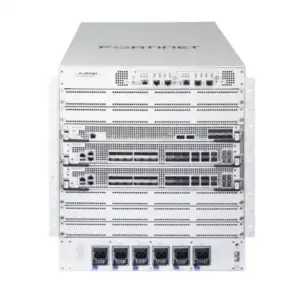
Fortinet FortiDDoS VM16 Virtual DDoS Protection System for Uganda
Fortinet FortiDDoS VM16 is the highest-capacity FortiDDoS virtual-machine tier in the VM04, VM08 and VM16 family. It is built for organizations that want dedicated distributed-denial-of-service protection while retaining a virtualized infrastructure model. The system is deployed inline on supported virtualization infrastructure and continuously observes network behavior, builds traffic baselines, identifies abnormal packet and protocol activity, and applies mitigation before malicious traffic can exhaust protected services. Fortinet publishes VM16 support for up to 16 vCPU cores, 32 GB vRAM, eight NIC ports plus two management ports, and performance up to 10 Gbps / 10 Mpps under the vendor’s stated test environment. Actual performance depends on server hardware, virtualization design and interface acceleration.
For procurement teams in Uganda, the main question is not simply whether a virtual DDoS platform can be licensed. The practical decision is whether the proposed server, hypervisor, NIC architecture, protected link, routing design and resilience plan can sustain the required traffic profile. FortiDDoS VM16 is therefore best treated as an infrastructure project rather than a standalone software purchase. FourTeck can help buyers validate the model tier, host resources, network-interface mapping, licensing requirements and deployment assumptions before a purchase order is issued.
Instant Specifications & Procurement Facts
FortiDDoS-VM16
FDD-VM016
Up to 16 vCPU
32 GB vRAM license sizing
Up to 10 Gbps / 10 Mpps
8 NIC ports + 2 management ports
VMware and KVM on current supported releases
Quote-based enterprise procurement
The published throughput figure should be interpreted as a sizing reference, not a guarantee for every host. Fortinet states that actual VM performance varies with underlying hardware and its published VM16 results were observed on specified bare-metal server hardware using VMware ESXi and SR-IOV. Buyers should therefore provide expected average and peak bandwidth, packet rates, protected service types and host specifications when requesting a quotation. Warranty and support coverage should also be confirmed against the exact license and FortiCare package included in the commercial offer.
Operational Architecture and Deployment Overview
FortiDDoS is designed as an inline DDoS defense platform. Unlike a conventional routed firewall, the protected data interfaces are used in bridged link pairs. This architecture allows the platform to sit in the traffic path, analyze traffic at packet level and enforce mitigation without requiring the protected data interfaces to behave like ordinary routed endpoints. That distinction matters greatly in virtual environments. The virtual host must expose the necessary network interfaces and virtual switching design so traffic actually traverses the FortiDDoS instance. Fortinet specifically notes that FortiDDoS VMs are not suitable for ordinary cloud-service environments such as AWS, Azure or Google Cloud because the data ports have no IP addresses and cannot be addressed using those cloud traffic-routing models. The VM must instead be attached to physical links through a supported virtualization design.
The VM16 tier gives larger enterprises more processing headroom than VM04 or VM08. Its role is to protect availability when attackers attempt to overwhelm internet-facing services with floods, reflection traffic, malformed or abusive protocol behavior, or high packet-per-second loads. FortiDDoS monitors a large number of traffic parameters and uses adaptive baselining to distinguish changing legitimate usage from abnormal behavior. Fortinet positions the platform around autonomous mitigation and full packet inspection rather than sampled traffic analysis. This is valuable where operations teams need protection to react quickly without waiting for a manual incident workflow.
In a production design, the FortiDDoS VM16 should be considered together with upstream connectivity, edge routing, firewalls, load balancers, server clusters and disaster-recovery paths. DDoS mitigation cannot compensate for an upstream circuit that is already saturated before traffic reaches the protected point. A complete architecture review therefore asks where attacks are expected to enter, what the circuit capacity is, what packet rate can reach the VM host, which services must remain reachable, and whether upstream provider cooperation is required for attacks larger than the local access capacity.
The virtual form factor can simplify procurement for organizations already standardized on suitable server and hypervisor infrastructure. It removes the need to allocate rack space for a dedicated FortiDDoS appliance, but it does not eliminate infrastructure requirements. CPU scheduling, NUMA placement, physical NIC capabilities, virtual-switch design, SR-IOV where appropriate, storage, management connectivity and redundant host power all affect operational quality. A VM that is nominally allocated 16 vCPUs but competes heavily for physical CPU resources may not deliver the same result as a carefully reserved deployment on an adequately sized host.
Enterprise Business Outcomes and Value
VM16 provides the largest processing tier in the FortiDDoS VM family, with published mitigation performance up to 10 Gbps and 10 Mpps. The packet-rate dimension is particularly important because DDoS events can stress infrastructure with enormous quantities of small packets even when bandwidth alone appears manageable. Correct sizing should consider both Gbps and Mpps rather than using internet-circuit speed as the only metric.
FortiDDoS supports high-availability designs. For VM deployments, resilience also depends on host architecture, redundant physical NICs, switching, power feeds and virtualization availability. Buyers should map failure domains so a single server, virtual switch or uplink cannot silently become the weakest link in the DDoS protection chain.
Organizations moving from VM04 or VM08 requirements can select VM16 when additional CPU and mitigation capacity are required. The tiered licensing approach helps procurement teams align virtual resources with expected traffic scale. Future growth should be assessed against internet bandwidth expansion, service launches and the likelihood that peak packet rates will rise faster than average traffic.
The platform is focused on denial-of-service resilience. It complements rather than replaces firewalls, application security controls, endpoint protection and identity systems. Its business value is continuity: keeping legitimate users connected while malicious floods and protocol attacks are detected and mitigated.
A dedicated mitigation platform gives network and security teams visibility into attack behavior, protected subnets and mitigation activity. Autonomous response can reduce dependence on human intervention during fast-moving incidents, while operational teams retain control for policy review, reporting and tuning.
Virtual deployment can reuse existing compute, rack, power and virtualization operations, but those resources still carry cost. Procurement comparisons should include server capacity, NIC upgrades, hypervisor support, FortiDDoS licensing, FortiCare, redundant infrastructure, implementation effort and lifecycle maintenance rather than comparing software license price with appliance purchase price alone.
Key Platform Highlights
FortiDDoS VM16 combines a dedicated DDoS software stack with virtualized compute and network resources. Up to 16 vCPUs provide the processing tier associated with the VM16 license, while 32 GB vRAM is the published license-size memory allocation. Eight NIC ports support four bridged data link pairs and two additional management ports provide administrative connectivity. The design supports inline inspection and mitigation while keeping management logically separate from protected data paths.
Fortinet highlights 100% packet inspection, sub-second mitigation behavior across the FortiDDoS family, adaptive traffic baselining and defenses for common reflection and protocol attacks. Support includes advanced DNS and NTP protection as well as mitigation capabilities for modern protocols such as DTLS and QUIC in current product positioning. Because FortiDDoS is purpose-built for availability protection, it should be deployed alongside existing perimeter controls rather than treated as a replacement for a next-generation firewall.
Technical Specifications Ledger
| Specification | FortiDDoS VM16 | Procurement Note |
|---|---|---|
| Product type | Virtual DDoS protection system | Inline virtual deployment |
| Vendor SKU | FDD-VM016 | Confirm license/support bundle on quote |
| vCPU | Up to 16 | Reserve suitable physical CPU resources |
| vRAM | 32 GB published VM16 sizing | Connection scale can depend on available memory |
| NIC ports | 8 data NIC ports | Supports four bridged link pairs |
| Management ports | 2 | Plan separate management reachability |
| Published performance | Up to 10 Gbps / 10 Mpps | Actual performance varies by host |
| Hypervisor support | VMware, KVM on supported current releases | Validate exact software release before deployment |
| Public-cloud suitability | Not intended for standard AWS/Azure/GCP deployment | Inline data ports must attach to physical links |
| License validation | Periodic Fortinet Distribution Network validation | Provide suitable FortiGuard connectivity |
Virtual products do not have appliance dimensions, rack-unit height or a dedicated hardware power-draw figure. Those values are determined by the selected server platform. For procurement, this means environmental, electrical and rack planning must be performed against the physical virtualization host rather than the FortiDDoS license itself. If the project requires deterministic appliance-level physical specifications, a FortiDDoS hardware model may be more appropriate.
Configuration and Sizing Worksheet
1. Estimate protected workload
Record normal bandwidth, busy-hour bandwidth, maximum internet-circuit capacity and observed packet rates. Add planned growth for new applications, branches, digital channels and customer-facing services. DDoS sizing must consider small-packet floods, so ask the network team for packet-per-second telemetry where available. If only bandwidth is known, treat the design as preliminary until packet-rate assumptions are reviewed.
2. Confirm traffic topology
Document every link that must traverse the mitigation system. Identify upstream routers, firewalls, load balancers and downstream switching. FortiDDoS uses bridged data link pairs, so the virtual switching and physical NIC plan must preserve the intended inline path. Determine whether one or several protected links are required and whether bypass behavior is expected at another infrastructure layer.
3. Validate host and rack environment
VM16 needs suitable compute and memory resources, but the quality of those resources matters. Check CPU generation and clock characteristics, virtualization contention, NUMA architecture, physical NIC capabilities and whether SR-IOV is available in the chosen design. Confirm server rack space, cooling, power and redundant power feeds. The FortiDDoS VM has no independent chassis, so all physical resilience derives from the server and network platform hosting it.
4. Review licensing and support
Confirm that the commercial offer specifically identifies the VM16 tier and any required FortiCare coverage. FortiDDoS VM must periodically validate its license with Fortinet infrastructure. Include management-network access requirements in implementation planning. Do not assume that a trial deployment can simply remain operational after evaluation; a production license is required.
5. Prepare the quote request
Provide organization name, delivery location in Uganda, required model, target deployment date, hypervisor, host specifications, expected bandwidth, packet rate if known, number of protected links, high-availability requirement and requested support term. Also state whether FourTeck should provide remote configuration assistance, pre-deployment review or bill-of-materials validation. Complete information reduces revision cycles and helps ensure that licensing and infrastructure assumptions match the intended production topology.
Deployment Scenarios and Industry Use Cases
Large Enterprise and Multi-Site Networks
A large organization may centralize internet-facing applications, VPN gateways and shared services in one or two data centers while branches connect through private WAN or internet circuits. FortiDDoS VM16 can be positioned at the protected data-center edge where inbound and outbound traffic crosses a controlled inline path. The design is particularly relevant when the organization already maintains robust VMware or KVM infrastructure and wants DDoS mitigation integrated into that operational environment. Multi-site planning should determine whether protection is centralized or whether each internet breakout requires its own mitigation point.
Financial and Banking Institutions
Banks, payment operators and financial platforms depend on continuous availability for online banking, transaction APIs, customer portals and partner connectivity. DDoS events can create operational and reputational impact even when no data is breached. A dedicated mitigation layer can help protect availability, but banking designs should also include redundant upstream connectivity, strong change control, independent management access, monitoring integration and tested failover procedures. Procurement should include implementation and support requirements, not only the VM license.
Educational and Campus Networks
Universities and large campuses can experience highly variable traffic from learning systems, research services, public websites and student networks. The VM16 tier can suit institutions with substantial data-center traffic and existing virtualization expertise. Capacity planning should account for semester peaks, online examination periods and public services whose availability is time-critical. Segmentation and firewall policy remain separate responsibilities; FortiDDoS focuses on denial-of-service behavior.
Government and Defense Procurement
Public-sector environments often require documented specifications, lifecycle support, controlled implementation and resilient service delivery. FortiDDoS VM16 can be considered where a virtual form factor aligns with approved infrastructure. Procurement teams should verify the exact supported software release, licensing, management connectivity, host security baseline, redundancy design and support entitlement. Any sovereignty, accreditation or classified-environment requirement must be assessed separately against organizational policy and the final technical architecture.
Technical Deep Dive: Processing and Acceleration
Virtual DDoS mitigation places unusual demands on the compute path because packet-per-second performance can become more important than conventional application throughput. A flood of minimum-size packets can consume CPU, interrupt and queue resources long before a link reaches its headline Gbps capacity. VM16 addresses this by providing the 16-vCPU tier and by supporting high-performance virtualization techniques in suitable environments. Fortinet’s published performance testing references VMware ESXi and SR-IOV, which is significant because SR-IOV can reduce layers of virtual switching overhead by exposing virtual functions from capable physical NICs to the guest. The exact design should be validated against the server vendor, NIC firmware, hypervisor release and FortiDDoS release.
CPU oversubscription should be approached cautiously. A host that performs well for ordinary business VMs may behave differently during sustained packet-processing load. Where DDoS protection is mission-critical, allocate predictable compute resources and avoid treating the mitigation VM as a best-effort workload. Monitor host-level CPU ready time, NUMA placement, NIC errors and interface utilization during testing. A controlled traffic test before production cutover can reveal bottlenecks that license sizing alone cannot show.
Technical Deep Dive: Software, Firmware and Operational Control
FortiDDoS software provides the detection, baselining, mitigation, logging and management functions of the platform. Current Fortinet documentation should be consulted before upgrades because supported hypervisors and hardware generations can change by software release. Change management should include configuration backup, release-note review, maintenance-window planning and rollback preparation. Security teams should also ensure that management interfaces are placed on controlled networks and that administrative access follows the organization’s authentication and privileged-access policies.
License validation is another operational dependency. Fortinet documentation states that FortiDDoS VM periodically re-validates licensing through the Fortinet Distribution Network and should be able to connect to FortiGuard services for that purpose. Networks with restricted outbound connectivity should include this requirement in firewall and proxy planning before deployment. This is especially important for regulated environments where internet access from management segments is tightly controlled.
Technical Deep Dive: High Availability and Recovery
High availability must be designed across layers. The mitigation software may support an HA architecture, but service continuity also depends on physical hosts, hypervisors, network adapters, upstream switches, routers, power systems and circuits. A resilient deployment maps each component and asks what happens when it fails. If both protection instances depend on one physical switch or one power distribution unit, apparent software redundancy may still contain a single point of failure.
Disaster-recovery planning should document configuration backup, license handling, replacement-host preparation, interface mappings and recovery order. Teams should know how to restore protected traffic if the primary virtualization cluster is unavailable. Where a secondary data center exists, determine whether it needs an independent licensed instance and whether traffic can be redirected without exceeding the secondary site’s mitigation or upstream bandwidth. Recovery procedures should be exercised rather than left as diagrams.
Pre-Purchase Buyer Gap Checklist
Is VM16 a cloud marketplace appliance? No. Fortinet specifically distinguishes FortiDDoS VM from conventional public-cloud virtual appliances. Its inline data ports have no IP addresses and the design requires attachment to physical links, making standard AWS, Azure and Google Cloud routing unsuitable. Buyers needing cloud-native DDoS services should evaluate a different architecture.
Does 10 Gbps mean every server will deliver 10 Gbps? No. Fortinet states that actual performance varies with underlying hardware. The published figure is a tested reference. CPU type, clock rate, NUMA, NIC model, virtualization overhead, SR-IOV and competing workloads can affect results.
Are 16 vCPUs the only host requirement? No. VM16 sizing also includes memory and networking requirements. The broader server platform must be able to sustain packet processing. Capacity should be reserved with the same seriousness given to other critical network functions.
Are there hidden infrastructure costs? Potentially. Budget for server resources, high-performance NICs where needed, redundant switching, virtualization support, implementation effort, support subscriptions and operational monitoring. A virtual license may reduce appliance rack requirements, but it is not infrastructure-free.
Can it replace the firewall? FortiDDoS is specialized for DDoS detection and mitigation. Existing firewall, VPN, application security and identity controls remain necessary. The correct architecture assigns each platform its intended role.
What should be confirmed before the purchase order? Confirm model tier, vendor SKU, license term, FortiCare coverage, hypervisor and release compatibility, host specifications, interface count, topology, expected throughput, packet rate, HA requirement, implementation scope, delivery terms and commercial validity. Ask that all assumptions appear on the quotation or accompanying design document.
Uganda Procurement and Delivery Logistics
FourTeck Uganda supports enterprise quotation workflows for Fortinet solutions. For FortiDDoS VM16, procurement normally begins with a requirement review because the correct deliverable is more than a box shipped to a site. The quotation should identify the virtual license, support entitlement and any implementation or engineering services requested. If the organization operates under formal tender or purchase-order procedures, provide the required company details, tax documentation requirements, delivery location, bid validity expectation and requested support term at the start of the process.
Because VM16 is a virtual product, fulfillment may involve license entitlement and support registration rather than physical appliance delivery. However, related servers, NICs, optics, switches or other infrastructure may have separate logistics. Lead time should therefore be confirmed against the complete bill of materials. FourTeck can assist with pre-deployment review so the receiving technical team understands CPU, memory, interface and hypervisor requirements before activation.
Local Coverage in Uganda
Organizations in Kampala can request enterprise quotations and technical planning for data-center and headquarters deployments. Entebbe customers can coordinate projects supporting corporate, hospitality, logistics and institutional networks. Jinja deployments may include industrial, education and distributed-enterprise environments. Mbarara organizations can plan regional data-center or campus requirements, while Gulu customers can procure solutions for growing institutional and multi-site networks. Delivery and service arrangements depend on the final bill of materials, support scope and project schedule, so exact timelines should be stated in the commercial quotation rather than assumed from the product model alone.
Cross-Border and Regional Supply
Regional organizations often standardize security architecture across several countries. FourTeck supports procurement pathways for Uganda, Kenya, the wider African market, the UAE and Kuwait. Cross-border projects should align model numbers, licensing, support registration and technical standards across sites while keeping local invoicing, tax, import and delivery requirements visible.
For a virtual product, regional consistency is often achieved by standardizing the approved server profile, hypervisor version, NIC design, management network and FortiDDoS software baseline. This can simplify operations and disaster recovery. Physical accessories and host infrastructure should still be validated locally because server availability, optics and rack standards can differ by site.
Related Fortinet Solutions and Project Components
A FortiDDoS deployment commonly sits within a wider security and network architecture. Buyers can explore the FourTeck Uganda enterprise technology portfolio and request related Fortinet components through the Uganda sales and engineering team. Depending on topology, the project may also require next-generation firewalls, managed switching, compatible server NICs, optical transceivers, redundant power infrastructure, monitoring integration and support services. The correct combination should be derived from the network diagram rather than added as generic accessories.
Organizations comparing VM sizes should ask for a side-by-side review of FortiDDoS VM04, VM08 and VM16. Where virtual infrastructure cannot provide the required deterministic performance or inline connectivity, FortiDDoS hardware appliances should also be evaluated. This comparison is particularly useful for data centers expecting sustained high packet rates or preferring dedicated bypass-capable hardware.
FourTeck Technical Service Capabilities
FourTeck can support engineering validation before ordering by reviewing the proposed model, traffic assumptions, virtualization platform and link topology. Bill-of-materials verification helps identify whether the quotation includes the correct VM tier, support entitlement and any supporting infrastructure. For projects that include physical equipment, staging can cover inventory checks, firmware planning and configuration preparation before shipment. For virtual deployments, the equivalent preparation is host-readiness review, interface mapping and implementation planning.
Post-sales support scope can be defined according to the project: remote deployment guidance, configuration review, troubleshooting coordination and vendor support escalation where covered. Customers should request the desired service level on the quotation so responsibilities are clear. Fortinet support entitlement and FourTeck engineering services are related but distinct commercial elements and should be documented separately.
Extended Technical FAQ
What is Fortinet FortiDDoS VM16?
FortiDDoS VM16 is a virtual edition of Fortinet’s dedicated DDoS protection platform. It is intended to run on supported virtualization infrastructure and process traffic inline through bridged network interfaces. The VM16 license tier supports up to 16 vCPU cores and is positioned above VM04 and VM08 for higher processing requirements. Fortinet publishes performance up to 10 Gbps / 10 Mpps under its referenced test conditions. It is not a general firewall replacement; its specialized role is detecting and mitigating denial-of-service attacks while preserving legitimate service availability.
Which hypervisors can run FortiDDoS VM16?
Current Fortinet release documentation lists VMware and KVM support for FortiDDoS VM04, VM08 and VM16 on supported releases. Compatibility must be checked against the exact FortiDDoS software version planned for production because support matrices can change. A procurement team should record the current hypervisor product, version, server hardware and NIC model, then validate those details before deployment. Do not rely on an older deployment guide alone when building a new system.
Can FortiDDoS VM16 run in AWS, Microsoft Azure or Google Cloud?
Fortinet’s FortiDDoS data sheet states that FortiDDoS VMs are not suitable for deployment in cloud-service environments such as AWS, Azure or Google Cloud. The reason is architectural: FortiDDoS data ports have no IP addresses and cannot be addressed in the way those cloud environments normally direct traffic. FortiDDoS VMs must be attached to physical links. If a project requires DDoS protection for cloud-hosted applications, the architecture should be reassessed rather than assuming VM16 can be deployed like a typical cloud firewall image.
How much traffic can VM16 inspect and mitigate?
Fortinet currently publishes FortiDDoS VM16 performance at up to 10 Gbps / 10 Mpps. This is a useful sizing reference but not an unconditional guarantee. Fortinet explicitly notes that actual performance varies depending on underlying hardware, and its published results reference a specific Intel Xeon server environment, VMware ESXi and SR-IOV. Production sizing should therefore consider the host CPU, NIC architecture, virtual switching, resource contention, packet sizes and traffic profile. A design operating continuously near its theoretical maximum should include appropriate engineering margin.
What CPU and memory should be allocated?
The VM16 tier is licensed for up to 16 vCPUs, and Fortinet’s VM licensing documentation lists 32 GB vRAM for VM16. Memory can also influence maximum session capacity, so deployments with unusual connection scale should consult the current maximum-values documentation. Allocate resources on a host capable of sustaining high packet-processing load. Merely presenting 16 virtual CPUs to the guest is not enough if the physical host is heavily oversubscribed or has an unsuitable NIC path.
How many network interfaces does VM16 support?
Fortinet’s current order information describes FortiDDoS VM16 with up to eight NIC ports and two management ports. The data interfaces can form bridged link pairs for inline protection. The management interfaces are used for administration rather than ordinary protected traffic forwarding. During design, map each virtual interface to the correct virtual switch, port group and physical uplink, then document that mapping for recovery. Incorrect virtual switching can bypass the mitigation path or create connectivity problems even when the VM itself is correctly licensed.
Does FortiDDoS VM16 require a subscription?
A production FortiDDoS VM requires a valid license, and support coverage should be quoted according to the customer’s required term. Fortinet documentation also states that the VM periodically re-validates its license with the Fortinet Distribution Network and should connect to FortiGuard servers for license validation. The exact commercial structure, support bundle and renewal term should be confirmed on the FourTeck quotation. This avoids assuming that every Fortinet virtual product follows the same licensing model.
How should high availability be planned?
Plan HA at both the FortiDDoS layer and the infrastructure layer. Two virtual instances do not provide full resilience if both rely on the same physical host, NIC, switch, power source or upstream circuit. Map the complete failure chain and decide which failures the design must survive. Consider separate hosts, redundant physical switching, independent uplinks and tested configuration recovery. If a disaster-recovery site is involved, verify licensing and capacity for the secondary environment rather than assuming the primary entitlement automatically covers it.
What warranty applies to a virtual product?
A virtual appliance does not have a physical chassis warranty in the same sense as a hardware FortiDDoS appliance. The relevant commercial protections are the software license, Fortinet support entitlement and any FourTeck implementation or support services included in the quotation. The underlying server, NICs, switches and storage remain covered by their respective hardware warranties. Procurement teams should keep these support domains separate so incident ownership is clear when a problem involves both the FortiDDoS software and the virtualization host.
What information should I send to FourTeck for an accurate Uganda quotation?
Send the required model, organization and delivery details, preferred license/support term, hypervisor and version, server specification, expected clean bandwidth, internet circuit capacity, peak packet rate if known, number of protected links, HA requirement and desired implementation support. A network diagram is particularly helpful for complex deployments. If packet-rate data is unavailable, state that clearly so engineering can identify assumptions. The objective is to ensure that the quote reflects a deployable design rather than simply listing a VM license without context.
Request a FortiDDoS VM16 Uganda Procurement Quote
For a reliable quotation, include your virtualization platform, server resources, protected-link capacity, expected traffic level, interface requirements, high-availability plan and preferred support term. FourTeck can review the requirement, validate the bill of materials and help align FortiDDoS VM16 licensing with the intended deployment. This pre-purchase validation is especially important for an inline virtual DDoS platform because host and network architecture directly influence performance and service continuity.