Fortinet FortiGate 2600F in Uganda
A high-end 2RU next-generation firewall for enterprise edge, data-center segmentation, secure SD-WAN and high-capacity encrypted traffic inspection.
The 2600F combines Fortinet NP7 and CP9 acceleration with dense 10/25/40/100 Gigabit Ethernet connectivity. It is aimed at organizations that need strong security throughput without forcing high-speed links through a low-capacity inspection point. The right purchase depends on interface design, enabled security services, VPN demand, HA topology, optics and subscription choices.
Fortinet
FortiGate 2600F
Enterprise NGFW
2RU rack mount
Up to 25 Gbps
Project dependent
What the 2600F is built to do
The FortiGate 2600F is a high-capacity security appliance for environments where firewalling, intrusion prevention, application control, encrypted-traffic inspection and secure connectivity have to operate at enterprise scale. Fortinet positions the series for large enterprises and service providers, including deployment at enterprise edges, hybrid data-center cores and internal segmentation points. Its design is particularly relevant where 25 Gigabit Ethernet and 100 Gigabit Ethernet links are already present or planned.
The appliance is not simply a fast packet-forwarding device. Fortinet combines networking and security functions under FortiOS, allowing routing, firewall policy, VPN, SD-WAN, segmentation and security services to be managed within one operating framework. This can reduce the number of separate platforms needed in designs where the firewall also acts as a WAN edge or segmentation control point.
For Uganda buyers, the important issue is matching the platform to real inspected traffic. A network may have high raw link capacity but a much lower requirement once IPS, application control, threat prevention and SSL inspection are enabled. Conversely, an organization with high east-west traffic, many concurrent sessions, large VPN populations or rapid connection rates may need the session scale and hardware acceleration available in this class.
Why the platform matters in a large network
Inspect high-volume traffic without designing around a low-speed choke point
Fortinet lists 31 Gbps IPS throughput, 27 Gbps NGFW throughput and 25 Gbps threat-protection throughput for the series under its defined enterprise traffic mixes. This gives architects meaningful headroom for security services on high-bandwidth links, subject to the exact policy mix, traffic profile and configuration.
Use high-density 10/25/40/100 GE connectivity
The 2600F provides sixteen hardware-accelerated 10 GE/GE RJ45 ports, sixteen 25 GE SFP28/10 GE SFP+/GE SFP slots and four 100 GE QSFP28/40 GE QSFP+ slots. This flexibility can simplify designs that connect core switches, WAN routers, server fabrics and segmented zones at different speeds.
Accelerate security and network processing in hardware
The NP7 network processor is designed to accelerate packet processing, session setup, VPN and other networking functions, while CP9 helps offload demanding content inspection and SSL-related workloads. In practical terms, the appliance is engineered to keep security functions closer to line-rate expectations than a design dependent only on general-purpose CPU processing.
Support large session and VPN populations
Published capacities include up to 24 million concurrent TCP sessions in the standard configuration, 1 million new TCP sessions per second, 55 Gbps IPsec VPN throughput and a recommended maximum of 30,000 concurrent SSL-VPN users. These figures matter for large campuses, remote-access programs and high-connection-rate internet services.
Build resilience with high availability and redundant power
The series supports active-active, active-passive and clustering high-availability configurations and ships with redundant hot-swappable power supplies. A resilient design still requires correct HA cabling, matching licenses, synchronization planning and upstream/downstream network redundancy.
Bring segmentation, SD-WAN and security policy into one operational model
FortiOS provides the common framework for firewall policy, routing, SD-WAN, VPN, ZTNA-related enforcement and integrated FortiGuard services. Organizations that already use the Fortinet Security Fabric may gain operational consistency when adding the 2600F to the same management and policy ecosystem.
A firewall built around secure high-speed connectivity rather than port scarcity
What distinguishes this platform is the combination of large session scale, substantial inspected throughput and a front panel that can connect directly into modern high-speed network fabrics. The value is strongest when those capabilities solve an actual architecture problem: consolidating security at a data-center edge, enforcing segmentation between critical zones, terminating large VPN populations or carrying multi-gigabit WAN traffic.
Capability: 4 x 100 GE QSFP28 / 40 GE QSFP+ slots. What it enables: direct attachment to high-capacity switching and core infrastructure. Configuration note: optics, breakouts and fiber type must match the network design.
Capability: 16 x 25 GE SFP28 / 10 GE SFP+ / GE SFP slots. What it enables: flexible aggregation of distribution, server or WAN links. Configuration note: interface speed grouping behavior should be checked in the relevant FortiOS release.
Capability: 20 Gbps published SSL inspection throughput under Fortinet’s stated test method. What it enables: inspection of encrypted application traffic at substantial scale. Configuration note: real results vary with cipher mix, certificate strategy, traffic profile and enabled services.
Capability: TPM hardware. What it enables: hardware-based protection for cryptographic keys and appliance integrity functions.
Capability: dual AC power supplies on FG-2600F, with DC variants available in the family. What it enables: redundant power design. Configuration note: confirm the exact AC or DC model before ordering.
FortiGate 2600F technical specifications
| Specification | FortiGate 2600F |
|---|---|
| Product class | High-end next-generation firewall / security appliance |
| IPS throughput | 31 Gbps |
| NGFW throughput | 27 Gbps |
| Threat protection throughput | 25 Gbps |
| IPv4 firewall throughput | 198 / 196 / 140 Gbps for 1518 / 512 / 64-byte UDP |
| Firewall latency | 3.41 microseconds, 64-byte UDP |
| Firewall packets per second | 210 Mpps |
| Concurrent TCP sessions | 24 million; up to 40 million with applicable hyperscale licensing/configuration |
| New TCP sessions/second | 1 million; up to 2 million with applicable hyperscale licensing/configuration |
| IPsec VPN throughput | 55 Gbps, 512-byte packets |
| Gateway-to-gateway IPsec tunnels | 20,000 |
| Client-to-gateway IPsec tunnels | 100,000 |
| SSL-VPN throughput | 16 Gbps |
| Recommended max SSL-VPN users | 30,000 concurrent tunnel-mode users |
| SSL inspection throughput | 20 Gbps, IPS average HTTPS test profile |
| 10 GE / GE RJ45 | 16 hardware-accelerated ports |
| 25 GE / 10 GE / GE fiber | 16 SFP28 / SFP+ / SFP slots |
| 100 GE / 40 GE | 4 QSFP28 / QSFP+ slots |
| HA ports | 2 x 10 GE SFP+ / GE SFP |
| Management ports | 2 x GE RJ45 |
| Storage | No onboard storage on FG-2600F; FG-2601F family variant includes 2 x 960 GB NVMe SSD |
| High availability | Active-active, active-passive, clustering |
| Dimensions | 88.4 x 438 x 536 mm |
| Weight | 13.9 kg |
| Form factor | Rack mount, 2RU |
| AC input | 100-240 VAC, 47/63 Hz |
| Power consumption | 416 W average / 510 W maximum for FG-2600F |
| Power supplies | Redundant hot-swappable; AC on FG-2600F, DC model available separately |
The figures above are useful for sizing, but the most important purchase variables are inspected throughput, SSL inspection demand, interface mix, session scale and service subscriptions. A design that only compares raw firewall throughput can be misleading because real enterprise policies commonly enable IPS, application identification, web filtering, malware controls and TLS inspection. FourTeck can help map current utilization and expected growth to the relevant Fortinet performance figures. Interface planning is equally important: 100 GE and 25 GE ports may require specific optics, breakout cables and switch-side compatibility. Buyers should also distinguish the FG-2600F from the FG-2601F family variant, which adds onboard NVMe storage, and from AC versus DC power versions. Exact features can vary by FortiOS release, service bundle and enabled license.
Five questions to answer before requesting a quote
01 — What traffic will actually be inspected?
Document present and expected internet, WAN, east-west and data-center traffic, then identify which flows will use IPS, application control, anti-malware, web filtering, SSL inspection or other FortiGuard services. This matters because threat-protection and NGFW throughput are more relevant than raw stateful firewall throughput for many production deployments.
02 — How many users, devices, sessions and VPN connections are expected?
Large user populations can generate very different connection behavior depending on applications. SaaS, web proxies, collaboration tools, mobile devices, branch tunnels and public-facing services may all increase concurrent sessions or new-session rates. Remote-access programs also need separate SSL-VPN or IPsec sizing.
03 — What must the firewall connect to?
List the upstream carriers, core switches, server fabrics, WAN routers and management networks. Record port speed, optic type, fiber type, connector, breakout requirements and LACP design. The 2600F offers a broad interface mix, but an incorrect optic or speed grouping assumption can delay installation.
04 — Which licenses, services and management platforms are required?
FortiGuard security subscriptions and FortiCare support should be selected for the security outcomes and support model the organization expects. If centralized management is required, confirm FortiManager design. If advanced hyperscale CGNAT acceleration is needed, verify the applicable perpetual hyperscale firewall license and exact feature requirements.
05 — What are the installation, resilience and lifecycle expectations?
Confirm rack space, airflow direction, power feeds, HA topology, maintenance windows, configuration migration, software version policy, spare optics and procurement timing. A two-node HA deployment normally changes appliance quantity, transceiver count, power planning and subscription costs.
Where the platform can make operational sense
Large enterprise internet edge
A corporate headquarters or large campus may aggregate multiple internet circuits, cloud paths and remote-access users through one resilient security boundary. The 2600F fits when that boundary needs substantial NGFW and threat-protection throughput together with high-speed physical interfaces. The configuration should be based on peak inspected traffic, SSL inspection policy, session rates and HA requirements rather than simply adding the nominal speed of all circuits.
Data-center segmentation
Organizations separating production, management, database, user, DMZ or regulated zones may require firewall policy between large east-west traffic domains. The 100 GE and 25 GE interface mix allows the appliance to sit in high-bandwidth architectures while FortiOS applies segmentation and security policy. Design teams should validate traffic asymmetry, routing, VLAN/VXLAN architecture, redundancy and failover behavior before deployment.
Secure SD-WAN hub or regional aggregation point
A large organization with many branches can use FortiGate appliances as part of a secure SD-WAN design where networking and security policies are coordinated. At a central hub, the 2600F can provide the performance and tunnel scale needed to aggregate substantial branch traffic. The right design depends on the number of tunnels, application steering policy, underlay diversity, centralized management and redundancy.
Service-provider or high-session environment
High connection rates and very large concurrent session tables can be important in ISP, hosting, mobile-network or shared-service designs. Fortinet publishes high TCP session and session-setup capacities for the series, with additional hyperscale capability available for specific functions. Engineers should confirm exactly which features are hardware accelerated, which license is required and whether the proposed traffic pattern matches Fortinet’s supported fast-path behavior.
Hardware acceleration changes how the firewall is sized
The FortiGate 2600F includes Fortinet’s NP7 network processor and CP9 content processor. This architecture matters because enterprise firewall workloads are not uniform. Some operations are dominated by packet forwarding and session setup, while others require computationally expensive content analysis or TLS decryption. Fortinet uses purpose-built processors to offload supported functions from the main CPU.
NP7 is designed to accelerate network functions including firewall processing, VPN, VXLAN and session handling. CP9 is used to accelerate content-inspection functions such as pattern matching, IPS pre-scan and antivirus-related processing, as well as helping with SSL/TLS inspection. The result is a platform engineered for substantial security throughput while maintaining low latency and large connection scale.
For buyers, this does not mean every traffic flow automatically receives maximum acceleration. Fast-path behavior depends on the FortiOS version, enabled features, interface configuration and the traffic itself. Some features may require CPU processing or may change how a session is handled. That is why a proof-of-concept or a careful vendor sizing exercise is valuable for unusually demanding workloads.
High-speed interfaces make architecture decisions visible at the firewall
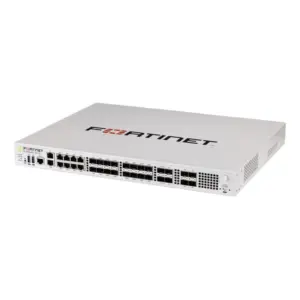
The front panel is unusually important in this class of purchase. The 2600F provides sixteen copper 10 GE/GE ports, sixteen SFP28/SFP+/SFP slots that can operate at 25/10/1 GE, and four QSFP28/QSFP+ slots for 100/40 GE connectivity. This lets the firewall connect to a mixture of legacy and modern infrastructure without depending on a single port speed.
Capability line 1: four 100/40 GE ports provide high-capacity uplink options for core or data-center fabrics.
Capability line 2: sixteen 25/10/1 GE fiber slots support dense aggregation and flexible migration between interface speeds.
Capability line 3: dedicated management and HA interfaces help separate operational control and cluster connectivity from ordinary data ports.
Port availability does not remove the need for interface engineering. The team should specify transceiver standards, single-mode or multimode fiber, link distance, breakout cables, switch compatibility, redundancy, LACP and routing design. Fortinet documentation also notes grouping behavior for certain SFP28 interfaces when changing speeds, so the active FortiOS release should be checked as part of implementation planning.
Security subscriptions and support are part of the configuration
A FortiGate appliance can perform core firewall and networking functions, but many advanced threat-protection capabilities depend on FortiGuard services and the chosen subscription bundle. Buyers therefore need to decide not only which hardware model is suitable, but which protection services and support term are appropriate for their operating model.
FortiGuard services can add capabilities such as intrusion prevention updates, web and DNS security, anti-malware, application intelligence, advanced threat prevention and other security functions depending on the selected bundle. FortiCare determines the support relationship and service level. The precise packaging can change over time, so the correct bundle should be confirmed at quotation rather than inferred from an old SKU.
Buyer decision checklist
- Which security profiles will be enabled from day one?
- Does the organization require web and DNS security, malware protection, IPS, application control or additional advanced services?
- What support response and lifecycle coverage are expected?
- Will FortiManager or other centralized tools be used?
- Is the project purchasing one appliance or an HA pair?
- Does the project require a one-year, three-year or other service term?
- Are hyperscale features, CGNAT acceleration or special carrier functions part of the design?
FourTeck can prepare the hardware and licensing structure together so the quote reflects the intended security posture rather than an appliance with an incomplete service plan.
What buyers should check before purchase
| Risk | What to confirm | Why it matters | What to share with FourTeck |
|---|---|---|---|
| Wrong family variant | FG-2600F vs FG-2601F and AC vs DC | Storage and power design differ | Storage need, power type, exact SKU preference |
| Insufficient inspected throughput | Traffic with IPS, SSL inspection and threat services enabled | Raw firewall throughput is not the same as security throughput | Peak bandwidth and enabled profiles |
| Optic incompatibility | SFP/SFP+/SFP28/QSFP+/QSFP28 type, fiber and distance | The appliance can be correct while the links still cannot come up | Switch model, port speed, fiber type and distance |
| Incomplete licensing | FortiGuard, FortiCare, hyperscale and management requirements | Security capability and support depend on selected services | Required features, term and support expectations |
Also confirm rack depth, airflow, power circuits, HA cabling, maintenance windows, configuration migration, quantity and delivery expectations. If the project is replacing an older firewall, provide the existing model, current CPU utilization, session count, VPN usage, interface map and enabled security profiles. These details make it easier to distinguish a true capacity requirement from a simple model-for-model replacement.
FortiGate 2600F availability and support for Uganda projects
FourTeck can assist Uganda organizations with quotation, configuration review, subscription selection and delivery coordination for enterprise Fortinet firewall projects. Availability can vary by exact hardware SKU, service bundle, support term, optic requirement and project quantity, so current supply should be confirmed at the time of quotation.
For Kampala deployments, buyers can share the planned network design and bill of materials so the quote includes the correct appliance variant, FortiGuard services, FortiCare support and required transceivers. FourTeck can also help structure an HA requirement, identify whether the 2601F storage variant is more appropriate, and clarify which items are configuration dependent.
Warranty and support guidance should be tied to the selected FortiCare offer and the terms that apply to the quoted product. FourTeck does not need to assume stock status or promise a delivery date before the relevant supply chain is checked. For projects with staged deployment or multiple firewalls, quantity and timing should be included in the initial request so procurement can be planned more accurately.
Coverage across Uganda
FourTeck can coordinate business technology requirements for customers in Kampala and for projects serving Entebbe, Jinja, Mbarara and Gulu. The practical requirement is to confirm delivery destination, project quantity, installation schedule and any site-specific rack, power or connectivity constraints. For multi-site rollouts, provide a site list and expected deployment sequence so firewall hardware, optics, support terms and related accessories can be planned consistently without creating separate location-specific product assumptions.
East Africa and regional procurement
Organizations operating across Uganda, Kenya and selected East Africa markets may need a common firewall standard, aligned service terms and consistent configuration templates across several countries. FourTeck can support quote coordination for such projects while the buyer defines the exact destination, quantity and deployment schedule for each market. Regional availability, import requirements, local support arrangements and delivery timing should be verified for the specific transaction rather than assumed from one country to another.
For broader procurement programs, FourTeck’s regional web presence includes FourTeck Kenya, FourTeck Africa, FourTeck UAE and FourTeck Kuwait. These links are useful when a project requires commercial coordination outside Uganda, but the final supply and support model remains subject to the destination and quoted terms.
Related Fortinet and firewall options to consider
FortiGate 1800F — suitable for buyers with lower inspected-throughput requirements who still need enterprise-class high-speed interfaces. Compare the FortiGate 1800F for Uganda.
FortiGate 3000F — a higher-capacity path for projects that need more threat-protection headroom and large data-center scale. Review the FortiGate 3000F option.
FortiManager — relevant when centralized configuration, policy management and administration are required across multiple FortiGate appliances. Find FortiManager options.
Fortinet firewall portfolio — useful when the 2600F appears larger or smaller than the workload actually requires. Browse FortiGate products on FourTeck Uganda.
Project assistance — for buyers who already have a bill of materials or need sizing support. Send the FortiGate project requirements to FourTeck.
Practical assistance for a complex firewall purchase
01. Product selection guidance: FourTeck can help determine whether the 2600F is appropriately sized by reviewing throughput, session scale, VPN demand and interface requirements.
02. Configuration review: Buyers can validate the exact FG-2600F or family variant, AC/DC power choice, HA quantity, optics and storage requirements before ordering.
03. Quote assistance: Hardware, FortiGuard services, FortiCare support and accessories can be aligned into one project bill of materials.
04. Business IT context: Firewall decisions often interact with switching, WAN, servers, cloud connectivity and data-center architecture. Sharing the broader project context can reduce compatibility mistakes.
05. Uganda delivery coordination: Destination, quantity and project timing can be considered during quotation without making unsupported stock or delivery promises.
06. Alternative matching: If the 2600F is not the best fit, the same requirements can be used to evaluate a lower or higher FortiGate model rather than forcing the project into an unsuitable appliance.
FortiGate 2600F buyer questions
01. What is the FortiGate 2600F mainly used for?
It is a high-end next-generation firewall for large enterprise and service-provider environments. Typical roles include internet edge security, data-center segmentation, secure SD-WAN hubs, large VPN aggregation points and other high-throughput security boundaries. Its mix of 10, 25, 40 and 100 GE connectivity makes it most relevant where the firewall must integrate with high-speed switching or WAN infrastructure.
02. How much threat-protection performance does it provide?
Fortinet publishes up to 25 Gbps threat-protection throughput, 27 Gbps NGFW throughput and 31 Gbps IPS throughput for the series under its defined enterprise traffic tests. These figures are not guarantees for every deployment. Actual performance depends on traffic mix, FortiOS version, enabled security profiles, SSL inspection, policy complexity and other configuration variables.
03. What high-speed interfaces are available?
The FG-2600F provides sixteen 10 GE/GE RJ45 ports, sixteen 25 GE SFP28/10 GE SFP+/GE SFP slots, four 100 GE QSFP28/40 GE QSFP+ slots, two 10 GE HA slots and two GE management ports. Buyers should specify the required optics, cable type, distance and switch-side interface because transceiver compatibility is a separate procurement decision.
04. Does the 2600F include onboard storage?
The FG-2600F itself is listed without onboard storage. The related FG-2601F family variant includes two 960 GB NVMe SSDs. If local logging or other storage-dependent requirements are important, discuss them during sizing rather than assuming every model in the 2600F series has the same storage configuration.
05. Are FortiGuard and FortiCare required?
The appliance can provide core firewall and networking functions, but many advanced security services depend on FortiGuard subscriptions, while FortiCare provides the associated support service. The correct bundle and term depend on the protection features and support level required. FourTeck can quote the appliance together with the relevant service package rather than treating licensing as an afterthought.
06. Can the FortiGate 2600F be deployed in high availability?
Yes. Fortinet lists active-active, active-passive and clustering HA options for the series, and the appliance includes redundant hot-swappable power supplies. A full HA design normally requires two appliances, appropriate subscriptions, dedicated HA links, redundant upstream and downstream connectivity, and a failover plan that matches the surrounding network architecture.
07. Is it suitable for SSL inspection at enterprise scale?
Fortinet publishes 20 Gbps SSL inspection throughput using its specified IPS average HTTPS profile, along with 2.7 million concurrent SSL inspection sessions under that test definition. Real results vary with TLS versions, cipher suites, certificate handling, traffic composition and enabled inspection features. Organizations with heavy encrypted traffic should size around their own application mix.
08. What information should I send for a Uganda quote?
Provide the appliance quantity, required security services, support term, expected internet and internal bandwidth, VPN user or tunnel counts, desired HA architecture, interface and optic requirements, AC or DC power preference, rack environment and delivery destination. If replacing an existing firewall, include the old model and current utilization data where available.
09. Is the FortiGate 2600F always the right choice for a large organization?
No. Large organizations can still have modest firewall traffic, while smaller organizations may run unusually heavy data-center or service-provider workloads. Selection should follow measured bandwidth, security throughput, session rates, VPN demand and growth expectations. A lower FortiGate model may be more economical in some cases, while a larger platform may provide safer headroom in others.
10. How can FourTeck help with deployment planning?
FourTeck can help review the bill of materials, appliance variant, service bundle, optics, HA quantity and procurement scope before quotation. Deployment engineering, policy migration and final configuration should be defined as part of the project requirements. The objective is to reduce mismatches between the hardware purchase and the network architecture that will actually be implemented.
Build the FortiGate 2600F quote around the real network
Send FourTeck the expected inspected bandwidth, interface schedule, security services, VPN scale, HA requirement, power preference, support term and Uganda delivery location. The team can use those details to prepare a more accurate hardware-and-services proposal and identify configuration points that need confirmation before purchase.
- Appliance quantity and HA design
- FortiGuard and FortiCare requirements
- 10/25/40/100 GE optics and cabling
- Bandwidth, sessions and VPN scale
- Delivery destination and project timing