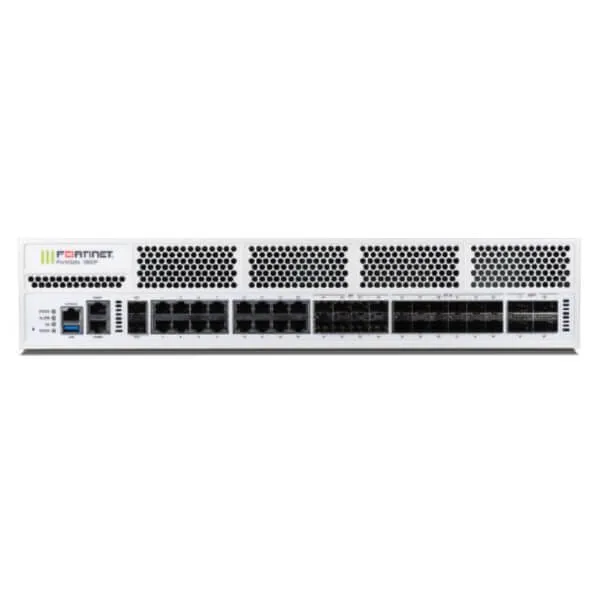
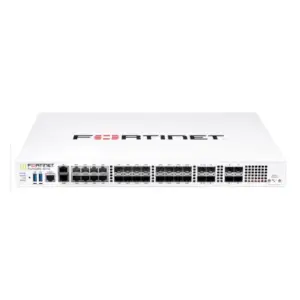
FortiGate 1800F in Uganda
A high-capacity 2RU next-generation firewall for enterprise edge security, data-center segmentation, encrypted traffic inspection, VPN, and secure networking.
The 1800F is built for networks where security controls must keep pace with large traffic volumes and diverse high-speed links. Fortinet publishes up to 22 Gbps IPS throughput, 17 Gbps NGFW throughput, and 15 Gbps threat-protection throughput for the series. Actual results depend on traffic mix, inspection profile, enabled services, software version, and configuration. FourTeck helps Uganda buyers translate those headline figures into a practical appliance, licensing, optics, power, and high-availability plan.
A security platform for high-volume enterprise traffic
The FortiGate 1800F sits in Fortinet’s high-end firewall portfolio and is intended for large enterprise and service-provider environments that need substantial security performance, dense high-speed connectivity, and consolidated policy enforcement. It can operate at the enterprise edge, within a data-center core, or as an internal segmentation firewall where east-west traffic must be inspected between sensitive network zones. Rather than treating firewalling, intrusion prevention, application control, encrypted traffic inspection, and VPN as unrelated functions, FortiOS brings them into a common policy and management framework.
That architectural position matters to buyers because the correct firewall is not selected from one throughput number. A data center may have relatively modest internet bandwidth but extremely high internal traffic. Another organization may rely on thousands of VPN users, extensive SSL inspection, many virtual domains, or very high session creation rates. Fortinet’s published performance figures therefore need to be mapped to the workload that will actually traverse the appliance. The 1800F is especially relevant where network designers need 25 GbE and 40/100 GbE options alongside traditional Gigabit and 10 GbE connectivity.
The series uses Fortinet security processing hardware and FortiOS to accelerate networking and security functions. Fortinet publishes up to 198 Gbps firewall throughput for large packets, 55 Gbps IPsec VPN throughput, 22 Gbps IPS throughput, 17 Gbps NGFW throughput, and 15 Gbps threat-protection throughput. These are laboratory maximums and vary by system configuration and traffic profile; procurement should therefore reserve suitable headroom instead of assuming every metric is simultaneously achievable.
For Uganda buyers, selection should also cover matters that datasheet tables cannot decide alone: whether the appliance will run standalone or as a high-availability pair, which transceivers are required for the surrounding switches, whether AC or DC power is preferable, how many virtual domains are needed, and what FortiGuard subscription term aligns with the security policy. FourTeck can review these points before quotation so the requested part numbers reflect the intended deployment rather than a generic hardware-only purchase.
Why enterprises shortlist this class of firewall
Protect high-bandwidth links without designing around a low security ceiling
The appliance provides dedicated performance for firewalling, IPS, NGFW functions, threat protection, VPN, and SSL inspection. This allows architects to size a security boundary around real application traffic instead of treating advanced inspection as an afterthought.
Keep segmentation practical at data-center speeds
The combination of high session capacity, fast session setup, hardware acceleration, and 25/40/100 GbE options makes the 1800F relevant for internal segmentation projects where security policy is applied between application tiers, tenants, departments, or critical network zones.
Consolidate policy and visibility
FortiOS provides a common operating environment for firewall policy, VPN, application control, secure SD-WAN functions, logging, and other security capabilities. Operational teams can work from a consistent policy model instead of stitching together separate point products for every traffic path.
Build resilient designs
Fortinet supports Active-Active, Active-Passive, and clustering high-availability configurations on the series. Dual hot-swappable power supplies are provided for 1+1 redundancy. A resilient network still requires correct upstream switching, routing, cabling, power feeds, and failover testing.
Accommodate diverse physical links
Accelerated copper and fiber ports plus SFP28 and QSFP28/QSFP+ slots give designers room to connect traditional access networks, 10/25 GbE server or aggregation links, and 40/100 GbE uplinks. Exact optics must be specified separately.
Support multi-domain administration
The series supports virtual domains, allowing policy and administrative separation within one physical appliance. This can help large organizations, service environments, or segmented estates, but the required VDOM count and licensing approach should be reviewed before purchase.
High-end security becomes useful only when interfaces, inspection and operations are designed together.
What distinguishes this platform is not one isolated specification. It is the combination of high-capacity security services, dense high-speed connectivity, hardware acceleration, HA options, and the FortiOS policy model. For architects, the practical question is how these characteristics match the traffic that must be protected.
22 Gbps IPS throughput: useful as a reference point for intrusion-prevention-heavy enterprise traffic; measured performance depends on the vendor test profile and active features.
17 Gbps NGFW throughput: Fortinet measures this with firewall, IPS and application control enabled, making it more relevant than raw packet forwarding for many buyers.
15 Gbps threat protection: reflects a deeper inspection profile including malware protection in the published test conditions.
High-speed interface flexibility: accelerated GE, 25 GE SFP28/10 GE SFP+, and 100 GE QSFP28/40 GE QSFP+ connectivity supports mixed enterprise and data-center topologies.
Large connection scale: Fortinet publishes 12 million concurrent TCP sessions as standard and a higher hyperscale figure when the applicable hyperscale license is used.
FortiGate 1800F confirmed technical profile
| Specification | Published value / guidance |
|---|---|
| IPS throughput | Up to 22 Gbps |
| NGFW throughput | Up to 17 Gbps |
| Threat protection throughput | Up to 15 Gbps |
| IPv4 firewall throughput | 198 / 197 / 140 Gbps for 1518 / 512 / 64 byte UDP packets |
| IPsec VPN throughput | Up to 55 Gbps using Fortinet’s published AES256-SHA256 test basis |
| SSL-VPN throughput | Up to 11 Gbps |
| Concurrent TCP sessions | 12 million standard; up to 40 million with applicable hyperscale capability/license |
| New TCP sessions/second | 750,000 standard; up to 2 million with applicable hyperscale capability/license |
| Firewall policies | Up to 100,000 |
| GE RJ45 ports | 16 hardware-accelerated GE RJ45 ports plus 2 GE RJ45 management ports |
| GE SFP slots | 8 hardware-accelerated GE SFP slots |
| 25/10/1 GE fiber slots | 12 hardware-accelerated 25 GE SFP28 / 10 GE SFP+ / GE SFP slots |
| 100/40 GE slots | 4 hardware-accelerated 100 GE QSFP28 / 40 GE QSFP+ slots |
| HA interfaces | 2 x 10 GE SFP+ / GE SFP HA slots |
| Storage | FG-1800F: no onboard storage; FG-1801F variant: 2 x 960 GB NVMe SSD |
| Virtual domains | 10 default / up to 250 maximum |
| High availability | Active-Active, Active-Passive, clustering |
| Form factor | 2RU rack mount; 88.4 x 438 x 536 mm |
| Weight | Approximately 13.7 kg for FG-1800F |
| AC power | 100-240 VAC, 50/60 Hz; dual hot-swappable power supplies for 1+1 redundancy |
| Average / maximum power | 410.9 W / 459.1 W for FG-1800F AC specification |
| Operating temperature | 0°C to 40°C |
| Included transceivers | 2 x SFP+ SR 10 GE transceivers according to the current series datasheet |
Which specifications affect the purchase most?
For most enterprise projects, the decisive numbers are not the 198 Gbps raw firewall figure. Start with the security services that will stay enabled during normal operation. If the policy requires intrusion prevention, application control and malware protection across much of the traffic, the 17 Gbps NGFW and 15 Gbps threat-protection figures are more useful starting points. If TLS inspection is extensive, the published 12 Gbps SSL inspection figure should also be considered. VPN-heavy deployments should compare the IPsec and SSL-VPN profiles with peak remote-access and site-to-site requirements.
Interface planning is equally important. A 100 GbE slot is valuable only if the surrounding switch, optics, fiber type, and traffic engineering are aligned. Buyers should also distinguish the FG-1800F from the storage-equipped FG-1801F variant and confirm whether local logging requires internal storage or an external logging platform such as FortiAnalyzer. Finally, high availability normally means two appliances plus duplicate power, optics, and upstream connectivity rather than one appliance with a second PSU. FourTeck can use a topology diagram and expected traffic profile to translate these specifications into a deployment bill of materials.
Five questions to answer before requesting the appliance
01 — What traffic must be inspected?
Document internet traffic, data-center east-west traffic, WAN traffic, remote-access VPN, site-to-site VPN, and any flows that will bypass deep inspection. The same appliance can behave very differently when simple firewall policy is replaced by IPS, SSL inspection, application control, anti-malware and extensive logging. Peak rather than average load should guide sizing, and planned growth needs headroom.
02 — How large is the connection and user scale?
Provide current and projected concurrent sessions, new connection rates, number of VPN users, branch tunnels, virtual domains, and major application patterns. An organization with moderate bandwidth but exceptionally high session creation can have different sizing needs from one with large sequential data flows. These figures also help determine whether the 1800F is appropriately sized or whether another FortiGate class would be more efficient.
03 — Which existing systems must connect?
List switch models, router handoffs, ISP presentation, fiber types, desired link speeds, transceiver types, authentication systems, logging platforms and management tools. The FortiGate provides multiple interface standards, but optics and cables must match both ends of every link. Integration requirements can also affect FortiOS features and subscription choices.
04 — What expansion, licensing or service term is expected?
Decide which FortiGuard security services are required and whether the project prefers one-, three- or five-year commercial terms where offered. Consider virtual domain growth, high-availability expansion, future WAN speed increases, and whether centralized analytics or management will be added. A hardware-only quotation may not represent the operating security requirement.
05 — What are the deployment and support expectations?
Confirm rack availability, airflow direction, power feeds, AC or DC requirement, implementation window, redundancy design, required documentation, project quantities, delivery location and support expectations. These details affect both the bill of materials and the rollout plan.
Ideal business use cases
Enterprise internet edge
A large business with multi-gigabit internet links may need perimeter policy, IPS, application control, secure remote access and TLS inspection on the same platform. The 1800F’s security throughput and high-speed interfaces make it a candidate when lower-end appliances no longer provide enough inspected-traffic headroom. The design should still be based on peak traffic, expected service growth, and failover behavior.
Internal data-center segmentation
Organizations separating user, application, database, development, backup, and management zones can place a high-performance firewall inside the data-center fabric. Here, east-west traffic may exceed internet traffic by a wide margin. High session scale and 25/40/100 GbE connectivity are particularly relevant, while routing design and asymmetric traffic paths require careful engineering.
High-capacity VPN hub
A headquarters or data-center security hub can terminate large numbers of site-to-site or client VPN connections. Fortinet publishes up to 55 Gbps IPsec VPN throughput, 20,000 gateway-to-gateway IPsec tunnels, and 100,000 client-to-gateway IPsec tunnels. Practical design must include authentication, routing, address planning, certificate handling, internet resilience, and the expected cryptographic profile.
Multi-domain enterprise security
Large institutions and service environments may need administrative separation without deploying a separate physical firewall for every domain. Virtual domains can provide logical separation, with 10 available by default and up to 250 supported by the platform. The target VDOM count, logging design, routing boundaries and operational responsibility should be determined before the architecture is finalized.
Inspection performance is the real sizing conversation
Firewall procurement often starts with an internet circuit size and a raw firewall throughput value. For a high-end NGFW, that shortcut can be misleading. The security stack changes the amount of processing required for each connection. An appliance forwarding packets with basic stateful rules is performing a different job from the same appliance decoding applications, applying intrusion signatures, scanning files, evaluating web categories, decrypting TLS traffic and recording detailed logs.
Fortinet publishes separate figures for these workloads so buyers can distinguish them. The 1800F series is rated for up to 22 Gbps IPS throughput, 17 Gbps NGFW throughput and 15 Gbps threat protection. Fortinet defines NGFW performance with firewall, IPS and application control enabled, while threat protection also includes malware protection. The series also lists up to 12 Gbps SSL inspection throughput using Fortinet’s stated HTTPS test mix. These figures are laboratory references rather than guaranteed production rates, but they are substantially more useful for design than the raw 198 Gbps large-packet firewall number when advanced security is continuously enabled.
The correct approach is to categorize traffic. Identify flows that require full inspection, flows that only need stateful policy, encrypted applications that will be decrypted, trusted high-volume backup or replication flows, guest traffic, voice, remote access, and east-west application traffic. Then add growth and failover assumptions. In a two-node high-availability design, for example, each appliance may need to carry the complete load during a maintenance event or failure. FourTeck can use this traffic map to help buyers determine whether the 1800F has suitable operational headroom.
High-speed ports make architecture choices visible
The front-panel interface mix lets the appliance connect across several network generations, but every port decision has consequences for optics, cabling, switch compatibility and redundancy. That is why interface planning should happen before the purchase order, not during rack installation.
12 x 25 GE SFP28 / 10 GE SFP+ / GE SFP slots: suitable for high-density aggregation or server-facing designs where different fiber speeds must coexist.
4 x 100 GE QSFP28 / 40 GE QSFP+ slots: provide high-capacity uplink options for data-center and core environments, subject to supported transceivers and peer interfaces.
Dedicated HA plus management connectivity: separate interfaces help structure resilient clustering and administrative access, but HA still requires a complete topology for upstream and downstream failover.
For procurement teams, the practical takeaway is to quote the firewall and the physical connectivity as one design. Identify how many copper links are needed, which fiber standard is in place, the cable distances, whether links will be aggregated, and which ports on existing switches can accept the required optics. Fortinet includes two SFP+ SR 10 GE transceivers according to the current series datasheet, but most deployments will need additional transceivers. FourTeck can include those items in the bill of materials once the switch-side requirements are known.
Licensing, logging and lifecycle planning belong in the hardware decision
The appliance provides the processing platform, but the business security outcome depends on the services and operational tools paired with it. FortiGuard service bundles determine which subscription-based security capabilities are available, while FortiCare support terms, centralized logging, management, sandboxing or other Fortinet components may be included according to the project. A buyer should therefore avoid comparing only chassis prices when different quotes contain different support and service terms.
The 1800F hardware variant has no onboard storage, while the related 1801F includes two 960 GB NVMe SSDs. That distinction can matter to organizations with specific local logging or storage requirements. Many enterprise environments still use external analytics and logging platforms, so the storage choice should be connected to the broader operations design rather than treated as a generic advantage.
Lifecycle planning also matters. Security appliances receive ongoing FortiOS updates and signature services during their supported life, but any long-term project should verify current lifecycle status, software release compatibility, subscription duration and replacement planning before commitment. FourTeck can align the quotation with the target term and confirm currently orderable service bundles rather than relying on an old SKU list.
Buyer decision checklist
- Which FortiGuard protection bundle is required by policy?
- What FortiCare support level and contract term should be quoted?
- Is centralized logging or FortiAnalyzer part of the architecture?
- Does the design require FG-1800F or the storage-equipped FG-1801F variant?
- Are FortiManager, FortiAuthenticator, FortiToken or other ecosystem components required?
- Has current Fortinet lifecycle and software compatibility been checked for the planned deployment date?
What buyers should check before purchase
| Risk | What to confirm | Why it matters | What to share with FourTeck |
|---|---|---|---|
| Wrong model or capacity class | Peak inspected traffic, session rate, VPN load and growth | Raw throughput alone can hide security-service bottlenecks | Traffic statistics and topology |
| Interface mismatch | Speed, fiber type, connector, optic compatibility and distance | A correct firewall can still be unusable with the wrong transceivers | Switch models and required link map |
| Incomplete subscription scope | FortiGuard services, support level, term and renewal plan | Security functions and ongoing updates depend on the selected services | Security policy and preferred contract term |
| Incomplete HA design | Second appliance, power, switch paths, routing and failover method | Redundant PSUs do not replace appliance-level high availability | Availability target and redundancy diagram |
| Deployment constraints | Rack space, airflow, power feeds, cooling and change window | The appliance is 2RU and has defined power and environmental requirements | Rack, power and site details |
A procurement error on a high-end firewall rarely comes from overlooking the brand name. It usually comes from ordering the right chassis with the wrong service bundle, optics, power assumption, storage variant, support term, or resilience architecture. For larger projects, a short technical discovery call before quotation can prevent multiple change orders later. The most useful information is concrete: traffic measurements, diagrams, switch port types, current security policy, VPN counts, desired go-live date and expected growth. Where a requested part number is no longer the most suitable current option, FourTeck can also help map the requirement to a current Fortinet alternative.
Plan the Uganda purchase around the final configuration
FortiGate hardware, FortiGuard bundles, support terms, transceivers and related accessories can have different procurement lead times, so availability should be checked against the exact bill of materials. FourTeck can prepare a current quotation for Uganda buyers, review the technical configuration, coordinate delivery planning, and clarify published warranty or support terms that apply to the selected SKU. For projects with multiple appliances, staged deployment, high availability or specific implementation windows, share the required quantities and schedule early so the commercial and logistics plan reflects the project rather than a single-unit request.
Kampala organizations can request configuration and quote assistance for enterprise firewall projects without assuming that a catalogue bundle is the correct fit. The quotation can distinguish chassis, subscriptions, support, optics and optional management or logging components, making approval easier for both technical and procurement teams.
Uganda location coverage
FourTeck can coordinate product quotations and delivery planning for customers in Kampala and for project destinations such as Entebbe, Jinja, Mbarara and Gulu. Actual availability, transport arrangements and delivery timing depend on the selected configuration, quantity and destination. For multi-site rollouts, provide a site list and quantity split so the quotation and logistics plan can be prepared as one project rather than as unrelated unit purchases.
East Africa and regional availability
Organizations operating across several countries often want a consistent firewall architecture and licensing approach while procurement and delivery are coordinated per destination. FourTeck can assist with enquiries originating in Uganda and can also route regional requirements through its Kenya, Africa, UAE and Kuwait web presences where relevant. This is useful for groups standardizing on Fortinet while still needing local project information, separate delivery points, or region-specific quotations.
Regional support should not be interpreted as a promise of local stock, identical commercial terms or identical delivery schedules in every market. Product availability, subscription SKUs, taxes, freight and warranty handling can vary. A better approach is to provide one technical standard — appliance class, HA design, FortiGuard bundle, optics, management approach and software baseline — then request country-specific commercial confirmation. Buyers can visit FourTeck Uganda, FourTeck Kenya, FourTeck Africa or FourTeck UAE when a project extends beyond Uganda.
Related Fortinet paths to compare
Model selection should follow workload rather than model numbering. These comparison paths help procurement teams frame the next technical question before requesting a quote.
Practical assistance before the purchase order
01. Product selection guidance that starts from inspected traffic, VPN, interfaces and resilience rather than a generic model recommendation.
02. Configuration review covering the firewall variant, FortiGuard services, support term, optics, rack and power requirements.
03. Quote assistance that separates hardware, subscriptions and accessories so business approvers can understand what is included.
04. Uganda delivery coordination based on current availability, project quantity and destination rather than unverified stock assumptions.
05. Warranty and lifecycle guidance based on the selected SKU and current vendor information, with no unsupported promise of coverage.
06. Alternative model matching when the requested platform is oversized, undersized, unavailable, or no longer the best fit for the requirement.
FortiGate 1800F buyer questions
01. What is the FortiGate 1800F mainly used for?
It is a high-end next-generation firewall for large enterprise edges, data-center networks, internal segmentation and high-capacity VPN. The model combines stateful firewalling with security services such as intrusion prevention, application control and encrypted-traffic inspection through FortiOS and applicable FortiGuard subscriptions. It is normally considered where inspected traffic, connection scale or high-speed interface requirements exceed smaller firewall platforms.
02. How much threat-protection throughput does it provide?
Fortinet publishes up to 15 Gbps threat-protection throughput for the 1800F series under its stated enterprise traffic test conditions. It also lists up to 17 Gbps NGFW throughput and 22 Gbps IPS throughput. These are maximum laboratory results rather than guaranteed production values. Actual performance varies with traffic mix, enabled services, SSL inspection, logging, software and configuration, so sizing should include operational headroom.
03. Does the FG-1800F include internal storage?
The FG-1800F variant does not include onboard storage. The related FG-1801F variant is published with two 960 GB NVMe SSDs. Whether internal storage is necessary depends on the logging and operational architecture because many enterprises use centralized FortiAnalyzer or other logging platforms. Buyers should confirm the desired variant before quotation rather than assuming all 1800F-series appliances have the same storage configuration.
04. Which high-speed interfaces are available?
The series provides 12 hardware-accelerated 25 GE SFP28 / 10 GE SFP+ / GE SFP slots and four hardware-accelerated 100 GE QSFP28 / 40 GE QSFP+ slots, alongside eight GE SFP slots, sixteen GE RJ45 ports, management ports and dedicated HA connectivity. Correct transceivers, fiber type, peer-switch compatibility and link distance still need to be confirmed for each connection.
05. Can it be deployed as a high-availability pair?
Yes. Fortinet lists Active-Active, Active-Passive and clustering high-availability configurations for the series. A resilient design normally requires two appliances and redundant upstream and downstream connectivity, not simply the dual power supplies inside one chassis. Buyers should define failover objectives, routing behavior, switch redundancy, session expectations and maintenance procedures before requesting the HA bill of materials.
06. Which licenses or subscriptions are required?
The exact requirement depends on the security services the organization intends to use. FortiGuard bundles and FortiCare support terms are sold in different combinations and durations, and some advanced capabilities can have additional licensing requirements. A quote should therefore specify the desired security functions, service level and term rather than comparing hardware-only prices with bundled prices as though they were equivalent.
07. Is it suitable for SSL inspection?
The platform supports SSL inspection, and Fortinet publishes up to 12 Gbps SSL inspection throughput under its stated average HTTPS test profile. The production result depends heavily on cipher suites, certificate handling, traffic composition, exceptions and other enabled security services. If SSL inspection is a major requirement, include the expected encrypted traffic percentage in the sizing exercise rather than basing the decision on raw firewall throughput.
08. What information should I send for an Uganda quotation?
Provide the required appliance quantity, HA requirement, current and expected traffic, security services, VPN counts, link speeds, switch or router interfaces, optic types, rack and power environment, subscription term, delivery destination and project timeline. If available, include a topology diagram. These details help FourTeck prepare a configuration-specific quote instead of a generic chassis price that may omit critical subscriptions or accessories.
09. How do I know whether the 1800F is the correct size?
Compare your peak inspected traffic, session scale, VPN load, SSL decryption requirement, desired growth headroom and interface speeds with Fortinet’s published metrics. The right model should carry the expected production workload during normal operation and during failure scenarios without forcing security controls to be disabled. FourTeck can help map these requirements to the 1800F or another FortiGate class before quotation.
10. Can FourTeck help with project quantities and accessories?
Yes. FourTeck can prepare project quotations that include the selected firewall configuration, FortiGuard and FortiCare terms, compatible optics and other required components once the technical scope is known. Availability and delivery arrangements remain configuration dependent, so project quantities, destinations and desired implementation dates should be shared early. This is especially useful for HA pairs, data-center refreshes and multi-site deployments.
Turn the firewall requirement into an orderable configuration
Send FourTeck the traffic profile, security services, interface map, HA requirement, preferred support term, quantity and delivery destination. The team can use those details to prepare a current Uganda quotation with the correct appliance variant, subscriptions and required connectivity components.
- Peak and projected inspected traffic
- VPN, SSL inspection and application-control requirements
- Required 1/10/25/40/100 GbE links and optics
- HA, rack, power and delivery requirements

Reviews
There are no reviews yet.