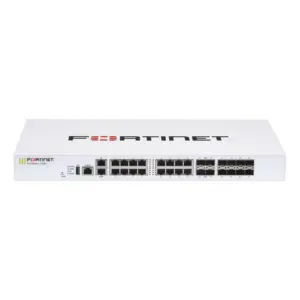
Fortinet FortiGate 4800F in Uganda
A 4RU next-generation firewall for high-throughput data-center, hyperscale, carrier and large-enterprise security architectures.
The FortiGate 4800F combines very high firewall capacity, hardware-accelerated security processing and dense multi-speed Ethernet connectivity in a platform intended for environments where core network performance and security inspection must scale together. FourTeck can help Uganda buyers map actual traffic, interface, power, licensing and high-availability requirements to the correct configuration before procurement.
Security capacity for networks that have outgrown ordinary enterprise firewalls
The FortiGate 4800F is positioned by Fortinet as a high-end data-center firewall. Its role is not simply to filter office internet traffic. It is designed for organizations where core traffic volumes, encrypted sessions, east-west segmentation, VPN aggregation or hyperscale connection counts can make a conventional perimeter appliance a bottleneck. Typical buyers include large enterprises, financial institutions, telecom and mobile-network operators, cloud or hosting environments, research infrastructure and organizations consolidating several security functions at a high-speed network edge.
Fortinet’s architecture combines FortiOS with purpose-built Security Processing Units. The 4800F family uses NP7 network processors and CP9 content processors to accelerate functions that would otherwise compete heavily for general CPU resources. This matters when the appliance must inspect encrypted traffic, enforce application controls, process IPsec VPN traffic, segment high-speed networks or establish very large numbers of sessions while maintaining predictable forwarding performance.
The physical connectivity is equally important. Fortinet documents eight hardware-accelerated 400GE/200GE/100GE/40GE QSFP-DD-capable slots, twelve 200GE/100GE/40GE QSFP56/QSFP28/QSFP+ slots, eight 50GE/25GE/10GE/GE SFP56/SFP28/SFP+/SFP slots and four additional high-availability or auxiliary slots supporting the same 50GE through GE range. Two 10GE/GE RJ45 ports are provided for management. This density lets architects connect the firewall directly into modern leaf-spine, core, data-center interconnect and carrier environments without immediately adding conversion equipment purely to bridge port speeds.
Selection still requires careful engineering. The base FortiGate 4800F differs from 4801F variants that include onboard SSD storage, and AC and DC power options exist in the broader family. FortiGuard services, FortiCare support, optics and the Hyperscale Firewall license are separate procurement considerations. In addition, Fortinet states performance figures as maximum laboratory values that vary with configuration and security functions. A real design should therefore start with traffic composition, expected encryption, packet size, session behavior and feature set rather than selecting solely from headline throughput.
What the platform can change operationally
Reduce the risk of security becoming the core-network choke point
With up to 3.1 Tbps IPv4 firewall throughput at larger packet sizes and 87 Gbps IPS throughput under Fortinet’s published test conditions, the platform is engineered for environments where inspection must coexist with high-capacity switching and routing. The business value is headroom for growth without forcing security teams to bypass controls simply to keep important applications responsive.
Inspect more encrypted traffic at useful speed
Fortinet publishes SSL inspection throughput of up to 63 Gbps using its stated HTTPS mix. For organizations with business-critical applications increasingly carried over TLS, that capacity can make deeper inspection practical while reducing the temptation to create broad decryption exceptions that become visibility gaps.
Consolidate high-speed network functions
FortiOS brings firewalling, segmentation, SD-WAN, VPN, application control and access-policy functions into one operating environment. Consolidation does not remove the need for good architecture, but it can reduce policy fragmentation and simplify operational ownership when compared with stitching together several independent devices for adjacent functions.
Support dense modern data-center links
Native 400GE and 200GE connectivity gives architects more freedom when inserting security between high-speed fabrics, data-center interconnects or large service zones. The benefit is design simplicity: fewer intermediate conversion devices may be required when the firewall can connect at the same speeds used by the network fabric.
Build very large VPN and session environments
Fortinet lists up to 800 Gbps IPsec VPN throughput, 40,000 gateway-to-gateway IPsec tunnels and 200,000 client-to-gateway IPsec tunnels. Those figures make the appliance relevant to large hub, carrier security gateway and distributed-enterprise designs, subject to protocol choice, configuration and actual traffic conditions.
Create policy separation at substantial scale
Virtual Domains can separate administrative and policy contexts on one physical platform. Fortinet lists 10 VDOMs by default and up to 500 maximum, allowing appropriate organizations to divide environments by business unit, tenant, security zone or operational responsibility while retaining one hardware platform.
Designed around traffic scale, not just feature count
The distinguishing characteristic of this platform is the combination of security throughput, very high interface speeds and session scale inside a 4RU appliance. Fortinet’s NP7 and CP9 processors offload networking and content-inspection work, while FortiOS presents networking and security functions through one policy and management framework.
Published enterprise-mix intrusion-prevention throughput with logging enabled.
Measured with firewall, IPS and application control enabled under Fortinet test conditions.
Measured with firewall, IPS, application control and malware protection enabled.
Eight QSFP-DD-capable slots support 400GE/200GE/100GE/40GE.
FortiGate 4800F verified technical profile
| Specification | Published value | Buyer note |
|---|---|---|
| Product class | High-end next-generation firewall | Designed for data-center and hyperscale requirements |
| IPS throughput | Up to 87 Gbps | Enterprise traffic mix, logging enabled |
| NGFW throughput | Up to 77 Gbps | Firewall + IPS + application control |
| Threat protection throughput | Up to 75 Gbps | Firewall + IPS + application control + malware protection |
| IPv4 firewall throughput | 3.1 / 3.1 / 0.93 Tbps | 1518 / 512 / 64-byte UDP |
| Firewall latency | 3.6 microseconds | 64-byte UDP test basis |
| Concurrent TCP sessions | 280 million / 1.8 billion* | *Higher figure requires Hyperscale Firewall license |
| New TCP sessions/sec | 915,000 / 25 million* | *Higher figure requires Hyperscale Firewall license |
| IPsec VPN throughput | Up to 800 Gbps | Fortinet test uses AES256-SHA256 |
| SSL inspection | Up to 63 Gbps | Average HTTPS mix; configuration dependent |
| 400GE slots | 8 x QSFP-DD family slots | 400/200/100/40GE supported modes |
| 200GE slots | 12 x QSFP56/QSFP28/QSFP+ family slots | 200/100/40GE supported modes |
| 50GE data slots | 8 x SFP56/SFP28/SFP+/SFP | 50/25/10/1GE supported modes |
| HA / AUX slots | 4 x 50/25/10/1GE | Used for HA and auxiliary designs as appropriate |
| Management ports | 2 x 10GE/GE RJ45 | Dedicated management connectivity |
| VDOMs | 10 default / 500 maximum | Maximum may depend on licensing/configuration |
| High availability | Active-active, active-passive, clustering | Architecture should be validated for the workload |
| Form factor | Rack mount, 4RU | Plan rack space and airflow |
| Dimensions | 175 x 435 x 663 mm | Height x width x depth |
| Weight | 41.2 kg for 4800F/4800F-DC | Rack handling should be planned |
| AC input | 200-240V AC, 50/60Hz | Confirm data-center power compatibility |
| Power consumption | 1602W average / 1918.2W maximum | Base 4800F published AC figures |
The most important numbers are not necessarily the largest ones. Buyers should start with inspected traffic, not raw interface capacity. A design that carries 100 Gbps of aggregate links may require far less or far more security-processing headroom depending on east-west flows, encrypted traffic, IPS policy coverage, application control, packet sizes and how much traffic can be accelerated. Similarly, 400GE ports only deliver value when connected to compatible switches, routers, optics and cabling. The transceiver plan should therefore be built alongside the firewall bill of materials, not after the appliance has arrived.
Power is another practical consideration. The base AC model operates from 200-240V AC and Fortinet publishes significant average and maximum power consumption. A 4RU appliance of this class belongs in a properly engineered rack environment with suitable power distribution, cooling, front-to-back airflow and redundancy. FourTeck can review these dependencies as part of quote preparation so that the requested hardware, power option, optics and service subscriptions align with the intended installation.
Five questions to answer before requesting the final configuration
01. What workload will cross the firewall?
Separate internet edge traffic, data-center interconnect, east-west segmentation, VPN aggregation, CGNAT, 5G security gateway and multi-tenant workloads. Each pattern stresses a different combination of session setup, encryption, packet processing and inspection. Defining the traffic role prevents selecting an appliance from one headline throughput number.
02. What is the real performance and session scale?
Provide current peak throughput, three-year growth expectations, concurrent sessions, new sessions per second, expected VPN volumes and approximate encrypted-traffic percentage. High-session environments may also need the Hyperscale Firewall license to unlock the published accelerated session scale.
03. Which existing systems must interoperate?
List switch and router models, interface speeds, transceiver standards, routing protocols, identity systems, management tools, logging platforms and any existing Fortinet Security Fabric components. Compatibility details influence optics, port allocation, management approach and migration planning.
04. What growth, licensing and expansion are expected?
Clarify whether the project needs FortiGuard security services, FortiCare, more VDOMs, centralized FortiManager control, hyperscale CGNAT functions or future 400GE expansion. Service terms and software capabilities should be budgeted together with hardware rather than treated as an afterthought.
05. What installation, delivery and support expectations apply?
Confirm rack location, power type, available circuits, airflow direction, high-availability topology, project quantity, preferred deployment window and support expectations. These operational details can change the correct SKU and the logistics plan for Uganda.
Where the 4800F can be a practical fit
Large data-center perimeter and core segmentation
Organizations running high-speed spine-leaf or core networks may need security controls between internet, application, tenant and infrastructure zones without dropping immediately to low interface speeds. The 4800F’s 400GE and 200GE-capable interfaces, high firewall throughput and accelerated VXLAN-related capabilities make it relevant to this role. The design should still model the inspected traffic rather than assume link speed equals required threat-protection throughput.
Telecom and high-session carrier networks
Fortinet specifically positions the platform for mobile and carrier use cases including CGNAT, 4G/5G connectivity and IPsec aggregation. Large connection counts and accelerated session setup can be important where thousands or millions of subscribers create and tear down sessions rapidly. The Hyperscale Firewall license is a key procurement variable because Fortinet ties the highest published concurrent-session and new-session figures to that license.
Large VPN hubs
Enterprises that aggregate many branches, remote environments or inter-data-center tunnels can use the 4800F as a high-capacity IPsec termination point. Fortinet publishes up to 800 Gbps IPsec throughput and large tunnel counts. Real sizing should consider cipher suites, packet size, traffic direction, redundancy and whether additional security inspection is applied after decryption.
Multi-tenant or administratively separated environments
Virtual Domains can provide policy and administrative separation for business units, hosted environments or complex operational boundaries. The 4800F supports up to 500 VDOMs, configuration dependent. Buyers should map tenant growth, routing-table scale, logging and operational ownership before deciding how much consolidation is sensible on one chassis.
Purpose-built acceleration changes how high-speed inspection is planned
High-end firewall performance depends on more than a fast general-purpose processor. The 4800F architecture uses sixteen NP7 network processors, while CP9 content processors accelerate intensive security functions such as SSL decryption and pattern matching. Fortinet’s documentation shows all front-panel data interfaces connected through an integrated switch fabric to the NP7 processors, allowing supported traffic between data ports to benefit from hardware offload.
For the buyer, the practical result is not simply a larger benchmark number. Hardware acceleration can preserve useful performance when the same appliance is simultaneously forwarding traffic, establishing sessions, terminating VPNs and applying security policy. That can help data-center teams consolidate functions that might otherwise be split across several platforms. However, acceleration has design boundaries: supported features, traffic paths and configuration choices determine what can be offloaded. A proper implementation should therefore be validated against the intended FortiOS feature set.
This is especially important for encrypted traffic. TLS 1.3 and other modern encryption improve privacy but reduce visibility unless the organization performs authorized SSL inspection. Fortinet publishes up to 63 Gbps SSL inspection for the 4800F under its specified test mix. Security teams should decide which applications will be decrypted, which must be exempt for legal or technical reasons, and what certificate infrastructure is required before translating that figure into a production capacity estimate.
400GE connectivity gives architects room to simplify the security insertion point
High-speed Ethernet support is one of the most product-specific reasons to consider this model. Eight QSFP-DD family slots can operate at 400GE, 200GE, 100GE or 40GE, while twelve additional QSFP family slots support 200GE, 100GE or 40GE. Another eight SFP-family data slots cover 50GE, 25GE, 10GE and 1GE. This range lets a single appliance connect to several generations of infrastructure and supports staged network upgrades.
Optics still require exact validation. QSFP-DD, QSFP56, QSFP28, SFP56 and SFP28 are families, not interchangeable purchasing labels. Reach, fiber type, breakout mode, connector format and the supported transceiver list for the target FortiOS release should be checked against the adjacent switch or router. FourTeck can include compatible optical requirements in the quotation discussion rather than treating the firewall as a standalone box.
Licensing, support and logging should be designed with the hardware
A high-end firewall purchase is incomplete if the appliance is selected without its ongoing security and operational services. Fortinet offers FortiGuard security-service bundles and FortiCare support options around FortiGate. Service selection affects the available threat intelligence and inspection capabilities, while support terms affect software access and the support experience. Buyers should compare the intended protection profile and support expectations against the exact bundle rather than assuming every security function is permanently included with the chassis.
The Hyperscale Firewall license is another distinct consideration for this platform. Fortinet states that it enables hardware acceleration of CGNAT-related functions such as hardware session setup, firewall session logging and NAT, and its specification table associates the highest concurrent-session and session-setup figures with that license. A data-center deployment that does not need those hyperscale behaviors may be sized differently from a carrier or massive-session environment.
Logging architecture also deserves attention. The base 4800F is listed without onboard storage, while 4801F variants include two 1.92TB SSDs. Organizations may still centralize logs to FortiAnalyzer or another approved platform depending on retention, compliance and operations. This distinction is a strong reason to identify the exact model suffix before ordering.
Buyer decision checklist
Confirm the exact 4800F-family SKU; FortiGuard bundle and term; FortiCare level; whether the Hyperscale Firewall license is required; local or centralized logging requirements; FortiManager needs; VDOM scale; HA topology; and the licensing implications of future growth.
What buyers should check before purchase
| Risk | What to confirm | Why it matters | Share with FourTeck |
|---|---|---|---|
| Wrong family variant | 4800F vs 4801F and AC vs DC | Storage and power characteristics differ | Power and logging design |
| Undersized inspected throughput | IPS, NGFW, SSL and VPN load | Raw firewall throughput does not equal fully inspected performance | Traffic mix and feature set |
| Optics mismatch | Speed, reach, fiber and transceiver type | High-speed ports require compatible optics and peers | Switch/router ports and cabling |
| Missing service entitlement | FortiGuard, FortiCare and Hyperscale needs | Capabilities and support depend on selected services | Required security features and term |
Other practical risks include rack depth, available power, cooling, delivery access and project sequencing. At 41.2 kg for the base appliance, this is not equipment that should be treated like a small branch firewall. Installation should be planned with suitable rack support and data-center handling. A high-availability pair doubles the hardware footprint and changes power, cabling and transceiver quantities. Project teams should also confirm whether configuration migration, staging, acceptance testing or change-window support is needed.
Planning a FortiGate 4800F project in Uganda
FourTeck can assist Uganda businesses with configuration review, quotation preparation, quantity planning and delivery coordination for high-end Fortinet firewall projects. Availability can vary by exact appliance variant, service bundle, support term, optical transceivers and project quantity, so the practical starting point is a requirements review rather than assuming a standard shelf configuration.
For Kampala-based data centers and enterprise projects, buyers should share the target interface map, power design, rack constraints and preferred security-service term. FourTeck can then align the quote request with the intended deployment and help identify any compatible accessories that should be included. Warranty and service guidance should be confirmed against the selected FortiCare option and the final supply channel; no support entitlement should be assumed until it appears on the quotation.
Project coordination beyond Kampala
FourTeck can discuss supply and delivery coordination for enterprise technology projects in Kampala and for customers planning deployments in Entebbe, Jinja, Mbarara and Gulu. The appropriate logistics arrangement depends on project quantity, hardware configuration, installation destination and the final quoted terms. For a platform of this size and value, buyers should confirm receiving-site access, rack readiness and change-window timing before dispatch arrangements are finalized.
East Africa and regional sourcing discussions
Organizations operating across Uganda, Kenya and selected East Africa markets may prefer to align firewall specifications and support terms across several sites. FourTeck can discuss regional sourcing requirements where relevant, while each destination should still be reviewed for local delivery, tax, support and project constraints. Buyers can also explore FourTeck resources for Kenya enterprise IT supply, selected Africa markets, UAE technology procurement and Kuwait business IT requirements. These links indicate regional enquiry routes, not guaranteed local stock or identical service terms.
Build the shortlist around actual traffic and deployment scale
Procurement help for a configuration-sensitive firewall
01. Product selection guidance helps distinguish when the 4800F’s data-center scale is necessary and when a smaller or different FortiGate model is a better fit.
02. Configuration review brings the appliance, subscriptions, optics, power, high availability and management requirements into one procurement conversation.
03. Quote assistance gives procurement teams a documented basis for comparing term lengths, quantities and service levels instead of comparing incomplete hardware-only prices.
04. Uganda delivery coordination can be planned around the project’s destination, equipment size, quantity and deployment schedule once availability is confirmed.
05. Alternative matching provides a path when the requested configuration, lead time or budget points toward another Fortinet model.
FortiGate 4800F buyer questions
01. What is the FortiGate 4800F mainly designed for?
It is a high-end next-generation firewall for data centers, hyperscale networks, carrier environments and very large enterprise security deployments. Its combination of high throughput, 400GE/200GE connectivity, accelerated session handling, IPsec performance and FortiOS security services targets networks where lower-capacity firewalls could constrain the core architecture.
02. How does the FortiGate 4800F differ from the 4801F?
The most visible procurement difference is onboard storage. Fortinet lists the base 4800F without onboard storage, while 4801F variants include two 1.92TB SSDs. Power variants also exist in the family. Logging, storage, support and deployment requirements should therefore be confirmed before the exact SKU is quoted.
03. Does the platform support 400 Gigabit Ethernet?
Yes. Fortinet documents eight hardware-accelerated QSFP-DD-family slots supporting 400GE, 200GE, 100GE and 40GE modes. The project must still specify compatible optics, fiber or cabling, reach and the port mode on the connected switch or router. Interface capability alone does not guarantee transceiver compatibility.
04. What security throughput should a buyer use for sizing?
Use the metric that matches the enabled functions. Fortinet publishes up to 87 Gbps IPS, 77 Gbps NGFW and 75 Gbps threat-protection throughput, while raw firewall throughput is much higher. Production sizing should consider encrypted traffic, application control, packet size, sessions, VPN use and growth rather than relying on a single laboratory maximum.
05. Is a Hyperscale Firewall license required?
Not for every deployment, but it is important for specific hyperscale functions. Fortinet states that the license enables hardware acceleration for CGNAT features such as session setup, session logging and NAT, and the highest published session-scale figures are tied to it. Carrier and massive-session projects should evaluate this license explicitly.
06. Can FortiManager be used with the 4800F?
Yes. FortiManager is Fortinet’s centralized management platform for FortiGate and broader Security Fabric environments. It can be particularly valuable where organizations operate multiple firewalls, many VDOMs or distributed policy domains. The FortiManager size and form factor should be chosen based on the total managed estate rather than the 4800F alone.
07. What should be included in a Uganda quote request?
Provide the exact workload, peak and forecast traffic, required port speeds, switch or router interfaces, optics requirements, AC or DC power preference, HA plan, expected VPN and session scale, FortiGuard services, FortiCare term, logging method, quantity and target deployment schedule. This information allows a much more accurate bill of materials.
08. Is the FortiGate 4800F suitable for a normal branch office?
Usually the 4800F would be substantially beyond ordinary branch requirements because it is a 4RU high-end platform built for data-center and hyperscale workloads. A smaller FortiGate model may be more practical when traffic, session counts and interface requirements are modest. FourTeck can help compare the requirement against the appropriate Fortinet tier.
09. Can FourTeck confirm warranty and availability?
FourTeck can provide current quotation, supply and warranty guidance based on the exact requested hardware and support configuration. Availability can change by SKU, service bundle and project quantity, and warranty expectations should be matched to the selected FortiCare entitlement. Buyers should rely on the final written quotation rather than assumptions about stock or support coverage.
Prepare the 4800F configuration before you prepare the purchase order
Send FourTeck the traffic profile, required interface speeds, optics, power type, high-availability design, security-service requirements, support term, quantity and intended deployment schedule. The team can use those details to prepare a configuration-focused Uganda quotation and identify any compatibility questions that should be resolved before ordering.
Useful details to share: peak traffic; encrypted-traffic percentage; new and concurrent sessions; IPsec requirements; 400/200/100/50/25/10GE port counts; switch/router models; rack and power constraints; FortiGuard bundle; FortiCare term; logging approach; quantity.