
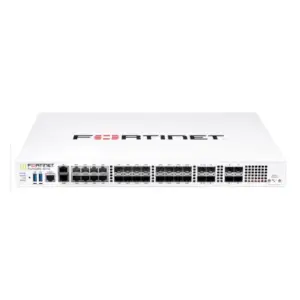
FortiSwitch FS-108F in Uganda
A compact, fanless 8-port Gigabit managed switch with two Gigabit SFP uplinks for secure office, branch and edge-network access.
The FS-108F is designed for buyers who want a small business access switch that can operate as part of a Fortinet Security Fabric through FortiLink or be managed in a standalone deployment. Its compact dimensions, silent fanless design and modest power draw make it practical for locations where a full rack switch is unnecessary. FourTeck can help review the exact model, uplink media, support coverage and integration plan before a Uganda quotation is prepared.
Where a compact Fortinet access switch makes sense
Fortinet positions the 108F as a small managed Ethernet access switch in the FortiSwitch Secure Access family. The model combines eight copper Gigabit Ethernet ports for local devices with two Gigabit SFP interfaces that can be used for fibre or compatible copper transceiver uplinks. Fortinet lists 20 Gbps switching capacity, 30 million packets per second forwarding capacity and 4 microsecond network latency for this platform. Those figures place the switch squarely in the role of a compact branch or edge access device rather than a high-density aggregation chassis.
For a Uganda buyer, the practical attraction is less about headline port count and more about controlled network growth. A small office may need to connect desktops, printers, point-of-sale systems, a local server, an upstream firewall and one or two fibre links without buying a 24-port or 48-port switch. A satellite branch may already use a FortiGate firewall and want the access layer to be visible through the same management approach. A school office or clinic may value a fanless switch because it can sit near occupied workspaces without adding fan noise. These are sensible roles for the FS-108F when eight copper ports are enough and endpoint power is not required from the switch.
The model can be managed through FortiLink when paired with a compatible FortiGate. In that architecture, the switch becomes part of a centrally administered Fortinet environment, helping teams coordinate access policies and visibility from the FortiGate interface. Fortinet also supports non-FortiLink operation through local management methods such as the onboard graphical interface, command line and API. That flexibility matters where a customer wants Fortinet switching but is not yet ready to place the switch under a FortiGate controller.
Selection still requires care. The plain FS-108F does not provide PoE output, while the FS-108F-POE and FS-108F-FPOE have different endpoint power capabilities. SFP modules are also a separate compatibility choice: fibre type, wavelength, connector, distance and the remote device must all match. FourTeck can help businesses in Uganda map these details to a bill of materials, identify the correct Fortinet variant and prepare a current quotation based on project quantity and sourcing conditions.
What the FS-108F can improve in a small network
Right-sized access capacity
Eight Gigabit RJ45 ports provide a practical footprint for small offices, counters, meeting areas, edge cabinets and branches where a larger access switch would leave many ports unused. The business value is a cleaner fit between actual endpoint count and deployed hardware.
Unified Fortinet management
FortiLink allows a compatible FortiGate to manage FortiSwitch devices as part of the network security architecture. For IT teams already operating FortiGate, this can reduce the number of separate management surfaces used to administer branch access switching.
Flexible uplink media
Two Gigabit SFP ports let the design accommodate compatible fibre transceivers where distance, electrical isolation or structured cabling requirements make fibre preferable to copper. Buyers should choose optics according to the actual fibre plant and link partner.
Silent local deployment
The FS-108F is fanless. In occupied offices, reception areas or other sound-sensitive spaces, fanless operation removes the persistent acoustic footprint associated with actively cooled network equipment while also simplifying a small installation.
Straightforward standalone option
A FortiGate-managed deployment is common, but the switch can also operate outside FortiLink. This gives businesses a path to use the hardware in an existing network and later reassess central management as their Fortinet architecture develops.
Low power demand for data-only access
Fortinet specifies 6.2 W power consumption for the standard FS-108F. That is useful for small edge installations where electrical load and heat generation matter, provided the absence of PoE output matches the endpoint design.
The distinctive value is not complexity; it is a small, manageable Fortinet access layer with both copper and fibre connectivity.
8 × Gigabit RJ45
Connect PCs, printers, appliances or other Ethernet endpoints at the access layer. Endpoint count remains the primary sizing constraint.
2 × Gigabit SFP
Use compatible transceivers for fibre or supported SFP-based uplink designs. Optics must be selected separately for media and distance.
20 Gbps switching capacity
Fortinet’s published duplex switching capacity is aligned to full use of the available Gigabit interfaces in this compact platform.
30 Mpps forwarding
Published packet-forwarding capacity provides a useful reference for buyers comparing compact access-switch performance.
Fanless enclosure
Well suited to installations where the switch may be located near users rather than in a dedicated equipment room.
FortiLink compatibility
Allows a compatible FortiGate to act as the switch controller and integrate the access layer into a Fortinet-managed environment.
FortiSwitch 108F technical facts
| Product class | Managed Layer 2 / Layer 2+ access switch in the FortiSwitch Secure Access family |
|---|---|
| Copper ports | 8 × Gigabit Ethernet RJ45 |
| Uplink / SFP ports | 2 × Gigabit Ethernet SFP |
| PoE output budget | 0 W on standard FS-108F; separate PoE variants are available |
| PoE device power | Built-in PoE-PD support on the standard model |
| Switching capacity | 20 Gbps duplex |
| Packet forwarding | 30 Mpps duplex |
| Network latency | 4 μs |
| MAC address storage | 8K |
| VLANs supported | 4K |
| Link aggregation | Group size 8; total 8 link aggregation groups |
| Packet buffer | 512 KB |
| Memory / flash | 256 MB DDR3 DRAM / 32 MB flash |
| Spanning Tree instances | 16 |
| Dimensions | 30 × 120 × 180 mm (H × D × W) |
| Weight | 0.62 kg |
| Power supply | 12V/1A DC power adapter included; 100–240V AC, 50/60 Hz input basis; PoE-PD built in |
| Power consumption | 6.2 W |
| Operating temperature | 0–45°C |
| Humidity | 5–95% non-condensing |
| Management modes | FortiGate-managed through FortiLink; standalone management supported through onboard GUI, CLI and API |
For most buyers, the decisive figures are not the headline switching capacity but port count, uplink type, power behavior and management model. Eight copper ports should be checked against both current endpoints and expected growth. If the location already needs seven or eight active devices, there may be little room for expansion once uplinks, local appliances or temporary devices are considered.
The two SFP interfaces are valuable only when the correct optics are selected. A fibre uplink depends on matching single-mode or multimode fibre, wavelength, link distance and the transceiver supported at the far end. FourTeck can review this before quoting. The absence of PoE output is equally important: standard FS-108F can be the right data switch, but it should not be ordered when the project expects the switch to power phones, cameras or wireless access points.
FortiLink should also be planned rather than assumed. Where a compatible FortiGate is present, central management may be the preferred architecture. In a mixed-vendor environment, standalone operation may be more appropriate. The hardware can support either approach, but deployment responsibilities, firmware planning and support expectations differ.
Five questions to answer before requesting the model
01 What will connect to the switch?
List the actual wired endpoints: PCs, printers, servers, POS terminals, IP phones, cameras, wireless access points, firewall links and other devices. The answer establishes whether eight copper ports are sufficient and exposes any requirement for powered endpoints. If several devices require PoE, the non-PoE FS-108F is not the correct output-power variant.
02 Is Gigabit access enough for the workload?
The switch offers Gigabit access and Gigabit SFP interfaces. This is appropriate for many office and branch workloads, but it is not intended to provide 2.5GbE, 5GbE, 10GbE edge access or 10GbE uplinks. High-throughput storage, dense Wi-Fi 6/6E/7 aggregation or other multi-gigabit workloads may justify a different FortiSwitch family.
03 How will it integrate with the existing network?
Confirm whether the site uses a compatible FortiGate and plans to manage switching through FortiLink, or whether the switch will operate independently. Also identify VLANs, spanning-tree requirements, link aggregation and the remote equipment used on SFP uplinks. Compatibility details can affect both hardware and deployment scope.
04 What growth is expected over the next project cycle?
An eight-port switch may fit perfectly today but become constrained if headcount, cameras, wireless coverage or desk count expands. Estimate the next realistic endpoint count and whether additional fibre links will be needed. A slightly larger model can be more economical than replacing a fully populated small switch shortly after installation.
05 What support, mounting and delivery expectations apply?
Clarify whether the switch will sit on a desk, shelf or rack solution, whether FortiCare support is required, what quantity is needed and when the project expects delivery. Availability and support SKUs can change over time, so these items should be confirmed as part of the quote rather than assumed from a hardware-only model number.
Practical deployment scenarios
Small branch office under FortiGate control
A branch with five or six user devices, a printer and an uplink to a FortiGate can use the switch as a compact access layer. FortiLink management is particularly useful when the organization wants branch switching to be administered alongside the FortiGate. The design should still reserve enough ports for maintenance and growth, and any powered Wi-Fi or voice devices need separate PoE provision or a PoE-capable switch variant.
Retail or service counter network
A retail counter, pharmacy, small hospitality desk or service outlet may need only a handful of wired devices such as POS terminals, receipt printers, local management PCs and a firewall uplink. Fanless operation helps when the switch is close to staff. The buyer should verify whether any surveillance camera or access point on the same network requires PoE, because that changes the recommended variant.
Fibre-connected remote room
Two Gigabit SFP ports make the model useful where a small remote room or floor needs a fibre uplink to the main network and local copper access for a limited number of endpoints. Fibre is often selected for longer runs or where electrical separation is desirable. The correct SFP transceivers, fibre type and patching should be confirmed before purchase.
Quiet office or executive workspace
Because the switch is fanless and compact, it can be considered for offices where network equipment must be close to users and noise should be minimized. It can serve desktops, printers or other local Ethernet devices without the acoustic impact of a fan-cooled chassis. Physical security, cable management and ventilation remain important even with a low-power switch.
FortiLink turns a small switch into part of a broader Fortinet operating model
The value of FortiLink is easiest to understand in operational terms. A standalone access switch is normally configured as its own device with its own administrative context. In a FortiGate-managed FortiSwitch deployment, the access layer can be controlled through the FortiGate environment, allowing the network team to manage switching and security from a more unified perspective. Fortinet describes FortiLink as the mechanism that integrates FortiSwitch with the Fortinet Security Fabric and enables centralized security and access management from the FortiGate interface.
For a small branch, this can be more significant than raw hardware specifications. A site with only eight wired ports might not justify a separate switching management platform, yet it still needs VLANs, controlled access and visibility. If the organization already standardizes on FortiGate, using a FortiSwitch can align the branch with established operational practices. The benefit is not that every configuration task disappears; it is that network access can be administered within a framework the IT team already uses.
The decision should remain architecture-led. A buyer should confirm the FortiGate model, FortiOS compatibility, intended FortiLink topology and whether the switch will initially run standalone. FourTeck can use those details to help identify whether FS-108F is the right access switch or whether a larger or newer multi-gigabit model would better match the network roadmap.
Copper access plus SFP uplinks in a compact form
The physical interface mix is one of the strongest reasons to select this model. Eight Gigabit RJ45 ports cover local copper endpoints, while two Gigabit SFP interfaces provide a path to fibre-connected upstream equipment or other SFP-supported links. This lets a designer place the switch in a small room, branch or work area without losing the option of fibre connectivity back to the core or firewall.
Eight 1GbE RJ45 access ports for standard business Ethernet endpoints.
Two 1GbE SFP ports for compatible fibre or SFP-based uplink designs.
20 Gbps duplex switching capacity and 30 Mpps published forwarding capacity.
The buyer decision is therefore less about whether SFP exists and more about what will be installed in those slots. Multimode and single-mode fibre are not interchangeable design assumptions, and transceiver support should be checked against Fortinet’s compatibility guidance. For a quotation, provide the fibre type, approximate distance and remote device or switch model so the optics can be reviewed with the hardware.
Power design: the standard model is data-only for endpoints
A frequent ordering error in compact switches is assuming that every model in a PoE-capable family can power connected devices. Fortinet distinguishes the standard FS-108F from its PoE variants. The standard model has a 0 W endpoint PoE budget. That means an IP phone, access point, camera or other powered device connected to its RJ45 interfaces will need its own power source or an external injector. If the project expects the switch to deliver PoE, the correct choice is a PoE-capable variant rather than the base model.
At the same time, the FS-108F itself has built-in PoE-PD capability, which is a different function: the switch can receive power over Ethernet in a compatible design. Fortinet also specifies an included DC power adapter and low overall power consumption for the base unit. This flexibility can be useful at edge locations, but the upstream power source and intended topology should be checked carefully before relying on PoE-PD operation.
Buyer decision checklist
- Do any connected endpoints require PoE or PoE+?
- Will the switch use its included DC adapter or receive power as a PoE powered device?
- Is the upstream PoE source compatible with the intended power design?
- Would a 65 W or 130 W PoE-output variant better fit the project?
- Is there adequate ventilation and protected power at the installation point?
What buyers should check before purchase
| Risk | What to confirm | Why it matters | What to share with FourTeck |
|---|---|---|---|
| Wrong 108F variant | Whether endpoint PoE output is needed. | Base FS-108F has no PoE output budget. | List powered phones, APs, cameras and other devices. |
| Insufficient port growth | Current and projected endpoint count. | Eight ports can fill quickly in a growing branch. | Current count plus expected additions. |
| Incorrect SFP optics | Fibre type, wavelength, distance and remote interface. | Mismatched optics can prevent the uplink from operating. | Cable type, link length and far-end equipment. |
| Management mismatch | FortiLink through FortiGate or standalone operation. | The deployment method affects configuration and support planning. | FortiGate model, firmware context and target topology. |
| Support assumption | Required FortiCare term and service level. | Hardware and support are separate commercial decisions. | Preferred support duration and project policy. |
| Project availability | Current sourcing lead time and quantity. | Availability varies by market and sourcing cycle. | Quantity, location and target deployment date. |
These checks are particularly important because small managed switches often appear simple at first glance. The physical device may have only a few interfaces, but the correct order still depends on power, optics, management, support and lifecycle context. For a replacement project, also provide the existing switch model and the reason for replacement. This helps distinguish a like-for-like refresh from a requirement that has grown beyond the capabilities of an eight-port Gigabit platform.
Quote and deployment support for Uganda projects
FourTeck can support Uganda businesses that need to source the FS-108F as a new branch switch, a Fortinet-standardization component or a replacement for an existing small access switch. Availability may change according to distributor supply, support term and requested quantity, so the commercial process should begin with a current quotation rather than an assumption of immediate stock.
For Kampala projects, FourTeck can review the requested switch model, management approach, SFP requirements, support preference and quantity before coordinating a quote. Where the deployment is outside the capital, delivery planning can be discussed alongside the hardware requirement. Warranty guidance should be based on the applicable Fortinet terms and the final supplied configuration, not on a generic promise.
Project buyers should also indicate whether the requirement is a single device, a branch rollout or a larger procurement with repeated site configurations. Consistent bills of materials are particularly useful when several locations need the same switch, optics and support package. Send FourTeck the project details for a current Uganda quote.
Planning supply across major business locations
FourTeck can discuss project requirements for organizations operating in Kampala and for deployments that need coordination to Entebbe, Jinja, Mbarara or Gulu. The useful starting point is the technical bill of materials rather than the city name: switch quantity, power method, required optics, support term and any FortiGate dependency should be clear first. Once the configuration is confirmed, commercial and delivery planning can be handled against the actual destination and project schedule. This keeps multi-site purchasing consistent and avoids location-by-location product variations that were not technically required.
Regional sourcing for multi-country IT teams
Organizations with operations beyond Uganda may need consistent Fortinet switching across multiple offices. FourTeck’s regional web presence can help procurement teams discuss requirements for Uganda technology sourcing, Kenya IT projects and broader Africa requirements. For organizations with procurement links into the Gulf, FourTeck also operates regional sites for the UAE and Kuwait.
Regional support should be planned around the actual country, sourcing route, configuration and support requirement. A product being listed in one market does not guarantee identical availability, delivery timing or warranty handling in another. For a multi-country rollout, provide the site list, quantity by location and whether each branch follows the same FortiGate and switching architecture. FourTeck can then help structure a more consistent procurement discussion.
Alternative paths when requirements change
Practical procurement support around the hardware
Questions buyers ask about the FS-108F
01. What is the FortiSwitch FS-108F mainly used for?
It is mainly used as a compact managed Gigabit access switch for small offices, branches, retail locations and edge networks. It provides eight Gigabit RJ45 ports for local devices and two Gigabit SFP ports for uplinks. It is particularly attractive in Fortinet environments because it can be managed through FortiLink from a compatible FortiGate, while standalone operation is also supported.
02. Does the standard FS-108F provide PoE to phones or access points?
No. Fortinet lists a 0 W PoE output budget for the standard FS-108F. If the switch must power IP phones, Wi-Fi access points, cameras or other PoE endpoints, review the FS-108F-POE or FS-108F-FPOE instead. The base FS-108F does have built-in PoE-PD capability, which allows the switch itself to receive power over Ethernet in a supported design.
03. Can the switch be used without a FortiGate firewall?
Yes. Fortinet supports standalone FortiSwitch deployments using local management methods such as the onboard graphical interface, command line and API. FortiGate integration through FortiLink is a major feature, but it is not the only operating model. Buyers should decide whether centralized Fortinet management is part of the intended architecture before deployment so configuration and support responsibilities are clear.
04. What are the two SFP ports used for?
The two Gigabit SFP ports are commonly used for compatible fibre uplinks or other supported SFP connections. They can be valuable for longer links between rooms, buildings or network cabinets, but the switch does not determine the fibre design by itself. The transceiver must match fibre type, wavelength, distance and the far-end interface. FourTeck can review these details as part of the quote.
05. Is eight ports enough for a growing office?
It depends on the endpoint plan. Eight copper ports can be ideal for a small branch, but a network that already expects seven or eight wired devices has very little growth capacity. Count current desktops, printers, phones, APs, cameras, servers and firewall links, then add realistic expansion. If the projected total is close to the limit, a 24-port FortiSwitch may be more appropriate.
06. Is the FS-108F fanless?
Yes. The standard 108F is a fanless compact switch. This makes it suitable for office environments where network equipment may be installed near users and audible fan noise is undesirable. Fanless does not mean ventilation can be ignored, however. The unit should still be installed within Fortinet’s published environmental limits, with adequate airflow and protected from excessive heat, dust and moisture.
07. What information should I send for a Uganda quote?
Provide the switch quantity, site location, number of wired endpoints, whether any device needs PoE, FortiGate model if FortiLink will be used, fibre type and approximate uplink distance, desired support term and preferred project timing. These details let FourTeck review whether the base model is correct and whether optics, support or a different FortiSwitch variant should be included.
08. Does the switch require a separate software subscription to operate?
The hardware can operate as a managed switch, but support and service requirements are separate commercial considerations. FortiCare options may be purchased according to the buyer’s support policy and lifecycle needs. The exact support SKU and term should be confirmed at quotation because service offerings can change. If the switch will be FortiGate-managed, the broader Fortinet environment should also be reviewed for compatibility.
09. Can FourTeck supply multiple units for branch rollouts?
FourTeck can discuss project and quantity requirements, but availability should be confirmed against the current sourcing cycle. For multi-branch rollouts, send the number of sites, units per site, repeated optic requirements, FortiGate models and desired support term. A standardized bill of materials helps reduce configuration differences between locations and makes it easier to review whether every branch truly fits the eight-port design.
10. What should I consider if I am replacing an older small switch?
Do not compare only port count. Check whether the replacement needs PoE, higher-speed uplinks, more VLAN capacity, centralized FortiGate management or additional growth ports. Also confirm the physical installation, power method and existing fibre transceivers. Sharing the old switch model and the reason for replacement lets FourTeck determine whether FS-108F is a sensible like-for-like choice or whether a newer or larger model is better.
Send the network details before the hardware model is finalized
For the most useful quote, provide the number of local Ethernet devices, whether PoE is needed, the FortiGate model if FortiLink is planned, the fibre uplink type and distance, quantity, support term and destination. FourTeck can use this information to validate the standard FS-108F or recommend the correct FortiSwitch variant for the project.
- Endpoint and port count
- PoE requirement
- FortiGate / FortiLink plan
- SFP optic and fibre requirement
- Quantity, support and delivery destination
Reviews
There are no reviews yet.