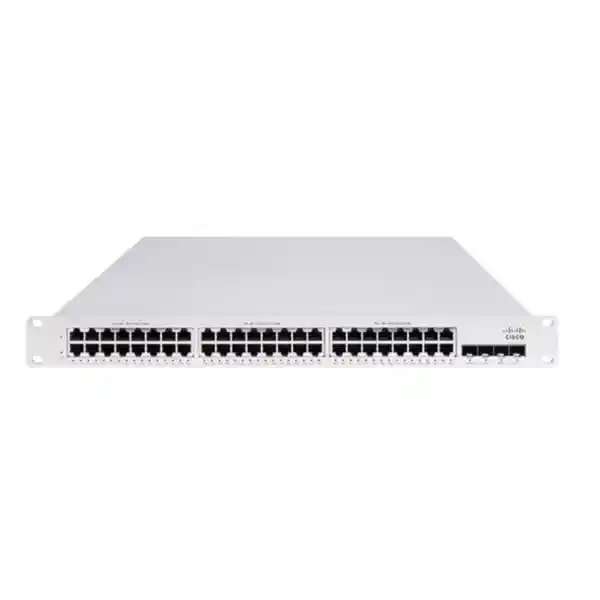
Cisco Meraki MS150-24MP-4X Cloud-Managed Multigigabit PoE Access Switch
The MS150-24MP-4X brings multigigabit connectivity, cloud operations and high-power edge connectivity into a 24-port access switch. It is designed for business networks where wireless access points and other demanding devices require more than a conventional 1GbE connection, while ordinary workstations can continue using familiar Gigabit Ethernet.
Its sixteen 1GbE ports and eight up-to-5GbE multigigabit ports allow engineers to reserve faster connections for devices that benefit from them. Four 10GbE SFP+ uplinks connect access infrastructure toward aggregation or distribution switches. Two dedicated stacking ports provide 80Gbps stacking bandwidth. The shared PoE budget is 370W, not 370W per port; up to 60W on eligible multigigabit ports does not remove this aggregate constraint.
For Uganda procurement teams, a useful quotation must include the precise hardware model, appropriate Meraki licensing, optics and cables where required, warranty terms and logistics. Hardware availability and delivery schedules require confirmation before an order is committed.
Procurement facts at a glance
16 × 1GbE plus 8 × up-to-5GbE RJ45
4 × 10GbE SFP+
370W aggregate PoE budget; up to 60W on ports 17–24
Cisco Meraki Dashboard; licensing to be quoted separately as applicable
The product is intended primarily for branch and campus access deployment. It offers cloud-managed operational control and static routing features; it should not be represented as a replacement for a full-featured campus core router without a requirements review. Stock, regional warranty eligibility and quotation validity are confirmed during procurement.
Architecture and operating role
A typical deployment places the MS150-24MP-4X between endpoint devices and an upstream distribution network. The copper interfaces carry workstation, phone, camera and wireless access traffic. The multigigabit ports are particularly useful when a wireless access point can exceed the capacity of a single 1GbE access connection. Uplink connections can be designed with appropriate fiber or copper SFP+ modules, subject to compatibility and distance.
Cloud management centralizes visibility into switch health, port behavior, configuration and firmware maintenance. Network engineers can plan VLAN segmentation, access control, troubleshooting and maintenance windows across geographically distributed offices. Features documented for the MS150 family include VLAN tagging, 802.1X authentication, IPv4/IPv6 access control lists, DHCP snooping, dynamic ARP inspection, storm control, remote packet capture and SNMP/syslog integration. Feature behavior should be verified against the deployed firmware and licensing.
The dedicated stack interfaces support a design in which compatible MS150 members operate together. Stacking should be engineered with approved cables, supported topologies and a realistic failure-domain assessment. A stack improves administration and port expansion but does not automatically make connected endpoint links redundant. Applications that demand continuous service still need suitable upstream and endpoint resilience.
Business outcomes
- Predictable access performance: Match the eight faster copper ports to high-throughput wireless access points while preserving sixteen Gigabit connections for routine endpoints.
- Operational resilience: Plan redundant upstream paths and monitoring rather than relying on a single cable or switch as the only route to critical services.
- Scalable branch growth: Dedicated stacking connections allow expansion within supported MS150 configurations.
- Controlled access: Apply appropriate VLANs, authentication, access lists and anti-spoofing protections as part of a documented security policy.
- Centralized administration: Use Dashboard workflows to standardize sites and reduce avoidable travel for routine changes.
- Cost awareness: Budget for licenses, optics, power, rack accessories, replacement coverage and support—not merely the initial hardware.
- Energy planning: Estimate actual PoE draw and switch load rather than treating the maximum supported budget as a constant electrical draw.
Technical specification ledger
| Attribute | MS150-24MP-4X specification |
|---|---|
| Copper ports | 16 × 10/100/1000 RJ45; 8 × multigigabit RJ45 up to 5GbE, ports 17–24 |
| Uplinks | 4 × 10GbE SFP+ |
| Management interface | 1 dedicated interface |
| PoE budget | 370W shared |
| High-power ports | Up to 60W on ports 17–24, within shared budget |
| Stacking | 2 dedicated ports; 80Gbps stacking bandwidth |
| Switching capacity | 192Gbps |
| Routing | Static routing |
| Input | 100–240VAC |
| Idle / maximum load | 43W / 454W as published |
| Mounting | 1U rack mounting; verify physical depth and airflow clearance against current installation guide |
Reference: Cisco Meraki MS150 official datasheet. Specifications and supported features may change with documentation revisions.
Configuration and sizing worksheet
Step 1 — Count endpoints: Record workstations, phones, cameras, printers and access points by room and floor. Reserve growth capacity rather than allocating every available port immediately.
Step 2 — Identify faster endpoints: Assign multigigabit ports to compatible devices that need them. Confirm the device’s supported Ethernet speed and cabling condition before assuming 5GbE operation.
Step 3 — Calculate PoE: Sum maximum negotiated power requirements, add a suitable margin and verify the total remains within 370W. Eight devices requiring 60W each would exceed the shared budget.
Step 4 — Size uplinks: Specify fiber distance, optical type, upstream transceiver compatibility and expected aggregate traffic. Four 10GbE interfaces are not a promise of any particular application throughput.
Step 5 — Validate rack and electrical services: Check 1U rack space, cable routing, cooling, grounding, UPS runtime and power distribution capacity.
Step 6 — Confirm cloud operations: Verify organization ownership, license type and term, administrator roles, configuration templates and deployment procedures.
Step 7 — Prepare the purchase request: Include exact model, quantity, licenses, transceivers, stacking accessories, destination, delivery deadline, installation scope and required supporting documents.
Deployment scenarios in Uganda
Corporate and multisite offices
Use the switch as an access layer for employee endpoints, meeting-room devices and wireless infrastructure. Standardized VLAN policies and Dashboard administration can support repeatable branch deployments. For headquarters aggregation, evaluate uplink redundancy and whether the distribution tier has sufficient capacity.
Financial institutions
Separate transaction terminals, staff systems, guest wireless and building services according to policy. Document authentication, monitoring and incident-response requirements before rollout. Financial compliance depends on the overall architecture and operational controls, not the switch model alone.
Schools and campuses
Connect classroom access points, office endpoints and security devices, giving priority multigigabit ports to higher-capacity wireless infrastructure. Plan switch-room ventilation, backup power and controlled administration.
Public-sector procurement
Prepare clear equipment schedules, warranty requirements, license terms, delivery acceptance criteria and implementation responsibilities. Sensitive networks may require additional approval of cloud management arrangements and data governance.
Three engineering considerations
Packet forwarding and multigigabit design
The 192Gbps published switching capacity provides a hardware-level sizing reference. Engineers should still evaluate real traffic patterns, packet sizes, uplink contention and endpoint behavior. The eight faster copper interfaces do not make all twenty-four ports multigigabit. Select uplink placement and VLAN boundaries deliberately.
Firmware and management governance
Meraki Dashboard provides central workflows for configuration, diagnostics and firmware operations. Establish administrator access controls, maintenance approvals, change records and monitoring destinations. Validate firmware release suitability before major production changes.
Availability and recovery
Consider power backup, upstream path diversity, spare hardware, configuration recovery and support escalation. Physical stacking supports scale and operational coordination but does not eliminate every failure mode. Design business continuity around critical services and acceptable recovery time.
Buyer questions to resolve before purchase
Is the correct Meraki subscription included in the quotation? Are the SFP+ modules suitable for the upstream equipment and installed fiber? Are approved stacking cables required? Does the PoE worksheet cover the highest expected endpoint draw? Are rack depth, cooling and UPS capacity sufficient? Is the offered hardware new and sourced through an acceptable channel? Which warranty and replacement process applies at the destination? What are the license renewal and support obligations over the intended service life? Request written answers for any commercial or operational requirement that affects acceptance.
Uganda delivery and procurement coverage
FourTeck can receive quotation requests for Kampala headquarters, Entebbe facilities, Jinja industrial and education sites, Mbarara regional offices and Gulu branches. Provide the delivery address, receiving contact, project timeline and documentation needs. Shipment lead time, import handling, on-site services and stock position are subject to confirmation in the formal offer. For multisite rollouts, submit a location-by-location equipment schedule so quantities and accessory requirements are visible before dispatch.
Regional procurement coordination can also begin through FourTeck Uganda, FourTeck Kenya, FourTeck Africa, FourTeck UAE and FourTeck Kuwait. Cross-border availability, duties and delivery commitments must be established per order.
Related solutions and technical services
When comparing the required mix of ports, consider the Cisco Meraki MS150 family, higher-density MS150-48MP-4X deployments, conventional Gigabit access switches, compatible SFP+ uplink optics, approved stacking accessories, wireless access points and power-protection equipment. Request these as separate bill-of-materials items to avoid ambiguity. FourTeck can discuss bill-of-materials validation, port and power sizing, staging expectations, configuration responsibilities and post-delivery support scope; all services and commercial commitments should be confirmed in writing.
Frequently asked questions
How many multigigabit ports does the MS150-24MP-4X provide?
Eight of its twenty-four RJ45 access ports are multigigabit, supporting up to 5GbE. The other sixteen copper ports are Gigabit Ethernet. This mixed design can reduce the need to pay for faster access interfaces on every endpoint while still supporting higher-capacity wireless devices.
Does every port deliver 60W?
No. Cisco documents up to 60W on the eight multigigabit ports, subject to a 370W total PoE budget for the switch. The engineer must calculate the combined demand of all powered devices and should allow headroom for device startup and future changes.
Can this switch connect to a 10GbE distribution layer?
Yes, it has four 10GbE SFP+ uplink interfaces. Verify the optical modules, cable type, fiber distance, upstream switch compatibility and intended uplink topology. The transceiver choice must match the actual installation.
Is a Meraki license required?
Meraki Dashboard management operates within Cisco Meraki’s licensing framework. Confirm the appropriate license, term and applicable support entitlements for the switch before ordering. Do not assume that a hardware-only quote includes the required subscription.
Can it be stacked?
The MS150 series provides two dedicated stacking ports and 80Gbps stacking bandwidth. Confirm supported members, approved cabling and firmware compatibility before deploying a stack. Stacking and high availability are related but not interchangeable design concepts.
Is it suitable for Wi-Fi 7 access points?
Its multigigabit access ports and higher-power PoE capability can be useful for compatible Wi-Fi 7 deployments. Check each access point’s Ethernet speed, PoE class and maximum draw. A particular access point may require different resources or features, so compatibility must be verified by model.
Can it replace a core router?
It offers static routing and access-switch functionality, but that does not establish suitability for complex core routing, internet-edge security or extensive dynamic routing requirements. Select the distribution and core platforms according to the full routing, resilience and security specification.
What information is needed for an accurate Uganda quote?
Send the full model, quantity, required licensing period, preferred transceivers, stacking needs, delivery destination and planned deployment date. If the project includes powered devices, include their models and expected quantities so the 370W power budget can be checked.
How are warranty and replacement requests handled?
Warranty eligibility, support access and replacement timing depend on the applicable Cisco terms, procurement channel, license and regional service arrangements. Request the exact coverage and replacement procedure in the written quotation before placing an order.
Request a configured MS150-24MP-4X quotation
Share your network design or equipment list to obtain a tailored Uganda procurement response. Specify whether you require hardware only or a complete package including licensing, optics, stacking accessories, staging and delivery. Confirmed pricing, availability and warranty terms will be supplied through the quotation process.

Reviews
There are no reviews yet.