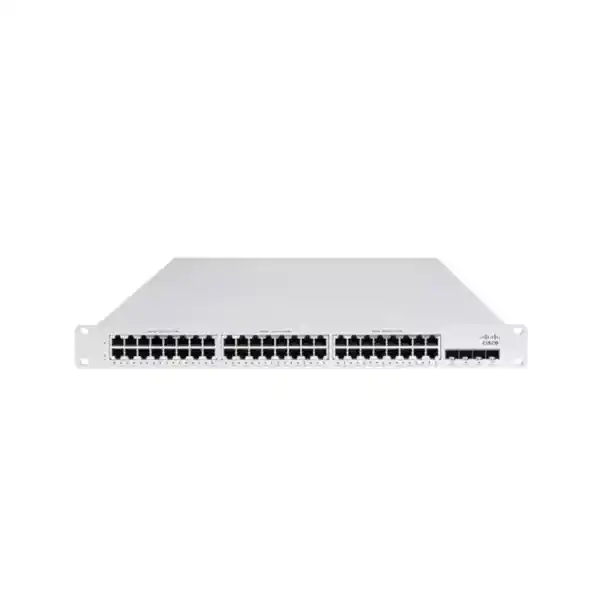
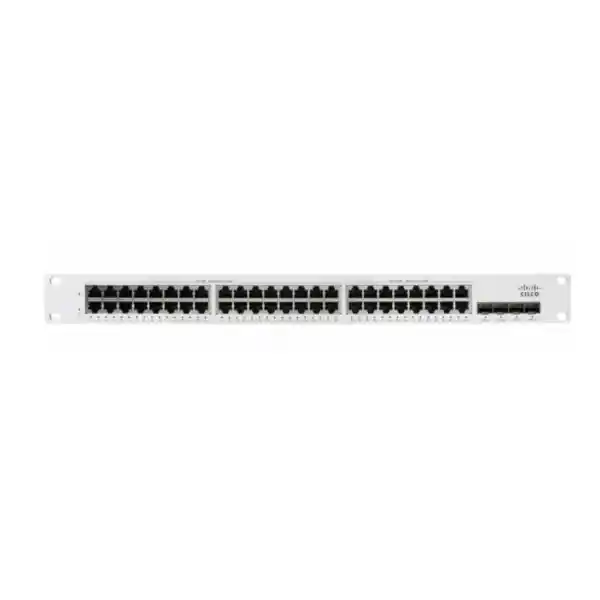
Cisco Meraki MS150-48FP-4X 48-Port Cloud-Managed PoE Access Switch
The Cisco Meraki MS150-48FP-4X is a rack-mounted enterprise access switch for organizations that need reliable wired connectivity, centralized visibility and significant endpoint power delivery. It combines 48 Gigabit copper access ports with four 10 Gigabit SFP+ uplinks and a 740W shared PoE budget. This configuration makes it especially relevant to schools, hospitals, office towers, hospitality sites and distributed enterprises that run numerous phones, cameras and wireless access points from their network closets.
Rather than purchasing a switch based solely on port count, infrastructure teams should assess how many connected endpoints need power, what bandwidth the upstream network can accommodate, and how operations staff will administer policies across locations. The MS150-48FP-4X offers an approachable answer: high-density access ports, cloud-managed configuration and physical stacking capability in a single access-layer platform.
For procurement in Uganda, FourTeck can discuss the required switch quantity, licensing, optical modules, rack accessories and delivery arrangements. Exact availability, final pricing, warranty terms and lead time are confirmed in a written quotation rather than assumed on this page.
Procurement Facts at a Glance
MS150-48FP-4X; 48 Gigabit RJ45 access ports.
Four 10GbE SFP+ uplinks; two dedicated stack ports with 80Gbps stacking bandwidth.
740W shared PoE budget; up to 30W per access port, subject to budget.
Price, stock, license term, delivery and applicable warranty to be confirmed by quotation.
Architecture and Operating Model
The MS150 family is intended primarily for branch and campus access. The 48FP-4X variant supplies dense 1GbE connections at the edge, where desktops, phones, printers, access points and surveillance equipment enter the network. Four separate 10GbE uplinks enable higher-capacity connectivity to aggregation switches, depending on transceiver selection, cabling and upstream equipment. A published 176Gbps switching capacity describes the switching fabric; it should not be confused with a guaranteed application throughput measurement across a particular topology.
Administrators use the Cisco Meraki Dashboard to configure and monitor the device. Features include VLAN tagging, 802.1X access authentication, IPv4 and IPv6 access-control lists, DHCP snooping, dynamic ARP inspection, broadcast storm control, remote packet capture and SNMP/syslog integration. These capabilities help reduce repetitive switch-by-switch configuration and support a consistent operational baseline across several sites.
Physical stacking is useful when a wiring closet requires more than 48 ports or when several switches must be administered as a coordinated group. Two dedicated stacking ports offer an 80Gbps stacking bandwidth specification. A stack should still be designed with attention to supported topology, compatible hardware and software, failure domains and uplink placement. Stacking is not a substitute for redundant building power or a tested disaster recovery plan.
The switch supports static routing, but procurement teams should avoid treating it as a full replacement for a sophisticated enterprise routing or security platform. The intended design is generally access switching with appropriate upstream distribution, firewall and WAN services.
Business Value in Practical Terms
- Performance: Dedicated 10GbE uplinks provide headroom for aggregated Gigabit endpoints. Calculate oversubscription against actual traffic profiles, not merely port counts.
- Continuity: Centralized visibility, alerts and monitoring can speed fault isolation. Plan UPS capacity and spare hardware for critical closets.
- Growth: The 48-port format and dedicated stacking connections support incremental expansion without redesigning every floor.
- Security: VLANs, authentication and traffic controls can enforce access policies when properly integrated with identity and upstream security systems.
- Administration: Dashboard-based management reduces the need for repeated manual visits, particularly for multi-site estates.
- Power consolidation: A 740W PoE budget can reduce separate power injectors and simplify endpoint wiring, provided each device stays within the port limit.
- Procurement clarity: A documented bill of materials can combine hardware, license, optics and deployment accessories into one accountable project scope.
Hardware and Software Feature Matrix
| Capability | Published Specification | Deployment Relevance |
|---|---|---|
| Access | 48 × 10/100/1000 RJ45 | Dense wired edge connectivity |
| Uplinks | 4 × 10GbE SFP+ | Fiber or compatible direct-attach aggregation |
| PoE | 802.3bt listed; 30W per port; 740W aggregate | Power compatible endpoints within limits |
| Stacking | 2 dedicated ports; 80Gbps bandwidth | Scale access closets |
| Fabric | 176Gbps switching capacity | Capacity planning reference |
| Management | Meraki Dashboard | Centralized policies and visibility |
| Power input | 100–240VAC | Confirm UPS and electrical design |
| Form factor | Integrated 1U rack mounting | Structured communications cabinet installation |
Confirm current datasheet revisions, physical dimensions, accessory compatibility and warranty eligibility against the exact hardware SKU before issuing a purchase order. Manufacturer reference: MS150 datasheet.
Sizing and Configuration Worksheet
1. Count powered and unpowered endpoints
Inventory every proposed connection by floor, room and application. Separate ordinary data connections from phones, wireless access points, cameras and other powered devices. Leave spare ports for expansion and maintenance. A switch with 48 ports does not guarantee that 48 power-hungry devices can all operate at their maximum rated draw simultaneously.
2. Calculate power demand
For each powered device, record its required PoE class or maximum power draw. Sum expected allocations and include reasonable operating margin. For example, 24 devices provisioned at 25W each require 600W before margin, within the 740W aggregate limit; 48 devices each demanding 30W would require 1,440W and exceed the switch budget. Verify actual device behavior and port-level requirements.
3. Design uplinks
Document the number of fiber paths, distances, optics, patch panels and core-switch interfaces. Check transceiver compatibility and link aggregation design. Use the 10GbE uplinks where appropriate; do not assume a particular module is bundled.
4. Check facilities
Confirm rack depth, cable bend radius, airflow, grounding, UPS runtime and ambient temperature. The published operating temperature range for the family is 0–45°C. High-density PoE closets can require deliberate cooling and power planning.
5. Confirm licensing
Specify the correct Meraki switch license and duration as part of the quote. Validate license co-termination or per-device licensing requirements against the organization’s Dashboard configuration and applicable commercial terms.
6. Prepare the purchase request
Include site names, delivery location, quantities, target date, power schedule, optics, cabling, license term, support requirements and preferred invoice details. This reduces quotation revisions and avoids omitted accessories.
Deployment Scenarios
Enterprise offices and distributed branches
Use the MS150-48FP-4X to consolidate workstation, voice and wireless connections at each floor or branch. Separate corporate, guest, voice and facilities traffic with appropriately configured VLANs. Route uplinks toward a resilient aggregation layer and standardize switch profiles across locations.
Financial institutions
Bank branches and back offices benefit from structured access controls, monitoring and clear change management. Authentication, port security design and network segmentation should be combined with approved identity and security systems. Any sector-specific compliance requirement needs independent validation.
Education and campus networks
Lecture halls, administration blocks and teaching spaces often mix access points, phones, CCTV and conventional data devices. A high PoE budget helps consolidate endpoint power, while stacking can extend port density in larger closets. Design uplink bandwidth for peak simultaneous classroom traffic.
Government and regulated environments
Public-sector deployments may require detailed procurement records, controlled administrative access and documented firmware policies. Validate cloud-management suitability against the institution’s data governance and connectivity requirements before selection.
Three Technical Considerations
Switching fabric and traffic engineering
The 176Gbps published switching capacity should be read alongside access speeds, uplink count, traffic direction and oversubscription. A building with many low-usage endpoints behaves differently from a video production office moving large files simultaneously. Measure or estimate busy-hour traffic and map critical applications to appropriate uplink and quality-of-service policies. When multiple uplinks are deployed, verify how link aggregation, spanning tree and upstream architecture influence usable capacity.
Cloud management and operational governance
Dashboard management provides centralized administration, monitoring and firmware lifecycle tools. Define administrator roles, change approval procedures, alert recipients and configuration standards before deployment. Security controls such as 802.1X, DHCP snooping and ACLs require deliberate design and testing. Preserve network diagrams and a recovery runbook outside the management interface so that staff can respond during an internet or management-service disruption.
Availability and recovery planning
Stacking can simplify growth and certain operational tasks, but a single rack or power source remains a potential common failure domain. Critical sites should consider separate UPS feeds, redundant uplink paths, documented spare-stock arrangements and tested restoration procedures. Confirm any power supply or component redundancy features against the exact model documentation rather than assuming capabilities from another Meraki series.
Buyer Questions to Resolve Before Purchase
Is a license included? Do not assume it is. Ask for hardware and license line items separately. Will it power every access point? Check both the 30W per-port limit and the 740W shared budget; higher-draw endpoints may need another switch variant. Does it support multigigabit copper? This specific model has 1GbE access ports; buyers needing 2.5GbE or 5GbE should evaluate the appropriate MS150 MP variants. Are SFP+ modules included? Confirm modules, fiber type, cable lengths and supported combinations on the bill of materials. Will the cabinet accommodate it? Validate full installation clearance and cooling, not just the 1U height. Can it replace the core router? It offers static routing but is primarily an access switch. Is stock guaranteed? No inventory claim is made until confirmed in a quotation. What about support? Confirm licensing, eligibility and local service responsibilities in writing.
Uganda Procurement and Delivery
FourTeck supports quotation planning for organizations deploying network infrastructure in Uganda. Buyers in Kampala can request a detailed bill of materials for office refreshes, while project teams in Entebbe, Jinja, Mbarara and Gulu can submit site-specific quantities and delivery requirements. Delivery coverage, shipping cost, tax treatment and lead time depend on order details and must be confirmed before payment.
For nationwide projects, provide a location-by-location schedule and identify which sites require staging, rack installation, configuration assistance or handover documentation. Network deployments often fail commercially because optics, licensing or installation accessories are omitted from the first quotation; a consolidated purchasing schedule reduces those risks.
Regional Supply Coordination
Organizations with regional operations can coordinate procurement discussions across Uganda, Kenya, broader African markets, the United Arab Emirates and Kuwait. Regional sourcing does not automatically establish stock, export eligibility or warranty portability. Confirm import documentation, currency, applicable duties and authorized support arrangements for each destination.
Related Network Procurement Options
Buyers comparing access-switch choices should consider the MS150-48LP-4X when a smaller shared power budget is sufficient, or the MS150-48MP-4X when select multigigabit ports and higher per-port power capability are needed. The MS150-24P-4X may be appropriate for smaller closets. For additional guidance on suitable accessories, licensing, optics and switching alternatives, contact the Uganda procurement team. Related regional sourcing resources include Kenya solutions, African enterprise supply and UAE infrastructure procurement.
FourTeck Technical Procurement Assistance
FourTeck can discuss bill-of-materials verification, model selection, compatible uplink components, licensing requirements and deployment planning as part of a project quotation. Any staging, firmware preparation, preconfiguration or post-sales engineering service should be explicitly scoped and confirmed. Before shipment, buyers should request serial-number records, documented commercial terms and a clear acceptance process appropriate to the project.
Frequently Asked Questions
1. What is the main purpose of the MS150-48FP-4X?
It is a cloud-managed enterprise access switch that connects up to 48 Gigabit Ethernet endpoints and can supply compatible PoE devices from a shared 740W budget. Four 10GbE uplinks connect the access layer to higher-capacity switching infrastructure. It is designed for locations where centralized monitoring and consistent policy administration are important. Select it based on endpoint count, power demand, licensing and the surrounding network design.
2. Can all 48 ports deliver 30W at the same time?
No. The published per-port limit is 30W, but the entire switch has a 740W shared budget. Forty-eight endpoints requesting 30W would require 1,440W, far beyond the aggregate capacity. Build a power schedule showing each device’s requested allocation and leave headroom. If the project needs sustained higher total power, distribute endpoints across additional switches or select an appropriate alternative architecture.
3. Does this model have 10GbE copper access ports?
No. Its 48 RJ45 access ports support 10/100/1000Mbps Ethernet. The four 10GbE interfaces are SFP+ uplinks. This distinction matters for modern wireless access points and workstations requiring multigigabit copper links. For those workloads, review the MS150 multigigabit variants and their exact port layouts. Do not order the FP-4X variant on the assumption that its access ports are 2.5GbE or 5GbE.
4. Is cloud licensing required?
Meraki switches are designed around the Meraki Dashboard management ecosystem, and appropriate licensing should be included in the purchasing plan. Ask for a written quotation showing hardware, license type, term and any relevant renewal obligations separately. Organizations already using Meraki should verify compatibility with their licensing model. Do not assume that hardware-only pricing represents the complete operational cost of ownership.
5. Which optical transceivers are suitable?
The switch provides four 10GbE SFP+ uplink slots. Appropriate modules depend on fiber type, distance, connector, upstream device and Cisco Meraki compatibility guidance. Some deployments use compatible direct-attach cabling for short connections, while longer paths may require fiber optics. Ask the supplier to identify exact supported part numbers and include patch leads and fiber accessories in the quote. A 10GbE port alone does not guarantee interoperability with an arbitrary optic.
6. Can it be stacked with another switch?
The MS150-48FP-4X has two dedicated stacking ports with 80Gbps stacking bandwidth. Before implementing a stack, validate supported members, firmware requirements, stacking cables and the intended physical topology against current manufacturer guidance. Consider the operational consequences of maintenance or power loss affecting a common rack. Stacking can increase manageability and port density, but it does not eliminate the need for resilient uplinks or a recovery plan.
7. What security features can administrators use?
The MS150 family includes VLAN tagging, 802.1X authentication, IPv4/IPv6 access-control lists, DHCP snooping, dynamic ARP inspection and storm control. These functions help implement network segmentation and reduce selected local-network threats. Effective security still depends on correct identity integration, policy design, firmware maintenance and upstream controls. For regulated environments, confirm the complete system architecture against applicable institutional requirements rather than relying on a switch feature list alone.
8. How should power and cooling be planned?
High-density PoE equipment can impose meaningful electrical and thermal loads on a wiring closet. Use the manufacturer’s maximum power figures and actual expected endpoint demand when sizing UPS capacity, branch circuits and cooling. The MS150 installation guidance identifies a 0–45°C operating temperature range. Ensure airflow paths are not obstructed, check the rack’s usable depth and reserve adequate cable-management space. Have facilities staff validate the final power design.
9. What warranty and replacement support applies in Uganda?
Warranty eligibility and replacement processes depend on the exact product, purchasing channel, licensing and applicable manufacturer terms. Request written confirmation of coverage, local handling procedures, return requirements and expected replacement logistics before ordering. Do not assume that international shipping, on-site engineering or immediate local spare-stock access is included. For business-critical deployments, consider a documented spare strategy and a separate maintenance service agreement if appropriate.
10. What information is needed for an accurate quotation?
Provide the requested quantity, delivery destination, deployment date, number of powered endpoints, expected power draw, uplink distances, preferred license term and any rack or installation accessories. Indicate whether the switches will join an existing Meraki organization and whether the project requires staging or engineering assistance. A complete request enables clearer pricing and reduces delays caused by missing optics, power planning or licensing details.
Plan Your MS150-48FP-4X Deployment
Send FourTeck your project location, switch quantity, endpoint schedule, licensing preference and uplink requirements. Request a written offer identifying hardware, software licensing, accessories, warranty conditions, taxes and estimated delivery. The right purchasing decision begins with a verified bill of materials and realistic power and network capacity planning.


Reviews
There are no reviews yet.