
Fortinet FortiADC 1000G Application Delivery Controller for Uganda
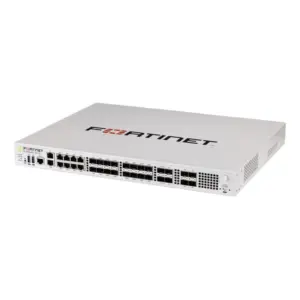
Fortinet FortiADC 1000G is a high-performance 1U application delivery controller designed to distribute, accelerate, protect and maintain access to business applications across enterprise data centers. It sits in front of application servers or security infrastructure and makes real-time decisions about where client traffic should go, how encrypted sessions should be handled, how application health should be checked and how services should continue when a server, link or site becomes unavailable. For Ugandan organizations running customer portals, banking services, ERP systems, university platforms, government applications, private cloud workloads or multi-site business services, this appliance provides a practical path to combining application availability, traffic management and security controls in a dedicated hardware platform.
The 1000G occupies a useful middle-to-high enterprise tier in the FortiADC hardware family. Its published performance includes up to 50 Gbps Layer 4/Layer 7 performance, 1.1 million Layer 4 connections per second, 4 million Layer 4 HTTP requests per second, up to 50 million concurrent Layer 4 connections, hardware-assisted TLS processing and 25 Gbps compression throughput. It also provides a broad 10 Gigabit interface mix with eight 10GBase-T RJ45 ports and twelve 10G SFP+ ports, allowing buyers to connect existing copper 10 Gigabit infrastructure, fiber aggregation, server switching and redundant upstream networks without choosing a platform that is constrained to one media type.
Procurement teams commonly evaluate the FortiADC 1000G when they have outgrown software-only load balancing, need predictable encrypted traffic capacity, require appliance-level redundancy or want to consolidate local and global application delivery functions. The right purchase decision depends on more than headline throughput. Real deployments must account for TLS transaction rates, concurrent sessions, backend server count, persistence methods, health checks, security profiles, interface density, transceiver type, power feeds, rack depth and support subscriptions. FourTeck helps buyers turn those variables into a verified bill of materials before the order is released.
Instant Specifications & Procurement Fact Rail
Fortinet FortiADC 1000G / FAD-1000G
Enterprise and data-center application delivery
Up to 50 Gbps
Up to 35 Gbps published platform figure
8×10G RJ45 + 12×10G SFP+
1U rack appliance
Dual hot-swappable supplies, 100–240V AC
Project quote, support-term and logistics confirmation
The fact rail is intended to make early-stage product selection faster. It should not replace workload sizing. A 50 Gbps platform can be an excellent match for one environment and an unsuitable choice for another if the dominant workload is extremely connection-heavy, relies on large volumes of new TLS handshakes, needs unusual persistence logic or requires interface types not covered by the built-in port set. Buyers should therefore compare the traffic profile against both throughput and transaction metrics. The physical side also matters: the appliance is 1U, approximately 440 mm wide, 44 mm high and 576 mm deep, with front-to-back airflow. Adequate cabinet depth, rail clearance, cable bend radius and separate power feeds should be confirmed before installation. Support and service terms are normally selected as part of the commercial bundle, so the quotation should identify the required duration and service level rather than treating the chassis alone as the complete procurement package.
Operational Product Architecture & Overview
Application delivery is fundamentally about controlling the path between users and the services they consume. In a traditional design, clients connect directly to an application server or to a basic network load balancer. That model becomes difficult to manage when there are many application instances, mixed protocols, encrypted sessions, multiple data centers, changing server health or security requirements. FortiADC inserts an application-aware control layer between clients and application resources. Client requests arrive at a virtual service on the ADC. The appliance then applies health, routing, persistence, security and load-distribution policies before forwarding the connection to the appropriate backend system.
The FortiADC 1000G is built as a dedicated hardware appliance rather than a general-purpose server running an ADC image. That distinction matters for organizations seeking predictable capacity. Published specifications list 64 GB memory, a 480 GB SSD, dedicated management connectivity, two high-availability interfaces and hardware-assisted cryptographic acceleration. The interface layout combines copper and SFP+ connectivity, making it easier to integrate with common data-center topologies. Eight 10G RJ45 ports can attach to copper-based switching or nearby server infrastructure, while twelve 10G SFP+ ports can connect to fiber distribution, aggregation switches or redundant fabrics. This mixture also gives architects flexibility when separating client-side, server-side, management, synchronization and service networks.
At Layer 4, the platform can distribute TCP and UDP services based on connection information and configured policies. At Layer 7, it can make richer decisions based on application-level information, enabling organizations to direct requests according to host names, URLs, application rules or service behavior. Health checking prevents new requests from being sent to a server that is unreachable or failing an application test. Persistence mechanisms can maintain user affinity where an application requires repeat requests to reach the same backend resource. Global server load balancing can extend availability decisions across sites rather than limiting selection to servers in one data center.
Encrypted traffic is a major sizing factor in modern application delivery because nearly every important business service uses TLS. When encryption is terminated directly on application servers, each server spends processor time on cryptographic work in addition to running the application. A dedicated ADC can terminate or re-encrypt connections according to the architecture, centralize certificate handling and reduce duplicate cryptographic overhead across the server farm. The 1000G uses hardware acceleration for this purpose and is published with substantial TLS transaction and bulk encryption capacity. Actual results depend on cipher suites, key type, key size, session reuse, payload size, security features and traffic pattern, so buyers should not treat a single laboratory figure as an unconditional production guarantee.
The appliance also supports application security functions that can be valuable where the ADC is positioned at a critical trust boundary. Depending on the selected software and service package, functions can include web application protection, reputation controls, bot mitigation, denial-of-service protections, application access controls and integration with the broader Fortinet ecosystem. Procurement managers should map required protections to the quoted licensing bundle. A hardware purchase that omits the necessary subscription or service entitlement can create delays during deployment even when the chassis itself is technically capable of the feature.
Typical triggers for evaluating this model include application slowdowns during peak periods, repeated outages caused by single-server dependence, certificate-management complexity, insufficient capacity on an older ADC, a data-center refresh to 10 Gigabit connectivity, consolidation of multiple smaller load balancers, or a requirement for active/standby or active/active application delivery. The model is also relevant where organizations want to protect upstream firewalls from unnecessary cryptographic load by handling selected secure application traffic on a purpose-built platform. A careful design review should determine where TLS terminates, which device owns client addressing and routing, how source addresses are preserved, how server return traffic is routed and how health checks behave during partial application failures.
Enterprise Business Outcomes & Value Analysis
1. Performance & Throughput Integrity
The first operational benefit is capacity headroom for busy application estates. The 50 Gbps L4/L7 rating, high request processing rates and dedicated cryptographic engine give infrastructure teams room to separate application growth from the processor limits of individual servers. This can improve consistency during traffic spikes, batch-processing windows, registration periods, payment deadlines or public-service events. The value is not simply faster packet forwarding; it is predictable control of how connections are distributed when backend capacity changes. Correct sizing should still preserve margin above observed peak utilization so normal growth, maintenance and failover do not push the platform to its design ceiling.
2. System Reliability & High Availability
Dual hot-swappable power supplies, dedicated high-availability interfaces and clustered deployment options support resilient designs. Two appliances can be deployed so that a hardware fault or planned maintenance event does not require a business application to be taken offline. The full resilience plan should include redundant switches, independent power feeds, redundant upstream routing and backend diversity; an ADC pair cannot compensate for a single electrical circuit or a single access switch feeding both units. Buyers should therefore treat the ADC as one component within an end-to-end availability architecture.
3. Network & Infrastructure Scalability
Twenty 10 Gigabit data interfaces allow segmentation of production, backend, partner, security and interconnect traffic without immediately relying on a small number of heavily trunked ports. Virtual domains can support logical separation for different business units, service groups or environments where appropriate. This provides a more scalable foundation for consolidation than deploying a separate appliance for every application group. Architects should confirm segmentation, routing and administrative requirements early because logical consolidation can simplify hardware while increasing the importance of governance and change control.
4. Enterprise Security & Access Control
Application delivery is a natural enforcement point because every protected request can pass through the ADC before reaching a server. That position allows organizations to apply certificate policy, connection controls, application rules and selected web protections close to the service edge. Centralizing these controls can reduce inconsistent server-by-server configurations. It also means policy mistakes can affect many applications at once, which is why change testing, staged deployment, configuration backups and restricted administrative access are essential parts of the operating model.
5. Centralized Management & Operational Simplicity
HTTPS management, SSH command-line access, console access and SNMP provide multiple operational paths. Administrators can standardize virtual server definitions, health checks, server pools, persistence and certificate processes rather than building separate methods for each application team. This helps with troubleshooting because engineers can review the application delivery layer independently from backend servers. The strongest operational gains come when naming standards, address plans, certificate ownership and change procedures are defined before large-scale onboarding begins.
6. Total Cost of Ownership & Energy Planning
A dedicated ADC has an upfront hardware and support cost, but consolidation can reduce the number of ad hoc load-balancing instances, duplicated certificates, manual failover procedures and emergency troubleshooting events. Published average power consumption is approximately 301 W with a listed maximum of 362 W. Those figures help facilities teams estimate UPS loading, rack power and cooling rather than discovering requirements after installation. Total ownership calculations should also include transceivers, patch leads, rack space, support subscriptions, spare strategy, training and the expected replacement lifecycle.
7. Application Modernization Without Immediate Rebuild
Many organizations cannot rewrite critical applications simply to improve availability. An ADC can provide health-aware distribution, SSL offload, persistence and traffic steering around existing applications, allowing infrastructure teams to increase resilience while application modernization proceeds at its own pace. This is especially valuable for ERP platforms, legacy portals and institutional systems where code changes require lengthy testing or vendor involvement. The ADC is not a substitute for application remediation, but it can provide a controlled delivery layer that reduces exposure to single-server design limitations.
Key Hardware & Software Highlights
| Component or Function | 1000G Capability | Operational Outcome |
|---|---|---|
| Hardware TLS acceleration | Dedicated cryptographic acceleration with up to 35 Gbps bulk TLS throughput | Moves heavy encryption work away from application servers and supports higher secure-session density. |
| 10G copper interfaces | 8×10G RJ45 | Useful for direct connection to copper 10 Gigabit switching and short-reach data-center links. |
| 10G SFP+ interfaces | 12×10G SFP+ | Supports fiber or approved direct-attach media for aggregation and redundant fabrics. |
| Power resilience | Dual hot-swappable power supplies | Allows independent feeds and serviceability without intentionally shutting down the appliance. |
| Storage | 480 GB SSD | Provides local platform storage for system functions, logs and operating requirements. |
| Virtual domains | Up to 60 | Supports logical administrative and service separation where the design requires it. |
| Global load balancing | GSLB capability | Supports decisions across data centers or service locations rather than only inside one server farm. |
| Application security | WAF and related controls available according to bundle | Provides a policy point in front of applications; exact services should be confirmed on the quote. |
The hardware and software features work together. Port density without adequate connection capacity would create a bottleneck; encryption acceleration without resilient power would leave a critical service exposed to a component failure. The 1000G is designed as an integrated delivery platform where interface bandwidth, memory, storage, cryptographic processing and application software are matched for enterprise use. When comparing alternatives, procurement teams should avoid evaluating one specification in isolation. A platform with more headline throughput but fewer suitable interfaces may require additional switching. A platform with lower initial cost may require separate web protection or global balancing products. Conversely, an organization that needs only basic local load distribution for a small server pool may not need the breadth of the 1000G. FourTeck can help compare the intended application estate against the model rather than defaulting to the largest or smallest appliance by habit.
Technical Specifications Ledger
The following ledger consolidates published platform specifications commonly required for technical evaluation, rack planning and procurement documentation. Performance values are laboratory maximums and can vary with configuration, traffic mix, encryption parameters and enabled services.
| Category | FortiADC 1000G Specification | Procurement Relevance |
|---|---|---|
| L4/L7 performance | Up to 50 Gbps | Primary aggregate application-delivery capacity indicator. |
| L4 CPS | 1.1 million | Important for workloads that create many new connections. |
| L4 HTTP RPS | 4 million | Relevant for high-rate HTTP service delivery. |
| L7 RPS | 1.5 million | Helps size application-aware request handling. |
| Maximum L4 concurrent connections | 50 million | Useful for long-lived sessions and large user populations. |
| TLS acceleration | Hardware-assisted | Reduces dependence on general-purpose CPU for cryptographic processing. |
| TLS bulk encryption | Up to 35 Gbps | Critical when most application traffic is encrypted. |
| Compression throughput | 25 Gbps | Relevant where compression is used to reduce payload transfer. |
| Memory | 64 GB | Supports large connection tables and platform operations. |
| Network interfaces | 8×10G RJ45, 12×10G SFP+ | Defines switch, optics, DAC and cabling requirements. |
| Management interface | 1×10/100/1000 | Supports separation of administrative traffic. |
| HA interfaces | 2 | Used for resilience and synchronization design. |
| Storage | 480 GB SSD | Platform storage capacity. |
| Management methods | HTTPS, SSH CLI, direct console, SNMP | Supports browser, command-line and monitoring workflows. |
| Power supply | Dual, hot-swappable | Supports A/B power-feed designs. |
| TPM | Yes | Hardware trust component for platform security functions. |
| Dimensions | 440 × 44 × 576 mm (W × H × D) | Confirm usable rack depth and rear cable clearance. |
| Weight | Approx. 10.75 kg | Relevant to rack loading and handling. |
| Form factor | 1U rack appliance | Consumes one rack unit per appliance; HA pairs require two. |
| Input voltage | 100–240V AC, 50/60 Hz | Compatible with common enterprise AC supply ranges. |
| Power consumption | Approx. 301 W average / 362 W maximum | Use maximum figure for conservative UPS and circuit planning. |
| Heat dissipation | Approx. 1027.05 BTU/h | Supports cooling and hot-aisle calculations. |
| Operating temperature | 0°C to 40°C | Data-room environmental control must stay within rated range. |
| Storage temperature | -20°C to 75°C | Relevant for transport and warehousing conditions. |
| Humidity | 10% to 85% non-condensing | Supports environmental facility planning. |
| Airflow | Front to back | Align with cold-aisle/hot-aisle rack orientation. |
| Regulatory | FCC/ICES, CM, RCM, VCCI, BSMI | Useful in formal compliance schedules and tender responses. |
| Safety | UL/cUL, CB | Platform safety certifications. |
| Power efficiency | 80 Plus Platinum | Supports efficient data-center power planning. |
Specification tables are most useful when turned into acceptance criteria. For example, a tender can specify required 10G copper and optical connectivity, dual hot-swappable power, minimum application-delivery throughput, encrypted traffic capacity, rack form factor and management interfaces. However, avoid copying a single vendor table without reference to the actual application. Connection rates and TLS transactions can be more important than aggregate gigabits for transactional services. Likewise, a pair of 1000G appliances may offer better operational resilience than one larger appliance when business continuity is the dominant requirement. The correct architecture should be based on both performance and failure-domain analysis.
Configuration & Sizing Worksheet
Step 1: Establish the real workload, not only the internet link speed
Start with measured traffic from firewalls, switches, current load balancers and application monitoring tools. Record average throughput, 95th-percentile throughput, short peaks and seasonal peaks. Then record new TCP connections per second, HTTP request rates, concurrent sessions and the proportion of traffic that uses TLS. For secure services, identify certificate key type, TLS versions and whether the ADC will decrypt and re-encrypt traffic or only terminate encryption once. A 10 Gbps internet link does not automatically mean a 10 Gbps ADC is sufficient because internal east-west traffic, multiple applications and future growth can increase the real workload substantially.
Step 2: Apply growth and failover margin
Capacity should remain comfortable when one node is unavailable. In an HA pair, design so the surviving appliance can carry the required workload during maintenance or failure. Add expected application growth, user growth, new services and encrypted traffic growth over the intended service life. Avoid sizing at 95–100 percent of a published maximum. Performance values represent controlled test conditions; production configurations can have additional security, logging, persistence and routing overhead. A practical worksheet should include present peak, three-year or five-year expected peak and single-node failover peak.
Step 3: Confirm rack, airflow and environmental requirements
Reserve one rack unit per appliance and verify at least 576 mm chassis depth plus rail and cable clearance. Deep server cabinets are normally preferable to shallow communications cabinets. Because airflow is front to back, the front of the appliance should face the cold aisle in a conventional data-center layout. Confirm ambient temperature, humidity and cooling capacity. A redundant pair doubles the hardware heat contribution and rack power requirement, so facilities planning must consider the pair rather than one chassis.
Step 4: Design A/B power and cabling
Connect the two power supplies to independent PDUs where available. Ideally those PDUs are fed by separate UPS paths or protected circuits. For network connectivity, list every required link and map it to RJ45 or SFP+ media. Specify fiber type, transceiver reach, connector type and switch-side compatibility. If direct-attach cables are planned, confirm supported cable types and distances. Order spare optics where service restoration time is critical. Label client-side, server-side, HA and management connections before deployment to reduce installation errors.
Step 5: Define software, licensing and service coverage
Determine whether the project requires core load balancing only or additional web protection, reputation, security and support services. Confirm the FortiADC bundle and FortiCare level on the quotation, including duration. Public-sector and enterprise procurements should ask for exact part numbers rather than generic descriptions such as “three-year support.” If a requirement depends on a subscription service, ensure the service is listed line by line in the bill of materials. Also define whether the organization wants vendor support for 24×7 critical incidents, advanced replacement or other service commitments.
Step 6: Prepare the quotation checklist
A useful quote request should include quantity, HA requirement, rack location, destination city, support duration, power type, interface media, required SFP+ optics or DACs, approximate peak throughput, secure-traffic percentage, number of applications, number of backend servers, global balancing requirement and target deployment date. Include whether pre-configuration or remote commissioning assistance is required. FourTeck can then validate the bill of materials and identify missing items before purchase approval. This prevents a common problem where the appliance arrives but a specific optic, license, cable or support entitlement needed for deployment was not included.
Deployment Scenarios & Industry Use Cases
Large Enterprise and Multi-Site Networks
A large enterprise may host ERP, CRM, document management, customer portals, APIs and collaboration systems in a central data center while branch offices access services over MPLS, SD-WAN or internet VPN links. The FortiADC 1000G can be placed in front of server farms to distribute traffic among multiple application nodes and remove failed nodes automatically. Where two data centers are used, global server load balancing can help direct users toward an available site according to configured policies. This design is particularly useful when a business wants planned maintenance without a full outage. Network teams can drain connections from one server pool, update application nodes and restore them to service after health checks pass.
Financial and Banking Institutions
Financial services depend on consistent application response, encrypted transactions and disciplined change control. Internet banking, mobile-service APIs, payment gateways, internal middleware and staff applications often create different traffic patterns. A dedicated ADC can isolate pools, enforce health checks, manage certificates and distribute secure sessions while application teams focus on the business layer. Banking designs should use redundant ADCs, redundant switching, independent power and carefully documented routing. Security functions should be coordinated with existing firewalls, dedicated web protection platforms and monitoring systems to avoid overlapping rules or unexpected session behavior.
Educational and Campus Networks
Universities and large schools can experience extreme demand changes around admissions, examination results, registration, learning management and fee-payment periods. A service that appears lightly loaded most of the semester can receive a sharp surge over a few hours. FortiADC can distribute those requests across multiple web and application servers, maintain session persistence when required and remove unhealthy servers from rotation. The 1000G’s 10 Gigabit interface density is appropriate for institutions with high-capacity campus backbones and modern data-center switching. Capacity planning should include student portal peaks rather than relying only on average daily traffic.
Government and Defense Procurement
Government ministries, agencies and defense-related environments often operate shared data centers that host multiple public-facing and internal services. Procurement may require formal equipment specifications, long support terms, controlled change management and high service continuity. FortiADC 1000G can support segmented delivery of multiple applications through virtual services and logical domains. For sensitive environments, administrators should build a hardened management network, restrict administrative interfaces, use strong authentication, log changes and integrate monitoring into the organization’s operational procedures. Any deployment connected to classified or specially regulated networks must follow the organization’s own accreditation requirements and approved cryptographic policies.
Across all four scenarios, the design principle is the same: the ADC should be treated as part of an application service chain rather than a standalone box. Upstream routing, DNS, firewalls, server certificates, backend health, monitoring and disaster-recovery processes must be coordinated. A well-sized appliance cannot guarantee service availability if the backend database remains a single point of failure. Conversely, redundant servers do not help if all user traffic depends on one unprotected network path. The project should therefore document end-to-end dependencies before implementation.
Technical Feature Deep-Dive 1: Processing, Acceleration & Hardware Engine Architecture
The FortiADC 1000G’s processing architecture is designed around the reality that application delivery involves several different workloads at once. Packet movement, TCP connection establishment, HTTP processing, TLS cryptography, compression, persistence lookup and policy evaluation all consume resources differently. The platform’s published figures therefore include more than one performance measure. L4/L7 throughput indicates aggregate data movement, while L4 CPS shows how quickly new transport connections can be created. HTTP RPS and L7 RPS describe request-processing capacity, and concurrent-connection limits describe how many open sessions the system can track. TLS transaction figures describe cryptographic handshake capacity, while bulk encryption throughput indicates sustained encrypted data handling.
This matters because two applications with identical bandwidth can place very different demands on an ADC. A video or large-file service may use relatively few long sessions carrying large volumes of data. A payment API may create many short encrypted transactions with much lower aggregate bandwidth. The first workload stresses bulk throughput; the second can stress connection and cryptographic transaction rates. Hardware-assisted TLS processing gives the 1000G a dedicated mechanism for cryptographic work rather than forcing all encryption through general-purpose processing. That design improves consistency for secure application delivery and makes the appliance useful as an SSL/TLS offload point.
The 64 GB memory allocation supports large session tables and system operations, while the 480 GB SSD provides local storage for platform needs. Interface bandwidth is distributed across twenty 10 Gigabit data ports, giving architects flexibility to create multiple links and network zones. The theoretical sum of port line rates is intentionally higher than the appliance’s application-processing rating; this is normal because ports provide connectivity options and redundancy rather than implying that every interface can simultaneously forward at full line rate through all services. Capacity planning should use the application-performance specification, not simply add port speeds.
Technical Feature Deep-Dive 2: Software Ecosystem, Firmware Security & Operational Control
The value of an application delivery controller depends heavily on how its software is operated. FortiADC provides a policy framework for virtual servers, real-server pools, health checks, persistence, certificates, routing, global service distribution and application protection. Administrators can use browser management, SSH command-line access, direct console access and SNMP monitoring. In mature environments, these interfaces should be placed on a dedicated management network with access restricted to approved administration hosts. Administrative accounts should be role-based, monitored and protected according to the organization’s identity and change-control standards.
Firmware management is part of service continuity. New releases can provide security fixes, compatibility improvements and feature changes, but upgrades should be tested against the application estate. Before a maintenance window, teams should capture configuration backups, confirm HA health, review release notes, verify available rollback methods and check whether certificates, scripts or application policies have dependencies that could change. In an HA pair, organizations can often structure maintenance to reduce service interruption, but the exact sequence should follow current vendor guidance for the installed software version.
Integration with the wider Fortinet ecosystem can provide operational advantages where FortiGate, FortiWeb or other Fortinet platforms are already present. The architectural goal should still be clear separation of responsibilities. For example, a FortiGate may provide perimeter firewall policy while FortiADC manages server selection and TLS offload. A dedicated web protection platform may inspect application threats in greater depth while the ADC handles availability and traffic distribution. The project should document packet flow, source-address preservation, inspection order and certificate ownership so troubleshooting does not become a dispute between devices.
Technical Feature Deep-Dive 3: High Availability, Redundancy & Disaster Recovery
A single high-performance ADC can still become a single point of failure, so critical applications are normally designed around two appliances. The FortiADC 1000G includes dedicated HA interfaces and redundant hot-swappable power supplies. At the appliance layer, an HA pair can synchronize necessary state and provide failover according to the chosen operating mode. At the facility layer, each appliance should connect to separate power distribution and ideally to separate network switches. If both ADCs depend on the same top-of-rack switch or the same PDU, the environment retains a shared failure point even though there are two appliances.
Disaster recovery extends beyond chassis-level HA. A second data center or cloud environment may host standby application resources. Global server load balancing can help direct traffic between sites when health conditions change, but DNS behavior, TTL values, authoritative name-service design and application data replication must all be included in the plan. An ADC can detect that a site is unreachable; it cannot by itself guarantee that the standby site has current data or that external dependencies are available. Recovery testing should therefore validate full business transactions, not only ping responses.
Operational procedures are as important as technical configuration. Teams should regularly test HA failover, power-supply removal, upstream link failure and backend server removal during controlled maintenance. They should record expected convergence times and user impact. Configuration backups should be stored securely outside the appliance. Replacement procedures should include access to support entitlement details, serial-number records, current software versions and a documented method for restoring configuration. Procurement teams can support this resilience by selecting an appropriate support level and ensuring replacement logistics align with the organization’s recovery targets.
Pre-Purchase Buyer Gap Checklist
Experienced buyers know that the expensive surprises are often outside the chassis line item. The following questions should be resolved before issuing a purchase order.
Are the required licenses and subscriptions included?
Confirm the exact FortiADC bundle, service term and FortiCare level. If the design depends on advanced application protection, reputation services or other subscribed capabilities, request the corresponding part numbers in writing. Do not assume that every feature mentioned in a family brochure is active under every commercial bundle.
Is the hardware generation appropriate for the expected lifecycle?
The 1000G is part of Fortinet’s current G-series hardware-accelerated lineup. Buyers planning a multi-year infrastructure lifecycle should still confirm current orderability, support term availability and lifecycle status on the final quotation. Large public tenders may take months from specification to award, so lifecycle validation should be repeated before contract signature if the procurement cycle is long.
Will the appliance physically fit the rack?
The chassis is approximately 576 mm deep, but the rack must also accommodate rails, rear power leads, network cables and bend radius. A shallow wall cabinet may be unsuitable even if it has a free 1U slot. For HA pairs, reserve two rack units and maintain sensible spacing according to facility standards.
What is the actual power requirement under full load?
Published average consumption is about 301 W and maximum consumption about 362 W per appliance. UPS and circuit planning should use a conservative figure and include both power supplies. In an HA pair, facilities staff should plan for the total load of both active appliances and ensure the A/B feed arrangement does not overload one path after a power failure elsewhere in the rack.
Are the optics included?
SFP+ ports require appropriate transceivers or supported direct-attach cabling. List the number of links, fiber type, distance and switch-side optics. The most common installation delay is not the appliance itself but a missing SR/LR optic, incompatible cable or wrong connector. Confirm whether optics are Fortinet-coded, third-party-approved or supplied under the network-switch standard accepted by the project.
Will it interoperate with non-Fortinet servers and switches?
An ADC uses standard Ethernet, IP, TCP/UDP, HTTP/HTTPS and related protocols, so it is commonly deployed with multi-vendor servers and switching. The practical compatibility questions concern VLAN tagging, routing, link aggregation, transceiver support, certificate formats, application behavior and monitoring integrations. Validate these details in the design rather than assuming that brand differences are inherently a problem.
Does the project need one appliance or two?
If the application has a business requirement for high availability, one appliance normally leaves a hardware maintenance and failure risk. An HA pair is the standard starting point for critical services. The commercial comparison should therefore often be “two correctly sized appliances” versus another resilient architecture, not “one appliance” versus “one appliance.”
What happens when support expires?
Support expiration can affect access to updates, technical assistance and replacement services. Organizations with strict uptime requirements should track renewal dates before expiry and align them with budget cycles. Multi-year terms can simplify planning, while annual terms can provide budget flexibility. The right choice depends on procurement policy and the expected hardware lifecycle.
Uganda Regional Procurement & Delivery Logistics
FourTeck supplies enterprise infrastructure projects in Uganda through a quote-led procurement process. For the FortiADC 1000G, the quotation can be prepared around the exact appliance quantity, support duration, required optics and accessories, destination city and any staging requirements. Enterprise products in this class are often project-ordered rather than treated as shelf inventory, so availability should be confirmed against the requested configuration at the time of quotation. This is particularly important when a project requires two identical appliances for HA, specific support bundles or a large quantity of matched transceivers.
After commercial approval, order processing includes validation of the part numbers and shipment plan. Delivery timing depends on current distributor or manufacturer allocation, configuration and import logistics. Rather than assuming a fixed lead time on a product page, FourTeck can provide the expected schedule on the formal quote. Customers with a deadline should state the required installation date early so procurement can identify whether standard sourcing is appropriate or whether an alternative shipment route should be considered.
Pre-configuration can include practical preparation such as software-version review, baseline settings, management-address planning, interface labeling and configuration templates where agreed. For complex application migrations, final service policies should be implemented in coordination with the customer’s application owners because health checks, persistence and TLS handling depend on application behavior. Remote technical assistance can also be planned for installation windows, subject to the agreed service scope.
Ugandan customers should provide delivery address, tax and company details required for commercial documents, contact person, telephone number and any site-access restrictions. Data-center deliveries may require advance booking, security clearance or controlled receiving hours. Including these details early reduces avoidable logistics delays after the equipment has arrived in country.
Local Coverage Matrix
Kampala
Primary enterprise, banking, telecom, government and data-center projects; quotation, delivery coordination and technical staging support.
Entebbe
Supply for corporate, aviation, hospitality and institutional sites with coordinated delivery from national logistics routes.
Jinja
Support for industrial, education and multi-site businesses requiring centralized application availability and secure service delivery.
Mbarara
Enterprise and institutional procurement with project-based delivery planning and remote technical coordination.
Gulu
Regional supply for government, education, development and commercial organizations requiring high-availability infrastructure.
Coverage is not limited to these cities. They represent major procurement and logistics hubs. For sites elsewhere in Uganda, FourTeck can arrange delivery according to project location, receiving procedures and transport requirements. Remote locations should provide site-contact details and any restrictions affecting access, vehicle entry or receiving hours. Where installation will be performed by an internal team or local contractor, pre-shipment documentation and remote engineering coordination can reduce on-site uncertainty.
Cross-Border & Regional Supply Chains
Regional organizations often standardize one ADC platform across several countries. FourTeck supports coordinated sourcing through its regional web presence for Uganda, Kenya, African enterprise markets, UAE and Kuwait. This can be useful for groups whose headquarters approves standards centrally while individual subsidiaries purchase locally.
Cross-border projects should maintain a master bill of materials with country-specific delivery lines. Hardware models may be common, while power cords, tax treatment, import documents, support registration and delivery logistics differ by market. Organizations planning active/active or disaster-recovery services across countries should also consider application latency, DNS design, data replication and local data-governance requirements. Procurement coordination is most effective when technical architecture and shipping responsibilities are agreed before purchase orders are issued.
Related Products & Internal Procurement Paths
FortiADC 1000G is normally purchased as part of a broader application-delivery and security design. Buyers may also need upstream firewalls, data-center switching, web protection, management platforms, optical transceivers and rack-power components. FourTeck’s Uganda technology catalog can be used as the starting point for related enterprise infrastructure. Organizations comparing smaller or larger ADC capacity can request current FortiADC family options through the Uganda contact desk. Projects extending into East Africa can coordinate through FourTeck Kenya or the wider FourTeck Africa operation.
A complete bill of materials may include a second FortiADC 1000G for HA, compatible 10G SFP+ modules, fiber patch leads or DACs, redundant switch ports, rack PDUs, UPS capacity and FortiCare services. Where security architecture calls for dedicated firewalling or web protection, FortiGate and FortiWeb platforms can be evaluated alongside the ADC. The objective is not to bundle unrelated products, but to make sure that every dependency required for the final design is represented in the procurement package. FourTeck can validate quantities and part-number consistency before submission of the purchase order.
FourTeck Technical Service Capabilities
FourTeck’s role can extend beyond supplying a sealed appliance. For enterprise projects, the most valuable pre-sales activity is engineering validation of the bill of materials. That review checks whether the selected model aligns with expected traffic, whether HA requires a second chassis, whether the quoted service bundle covers the requested term, whether the chosen optics match the physical links and whether any obvious rack or power dependencies have been omitted.
Staging can reduce deployment risk when agreed in the project scope. Typical activities may include inventory verification, serial-number capture, visual inspection, software-version review, basic power-on testing, management configuration templates and interface labeling. Firmware updates can be planned before shipment where appropriate, but upgrades should always consider the target production design and current vendor guidance. For customers replacing an existing ADC, configuration migration should be treated as a separate engineering task because object names, certificates, persistence methods, scripts and health checks require careful mapping.
Post-sales support can include coordination of vendor support cases, replacement logistics, remote troubleshooting and deployment assistance according to the purchased service scope. Customers should keep entitlement information, serial numbers and support contacts in their internal asset register. For critical services, escalation procedures should be documented before an incident occurs. This turns the hardware purchase into an operationally supportable service rather than an isolated equipment transaction.
Extended Technical FAQ
1. What is the FortiADC 1000G primarily used for?
The FortiADC 1000G is primarily used to distribute and control application traffic across multiple servers or sites while adding health monitoring, encryption handling and application delivery policies. It can publish virtual services that users connect to, select an appropriate backend server, maintain persistence where required and stop sending requests to unhealthy systems. It is suitable for business portals, APIs, ERP environments, banking applications, government services, university systems and private-cloud applications. The appliance can also participate in global server load balancing and selected application-security functions. Its role should be designed together with firewalls, switches, DNS, servers and application databases because application availability depends on the complete service chain.
2. Does FortiADC 1000G support high availability?
Yes. The platform includes dedicated HA interfaces and is designed for resilient enterprise deployment. Critical environments commonly use two appliances so one unit can continue service when the other has a hardware fault or is under maintenance. The design should also provide redundant switches and independent power paths. Simply buying two appliances does not eliminate shared infrastructure risks if both connect to the same PDU or switch. Before production, teams should test failover behavior, confirm state synchronization and record expected service impact. The exact HA configuration and upgrade sequence should follow the software version in use and current Fortinet documentation.
3. What interfaces are available on the 1000G?
The FortiADC 1000G provides eight 10 Gigabit RJ45 data interfaces and twelve 10 Gigabit SFP+ data interfaces, plus dedicated management and HA connectivity. This mixed-media design is useful in data centers that have both copper 10G and optical 10G networks. SFP+ ports require suitable optics or supported direct-attach cabling, which should be included in the bill of materials when needed. Buyers should specify fiber type and distance before ordering. Port count should also be mapped to the logical design: client side, server side, redundant fabrics, management, synchronization and any dedicated security zones.
4. Is the appliance suitable for encrypted application traffic?
Yes. The platform uses hardware-assisted TLS processing and is published with up to 35 Gbps of TLS bulk encryption throughput. Actual secure-traffic capacity varies according to cipher suites, key type, session reuse, request size and enabled services. An architecture may terminate TLS on the ADC and send clear traffic internally, or decrypt and re-encrypt traffic toward backend servers, depending on security requirements. Certificate ownership and renewal procedures should be established before migration. Organizations should size against their actual TLS transaction profile rather than assuming that aggregate application throughput and encrypted throughput are identical.
5. Are web application protection functions included?
FortiADC supports web application protection and related security capabilities, but the commercial entitlement depends on the selected software and service bundle. The procurement request should identify which protections are required and ask for exact subscription part numbers and service duration. This is especially important for organizations that must document control coverage for audits or tenders. If the environment already uses a dedicated web application firewall, the design can divide responsibilities so the ADC handles availability and traffic distribution while the dedicated security platform performs deeper inspection. Packet flow and certificate placement should be documented to avoid double processing or troubleshooting confusion.
6. What warranty and support should be ordered?
Support should be selected according to business criticality, replacement expectations and procurement policy. The appliance is typically purchased with FortiCare and, where required, FortiADC service bundles for a defined term. Buyers should ask for the exact support level and duration on the quote rather than relying on a generic statement such as “warranty included.” For mission-critical systems, consider the required response and replacement arrangements. Keep support entitlement details and serial numbers in the asset register. FourTeck can help align the commercial line items with the project’s intended support term and coordinate vendor cases within the agreed service scope.
7. Can the FortiADC 1000G work with Cisco, HPE, Dell or other switches and servers?
In general, yes, because the appliance connects using standard Ethernet and IP networking and delivers common transport and application protocols. Practical interoperability depends on correct configuration rather than matching brands. Engineers should validate VLAN tagging, routing, link aggregation where used, transceiver compatibility, MTU, gateway placement, source-address behavior and server return paths. Application compatibility should also be checked for persistence, health monitoring and TLS. If third-party optics or direct-attach cables are proposed, confirm support policy before purchase. A short proof-of-concept or staged test is valuable for unusual network designs or business-critical migrations.
8. How should we size the appliance for our organization?
Collect measured peak throughput, new connections per second, HTTP requests, concurrent sessions, TLS transaction volume and the number of applications to be onboarded. Then add growth and single-node failover margin. Do not size solely from WAN bandwidth. Internal application traffic, east-west data-center flows and secure handshakes can create higher processing demand than the internet circuit suggests. Also account for services that may add processing overhead, such as advanced security policies or content handling. FourTeck can review the workload assumptions and help determine whether the 1000G, a smaller platform or a larger FortiADC model is the better procurement fit.
9. What should be prepared before installation?
Prepare rack space, A/B power, management addressing, VLAN and routing plans, interface mapping, DNS changes, server-pool definitions, health-check criteria, certificates and an implementation rollback plan. Confirm that the cabinet has enough depth for a 576 mm chassis plus rails and cables. Verify all SFP+ optics, DACs and patch leads before the maintenance window. For an HA pair, cable and label synchronization links and redundant data links. Back up existing load-balancer configurations if this is a migration. Application owners should be available to validate end-to-end transactions because a successful health check does not necessarily prove that every application function works.
10. How is FortiADC 1000G pricing handled in Uganda?
Enterprise ADC pricing varies with hardware availability, support duration, subscription bundle, optics, quantity, shipping and project conditions, so FourTeck provides a formal quotation rather than presenting a fixed Uganda price that may become inaccurate. When requesting pricing, state whether the project requires one unit or an HA pair, the desired support term, destination city and any 10G optics or cabling. If you have a tender specification, attach the technical schedule so the proposed bill of materials can be checked against it. This approach gives procurement teams a line-by-line commercial document suitable for internal approval and avoids ambiguity about what is included.
Request a FortiADC 1000G Uganda Procurement Quote
For a purchase-ready quotation, send FourTeck your required quantity, delivery city, support duration, HA requirement, approximate application workload and any SFP+ optics or cabling needed. The team can review the bill of materials, confirm current availability, coordinate regional sourcing and include technical staging or deployment support where requested. If the FortiADC 1000G is being considered as a replacement for an older load balancer, include the current model and peak traffic figures so sizing can be checked before purchase. For new projects, provide the number of applications, backend servers, expected secure-traffic percentage and resilience target. This information allows a more accurate recommendation and reduces the risk of missing licenses, transceivers or support items during procurement.
Reviews
There are no reviews yet.