
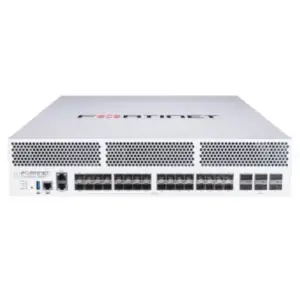
Fortinet FortiAuthenticator 300F Enterprise Identity and Access Management Appliance
Fortinet FortiAuthenticator 300F, model FAC-300F, is a rack-mount identity and access management appliance built for organizations that want to centralize authentication, strengthen user verification, simplify certificate operations and connect trusted identity services to security infrastructure. In a practical enterprise design, the appliance becomes a controlled identity service point between users, directories, applications, network access devices, FortiGate security gateways and other standards-compatible systems. Instead of distributing authentication policy across many independent devices, administrators can establish a more consistent operational model for RADIUS authentication, directory integration, multifactor authentication, single sign-on, guest access and certificate-based access.
For procurement teams in Uganda, the 300F is particularly relevant where an organization has outgrown smaller identity systems but does not yet need the capacity profile of the larger FortiAuthenticator 800F or 3000F platforms. The base appliance supports up to 1,500 local and remote users and can be expanded to 3,500 users through applicable hardware user upgrade licensing. It also supports up to 3,000 FortiTokens, 150 user groups at base capacity, 500 RADIUS clients at base capacity, 10 certificate authorities and 7,500 user certificates. These limits give buyers a measurable starting point for sizing rather than relying on vague appliance classes.
The physical platform is a 1RU rack-mount appliance with four 10/100/1000 copper interfaces, two 1 TB hard disks configured for mirrored storage, front-to-back airflow, a Trusted Platform Module and a 300W auto-ranging power supply. An optional second power supply can be used for 1+1 redundancy. Average power consumption is listed at 82.35W and maximum consumption at 131.23W, giving facilities teams useful figures for rack power and cooling plans. Organizations can deploy active-passive high availability or configuration synchronization between appliances to reduce dependence on a single authentication node.
Instant Specifications and Procurement Fact Rail
FAC-300F hardware appliance
Mid-size to large enterprise identity services
4 × GE RJ45 copper ports
2 × 1 TB hard drives, mirrored
1,500 base / 3,500 upper limit
Up to 3,000 FortiTokens
300W auto-ranging; optional dual 1+1
Enterprise quotation and configuration validation
A correct quotation should be based on more than the chassis part number. Buyers should identify the total number of users that require authentication, likely growth over the support term, whether FortiToken hardware or mobile licenses are required, which FortiCare support level is expected, whether a second appliance is required for high availability, and whether the optional second power supply is required in each chassis. A formal bill of materials should also separate appliance cost, user-capacity upgrades, authentication tokens, support coverage, implementation services and any spare or redundancy items. This approach helps prevent a low initial hardware quotation from being mistaken for the full production requirement.
Operational Product Architecture and Overview
FortiAuthenticator is designed around the principle that network security decisions become more reliable when devices can associate access requests with verified identities. The 300F provides a dedicated platform for storing and processing identity information, communicating with external directories, validating credentials, issuing or managing certificates, coordinating token-based verification and supplying identity context to compatible Fortinet infrastructure. This role is different from a firewall or switching appliance. Its purpose is not to forward production traffic at high throughput; its purpose is to make trusted authentication and identity services available to the systems that control access.
The hardware architecture reflects that service role. Four Gigabit Ethernet copper ports provide physical connectivity for management and service networks. The appliance includes two 1 TB hard disks arranged as mirrored storage so that identity databases, logs and related system data are not dependent on a single disk. A Trusted Platform Module supports platform trust functions, while the rack-mount chassis gives data-center teams a predictable 1RU installation profile. Front-to-back airflow matches common enterprise rack arrangements, and the optional dual power configuration allows connection to separate power distribution paths where the facility supports them.
At the protocol layer, the platform supports standards and interfaces commonly encountered in enterprise identity environments, including RADIUS, LDAP, X.509 certificates, certificate revocation mechanisms, PKCS certificate workflows, OCSP, EAP-TLS, SCEP, OAuth, OIDC and SAML 2.0. Management can be performed through HTTPS and command-line interfaces, including a direct console connection. This breadth matters because many organizations operate a mixed estate: some users authenticate against Microsoft or LDAP-based directories, wireless systems may rely on RADIUS, remote-access users may need multifactor verification, SaaS applications may use SAML or OIDC, and device access may depend on certificates.
A common procurement trigger is identity sprawl. An organization may have accumulated separate authentication settings on firewalls, wireless controllers, switches, VPN gateways, portals and applications. When staff join, change roles or leave, administrators may need to modify several systems manually. This increases the chance of stale accounts, inconsistent policies and delayed removal of access. Centralizing identity services does not eliminate the need for sound directory governance, but it gives infrastructure teams a more coherent control point for authentication-related workflows.
Another trigger is multifactor adoption. Many organizations begin with password-only access and later need stronger verification for administrators, VPN users, privileged staff or sensitive applications. FortiAuthenticator can coordinate FortiToken-based verification and can be used in designs that combine directory credentials with an additional authentication factor. Procurement teams should distinguish the appliance capacity from the token licenses themselves: the platform can support a defined number of FortiTokens, but required token licenses are purchased according to the planned deployment and user population.
Certificate management is also a major operational driver. Enterprise wireless, VPN, device onboarding and internal application environments often become difficult to manage when certificates are issued manually or through fragmented processes. FortiAuthenticator includes certificate-related capabilities that allow organizations to create more structured enrollment, validation and revocation workflows. The value is not merely technical; better certificate operations can reduce manual tickets, improve lifecycle control and make it easier to demonstrate how access credentials are issued and withdrawn.
The 300F capacity position should be assessed carefully. The base limit of 1,500 local and remote users is suitable for many mid-size organizations, but a buyer with 1,300 current users and strong growth expectations may be better served by including user-upgrade licensing from the beginning or comparing the economics of a larger appliance. The upper user limit of 3,500 creates a clear ceiling for the platform. Sizing should therefore consider at least a three-to-five-year horizon, not only the current employee count. Guest users, contractors, remote identities, test accounts and service-related identities can all influence practical sizing depending on the intended configuration.
Enterprise Business Outcomes and Value Analysis
1. Authentication Performance and Service Integrity
Identity services sit on the critical path of user access. When authentication is slow or unavailable, otherwise healthy applications and networks can appear unusable. The FAC-300F provides a dedicated hardware platform with defined user, token, group and RADIUS client capacities. This separation reduces competition with unrelated server workloads and gives IT teams a platform that can be sized specifically for identity operations. The most important performance decision is therefore not a generic throughput figure but correct capacity planning around user counts, authentication volume, certificate activity and integrated systems.
2. System Reliability and High Availability
The appliance supports active-passive high availability and configuration synchronization designs. For organizations where remote access, wireless connectivity or privileged administration depends on FortiAuthenticator, a second unit can remove a major single point of failure. Mirrored local disks protect against loss of service from a single disk failure, while the optional second power supply can protect against a single power-supply path failure when connected correctly. Procurement teams should budget redundancy explicitly because a high-availability requirement normally means two appliances, suitable support coverage and duplicated power/network connections.
3. Infrastructure Scalability
The base 1,500-user capacity can be expanded to a 3,500-user upper limit using supported user upgrade licensing. RADIUS client and group limits also scale according to licensed capacity rules. This allows an organization to start at the base tier and expand within the model’s ceiling. However, expansion planning should include growth in users, branch locations, network access servers, certificate populations and token requirements. Where forecast demand is likely to exceed the 300F ceiling, comparing the 800F at procurement stage can reduce later migration effort.
4. Enterprise Security and Access Control
Centralized identity services make it easier to apply consistent authentication policy across multiple access points. Support for multifactor workflows, RADIUS, LDAP, certificates, SAML, OIDC and related standards means the appliance can participate in both network and application access designs. The operational benefit comes from reducing fragmented account handling and introducing stronger verification for selected user groups. The correct implementation still depends on directory hygiene, role design, token enrollment processes, certificate lifecycle practices and documented recovery procedures.
5. Centralized Management and Operational Simplicity
Rather than configuring identity rules independently on every firewall, wireless system or service, administrators can use FortiAuthenticator as a common authentication and identity layer. This can simplify onboarding, offboarding, guest access, token administration and certificate workflows. Centralization also gives support teams a more logical place to investigate authentication failures. The goal is not to remove every identity dependency, but to make those dependencies easier to understand, document and maintain.
6. Total Cost of Ownership and Energy Planning
The appliance averages 82.35W and is rated at 131.23W maximum consumption. These values are modest relative to many data-center servers, but power should still be included in facility planning, especially when deploying an HA pair. Consolidating identity functions onto a purpose-built platform can reduce the number of separate systems used for authentication tasks. The financial model should include hardware, user upgrades, token licenses, support, redundancy, implementation effort, rack space, power and expected lifecycle rather than comparing chassis price alone.
7. Governance and Audit Readiness
A centralized identity service can help teams document where authentication policies are enforced and how users are verified. This can improve operational evidence during internal reviews, security assessments and regulated-industry audits. Buyers should still define retention, administrator access, backup and change-management policies according to their own governance framework. The appliance is a technical control platform; its value increases when it is supported by clear organizational procedures.
Key Hardware and Software Highlights
| Component or Capability | 300F Implementation | Operational Outcome |
|---|---|---|
| Network connectivity | 4 × 10/100/1000 RJ45 | Flexible service and management connectivity within copper-based data-center or campus networks. |
| Local storage | 2 × 1 TB hard drives in RAID 1 | Mirrored storage protects against a single disk failure and provides local capacity for system data. |
| Platform trust | Trusted Platform Module | Provides hardware-backed platform trust capabilities as part of the appliance design. |
| Power architecture | 300W auto-ranging, optional dual 1+1 | Supports resilient rack power design when a second supply and independent power feeds are used. |
| User licensing | 1,500 base / 3,500 upper limit | Allows measured expansion while keeping the appliance in a defined capacity range. |
| Authentication ecosystem | RADIUS, LDAP, SAML 2.0, OIDC, OAuth, EAP-TLS | Supports integration with common directory, network access and application identity workflows. |
| Certificate services | X.509, SCEP, OCSP, CSR and certificate import workflows | Helps centralize certificate issuance, enrollment and validation for supported use cases. |
| High availability | Active-passive and configuration synchronization | Enables resilient authentication designs when paired appliances are correctly deployed. |
The most important architectural point is that these features work together. A buyer may focus on user count, but production success also depends on the number of integrated network access devices, directory topology, token policy, certificate population, administrative access model and resilience target. Four physical Ethernet ports can be sufficient for many identity deployments because authentication traffic volumes are modest compared with application traffic, yet network segmentation still needs careful planning. Administrators should determine whether management, RADIUS, directory and synchronization traffic will share interfaces or be separated according to internal security policy. Similarly, mirrored storage helps protect local data from a single disk failure, but it is not a substitute for documented backup and recovery procedures.
Technical Specifications Ledger
| Specification | FortiAuthenticator 300F | Procurement Note |
|---|---|---|
| Manufacturer model | FAC-300F | Use the exact model code on RFQs and purchase orders. |
| Copper interfaces | 4 × 10/100/1000 Base-T RJ45 | No SFP interfaces are listed for the 300F. |
| Local storage | 2 × 1 TB HDD, RAID 1 | Mirrored pair; maintain backup procedures separately. |
| Trusted Platform Module | Yes | Hardware trust feature integrated into platform. |
| Base / upper user limit | 1,500 / 3,500 | Upper limit requires applicable upgrade licensing. |
| FortiTokens | Up to 3,000 | Token licenses are selected separately according to deployment. |
| RADIUS clients | 500 base / 1,166 upper limit | Important for branch, wireless and distributed access designs. |
| User groups | 150 base | Group limits vary with licensed user capacity. |
| CA certificates | 10 | Assess certificate authority requirements before deployment. |
| User certificates | 7,500 | Relevant for device, wireless and VPN certificate use cases. |
| Dimensions | 44 × 438 × 422 mm | Plan rack depth and cable clearance behind the chassis. |
| Weight | 8.2 kg | Include rails and rack loading in installation planning. |
| Form factor | 1RU rack mount | HA pair normally consumes two rack units. |
| Power source | 100–240 VAC, 50/60 Hz | Confirm rack PDU outlets and cable type. |
| Power supply | 300W redundant-capable; optional dual 1+1 | Order second PSU when dual-feed resilience is required. |
| Maximum current | 5A at 100V / 2.5A at 240V | Use facility voltage when validating PDU capacity. |
| Average / maximum power | 82.35W / 131.23W | Useful for UPS and cooling calculations. |
| Heat dissipation | 482 BTU/h | Include in data-center cooling plan. |
| Airflow | Front to back | Align with rack hot-aisle/cold-aisle arrangement. |
| Operating temperature | 0°C to 40°C | Maintain controlled equipment-room conditions. |
| Storage temperature | -20°C to 70°C | Applies to non-operating storage conditions. |
| Humidity | 5%–90% non-condensing | Avoid condensation and uncontrolled environments. |
| Management | HTTPS, CLI, DB9 direct console CLI | Include secure management network and console access plan. |
| High availability | Active-passive HA, configuration sync HA | Requires appropriate paired design and validation. |
| Safety / regulatory | FCC Part 15 Class A, RCM, VCCI, CE, UL/cUL, CB | Confirm tender-specific compliance requirements before order. |
These figures should be treated as the technical baseline for the FAC-300F hardware platform. Firmware releases can add or refine software functions, and some object limits are related to licensed user capacity. For that reason, projects should verify the intended firmware branch, support entitlement and current release notes during implementation. A procurement comparison should also distinguish the 300F from nearby FortiAuthenticator models: the 300F has no SFP interfaces, while larger F-series models provide different interface and capacity profiles. Where optical connectivity is mandatory, the network design may need copper handoff equipment or a different appliance model.
Configuration and Sizing Worksheet
Step 1: Establish Workload and Scale
Begin with a count of every identity expected to use the system, not only permanent employees. Include contractors, external administrators, branch staff, remote users, guest populations where applicable and expected growth. Map the number of network access devices that will use RADIUS, including FortiGate appliances, wireless controllers, access points where they act as clients, switches, VPN concentrators and third-party systems. Record the number of user groups, token users and certificates expected. Compare the result with the 1,500-user base and 3,500-user upper limit rather than sizing to the current employee headcount alone.
Step 2: Validate Rack and Environmental Requirements
Reserve one rack unit for a standalone deployment and two rack units for a two-appliance HA pair. The chassis measures 44 × 438 × 422 mm and weighs approximately 8.2 kg. Leave sufficient rear space for power and Ethernet cabling and ensure that front-to-back airflow is not blocked. The supported operating range is 0°C to 40°C with 5% to 90% non-condensing humidity. Sites without controlled cooling should address the environment before installing an authentication service that may become critical to network access.
Step 3: Plan Power Resilience and Cabling
Determine whether a single power input is acceptable or whether each appliance needs the optional second 300W power supply. In resilient data centers, the preferred arrangement is usually to connect redundant supplies to independent PDUs or UPS-backed circuits so a single feed failure does not remove the appliance. For HA, repeat the same principle across both chassis. Network cabling should be planned around the four copper Gigabit Ethernet interfaces. If the core network exposes only fiber at the intended rack position, include a suitable switch handoff rather than assuming the 300F includes SFP slots.
Step 4: Define Licensing and Subscription Requirements
The base FAC-300F license supports up to 1,500 users. User expansion is available within the platform’s 3,500-user upper limit through supported hardware upgrade licenses. FortiToken requirements must be calculated separately. Select the required FortiCare support term and service level based on the organization’s maintenance standard, replacement expectations and procurement policy. When planning a three- or five-year lifecycle, compare the cost of buying capacity immediately with staged upgrades. Also consider whether project policy requires identical licensing and support on both nodes of an HA pair.
Step 5: Prepare the Quote Checklist
A strong RFQ should include: FAC-300F quantity; total current and forecast users; required hardware user upgrades; number and type of FortiTokens; FortiCare support duration; high-availability requirement; number of optional redundant power supplies; installation location; rack and power constraints; directory sources; RADIUS client estimate; SAML/OIDC application count; certificate use cases; requested staging services; delivery destination; and any tender-specific warranty or compliance wording. This information allows the supplier to prepare a bill of materials that can actually be deployed rather than quoting only the base chassis.
Organizations with strict change windows should also define whether pre-configuration is required before shipment. Typical preparation can include firmware alignment, management addressing, hostname conventions, administrative access policy, basic directory connectivity parameters and documented handover settings. Sensitive secrets should be exchanged through an agreed secure process rather than ordinary email. Where the customer prefers to configure the appliance internally, FourTeck can still validate the bill of materials and provide a deployment checklist so licenses, support and power options match the design.
Deployment Scenarios and Industry Use Cases
Large Enterprise and Multi-Site Networks
A distributed company may operate a headquarters in Kampala together with branches, warehouses or regional offices. Each site can contain firewalls, wireless infrastructure, switches and remote-access services that need consistent user verification. FortiAuthenticator can provide centralized RADIUS and directory-linked authentication while FortiGate devices and other network access systems enforce access at the edge. With appropriate design, identity information can be made available consistently across sites without creating separate local user databases on every device. An HA pair can be placed in the primary data center, with network routes and firewall policy designed so branch authentication traffic reaches the service securely.
For multi-site projects, WAN dependency should be assessed explicitly. If a branch loses connectivity to the data center, authentication behavior depends on the surrounding access design and cached or fallback mechanisms of the participating systems. The identity architecture should therefore document acceptable behavior during WAN outages. Critical sites may need additional design measures, while non-critical branches may accept temporary restrictions. The objective is to avoid discovering these dependencies during a real circuit failure.
Financial and Banking Institutions
Banks, microfinance organizations and payment-related businesses often need stronger administrator verification, controlled remote access and well-defined certificate practices. FortiAuthenticator can provide a dedicated authentication layer for network access and selected applications while integrating with existing directories. Multifactor authentication can be introduced for privileged teams or wider employee populations. Certificate services may support secure wireless or device identity use cases. In regulated environments, the platform should be deployed with strict administrator separation, change control, log retention, backup, HA and documented recovery procedures.
Financial institutions should treat the appliance as part of a broader control framework. A strong authentication server cannot compensate for unmanaged privileged accounts, weak joiner-mover-leaver processes or shared credentials. The purchasing process should therefore involve security, infrastructure, directory administrators, audit stakeholders and business continuity teams. This cross-functional review helps ensure the selected capacity and licensing match both technical and governance requirements.
Educational and Campus Networks
Universities, colleges and large schools frequently have diverse identity populations: staff, faculty, students, visiting lecturers, contractors and guests. Wireless and VPN access may rely on RADIUS, while portals and internal services may need federated sign-on. Certificate-based wireless can reduce dependence on repeated password entry for managed devices. The 300F can suit campuses where the total population and RADIUS client count remain within its capacity envelope, though universities with rapid enrollment growth should compare projected populations with the 3,500-user upper limit before committing to the platform.
Campus networks also experience seasonal user changes. Enrollment periods can create large onboarding waves, while graduation and contract completion require timely access removal. Central identity integration makes these processes easier to standardize, but institutions should define data ownership and directory synchronization carefully. Guest workflows should be separated from permanent student and staff identities so temporary access does not create long-lived administrative overhead.
Government and Defense Procurement
Government agencies often require formal tender documentation, product codes, compliance statements, manufacturer support alignment and controlled deployment procedures. The FAC-300F provides a clearly defined hardware platform with standards-based authentication and certificate capabilities. For sensitive environments, procurement should confirm the required firmware branch, administrative hardening standard, support entitlement, replacement process, network segmentation and physical security requirements before shipment. Any defense or security-sensitive implementation should follow the customer’s approved architecture and applicable national procedures.
Public-sector buyers should also separate mandatory tender requirements from optional features. If dual power is mandatory, specify the second supply explicitly. If high availability is mandatory, request two appliances and define required support coverage for both. If optical uplinks are mandatory at the rack, remember that the 300F exposes copper GE interfaces only. Clear tender language reduces variation between competing quotations and makes technical evaluation more objective.
Technical Deep Dive 1: Processing, Hardware Platform and Identity Service Architecture
The FortiAuthenticator 300F should be understood as an identity-processing appliance rather than a packet-forwarding platform. Its workload consists of handling authentication requests, communicating with identity stores, validating credentials and tokens, maintaining local objects, processing certificate operations and supplying identity services to network infrastructure. This distinction is important because buyers sometimes compare security products only by interface speed. Four Gigabit Ethernet ports are not intended to carry end-user application traffic through the appliance. They provide connectivity for the authentication and management traffic required by the identity service.
The appliance’s dedicated hardware model gives organizations predictable ownership boundaries. IT teams know where the identity service runs, where local data resides, how power is supplied and how network paths are built. Two 1 TB drives configured as RAID 1 provide mirrored local storage, meaning the loss of one disk does not immediately remove the complete local storage set. The Trusted Platform Module adds a hardware trust component. These design choices support use in enterprise racks where appliances are expected to remain available continuously and where local service data should not depend on a single disk.
Capacity is governed by licensed object limits rather than raw link throughput. At base capacity, the appliance supports 1,500 local and remote users, 500 RADIUS clients and 150 user groups. The user limit can be expanded to 3,500 using supported upgrades, and related object ceilings increase according to licensing rules. Therefore, proper sizing starts with identity objects and authentication topology. A network with 800 employees but 700 distributed RADIUS clients might stress a different dimension than a centralized network with 1,400 users and only a few access systems. A useful discovery workshop should capture both user and infrastructure counts.
Technical Deep Dive 2: Software Ecosystem, Firmware Security and Operational Control
FortiAuthenticator participates in a standards-rich identity ecosystem. RADIUS remains central for network authentication, particularly for VPN, wireless and administrative access. LDAP allows integration with directory services. SAML 2.0 and OIDC support modern federation patterns for applications and web services, while OAuth-related support helps the platform participate in contemporary authorization flows. EAP-TLS, X.509, SCEP and OCSP provide building blocks for certificate-driven access. These standards allow the 300F to support mixed environments rather than requiring every connected system to come from a single vendor.
Firmware lifecycle management is a major operational responsibility. Before upgrading, administrators should review the supported upgrade path, release notes, compatibility considerations and backup procedures. A production identity service should not be upgraded simply because a new image is available. Change plans should include configuration backup, maintenance window, administrator access verification, rollback or recovery planning, HA sequencing where applicable and post-upgrade tests for the most important RADIUS, directory, token, SSO and certificate workflows. Where FourTeck provides staging, the requested firmware version can be aligned before shipment subject to project requirements and support entitlement.
Administrative control also deserves careful design. Management should occur over a restricted network, with HTTPS and console access governed by policy. Named administrator accounts, strong authentication and role separation should be used where the customer’s security standard supports them. Configuration changes should be documented, and break-glass recovery credentials should be stored securely. Because authentication systems often become highly privileged infrastructure, access to FortiAuthenticator itself should be treated with at least the same seriousness as access to firewalls and directory servers.
Technical Deep Dive 3: High Availability, Redundancy and Disaster Recovery
Authentication infrastructure can become a hidden single point of failure. Users may perceive a failed identity service as a network outage because VPN login, wireless authentication or administrator access stops working even though the underlying links and devices remain operational. FortiAuthenticator addresses this risk through active-passive high availability and configuration synchronization options. A resilient design normally uses two suitably licensed appliances, redundant network connections and independent power arrangements. The exact topology should be validated against the customer’s firmware version and Fortinet documentation during implementation.
Hardware redundancy exists at multiple layers. Each 300F includes mirrored disks, reducing exposure to a single local disk failure. An optional second power supply can create 1+1 PSU resilience, but only if the second supply is ordered and connected to an independent source where possible. An HA pair then protects against a complete appliance failure. These layers should not be confused: RAID protects storage continuity, dual PSUs protect power input continuity, and an HA peer protects service continuity at the appliance level. None of these replaces backups.
Disaster recovery planning should define where configuration backups are stored, who can access them, how replacement hardware would be obtained, what support entitlement governs replacement, and how directory or token services would be restored after a major site event. Organizations with a secondary data center should decide whether the identity service is replicated there or whether network routing will reach the surviving primary service. Recovery tests are valuable because authentication dependencies can be more complex than diagrams suggest. A written runbook should identify DNS, NTP, directory, certificate, firewall and routing dependencies required for the appliance to function after restoration.
Pre-Purchase Buyer Gap Checklist
Licensing beyond the base appliance: The FAC-300F includes a base capacity of 1,500 users, but organizations approaching that number should account for growth. Upgrades can extend the appliance to 3,500 users. FortiToken licenses are separate from the platform’s token capacity. Support coverage is also a separate commercial line item. A complete quote therefore needs more than the appliance SKU.
Hardware generation and lifecycle: The 300F is part of Fortinet’s F-series FortiAuthenticator hardware family. Buyers planning long deployment cycles should request current lifecycle and support information at quotation stage, particularly for projects that require five-year support, public-sector tender compliance or synchronized refresh dates with existing Fortinet estates.
Physical rack clearance: The chassis is 1RU high and approximately 422 mm deep. Rack planning should include space for rails, rear power connectors and copper Ethernet patching. In compact wall cabinets, depth can matter more than rack-unit count. For HA, reserve physical space for two appliances and avoid placing both on the same unprotected power feed.
Power under load: Manufacturer data lists 82.35W average and 131.23W maximum consumption. Facilities teams should size UPS capacity against maximum demand and consider both nodes in an HA pair. The 300W PSU rating is the supply capacity, not the appliance’s typical consumption figure. This distinction is useful when calculating rack budgets.
Cross-vendor compatibility: FortiAuthenticator is strongest in Fortinet-centered environments, but it supports broadly used identity standards such as RADIUS, LDAP, SAML 2.0, OIDC, OAuth and X.509-related workflows. Compatibility should still be tested against the exact third-party product and software version because support for a protocol does not guarantee that every vendor implements all optional behavior identically.
Optical connectivity: The 300F does not provide SFP interfaces. If the data-center standard requires fiber-only server access, the project may need a nearby switch that converts the handoff to copper or a different FortiAuthenticator model. This should be resolved before purchase rather than during rack installation.
High availability cost: An HA requirement usually means two appliances rather than one, plus corresponding support, rack space, power feeds and network ports. Buyers should ask whether user upgrade licenses and support services must be matched across nodes for the intended configuration. Budgeting only for a single chassis can substantially understate project cost.
Token economics: The maximum FortiToken capacity is not the same as included token entitlement. Determine how many users need multifactor verification, whether mobile or hardware tokens are preferred, whether spare hardware tokens are required, and how replacements will be administered. This calculation can be a major part of the overall authentication project budget.
Directory and certificate dependencies: The appliance may depend on external directory servers, DNS, NTP and certificate infrastructure. Those dependencies must be reachable and resilient. A redundant FortiAuthenticator pair will not solve an outage caused by unavailable directory controllers or incorrect time synchronization. Architecture reviews should therefore cover the whole authentication chain.
Uganda Procurement and Delivery Logistics
FourTeck Uganda supports business and institutional procurement of Fortinet infrastructure through formal quotation, bill-of-materials review and project-oriented supply. For the FortiAuthenticator 300F, the process should begin with confirmation of the appliance quantity, licensed user requirement, FortiToken requirement, support term, redundancy target and delivery location. This information is used to distinguish a simple appliance purchase from a complete production identity solution.
Enterprise orders may require manufacturer or regional distribution lead time, especially where the configuration includes optional power supplies, multiple appliances, user upgrade licenses or long support terms. Delivery timing should therefore be confirmed on the commercial quotation rather than assumed from a general product listing. For tenders and project deployments, customers should provide required delivery dates early so sourcing, import handling and staging can be coordinated against the implementation window.
Pre-configuration assistance can be arranged where appropriate. Typical services can include bill-of-materials verification, firmware alignment, management network preparation, basic identity integration planning and a documented handover checklist. Customers with strict security rules may choose to complete all credentials and directory secrets internally after delivery. In either case, the objective is to ensure that the product arriving at site matches the architecture and that avoidable licensing or cabling gaps do not delay commissioning.
Warranty and replacement processes depend on the selected FortiCare service level and applicable manufacturer terms. Buyers with strict restoration targets should select support coverage based on the business impact of authentication downtime, not simply on the lowest annual cost. The quotation should clearly show support duration and any priority replacement service selected so procurement teams can compare offers on equivalent terms.
Uganda Local Coverage Matrix
Kampala
Enterprise headquarters, data centers, banks, government offices, universities and systems integrators can request centralized delivery coordination, staging and project quotation support.
Entebbe
Suitable for organizations around aviation, hospitality, logistics and institutional environments requiring secure staff, guest or remote-access authentication.
Jinja
Manufacturing, education and branch-office projects can be supplied with appliance, licensing and support planning aligned to centralized Kampala or regional IT operations.
Mbarara
Regional institutions and multi-site organizations can deploy FortiAuthenticator as part of secure WAN, VPN and campus identity projects.
Gulu
Public-sector, education, NGO and commercial branch environments can be supported through planned equipment supply and remote technical coordination.
For locations outside these hubs, project logistics can be coordinated according to the destination, order size and installation schedule. Remote sites should provide complete delivery contact information and note any access restrictions, receiving windows or internal asset-registration requirements before dispatch.
Cross-Border and Regional Supply Chains
Organizations operating across East Africa, the Gulf and wider African markets often prefer a coordinated sourcing model for common infrastructure. FourTeck regional sites can support product enquiries and project planning across multiple markets: FourTeck Uganda, FourTeck Kenya, FourTeck Africa, FourTeck UAE and FourTeck Kuwait.
For cross-border projects, bills of materials should be standardized where possible but still account for country-specific delivery, tax, import, support and power requirements. A FortiAuthenticator deployment serving multiple countries may be centralized in one data center or distributed according to resilience and latency needs. Procurement teams should coordinate serial-number records, support registration, license ownership and deployment locations so future renewals and hardware replacement requests can be handled cleanly.
Regional supply planning is especially useful for organizations with branch rollouts or scheduled security refresh programs. Consolidated design standards can reduce configuration variation, while local delivery coordination helps each country team receive the correct equipment and documentation. Exact commercial terms, shipping routes and lead times remain project-specific and should be confirmed on the quotation.
Related Products and Architecture Options
FortiAuthenticator is commonly deployed as part of a broader access and security architecture. Buyers evaluating the 300F may also need FortiGate firewalls for VPN and network policy enforcement, FortiToken authentication options for multifactor verification, FortiSwitch access switching for campus control, and FortiAP wireless infrastructure for authenticated wireless access. Projects that exceed the 300F user ceiling should compare the FortiAuthenticator 800F and larger models before committing to the platform.
Infrastructure accessories can be just as important as the primary appliance. High-availability deployments may require a second FAC-300F, additional rack space, duplicate copper patch leads, separate PDU outlets and optional second power supplies. Projects with strong business-continuity requirements should also consider UPS sizing, spare cabling and out-of-band console access. If the surrounding network is fiber-only, include the appropriate switch handoff because the FAC-300F does not include SFP interfaces.
The right related products depend on the authentication use case. A VPN-focused project may emphasize FortiGate and FortiToken. A campus project may emphasize RADIUS, FortiSwitch and FortiAP. A certificate-heavy environment may focus on enrollment and device identity workflows. FourTeck can help convert these requirements into a coordinated bill of materials rather than treating each device as an isolated purchase.
FourTeck Technical Service Capabilities
FourTeck can support FortiAuthenticator procurement with engineering validation before order. This begins with confirming the model and user-capacity fit, checking whether upgrade licenses are required, reviewing token quantities, and assessing whether the customer needs a standalone appliance or an HA pair. A bill-of-materials review is particularly useful for projects where identity services are part of a wider firewall, wireless or campus refresh, because authentication dependencies often span several product families.
Staging services can be scoped according to customer policy. Where permitted, this may include inventory checks, firmware alignment, management addressing, hostname preparation, initial interface planning and configuration documentation. Sensitive credentials can remain under customer control and be entered on site. Pre-shipment firmware updates are useful when the project has standardized on a particular supported release, but the selected release should follow Fortinet guidance and the customer’s compatibility requirements rather than simply using the newest available image.
Post-sales support can include deployment assistance, troubleshooting coordination, configuration review and guidance during support escalation. The exact service scope should be defined on the quotation or statement of work. For critical identity systems, FourTeck recommends documenting current configuration, support entitlement, software version, serial numbers, administrator ownership and recovery contacts so incidents can be handled efficiently.
Extended Technical FAQ
1. How many users does the FortiAuthenticator 300F support?
The FAC-300F supports 1,500 local and remote users in its base configuration and can be expanded to an upper limit of 3,500 users through supported hardware user upgrade licensing. Procurement should be based on the full expected identity population rather than current employee count alone. Include contractors, remote users, administrators and forecast growth where they will be represented on the platform. If the organization expects to exceed 3,500 users during the planned lifecycle, comparing the FortiAuthenticator 800F before purchase can reduce the need for a future platform migration.
2. Are FortiTokens included with the appliance?
The platform supports up to 3,000 FortiTokens, but token capacity should not be interpreted as an included entitlement for 3,000 users. Token licenses are selected according to the organization’s multifactor authentication design. Buyers should specify how many users need tokens, whether mobile or hardware formats are preferred, and whether spare physical tokens are required. Token lifecycle procedures should also cover enrollment, replacement, lost devices and employee departure. FourTeck can include the required token items as separate lines in the project bill of materials.
3. Can the 300F integrate with non-Fortinet systems?
Yes, the appliance supports common identity standards including RADIUS, LDAP, SAML 2.0, OIDC, OAuth and certificate-related protocols. This makes integration with many third-party directories, network devices and applications possible. However, buyers should verify the exact use case and product version before deployment because standards can include optional behavior and vendors sometimes implement features differently. For critical integrations, a pilot or configuration validation is advisable. FortiAuthenticator delivers its strongest operational value when connected to Fortinet infrastructure, but it is not restricted to a single-vendor environment.
4. Does the FAC-300F support high availability?
Yes. FortiAuthenticator supports active-passive high availability and configuration synchronization modes. A production HA design normally requires two appliances and should include redundant network paths, appropriate support coverage and resilient power. The optional second power supply can be used to improve power-feed resilience within each chassis. High availability does not eliminate upstream dependencies such as directory servers, DNS, NTP or network routing, so the overall identity architecture should be reviewed as a complete service chain. Configuration and failover procedures should be tested during planned maintenance.
5. What network interfaces are available on the FortiAuthenticator 300F?
The 300F provides four 10/100/1000 Base-T RJ45 copper interfaces. It does not list SFP interfaces. This is sufficient for many authentication deployments because the appliance handles identity and management traffic rather than acting as an inline high-bandwidth gateway. However, data centers that provide only fiber server connections should address the physical handoff during design. A nearby access switch can provide copper presentation, or a different FortiAuthenticator model with optical interface capability may be more appropriate depending on the project.
6. What are the power and rack requirements?
The FAC-300F is a 1RU rack-mount appliance measuring approximately 44 × 438 × 422 mm and weighing 8.2 kg. It accepts 100–240 VAC at 50/60 Hz. Manufacturer figures list 82.35W average power consumption and 131.23W maximum consumption. The platform uses a 300W auto-ranging power supply and can be equipped with an optional second supply for 1+1 redundancy. For resilient deployments, connect redundant supplies to separate protected power paths where available. Plan rear clearance for power connectors and Ethernet patching.
7. How is warranty and hardware replacement handled?
Warranty and replacement service depend on the FortiCare coverage purchased with the appliance and the applicable manufacturer service terms. Organizations with strict uptime requirements should select support based on business impact and required replacement response rather than treating support as a generic accessory. When requesting a quote, specify whether the project requires standard support, premium coverage or priority replacement options where available. Keep serial numbers, proof of entitlement and configuration backups documented so support cases can be opened efficiently if a hardware issue occurs.
8. Can FourTeck pre-configure the appliance before delivery?
Pre-configuration can be scoped according to the customer’s security policy and project requirements. Typical preparation may include firmware alignment, management addressing, host naming, initial interface setup, basic administrative settings and configuration documentation. Sensitive directory credentials, token secrets and privileged passwords can remain under customer control and be completed on site. For regulated environments, FourTeck can limit staging to hardware and firmware validation while the customer performs all production identity configuration. The objective is to reduce installation delays without weakening the customer’s credential-handling procedures.
9. Does RAID 1 mean backups are unnecessary?
No. RAID 1 mirrors data across two local drives so that a single disk failure does not necessarily remove the appliance’s complete local storage set. It does not protect against configuration mistakes, corruption affecting both copies, accidental deletion, catastrophic chassis loss or site failure. Organizations should maintain regular configuration backups and store them according to internal recovery policy. HA also does not replace backups because configuration changes can synchronize between nodes. A complete resilience design includes disk protection, appliance redundancy, protected power, backups and a tested recovery procedure.
10. What information should be supplied for an accurate Uganda quotation?
Provide the number of FAC-300F appliances required, current and forecast user count, expected RADIUS client count, FortiToken quantity and type, support duration, high-availability requirement, redundant power requirement, delivery destination and required installation date. It is also helpful to identify directory sources, major applications requiring SAML or OIDC, certificate use cases, staging requirements and any tender-specific compliance wording. This information allows the quotation to include required licensing, support and accessories rather than presenting only the base chassis. For large projects, a short technical discovery session can reduce procurement rework.
Prepare a Complete FortiAuthenticator 300F Procurement Package
Request a FourTeck Uganda quotation for the Fortinet FortiAuthenticator 300F with the correct user capacity, FortiToken quantities, FortiCare term, optional redundant power and high-availability components. Share your present user count, three-to-five-year growth estimate, directory environment, number of RADIUS devices, major SSO applications, certificate requirements and deployment location. FourTeck can review the bill of materials before order and help align the appliance with your rack, power, network and support standards.
For critical environments, ask for a two-node HA design and include recovery, backup and support requirements during the procurement stage. For organizations approaching the 300F upper capacity limit, request a comparison against the next FortiAuthenticator tier so lifecycle cost can be evaluated before purchase. Clear technical requirements at the quotation stage make deployment more predictable and reduce the risk of missing licenses or accessories.
Reviews
There are no reviews yet.