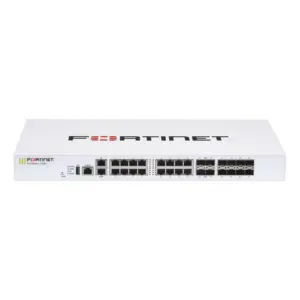
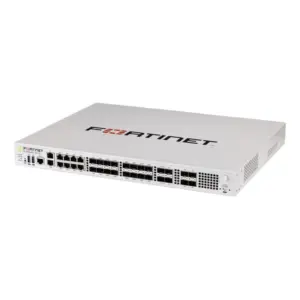
Fortinet FortiGate 1000F in Uganda
A high-performance 2RU next-generation firewall for enterprise data centers, large campus cores, internet edges, and hybrid network security.
The FortiGate 1000F combines high firewall and VPN capacity with hardware-accelerated security inspection, multi-speed interfaces, FortiOS networking functions, and optional FortiGuard security services. It is aimed at organizations that need to secure substantial north-south and east-west traffic without treating firewalling, SD-WAN, VPN, application control, and threat prevention as separate infrastructure projects.
Fortinet
FortiGate 1000F
Next-generation firewall
2RU rack mount
FortiOS / Fortinet ecosystem
Quote dependent
High-capacity security for busy enterprise network edges
The FortiGate 1000F is built for organizations whose security gateway must carry far more than routine branch traffic. Fortinet positions the 1000F series for data-center and hybrid IT security, where large volumes of application traffic, encrypted sessions, site-to-site VPNs, and multiple high-speed network segments have to be inspected and controlled. The appliance runs FortiOS, so firewall policy, routing, virtual private networking, SD-WAN capabilities, application visibility, and subscribed security services can operate in a common platform rather than as unrelated systems.
For a Ugandan enterprise, that can be particularly useful when a core site in Kampala acts as a hub for branches, cloud services, remote users, hosted applications, or partner connectivity. The 1000F provides a high ceiling for raw firewall throughput while retaining substantial performance when intrusion prevention, next-generation firewall inspection, and threat-protection services are involved. Fortinet publishes 198/196/134 Gbps IPv4 firewall throughput for 1518/512/64-byte UDP packets, 19 Gbps IPS throughput, 15 Gbps NGFW throughput, and 13 Gbps threat-protection throughput under its stated test conditions. These figures should be treated as sizing references rather than guaranteed application throughput because real deployments depend on traffic mix, enabled security profiles, packet sizes, software version, logging, encryption, and policy design.
The platform also addresses connectivity scale. Fortinet lists two 100GE QSFP28 interfaces, eight 25GE SFP28 interfaces, sixteen 10GE SFP+ interfaces, eight 10GE BASE-T RJ45 interfaces, a 1GE management port, and a 2.5GE high-availability port for the FG-1000F hardware configuration. That combination supports designs where the firewall must sit between high-capacity switches, server fabrics, WAN routers, and internet links without immediately becoming constrained by port speed. Transceiver selection is still important: buyers should identify which links use copper, multimode fiber, single-mode fiber, 10GE, 25GE, or 100GE before ordering optics and patching.
The 1000F also uses Fortinet SPU hardware acceleration and incorporates NP7 and CP9 processors according to Fortinet’s product documentation. In practical buying terms, that architecture is intended to offload networking and security operations from general-purpose processing. The benefit is not simply a higher headline number; it is the ability to preserve inspection capacity as the appliance performs firewall, VPN, and security tasks concurrently.
Selection matters because the appliance itself is only one part of the deployment. FortiGuard subscriptions determine access to specific security services, FortiCare determines support coverage, and a high-availability pair changes hardware quantity, power, rack, interface, and licensing requirements. FourTeck can help map those variables to the planned deployment, prepare the correct bill of materials, and coordinate a Uganda quotation without assuming that every buyer needs the same bundle.
Why the 1000F can make sense in a large security design
High throughput for consolidated network edges
A large firewall often serves multiple internet links, internal zones, VPNs, application tiers, and east-west segmentation paths. The 1000F’s published firewall and inspected-traffic figures provide headroom for architectures where a single security platform protects several high-bandwidth flows. That can reduce pressure to split policy and visibility across numerous smaller devices solely because one appliance lacks capacity.
Security inspection at meaningful enterprise speeds
Fortinet publishes 19 Gbps IPS, 15 Gbps NGFW, 13 Gbps threat protection, and 10 Gbps SSL inspection throughput for the platform under defined test conditions. Those numbers are more useful for security sizing than raw firewall throughput alone because enterprise policies frequently enable inspection. The main business value is the ability to design around realistic protected traffic instead of turning controls off to recover performance.
Flexible high-speed interfaces
100GE, 25GE, 10GE fiber, and 10GE copper interfaces allow the firewall to participate in different parts of a modern data-center or campus network. This flexibility is valuable when uplinks, aggregation switches, WAN equipment, and server fabrics do not all use the same media or speed. It also provides more options for staged migration from 10GE toward 25GE or 100GE infrastructure.
Strong VPN capacity for hubs and private connectivity
Fortinet specifies up to 55 Gbps IPsec VPN throughput using its stated 512-byte test profile. Actual results depend on encryption settings and network conditions, but the published capacity makes the platform relevant to organizations that terminate many site-to-site tunnels or carry significant private traffic between offices, data centers, and cloud environments.
Integrated networking and security operations
FortiOS combines firewall policy with routing, VPN, SD-WAN functions, application control, and access enforcement. For IT teams, a shared platform can simplify policy ownership and change management compared with building separate operational silos for every network-security function. The exact benefit depends on how much of the Fortinet ecosystem the organization plans to use.
Redundancy-ready power and HA design
The FG-1000F is specified with dual AC power supplies and a dedicated 2.5GE HA port. These features support resilient enterprise deployment planning, although true service continuity requires a complete design covering device pairs, upstream and downstream redundancy, power feeds, routing behavior, state synchronization, maintenance procedures, and licensing.
A firewall platform that pairs enterprise inspection capacity with a broad interface mix
What distinguishes this model is not a single feature but the combination of inspection performance, high-speed networking, VPN scale, FortiOS integration, and hardware acceleration in a 2RU platform. For buyers, the practical question is whether that combination matches the planned security boundary and whether the subscription and interface configuration are correctly specified.
198 / 196 / 134 Gbps firewall throughput: published for 1518/512/64-byte UDP traffic and useful as a raw forwarding reference.
19 Gbps IPS and 15 Gbps NGFW throughput: relevant when intrusion prevention and application-aware security are central to the deployment.
13 Gbps threat-protection throughput: a more security-intensive reference for environments enabling multiple protection functions.
55 Gbps IPsec VPN throughput: supports consideration as a large VPN hub, subject to encryption profile and real traffic conditions.
2x100GE, 8x25GE, 16x10GE SFP+, and 8x10GE RJ45: enables varied data-center, aggregation, WAN, and migration designs.
NP7 and CP9 acceleration: purpose-built Fortinet processing supports networking and security workloads.
FortiGate 1000F technical reference
| Specification | Fortinet published value / guidance |
|---|---|
| Product type | Next-generation firewall appliance |
| Form factor | 2RU rack mount |
| Firewall throughput | 198 / 196 / 134 Gbps for 1518 / 512 / 64-byte UDP |
| Firewall latency | 3.45 microseconds for 64-byte UDP |
| Firewall packets per second | 201 Mpps |
| Concurrent TCP sessions | 7.5 million |
| New TCP sessions per second | 650,000 |
| IPS throughput | 19 Gbps, enterprise traffic mix |
| NGFW throughput | 15 Gbps, enterprise traffic mix |
| Threat protection throughput | 13 Gbps, enterprise traffic mix |
| SSL inspection throughput | 10 Gbps, Fortinet stated HTTPS inspection profile |
| Application control throughput | 44 Gbps for Fortinet stated HTTP test profile |
| IPsec VPN throughput | 55 Gbps, 512-byte test profile |
| 100GE interfaces | 2 x 100GE QSFP28 |
| 25GE interfaces | 8 x 25GE SFP28 |
| 10GE fiber interfaces | 16 x 10GE SFP+ |
| 10GE copper interfaces | 8 x 10GE BASE-T RJ45 |
| Management / HA | 1 x 1GE MGMT, 1 x 2.5GE HA port |
| Security processors | Fortinet SPU architecture with NP7 and CP9 acceleration |
| Power supplies | Dual AC power supplies |
| Local storage | FG-1000F does not include the 960 GB onboard SSD specified for FG-1001F; choose the correct model where local storage matters |
| Virtual domains | 10 default / up to 250 maximum, subject to Fortinet licensing and platform conditions |
| Security services | Based on selected FortiGuard bundle and FortiOS configuration |
The figures most likely to influence a purchase are inspected throughput, interface mix, session scale, VPN capacity, and subscription choice. A buyer with a 10 Gbps internet circuit may still need more than 10 Gbps of firewall capacity because internal segmentation and private WAN traffic can traverse the appliance at the same time. Conversely, a fast physical interface does not mean every security profile will process traffic at that interface’s line rate. For realistic sizing, identify the percentage of encrypted traffic, the services enabled on each policy, expected growth, remote-access or site-to-site VPN demand, and whether east-west traffic will also pass through the appliance.
The interface list should be converted into an actual port plan before ordering. The appliance may have enough ports numerically but still require specific optics, breakout arrangements, fiber types, or copper runs. Also distinguish the FG-1000F from the FG-1001F: the 1001F adds onboard SSD storage, so buyers expecting local log or storage capabilities should verify whether the 1000F or 1001F better matches the operational requirement.
Five questions to answer before the quote
01 — What traffic must be protected?
List internet traffic, data-center applications, inter-VLAN or east-west flows, cloud connectivity, WAN links, partner connections, and VPN traffic that will cross the firewall. Then identify which security controls apply to each flow. This matters because raw forwarding and fully inspected traffic have different performance profiles. A design based only on ISP bandwidth can under-size a central firewall if internal segmentation is significant.
02 — What scale must the platform sustain?
Estimate normal and peak throughput, concurrent sessions, new connection rates, VPN tunnels, remote users, and application growth. Large web-facing or service-provider-like environments can create very high session churn even when average bandwidth appears manageable. FourTeck can compare these estimates with Fortinet’s published capacity figures and add sensible headroom rather than sizing to a single peak number.
03 — Which systems and interfaces must connect?
Document switch models, router handoffs, fiber standards, transceiver types, copper requirements, VLAN design, dynamic routing protocols, and high-availability topology. A technically powerful firewall can still be the wrong bill of materials if the optics or port speeds do not match the existing network. The 1000F’s mix of 100GE, 25GE, 10GE fiber, and 10GE copper provides options, but each link should be mapped in advance.
04 — Which security services and licenses are required?
Decide whether the deployment needs intrusion prevention, anti-malware, web and DNS filtering, application control, advanced threat services, support coverage, central management, logging, or other Fortinet ecosystem components. Subscription bundles change both the commercial quote and the available security functions. The hardware should not be purchased in isolation from the security outcome the organization expects.
05 — What are the resilience and project requirements?
Confirm whether the firewall will run as a standalone appliance or an HA pair, which power feeds are available, how much rack space is reserved, what maintenance windows exist, whether migration services are required, and what quantity is needed. For project supply, also note target deployment dates and whether the requirement is new installation, expansion, or replacement.
Where this firewall can provide a strong fit
Enterprise internet edge
A large organization with multiple ISP links, public services, SaaS usage, and substantial encrypted traffic can use the 1000F as a consolidated perimeter security platform. Its high-speed interfaces can connect to modern aggregation equipment while FortiOS policies enforce application, threat, and VPN controls. Sizing should be based on inspected traffic and redundancy, not only contracted ISP bandwidth.
Data-center segmentation
Organizations that separate production, database, management, user, partner, and development zones can place the appliance at a high-capacity security boundary. The value is visibility and control between network segments that may communicate at much higher rates than external internet traffic. Port mapping and east-west traffic analysis are essential because internal flows can dominate total firewall load.
Large VPN and SD-WAN hub
A central site receiving encrypted traffic from many branches can benefit from the platform’s published IPsec capacity and integrated FortiOS networking. The design should include tunnel count, encryption algorithms, WAN diversity, routing, SLA monitoring, and failover behavior. The 1000F may be appropriate as a hub when a smaller branch-class firewall would leave insufficient growth margin.
Hybrid cloud connectivity point
Enterprises connecting on-premises networks to public cloud, colocation, private infrastructure, and remote sites need consistent route and security policy across several connectivity domains. The appliance can provide a physical enforcement point at the on-premises edge while virtual or cloud-native Fortinet components extend the architecture elsewhere. Compatibility and routing design should be validated for each cloud connection.
Inspection performance is the core sizing metric
Firewall buyers frequently start with a WAN speed such as 1 Gbps, 5 Gbps, or 10 Gbps and then look for a device whose firewall-throughput number exceeds that value. That method is incomplete for an enterprise-class deployment. A next-generation firewall processes different traffic in different ways depending on policy. Simple stateful forwarding is lighter than intrusion prevention. Adding application control, anti-malware, encrypted-traffic inspection, logging, VPN encryption, or other security services increases the work per packet and session.
For the 1000F, Fortinet publishes several performance measures precisely because no one number describes every workload. The platform’s raw firewall figure reaches 198 Gbps for large UDP packets, while IPS is listed at 19 Gbps, NGFW throughput at 15 Gbps, threat protection at 13 Gbps, and SSL inspection at 10 Gbps under Fortinet’s defined test conditions. These numbers are not contradictory; they represent different security processing scenarios. A buyer expecting 12 Gbps of heavily inspected traffic should therefore pay much more attention to the security-service figures than to the 198 Gbps firewall figure.
Headroom matters as well. Traffic rarely remains flat throughout a firewall’s service life. Cloud migration, new SaaS applications, backups, software distribution, video collaboration, new branches, guest access, and digital services can increase flows substantially. Security teams may also enable additional inspection after deployment. A design that starts close to a published maximum leaves less room for future controls, unusual peaks, or software changes.
FourTeck can help convert the network requirement into a practical sizing worksheet. The process should separate north-south internet traffic, east-west data-center traffic, VPN traffic, and management flows; estimate which percentages receive which security profiles; then consider high availability and growth. The result is a purchasing decision tied to operational reality instead of a single marketing number.
High-speed ports create design flexibility only when the media plan is correct
The FortiGate 1000F offers a mix of 100GE QSFP28, 25GE SFP28, 10GE SFP+, and 10GE BASE-T interfaces, plus dedicated management and HA connectivity. This gives network architects several ways to connect the firewall to core switches, leaf-spine fabrics, WAN routers, internet handoffs, and server or service networks. Yet the presence of a port does not automatically make the link deployable. Fiber type, transceiver standard, connector type, distance, switch compatibility, breakout requirements, and cabling all matter.
For example, a 100GE uplink may require specific QSFP28 optics and matching fiber infrastructure, while a 25GE connection uses SFP28. Existing 10GE links may be fiber or copper, and their transceiver or cabling requirements differ. If an HA pair is deployed, the port plan must also account for symmetric connectivity, redundant upstream and downstream devices, and maintenance access. A bill of materials that omits optics can delay installation even when the firewall itself arrives on schedule.
Capability line 01: 2 x 100GE QSFP28 supports high-capacity aggregation or fabric connectivity.
Capability line 02: 8 x 25GE SFP28 and 16 x 10GE SFP+ provide flexible fiber connectivity for segmented networks.
Capability line 03: 8 x 10GE BASE-T RJ45 offers high-speed copper options where appropriate.
Subscriptions and lifecycle planning are part of the firewall design
The hardware platform delivers routing, firewall, VPN, and FortiOS capabilities, while many advanced threat-intelligence and security services are subscription based. Buyers should decide the required service level before requesting a commercial quote because subscription bundles affect both functionality and total project cost. Fortinet offers different protection bundles and FortiCare support options; the right choice depends on the organization’s threat model, compliance expectations, operational resources, and renewal plan.
Another practical distinction is the model itself. Fortinet’s product matrix lists 960 GB onboard storage for the FG-1001F, while the FG-1000F hardware configuration is the non-storage variant. Organizations that expect local logging or want the specific capabilities associated with the storage model should not assume the two SKUs are interchangeable. Centralized logging platforms may also be part of the broader design, depending on retention and analytics requirements.
Support term should match procurement expectations. A one-year hardware purchase followed by an unplanned renewal process can be disruptive for security operations, while a multi-year bundle changes the initial budget profile. FourTeck can quote different support and security-service terms so procurement teams can compare total cost and renewal timing.
Buyer decision checklist
- Confirm FG-1000F versus FG-1001F based on local-storage requirements.
- Select the FortiGuard protection bundle that matches required security controls.
- Select FortiCare support level and term.
- Decide whether central management or logging components are part of the project.
- Document renewal ownership and budget timing.
- Include optics, power cords, rack accessories, and HA quantity in the bill of materials where required.
What buyers should check before purchase
| Risk | What to confirm | Why it matters | What to share with FourTeck |
|---|---|---|---|
| Wrong performance assumption | Inspected throughput, sessions, VPN, SSL inspection, growth margin | Raw firewall throughput can be much higher than throughput with security services enabled. | Traffic estimates and security profiles |
| Incorrect SKU or bundle | 1000F vs 1001F, FortiGuard bundle, FortiCare term | Storage and subscription differences change functionality and cost. | Logging requirements, support term, protection services |
| Interface mismatch | Port speed, copper/fiber, optics, connector and distance | The firewall cannot be installed as planned if the physical connectivity is incomplete. | Switch/router models and link map |
| Incomplete resilience design | HA pair, dual power feeds, redundant switches, routing failover | Dual PSUs alone do not eliminate all points of failure. | Topology, power availability, uptime goals |
The most expensive firewall mistake is often not choosing a device that is too small; it is ordering the wrong complete configuration. A project can stall because transceivers are missing, a support term does not meet policy, the non-storage model was selected unintentionally, or only one appliance was budgeted despite an HA requirement. Procurement teams should therefore treat the quote as a complete deployment bill of materials rather than a single hardware line item.
Availability and replacement planning also deserve attention. Enterprise security products can have changing lead times, licensing bundles, and lifecycle status. FourTeck should be given the target deployment window and quantity so the quote can reflect current options. If the exact requested configuration is not practical, a suitable current Fortinet alternative can be proposed based on capacity, interfaces, and project timing.
Procurement support for Uganda deployments
FortiGate 1000F availability in Uganda can vary by hardware quantity, license bundle, support term, accessories, and supplier lead time. FourTeck can prepare a current quotation after reviewing the exact deployment requirement rather than assuming a fixed package. For Kampala projects, the review can cover firewall quantity, HA design, high-speed optics, FortiGuard subscriptions, FortiCare support, rack requirements, and delivery coordination.
Warranty and support expectations should be stated during quotation so the supplied bundle can be aligned with the required FortiCare coverage and project process. FourTeck can also help procurement teams separate hardware cost from subscription and accessory cost, making it easier to compare one-year and multi-year service approaches. Delivery dates should be confirmed against the final quoted configuration instead of relying on generic availability statements.
For migrations, provide the existing firewall model, current interface count, VPN architecture, routing design, and required maintenance window. That information helps identify whether the new appliance requires additional optics, cabling, central management, logging, or professional deployment resources.
Uganda location coverage
FourTeck can coordinate business technology enquiries from Kampala as well as projects serving organizations in Entebbe, Jinja, Mbarara, and Gulu. The same configuration-first process applies across these locations: confirm the exact firewall model, subscriptions, optics, support level, project quantity, and destination before finalizing the quotation. For multi-site projects, share the planned rollout by location so branch connectivity, central VPN capacity, and logistics can be considered together rather than as unrelated purchases.
East Africa and regional project coordination
Organizations operating across Uganda and Kenya or across selected East Africa markets may want a consistent Fortinet security standard across multiple sites. FourTeck can help structure regional enquiries around a common equipment specification while allowing each site to have the interface, subscription, and capacity profile it actually needs. A central 1000F may serve as a hub while smaller FortiGate models are used at branches; the correct mix depends on site bandwidth, VPN topology, local applications, and resilience targets.
For broader procurement, FourTeck also operates regional web channels for Africa, the UAE, and Kuwait. These links can be useful where a customer’s procurement team spans more than one market: FourTeck Africa, FourTeck Kenya, FourTeck UAE, and FourTeck Kuwait. Regional availability, local stock, delivery timing, and warranty handling should always be confirmed for the specific destination rather than inferred from another market.
Build the security architecture around the requirement
Practical support before a high-value firewall order
01. Product selection guidance — review whether the 1000F capacity and interface profile align with the actual network rather than simply matching a requested model number.
02. Configuration review — identify the required FortiGuard bundle, FortiCare term, high-availability quantity, optics, cabling, and supporting components.
03. Quote assistance — separate hardware, services, subscriptions, and accessories so procurement teams can understand what is included.
04. Uganda delivery coordination — prepare the supply plan around the confirmed destination, quantity, and configuration without making unverified stock or lead-time claims.
05. Alternative product matching — where the requested SKU does not fit capacity, timing, storage, or interface needs, compare another Fortinet path on technical grounds.
06. Project planning — support multi-site and bulk enquiries by gathering the technical and commercial details needed for a coherent bill of materials.
FortiGate 1000F buyer questions
01. What is the FortiGate 1000F designed for?
It is a high-performance next-generation firewall for enterprise data centers, large network edges, VPN hubs, campus cores, and hybrid infrastructure. Fortinet publishes high raw firewall throughput plus separate IPS, NGFW, threat-protection, SSL-inspection, and IPsec VPN performance figures. The most suitable role depends on how much traffic will be inspected, how many high-speed links are required, and whether the deployment needs high availability.
02. How much firewall throughput does it support?
Fortinet lists IPv4 firewall throughput of 198 / 196 / 134 Gbps for 1518 / 512 / 64-byte UDP traffic. This is a raw forwarding reference, not a promise that every security policy will run at that rate. For real design work, compare the 19 Gbps IPS, 15 Gbps NGFW, 13 Gbps threat-protection, and 10 Gbps SSL-inspection references with the expected traffic mix.
03. What high-speed interfaces are available?
The FG-1000F hardware specification includes two 100GE QSFP28, eight 25GE SFP28, sixteen 10GE SFP+, and eight 10GE BASE-T RJ45 interfaces, plus dedicated management and HA connectivity. Before ordering, verify the exact optics, fiber type, copper cabling, switch ports, link distances, and redundancy plan. Interface count alone does not ensure physical compatibility with the existing network.
04. Does the FortiGate 1000F include local SSD storage?
The FG-1000F is the non-storage model in the 1000F series. Fortinet’s product matrix specifies 960 GB onboard storage for the FG-1001F variant. If local storage is part of your logging or operational requirement, confirm whether the 1001F should be quoted instead. Centralized Fortinet logging or analytics may also be relevant depending on retention, reporting, and multi-device management needs.
05. Are FortiGuard services included automatically?
Security-service access depends on the selected FortiGuard subscription bundle and support configuration. The hardware should therefore be quoted together with the services required by your security policy, such as intrusion prevention, malware protection, web or DNS controls, and other subscribed capabilities. FourTeck can prepare alternative terms and bundles so the commercial proposal aligns with the organization’s operational and renewal plan.
06. Can the FortiGate 1000F be deployed in high availability?
Yes, the platform includes dedicated HA connectivity and dual AC power supplies, but a resilient deployment requires more than those features. A proper HA design should consider two firewalls, matching licenses where required, dual power sources, redundant upstream and downstream networking, routing behavior, state synchronization, maintenance procedures, and failure scenarios. Share the uptime target and network topology when requesting the quote.
07. Is it suitable for a large IPsec VPN hub?
Fortinet publishes up to 55 Gbps IPsec VPN throughput under its stated 512-byte test profile, making the model relevant to high-capacity hub designs. Actual VPN performance depends on encryption algorithms, packet sizes, WAN quality, concurrent security inspection, and routing. Provide the number of sites, tunnel architecture, expected encrypted throughput, and resilience design so the platform can be sized against the real requirement.
08. What information should I send for a Uganda quote?
Provide the requested model, quantity, expected traffic, internet and WAN speeds, VPN requirements, HA preference, required security services, support term, port speeds, transceiver or fiber requirements, rack and power constraints, and delivery destination. If this is a replacement project, include the existing firewall model and current topology. These details help FourTeck prepare a more accurate bill of materials and reduce later changes.
09. Is the FortiGate 1000F available in Kampala?
Availability should be confirmed against the exact hardware, subscription, support, accessory, and quantity requirement at the time of quotation. FourTeck can coordinate Uganda enquiries and Kampala delivery planning, but stock and lead time should not be assumed before the final configuration is checked. Contact the team with your target deployment date so current supply options can be reviewed.
10. What if the 1000F is not the right size for my project?
Fortinet offers multiple FortiGate performance tiers. If the 1000F is too large, too small, lacks a required storage option, or does not match the target interface mix, another model may be a better fit. FourTeck can compare alternatives using inspected throughput, VPN demand, session scale, interface requirements, HA design, licensing, and growth expectations rather than recommending a replacement based only on model numbering.
Plan the FortiGate 1000F configuration before procurement
Send FourTeck your expected inspected bandwidth, VPN requirements, high-availability plan, interface and optics map, preferred FortiGuard and FortiCare term, quantity, and Uganda delivery destination. The team can use those details to prepare a configuration-focused quotation and identify missing accessories or a more appropriate Fortinet model where necessary.
- Traffic and security-service profile
- HA and power design
- Optics, cabling, and port speeds
- Subscription and support term
- Project quantity and delivery location