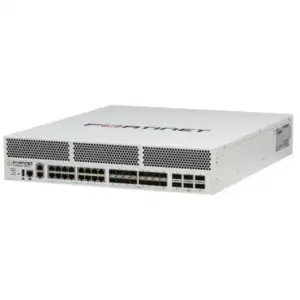
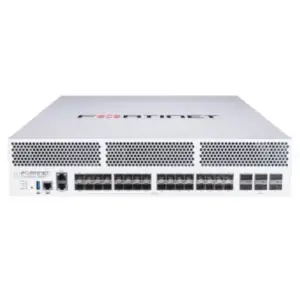
Fortinet FortiGate 1200G in Uganda
A high-performance next-generation firewall built for large campus, data-center and hybrid networks that need fast inspection, modern high-speed links and unified security control.
Fortinet introduced the 1200G series for organisations handling growing encrypted traffic, AI-oriented infrastructure and mixed on-premises and cloud environments. Its FortiASIC-powered architecture, FortiOS operating system and support for 10G, 25G and 100G connectivity make it particularly relevant where security enforcement must scale without forcing a redesign of the network core. FourTeck can help Uganda buyers translate published platform capability into the correct appliance, FortiGuard services, optics, high-availability design and support term for a real deployment.
A firewall platform for networks where inspection speed matters
The FortiGate 1200G is positioned above typical branch and midrange firewall requirements. It is intended for environments where the security gateway may sit beside high-capacity internet services, large campus cores, data-center aggregation, private-cloud infrastructure or hybrid interconnects. In these locations, a firewall must do much more than pass packets. It may need to terminate large numbers of sessions, inspect encrypted application traffic, support virtual private networks, enforce segmentation policy, connect multiple high-speed network domains and participate in a broader security architecture.
Fortinet’s published figures show why the model is aimed at demanding deployments. The series is rated at up to 397 Gbps firewall throughput, 102 Gbps IPsec VPN throughput, 40 Gbps threat-protection throughput, 40 million concurrent sessions and one million new connections per second. Those numbers should not be treated as interchangeable. Raw firewall throughput is useful for understanding forwarding capacity, while threat-protection throughput is far more relevant when advanced inspection is enabled. A careful buyer therefore maps expected traffic to the actual security profile rather than selecting solely from the largest headline number.
The architecture also matters. Fortinet states that the 1200G uses its latest FortiASIC architecture to accelerate networking and security processing. The platform runs FortiOS, allowing networking and security functions to be managed within the same operating environment. For organisations already using Fortinet switching, wireless, central management or security services, that can simplify policy consistency and operational workflows. For organisations moving to Fortinet for the first time, it makes the design phase important because licensing, policy migration and management topology should be planned before cutover.
Flexible 10G, 25G and 100G connectivity gives the appliance a place in modern high-bandwidth designs. Exact port counts, transceiver requirements, breakout choices and cabling should be confirmed against the selected hardware and current Fortinet documentation. This is especially important when the firewall will connect to a data-center spine, a carrier handoff, a high-availability peer or a storage and compute fabric where optical standards and link speeds must match on both sides.
For Uganda buyers, FourTeck can help convert these technical capabilities into a purchase specification. That includes checking the expected number of users and devices, internet and WAN capacity, VPN scale, segmentation requirements, FortiGuard subscriptions, management approach, resilience objectives, rack and power planning, optics and project quantity. The purpose of that review is not to add complexity; it is to prevent a high-end firewall from being ordered with the wrong license bundle, insufficient interface accessories or a design assumption that only becomes visible during installation.
What the 1200G can change for a large network
Keep inspection from becoming the new bottleneck
Encrypted applications, cloud workloads and east-west traffic can consume significant security-processing capacity. Fortinet’s 40 Gbps threat-protection rating provides a substantial inspection envelope for the series, allowing architects to design for security services without automatically constraining high-speed network links. The business result is more freedom to apply policy where it is needed while protecting application responsiveness.
Create headroom for network growth
Support for 10G, 25G and 100G connectivity makes the platform suitable for upgrades that would outgrow conventional Gigabit or low-density 10GbE firewall designs. This matters when a campus backbone, data-center interconnect or carrier service is being refreshed and the security layer should remain useful through several network capacity increases.
Support large VPN and hybrid-network requirements
With 102 Gbps published IPsec VPN throughput, the 1200G can be evaluated for organisations that encrypt substantial site-to-site or infrastructure traffic. VPN design still depends on packet size, tunnel count, cryptographic settings and enabled inspection, but the capacity gives architects room to consolidate encrypted connectivity and secure hybrid paths.
Handle very large connection populations
Fortinet publishes support for 40 million concurrent sessions and one million new connections per second. These figures are relevant to high-density user networks, data-center application environments and services with rapidly changing connection patterns. Correct sizing can reduce the risk of session-table pressure during peak demand.
Unify networking and security operations
FortiOS combines security and networking functions in one platform. For teams managing segmentation, secure SD-WAN, firewall policy, VPNs and connected Fortinet services, a shared operating model can reduce handoffs and make policy relationships easier to trace. The operational benefit depends on how the wider Fortinet environment is deployed and managed.
Strengthen resilience at the security layer
Fortinet describes hardware-rooted protections, secure credential storage and built-in redundancy as important 1200G design elements. For business buyers, resilience is not only a hardware feature; it also means designing power, high availability, upstream and downstream links, software maintenance and operational procedures so the security gateway does not become a single point of failure.
Designed for the point where network scale and security depth meet
The FortiGate 1200G stands out because it combines very high forwarding capacity with substantial security-service throughput and modern interface speeds in a single FortiOS platform. That combination matters when an organisation is modernising the network core but does not want security policy to be treated as a lower-speed side system.
FortiGate 1200G published platform figures
| Specification | Published value / guidance |
|---|---|
| Product type | Next-generation firewall / secure networking platform |
| Firewall throughput | Up to 397 Gbps |
| IPsec VPN throughput | Up to 102 Gbps |
| Threat protection throughput | Up to 40 Gbps |
| Concurrent sessions | Up to 40 million |
| New connections per second | Up to 1 million |
| High-speed connectivity | 10G, 25G and 100G connectivity options; exact interface mix is configuration dependent |
| Security acceleration | Fortinet FortiASIC architecture |
| Operating system | FortiOS |
| Deployment contexts | Campus, data center, edge and hybrid infrastructure |
| FortiSASE Outpost | Supported when appropriately configured; enables local SASE point-of-presence capability |
| Security services | Based on selected FortiGuard services and license bundle |
| High availability / redundancy | Supported platform capability; exact design and required components depend on deployment |
| Optics and cabling | Configuration dependent; confirm transceiver, DAC/AOC and fiber requirements for selected interfaces |
| Power / rack details | Confirm against current Fortinet datasheet and selected appliance configuration before installation |
Which specifications should drive the purchase?
The first number to examine is the throughput associated with the security services you will actually enable. A design that needs application control, intrusion prevention, malware inspection and encrypted traffic inspection should not be sized solely from the 397 Gbps firewall figure. The 40 Gbps threat-protection figure provides a more realistic planning reference for heavily inspected traffic, while detailed service combinations should still be validated for the intended software release and policy set.
Next consider the physical network. A 100GbE-capable firewall can only deliver value if the correct ports, optics, cabling and upstream/downstream equipment are selected. In high-availability deployments, the bill of materials may require duplicate interface accessories and careful path diversity. Finally, confirm the FortiGuard subscription bundle and support term. Security-service entitlement changes what the appliance can inspect and how threat intelligence is maintained over time. FourTeck can help align those variables before a Uganda quotation is prepared.
Five questions that determine the right 1200G design
01 — What traffic and security workload will cross the firewall?
Document internet traffic, inter-VLAN or east-west flows, data-center application traffic, cloud interconnects, remote access and site-to-site VPN use. Then identify which flows require intrusion prevention, application control, web security, malware inspection, SSL inspection or other FortiGuard services. This determines whether the key sizing reference is raw firewall throughput, threat protection, VPN capacity or a combination. It also highlights where policy segmentation may increase session and inspection load.
02 — How large can the connection and performance scale become?
Record current peak throughput, expected three-to-five-year growth, user and device populations, session counts, public-facing application connection rates and planned uplink upgrades. The 40-million-session and one-million-connections-per-second ratings may provide substantial headroom, but the project should still be sized from real peak data. Where 25GbE or 100GbE links are planned, check whether all connected switches, routers and optics support the required standards and breakout method.
03 — What must the firewall integrate with?
Compatibility planning should include routing protocols, VLAN design, authentication sources, logging destinations, SIEM or SOC workflows, existing Fortinet Security Fabric components, network management tools and any cloud or SASE architecture. A firewall can meet its performance target and still be the wrong purchase if integration assumptions are incomplete. Migration from another platform should also include policy review, object cleanup, NAT requirements and cutover planning rather than a simple one-for-one rule import.
04 — Which licenses, services and growth options are required?
FortiGuard service bundles and support terms affect both security capability and ongoing operational coverage. Decide which protections are required at launch, how long the initial service term should run, whether centralized management or analytics are part of the project, and whether FortiSASE Outpost is relevant to the organisation’s sovereignty or enforcement-location strategy. A complete quote should separate appliance hardware, subscriptions, support, transceivers and implementation-related items so the total project is clear.
05 — What are the installation, resilience and delivery expectations?
Confirm rack location, available power, cooling, cable paths, high-availability topology, maintenance windows and the person responsible for final configuration. If redundancy is required, document whether the design uses active-passive or another supported arrangement and whether upstream/downstream devices also provide path resilience. For Uganda projects, delivery coordination and quantity planning should be discussed early because enterprise firewall availability can vary by configuration and order size.
Where the platform earns its place
Large enterprise campus core
A campus with thousands of users, dense wireless access, high-speed distribution switching and multiple internet or private-WAN links may need security policy at a point where conventional firewall platforms would force down-speeding. The 1200G’s high throughput and 10/25/100GbE connectivity allow it to be evaluated as a central enforcement platform. The design should map VLAN and routing architecture, east-west inspection requirements, redundant paths and authentication integrations before purchase.
Data-center perimeter and segmentation
Data centers often combine high connection rates with stringent policy boundaries between application tiers, tenants, internet services and hybrid-cloud links. Forty million concurrent sessions and one million new connections per second provide relevant scale for these environments. The buyer still needs to decide where inspection occurs, which application flows are encrypted, how much threat protection is enabled and whether 25GbE or 100GbE interfaces are required on each side.
Hybrid infrastructure and encrypted interconnect
Organisations linking private data centers to cloud environments, secondary sites or disaster-recovery facilities can use IPsec to protect large traffic volumes. The 102 Gbps published IPsec figure makes the platform a candidate for substantial encrypted links. Tunnel topology, cipher choice, routing design, failover and security inspection must be planned together so the VPN architecture does not consume unexpected capacity or create asymmetric paths.
AI and high-bandwidth application environments
Fortinet specifically positions the series for the growth of AI-driven and encrypted traffic. In practice, this can mean clusters, model-serving platforms, analytics systems or other compute-heavy environments that generate large east-west and north-south flows. The firewall should be placed where it protects the required trust boundaries without forcing every internal flow through unnecessary inspection. Interface density, latency sensitivity and segmentation policy become the key design questions.
FortiASIC acceleration and security-service headroom
High-speed firewall projects fail when the security platform is sized as though every packet requires the same amount of work. A simple allow or deny decision is not equivalent to decrypting TLS, identifying applications, examining content, checking signatures and evaluating policy context. Fortinet’s use of purpose-built FortiASIC processing is intended to accelerate networking and security tasks so more inspection can occur without forcing the appliance to rely entirely on general-purpose CPU resources.
For the 1200G, the gap between 397 Gbps firewall throughput and 40 Gbps threat-protection throughput is not a weakness; it is a planning signal. It shows why architects must understand which traffic will receive advanced inspection. A data-center deployment might carry hundreds of gigabits of trusted east-west traffic while only a portion crosses a fully inspected perimeter policy. Another organisation may require deep inspection on most internet traffic and therefore size much closer to the threat-protection figure. Both can be valid designs, but they demand different assumptions.
The practical procurement task is to document inspection zones and traffic classes before ordering. This makes it possible to estimate whether one appliance pair can provide the required resilience and performance, whether certain traffic should remain on separate paths, and which security subscriptions are necessary. It also gives the implementation team a clear basis for testing after deployment. FourTeck can use that information to help Uganda buyers compare the desired design against published platform capabilities rather than relying on a single marketing number.
High-speed connectivity for campus and data-center change
Network refresh projects increasingly move from 10GbE uplinks toward 25GbE server or distribution connections and 100GbE aggregation. Fortinet’s 10G, 25G and 100G connectivity options let the 1200G participate in those designs without requiring an external speed-conversion layer. That simplifies architecture, but only when physical interfaces and optical standards are specified correctly.
Use high-speed links for core, carrier, data-center or peer connections where the security layer must match surrounding network capacity.
Confirm exact interface count, connector type, supported transceivers and breakout requirements against current Fortinet hardware documentation.
For high availability, duplicate optics and cabling may be required so the standby path offers the same capacity and physical diversity as the active path.
The buyer decision is therefore more detailed than choosing “100G support.” A design may need single-mode or multimode optics, a specific reach, direct-attach copper, active optical cabling, breakout from 100G to lower-speed links, or compatibility with a particular switch vendor’s interface policy. The safest procurement method is to build the complete port map first and then quote the firewall together with the required transceivers and cabling.
FortiSASE Outpost and enforcement-location choice
One of the most distinctive aspects of the 1200G announcement is support for FortiSASE Outpost. Fortinet describes this capability as a way to bring cloud-delivered security services into a customer-controlled environment, with the appliance able to operate as a high-performance local SASE point of presence when appropriately configured. The goal is to give organisations another choice for where inspection and policy enforcement happen.
This can matter for workloads where latency, data sovereignty, local breakout, operational control or application performance make a fully remote cloud inspection path less attractive. It can also matter to organisations that want consistent FortiOS-aligned policy across on-premises and cloud-delivered security. The capability should not be assumed to be included automatically with every appliance purchase. Licensing, service entitlement, architecture and software requirements need to be checked as part of the quote.
Buyer decision checklist
- Which users, sites or applications would benefit from local SASE enforcement?
- Are there sovereignty or compliance requirements that influence inspection location?
- Which FortiSASE and FortiGuard services are required for the intended policy?
- How will identity, logging, management and incident workflows integrate?
- Does the design need active-high availability or another resilient local enforcement model?
- What internet, WAN and cloud paths must remain available if the local site experiences an outage?
Answering these questions before purchase prevents a situation where the hardware is technically capable but the service architecture, subscriptions or operational process are incomplete. FourTeck can help structure the hardware and licensing request for Uganda buyers while the customer’s security team or implementation partner validates the final policy design.
What buyers should check before purchase
| Risk | What to confirm | Why it matters | What to share with FourTeck |
|---|---|---|---|
| Wrong performance basis | Raw, VPN and threat-protection traffic mix | Security services can change the relevant throughput ceiling. | Peak bandwidth, inspection percentage, VPN load and growth estimate. |
| Interface mismatch | 10/25/100G port map, optics, cable type and peer compatibility | A correct appliance can still be unusable if physical links do not match. | Switch/router models, link speed, connector type and cable reach. |
| Incomplete licensing | FortiGuard services, support term, FortiSASE requirements and management tools | Security and support capabilities depend on entitlements. | Required protections, term length and management architecture. |
| Single-point-of-failure design | HA topology, dual power/network paths and maintenance plan | A high-capacity firewall often protects services that cannot tolerate an outage. | Redundancy objective, rack/power layout and upstream/downstream design. |
A high-end firewall purchase should be treated as a system rather than a single SKU. In addition to the appliance itself, the project may require a second unit for resilience, security subscriptions, support coverage, 25GbE or 100GbE transceivers, direct-attach or active optical cables, rack accessories, console or management connectivity and professional implementation. Quantities should also be planned around the intended rollout: a central data center may require one HA pair, while a distributed architecture can involve multiple pairs or staged installations.
Replacement guidance deserves the same attention. If the 1200G is being considered to replace an older FortiGate, compare current policies, interface use, virtual domains, VPN tunnels, routing, logging, security profiles and actual peak load. A newer model should not be selected by nameplate equivalence alone. Migration is a good time to remove obsolete policies, increase segmentation, update cipher choices and revise capacity assumptions based on current traffic rather than the network that existed when the previous firewall was purchased.
Planning a FortiGate 1200G deployment in Uganda
Fortinet announced the 1200G series in July 2026 and indicated expected availability in the third quarter of 2026. Actual supply for a specific Uganda project can vary by appliance configuration, support term, subscription bundle, optics and project quantity. FourTeck therefore handles the product as a quotation-led enterprise purchase rather than making assumptions about local shelf stock or immediate delivery.
For Kampala-based organisations and nationwide projects, FourTeck can coordinate configuration review, quotation, delivery planning and warranty guidance based on the supplied product and service terms. The most useful request includes the expected traffic profile, WAN and data-center link speeds, required FortiGuard services, whether high availability is needed, the desired support term and any transceivers or cables that should be included. Project buyers should also state whether the firewall is part of a new network, a migration from an existing FortiGate or a replacement for another platform, because each case changes the information needed before finalising the bill of materials.
One national project plan, not repeated city assumptions
FourTeck can discuss FortiGate 1200G requirements for organisations in Kampala as well as projects serving Entebbe, Jinja, Mbarara and Gulu. The important factor is the deployment design and delivery destination, not a different product description for each city. A headquarters firewall in Kampala may protect remote sites across the country, while another project may place equipment in a regional data center or disaster-recovery location. Share the installation site, quantity, target dates and any requirements for phased delivery so the quote can reflect the real project structure. Availability, delivery timing and service handling should be confirmed for the specific order rather than assumed from location alone.
Regional coordination for multi-country security projects
Some enterprise firewall projects are regional rather than country-specific. A Uganda headquarters may need consistent security architecture with offices or data centers in Kenya or other selected East Africa markets, while multinational organisations may also coordinate technology procurement with teams in the UAE, Kuwait or other selected Africa markets. FourTeck can discuss regional product sourcing and quotation requirements through the relevant country or regional channels without implying local stock or identical delivery conditions in every market.
The architectural benefit of planning regionally is consistency. Organisations can define a common FortiOS policy model, service bundle, support approach, logging architecture and high-availability standard while still adjusting appliance sizing to local traffic. For regional enquiries, buyers can review FourTeck Uganda, FourTeck Kenya, FourTeck Africa, FourTeck UAE and FourTeck Kuwait for the appropriate commercial contact path.
Fortinet alternatives and adjacent planning options
Model choice should be based on real throughput, inspection, interface and session requirements rather than selecting the closest product number. If your project is still at the sizing stage, send FourTeck the network requirements and request a comparison of suitable Fortinet options.
Practical assistance before the purchase order
FortiGate 1200G buyer questions
01. What is the FortiGate 1200G primarily designed for?
It is designed for high-performance enterprise, campus, data-center and hybrid network security. Fortinet positions the series for environments facing growing encrypted traffic, AI-oriented infrastructure and the need for flexible 10G, 25G and 100G connectivity. Its role is broader than packet filtering: it can combine firewalling, VPN, segmentation and FortiGuard security services through FortiOS, subject to the selected license and configuration.
02. How much threat-protection throughput does the 1200G provide?
Fortinet publishes up to 40 Gbps threat-protection throughput for the series. This is usually a more meaningful sizing figure than raw firewall throughput when advanced security inspection is enabled. Actual performance depends on the traffic mix, packet sizes, software version, security profiles, SSL inspection and other enabled functions, so a production design should be checked against the exact workload rather than assuming every traffic type will reach the published maximum.
03. Does the platform support 100GbE networking?
Yes. Fortinet states that the 1200G series supports flexible 10G, 25G and 100G connectivity. Exact interface counts and physical port options should be confirmed against the current model datasheet. Buyers should also specify the required optics, cable reach and peer equipment because 100GbE compatibility depends on transceiver type, fiber or direct-attach choice, breakout requirements and the interfaces available on connected switches or routers.
04. What VPN scale is published for the FortiGate 1200G?
Fortinet publishes up to 102 Gbps IPsec VPN throughput. This makes the platform relevant for high-volume site-to-site, data-center and hybrid interconnect designs. A buyer should still document tunnel count, encryption settings, routing, failover and the percentage of VPN traffic that will also receive security inspection. These factors can change the performance and architecture required for the actual deployment.
05. What is FortiSASE Outpost on the 1200G?
FortiSASE Outpost is a capability Fortinet announced with the series that can allow an appropriately configured 1200G to operate as a high-performance local SASE point of presence. It gives organisations another option for placing security inspection and enforcement in a customer-controlled environment. Licensing, supported services, software requirements and the final architecture should be confirmed for the intended project rather than assuming the capability is automatically enabled with every hardware purchase.
06. Do I need FortiGuard subscriptions with the appliance?
The appliance can perform core FortiOS networking and firewall functions, but many advanced threat-protection capabilities depend on selected FortiGuard security services and support entitlements. The correct bundle depends on what the organisation wants to inspect and protect. When requesting a quote, specify required services such as intrusion prevention, web or application security, malware protection and other relevant functions so the commercial configuration can be matched to the security policy.
07. Should I buy one unit or a high-availability pair?
That depends on the uptime requirement and network topology. In large campus and data-center deployments, a firewall often protects services whose outage would affect many users or applications, so an HA design is commonly evaluated. The complete resilience plan should also consider redundant power, upstream and downstream switching, routing, carrier paths and management access. Share the continuity requirement with FourTeck so the quote can include the appropriate quantity and supporting interface components.
08. Is the FortiGate 1200G available in Uganda?
Fortinet announced expected Q3 2026 availability for the series. FourTeck can provide current quotation and delivery guidance for Uganda, but availability can vary by configuration, FortiGuard bundle, support term, optics and order quantity. Rather than assume local stock, request a current project quote with the required specifications and destination. This gives the commercial team enough information to confirm the appropriate supply path and any configuration-dependent lead considerations.
09. What information should I send for a quote?
Provide current and expected bandwidth, the percentage of traffic requiring advanced inspection, IPsec VPN requirements, user or device scale, 10/25/100GbE link needs, high-availability requirements, desired FortiGuard services, support term, optics or cabling, installation location and quantity. If this is a replacement project, include the existing firewall model and any important interface, routing, VPN or virtual-domain requirements. That information allows a much more accurate bill of materials.
Build the 1200G quote around your real traffic and resilience needs
Share the performance profile, security services, high-speed interfaces, VPN load, FortiGuard requirements, high-availability plan and project quantity. FourTeck can use those details to prepare a Uganda quotation and flag configuration items such as subscriptions, optics and support that should be confirmed before purchase.
- Peak and future bandwidth
- Threat-inspected traffic estimate
- 10G, 25G and 100G interface requirements
- VPN and HA requirements
- FortiGuard services and support term
- Delivery location and quantity