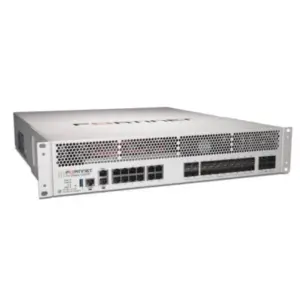
Fortinet FortiGate 3000G in Uganda
A high-capacity FortiGate platform for securing data-center, campus-core and hybrid enterprise traffic with accelerated firewalling, inspection and high-speed interfaces.
The 3000G is aimed at organizations whose security edge must keep pace with multi-gigabit application traffic, encrypted sessions and large connection volumes. FourTeck can help translate traffic forecasts, interface requirements, resiliency targets and security-service choices into a procurement-ready configuration for Uganda.
Security capacity for demanding enterprise and data-center edges
The FortiGate 3000G is positioned by Fortinet in its high-end data-center firewall range. Its role is not simply to pass packets quickly; it is designed to combine high-speed network enforcement with intrusion prevention, application control, malware protection, VPN functions, segmentation and the broader security services available through FortiOS and FortiGuard. Fortinet’s current product matrix lists up to 397/394/234 Gbps IPv4 firewall throughput for 1518/512/64-byte UDP traffic, 105 Gbps IPsec VPN throughput, 90 Gbps IPS throughput, 85 Gbps NGFW throughput and 80 Gbps threat-protection throughput. These figures are useful sizing references, but production performance depends on enabled functions, policy design, traffic profile and software configuration.
That distinction matters for large Ugandan organizations. A bank, telecom environment, government data center, cloud operator, university, healthcare group or diversified enterprise may have several very different flows crossing the same security boundary: internet access, application publishing, east-west server traffic, site-to-site VPN, cloud connectivity, partner networks and administrative access. The correct firewall design therefore begins with traffic paths and security controls rather than a single bandwidth number.
The appliance also brings dense high-speed connectivity. Publicly listed hardware information identifies six 100GE QSFP28 slots, sixteen 25GE SFP28/10GE SFP+ positions including two HA ports, and eighteen 10G Base-T interfaces including two management ports. This makes the platform relevant where the firewall must connect directly into fast switching, routing or data-center fabrics without an artificial low-speed bottleneck at the security layer.
FourTeck’s role in a procurement discussion is to help turn the intended architecture into a complete bill of materials. That can include the base appliance, suitable FortiGuard service bundle, FortiCare term, optical transceivers, cabling, rack and power considerations, and an HA peer when redundancy is required. Buyers should also confirm the FortiOS release supported for the model and align deployment planning with their operational change process.
Why the 3000G belongs in high-throughput security designs
Inspection capacity that matches modern links
Up to 90 Gbps IPS and 80 Gbps threat-protection figures give architects a stronger starting point for environments where enabling security inspection on fast links would otherwise create a capacity constraint. The business value is the ability to preserve security controls while supporting higher application and internet traffic volumes.
High-speed interface flexibility
100GE, 25GE and 10GE connectivity helps the appliance integrate with modern core and data-center switching. This reduces the risk that a firewall refresh forces an otherwise unnecessary network-speed compromise and gives architects more options for north-south and segmentation designs.
Converged networking and security operations
FortiOS combines firewall policy, VPN, SD-WAN, segmentation and security functions within one operating environment. For teams already standardizing on Fortinet, this can simplify policy administration and operational training compared with maintaining unrelated tools for every network boundary.
Resiliency planning through HA
Dedicated HA-capable interfaces and FortiGate high-availability options allow the platform to be designed as a redundant pair where uptime objectives demand it. The practical benefit is not that failure becomes impossible, but that the architecture can reduce dependence on a single firewall appliance.
Secure remote and inter-site connectivity
Fortinet lists up to 105 Gbps IPsec VPN throughput. That makes the model relevant for large encrypted site-to-site designs, cloud connectivity and distributed enterprise architectures, subject to actual cryptographic settings, tunnel counts, traffic mix and policy requirements.
Room for growth when sizing is disciplined
A properly sized high-end firewall can accommodate traffic growth, additional inspection and new application flows without forcing an immediate replacement. The value comes from disciplined capacity planning: buyers should model realistic peak traffic and security services rather than buying solely from theoretical maximums.
A firewall platform where inspection performance, interface density and FortiOS services are designed to operate as one system.
The strongest case for this platform is architectural: it gives security teams substantial inspected-throughput headroom while giving network teams the high-speed physical interfaces expected at large enterprise and data-center boundaries. It is powered by Fortinet’s accelerated architecture, with public product listings identifying NP7 and CP10 hardware acceleration. Fortinet also positions the model as part of its Hybrid Mesh Firewall strategy, where consistent security policy can extend across data-center, campus, branch, cloud and remote-access environments.
Enterprise-mix reference figure for intrusion-prevention sizing.
Reference performance with firewall, IPS and application control.
Reference figure with additional malware-protection workload enabled.
High-speed connectivity for modern core and data-center fabrics.
FortiGate 3000G technical specifications
| Specification | Published / applicable value | Buyer interpretation |
|---|---|---|
| Firewall throughput | Up to 397 / 394 / 234 Gbps (1518 / 512 / 64 byte UDP) | Raw firewall reference; do not substitute for inspected-traffic sizing. |
| IPS throughput | Up to 90 Gbps | Important for intrusion-prevention-heavy designs. |
| NGFW throughput | Up to 85 Gbps | Useful reference when firewall, IPS and application control are enabled. |
| Threat protection | Up to 80 Gbps | Fortinet’s high-end model comparison metric for broader protection workload. |
| IPsec VPN throughput | Up to 105 Gbps | Actual results depend on encryption settings, packets and topology. |
| 100GE interfaces | 6 × QSFP28 slots | Confirm transceiver and switch compatibility. |
| 25/10GE fiber interfaces | 16 positions, including 14 ports and 2 HA ports | Plan production, HA and spare-interface requirements separately. |
| 10G Base-T | 18 total, including 2 management ports | Useful for copper-based high-speed links and administration. |
| Hardware acceleration | SPU NP7 and CP10 | Acceleration architecture is central to the platform’s performance design. |
| Power supplies | 2 × AC power supplies on base FG-3000G listing | Confirm rack power feeds and redundancy plan. |
| Operating system | FortiOS; release support must be checked for deployment | Align upgrades with the Fortinet support matrix and change policy. |
| Security services | Based on selected FortiGuard bundle | Subscription choice affects available protection and lifecycle cost. |
The most important figures for procurement are usually the inspected-throughput values, interface mix and service subscription rather than the maximum firewall number. A design carrying encrypted web applications may need SSL inspection and threat services on a large percentage of traffic, while a data-center segmentation deployment may prioritize connection scale, east-west flows and 100GE attachment. A large VPN hub may place more weight on IPsec performance and tunnel architecture. These are different workloads even if their aggregate bandwidth looks similar.
Interface planning deserves equal attention. A QSFP28 or SFP28 port is only useful when the correct optics, fiber type and peer-device compatibility are specified. High availability adds another layer: buyers should decide whether they need an active-passive or other supported HA design, how each appliance connects to upstream and downstream switches, and whether power is delivered from independent sources. FourTeck can use these details to prepare a more complete quote rather than treating the firewall as an isolated appliance.
Five questions to answer before requesting a quote
01 — What traffic will actually cross the firewall?
Document internet traffic, server-to-server flows, published applications, cloud links, partner networks and VPN traffic. Then identify which flows require IPS, application control, malware protection or deep inspection. This changes the sizing basis because inspected traffic consumes different resources from simple stateful forwarding.
02 — What is the current peak and expected three-to-five-year scale?
Provide measured peak bandwidth where possible, not only ISP circuit size. Include session growth, new data-center links, additional sites and major digital projects. The objective is to create sensible headroom without turning the purchase into an arbitrary maximum-capacity exercise.
03 — What must the appliance connect to?
List switch models, router handoffs, ISP presentation, required 100GE/25GE/10GE media, VLAN design and any link aggregation. Compatibility affects optics, cabling and port allocation, and can materially change the bill of materials.
04 — Which services and support term are required?
FortiGuard bundles and FortiCare terms should be selected against the organization’s security policy and support expectations. Buyers should identify whether the project requires advanced threat services, content controls, application visibility, support escalation, centralized management or logging integrations.
05 — What are the resiliency and deployment expectations?
Confirm whether the firewall will be standalone or deployed as an HA pair, where it will be racked, how redundant power is provided, and whether migration from an existing firewall requires policy conversion or staged cutover. These choices affect quantity, accessories and implementation planning.
Where this platform can make architectural sense
Large enterprise internet edge
An organization with multiple high-speed internet circuits may need firewall policy, application control, IPS and malware protection applied to substantial aggregate traffic. The 3000G’s inspected-throughput figures and high-speed interfaces can fit this role when the design has been validated against peak usage. Buyers should include encrypted-traffic assumptions and public-facing application requirements because these can change the workload significantly.
Data-center segmentation and north-south security
Modern data centers often need security controls between external networks, application zones, shared services and critical systems. 100GE and 25GE connectivity can help integrate the firewall into fast switching environments. The final architecture should account for routing, VLAN or virtual-domain design, asymmetric traffic risk, application dependencies and the impact of inspection on latency-sensitive services.
High-capacity VPN aggregation
Organizations linking many sites or cloud environments may use a high-end FortiGate as an IPsec concentration point. Fortinet’s published 105 Gbps IPsec figure provides a reference, but real designs should consider tunnel count, encryption suite, packet size, failover behavior and whether the same appliance is simultaneously performing intensive security inspection for other traffic.
Hybrid enterprise security core
A distributed enterprise may want consistent FortiOS policy across campus, data-center, branch and cloud-connected environments. In that context, the 3000G can serve as a high-capacity anchor while smaller FortiGate models protect remote sites. Centralized management and logging should be planned as part of the operating model rather than added after deployment.
Inspected throughput is the number that protects the design from false confidence
High-end firewalls are often compared using maximum stateful firewall throughput, but enterprise traffic rarely consists only of packets passing through simple rules. Security teams typically want intrusion prevention, application identification, anti-malware controls, web and DNS security, encrypted-traffic inspection and detailed logging. Each enabled function changes the workload. Fortinet therefore publishes several performance measurements, and the 3000G’s 90 Gbps IPS, 85 Gbps NGFW and 80 Gbps threat-protection values are more useful for many production designs than the 397 Gbps large-packet firewall figure alone.
A practical sizing exercise starts by dividing traffic into classes. Internet browsing may require a different inspection stack from application publishing. Data-center replication may need segmentation but not the same content controls as user internet access. VPN traffic may arrive encrypted and then be subjected to additional policy. Backup windows can create short peaks that are very different from daily averages. Once these patterns are understood, an architect can decide what portion of traffic needs which controls and how much capacity reserve is appropriate.
For Uganda buyers, this exercise also helps avoid over- or under-buying. A model that appears oversized against ISP bandwidth may be justified when internal segmentation traffic is much larger. Conversely, a large chassis may be unnecessary if the real inspected workload is modest. FourTeck can review measured traffic, planned links and enabled security services before quotation so the proposed configuration reflects the actual environment.
100GE, 25GE and 10GE connectivity changes how the firewall can sit in the network
High-speed interface density is a practical differentiator in a data-center firewall. The 3000G can connect to fast switching and routing infrastructure without forcing every protected path through lower-speed links. Six 100GE QSFP28 slots can support high-capacity uplinks or aggregated traffic paths, while the SFP28/SFP+ and 10G Base-T options provide flexibility for server, switch, router, management and HA connectivity. That flexibility is valuable, but only when ports are mapped deliberately.
Capability line 01: Six 100GE QSFP28 positions provide a basis for high-bandwidth fabric or core attachment. The design must still validate supported optics and the capabilities of the peer device.
Capability line 02: Sixteen 25GE/10GE fiber positions, including HA ports, support mixed-speed environments and dedicated resiliency links. Port allocation should reserve capacity for failover and future changes.
Capability line 03: Eighteen 10G Base-T connections, including management ports, can simplify copper-based integration where appropriate. Cable category, distance, heat and switch-port compatibility should be considered.
The procurement implication is straightforward: do not quote only the chassis. Identify each physical connection, media type, speed and redundancy role. Then specify compatible transceivers, fiber or copper assemblies and spare optics where the operational standard requires them. This avoids a common project delay in which the firewall arrives but cannot be connected to the intended network fabric.
Licensing, support and lifecycle planning are part of the firewall architecture
The base appliance provides the hardware platform, but many advanced security outcomes depend on the FortiGuard services and support package selected for the deployment. Available bundles can include combinations of intrusion prevention, malware protection, application control, URL and DNS filtering, data-loss-prevention-related capabilities and other services. Package names and inclusions can evolve, so the current Fortinet ordering information should be reviewed at quotation time rather than assuming that an older bundle description still applies.
Support is equally important on a high-end production firewall. Buyers should decide the required FortiCare level and term, internal escalation process, maintenance-window expectations and renewal ownership. A three- or five-year procurement may make budgeting more predictable, while a shorter term may suit a different lifecycle strategy. The correct choice depends on organizational policy and project funding rather than a universal recommendation.
Buyer decision checklist
□ Which FortiGuard services are mandatory under the security policy?
□ Is centralized management or analytics part of the design?
□ What FortiCare support level is required?
□ Is the subscription term aligned with the expected hardware lifecycle?
□ Who owns renewals and license registration?
□ Is an HA peer required from day one?
□ Are optics, rack power and migration services included in project scope?
□ Has the target FortiOS release been validated for this model and integrations?
Making these decisions before the purchase order is issued produces a cleaner deployment and a more accurate total-cost view. FourTeck can help buyers structure the quote around appliance quantity, service term and accessory requirements, while the customer’s security and network teams retain responsibility for approving the final architecture.
What buyers should check before purchase
| Risk | What to confirm | Why it matters | What to share with FourTeck |
|---|---|---|---|
| Wrong capacity basis | Peak inspected traffic and enabled services | Raw firewall throughput can overstate usable capacity for security-heavy workloads. | Traffic reports, link speeds and growth forecast. |
| Incomplete connectivity | Optics, fiber, copper, port speed and peer compatibility | Missing transceivers can delay commissioning. | Switch/router models and physical interface plan. |
| Service mismatch | FortiGuard bundle, FortiCare level and term | Capabilities and lifecycle cost depend on the selected services. | Required controls, support policy and preferred term. |
| Single point of failure | HA requirement, dual power and switch topology | Critical security edges often need redundancy beyond one appliance. | Availability target and proposed topology. |
Also confirm rack space, power-feed arrangement, cooling, migration scope, configuration backup, policy conversion needs, maintenance windows and rollback planning. Where the firewall replaces an older model, do not assume every configuration object can be moved unchanged. Interface naming, feature behavior, deprecated commands and software-version differences can affect migration. A staged technical review before the purchase reduces surprises later.
Procurement support for Uganda enterprise projects
FortiGate 3000G availability in Uganda can vary with the exact hardware requirement, service bundle, support term, optics and project quantity. FourTeck can prepare a quote after reviewing the intended deployment rather than presenting an unqualified stock promise. For organizations in Kampala, the useful first step is to share the target architecture, required throughput, interface media, HA requirement and subscription duration.
Delivery coordination should be treated as part of the project schedule, especially for a high-end firewall that may require specific transceivers or a matched HA pair. FourTeck can also help organize warranty and support information for the proposed configuration so procurement teams understand what is included and what depends on the selected FortiCare package. Project buyers should provide target deployment dates early enough to align commercial lead time with internal change windows.
For multi-site or phased projects, quantity planning is useful because the high-end data-center unit may be paired with different FortiGate models at branch or campus locations. A consolidated requirement can make it easier to review common subscription terms, management strategy and accessory standards.
Uganda location coverage
FourTeck can coordinate quotation and product-supply discussions for organizations planning deployments in Kampala as well as projects serving Entebbe, Jinja, Mbarara and Gulu. The delivery approach, project quantity and implementation schedule should be confirmed during quotation because logistics can differ by destination and configuration. For distributed organizations, it is helpful to identify whether the high-end firewall will be installed centrally while smaller security appliances are required at other locations.
East Africa and wider regional requirements
Organizations with infrastructure spanning Uganda and Kenya or other selected East Africa markets may need a consistent firewall architecture across more than one country. FourTeck can discuss regional product requirements and help structure model, subscription and accessory lists so procurement teams have a clearer view of what is common and what varies by site. This is particularly useful for enterprises standardizing FortiOS policy while using different appliance sizes at headquarters, data centers and branches.
Regional availability, delivery arrangements, licensing conditions and support handling should be confirmed for each destination rather than assumed from one market. Buyers can review the FourTeck Uganda site, FourTeck Kenya, FourTeck Africa, FourTeck UAE or FourTeck Kuwait when those markets are relevant to a wider project.
Related Fortinet and firewall procurement paths
FortiGate high-end firewall range — Best for buyers comparing data-center capacity tiers. Review the broader FourTeck Uganda enterprise security catalogue and request a model comparison based on inspected throughput.
FortiGate 3500G path — Suitable when a project requires a higher performance tier within the G-generation high-end family. Ask FourTeck to compare workload and interface requirements before moving up a model.
FortiGate 3800G path — Relevant for still larger inspected-throughput requirements. Model selection should be driven by validated capacity rather than choosing the largest platform automatically.
FortiManager and FortiAnalyzer — Consider centralized management, logging and analytics when the firewall forms part of a larger Fortinet estate. These are separate products and should be sized for the device and logging environment.
Configuration review — For a project-specific alternative, use the FourTeck Uganda contact page and provide throughput, interfaces, sites and service requirements.
Practical assistance around a complex firewall purchase
01. Product selection guidance. High-end firewall selection is workload dependent. FourTeck can help organize the buyer’s requirements so the requested model is evaluated against inspected traffic, VPN needs, interface speeds and growth.
02. Configuration review. A complete order may involve an HA peer, security subscriptions, support, optics and cabling. Reviewing these elements together helps reduce incomplete bills of materials.
03. Quote assistance. Commercial pricing depends on configuration, service term and quantity. A structured requirement allows the quotation to reflect the actual project instead of a generic appliance-only estimate.
04. Uganda delivery coordination. FourTeck can discuss delivery destination and timing as part of the quote, without assuming immediate availability for every configuration.
05. Warranty and support guidance. Buyers can review the applicable FortiCare choice and commercial support details before purchase so internal teams know what they are procuring.
06. Alternative model matching. If measured workload does not justify this model, FourTeck can discuss another FortiGate tier that better fits the project’s performance and budget constraints.
FortiGate 3000G buyer questions
01. What is the FortiGate 3000G mainly used for?
It is a high-end next-generation firewall intended for demanding enterprise and data-center security roles. Typical designs include high-capacity internet edges, data-center segmentation, VPN aggregation and hybrid network security. Fortinet publishes up to 90 Gbps IPS and 80 Gbps threat-protection throughput, so the model is aimed at workloads substantially above branch-firewall scale. Final suitability depends on enabled inspection, traffic mix and growth.
02. How should we size the appliance for our network?
Start with measured peak traffic and identify which security functions will be enabled for each traffic class. Compare the resulting requirement with IPS, NGFW and threat-protection figures rather than relying only on maximum firewall throughput. Include SSL inspection, VPN traffic, session scale and future growth. FourTeck can review these inputs when preparing a quote, but the final architecture should be approved by the customer’s technical team.
03. Does it support 100GbE connectivity?
Yes. Public hardware listings for FG-3000G identify six 100GE QSFP28 slots. The appliance also provides 25GE/10GE fiber and 10G Base-T connectivity. Buyers should separately confirm supported transceivers, fiber type, cable distance and compatibility with the peer switches or routers. The correct optics should be included in the bill of materials rather than assumed to be part of every appliance order.
04. Do FortiGuard security services come with every hardware purchase?
Service entitlement depends on the SKU or bundle purchased. The base hardware and bundled offers are commercially distinct, and FortiGuard packages can include different security capabilities and terms. Buyers should define the required controls and request the corresponding current bundle. FourTeck can include suitable subscription options in the quotation, while exact package inclusions should be confirmed against current Fortinet ordering information.
05. Should we deploy one unit or an HA pair?
That decision depends on business continuity requirements and the overall network design. A single firewall can become a critical dependency at a major data-center or internet edge. Where the organization requires redundancy, a supported FortiGate high-availability design may be appropriate. The quote should then account for two appliances, matching subscriptions where required, HA connectivity, switch topology, dual power feeds and operational failover testing.
06. Which FortiOS version should be used?
The appropriate FortiOS release should be selected from Fortinet’s current support documentation for the model and validated against the customer’s features and integrations. Fortinet documentation can place newer hardware on model-specific or special software branches during parts of its lifecycle. Do not assume that every release used on an older FortiGate is immediately interchangeable. Plan software choice and migration as part of implementation.
07. Is the FortiGate 3000G available in Uganda?
It can be quoted for Uganda projects, but availability and lead time may vary according to hardware, service bundle, support term, optics and quantity. FourTeck does not need to assume ready stock to help with procurement. Share the required configuration and delivery destination so the current commercial and logistics position can be checked during the quotation process.
08. What information should we provide for a useful quote?
Provide current firewall model, peak traffic, internet and WAN speeds, expected growth, enabled or desired security functions, interface speeds, optic types, HA requirement, preferred FortiGuard package, FortiCare term, deployment location and target project date. If this is a migration, include the existing topology and major integrations. These details help avoid an appliance-only quote that omits necessary subscriptions or connectivity components.
09. Can it be used as a VPN hub?
Yes, it supports IPsec VPN and Fortinet publishes up to 105 Gbps IPsec VPN throughput as a reference measurement. A real VPN-hub design should additionally consider tunnel count, encryption settings, routing, failover, authentication, remote-site models and simultaneous inspection workloads. If VPN aggregation is a primary purpose, state that clearly during sizing so the design is evaluated around encrypted traffic rather than generic internet throughput.
10. What if our workload does not require this capacity?
A smaller FortiGate may be a better procurement choice. Fortinet offers multiple high-end and mid-range models with different inspected-throughput levels and interfaces. The goal should be to meet security, capacity and growth requirements with appropriate headroom, not to select the largest appliance by default. FourTeck can discuss a lower or higher tier when the traffic profile and connectivity requirements indicate a different fit.
Build the quote around your real traffic and topology
For a more accurate FortiGate 3000G proposal, share your peak inspected traffic, link speeds, required 100/25/10GbE interfaces, HA plan, FortiGuard services, FortiCare term and delivery location. FourTeck can use that information to prepare a configuration-focused Uganda quotation and identify accessories or alternative models that should be considered.
Useful details: current firewall • peak bandwidth • security services • VPN scale • optics • HA • support term • project quantity • target deployment date.