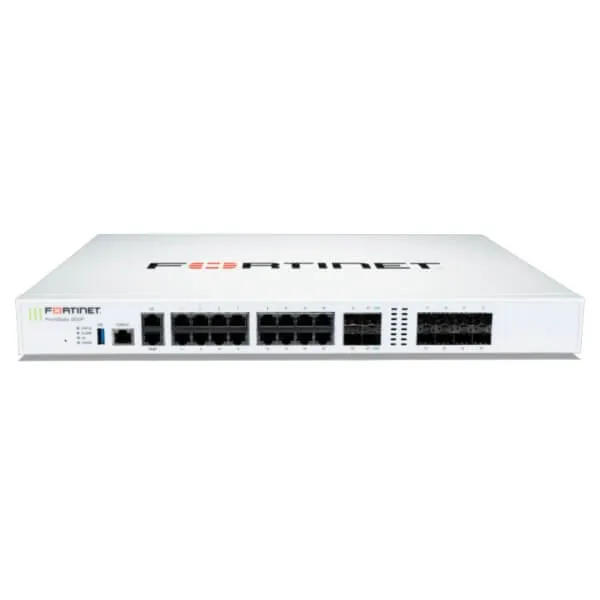
FortiGate 200F in Uganda
A 1RU enterprise firewall for organizations that need converged security, high-speed interfaces, secure SD-WAN and scalable VPN connectivity in one FortiOS platform.
The FortiGate 200F is positioned for demanding mid-range deployments where internet edge security, branch aggregation, segmentation and application-aware inspection must share the same appliance. FourTeck can help Uganda buyers match the appliance, FortiGuard service bundle, transceivers and deployment plan to real bandwidth, user and site requirements.
Fortinet
FG-200F
Next-generation firewall
1RU rack mount
FortiOS
Configuration dependent
A security and networking platform for a busy enterprise edge
The FortiGate 200F is a hardware next-generation firewall built for organizations that have moved beyond basic perimeter filtering and need security to work closely with routing, switching, branch connectivity and remote access. In practical terms, it can sit at the internet edge of a headquarters, serve as a regional aggregation firewall, secure a campus, or become the policy control point for a multi-site secure SD-WAN design. Fortinet combines these functions through FortiOS, so policy, visibility and networking features can be managed in a common operating environment instead of being treated as unrelated appliances.
Its hardware profile is important because the model gives buyers a mixture of copper, fiber and 10-gigabit connectivity. The appliance provides sixteen Gigabit Ethernet RJ45 interfaces, eight Gigabit Ethernet SFP slots, and four 10 Gigabit Ethernet SFP+ ports. Two of those 10GE SFP+ ports are configured for FortiLink by default and can be used for integrating compatible FortiSwitch infrastructure, while interface use can be adapted to the deployment. This makes the model suitable where a firewall must connect to redundant internet circuits, upstream routers, distribution switches, server segments or fiber handoffs without forcing every connection into the same media type.
Performance should be interpreted according to enabled inspection. Fortinet lists firewall throughput of up to 27/27/11 Gbps for 1518/512/64-byte UDP traffic, 5 Gbps IPS throughput using its enterprise traffic mix, 3.5 Gbps NGFW throughput and 3 Gbps threat-protection throughput. SSL inspection throughput is stated at 4 Gbps under the vendor’s test conditions. These figures are useful for comparing workload classes, but they are not promises for every real network. Encryption mix, policy complexity, logging, inspection profile, application behavior and firmware configuration all influence experienced performance.
For Uganda buyers, that difference between raw forwarding and inspected traffic is one of the most important procurement considerations. A business with a 2 Gbps internet service, extensive TLS inspection and site-to-site VPN may have a very different sizing requirement from a business with the same ISP speed but mostly uninspected public traffic. FourTeck can help translate the operational requirement into a configuration and quotation that includes the correct security services, optics and implementation considerations rather than treating the appliance as a standalone box.
What the platform can change operationally
01
Run security inspection with practical headroom
The 5 Gbps IPS, 3.5 Gbps NGFW and 3 Gbps threat-protection ratings give IT teams more useful sizing references than raw firewall forwarding alone. That helps organizations plan for application control, intrusion prevention and malware protection while reserving capacity for traffic growth and policy expansion.
02
Consolidate secure WAN and branch control
FortiOS supports secure SD-WAN functions, allowing routing decisions and security policy to operate in the same platform. For businesses with multiple circuits or branches, this can reduce the operational gap between WAN design and threat control while making policy intent easier to coordinate.
03
Use copper, fiber and 10GE where each makes sense
A combination of RJ45, SFP and SFP+ interfaces gives designers flexibility when connecting service-provider handoffs, distribution switches and internal network zones. This is especially useful during infrastructure transitions where not every upstream or downstream connection uses the same medium or speed.
04
Protect encrypted application traffic
With an SSL inspection rating of up to 4 Gbps under Fortinet test conditions, the platform is designed for deployments where examining HTTPS sessions forms an important part of security policy. Actual capacity depends on cipher suites, inspection mode, certificate handling and traffic mix, so sizing should use a realistic encrypted-traffic estimate.
05
Support large session and VPN populations
Fortinet publishes capacity for up to 3 million concurrent TCP sessions, 280,000 new TCP sessions per second, 2,000 gateway-to-gateway IPsec VPN tunnels and 16,000 client-to-gateway IPsec tunnels. These ceilings do not replace design validation, but they show why the model is aimed beyond small office edge use.
06
Plan for resilient power at the rack
The appliance includes dual non-swappable AC power supplies for 1+1 redundancy. When connected to appropriately designed power feeds and UPS infrastructure, redundant power inputs can reduce the risk that a single supply failure takes the security gateway offline.
The distinguishing value is the combination of security throughput, interface density and Fortinet integration.
A mid-range firewall is rarely purchased for a single metric. The 200F stands out because its physical interface mix and published inspected-throughput figures support a broad set of edge and aggregation roles while FortiOS provides the software environment for security and networking services. That combination matters when IT teams want fewer operational handoffs between firewalling, VPN, SD-WAN, segmentation and access-layer integration.
5 Gbps IPS throughput: a sizing reference for intrusion-prevention workloads using Fortinet’s enterprise traffic mix with logging enabled.
3.5 Gbps NGFW throughput: measured with firewall, IPS and application control enabled, providing a more representative security-workload benchmark than basic forwarding.
3 Gbps threat-protection throughput: measured with multiple security services enabled, useful for evaluating heavily inspected internet-edge traffic.
4 x 10GE SFP+ connectivity: two ports are FortiLink-capable by default, supporting high-speed uplinks and compatible FortiSwitch integration.
Dual AC power: integrated 1+1 redundancy gives infrastructure teams a better foundation for resilient rack designs.
FortiGate 200F specification ledger
| Specification | Confirmed value | Buyer note |
|---|---|---|
| Product model | FG-200F | FG-201F is a separate storage-equipped variant |
| GE RJ45 ports | 16 | Plus dedicated management and HA interfaces |
| GE RJ45 management / HA | 1 / 1 | Useful for administration and high-availability design |
| GE SFP slots | 8 | Transceivers are not included |
| 10GE SFP+ ports | 4 total | Two are FortiLink ports by default |
| Firewall throughput | 27 / 27 / 11 Gbps | 1518 / 512 / 64 byte UDP; up to values |
| Firewall latency | 4.78 microseconds | 64-byte UDP test condition |
| IPS throughput | 5 Gbps | Enterprise traffic mix |
| NGFW throughput | 3.5 Gbps | Firewall + IPS + application control |
| Threat protection throughput | 3 Gbps | Multiple security services enabled |
| IPsec VPN throughput | 13 Gbps | 512-byte test; AES256-SHA256 |
| SSL-VPN throughput | 2 Gbps | Actual remote-access design is configuration dependent |
| SSL inspection throughput | 4 Gbps | IPS, average HTTPS sessions under vendor test conditions |
| Concurrent TCP sessions | 3 million | Useful capacity indicator for busy environments |
| New TCP sessions / second | 280,000 | Traffic behavior still matters in production |
| Gateway IPsec tunnels | 2,000 | Plan topology and routing separately |
| Client IPsec tunnels | 16,000 | License and endpoint design may affect deployment choices |
| Recommended max concurrent SSL-VPN users | 500 | Tunnel mode; validate current Fortinet guidance |
| FortiSwitch support | Up to 64 | Based on published platform capacity |
| FortiAP support | 256 total / 128 tunnel | Deployment mode affects planning |
| Onboard storage | None on FG-200F | FG-201F includes 480 GB SSD |
| Power input | 100–240V AC, 50/60Hz | Confirm rack PDU and UPS design |
| Power redundancy | Dual AC, 1+1 | Non-swappable integrated supplies |
| Dimensions | 44 x 432 x 342 mm | 1RU rack installation |
| Operating temperature | 0–40°C | Rack cooling and airflow remain important |
For procurement, the most important values are usually not the largest numbers in the table. Internet bandwidth should be compared against the throughput figure that best matches the security profile to be enabled. A site relying on IPS, application control, malware inspection and HTTPS inspection should reserve headroom against the relevant inspected-throughput ratings, not the 27 Gbps large-packet forwarding figure. Interface planning is equally important: eight SFP and four SFP+ slots provide useful flexibility, but optics are not included, so fiber type, reach, connector standard and upstream switch compatibility should be listed in the bill of materials.
Storage is another model-specific decision. The FG-200F does not include onboard SSD storage, while the FG-201F variant does. Organizations with local logging requirements should therefore decide whether logs will be retained centrally, sent to FortiAnalyzer or another logging platform, or whether the storage-equipped model better fits the design. Power, rack depth, airflow and high-availability design should be reviewed at the same time because a firewall may be logically redundant yet remain vulnerable to a shared power or rack failure.
Five questions that change the recommended configuration
01 — What security workload will the appliance actually inspect?
Define the internet circuit size, expected east-west traffic, application profile, use of IPS, application control, web filtering, malware protection and SSL inspection. This changes the sizing basis because each security function consumes processing resources differently. A deployment built around 1 Gbps of lightly inspected traffic can have very different requirements from a 1 Gbps environment where almost every session is decrypted and inspected.
02 — How many users, devices, sessions and sites must be served?
Count office users, guest networks, servers, cloud workloads, IoT devices and branch connections rather than using employee headcount alone. A high-session environment such as a campus, hospitality deployment or service platform can create far more concurrent connections than a conventional office. VPN quantities, remote-access peaks and branch tunnel topology should also be included.
03 — What must connect to the firewall?
List ISP handoffs, switches, routers, servers, HA peers, monitoring systems and management networks. Identify whether each link uses copper or fiber and whether 1GE or 10GE is required. The appliance has a flexible port mix, but a correct design also requires compatible optics, patching, VLAN planning, route design and any required switch-side configuration.
04 — What growth, subscription and management plan is expected?
Security services are selected according to business requirements and subscription terms. Consider future bandwidth increases, additional branches, remote users and deeper inspection. Also decide how events will be logged and monitored, whether centralized FortiManager or FortiAnalyzer functions are required, and whether the firewall will control compatible FortiSwitch or FortiAP infrastructure.
05 — What deployment and support expectations apply?
Confirm rack space, power feeds, UPS capacity, implementation window, migration requirements, firmware baseline, high-availability expectations and warranty or support terms required by the organization. Availability and support coverage can vary by SKU and service bundle, so these details should be established before the final quote.
Where the 200F can make architectural sense
Headquarters internet edge with layered inspection
A growing business headquarters may have multiple ISP links, a large employee population, public-facing services and substantial SaaS traffic. The 200F provides enough interface variety to connect WAN circuits, internal distribution and management networks while applying firewall, application and intrusion-prevention policy through FortiOS. The procurement team should estimate encrypted traffic carefully because SSL inspection can become the more relevant performance figure than raw firewall throughput. High availability, subscription coverage and centralized logging should be designed as part of the same project.
Multi-branch secure SD-WAN aggregation
An organization with many branches may use a central firewall to terminate IPsec tunnels, enforce branch-to-datacenter policy and coordinate secure SD-WAN connectivity. Published capacity for 2,000 gateway-to-gateway IPsec tunnels and 13 Gbps IPsec throughput gives the platform substantial architectural scope, although real deployment limits depend on routing, policy, crypto settings and traffic patterns. The buyer should document branch count, tunnel topology, failover behavior and expected aggregate throughput before choosing hardware and support services.
Campus security with FortiSwitch and FortiAP integration
Where an organization is already standardizing on compatible Fortinet access infrastructure, FortiLink can allow the firewall to serve as a control point for selected FortiSwitch deployments, while FortiGate can also integrate with FortiAP environments. This can help unify policy and visibility across wired and wireless access. The published platform limits are broad, but actual switch, access-point and tunnel counts should be validated against the proposed FortiOS release and topology before purchase.
Segmentation gateway for mixed business systems
Enterprises often need to separate employee, server, guest, voice, application and operational networks while preserving controlled communication between them. A firewall with multiple physical interfaces, VLAN support and substantial session capacity can become a useful segmentation point. The 200F may fit when security policy needs to inspect traffic between major network zones, but interface placement, routing and inspection policy should be designed so that traffic does not create unnecessary bottlenecks or single points of failure.
Security throughput should drive the capacity conversation
The easiest sizing mistake is to compare a firewall only with the speed printed on an ISP contract. Network security devices perform several different workloads, and Fortinet publishes separate figures because packet forwarding, intrusion prevention, application control, malware inspection and SSL decryption do not consume resources in the same way. For the 200F, the headline firewall forwarding figure reaches 27 Gbps for large and medium UDP packets, but the more security-intensive figures are 5 Gbps for IPS, 3.5 Gbps for NGFW and 3 Gbps for threat protection under the vendor’s test methodology.
That difference is not a weakness; it is a planning signal. A business should map its intended policy set to the most relevant performance category. If security policy requires IPS and application control on most internet sessions, NGFW throughput is more meaningful than basic forwarding. If malware protection and other threat services are added across a large share of traffic, threat-protection throughput becomes a better benchmark. When HTTPS traffic will be decrypted, SSL inspection deserves its own capacity estimate because encryption algorithms, certificate handling and session behavior influence performance.
Headroom is also important. Networks rarely remain static after a firewall is installed. New SaaS applications, branch links, guest traffic, video collaboration, backups and cloud migrations can change session patterns and bandwidth demand. A sensible design therefore considers today’s measured peak, the proportion of inspected traffic, growth expectations and failover scenarios before selecting the hardware class. FourTeck can help turn these variables into a practical sizing discussion for Uganda projects instead of treating one throughput figure as a universal guarantee.
Connectivity that supports mixed enterprise handoffs
The physical port layout gives the appliance more flexibility than an edge device built only around copper Ethernet. Sixteen GE RJ45 ports can handle conventional copper links, eight GE SFP slots can connect fiber or other supported SFP media, and four 10GE SFP+ ports provide higher-speed uplinks. Two of the SFP+ interfaces are assigned to FortiLink by default, creating a direct path to compatible FortiSwitch integration where that architecture is appropriate.
This matters during network refreshes because organizations often operate a mixture of old and new infrastructure. One ISP may present copper, another may present fiber, the distribution layer may require 10GE, and a management network may need a dedicated port. The appliance can accommodate several of these requirements without external media conversion, but the correct transceivers and cabling still need to be selected. Fortinet states that transceivers are not included with the 200F, so they should be explicit line items in a project bill of materials.
For copper network handoffs and routed or switched segments.
For supported fiber and SFP-based connectivity; optics selected separately.
For higher-speed uplinks, with two FortiLink-capable ports by default.
Resilience requires more than a second firewall
The 200F supports active-active and active-passive high-availability configurations, and the hardware includes dual AC power supplies for 1+1 redundancy. These features provide a strong basis for resilient architecture, but buyers should treat them as building blocks rather than complete continuity guarantees. Two firewalls connected to the same single power circuit, rack switch or provider handoff can still share common failure points.
A robust design should consider separate UPS feeds where possible, redundant upstream and downstream switching, diverse provider circuits, synchronized configuration, appropriate heartbeat links and maintenance procedures. The dual power supplies are integrated and non-swappable, so the operational response to a supply fault should be understood before deployment. HA design also affects port allocation because each unit needs appropriate links for management, heartbeat and production traffic.
Buyer decision checklist
- Will the project use one appliance or an HA pair?
- Are there independent power paths and UPS capacity for both units?
- Which interfaces will be reserved for HA, management and production traffic?
- Are upstream ISP and downstream switching paths also redundant?
- How will firmware upgrades, backup, failover testing and change control be handled?
- Where will logs and analytics be retained if the FG-200F has no onboard SSD?
Answering these questions before the purchase makes the deployment easier to quote and helps prevent a hardware-only definition of resilience.
What buyers should check before purchase
| Risk | What to confirm | Why it matters | What to share with FourTeck |
|---|---|---|---|
| Wrong performance basis | Inspection services, SSL percentage and peak bandwidth | Raw forwarding is higher than inspected throughput | Traffic profile and growth forecast |
| Incomplete bill of materials | Optics, cables, rack accessories, subscriptions | The appliance ships without transceivers | Link media, distance and connector type |
| Storage assumption | Local versus centralized logging | FG-200F has no onboard SSD; FG-201F does | Retention and analytics requirement |
| License mismatch | Security bundle, support term and renewal plan | Services affect both functionality and project cost | Required controls and preferred term |
Other important checks include the intended FortiOS version, compatibility with existing FortiManager or FortiAnalyzer deployments, rack space, environmental conditions and the availability of suitable power feeds. If the firewall replaces an older model, document interface mappings, VPN settings, routing protocols and policy migration requirements before the maintenance window. For project quantities, provide a realistic deployment schedule rather than assuming every unit must arrive at the same time. FourTeck can use these details to make the quotation more aligned with the installation plan.
Configuration-led supply for Uganda projects
FortiGate 200F availability in Uganda can vary according to hardware supply, subscription term and project quantity. FourTeck can assist with quotation, configuration review, compatible optics and accessories, delivery coordination and guidance on support or warranty options offered for the selected SKU. For projects in Kampala, it is useful to provide the required deployment date, number of appliances, HA requirement and security-service term early so the quotation reflects the complete project rather than only the base appliance.
FourTeck does not need to assume that every buyer requires the same bundle. Some organizations focus on perimeter security and VPN, while others need broader threat services, centralized management or access-layer integration. A short design review helps identify those differences before procurement and can reduce delays caused by missing transceivers, incompatible subscriptions or overlooked rack requirements.
Uganda location coverage
Business buyers can request project and delivery coordination for Kampala and, depending on the order and logistics plan, other Uganda locations including Entebbe, Jinja, Mbarara and Gulu. Delivery arrangements, lead times and service expectations should be confirmed for the specific order because availability can differ by configuration and destination. For multi-location deployments, share the site list and preferred rollout sequence so equipment, licensing and deployment planning can be organized around the project rather than handled as isolated purchases.
Support for wider East Africa and regional requirements
Organizations managing technology across more than one country may need a common specification, license strategy and deployment plan. FourTeck can discuss requirements that include Uganda, Kenya and selected East Africa markets, while broader regional needs can also be reviewed through FourTeck’s Africa and Gulf channels where relevant. The practical goal is consistency: the same firewall model, compatible optics, aligned subscription terms and documented configuration standards can simplify operations for a distributed IT team.
Regional supply should still be planned country by country because product availability, delivery arrangements, taxation, support terms and project timing can vary. Buyers should avoid assuming that stock, warranty handling or lead time in one market automatically applies elsewhere. For cross-border projects, provide the destination list, quantities, preferred schedule and whether configuration will be standardized centrally. Relevant FourTeck regional resources include FourTeck Kenya, FourTeck Africa, FourTeck UAE and FourTeck Kuwait.
Related Fortinet and network-security paths
Procurement support built around the actual deployment
01. Product selection guidance — FourTeck can compare the firewall requirement with expected inspection load, interface needs and site scale rather than assuming the model from internet speed alone.
02. Configuration review — buyers can confirm subscription bundles, HA design, logging approach, transceivers, cabling and rack requirements before the quote is finalized.
03. Quote assistance — a commercial response can be prepared around quantity, project timing and selected services, with current availability checked for the requested configuration.
04. Business IT context — network security purchases can be coordinated with switching, wireless, power protection and other infrastructure when those dependencies affect the project.
05. Uganda delivery coordination — destination, site sequence and quantity can be incorporated into planning without making unverified promises about stock or delivery time.
06. Alternative matching — when lifecycle, availability or capacity points toward another FortiGate model, FourTeck can help identify a practical alternative path and explain the decision difference.
FortiGate 200F buyer questions
01. What is the FortiGate 200F mainly used for?
It is a mid-range next-generation firewall for enterprise edge security, secure SD-WAN, VPN connectivity, segmentation and integrated network protection. Typical deployments include headquarters internet edges, campus networks and branch aggregation points. The right role depends on actual inspection load, traffic pattern and network architecture, so buyers should match the platform to security throughput rather than using only the ISP circuit size.
02. How much threat-protection performance does it provide?
Fortinet publishes up to 3 Gbps threat-protection throughput under its enterprise traffic-mix methodology with several security functions enabled. IPS throughput is listed at 5 Gbps and NGFW throughput at 3.5 Gbps. These figures are laboratory references, not guaranteed production rates; real performance varies with traffic, enabled profiles, logging, encryption and configuration.
03. Does the FG-200F include 10 Gigabit interfaces?
Yes. The appliance has four 10GE SFP+ interfaces in total. Two are configured as FortiLink ports by default and can support compatible FortiSwitch integration, while the other two are general 10GE SFP+ slots. It also has eight GE SFP slots and sixteen GE RJ45 ports. Required transceivers are not included and should be selected for the specific fiber or cabling environment.
04. Does the FortiGate 200F have internal storage?
No. The FG-200F has no onboard storage. The closely related FG-201F model includes a 480 GB SSD. If local log retention is important, buyers should determine whether the storage-equipped variant is needed or whether logs will be sent to FortiAnalyzer or another centralized logging platform. That decision should be made before finalizing the hardware SKU.
05. Can it support a high-availability firewall pair?
Yes. Fortinet lists active-active, active-passive and clustering high-availability options for the platform. The appliance also includes dual AC power supplies for 1+1 power redundancy. A complete HA design should consider separate power feeds, UPS, upstream and downstream switching, heartbeat links and provider redundancy so the overall service does not retain hidden single points of failure.
06. Which subscriptions or licenses are required?
The appropriate FortiGuard security services and support term depend on the functions the organization intends to use. Buyers should identify whether they need intrusion prevention, web and application security, malware protection, centralized management or other Fortinet services. Bundle names and entitlements can change, so FourTeck should quote the current service package that matches the required security outcome and preferred subscription term.
07. Is it suitable for SSL inspection?
Fortinet publishes SSL inspection throughput of up to 4 Gbps using an IPS-oriented average HTTPS test profile. Whether that is sufficient depends on how much production traffic will be decrypted, the cipher suites in use, session behavior and other security services enabled at the same time. Organizations planning broad TLS inspection should include encrypted-traffic measurements in the sizing exercise.
08. Can FourTeck supply the firewall for a Uganda project?
FourTeck can assist with Uganda quotation and project coordination, with availability depending on the requested configuration, subscription term and quantity. Buyers should provide the deployment location, number of units, expected security services, HA requirement and required interfaces. This allows the quote to account for optics, subscriptions and related project items rather than covering only the base appliance.
09. What should I provide to get an accurate quote?
Share current and future internet bandwidth, user and device estimates, number of branches or VPN peers, remote-access requirement, intended security services, fiber or copper interface needs, HA preference, subscription term, project quantity and deployment timeframe. If the firewall will integrate with FortiSwitch, FortiAP, FortiManager or FortiAnalyzer, include the existing models and software versions where available.
10. Should I consider a different FortiGate model?
Possibly. A smaller model may be more appropriate when inspected bandwidth and session requirements are lower, while a newer or higher-capacity platform may be better for fast growth, heavier SSL inspection or larger 10GE workloads. Lifecycle, FortiOS roadmap, project timing and availability should also influence the decision. FourTeck can help compare these factors before the final bill of materials is approved.
Build the quote around your real FortiGate workload
Send FourTeck your internet bandwidth, security-service requirements, VPN scale, interface and fiber needs, HA plan, subscription term, quantity and preferred deployment timing. We can use those details to review the configuration, identify required accessories and prepare a Uganda business quotation without assuming stock, warranty terms or delivery timing that have not been confirmed.
- Bandwidth and expected growth
- Inspection and FortiGuard requirements
- VPN and branch count
- Port speeds, optics and cabling
- HA, logging and management plan
- Quantity and deployment schedule

Reviews
There are no reviews yet.