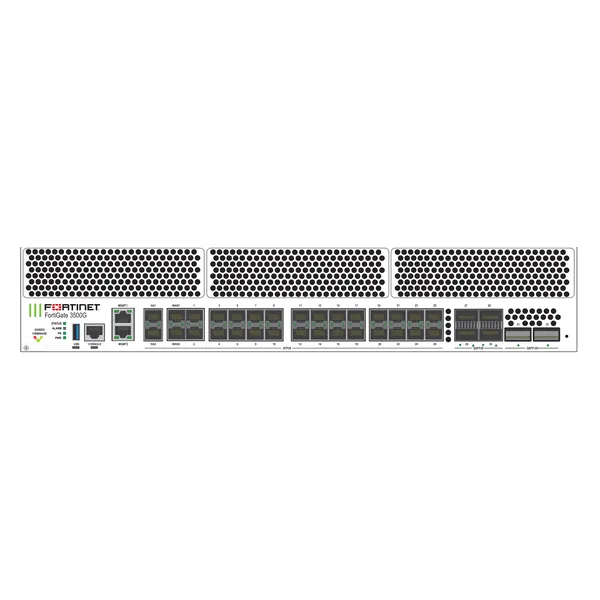
FortiGate 3500G Uganda
A 2 RU high-end Fortinet next-generation firewall built for data-center and large-enterprise security where dense 400GE, 100GE and 25GE connectivity must be matched by high inspection performance.
The 3500G is aimed at infrastructure teams that need to consolidate perimeter security, segmentation, encrypted-traffic inspection, VPN and secure networking on a platform designed for very large session counts and sustained enterprise traffic. FourTeck can help Uganda buyers translate those headline capabilities into the correct interface, optics, high-availability, subscription and support configuration for a real project.
Where the FortiGate 3500G fits in an enterprise network
The FortiGate 3500G is a high-end Fortinet next-generation firewall for organizations whose internet edge, data-center perimeter, private cloud, inter-zone segmentation or large campus security requirement has moved beyond the capacity of mid-range appliances. Fortinet introduced the 3500G as part of the G-series expansion for modern enterprise edges and data centers, with purpose-built security processing and FortiOS combining networking and security functions in one platform.
The important buying point is not simply that the appliance has a very high raw firewall figure. Enterprise firewall design usually becomes constrained by the traffic that must be inspected with intrusion prevention, application control, malware protection and TLS/SSL decryption enabled. Fortinet lists 125 Gbps IPS throughput, 115 Gbps NGFW throughput, 105 Gbps threat protection throughput and 112 Gbps SSL inspection throughput for the 3500G in its current product matrix. Those are more useful planning markers for a security-heavy environment than the maximum 595 Gbps firewall figure alone.
Connectivity is another defining factor. The chassis provides two 400GE QSFP-DD slots, four 100GE QSFP28 ports and thirty 25GE SFP28 slots, with two of the 25GE ports designated for high availability. Two 10GE RJ45 management interfaces support administrative access. This port mix suits data-center designs where the firewall must sit between high-capacity core, aggregation, WAN, internet or security zones without depending on a large number of external conversion devices.
The 3500G also supports large operational scale. Fortinet lists 4,096 FortiAPs total with up to 2,048 in tunnel mode, up to 300 FortiSwitches, 20,000 FortiTokens and 10 default / 500 maximum virtual domains. Those limits should not be interpreted as automatic design recommendations; they show that the platform can participate in large Fortinet Security Fabric environments when architecture, management and licensing are planned accordingly.
For Uganda buyers, FourTeck can help map the appliance to the actual project: ISP and upstream speeds, internal east-west traffic, encrypted application mix, segmentation zones, VPN demand, high-availability requirements, optics, rack power and FortiGuard service term. That configuration work matters because a correctly selected high-end firewall is a long-lived infrastructure decision, while an oversized or poorly licensed platform can tie up budget without solving the intended security problem.
Business outcomes that justify a high-end firewall platform
Preserve security headroom as traffic grows
The gap between raw forwarding and fully inspected traffic is why high-end sizing should start from NGFW and threat-protection requirements. With published threat protection of up to 105 Gbps, the platform gives large organizations more room to keep security services enabled as WAN, cloud and data-center traffic expands.
Connect high-speed infrastructure without an interface bottleneck
Two 400GE, four 100GE and thirty 25GE interfaces allow a design team to connect modern data-center fabrics, carrier circuits and aggregation layers at native high speeds. The business value is architectural flexibility: the firewall can be placed where security policy is needed rather than where legacy port speeds force it to sit.
Reduce the penalty of encrypted-traffic inspection
Modern business traffic is heavily encrypted. Fortinet publishes 112 Gbps SSL inspection throughput for the 3500G under its stated test conditions. This gives security architects a stronger basis for applying inspection to important application classes while preserving capacity for ordinary traffic and growth.
Support large-scale segmentation and administrative separation
Virtual Domains let one physical FortiGate be divided into separate logical environments. Fortinet lists 10 VDOMs by default and up to 500 maximum for this model. That can support multi-tenant, departmental, regulated-zone or service-provider-style separation where design and licensing support the intended topology.
Build resilience into the security edge
The platform includes dual power supplies and dedicated high-availability ports in its high-speed interface set. A properly designed HA deployment can reduce dependence on a single firewall chassis, but redundancy still requires duplicate licensing, compatible optics, power paths and an agreed failover architecture.
Unify networking and security operations in FortiOS
Organizations already standardized on FortiGate can retain a familiar policy and management model while moving into a much higher performance tier. FortiManager and FortiAnalyzer can be introduced where centralized policy, change control, visibility, analytics and logging requirements justify them.
High-end security becomes useful when performance, ports and policy scale align
The distinguishing characteristic of this appliance is the combination of high inspected throughput with a port layout built for modern data-center links. It is not merely a faster branch firewall. The 3500G is designed for environments where security must sit directly in front of substantial bandwidth, encrypted applications and large session volumes while remaining manageable through the Fortinet platform.
FortiGate 3500G specification ledger
| Area | Confirmed value | Buyer interpretation |
|---|---|---|
| Product type | High-end next-generation firewall | For data center and large enterprise edge deployments. |
| Firewall throughput | 595 / 590 / 420 Gbps (1518 / 512 / 64-byte UDP) | Raw forwarding benchmark; inspection services reduce effective design capacity. |
| IPsec VPN throughput | 163 Gbps | Useful for large encrypted site-to-site and backbone VPN designs. |
| IPS throughput | 125 Gbps | Important sizing metric where intrusion prevention is broadly applied. |
| NGFW throughput | 115 Gbps | Reflects firewall with IPS and application control under Fortinet test conditions. |
| Threat protection | 105 Gbps | A strong planning figure when malware protection and core security services are enabled. |
| SSL inspection | 112 Gbps | Relevant to encrypted application inspection; actual traffic mix matters. |
| Application control | 197 Gbps | Provides substantial capacity for application-aware policy enforcement. |
| High-speed ports | 2× 400GE QSFP-DD, 4× 100GE QSFP28, 30× 25GE SFP28 | Confirm transceivers, cabling and peer-device compatibility before ordering. |
| Management ports | 2× 10GE RJ45 | Separates administrative connectivity from production traffic. |
| Virtual domains | 10 default / 500 maximum | Supports logical separation where licensing and design permit. |
| FortiAP scale | 4,096 total / 2,048 tunnel | Potential fit for large Fortinet-managed wireless estates. |
| FortiSwitch scale | Up to 300 | Useful in large Security Fabric deployments. |
| FortiTokens | Up to 20,000 | Supports large authentication deployments where appropriate. |
| Local storage | 3500G: no storage listed; 3501G: 2× 1.92 TB | Choose variant based on local logging/storage requirement. |
| Power supplies | Dual power supplies | Plan redundant feeds and UPS capacity for resilient deployment. |
| Form factor | 2 RU | Confirm rack space, airflow and service clearance. |
| Operating system | FortiOS | Security, networking and policy management depend on FortiOS version and licensed services. |
The three specification groups that most strongly affect purchase decisions are inspected throughput, interface design and service licensing. First, determine the real traffic that will pass through IPS, application control, malware protection and SSL inspection. A deployment with 80 Gbps of heavily encrypted business traffic is a very different sizing problem from one that forwards 80 Gbps with minimal inspection. Second, map every intended 400GE, 100GE and 25GE connection to exact optics, fiber type, distance and peer interfaces. The appliance port count is only one part of the bill of materials. Third, identify which FortiGuard services and FortiCare support term must remain active for the security outcomes expected by the organization. High-end firewall projects should normally be quoted as a complete architecture rather than appliance hardware in isolation.
Buyers should also decide whether the standard 3500G or storage-equipped 3501G better matches logging and local storage requirements. Centralized logging to FortiAnalyzer may change that decision. FourTeck can review these variables before quotation so the project specification reflects the real traffic path and operational model rather than only headline performance numbers.
Five questions to answer before requesting a quote
01 What traffic must the firewall inspect?
List current internet, private WAN, data-center and inter-zone throughput, then separate traffic that needs basic stateful firewalling from traffic that requires IPS, application control, malware inspection or TLS decryption. This determines whether 105 Gbps threat protection and 112 Gbps SSL inspection provide the right headroom for your expected peak load.
02 How large is the session and VPN requirement?
Large data-center workloads can create millions of short-lived connections even when average bandwidth seems moderate. Document peak concurrent sessions, new sessions per second, site-to-site VPN demand and remote-access expectations. Session behavior can be as important as gigabits per second when sizing a platform for busy application environments.
03 Which interfaces and optics are required?
Create a port map showing every 400GE, 100GE, 25GE and management connection. Include fiber type, reach, connector, transceiver standard and peer-device model. This prevents a high-value firewall from arriving without the optics or cabling needed to integrate it into the intended core, WAN or data-center fabric.
04 What growth, HA and licensing plan applies?
Decide whether the design needs one appliance or a high-availability pair, how much three-to-five-year traffic growth should be reserved, which FortiGuard security bundle is required, and how long FortiCare support should run. These choices can materially change the project cost and operational resilience.
05 What installation and support outcome is expected?
Clarify whether FourTeck is being asked for hardware supply only, configuration planning, migration guidance, policy review, rollout coordination, licensing support or ongoing assistance. Also confirm rack space, power feeds, UPS capacity, maintenance window, delivery location and project quantity.
Where this platform can make operational sense
Data-center internet edge
A large enterprise or service environment with multiple high-capacity upstreams may need firewalling, intrusion prevention, application control and encrypted-traffic inspection at aggregate rates well beyond typical campus appliances. The 3500G fits when the firewall must connect directly to 100GE or 400GE infrastructure while keeping enough inspected-throughput headroom for peak traffic. The project should still model real TLS traffic, DDoS strategy, upstream routing and HA rather than relying only on a single firewall benchmark.
Internal data-center segmentation
Organizations separating production, development, regulated, partner and management zones can use a high-performance NGFW to apply policy to east-west flows. This is especially relevant when segmentation traffic is large enough that lower-speed security devices would create a bottleneck. The important configuration note is interface topology: determine whether the design is routed, transparent, virtual-domain based or part of a broader fabric, then confirm ports and optics accordingly.
Large enterprise campus core edge
A major campus with thousands of users, large wireless estates, multiple WAN paths and significant cloud consumption may need more capacity than a conventional mid-range firewall provides. The Fortinet product matrix also lists support for large FortiAP and FortiSwitch counts, which can align with a broader Fortinet architecture. Management design becomes important at this scale, so FortiManager and FortiAnalyzer should be considered where centralized configuration and visibility are operational requirements.
Hybrid infrastructure and cloud connectivity
Enterprises moving large datasets between on-premises data centers, private cloud, public cloud and regional sites may require high-capacity IPsec, application visibility and policy enforcement without forcing every path through a low-speed security choke point. Fortinet publishes 163 Gbps IPsec VPN throughput for the 3500G. Real designs should factor encryption settings, tunnel count, routing, redundancy and cloud-side limits before translating that figure into expected production performance.
Deep dive one: inspected throughput and encrypted traffic
The central question in a modern firewall project is not how quickly the appliance forwards packets with minimal services enabled. It is how much traffic the platform can process while applying the controls your security policy actually requires. That distinction becomes especially important in a data center where the majority of web, cloud and application traffic is encrypted.
Fortinet publishes separate metrics for the 3500G: 125 Gbps IPS throughput, 115 Gbps NGFW throughput, 105 Gbps threat protection throughput and 112 Gbps SSL inspection throughput. Each benchmark represents a different test profile. The practical interpretation is that the buyer should build a traffic model showing which portions of the network need application awareness, IPS, malware protection and TLS inspection, rather than treating 595 Gbps firewall throughput as a universal production figure.
TLS inspection also has operational implications beyond performance. Organizations must decide where decryption is appropriate, how certificates are deployed, which privacy or regulatory exceptions apply, and how applications that use certificate pinning or unusual protocols will be handled. A high SSL-inspection benchmark gives capacity headroom, but policy design determines whether that capability improves security without disrupting business applications.
FourTeck can help translate the traffic model into a sizing discussion: peak versus average throughput, encrypted percentage, security-profile coverage, session churn and projected growth. This is one of the most important checks before choosing a 3500G rather than a smaller or larger FortiGate.
Deep dive two: high-speed interface architecture
At this tier, interface planning becomes part of the security architecture. The 3500G includes two 400GE QSFP-DD slots, four 100GE QSFP28 ports and thirty 25GE SFP28 slots, with two 25GE ports identified for high availability. This allows a designer to connect the firewall directly into modern core, spine-leaf, carrier and data-center environments without stepping every connection down to older speeds.
The port count does not remove the need for detailed compatibility work. QSFP-DD, QSFP28 and SFP28 are physical form factors and link technologies that still require the correct transceiver type, optical reach, fiber grade, breakout support and peer-side capability. For example, a design may need short-range multimode optics inside a data center and different optics for a carrier handoff. Those choices should be included in the bill of materials rather than treated as an installation afterthought.
Two QSFP-DD slots for very high-bandwidth links.
Four QSFP28 ports for core, WAN or fabric connectivity.
Thirty SFP28 slots for multiple high-speed security zones and HA connectivity.
Deep dive three: FortiOS, segmentation and operational control
High performance matters only if administrators can turn it into consistent policy. The 3500G runs FortiOS, the same operating environment that underpins Fortinet’s Secure Networking approach. That gives teams a common platform for firewall policy, routing, VPN, application control, intrusion prevention, segmentation and integration with other Fortinet components.
For very large environments, virtual domains can be particularly useful. Fortinet lists 10 VDOMs by default and up to 500 maximum for this model. VDOMs can separate departments, customers, security zones or operational teams on one appliance while preserving independent policy contexts. The design should still account for licensing, resource allocation, change-control ownership and the blast radius of shared hardware.
Central management and logging also deserve planning attention. A high-end firewall can generate substantial logs and security events. FortiManager may be appropriate for centralized policy and device administration, while FortiAnalyzer can support consolidated logging, reporting and analytics. The standard 3500G does not list the onboard storage included with the 3501G variant, so buyers should decide whether centralized logging makes local storage less important or whether the storage variant provides operational value.
Buyer decision checklist
- Will the appliance be managed locally, through FortiManager, or through another approved workflow?
- How many administrative or tenant boundaries require VDOM separation?
- Where will logs be retained, and for how long?
- Which FortiGuard services must be licensed for the intended controls?
- How will software upgrades, backups and policy changes be governed?
What buyers should check before purchase
| Risk | What to confirm | Why it matters | Share with FourTeck |
|---|---|---|---|
| Wrong performance tier | Peak inspected traffic and growth | Raw firewall throughput can overstate usable security capacity. | WAN speeds, TLS percentage, security profiles |
| Interface mismatch | Exact 400GE/100GE/25GE optics and peers | Incorrect transceivers can block deployment. | Switch/router models, fiber type, distances |
| Incomplete subscription scope | FortiCare and FortiGuard bundle/term | Security services and support expectations depend on the selected entitlement. | Required services, 1/3/5-year preference |
| HA under-scoped | Two-chassis design, power, optics and licenses | Redundancy requires more than a second box. | Failover goal, rack and power topology |
| Logging plan omitted | 3500G vs 3501G and FortiAnalyzer | Retention and analytics can influence model choice. | Retention period and analytics requirement |
| Rack/power conflict | 2 RU space, power feeds, UPS, airflow | High-end appliances need proper data-room preparation. | Rack plan and facilities information |
These checks are especially important for a newly introduced enterprise platform because different bundle SKUs may combine hardware with FortiCare and FortiGuard services for different terms. Procurement teams should insist that every quoted line item clearly distinguishes appliance hardware, security service bundle, support term, transceivers, accessories and implementation scope. That makes competing internal project options easier to evaluate and reduces the chance that a low initial quote omits a service required for the intended security design.
Enterprise procurement support for Uganda deployments
FortiGate 3500G availability can vary by distributor allocation, service bundle, optics, project quantity and delivery timing. FourTeck can prepare a current Uganda quotation after reviewing the required hardware configuration, subscription term, accessories and deployment scope. For Kampala-based data centers, corporate offices and technology projects elsewhere in Uganda, the practical first step is a configuration review rather than an assumption about immediate inventory.
FourTeck can also help buyers structure the bill of materials for an HA pair, confirm whether the storage-equipped 3501G variant is relevant, identify required transceivers, align FortiCare and FortiGuard terms, and coordinate delivery planning. Warranty guidance can be provided according to the manufacturer and supply-channel terms attached to the final quotation. For multi-unit, phased or project-based requirements, share the target installation schedule early so sourcing and licensing can be planned together.
One procurement process across key Uganda locations
FourTeck can coordinate quotation and supply planning for organizations in Kampala as well as projects serving Entebbe, Jinja, Mbarara and Gulu. High-end firewall deployments are usually specified centrally, so a multi-site organization can use one technical bill of materials, licensing plan and deployment standard while adjusting local optics, circuit speeds, rack conditions or rollout dates by location. Availability and delivery arrangements should be confirmed for each project rather than assumed in advance.
Regional planning for East Africa and cross-border projects
Organizations with networks extending beyond Uganda may need one firewall standard across several countries. FourTeck can support quotation coordination for Uganda, Kenya and selected East Africa or Africa markets, subject to the actual sourcing and delivery requirements of the project. Regional procurement can be useful when a security team wants aligned FortiGate models, license terms, optics and documentation across multiple sites.
For organizations that also buy technology through Gulf operations, FourTeck’s regional web properties for the UAE and Kuwait can be used as additional contact points. Cross-border supply, warranty handling, taxes, import conditions and lead times vary by destination and should be confirmed in the quotation for each location rather than treated as identical across markets.
Useful FourTeck paths for Fortinet firewall buyers
Practical assistance around a complex firewall purchase
FortiGate 3500G buyer questions
01. What is the FortiGate 3500G mainly designed for?
It is a high-end next-generation firewall for data-center and large-enterprise security. Its combination of 400GE, 100GE and 25GE connectivity with high IPS, NGFW, threat-protection and SSL-inspection performance makes it suitable where a firewall must protect very large traffic flows. Smaller branch or SME environments normally do not need this performance tier.
02. What throughput figure should I use for sizing?
Use the metric that resembles your security policy, not only the raw firewall number. Fortinet lists 595 Gbps firewall throughput, 125 Gbps IPS, 115 Gbps NGFW, 105 Gbps threat protection and 112 Gbps SSL inspection. FourTeck recommends sizing from the inspected traffic mix, encrypted-traffic share, session behavior and future growth headroom.
03. Which high-speed interfaces are built into the 3500G?
The published interface set includes two 400GE QSFP-DD slots, four 100GE QSFP28 ports and thirty 25GE SFP28 slots, plus two 10GE RJ45 management ports. The project still needs the correct optics and cabling for each connection. Confirm transceiver type, fiber, reach and peer-device compatibility before the bill of materials is finalized.
04. Does it support high availability?
The hardware includes dedicated high-availability connectivity within the 25GE interface set and dual power supplies, making it suitable for resilient designs. A complete HA project normally requires two appropriately licensed appliances, redundant power paths, matching optics, peer connectivity and a tested failover plan. FourTeck can help list these elements for quotation.
05. What is the difference between 3500G and 3501G?
The key published difference is local storage. Fortinet’s product matrix lists the 3501G with two 1.92 TB drives, while the 3500G does not list local storage. Choose between them according to the logging and local-storage design, especially if FortiAnalyzer or another centralized logging platform will already be used.
06. Are FortiGuard services included with the hardware?
Fortinet sells multiple hardware-plus-service bundle SKUs with different FortiGuard and FortiCare combinations and terms. Do not assume a specific security subscription is included with every hardware quote. Ask for the exact bundle name, service level and contract duration so the appliance has the entitlements required by the intended security policy.
07. Can it be used for large IPsec VPN deployments?
Yes. Fortinet publishes up to 163 Gbps IPsec VPN throughput for the 3500G. Production performance depends on encryption settings, tunnel design, routing, packet sizes, peer capabilities and traffic mix. Large VPN projects should document expected tunnel count, aggregate bandwidth, redundancy and whether traffic will also receive other security inspection.
08. Is FortiManager or FortiAnalyzer required?
They are not simply physical prerequisites for the appliance, but they can be valuable in large environments. FortiManager supports centralized policy and device management, while FortiAnalyzer supports centralized logging and analysis. Whether they belong in the project depends on the number of Fortinet devices, change-control model, reporting needs and log-retention requirements.
09. How can I request FortiGate 3500G pricing in Uganda?
Contact FourTeck Uganda with your required quantity, appliance or HA design, subscription term, FortiGuard bundle preference, optics, delivery location and project timeline. Pricing can vary by bundle and sourcing conditions, so a current configuration-based quotation is more useful than a generic hardware-only figure.
10. What should I send before asking for a final quote?
Send current and projected WAN speeds, estimated inspected traffic, TLS percentage, security services to be enabled, interface speeds, optics, number of zones, VPN requirements, HA need, preferred support term, logging plan, rack/power information, deployment city and expected purchase schedule. That information lets FourTeck prepare a more accurate bill of materials.
Build the FortiGate 3500G quote around your real traffic and interface plan
For a high-end firewall project, share the details that materially affect configuration: inspected bandwidth, encrypted traffic, port map, optics, HA requirement, subscription term, logging design and delivery schedule. FourTeck will use that information to help prepare a practical Uganda quotation and identify any missing accessories or licensing items before purchase.
- Current and future traffic volumes
- 400GE, 100GE and 25GE port requirements
- FortiGuard and FortiCare term preference
- HA, storage and logging requirements
- Uganda delivery location and project timeline

Reviews
There are no reviews yet.