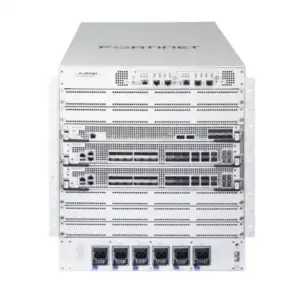
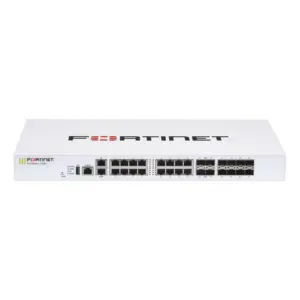
Fortinet FortiGate 3300E in Uganda
A 2RU enterprise NGFW built for high-throughput perimeter security, data-center segmentation, encrypted connectivity and dense multi-speed network interfaces.
The FortiGate 3300E is aimed at large organizations and service providers that need security inspection without reducing a high-capacity network to a low-speed choke point. Its design combines Fortinet security processing hardware, 1G/10G/25G/40G connectivity, high session capacity, IPsec VPN acceleration and high-availability options in one appliance platform.
Fortinet
FortiGate 3300E
High-end NGFW appliance
Configuration dependent
Built for networks where firewall capacity and port density both matter
The FortiGate 3300E is a high-performance next-generation firewall for large enterprise and service-provider environments. Fortinet positions the 3300E series for the enterprise edge, hybrid data-center core and internal network segmentation. That makes it relevant where an organization is not simply filtering a modest internet circuit but is inspecting large amounts of traffic between important network zones, protecting high-speed north-south flows, or terminating many encrypted VPN connections.
A major reason to consider this model is the combination of security performance and interface flexibility. The appliance provides four 40GbE QSFP+ slots, fourteen 25GbE SFP28/10GbE SFP+ data interfaces, two additional 25/10GbE SFP28/SFP+ HA interfaces, four 10GbE RJ45 ports, twelve Gigabit Ethernet RJ45 ports and two Gigabit management/HA interfaces. This range can simplify designs where the firewall must connect simultaneously to high-speed core switching, internet routers, management networks and lower-speed service segments.
Performance should be evaluated using the metric that matches the planned security policy rather than the largest headline number. Fortinet publishes up to 160 Gbps stateful firewall throughput, but the figures for IPS, NGFW, threat protection and SSL inspection are lower because these services perform deeper inspection. For an enterprise buyer, the correct sizing exercise therefore starts with expected inspected traffic, application mix, encrypted traffic ratio, session count, VPN requirements and growth margin.
The platform also supports active-active, active-passive and clustering high-availability configurations. This is important for environments where perimeter or segmentation failure would interrupt business systems. Redundant hot-swappable power supplies are included by design, but high availability at the firewall layer still requires a second compatible appliance and an architecture that also accounts for upstream and downstream resilience.
Uganda organizations evaluating this appliance should also review FortiGuard security services and FortiCare support terms. The hardware can provide firewalling and network functions, while advanced security services and ongoing protection capabilities depend on the selected subscription and support package. FourTeck can help translate the business requirement into a hardware, subscription, optics and accessory list suitable for quotation.
Business outcomes from a correctly sized 3300E deployment
Protect high-capacity network paths without immediately redesigning the core
The appliance combines up to 160 Gbps firewall throughput with high-speed 40GbE and 25GbE connectivity. That gives architects room to place security controls at major network boundaries while preserving a multi-gigabit physical topology. The practical value is less pressure to compromise between network speed and inspection architecture, provided deeper security throughput is sized correctly.
Scale encrypted site connectivity
Fortinet specifies up to 98 Gbps IPsec VPN throughput and support for large numbers of gateway-to-gateway and client-to-gateway IPsec tunnels. For enterprises linking data centers, headquarters, large branches or cloud networks, this creates a strong platform for encrypted connectivity without requiring a separate VPN concentrator for every use case.
Segment important systems at enterprise scale
Support for high session counts, many firewall policies and multiple virtual domains helps organizations separate departments, tenants, environments or security zones. Segmentation is useful for limiting lateral movement and applying different controls to workloads with different risk levels.
Consolidate networking and security functions
FortiOS provides firewalling, application control, routing, VPN, SD-WAN and policy management within one operating environment. Consolidation can reduce operational fragmentation, especially for teams already using other Fortinet products, though each organization should validate feature licensing and integration requirements.
Design for resilience
Dual hot-swappable power supplies and supported HA modes allow the firewall layer to be incorporated into a resilient network design. The operational benefit is reduced dependence on a single appliance, provided redundant switching, routing, cabling and power are designed around it.
Support complex physical connectivity
The mix of copper, SFP28/SFP+ and QSFP+ interfaces can reduce the number of media converters and intermediate devices required in complex deployments. The benefit depends on choosing the right transceivers, cables and interface speeds, making pre-purchase port mapping essential.
A firewall platform defined by high interface density, accelerated inspection and enterprise-scale sessions
What distinguishes this platform is not one isolated throughput number. It is the way Fortinet combines a large number of physical interfaces with hardware-accelerated packet processing, security inspection, VPN capacity and segmentation features in a fixed 2RU appliance. That combination is particularly relevant to architects who need to insert security controls into a large network without introducing a chassis system.
FortiGate 3300E specification ledger
| Specification | Published value / guidance |
|---|---|
| Firewall throughput | Up to 160 / 158 / 100 Gbps for 1518 / 512 / 64-byte UDP packets |
| IPS throughput | 27 Gbps |
| NGFW throughput | 23 Gbps |
| Threat protection throughput | 17 Gbps |
| SSL inspection throughput | 21 Gbps average HTTPS with IPS |
| IPsec VPN throughput | 98 Gbps, AES256-SHA256 test basis |
| SSL-VPN throughput | 10 Gbps |
| Concurrent TCP sessions | 50 million |
| New TCP sessions per second | 700,000 |
| Firewall policies | 200,000 |
| Virtual domains | 10 default / up to 500 maximum |
| 40GbE | 4 x QSFP+ slots |
| 25/10GbE data interfaces | 14 x SFP28/SFP+ |
| 25/10GbE HA interfaces | 2 x SFP28/SFP+ |
| 10GbE copper | 4 x RJ45 |
| Gigabit copper | 12 x GE RJ45 plus 2 x GE management/HA |
| Included transceivers | 2 x SFP+ SR 10GbE |
| High availability | Active-active, active-passive and clustering |
| Form factor | 2RU rack mount |
| Dimensions | 88.9 x 443 x 556 mm |
| Weight | 19.5 kg |
| Power | 100–240V AC; dual hot-swappable AC PSUs for 1+1 redundancy |
| Power consumption | 492 W average / 610 W maximum |
| Operating temperature | 0°C to 40°C |
| Internal storage | None on FG-3300E; FG-3301E variant has 2 x 1 TB SSD |
For purchasing, the most important numbers are usually not the absolute firewall maximum but the inspected-traffic values. An organization using IPS, application control, malware protection and SSL inspection simultaneously should size around the relevant threat-protection and SSL-inspection figures, while allowing margin for traffic growth. Session scale also matters in environments with large user populations, NAT, internet-facing services or many east-west application flows.
Interface planning is equally important. The appliance has unusually dense 25GbE and 40GbE connectivity for a fixed platform, but its 10/25GbE ports operate in hardware speed groups. If a design mixes 10GbE and 25GbE optics, the grouping rules should be reviewed in advance so one speed change does not unexpectedly affect adjacent ports. Power, rack depth, airflow and redundant power feeds should also be included in the site-readiness check.
Five questions that should be answered before a quote is finalized
01 — What traffic must be inspected?
Define internet bandwidth, inter-zone traffic, data-center flows and the proportion of encrypted traffic. A design that needs only stateful firewalling can support a very different load from one using IPS, application control, malware protection and deep SSL inspection. This question determines whether the 3300E has appropriate headroom and which published throughput metric should guide sizing.
02 — What session and VPN scale is expected?
Provide current and forecast concurrent sessions, new connections per second, remote-access users, site-to-site VPN tunnels and cloud connectivity. High-bandwidth VPN and high session counts can be a primary reason to choose a platform in this class, but over-sizing without real requirements increases acquisition and subscription cost.
03 — Which interfaces must connect to existing systems?
List core switches, routers, ISP handoffs, HA links, server fabrics and management networks. Include desired interface speed, media type and transceiver standard. This is especially important because the 25/10GbE interfaces have grouped speed behavior. Correct port mapping prevents procurement of incompatible optics and avoids redesign during installation.
04 — Which subscriptions and growth path are required?
Clarify whether the requirement includes IPS, web filtering, malware protection, application control, sandboxing, support services or other FortiGuard capabilities, and specify the preferred subscription term. Also consider whether the organization expects additional sites, VLANs, virtual domains, user growth or traffic increases during that term.
05 — What are the installation, resilience and support expectations?
Confirm whether the deployment will use a single appliance or HA pair, how power redundancy will be provided, what rack space is available, which support response level is required and whether implementation services are needed. Commercial planning should also include project quantity and expected delivery location in Uganda.
Where this platform can make practical sense
Large enterprise internet edge
An organization with multiple high-speed ISP links may need one security layer to apply firewall policy, application visibility, IPS and encrypted traffic inspection. The 3300E provides substantial throughput and high-speed interfaces, but the final design should be based on inspected traffic rather than internet circuit speed alone. HA is commonly worth evaluating where the internet edge supports critical applications.
Hybrid data-center segmentation
Data centers increasingly need controls between application tiers, environments or trust zones rather than only at the perimeter. The 3300E can support a large policy set, high session count and multiple virtual domains, making it suitable for separating infrastructure at scale. The design team should quantify east-west traffic because internal segmentation can create throughput requirements much larger than the public internet circuit.
Large VPN aggregation
Enterprises linking many branches, remote users or cloud networks can use the appliance as an IPsec aggregation point. Fortinet publishes 98 Gbps IPsec throughput and high tunnel counts. Buyers should still model encryption settings, tunnel design, routing, redundancy and authentication architecture to ensure the system aligns with the actual remote-access strategy.
Service-provider or multi-domain security
The ability to support many virtual domains and high session volumes can suit managed environments where logical separation between business units or tenants is required. This use case demands careful operational design around management rights, logging, policy ownership, subscription scope and change control rather than simply dividing one appliance into many logical instances.
Security throughput is the sizing number that protects the project from disappointment
Firewall vendors publish several performance metrics because different security functions create different processing loads. The FortiGate 3300E illustrates why buyers should distinguish these measurements. The platform can forward stateful firewall traffic at up to 160 Gbps, yet Fortinet publishes 27 Gbps IPS throughput, 23 Gbps NGFW throughput, 17 Gbps threat-protection throughput and 21 Gbps SSL inspection throughput. These are not contradictory numbers; they describe different feature combinations and test conditions.
If a buyer chooses the appliance only because the stateful firewall number is larger than the internet circuit, the design may miss the real requirement. An enterprise security policy may decrypt HTTPS, inspect applications, run intrusion prevention, scan for malware and log sessions. The traffic volume that matters is therefore the volume passing through the enabled security stack. A good sizing worksheet estimates present load, peak load and expected growth, then maps those figures to the appropriate Fortinet metric.
This is particularly important as encrypted traffic becomes a larger share of business communications. SSL inspection can expose threats hidden inside encrypted sessions, but decryption and inspection require processing capacity and can create certificate, privacy and application-compatibility considerations. Organizations should decide which traffic categories will be inspected, which will be bypassed for policy reasons, and how exceptions will be governed.
For large deployments, session rates are another layer of sizing. Fortinet specifies 50 million concurrent TCP sessions and 700,000 new TCP sessions per second. Those figures can matter for public services, large user communities and data-center applications that create many short-lived connections. The result should be a capacity plan based on real traffic characteristics, not a single headline metric.
Multi-speed interfaces provide flexibility, but port grouping changes how they should be engineered
The appliance has four 40GbE QSFP+ slots, fourteen 25/10GbE SFP28/SFP+ data ports, two additional 25/10GbE HA ports, four 10GbE copper interfaces and multiple Gigabit copper ports. This is a broad physical connectivity range for a fixed 2RU firewall and makes the platform useful where the same security device must connect to core switching, upstream routing, dedicated HA links and management segments.
However, Fortinet hardware documentation notes that interfaces 17–30 plus HA1 and HA2 are arranged into groups. Interfaces in a group operate at the same speed, so changing one port from 25Gbps to 10Gbps changes the other ports in that group. This detail can affect a project that assumes every SFP28/SFP+ slot can be set independently. The safest approach is to produce an interface matrix before optics are purchased.
Four 40GbE QSFP+ slots support high-capacity core or aggregation links.
Sixteen 25/10GbE SFP28/SFP+ interfaces include fourteen data interfaces and two HA interfaces.
Copper 10GbE and Gigabit interfaces provide options for routing, services and management networks.
High availability is a design decision, not a checkbox
The 3300E supports active-passive, active-active and clustering configurations, while the chassis includes dual hot-swappable AC power supplies for 1+1 power redundancy. These capabilities make the platform suitable for resilient security architectures, but they do not automatically remove every single point of failure. A production HA design normally considers two appliances, redundant power sources, appropriate heartbeat/HA links, resilient upstream routing, redundant downstream switching and a maintenance process that allows one node to be upgraded or serviced without unexpected loss of connectivity.
Organizations should also distinguish between device redundancy and service continuity. A firewall pair may remain available while an ISP circuit, switch, authentication platform or power feed fails. Procurement should therefore reflect the whole path, not only the firewall appliance. For data-center or mission-critical edge deployments, mapping dependencies before ordering can prevent an HA investment that still leaves critical infrastructure exposed to another single failure point.
Buyer decision checklist
- Will the deployment use one appliance or a matched HA pair?
- Are dedicated HA interfaces and compatible optics included in the port plan?
- Are both power supplies connected to independent power paths where available?
- Can upstream and downstream devices provide redundant links?
- Is the required FortiCare support level defined?
- Does the maintenance plan include firmware upgrades, failover tests and configuration backup?
What buyers should check before purchase
| Risk | What to confirm | Why it matters | What to share with FourTeck |
|---|---|---|---|
| Wrong performance metric | Inspected throughput and encrypted traffic | Deep inspection performance is lower than stateful firewall throughput | Circuit speeds, peak traffic, security services |
| Interface mismatch | 10/25/40GbE media and grouped speeds | Incorrect optics or grouping can disrupt the port plan | Port map, transceiver type, switch/router models |
| Incomplete subscription | FortiGuard and FortiCare scope and term | Advanced security capabilities and support depend on selected services | Required features, term, support response expectation |
| Deployment readiness | Rack, power, HA and implementation plan | The appliance is 2RU, approximately 19.5 kg and requires appropriate cooling and power planning | Rack details, power feeds, HA requirement, site location |
One additional risk is model lifecycle and replacement planning. The 3300E is an E-series platform, and buyers making a new long-term investment should ask whether this exact model, a later FortiGate generation or another capacity tier best fits the project horizon. FourTeck can review the requirement and prepare alternative paths when appropriate rather than treating the appliance name as the only decision.
Planning FortiGate 3300E procurement in Uganda
Availability can vary by appliance status, subscription term, optics and project quantity. FourTeck can assist Uganda buyers with configuration review, quotation, compatible accessory planning, delivery coordination and guidance on the support package being proposed. For a high-capacity firewall, a complete quote should identify the exact appliance, FortiGuard bundle, FortiCare term, required transceivers, HA quantity and any additional implementation-related items.
For organizations in Kampala, the commercial process should start with a technical requirement rather than a hardware-only request. That makes it easier to verify that throughput, subscriptions, interfaces and resilience match the intended deployment. FourTeck can also support project and quantity planning where multiple security appliances, spares, optics or related network products are required.
Uganda location coverage
FourTeck can coordinate product enquiries and project discussions for customers in Kampala, Entebbe, Jinja, Mbarara and Gulu as part of a single Uganda procurement process. Exact delivery arrangements, lead times and product availability should be confirmed at quotation stage because they can vary with configuration and supply conditions.
East Africa and regional availability
Organizations operating across several markets can use FourTeck regional channels to discuss standardized Fortinet requirements for Uganda, Kenya and selected East Africa or Africa projects. Regional enquiries can also be coordinated through FourTeck Kenya, FourTeck Africa, FourTeck UAE and FourTeck Kuwait when those markets are relevant. Regional supply, support coverage and warranty handling should always be confirmed for the destination and selected support contract rather than assumed from another country.
Related Fortinet paths to consider during sizing
For current Fortinet availability and model matching, visit FourTeck Uganda or send the deployment requirement through the Uganda contact and quotation page.
Practical assistance for a complex firewall purchase
01. Product selection guidance. FourTeck can review whether the requested 3300E aligns with the intended traffic, security inspection and project horizon, and can identify a different capacity tier where the requirement points elsewhere.
02. Configuration review. Firewall hardware is only one part of the bill of materials. Subscription services, support term, transceivers, HA quantity and integration requirements should be checked together.
03. Quote assistance. Business buyers can request a structured commercial proposal that reflects the appliance, licensing term, accessories and project quantity instead of relying on a generic hardware price.
04. Uganda delivery coordination. FourTeck can discuss destination, quantity and procurement timing during quotation. Availability and lead time remain subject to the selected configuration and current supply conditions.
05. Warranty and support guidance. Buyers can clarify the proposed FortiCare support coverage, contract term and handling path before approval so expectations are aligned with the actual commercial package.
06. Alternative model matching. When the named appliance is not the best fit for lifecycle, capacity or commercial reasons, FourTeck can review suitable Fortinet alternatives against the same technical requirement.
FortiGate 3300E purchasing questions
01. What is the FortiGate 3300E designed for?
It is designed for large enterprise and service-provider security deployments that need high firewall performance, deep security inspection, dense high-speed interfaces and high session scale. Fortinet identifies enterprise edge, hybrid data-center core and internal segmentation as key deployment areas. It is generally more appropriate for large networks than for small branch offices.
02. What is the difference between firewall and threat-protection throughput?
Firewall throughput measures stateful forwarding under a defined packet test, while threat-protection throughput reflects a heavier workload with multiple security services enabled. Fortinet lists up to 160 Gbps firewall throughput and 17 Gbps threat-protection throughput for this series. Buyers should size using the metric closest to the features they plan to enable.
03. Does the 3300E support 25GbE and 40GbE?
Yes. The appliance includes four 40GbE QSFP+ slots and fourteen 25GbE SFP28/10GbE SFP+ data interfaces, plus two additional 25/10GbE HA interfaces. Optics are not all interchangeable, and interface-speed grouping should be checked before ordering transceivers or finalizing switch connections.
04. Can the FortiGate 3300E be deployed in high availability?
Yes. Fortinet supports active-passive, active-active and clustering configurations, and the appliance has dual hot-swappable AC power supplies. A resilient design typically requires two compatible firewalls plus redundant network and power paths. The exact HA architecture should be reviewed as part of the deployment plan.
05. Which FortiGuard or FortiCare services should be purchased?
The answer depends on the required security functions, support level and contract term. Advanced capabilities such as intrusion prevention, malware protection, web filtering and related security services are tied to selected FortiGuard offerings, while FortiCare addresses support and service coverage. FourTeck can prepare a quote around the required bundle and duration.
06. Does the FortiGate 3300E include internal storage?
The FG-3300E does not include internal storage in Fortinet’s published specification. The closely related FG-3301E variant includes two 1 TB SSDs. Buyers who require local logging should therefore verify whether the 3301E or a centralized logging platform such as FortiAnalyzer is more appropriate for the design.
07. Is the FortiGate 3300E available in Uganda?
Availability is configuration dependent and should be confirmed when requesting a quote. The appliance, security subscriptions, support term, optics and project quantity can each affect sourcing. FourTeck can review the requested configuration and coordinate a Uganda commercial proposal without assuming ready stock or a fixed delivery date.
08. What information should I provide for a quote?
Provide internet and internal traffic estimates, required security services, expected encrypted traffic, session or VPN scale, interface speeds, transceiver types, HA requirement, support level, subscription term, quantity and delivery location. This allows the proposal to address the complete deployment rather than only the base appliance.
09. Should a new project also consider later FortiGate models?
Yes. For a new long-term deployment, buyers should compare the named appliance with current Fortinet high-end models that may offer different performance, lifecycle and subscription economics. The right choice depends on capacity, interfaces, operational standards and project horizon. FourTeck can help compare the requirement against suitable current alternatives.
Prepare a FortiGate 3300E requirement that can be quoted accurately
Send FourTeck the planned throughput, inspection services, interface map, VPN scale, HA requirement, subscription term, support expectation and delivery destination. This information helps separate essential items from optional components and reduces the chance of missing optics, licensing or resilience requirements.
- Inspected traffic and internet capacity
- Required FortiGuard services and FortiCare term
- 10/25/40GbE optics and switch/router interfaces
- Single appliance or HA pair
- Quantity and Uganda destination