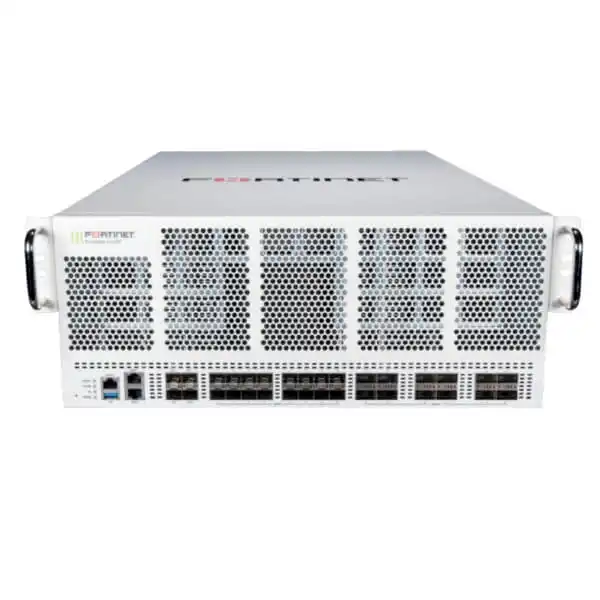
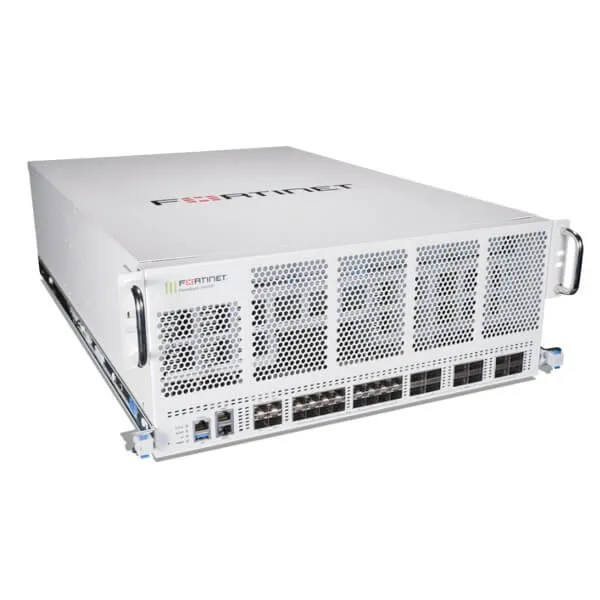
FortiGate 4400F in Uganda
A 4RU Fortinet NGFW built for high-throughput data-center, enterprise-edge, segmentation and service-provider security.
The 4400F combines Fortinet NP7 network processors, CP9 content processing, high port density and FortiOS security services for environments where ordinary branch-firewall capacity is not enough. Selection should be based on inspected traffic, interface speed, VPN scale, subscriptions, redundancy and power design.
Security capacity for networks where inspection cannot become the bottleneck
The FortiGate 4400F sits in Fortinet’s high-end firewall range and is aimed at organizations that need substantial throughput together with next-generation inspection. Its purpose is not simply to pass packets quickly. It is designed to apply firewall policy, intrusion prevention, application control, malware protection, SSL inspection, VPN, segmentation and related FortiOS functions at scales that suit large enterprise edges, data-center cores, internal segmentation boundaries and selected service-provider deployments.
Fortinet’s current data sheet positions the series around Hybrid Mesh Firewall architecture and high-speed security. Hardware acceleration is central to the design. Six NP7 network processors connect data interfaces through an integrated switch fabric, while CP9 content processing helps accelerate inspection-heavy functions. For a buyer, the practical consequence is that the appliance is intended for environments with large numbers of concurrent sessions, high interface speeds and demanding encrypted traffic rather than ordinary small-office perimeter use.
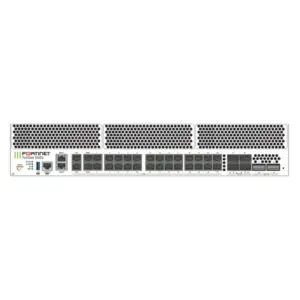
The physical interface mix is also a major reason to consider this model. The 4400F provides twelve hardware-accelerated 100GE QSFP28/40GE QSFP+ slots, sixteen hardware-accelerated 25GE SFP28/10GE SFP+/GE SFP data slots, two corresponding HA slots, two AUX slots and two Gigabit Ethernet RJ45 management ports. That density lets architects connect high-capacity upstream, downstream and segmentation links directly without inserting lower-speed aggregation purely to match the firewall.
However, the appliance must be designed into the network rather than selected from headline figures. Transceiver type, optic distance, link breakout, HA mode, FortiGuard subscriptions, logging architecture, SSL inspection ratios, VPN use, virtual-domain requirements and growth expectations can materially change the recommended configuration. AC and DC variants are available, and the hyperscale feature set requires specific licensing for certain accelerated capabilities.
FourTeck can assist Uganda buyers by turning those design variables into a procurement-ready configuration. A useful quotation request should include current and projected inspected bandwidth, the number and speeds of physical links, high-availability requirements, power preference, subscription term, logging or FortiManager plans and whether the deployment replaces an existing firewall. That preparation reduces the risk of ordering the correct chassis with the wrong supporting licenses or connectivity.
Why the 4400F is considered for demanding security boundaries
01
Security inspection at high traffic volumes
Fortinet specifies up to 94 Gbps IPS, 82 Gbps NGFW and 75 Gbps threat-protection throughput. For organizations consolidating large internet links or internal security zones, this gives planners a high-performance platform while retaining inspection functions that smaller appliances may struggle to sustain at similar traffic levels.
02
Dense 100GbE and 25GbE connectivity
Twelve 100GE/40GE slots and the 25GE/10GE interface set allow the firewall to sit naturally in modern data-center fabrics. This can simplify topology and preserve interface headroom when upstream routers, switches or server fabrics have already moved beyond 10GbE.
03
Hardware-assisted packet and content processing
NP7 and CP9 processors offload key network and inspection workloads from the general CPU. The business value is predictable performance under security functions, especially when the design includes SSL inspection, VPN, segmentation or large session counts.
04
Large session and VPN scale
The base published capacity reaches 210 million concurrent TCP sessions, with higher hyperscale values requiring the relevant license, while gateway-to-gateway IPsec tunnel capacity is listed at 40,000. This makes the platform suitable for architectures that aggregate large populations of connections or encrypted links.
05
Segmentation and hybrid-network control
FortiOS supports dynamic segmentation and VXLAN-related use cases, helping large environments control east-west movement and apply security policy between logical zones without treating the firewall only as an internet-edge device.
06
Operational consolidation
FortiOS brings firewalling, SD-WAN, VPN, ZTNA enforcement and other security functions into one operating framework, while FortiManager can provide centralized administration where multiple Fortinet devices are involved. That can reduce policy fragmentation in large distributed deployments.
Its distinction is the combination of inspection performance, 100GbE port density and FortiOS security in one high-end appliance.
Many firewall comparisons focus on one number, but this platform is better understood as a coordinated system. Raw forwarding, inspected throughput, SSL decryption, VPN, session scale, interface density and licensing all contribute to the design. The following facts are the most useful evidence points for procurement.
IPS: up to 94 Gbps for Fortinet’s enterprise traffic mix. Enables: high-volume intrusion prevention. Note: performance is up to and varies with configuration.
NGFW: up to 82 Gbps with firewall, IPS and application control. Enables: meaningful security sizing beyond raw packet forwarding. Note: actual traffic profile matters.
Threat protection: up to 75 Gbps with firewall, IPS, application control and malware protection. Enables: security-service planning for large links. Note: services and policy mix affect results.
SSL inspection: up to 86 Gbps published with IPS average HTTPS testing. Enables: encrypted-traffic visibility at high scale. Note: certificate, cipher and application mix affect deployment.
Connectivity: twelve 100/40GbE plus high-density 25/10/1GbE SFP-family ports. Enables: direct integration with high-speed fabrics. Note: optics and breakout requirements should be confirmed.
FortiGate 4400F technical specifications
| Specification | Published value / guidance |
|---|---|
| IPS throughput | Up to 94 Gbps |
| NGFW throughput | Up to 82 Gbps |
| Threat protection | Up to 75 Gbps |
| IPv4 firewall throughput | 1.15 / 1.14 / 0.50 Tbps for 1518 / 512 / 64-byte UDP |
| Firewall latency | 2.98 microseconds at 64-byte UDP |
| Packets per second | 750 Mpps |
| Concurrent TCP sessions | 210 million / 700 million with hyperscale license for higher value |
| New TCP sessions/second | 1 million / 10 million with hyperscale license for higher value |
| IPsec VPN throughput | Up to 310 Gbps, Fortinet test basis AES256-SHA256 |
| Gateway IPsec tunnels | 40,000 |
| Client IPsec tunnels | 200,000 |
| SSL-VPN throughput | 16 Gbps |
| SSL inspection | Up to 86 Gbps; 70,000 CPS; 9 million concurrent sessions on published test basis |
| Application control | Up to 140 Gbps |
| 100/40GbE slots | 12 x QSFP28/QSFP+ |
| 25/10/1GbE data slots | 16 x SFP28/SFP+/SFP |
| HA / AUX slots | 2 x HA plus 2 x AUX using 25/10/1GbE SFP-family interfaces |
| Management ports | 2 x GE RJ45, plus USB 3.0 and console |
| Included transceivers | 2 x SFP+ SR 10GE |
| VDOMs | 10 default / 500 maximum |
| HA modes | Active-active, active-passive, clustering |
| Dimensions | 177 x 437 x 665 mm |
| Weight | 37.1 kg for 4400F AC model |
| Form factor | Rack mount, 4RU |
| AC power | 100-240V AC, 50/60 Hz; average 1533W, maximum 1875W |
| Redundant power | Hot-swappable, 2+2 AC; 1+1 DC variant |
| Operating temperature | 0°C to 40°C |
The most important figures for procurement are usually not the highest raw firewall number. An organization that intends to enable IPS, application control, malware protection and TLS inspection should compare its peak and sustained traffic against the corresponding inspected figures, then retain reasonable growth margin. Interface capacity also deserves separate attention: a design with multiple 100GbE uplinks may require specific QSFP28 optics, breakout cables or compatibility checks that are not implied by the appliance itself.
Power and rack planning matter because this is a 4RU, high-power platform. Confirm rack depth, airflow, available circuits, redundant feeds and data-center cooling before delivery. Finally, treat subscription selection as part of functional sizing. FortiGuard service bundles determine which security services are available, while the hyperscale license unlocks specific accelerated CGNAT/session functions. FourTeck can use these details to prepare a quote that reflects the intended production role rather than a bare chassis alone.
Five questions to answer before requesting a quote
01. What traffic will actually be inspected?
Document peak internet, east-west, VPN and inter-zone bandwidth, then state which controls will be enabled. A firewall forwarding 100Gbps of relatively simple traffic is a different design from one decrypting TLS, running IPS and scanning malware on the same volume. This answer determines whether the 4400F has appropriate margin and which published performance line should guide sizing.
02. What session, tunnel and interface scale is required?
Count current concurrent sessions, expected growth, IPsec tunnels, remote-access users and physical links. Include port speeds and fiber types. This decides whether the high-end session capacity and interface density are useful, and it also reveals which optics or DAC cables need to be quoted.
03. How must it integrate with the existing network?
Share core-switch models, routing design, VLAN/VXLAN use, authentication services, logging platform and whether FortiManager or FortiAnalyzer is already present. Compatibility and management integration can influence software planning, interface mode and migration methodology.
04. What growth, licensing and service term is planned?
Specify whether FortiGuard Enterprise Protection, Unified Threat Protection, Advanced Threat Protection or another service combination is expected, together with term length. If hyperscale CGNAT or expanded session capacity is relevant, say so because separate licensing applies to those accelerated features.
05. What are the installation, power and support expectations?
Confirm AC or DC, rack location, redundant power feeds, maintenance window, migration support expectations, project quantity and desired FortiCare level. This influences the bill of materials and the support options attached to the hardware.
QUOTE PREPARATION
Send FourTeck: expected inspected throughput, WAN/core link speeds, optic requirements, HA topology, VPN counts, estimated sessions, security services, subscription term, AC/DC preference, rack constraints, management/logging tools, deployment timing and project quantity.
Deployment scenarios where the platform makes practical sense
Large enterprise internet edge
A bank, telecom, university group, government platform or large commercial enterprise may aggregate multiple high-capacity internet links and require IPS, application control, malware protection and encrypted-traffic inspection. The 4400F fits where inspected throughput and session scale exceed ordinary campus firewall requirements. The key configuration note is to size against real security services and procure the correct 100/25GbE optics.
Data-center segmentation
In a virtualized data center, high-volume traffic often moves between server zones rather than only to the internet. The appliance can provide high-speed segmentation, VXLAN-oriented designs and policy enforcement across internal boundaries. Architects should confirm whether traffic hairpins through the firewall, how many logical zones are required and whether active-active or clustering aligns with the target topology.
Service-provider and carrier security
Fortinet documents mobile-security and CGNAT-oriented use cases for the series, including high-performance IPsec and IPv6 migration functions. A service-provider design may benefit from the NP7 architecture, large session counts and hyperscale options. The configuration note is particularly important: certain accelerated hyperscale capacities require the relevant perpetual license and engineering validation.
Consolidated enterprise perimeter
Organizations replacing several security appliances may prefer one larger NGFW pair with centralized policies, VPN, SD-WAN and security subscriptions. Consolidation can simplify operations, but it also concentrates failure impact. Redundant appliances, power, high availability, logging and change control should therefore be planned as part of the project rather than added later.
NP7 and CP9 acceleration: why architecture matters
Fortinet’s performance approach uses purpose-built Security Processing Units rather than relying only on a general CPU. In the 4400F, six NP7 processors connect to the front-panel data interfaces through an integrated switch fabric. Supported traffic can be offloaded through this architecture, while CP9 content processors accelerate inspection-oriented functions such as pattern matching, SSL decryption, application identification, IPS pre-processing and antivirus processing.
For buyers, this matters because modern firewall workloads are mixed. The device may need to route packets, maintain huge session tables, terminate VPNs, decrypt TLS, identify applications and inspect content at the same time. Hardware acceleration is intended to reduce the performance conflict between those functions. It also helps explain why raw firewall throughput, IPS throughput and threat-protection throughput are different figures: each measurement represents a different workload.
Deployment design still controls the result. Unsupported traffic paths, unusual features, software versions or policy choices can change the amount of offload achieved. Engineers should therefore verify the target FortiOS release and test the intended policy set before assuming laboratory figures will appear unchanged in production. This is especially important in a high-capacity Uganda data-center deployment where links may be fast enough that a configuration error becomes visible immediately.
100GbE connectivity changes how the firewall can sit in the fabric
The appliance exposes twelve 100GE QSFP28/40GE QSFP+ hardware-accelerated slots and a large set of 25GE SFP28/10GE SFP+/GE SFP connections. That is more than a marketing convenience: it allows the firewall to be placed at high-capacity aggregation points without immediately stepping traffic down to legacy interface speeds.
Capability line 01: 12 x 100/40GbE slots support high-bandwidth core, edge and segmentation links.
Capability line 02: 16 x 25/10/1GbE data slots plus HA and AUX interfaces provide flexible fan-out to diverse network tiers.
Capability line 03: Selected 100GbE interfaces can be used with breakout approaches supported by the platform, but optic and speed-group behavior should be validated in the final design.
Procurement teams should request a port map before ordering. A port map identifies what connects to each firewall interface, expected speed, media type, optic standard, redundancy path and whether a link participates in a LAG. That simple worksheet prevents costly gaps such as ordering the appliance without enough QSFP28 modules, choosing incompatible fiber distances or overlooking HA cabling.
Security subscriptions are part of the architecture
The hardware provides the processing platform, but many security outcomes depend on FortiGuard service selection and FortiCare support. Fortinet offers bundle combinations that can include IPS, anti-malware, URL/DNS/video filtering, inline malware prevention, data-loss prevention, attack-surface capabilities, OT security, cloud management options and other services depending on the chosen package and software release.
A buyer should therefore avoid treating a one-year, three-year or five-year bundle as a simple commercial preference. The term affects renewal planning, budget profile and the continuity of subscription-based controls. Service bundles also differ in coverage. For example, an environment primarily concerned with core firewalling and IPS may not need the same package as one requiring DLP, OT controls, advanced malware prevention or managed services.
Buyer decision checklist
Confirm which FortiGuard security services are mandatory; decide the subscription term; confirm FortiCare level; identify whether FortiManager/FortiAnalyzer or cloud logging is needed; verify whether hyperscale licensing is required; and record renewal ownership inside the organization’s support process. FourTeck can use this list to match the quote to the planned operating model rather than presenting an arbitrary bundle.
What buyers should check before purchase
| Risk | What to confirm | Why it matters | What to share with FourTeck |
|---|---|---|---|
| Under-sizing inspected traffic | Peak IPS, NGFW, threat and SSL workload | Raw firewall capacity does not equal security-enabled capacity. | Traffic baselines, growth and enabled services. |
| Wrong connectivity bill | Port speed, optic type, distance and breakout | A correct chassis can still be unusable without compatible optics. | Port map and peer-device interface details. |
| Incomplete licensing | FortiGuard bundle, FortiCare, hyperscale needs | Security services and accelerated hyperscale features depend on selected licenses. | Required controls and service term. |
| Facility mismatch | 4RU space, depth, power, cooling and airflow | High-end appliances impose real rack and power requirements. | Rack, PDU and AC/DC details. |
Also confirm replacement-model planning, migration expectations and project quantity. Large firewall changes often require a maintenance window, staged policy migration, test plan and rollback method. If the unit will operate as an HA pair, both physical and logical redundancy should be included in the quote. For project purchases, provide the desired deployment sequence so logistics and support terms can be coordinated around the implementation plan.
Procurement support for Uganda deployments
FortiGate 4400F availability in Uganda should be confirmed against the exact hardware variant, subscription bundle and project quantity. FourTeck can help buyers review the configuration before quotation, including the AC or DC platform choice, high-availability requirement, FortiGuard services, optics, FortiCare term and any FortiManager or logging dependencies. This is particularly useful for high-end firewalls because a small mismatch in transceiver specification, subscription scope or rack-power design can delay an otherwise well-planned deployment.
For Kampala projects, FourTeck can coordinate quote preparation and delivery planning based on the required configuration and procurement schedule. Warranty guidance should be tied to the selected FortiCare service and actual vendor terms rather than assumed from the hardware name alone. Organizations purchasing for tenders, data-center refreshes or multi-site projects should share expected quantities early so product availability, service terms and alternative configuration paths can be reviewed before purchase approval.
Uganda location coverage
FourTeck can discuss supply and project coordination for organizations in Kampala and can also plan deliveries or procurement support for Entebbe, Jinja, Mbarara and Gulu based on the confirmed order, configuration and logistics requirements. Availability and timing remain dependent on the selected product bundle and current supply conditions, so buyers should request a current quotation rather than assume local stock.
East Africa and regional availability
Organizations with multi-country infrastructure may need consistent firewall models, licensing and policy architecture across several markets. FourTeck can help coordinate product-selection discussions for Uganda, Kenya and selected East Africa or Africa projects, while regional FourTeck sites can support country-specific enquiries where relevant. This is useful for groups that want common FortiGate hardware standards but still need procurement to reflect each project’s logistics and commercial requirements.
Regional coordination should not be confused with guaranteed local stock or identical delivery conditions. Each country request should be checked against product availability, subscription term, import requirements and the final bill of materials. Buyers can use the FourTeck Uganda site, FourTeck Kenya, FourTeck Africa, FourTeck UAE or FourTeck Kuwait when a regional procurement project spans those markets.
Build the surrounding security architecture, not just the firewall
Fortinet high-end firewall family: best for buyers comparing throughput tiers around this class. Decision difference: size by inspected traffic, ports and session requirements. Browse enterprise security solutions in Uganda.
FortiManager: best for teams managing multiple FortiGate devices or distributed policies. Decision difference: centralized administration and automation rather than packet security hardware. Explore Fortinet management options.
FortiAnalyzer: best for organizations that need centralized security analytics and logs. Decision difference: reporting, event visibility and retention strategy. Review logging and security analytics solutions.
Data-center switching and 100GbE optics: required when the firewall connects into high-speed network fabrics. Decision difference: media type, distance, speed and redundancy. Find enterprise networking products.
Configuration assistance: useful when the exact model, bundle or supporting accessories are not yet final. Send your firewall requirements to FourTeck Uganda.
Practical assistance around a high-end firewall purchase
01 / Product selection guidance. FourTeck can compare the requested throughput, interface density, VPN scale and deployment role against the selected model so the quote is based on the project rather than the model name alone.
02 / Configuration review. The team can help organize requirements for FortiGuard services, FortiCare, HA, optics, power and management tools. That review is especially useful where multiple subscription choices exist.
03 / Quote assistance. Enterprise purchases often require a precise bill of materials, project quantities and service terms. FourTeck can turn the buyer’s technical worksheet into a quotation request that is easier for technical and procurement teams to validate.
04 / Uganda delivery coordination. Delivery planning can be discussed once the final hardware, bundle and schedule are confirmed. This avoids implying stock or lead times before the exact order is known.
05 / Warranty and support guidance. Support expectations should be matched to the selected FortiCare level and vendor terms. FourTeck can help buyers identify which support term is being quoted and what renewal planning is required.
06 / Alternative product matching. If the 4400F is larger, smaller or differently configured than the project requires, FourTeck can review adjacent firewall models or architecture choices rather than forcing a poor fit.
Questions Uganda buyers often need answered
01. What is the FortiGate 4400F mainly used for?
It is a high-end next-generation firewall for large enterprise and service-provider networks. Typical roles include data-center security, internet edge, internal segmentation, large VPN aggregation and other environments requiring high throughput plus security inspection. Fortinet publishes up to 94 Gbps IPS, 82 Gbps NGFW and 75 Gbps threat-protection throughput, making the product relevant where smaller firewall tiers do not provide enough inspected capacity.
02. How should I size this firewall for my network?
Start with peak inspected traffic rather than raw interface speed. Document how much traffic will use IPS, application control, malware protection and SSL inspection, then add growth margin. Also record concurrent sessions, VPN tunnels and interface requirements. FourTeck can use those figures to help assess whether this model, an adjacent FortiGate tier or a different HA design best matches the project.
03. Does the appliance support 100GbE connections?
Yes. Fortinet specifies twelve hardware-accelerated 100GE QSFP28/40GE QSFP+ slots. The platform also provides multiple 25GE SFP28/10GE SFP+/GE SFP interfaces. Buyers still need to confirm compatible transceivers, fiber type, link distance and whether breakout is required. Those accessories should be included in the port map and quotation rather than assumed to be part of the base chassis.
04. Which FortiGuard license should I choose?
The right bundle depends on required controls. Organizations may need IPS, anti-malware, URL/DNS filtering, advanced malware prevention, DLP, OT security or other services, and Fortinet packages these capabilities differently across service bundles. Share the security features your policy requires and the desired term with FourTeck so the quotation can be matched to those needs instead of selecting a bundle by name alone.
05. Is a hyperscale license required?
Not for ordinary base operation, but Fortinet notes that specific higher session and session-setup figures and accelerated CGNAT-related features require the Hyperscale Firewall License. If the deployment is for carrier-grade NAT, very large session populations or service-provider use, state that requirement during design so the license and architecture can be reviewed before procurement.
06. Can the 4400F be deployed in high availability?
Yes. Fortinet lists active-active, active-passive and clustering configurations. A production HA design should include two appropriately matched appliances, redundant power, correct HA links, synchronized licensing considerations and a tested failover plan. The preferred mode depends on network topology and traffic flow, so buyers should share the target design rather than request two units without an HA architecture.
07. What power and rack space should be planned?
The AC model is a 4RU rack-mount appliance measuring about 177 x 437 x 665 mm and weighing about 37.1 kg. Fortinet lists average AC power consumption of 1533W and maximum of 1875W for the 4400F. Confirm rack depth, front-to-back airflow, PDU capacity, redundant feeds and cooling. DC variants are available for environments designed around -48V to -60V DC.
08. Is the FortiGate 4400F available in Uganda?
It can be quoted for Uganda, but current availability should be checked against the exact appliance variant, FortiGuard/FortiCare bundle and project quantity. FourTeck does not need to assume ready stock to assist: the team can first review the configuration, then provide current commercial and delivery guidance for Kampala or other Uganda project locations based on the finalized bill of materials.
09. What information should I send to get an accurate quote?
Provide expected inspected bandwidth, peak sessions, VPN counts, required 100/25/10GbE links, optics or fiber details, HA requirements, AC or DC preference, FortiGuard services, FortiCare term, logging/management tools and quantity. If replacing another firewall, include current model and real traffic statistics. This gives FourTeck enough context to prepare a configuration-focused quotation rather than a bare hardware price.
10. Can FourTeck help if this model is not the right size?
Yes. The useful outcome is the correct firewall architecture, not simply this particular chassis. If the workload is lower, higher or requires a different interface pattern, FourTeck can review adjacent FortiGate models and supporting management or analytics products. A sizing discussion is particularly important for high-end equipment because oversizing affects budget while undersizing can create security-performance constraints later.
Prepare the 4400F as a complete security system
Send your inspected-throughput target, port map, HA topology, security-service requirements, subscription term, optics, power preference and project quantity. FourTeck can use those details to review the configuration and prepare a Uganda quotation that includes the supporting elements required for deployment.
Share: traffic profile / interfaces / VPN scale / FortiGuard services / FortiCare term / AC or DC / HA / optics / quantity.

Reviews
There are no reviews yet.