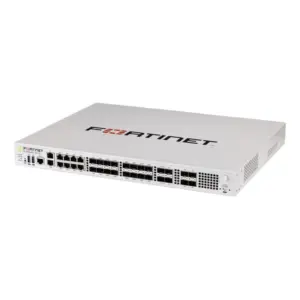
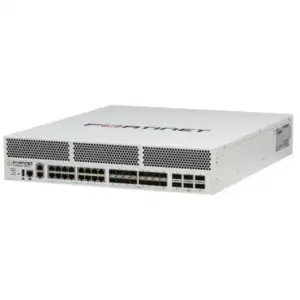
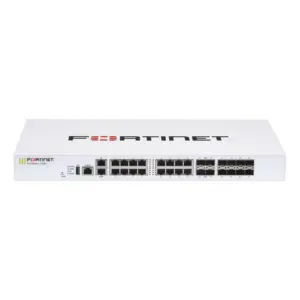
Fortinet FortiNDR 1000F Network Detection and Response Appliance in Uganda
FortiNDR 1000F is a dedicated 2RU on-premises network detection and response platform built for organizations that need deeper visibility into network activity after perimeter controls have already done their work. It observes mirrored or tapped traffic, analyzes behavior and files, and helps security teams identify suspicious activity that may otherwise remain hidden inside enterprise, campus, data-center or operational networks. For Ugandan organizations planning a security operations refresh, the appliance provides a practical way to keep monitoring and investigation functions on premises while integrating with the wider Fortinet security ecosystem.
The model is particularly relevant where a procurement team must balance inspection capacity, data locality, rack availability, resilient power, interface compatibility and ongoing service coverage. Fortinet lists the FortiNDR-1000F as supporting standalone and sensor operation. Its hardware specification includes four 10GbE SFP+ ports, two 10/100/1000 RJ45 interfaces, RAID-protected solid-state storage and redundant hot-swappable power supplies. Published performance figures include up to 10 Gbps for a single-port HTTP sniffer profile and up to 20 Gbps for a dual-port HTTP profile, with enterprise-mix results varying by test condition. These figures should be treated as sizing references rather than a substitute for measuring the customer’s real traffic mix.
FourTeck supports buyers in Kampala and across Uganda with commercial quotation, bill-of-materials review, subscription selection, optics and cabling checks, delivery coordination and deployment preparation. A well-prepared FortiNDR project starts with the traffic sources that must be observed: internet edges, data-center aggregation, east-west server segments, critical VLANs, campus cores or selected operational networks. Once those points are known, the correct monitoring interfaces, expected aggregate load and service options can be mapped before purchase.
Instant Specifications and Procurement Fact Rail
FortiNDR-1000F / FNR-1000F
On-premises sensor or standalone
2RU rackmount appliance
10GbE SFP+ based capture options
Redundant hot-swappable supplies
Quote-based supply; confirm lead time
The fact rail is intended to help technical and procurement teams quickly establish whether the platform belongs in the correct class for a project. It is not a complete bill of materials. Transceivers, cabling, NetFlow support, operational-technology services and FortiCare coverage may be separate commercial items depending on the selected bundle and architecture. Fortinet’s ordering information identifies the base FNR-1000F appliance and also lists a hardware bundle that combines the appliance with FortiCare Premium and NDR engine updates. NetFlow support is separately orderable. Buyers should therefore request a line-item quotation rather than compare appliance-only pricing with a bundled proposal.
Warranty and support entitlement should be confirmed against the exact FortiCare term on the quotation. For Uganda deployments, FourTeck can align the proposed support term with the organization’s procurement cycle and provide serial-number-based documentation after supply. Where the appliance will sit in a critical security operations path, it is sensible to consider the support response level, replacement process and renewal timing at the same stage as hardware approval.
Operational Product Architecture and Overview
FortiNDR 1000F is designed around passive network observation rather than inline traffic enforcement. In a typical deployment, a network TAP or switch SPAN session provides copies of traffic to one or more sniffer interfaces. This design allows the platform to inspect communications without becoming a forwarding dependency for production traffic. That distinction matters to architects who want richer threat visibility but do not want another inline device to introduce routing changes, latency considerations or a new failure point in a critical path.
The appliance combines high-speed capture interfaces, local storage and specialized analysis functions to examine traffic patterns and files. Fortinet publishes a storage configuration of two 7.68 TB drives in RAID 1 for the 1000F, providing 7.68 TB usable capacity under the stated arrangement. RAID protection helps reduce the operational impact of a single drive failure, while removable drives and redundant hot-swappable power supplies support maintainability in enterprise racks. These hardware characteristics are particularly useful for organizations where security monitoring is expected to run continuously and maintenance windows are tightly controlled.
Traffic sizing is central to a successful deployment. Fortinet’s published performance table lists 10 Gbps for a single-port HTTP sniffer profile and 10 Gbps for a single-port enterprise-mix profile. For dual-port sniffing, the published figures are 20 Gbps for HTTP and 13 Gbps for the enterprise mix. Malware analysis throughput is listed at 170,000 files per hour under the vendor’s stated combined real-world methodology. NetFlow capacity is listed at 70,000 flows per second when the relevant capability is ordered. These numbers provide a useful planning baseline, but actual requirements should be derived from peak mirrored traffic, protocol mix, file transfer patterns and the number of observation points.
The operational problem this model addresses is visibility after initial prevention controls. Firewalls, endpoint controls and access policies are essential, but security teams also need evidence of unusual internal communication, suspicious file movement, command-and-control behavior and other activity that may appear legitimate at first glance. Passive monitoring provides another layer of evidence. It can be especially valuable in environments where endpoints cannot all run agents, where unmanaged devices exist, or where industrial and embedded systems must be observed without direct software installation.
FortiNDR also fits into a broader investigation workflow. Alerts have more value when analysts can correlate them with firewall, endpoint and security operations data. Fortinet positions the product for integration with its Security Fabric and other security operations components. During design, buyers should identify where alerts will be triaged, who owns escalation, what event retention is required and how incidents move from detection to containment. Purchasing the appliance without defining this workflow can leave technical capability underused.
For regulated or isolated networks, on-premises deployment can also address data-handling requirements. The FortiNDR on-premises family is positioned for environments including operational technology and air-gapped networks. This does not automatically make any deployment compliant with a particular regulation; compliance depends on architecture, policies, access controls and operational procedures. However, local deployment gives organizations more direct control over where monitored data is processed and stored.
Enterprise Business Outcomes and Value Analysis
A monitoring platform must keep pace with the traffic presented to it. The 1000F offers 10GbE-class capture connectivity and published multi-gigabit inspection figures suited to substantial enterprise segments. The practical benefit is the ability to monitor high-value aggregation points rather than limiting observation to small branch links. Correct sizing remains essential: architects should measure peak traffic and avoid assuming that interface speed equals sustained analysis capacity under every workload.
Redundant hot-swappable power supplies and RAID-protected storage reduce common hardware maintenance risks. Because monitoring is normally passive, production forwarding can continue if the appliance is taken offline, but visibility is lost during that period. Critical environments should therefore consider redundant sensors, diversified TAP feeds or an architecture that preserves monitoring coverage during maintenance.
The platform can be deployed as a standalone appliance or sensor, allowing organizations to begin with a defined monitoring zone and expand their architecture as visibility requirements grow. A multi-site enterprise can place sensors at strategic traffic concentration points and centralize operational processes. Expansion should be based on actual capture volume, site criticality and investigation needs rather than simply counting users.
Network behavior monitoring adds evidence that complements prevention technologies. It can help expose suspicious east-west communication, unexpected service use and malicious file activity. The appliance itself should be placed on a protected management network, with administrative access restricted to authorized security personnel and change activity governed by the organization’s standard privileged-access controls.
A security product delivers value when alerts become actionable investigations. Fortinet’s ecosystem approach allows FortiNDR findings to participate in broader security operations workflows. Procurement teams should confirm the intended integrations before ordering so that licensing, network reachability, administrative ownership and log handling are planned as part of the project rather than discovered after installation.
Acquisition cost is only one component. Rack space, optics, support subscriptions, power, cooling, staff time and future expansion all influence lifetime cost. The 2RU footprint should be reserved in the target rack, and power feeds should be mapped to separate protected circuits where the site design permits. A complete quotation should show appliance, services, transceivers and optional capabilities as separate line items for transparent budgeting.
Key Hardware and Software Highlights
10GbE Capture Connectivity
Four 10GbE SFP+ interfaces provide flexible options for receiving mirrored or tapped traffic. Port assignment depends on deployment mode and topology, so the capture design should be confirmed before optics are ordered.
Local SSD Storage
Two 7.68 TB SSDs are listed in RAID 1, giving resilience for locally retained operational data. Retention duration depends on traffic, event volume and configuration rather than drive capacity alone.
Redundant Power
Hot-swappable redundant supplies help maintain appliance availability through a single power-supply fault or replacement procedure when feeds and upstream power infrastructure are correctly designed.
Standalone or Sensor Role
The 1000F can serve as a standalone platform or participate as a sensor in a broader FortiNDR architecture. This gives architects a path from a focused deployment toward multi-sensor monitoring.
File and Behavior Analysis
The system examines network activity and suspicious files to identify threats that may not be apparent from signatures or perimeter policy alone. This supports threat hunting and incident investigation.
Optional NetFlow and OT Services
Fortinet lists NetFlow support and an OT Security Service as separately orderable items for the platform. Buyers should include these requirements explicitly in the request for quotation.
These components work together as an operational system rather than isolated specifications. High-speed ports matter only when the source switches, TAPs, optics and capture architecture are compatible. Storage matters only when retention expectations are understood. Redundant power matters only when the two supplies are connected to appropriately independent feeds. Subscription services matter only when renewal ownership and update access are planned. FourTeck can review these dependencies before order placement so the delivered configuration matches the intended environment.
Technical Specifications Ledger
| Category | FortiNDR 1000F Detail | Procurement Note |
|---|---|---|
| Product SKU | FNR-1000F | Use exact SKU on commercial request. |
| Form factor | 2RU rackmount | Reserve rack units plus cable clearance. |
| Total interfaces | 2 x 10/100/1000 RJ45, 4 x 10GbE SFP+, console connectivity | Confirm management and sniffer assignment. |
| Sniffer interfaces | Published as three 10G fiber SFP+ sniffer interfaces in the current data sheet configuration | Validate exact port plan against current documentation. |
| Storage | 2 x 7.68 TB SSD, RAID 1; 7.68 TB usable under stated layout | Retention varies by workload. |
| Drive serviceability | Removable drives | Useful for controlled maintenance. |
| Power supplies | Redundant, hot-swappable | Plan separate protected feeds where available. |
| Single-port sniffer throughput | 10 Gbps HTTP / 10 Gbps enterprise mix | Vendor test figures; size for real traffic. |
| Dual-port sniffer throughput | 20 Gbps HTTP / 13 Gbps enterprise mix | Aggregate monitored load must be assessed. |
| NetFlow | Up to 70,000 flows/second when ordered | Separate commercial item. |
| Malware analysis | Published 170,000 files/hour under vendor methodology | Actual mix affects observed rate. |
| Deployment modes | Sensor and standalone | Choose based on centralized architecture. |
| Optics | Supported Fortinet 10G multimode/long-range options depend on link design | Confirm fiber type and distance before order. |
Specifications should be validated against the current Fortinet data sheet at the time of quotation because vendor hardware documentation, supported transceivers and commercial bundles can change during a product lifecycle. Where a specification is not explicitly confirmed in the current source material, FourTeck recommends treating it as a design question rather than an assumption. This is especially important for dimensions, power draw, environmental limits and exact accessory inclusion. A procurement-grade bill of materials should state every required optic, cable, service and support term.
Configuration and Sizing Worksheet
Step 1: Estimate Workload and Monitoring Scale
List every traffic source intended for monitoring. Record normal and peak throughput for each SPAN, TAP or aggregation feed. Separate north-south internet traffic from east-west data-center traffic because the volume and protocol mix can differ significantly. If several sources are combined, use aggregate peak figures rather than average utilization. Compare those measurements with the vendor’s enterprise-mix performance figures and preserve engineering headroom for bursts and growth.
Step 2: Confirm Rack and Environmental Readiness
Reserve 2RU in a suitable equipment rack and confirm front and rear access for installation and service. Check cabinet depth, rail compatibility, cable bend radius and airflow practices. Security monitoring appliances should be installed in controlled areas with reliable cooling. If the site has a generator or UPS strategy, include the appliance in the protected-load calculation rather than assuming spare capacity.
Step 3: Map Redundant Power and Cabling
Where the facility design supports it, connect the two power supplies to independent protected feeds or power distribution units. For network connectivity, document each source switch or TAP, fiber type, connector, link distance and required optic. A 10GbE SFP+ port does not by itself determine the correct transceiver. Multimode and single-mode links require different optics, and copper requirements should be reviewed separately against supported options.
Step 4: Select Services and Support
Decide whether the project requires the hardware-only appliance or a bundle with FortiCare Premium and NDR engine updates. Determine whether NetFlow support is needed and whether the environment includes operational technology that would benefit from the separately orderable OT Security Service. Align subscription duration with internal budgeting, planned project life and renewal governance.
Step 5: Prepare the Quote Package
A useful request should state the FortiNDR 1000F model, quantity, delivery city, required support duration, expected traffic volume, deployment role, optic types, rack environment and optional services. Include the target installation date and whether pre-shipment firmware validation or configuration assistance is required. This information reduces back-and-forth and helps the commercial proposal reflect the real deployment rather than an incomplete appliance-only price.
Deployment Scenarios and Industry Use Cases
Large Enterprise and Multi-Site Networks
A large enterprise can place the 1000F at a data-center aggregation point where mirrored traffic from critical server, internet and inter-site segments is available. Remote sites may continue using their existing security controls while central monitoring focuses on high-value traffic. For larger distributed designs, multiple sensors can be considered so that capture does not depend on backhauling every packet to one location. The design goal is to position visibility where it produces meaningful investigation evidence without creating unnecessary WAN load.
Financial and Banking Institutions
Banks and financial organizations often operate segmented networks with strict change control, privileged systems and high-value transaction infrastructure. Passive monitoring can add visibility without inserting another forwarding device into sensitive application paths. A deployment may observe data-center VLANs, service zones and selected branch aggregation links. Access to the management plane should be tightly controlled, and retention, incident handling and support procedures should be documented as part of governance.
Educational and Campus Networks
Universities and large campuses commonly support diverse devices, research systems, guest access and decentralized administration. Endpoint coverage can be uneven, making network-level observation useful. A FortiNDR sensor positioned near the campus core can help analysts identify unusual communications across high-value segments. Sizing should account for bursty student traffic, software downloads, research transfers and residence networks rather than relying on user count alone.
Government and Defense Procurement
Government environments may require local data processing, controlled administrative access and carefully documented supply chains. The on-premises FortiNDR architecture can be considered for networks where local monitoring is preferred or required. In isolated or restricted environments, update procedures, removable media policy, time synchronization, administrative authentication and incident export processes should be designed before deployment. Product selection does not by itself satisfy a security standard; the surrounding architecture and operating procedures remain essential.
Across all sectors, the best monitoring point is not automatically the fastest link. It is the point that provides the clearest view of assets and behaviors relevant to the organization’s risk model. A short discovery exercise before purchase can identify whether one 1000F is appropriate or whether traffic distribution, capacity or resilience requirements justify multiple sensors or a different FortiNDR model.
Technical Deep Dive: Processing and Acceleration Architecture
Network detection differs from conventional firewall forwarding because the platform must ingest copied traffic, reconstruct relevant sessions, extract behavioral evidence and examine files without controlling the original packet path. The FortiNDR 1000F is engineered as a purpose-built appliance for this workload. Its capture connectivity supports high-speed monitored segments, while local storage provides working capacity for investigations and retained evidence. Fortinet’s published figures distinguish HTTP and enterprise traffic mixes, which is important because workload composition affects practical throughput.
For sizing, engineers should avoid using only switch port speed. A 10GbE uplink may average far below line rate but experience short bursts; conversely, several lower-speed VLANs mirrored into one destination can create oversubscription. Measure peak utilization over a representative period, identify whether the SPAN source can drop packets under congestion and decide whether a dedicated TAP is more appropriate for critical visibility. If two capture ports are used, the combined workload should be compared with dual-port enterprise-mix guidance rather than treating each port as an independent full-capacity system.
File analysis throughput also deserves context. The vendor’s files-per-hour metric is based on a stated real-world mix. Environments with large repositories, software distribution, backups or heavy web traffic may present very different file patterns. During a proof-of-concept or sizing exercise, capture representative traffic and evaluate detection coverage, resource behavior and alert quality. This turns a headline specification into an architecture decision grounded in the customer’s actual network.
Technical Deep Dive: Software Ecosystem, Updates and Operational Control
FortiNDR is most effective when treated as part of an operational detection workflow. Updates and baseline services keep the detection platform current, while FortiCare provides support coverage according to the purchased entitlement. The hardware bundle listed by Fortinet combines FortiCare Premium with NDR engine updates and baseline services. Procurement teams should verify the term, start date and renewal process so there is no ambiguity between hardware ownership and ongoing service entitlement.
Administrative control should follow enterprise security practice. Place management interfaces on a restricted network, limit access by role, use centralized identity controls where supported and appropriate, and maintain configuration backups. Define who can change capture sources, tune detections, acknowledge incidents and export evidence. These responsibilities are operational controls, not merely installation tasks. A product can generate strong telemetry and still create risk if too many administrators have unrestricted access or if alert ownership is undefined.
Integration planning should identify the systems that will consume FortiNDR findings. In a Fortinet-centered environment, Security Fabric integration can help correlate information with other controls. In mixed-vendor estates, confirm required data exchange methods and supported integrations before purchase. The objective is to avoid creating another isolated console. Analysts should be able to move from a detection to supporting network, endpoint or firewall context with a clear escalation path.
Technical Deep Dive: Availability, Redundancy and Disaster Recovery
The 1000F includes redundant hot-swappable power supplies and RAID 1 storage, addressing two common appliance-level failure domains. These features improve serviceability but should not be confused with complete monitoring redundancy. If the appliance itself is unavailable, passive production traffic can continue because the sensor is not normally inline, yet the organization may temporarily lose detection coverage. Critical environments should therefore assess whether a second sensor or alternate observation path is justified.
Power design should use independent feeds where possible. Connecting both supplies to the same PDU protects against a power-supply module failure but not a PDU or circuit failure. Similarly, RAID 1 protects against a single drive failure but does not replace configuration backup, evidence retention policy or disaster-recovery planning. Organizations should document how quickly a failed appliance must be restored, where replacement hardware would be sourced and how configuration state would be recovered.
Monitoring resilience also depends on the network. A SPAN session configured on a single switch may disappear during switch maintenance. A TAP can offer a more persistent observation point, but it introduces its own optical and cabling design considerations. For high-value environments, map the complete visibility chain from production links through TAPs or mirrors, optics, sensor ports, management access and alert destinations. Redundancy is only as strong as the least resilient dependency in that chain.
Pre-Purchase Buyer Gap Checklist
Are subscriptions included? Not necessarily. Fortinet lists a base hardware SKU and a hardware bundle with FortiCare Premium plus NDR engine updates and baseline services. NetFlow support and OT Security Service are listed separately. Request a line-item bill of materials showing exactly what is included and the service duration.
Are transceivers included? Do not assume every required optic is included. The current documentation identifies supported transceiver options and notes separate purchase considerations. Match optics to fiber type, distance and source equipment. Include spare optics if the organization’s maintenance policy requires them.
Will it fit the rack? The appliance is 2RU, but rack-unit height is only part of the requirement. Confirm cabinet depth, rail mounting, rear cable clearance, airflow and service access. Leave enough space for fiber bend radius and avoid routing patch leads where drive or power-supply replacement would be obstructed.
What power should be reserved? Confirm the current Fortinet hardware specification for the exact unit before final electrical planning. Use the documented maximum rather than a guessed average when calculating UPS and PDU capacity. Connect redundant supplies to independent protected feeds where practical.
How much traffic can be monitored? Published figures are workload-specific. The 1000F is listed at 10 Gbps for single-port HTTP and enterprise-mix profiles, and dual-port results of 20 Gbps HTTP and 13 Gbps enterprise mix. Measure actual peak traffic and preserve headroom. Mirrored traffic can also be affected by SPAN oversubscription before it reaches the appliance.
Does it work in a mixed-vendor network? Passive capture can observe traffic regardless of the forwarding vendor when the network can provide compatible mirrored or tapped traffic. Integration requirements are separate: confirm the specific management, event and security operations systems that must exchange data with FortiNDR.
What about product lifecycle? Before purchase, request current availability, support term options and lifecycle information applicable to the proposed SKU. This matters for multi-year projects and standardized deployments. A current quotation should be used as the commercial source of truth for supply status.
What should be tested before acceptance? Verify appliance condition, serial numbers, power redundancy, management access, firmware level, capture visibility, time synchronization, alert generation and any licensed services. For complex environments, agree an acceptance checklist before shipment or installation so technical completion is measurable.
Uganda Procurement and Delivery Logistics
FourTeck supports FortiNDR 1000F procurement for Ugandan enterprises through a quotation-led process. The buyer can submit the required model, quantity, support duration, deployment location and interface requirements. The commercial team can then structure a proposal covering the appliance and relevant services rather than presenting an incomplete price that omits subscriptions or optics. For organizations purchasing through formal tender or internal approval, the quote can be aligned with the requested company details and bill-of-materials structure.
Lead time should be confirmed at the point of quotation because enterprise security hardware availability can change by region and order date. Delivery planning should include the destination city, receiving contact, site access requirements and any deadline tied to a maintenance window. Where the unit will be installed outside Kampala, allow time for onward transport and local receiving procedures.
Technical pre-configuration can reduce installation-day risk. Depending on the agreed scope, preparation may include firmware verification, asset recording, interface planning, service entitlement checks and configuration review. Customers should provide addressing, management VLAN, DNS, NTP and integration requirements through an approved secure process. Sensitive production credentials should not be embedded in ordinary procurement correspondence.
For regulated buyers, documentation can be as important as the hardware. Maintain the purchase order, invoice, serial records, service entitlement details, delivery note and acceptance results together. This creates a clear chain from procurement through support renewal and future replacement. FourTeck can assist with product identification and bill-of-materials consistency before the order is finalized.
Uganda Coverage Matrix
Enterprise headquarters, data centers, financial institutions and public-sector projects can be quoted with delivery and deployment coordination.
Support for organizations requiring security infrastructure near aviation, hospitality, logistics and government facilities.
Procurement assistance for industrial, manufacturing, education and multi-site network environments.
Supply coordination for regional enterprises, universities, healthcare and distributed business networks.
Quote and logistics support for institutions extending security operations into northern Uganda.
Coverage is not limited to these hubs. For any Ugandan destination, provide the delivery location during quotation so transport planning can be included. Projects involving remote sites should also identify where technical staff will receive and install the appliance, whether rack and power readiness has been confirmed, and whether remote commissioning support is required.
Cross-Border and Regional Supply Chains
Organizations operating across East Africa and the Gulf often need consistent product specifications across multiple legal entities and delivery destinations. FourTeck regional sites can support coordinated enquiries for Uganda, Kenya, the wider African market, the United Arab Emirates and Kuwait.
For cross-border projects, keep the technical bill of materials consistent while allowing commercial terms, taxes, freight and local delivery conditions to be handled per destination. Record the exact model and service term for every site so that renewal dates and support entitlements do not become fragmented. If a central architecture will aggregate findings from several countries, include WAN reachability, data-handling policy and administrative ownership in the design before equipment is dispatched.
Related Fortinet Products and Project Components
FortiNDR 1000F is usually one component of a broader security architecture. Buyers evaluating perimeter enforcement can review FortiGate security appliances. Centralized policy and device administration requirements may lead to FortiManager, while event retention and analytics requirements may involve FortiAnalyzer. Endpoint telemetry projects can consider FortiEDR, and organizations with operational networks should discuss the FortiNDR OT service option as part of the same design.
Physical infrastructure also matters. Request compatible SFP+ transceivers, fiber patching and rack accessories alongside the appliance where appropriate. If monitoring traffic will be delivered from aggregation switches, verify the switch’s SPAN capabilities and port capacity. For highly critical observation points, network TAPs may be preferable to ordinary mirroring. The correct accessory choice depends on link media, speed, topology and availability requirements.
FourTeck Technical Service Capabilities
A successful FortiNDR project begins before the appliance reaches the rack. FourTeck can assist with engineering validation by reviewing the proposed monitoring points, interface speeds, optic types, rack location and expected traffic load. This helps identify mismatches such as a single-mode link paired with a multimode optic, an undersized capture design or a quotation that omits a required subscription.
Bill-of-materials verification focuses on commercial completeness. The appliance SKU, support term, optional NetFlow capability, OT service requirements, transceivers and related components can be checked against the intended design. For multi-unit projects, consistent naming and service durations simplify asset management and future renewals.
Where agreed, staging can include serial recording, physical inspection, firmware-level review and configuration preparation. Pre-shipment updates should follow the customer’s change policy and compatibility requirements rather than applying versions without review. Post-sales support can assist with deployment questions, entitlement clarification, fault isolation and vendor support coordination according to the purchased service coverage. Customers should retain configuration backups and serial records internally so support activity is not dependent on a single administrator.
Extended Technical FAQ
1. What is the FortiNDR 1000F used for?
FortiNDR 1000F is an on-premises network detection and response appliance. It receives copies of network traffic from SPAN ports or TAPs and analyzes that activity for suspicious behavior and malicious files. It is intended to complement firewalls, endpoint controls and other security systems rather than replace them. Because it normally observes traffic passively, it can add visibility without becoming an inline forwarding dependency. Typical deployment points include data-center aggregation, internet-edge monitoring, campus cores and selected operational networks.
2. Does FortiNDR 1000F require a subscription?
Commercial requirements depend on the selected ordering option. Fortinet lists a base FNR-1000F hardware SKU and a bundle that combines hardware with FortiCare Premium, NDR engine updates and baseline services. NetFlow support and the OT Security Service are separately listed options. For budgeting, request a quotation that clearly identifies hardware, service duration, optional capabilities and renewal items. This prevents an appliance-only comparison from being mistaken for the complete operational cost of the solution.
3. What network interfaces are available?
Current Fortinet documentation lists four 10GbE SFP+ interfaces and two 10/100/1000 RJ45 interfaces for the 1000F platform, with the exact use of ports depending on deployment and configuration. The data sheet also describes the sniffer-port arrangement used for capture. Before purchasing optics, document whether each monitored link uses multimode fiber, single-mode fiber or copper, the distance involved and the source device. The physical port type alone is not enough to select the correct transceiver.
4. How much traffic can the appliance inspect?
Fortinet publishes workload-specific figures rather than one universal number. The 1000F is listed at 10 Gbps for single-port HTTP and enterprise-mix sniffer tests. Dual-port figures are listed at 20 Gbps for HTTP and 13 Gbps for the enterprise mix. These are vendor test results and should be used as sizing references. Actual deployments should measure peak mirrored traffic, consider bursts and protocol mix, and preserve capacity headroom. The SPAN or TAP infrastructure must also be capable of delivering traffic without loss.
5. Can it monitor operational technology networks?
Fortinet positions the on-premises FortiNDR family for operational technology and isolated environments, and it offers a separately orderable OT Security Service for the 1000F. Passive observation is useful where installing software agents on industrial devices is impractical. However, an OT deployment should be designed carefully around network segmentation, TAP placement, approved protocols, maintenance windows and change control. Confirm the required OT service entitlement in the quotation and validate the monitoring design with the organization’s operational engineering team.
6. Is FortiNDR 1000F compatible with non-Fortinet switches and networks?
The appliance can receive mirrored or tapped Ethernet traffic when the source infrastructure can provide a compatible feed, so the forwarding network does not have to be exclusively Fortinet. The more detailed question is integration: if the security operations team expects FortiNDR events to feed another platform, confirm the supported exchange method and version compatibility before purchase. Physical compatibility, traffic visibility and management integration are separate design considerations and should each be verified.
7. What resilience features are built into the hardware?
The 1000F is listed with redundant hot-swappable power supplies, removable drives and RAID 1 storage using two 7.68 TB SSDs. These features improve hardware serviceability and protect against common component failures. They do not create complete sensor redundancy. If the appliance is offline, production traffic normally continues because monitoring is passive, but detection visibility may be interrupted. Organizations with strict monitoring continuity requirements should consider redundant observation paths or additional sensors.
8. How should warranty and hardware replacement be handled in Uganda?
Warranty and replacement handling should follow the FortiCare entitlement purchased with the appliance. Keep serial numbers, proof of purchase, entitlement details and configuration backups available. If a fault occurs, initial diagnosis should distinguish power, storage, interface, optic and software issues before replacement is requested. FourTeck can assist with support coordination according to the commercial coverage in place. Buyers with strict recovery objectives should choose a support level that matches the business impact of losing monitoring visibility.
9. Can FourTeck help with configuration before delivery?
Configuration assistance can be scoped as part of the project. Useful pre-deployment tasks include verifying firmware, documenting serial numbers, reviewing management addressing, mapping capture ports and checking service entitlement. The customer should provide network parameters through an approved secure channel and retain control of privileged credentials. For complex deployments, a written implementation plan should identify switch mirroring, TAP connections, management routing, time synchronization, integrations and acceptance tests before the installation window begins.
10. What information is needed for an accurate quotation?
Provide the FortiNDR 1000F model and quantity, delivery city, desired FortiCare term, expected peak monitored traffic, deployment role, required NetFlow or OT services, and optic requirements. Also state the planned installation date and whether technical staging is required. If the project is part of a tender, include the required quotation format and any mandatory documentation. A complete request allows the supplier to price the actual deployment rather than only the chassis, reducing the chance of accessories or services being discovered after approval.
Request a FortiNDR 1000F Procurement Quote for Uganda
For a procurement-ready proposal, send FourTeck your required quantity, delivery location, preferred support duration, expected monitoring throughput and interface requirements. Include whether the project needs NetFlow support, operational-technology coverage, optics, staging or deployment assistance. The response can then be structured around the complete bill of materials rather than a chassis-only estimate.
Organizations planning a larger rollout should also provide the number of sites, monitoring topology and target implementation schedule. This allows capacity, service terms and logistics to be reviewed consistently across the project. For formal tenders, share the technical schedule so model references and accessories can be checked before submission.