
Fortinet FortiProxy 2000G Secure Web Gateway for Enterprise Web Security
Fortinet FortiProxy 2000G is a high-capacity secure web gateway appliance for enterprises, institutions and public-sector networks that need controlled, inspected and policy-driven access to web applications and internet services. The platform is designed to consolidate secure browsing, URL filtering, application control, SSL inspection, intrusion prevention, sandbox integration, inline cloud application controls and data protection functions into a dedicated proxy architecture. For procurement teams in Uganda, the 2000G sits between smaller branch or mid-market platforms and the larger 4000G, providing a practical capacity range for centralized internet gateways, campus environments and multi-site organizations.
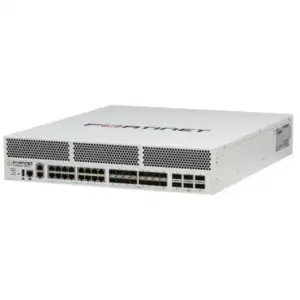
A procurement decision for a secure web gateway is rarely based on port count alone. User concurrency, encrypted traffic volume, inspection depth, authentication methods, high-availability objectives, subscription coverage, rack space, power feeds and operational ownership all affect the final design. FortiProxy 2000G supports 500 to 20,000 licensed users, up to 100 virtual domains, multiple proxy deployment modes, 128 GB of memory and 8 TB of local storage. Its physical connectivity includes two 10GE SFP+, two GE SFP, four GE RJ45 and two GE RJ45 bypass interfaces, giving architects flexibility for copper and fiber handoffs.
FourTeck Uganda supports organizations that need to translate these capabilities into a complete bill of materials. Before ordering, the project can be reviewed for appliance quantity, licensing, FortiGuard services, support level, optics, patching, redundant power arrangements and implementation scope. This reduces the risk of receiving a powerful appliance without the subscriptions, accessories or deployment assumptions required to put it into production.
Instant Specifications and Procurement Fact Rail
FortiProxy 2000G / FPX-2000G
500–20,000 users
2U rack appliance
128 GB / 8 TB
Dual PSU, 100–240V AC
Project quotation on request
The fact rail should be treated as a starting point rather than a complete sizing decision. A 20,000-user license ceiling does not mean every 20,000-user environment has the same workload. An organization with heavy SaaS usage, extensive encrypted inspection, large file transfers and strict data-loss policies can impose a different processing profile from an organization with lighter browsing. Procurement should therefore pair user count with traffic patterns, security services and growth expectations.
Operational Architecture and Product Overview
FortiProxy is purpose-built around secure web gateway functions. It can be positioned as an explicit proxy where endpoints or browsers deliberately send traffic to the appliance, as a transparent or WCCP proxy where traffic is redirected without traditional endpoint proxy configuration, as an inline proxy, or as a routed proxy. This range matters when replacing legacy proxy infrastructure because organizations often have different endpoint populations, authentication constraints and network topologies. A migration may involve managed corporate computers using PAC files, unmanaged devices traversing transparent inspection paths, and selected server workloads using policy-based routing.
The 2000G provides local resources suited to large-scale policy enforcement and logging. Its 128 GB memory supports demanding operational workloads, while four 2 TB disks provide 8 TB of storage. Up to 100 virtual domains allow logical separation where business units, tenants or administrative boundaries require distinct policy contexts. Management methods include HTTPS, SSH, command-line access, SNMP and an RJ45 console interface, allowing integration into both modern management workflows and conventional data-center operations.
At the security layer, FortiProxy combines web filtering, application visibility and control, SSL inspection, intrusion prevention, antivirus capabilities, sandboxing integration, inline CASB functionality and data-loss controls. Fortinet also positions FortiProxy for deep content analysis, including OCR-assisted DLP use cases. In practical terms, the appliance is intended to give security teams a central enforcement point for web traffic while retaining visibility into encrypted sessions and application behavior according to configured policies and licensed services.
Common procurement pain points include uncertainty about whether an appliance can accommodate existing fiber uplinks, whether bypass connectivity is available, whether dual power is standard, whether licensing scales with the organization, and whether the rack can physically accommodate the chassis. The 2000G answers several of these directly: dual power supplies are included, 10GE SFP+ and GE connectivity are present, two GE RJ45 bypass interfaces are available, and the chassis is 2U. However, its 810 mm depth is significant. Rack depth, cable bend radius, rear clearance and PDU placement should be verified before purchase.
Enterprise Business Outcomes and Value Analysis
1. Performance and Throughput Integrity
A dedicated secure web gateway separates intensive web inspection from general routing and firewall duties. For enterprises with large numbers of users and significant encrypted web traffic, this architectural separation can simplify capacity planning. The 2000G provides 10GE uplink options and a hardware platform sized for up to 20,000 licensed users. Actual production sizing should account for enabled inspection features, traffic composition and concurrency rather than relying on a single headline figure.
2. System Reliability and High Availability
Dual power supplies allow connection to independent power feeds or PDUs, reducing exposure to a single PSU or circuit failure. Organizations with strict availability objectives should evaluate appliance-level redundancy as well, designing a high-availability pair where appropriate and confirming upstream/downstream switching paths.
3. Network and Infrastructure Scalability
The 500–20,000-user licensing range provides room to align capacity with current requirements and future growth. Up to 100 VDOMs can support logical separation for complex enterprises. Multiple deployment modes help architects adapt the proxy to existing network designs instead of forcing a single migration pattern.
4. Enterprise Security and Access Control
Web filtering, application control, SSL inspection, intrusion prevention, sandbox integration, inline CASB and DLP capabilities provide layered controls around user internet access. The value is strongest when policies are designed around business roles, acceptable-use requirements, data sensitivity and regulatory obligations rather than deployed as generic blocking rules.
5. Centralized Management and Operational Simplicity
HTTPS, SSH, CLI, SNMP and console management provide multiple operational paths. Centralizing proxy policy can reduce fragmented browser, gateway and point-product administration, particularly where multiple departments require consistent web controls.
6. Total Cost of Ownership and Energy Planning
The platform consolidates multiple web security functions, but procurement should model appliance, subscriptions, support, optics, rack space, electricity and engineering effort together. Average power consumption is listed at 289 W with a 353 W maximum, and heat dissipation is listed at 1,238 BTU/h, both relevant to data-center planning.
Key Hardware and Software Highlights
| Component or Capability | FortiProxy 2000G | Operational Relevance |
|---|---|---|
| Memory | 128 GB | Supports large enterprise proxy workloads and policy processing. |
| Storage | 8 TB, 4 × 2 TB | Provides substantial local storage resources for appliance operations. |
| Network Ports | 2 × 10GE SFP+, 2 × GE SFP, 4 × GE RJ45 | Supports mixed fiber and copper integration. |
| Bypass | 2 × GE RJ45 | Useful in designs requiring supported bypass connectivity. |
| Power | Dual PSU | Enables redundant power-feed design. |
| Deployment Modes | Inline, Transparent/WCCP, Explicit, Routed | Supports varied migration and traffic-steering approaches. |
Technical Specifications Ledger
| Specification | Value |
|---|---|
| License Capacity | 500–20,000 users |
| Virtual Domains | Up to 100 |
| Memory | 128 GB |
| Storage | 8 TB, 4 × 2 TB hard disk |
| Interfaces | 2 × 10GE SFP+, 2 × GE SFP, 4 × GE RJ45 |
| Bypass Interfaces | 2 × GE RJ45 |
| Power Supply | Dual |
| Input Voltage | 100–240V AC, 50–60 Hz |
| Power Consumption | 289 W average / 353 W maximum |
| Maximum Current | 100V/7.5A, 240V/3.9A |
| Heat Dissipation | 1,238 BTU/h |
| Operating Temperature | 0–40°C |
| Storage Temperature | -25–70°C |
| Humidity | 8%–90% non-condensing |
| Dimensions | 88 × 445 × 810 mm |
| Weight | 43 lb / 19.4 kg |
| Safety / Compliance | FCC, ICES, CE, RCM, VCCI, BSMI Class A, UL/cUL, CB |
Specifications should be validated against the current manufacturer documentation and exact order code at quotation time. In particular, licensing, service bundles and support terms are commercial items that may evolve independently of the base hardware. The physical depth deserves special attention: at 810 mm, the appliance requires a data-center rack with sufficient usable depth plus room for rear power connectors, airflow and cable management.
Configuration and Sizing Worksheet
1. Workload and Scale Estimation
Record total employees, concurrent users, managed and unmanaged endpoints, branch populations, guest traffic and projected growth. Then document typical internet bandwidth, peak utilization, SaaS dependence, video usage, file-transfer patterns and whether deep SSL inspection will be broadly enabled. The licensed capacity is 500–20,000 users, but a resilient design must also consider security policy complexity and peak encrypted traffic.
2. Environmental and Rack Requirements
Reserve 2U of rack height and confirm at least 810 mm appliance depth can be accommodated. Include front and rear service clearance, rail compatibility, cable management and airflow. The operating range is 0–40°C, and the stated heat dissipation of 1,238 BTU/h should be included in cooling calculations.
3. Power Feeds and Cabling
The appliance includes dual power supplies. For meaningful redundancy, connect them to independent PDUs or power paths where facility design allows. Identify whether the production uplinks require 10GE SFP+, GE SFP or GE RJ45 and specify compatible transceivers and patch leads in the bill of materials rather than assuming they are included.
4. Licensing and Subscriptions
Fortinet’s ordering structure includes security and data-protection subscriptions, browser isolation options, DLP services, VDOM upgrades and support offerings. Determine which services are required by policy and compliance needs. A base appliance without the intended subscriptions may not represent the operational solution envisioned by the security team.
5. Quote Preparation Checklist
Provide the required user tier, appliance quantity, HA preference, support duration, subscription term, required security services, optics, rack location, delivery city and whether staging or implementation support is required. Include current proxy architecture and migration constraints if replacing an existing secure web gateway. This allows the quotation to be structured as a deployable solution rather than a standalone chassis.
Deployment Scenarios and Industry Use Cases
Large Enterprise and Multi-Site Networks
A large organization can centralize internet-bound web traffic through a FortiProxy 2000G at a primary data center or regional hub. Branches may forward traffic using the routing and proxy method appropriate to the WAN design. Explicit proxy can provide deliberate endpoint-level traffic direction, while transparent or routed approaches can be useful where endpoint reconfiguration is impractical. Multi-site designs should evaluate WAN dependency and determine whether local internet breakout, secondary gateways or redundant proxy appliances are needed for continuity.
Financial and Banking Institutions
Banks and financial institutions often require strict acceptable-use controls, encrypted traffic inspection, application governance and measures to reduce data leakage. FortiProxy can become a dedicated enforcement point for these policies. Deployment planning should include certificate management, authentication, exception handling for sensitive applications, log retention, change control and HA. Security teams should also determine which DLP and FortiGuard subscriptions are necessary for the intended control framework.
Educational and Campus Networks
Universities and large schools have diverse populations that can include staff, students, labs, residences and guest networks. Up to 100 VDOMs can support logical separation in complex designs, while web filtering and application control can enforce different policies by population. Capacity planning should consider seasonal peaks, software downloads, streaming, research traffic and BYOD behavior.
Government and Defense Procurement
Public-sector environments often require formal bills of materials, controlled administrative access, redundancy planning, auditable policy enforcement and documented support arrangements. Procurement should validate exact compliance requirements, support terms, replacement procedures and any mandatory configuration baselines. Where security accreditation applies, the product should be assessed within the complete architecture rather than treated as independently sufficient for a regulatory requirement.
Technical Deep Dive: Processing and Hardware Architecture
Fortinet describes FortiProxy as using a purpose-built architecture with specialized hardware acceleration and software designed for web security. This matters because secure web gateway workloads involve more than forwarding packets. Connections may require policy lookup, user identification, TLS processing, content inspection, URL categorization, application identification and security-service decisions. In high-volume environments, these operations must occur without turning the security layer into an unacceptable user-experience bottleneck.
The 2000G combines high-capacity system memory with mixed network interfaces and substantial local storage. Two 10GE SFP+ ports can serve high-speed aggregation paths, while GE SFP and RJ45 ports provide flexibility for management or production designs. Two GE RJ45 bypass interfaces add another physical design option. Buyers should map every interface before ordering and specify the optical standards required by adjacent switches, including fiber type and distance.
Hardware acceleration does not remove the need for realistic sizing. Deep encrypted inspection can materially change workload characteristics, as can advanced content controls. A proof-of-concept or representative traffic assessment is valuable when the environment is near the upper end of the intended scale or has unusually demanding traffic patterns.
Technical Deep Dive: Software Ecosystem and Operational Control
FortiProxy’s software capabilities are designed around secure browsing, SaaS access and data protection. Administrators can apply URL filtering, application controls, intrusion prevention, antivirus scanning, SSL inspection, sandbox-related controls, inline CASB and DLP functions according to licensed services and configuration. OCR-assisted data protection can extend inspection into image-based content in supported workflows, helping organizations address information that may not exist as plain text.
Operational control begins with deployment mode. Explicit proxy designs can provide precise endpoint behavior but require PAC files, browser settings or endpoint management. Transparent and WCCP approaches reduce endpoint configuration but depend on network redirection design. Routed and inline options provide additional architecture choices. The best mode depends on existing routing, authentication, failure behavior and migration requirements.
Firmware lifecycle should be incorporated into change management. Before production deployment, administrators should establish backup procedures, maintenance windows, upgrade testing and rollback planning. FourTeck can assist with pre-shipment firmware review and staging when included in the project scope, reducing the amount of basic preparation required after delivery.
Technical Deep Dive: High Availability, Redundancy and Recovery
The included dual power supplies protect against a class of hardware and power-path failures, but they are only one layer of resilience. For critical internet access, organizations should consider redundant appliances, switches, links and upstream connectivity. Both power supplies should ideally terminate on independent power infrastructure. If both connect to one PDU, the appliance remains exposed to that PDU as a single point of failure.
Recovery planning should cover configuration backups, certificates, authentication dependencies, DNS, upstream routing, proxy auto-configuration hosting and any external logging or management systems. A proxy outage can affect a large user population even when the rest of the network remains available, so failure modes should be documented before deployment. Determine whether traffic should fail closed, fail open where supported and appropriate, or divert to another gateway.
Hardware replacement is another operational consideration. Support level and RMA objectives should match business criticality. Fortinet offers support and priority replacement options across its product family; exact entitlement should be specified in the quotation. Keeping documented serial numbers, configuration backups and support contacts can reduce restoration time during an incident.
Pre-Purchase Buyer Gap Checklist
Are subscriptions included with the hardware? Do not assume that every desired security service is bundled with the appliance. Fortinet’s ordering guide identifies separate service and support options. Ask for a line-by-line quotation showing appliance, security subscriptions, data-protection services, browser isolation where required, support, optics and implementation.
Will the chassis fit the rack? The 2000G is 2U but is also 810 mm deep. Depth is often overlooked when buyers focus only on rack units. Verify rail depth, rear clearance and PDU positioning.
How much power and cooling should be reserved? Manufacturer data lists 289 W average and 353 W maximum consumption, with 1,238 BTU/h heat dissipation. Use maximum and facility design standards when planning circuits and cooling rather than assuming average draw is sufficient for every calculation.
Are transceivers included? Treat SFP/SFP+ optics and fiber patching as separate bill-of-materials items unless the quotation explicitly includes them. Match transceiver type to switch compatibility, fiber medium and distance.
Can it integrate with an existing FortiGate environment? Fortinet documents complementary use of FortiProxy and FortiGate, including content inspection integration scenarios. The actual topology should be reviewed for traffic steering, policy ownership and operational boundaries.
What is the correct user tier? The hardware supports a broad licensing range, but procurement should license the intended population and allow for growth. Clarify how contractors, guests, remote users and shared devices are counted under the selected commercial terms.
What happens during migration? Document current proxy settings, PAC files, authentication, certificates, bypass lists, application exceptions and logging. Migration risk frequently comes from overlooked exceptions rather than from appliance installation itself.
Uganda Procurement and Delivery Logistics
FourTeck Uganda can prepare a project quotation based on the required FortiProxy 2000G hardware, subscriptions, support period and accessories. For enterprise procurement, providing the intended user count, deployment topology, required services and delivery location at the beginning helps avoid repeated revisions. Organizations operating formal tender or purchase-order processes can request a structured bill of materials suitable for internal technical and commercial review.
Order processing depends on the confirmed configuration and supply position at quotation time. Delivery timing should therefore be confirmed against the specific bill of materials rather than assumed from a generic product listing. Where a deployment deadline is fixed, share it before order placement so sourcing and logistics expectations can be aligned.
Technical pre-configuration can include baseline firmware review, interface planning, policy preparation and staging activities when agreed in the scope. For migrations, providing existing network diagrams and proxy requirements can accelerate design validation. Final production changes should follow the customer’s change-control and security procedures.
Local Coverage Matrix
Enterprise, government, finance and data-center procurement support.
Secure gateway sourcing for corporate and institutional networks.
Commercial and industrial network security projects.
Regional enterprise and campus deployment support.
Procurement assistance for distributed organizational networks.
For sites outside these hubs, the quotation can be structured around the actual delivery destination and project requirements. Multi-site customers should identify every location, WAN relationship and installation priority so hardware, licensing and rollout planning can be coordinated.
Cross-Border and Regional Supply Chains
Organizations operating across East Africa, the Gulf and broader African markets may need consistent product families and support structures across several countries. FourTeck maintains regional web presences for Uganda, Kenya, Africa, UAE and Kuwait. Cross-border projects should identify destination country, consignee requirements, commercial terms and deployment schedule at quotation stage.
For standardized multi-country rollouts, use a common technical baseline but allow for differences in logistics, local power infrastructure, implementation timing and support arrangements. A central bill of materials can help maintain consistency while country-specific quotations address delivery and commercial requirements.
Related Products and Planning Links
A complete secure web gateway project may include adjacent firewall, switching, wireless, management, logging and power components. Browse the FourTeck Uganda technology portfolio or contact the team for compatible Fortinet security platforms, enterprise switching, rack infrastructure, UPS systems, optical transceivers and structured cabling. Buyers comparing capacity tiers can also request guidance on FortiProxy 400G and FortiProxy 4000G alternatives, while organizations preferring virtual deployment can assess FortiProxy VM editions.
Related-item selection should follow the topology rather than be added mechanically. For example, a high-availability pair may require additional switch ports and optics; a new rack location may require UPS capacity and PDUs; centralized logging may influence storage and management requirements. Requesting the full architecture at quotation stage helps ensure accessory and infrastructure dependencies are visible.
FourTeck Technical Service Capabilities
FourTeck’s role can extend beyond product supply when engineering services are included in the project. Technical validation begins by reviewing the proposed model against user scale, interface requirements, deployment mode and availability objectives. Bill-of-materials verification checks that hardware, subscriptions, support and accessories correspond to the intended design.
Staging services can reduce on-site preparation by confirming basic hardware condition, reviewing firmware level and applying agreed baseline configuration steps before shipment. For security appliances, any pre-configuration should be handled under an agreed process that protects administrative credentials, certificates and customer-specific information.
Post-sales support can assist with deployment questions, escalation coordination and hardware replacement workflows according to the purchased support entitlement. Customers should maintain their own configuration backups and operational documentation as part of normal governance, even when external engineering assistance is available.
Extended Technical FAQ
How many users can the FortiProxy 2000G support?
Fortinet lists a licensed capacity range of 500 to 20,000 users for the FortiProxy 2000G. This figure is important for commercial sizing, but it should not be treated as the only technical sizing variable. Traffic volume, encrypted inspection, application mix, DLP rules, concurrent sessions and enabled security services can all influence real-world load. A 10,000-user environment with intensive SaaS use and comprehensive inspection may have different requirements from a similarly sized environment with lighter browsing. Provide both user count and representative traffic information when requesting a quotation.
Which network interfaces are built into the 2000G?
The appliance provides two 10GE SFP+ interfaces, two GE SFP interfaces and four GE RJ45 interfaces, plus two GE RJ45 bypass interfaces. This mix allows connection to both fiber and copper infrastructure. Before ordering, document the exact switch ports and media types on each side of the appliance. SFP and SFP+ transceivers should be selected for the required fiber standard, wavelength and distance, and compatibility should be checked against the adjacent equipment.
Does FortiProxy 2000G include redundant power supplies?
Yes. The manufacturer’s specification lists dual power supplies for the 2000G. To benefit from that redundancy, each PSU should be connected to an independent power path where the facility supports it, such as separate PDUs backed by resilient UPS infrastructure. Dual PSUs connected to the same power strip still leave a common failure point. The appliance accepts 100–240V AC at 50–60 Hz, and the data sheet lists 289 W average and 353 W maximum consumption.
What proxy deployment modes are supported?
FortiProxy supports inline proxy, transparent/WCCP proxy, explicit proxy and routed proxy modes. This gives architects several migration options. Explicit proxy is useful where endpoint proxy configuration can be controlled; transparent or WCCP designs can redirect traffic without the same endpoint settings; routed and inline approaches provide other network integration choices. Selection should consider authentication, routing, failure behavior, certificate deployment and the existing gateway architecture. Mixed environments may use more than one method for different traffic populations.
Are security subscriptions required?
The appliance and the complete security solution should be treated as separate procurement layers. Fortinet’s ordering guide lists service options including secure web gateway protection, data protection, client browser isolation, DLP services, VDOM upgrades and support. Which subscriptions are required depends on the controls the organization intends to deploy. Ask for a quotation that explicitly itemizes each service, its term and support coverage so stakeholders can understand recurring costs and avoid assuming every feature is permanently included with hardware purchase.
What rack space and physical clearance are required?
FortiProxy 2000G is a 2U appliance measuring approximately 88 × 445 × 810 mm and weighing about 19.4 kg. The 810 mm depth is particularly important. Verify usable rack depth, rail support, rear-door clearance, cable bend radius and PDU position. Leave appropriate space for airflow and service access. The stated operating temperature range is 0–40°C, with heat dissipation listed at 1,238 BTU/h, so data-center cooling planning should include the appliance load.
Can FortiProxy 2000G work alongside FortiGate?
Yes, Fortinet presents FortiProxy and FortiGate as complementary technologies in supported designs, including scenarios where FortiProxy contributes deeper content and data-protection inspection while FortiGate handles network-level security. The exact integration should be engineered around traffic flow, ICAP or other supported mechanisms where applicable, policy ownership and operational responsibilities. Existing FortiGate customers should provide their current topology and objectives so the FortiProxy role can be defined clearly rather than duplicating controls unnecessarily.
What should be included in a high-availability design?
A resilient design goes beyond the dual PSUs inside one appliance. Consider two FortiProxy appliances where uptime requirements justify it, redundant upstream and downstream switches, independent power feeds, resilient WAN or internet paths and documented failure behavior. Configuration backups, certificate recovery, authentication dependencies and proxy configuration distribution should also be included in the continuity plan. Support and RMA entitlement should match the business impact of an outage, especially when the proxy serves a large centralized user population.
How is warranty or hardware replacement handled?
Hardware replacement depends on the support entitlement purchased with the solution and the applicable manufacturer terms. Fortinet offers support and priority RMA options across its product family. For procurement, specify the required response and replacement objectives instead of leaving support as an unspecified add-on. After deployment, maintain serial-number records, proof of entitlement, current configuration backups and escalation contacts. These operational details can significantly reduce recovery time if a hardware fault occurs.
Can FourTeck assist with configuration before delivery?
Pre-delivery staging and configuration assistance can be included where agreed in the project scope. Typical activities may include hardware verification, firmware review, interface planning and preparation of baseline settings. More complex production policies, authentication integration, certificate deployment and migration steps should be defined in a statement of work and coordinated with the customer’s security and change-management teams. Providing the current topology and desired policy outcomes early helps determine the appropriate level of staging and implementation assistance.
Request a FortiProxy 2000G Procurement Quote for Uganda
For an accurate quotation, share your licensed user requirement, preferred subscription term, security services, appliance quantity, HA requirement, interface and optics needs, support level and delivery location. FourTeck Uganda can help structure the hardware and services into a procurement-ready bill of materials and review practical considerations such as rack depth, power redundancy, cabling and migration requirements before order placement.
The FortiProxy 2000G is particularly relevant to organizations that need a dedicated, scalable secure web gateway with flexible proxy deployment, high-capacity local resources, mixed 10GE/GE connectivity and enterprise data-protection capabilities. A properly scoped project ensures those capabilities are matched with the subscriptions, infrastructure and operational support needed for production use.
Reviews
There are no reviews yet.