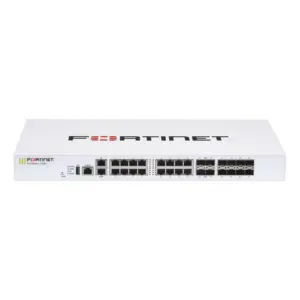
Fortinet FortiWiFi 80F-2R in Uganda
A compact next-generation firewall, secure SD-WAN gateway and integrated Wi-Fi 6 platform for branch and distributed business networks.
The FortiWiFi 80F-2R combines wired network security, policy control, VPN, SD-WAN and dual-radio wireless access in one desktop-class appliance. It is aimed at organizations that want to reduce appliance sprawl at smaller sites without giving up centralized FortiOS management or access to FortiGuard security services.
One appliance for branch security, WAN control and local wireless
The FortiWiFi 80F-2R belongs to Fortinet’s 80F family of converged branch security appliances. Its purpose is straightforward: protect traffic at the edge of a site, control how applications use available WAN links, provide secure remote connectivity and deliver integrated business Wi-Fi from the same operating platform. That makes it particularly relevant for offices where separate firewall, router and wireless hardware would add unnecessary complexity.
Fortinet publishes a strong set of performance figures for the family. Firewall throughput is rated up to 10 Gbps for larger and medium packet sizes, while the enterprise traffic mix figures list up to 1.4 Gbps for intrusion prevention, 1 Gbps for next-generation firewall operation and 900 Mbps for threat protection. These are laboratory-style maximum figures rather than sizing guarantees. Real performance depends on traffic patterns, encrypted inspection, enabled security profiles, VPN use, logging and software configuration.
The wireless side is equally important to the product identity. Fortinet specifies dual radios for 2.4 GHz and 5 GHz service using 802.11a/b/g/n/ac/ax, plus a separate scanning radio. Maximum radio rates are listed as 574 Mbps at 2.4 GHz and 1201 Mbps at 5 GHz, with 2×2 MU-MIMO. For a branch office, this can reduce the need for a separate access point when the physical layout and client density suit an integrated appliance.
The appliance also fits into the wider Fortinet ecosystem. FortiOS provides security policy, routing, SD-WAN and VPN functions, while FortiGuard subscriptions can add threat-intelligence-driven services. FortiSwitch and FortiAP integrations can be relevant when a site grows beyond the built-in ports or wireless coverage. Buyers therefore need to look beyond headline throughput and decide how the device will sit within their wider LAN, WAN and security architecture.
For Uganda projects, FourTeck can help translate those technical choices into an orderable configuration. That includes checking the regional wireless variant, service bundle, subscription term, WAN media, mounting choice, downstream switching and expected remote-access requirements before preparing a quotation.
Business outcomes grounded in the 80F-2R platform
Consolidate branch-edge functions
Firewalling, routing, secure SD-WAN, VPN and wireless access can be managed on one appliance. For smaller branches this can reduce the number of separately managed edge devices and simplify policy ownership.
Inspect business traffic at practical branch speeds
Fortinet rates the platform at up to 1 Gbps NGFW throughput and 900 Mbps threat protection under its published enterprise traffic mix tests. This is the more useful starting point for protected internet sizing than the raw firewall number.
Use multiple WAN paths more intelligently
Secure SD-WAN functions in FortiOS can steer applications over available links according to policy and link health. Organizations with fiber plus backup internet can use this to improve resilience and application experience.
Provide Wi-Fi 6 from the security edge
The integrated dual-radio 802.11ax capability can serve local wireless clients where coverage needs are modest, helping a branch avoid a separate access point solely for basic office connectivity.
Scale into Fortinet-managed LAN infrastructure
The 80F family supports FortiSwitch and FortiAP management, allowing a site to grow beyond the appliance’s built-in ports and integrated wireless while retaining coordinated management.
Support remote and site-to-site connectivity
Fortinet lists IPsec VPN throughput up to 6.5 Gbps, along with substantial tunnel capacity. Actual deployment sizing should account for encryption profiles, concurrent users and security inspection.
The distinguishing point is convergence, not a single headline speed.
The FortiWiFi 80F-2R is valuable when a buyer needs a capable security gateway, SD-WAN edge and local Wi-Fi in a single compact platform. Its strongest fit comes from the combination of FortiOS policy control, hardware-accelerated performance, dual-band Wi-Fi 6 and support for Fortinet’s broader Security Fabric ecosystem.
Up to published maximum; useful for high-speed routing and uninspected flows.
Published enterprise mix figure with logging enabled.
Dual service radios plus a dedicated radio for wireless scanning.
Unified networking and security configuration across core branch functions.
FortiWiFi 80F-2R specification ledger
| Specification | Confirmed value / guidance |
|---|---|
| Product type | Next-generation firewall, secure SD-WAN appliance and integrated wireless gateway |
| GE RJ45 internal ports | 6 |
| GE RJ45 FortiLink ports (default) | 2 |
| GE RJ45/SFP shared media pairs | 2 |
| Wireless interface | Dual Wi-Fi radio, 2.4 GHz and 5 GHz, 802.11a/b/g/n/ac/ax, plus one scanning radio |
| MU-MIMO | 2×2 |
| Maximum Wi-Fi rates | 574 Mbps at 2.4 GHz; 1201 Mbps at 5 GHz |
| Antenna ports | 3 SMA |
| USB | 1 × USB 3.0 |
| Console | 1 × RJ45 console |
| Internal storage | No internal SSD on 80F-2R model |
| Trusted Platform Module | Yes |
| Bluetooth Low Energy | Yes |
| Firewall throughput | Up to 10 / 10 / 7 Gbps for 1518 / 512 / 64-byte UDP packets |
| IPS throughput | Up to 1.4 Gbps, enterprise traffic mix |
| NGFW throughput | Up to 1 Gbps |
| Threat protection throughput | Up to 900 Mbps |
| IPsec VPN throughput | Up to 6.5 Gbps using Fortinet’s stated test profile |
| SSL-VPN throughput | Up to 950 Mbps |
| Concurrent TCP sessions | 1.5 million |
| New TCP sessions/second | 45,000 |
| FortiSwitch support | Up to 24 |
| FortiAP support | Up to 96 total / 48 tunnel mode |
| High availability | Active-active, active-passive and clustering |
| Dimensions | 60 × 216 × 178 mm |
| Weight | 1.5 kg |
| Form factor | Desktop / wall mount / rack tray |
| Power input | 12 V DC, 5 A; optional dual redundancy with supported external adapters |
The most important specifications for purchase planning are not all the largest numbers in the table. For a security gateway, buyers should size around the traffic that will actually be inspected. If intrusion prevention, application control, malware protection and encrypted traffic inspection are central to policy, the NGFW and threat-protection figures matter more than the 10 Gbps raw firewall result. Internet circuit speed, expected growth, concurrent sessions and remote-access usage should all be considered together.
The interface layout also needs attention. The appliance combines six internal GE RJ45 ports, two default FortiLink GE ports and two shared RJ45/SFP media pairs. A project using fiber handoff may need suitable SFP transceivers. A site with more access-layer ports may need a FortiSwitch. Integrated Wi-Fi can be sufficient for a compact office, but floor plan, wall construction, client count and roaming expectations should determine whether additional FortiAP units are required.
Finally, the 80F-2R does not include the 128 GB SSD found on the 81F variants. Buyers who have a requirement tied to local storage or extended local logging should examine the 81F-2R path rather than assuming the models are identical.
Five questions that determine the right configuration
01 — What traffic and security services will the branch run?
List the internet circuit speed, expected application mix and which security functions will be enabled. A branch carrying ordinary office traffic has different requirements from a site using extensive SSL inspection, large VPN transfers or cloud-heavy workflows. This answer helps size the appliance around protected throughput rather than raw packet forwarding.
02 — How many users, devices and wireless clients are expected?
User count alone is not enough, but it helps indicate connection density. Include computers, phones, printers, cameras, IoT devices, guest users and VPN users. For wireless planning, state whether one integrated access point can physically cover the premises or whether the design needs additional FortiAP units for capacity and roaming.
03 — What must connect to the appliance?
Confirm WAN handoff type, existing switches, VLAN design, SFP requirements, authentication services and any central Fortinet management already in use. A mismatch here can lead to missing transceivers, incorrect cabling or an unrealistic port plan. If FortiSwitch or FortiAP integration is intended, include those models in the review.
04 — What growth, licensing or resilience requirements matter?
Decide whether the organization expects more bandwidth, additional branches, higher user counts, new security services or high availability. FortiGuard subscription bundles and FortiCare terms affect both functionality and lifecycle planning. High availability also requires a deliberate design rather than purchasing one appliance and assuming redundancy later.
05 — What are the deployment and service expectations?
State whether the unit will sit on a desk, wall or rack tray, whether redundant power is desired, and what delivery, installation or warranty guidance is required. Region-specific wireless ordering codes should also be confirmed before purchase.
Share the number of sites, internet speed per site, estimated users and devices, wireless coverage requirement, preferred security bundle and term, VPN requirements, existing Fortinet equipment, needed transceivers or mounting accessories, quantity and delivery destination.
Where the integrated design makes practical sense
Professional branch office
A finance, consulting, legal, engineering or service branch may need secure internet access, site-to-site VPN, segmented staff and guest networks, and manageable Wi-Fi without dedicating separate appliances to every function. The 80F-2R fits when traffic levels align with its inspected-throughput profile and the integrated radio can cover the office. Additional switches or APs can be added where port count or floor layout requires them.
Distributed retail or service location
A multi-site organization can use FortiOS and secure SD-WAN to apply consistent branch policy while steering business applications across primary and backup WAN links. The appliance is particularly useful where local Wi-Fi is needed for staff or managed devices. Network segmentation, payment-system requirements and central management standards should be included in the design review.
Education administration or training site
A small campus office, training center or administration building may need content control, VPN connectivity, staff and guest segmentation and wireless access. The integrated Wi-Fi can be useful for a contained area, but larger classrooms or high-density environments should use separately planned access points. The security subscription chosen should match the institution’s filtering and threat-protection needs.
Remote project or satellite office
Organizations opening temporary or satellite locations can benefit from combining edge security and wireless in one compact unit. The shared RJ45/SFP media pairs allow flexibility in WAN handoff, while VPN and SD-WAN capabilities support connectivity back to headquarters or cloud services. Buyers should still verify power, mounting, local ISP handoff and the regional wireless variant.
Security performance should be sized around inspected traffic
Firewall appliances are often compared using the largest throughput figure, but that number can mislead a buyer if the intended deployment enables advanced security services. Fortinet lists raw firewall throughput up to 10 Gbps for the 80F family, yet also publishes enterprise-mix figures of 1.4 Gbps IPS, 1 Gbps NGFW and 900 Mbps threat protection. Those lower figures are far more representative of a branch that expects the appliance to inspect traffic rather than simply route it.
For procurement, start with the fastest expected internet connection over the planned service life. Then identify which security profiles will apply to most sessions. Intrusion prevention, application control, malware prevention, web filtering and encrypted traffic inspection each add work. Remote-access VPN and site-to-site VPN may also share the same appliance resources. The correct selection therefore depends on the combination, not one feature in isolation.
Headroom is important. A firewall that operates close to its tested maximum from day one leaves less room for increased cloud use, additional users or new inspection policies. FourTeck can help map the branch’s current and projected bandwidth to the published performance categories before quoting.
Integrated Wi-Fi 6 changes the branch design conversation
The 80F-2R is not simply an 80F firewall with a marketing wireless label. Fortinet specifies 2.4 GHz and 5 GHz 802.11ax service radios, 2×2 MU-MIMO, maximum rates of 574 Mbps and 1201 Mbps respectively, three SMA antenna ports and a separate scanning radio. This means the appliance can provide useful local wireless service while still participating in a broader secure networking design.
2.4 GHz and 5 GHz radios support modern and legacy-compatible client connectivity.
Wi-Fi 6 capability is built into the appliance for compatible client devices.
A third radio supports wireless scanning rather than being limited to client service.
Integrated wireless is most valuable in offices where one appliance location can provide suitable coverage. It is less suitable as the sole radio source for a large, multi-floor, high-density or complex RF environment. In those cases, the 80F-2R can still act as the security edge while separately planned FortiAP units handle wireless coverage. Buyers should therefore provide floor size, wall construction, expected client density and roaming requirements during quote preparation.
FortiOS turns the hardware into a branch networking platform
The practical value of the 80F-2R extends beyond ports and packet rates. FortiOS brings firewall policy, routing, secure SD-WAN, VPN, application control and other security functions into one operating environment. For an IT team managing multiple locations, that convergence can reduce the number of separate interfaces and policy models used at the branch edge.
Secure SD-WAN is especially relevant in Uganda deployments where organizations may combine more than one internet service for resilience. Policy can be designed around application needs and link quality rather than treating every connection the same. A branch might prefer one path for business-critical services while reserving another as failover or lower-priority transport. The exact architecture depends on ISP handoff, addressing, VPN topology and application requirements.
Fortinet also positions the 80F series within its Security Fabric ecosystem. FortiSwitch and FortiAP support allows the appliance to participate in wider wired and wireless management. That can be attractive to organizations standardizing on Fortinet across branches, but it should not be interpreted as meaning every deployment needs the full ecosystem.
Buyer decision checklist
- Will this appliance be standalone or part of a centrally managed Fortinet estate?
- How many WAN links will be used, and what are their handoff types?
- Is high availability required now or later?
- Will built-in Wi-Fi cover the site or will FortiAP units be deployed?
- Which FortiGuard and FortiCare term best matches the organization’s risk and support policy?
What buyers should confirm before purchase
Another important model distinction is local storage. The 80F-2R has no internal SSD, while the 81F-2R variants include 128 GB. If local storage is important for a specific logging or application requirement, that should be raised before ordering. Power and mounting also deserve attention: the appliance can be desktop or wall mounted, while a rack-tray approach may require the relevant accessory. Organizations planning a redundant design should define whether they mean dual power input, high-availability appliance pairing, WAN path redundancy or all three, because those are separate requirements.
Procurement support for Uganda deployments
FourTeck can assist Uganda organizations that are evaluating the FortiWiFi 80F-2R for a new branch, firewall refresh or wider secure-networking project. Availability can vary by regional SKU, subscription bundle and requested service term, so the recommended approach is to request a configuration-based quotation rather than assume a specific appliance package is immediately available.
For Kampala customers and nationwide projects, FourTeck can help review the part number, FortiGuard option, FortiCare term, quantity, WAN interface needs and related switching or wireless requirements before a quote is prepared. Delivery coordination can then be planned against the confirmed order and destination. Warranty handling and support expectations should be matched to the selected FortiCare entitlement and the terms included in the final quotation.
For multi-site projects, provide a simple site schedule showing bandwidth, users, wireless requirements and quantity per location. This makes it easier to determine whether every branch should use the same configuration or whether some sites need a larger firewall, separate access points or a different model variant.
Uganda location coverage
FourTeck can coordinate product enquiries and project quotations for customers in Kampala as well as requirements serving Entebbe, Jinja, Mbarara and Gulu. The practical delivery plan depends on confirmed product availability, quantity, destination and order details. For organizations with several offices, it is useful to provide one consolidated site list so the same model, regional wireless code and service term can be checked consistently across the project.
East Africa and regional procurement
Organizations operating across more than one country may need a coordinated approach to model selection while still respecting local regulatory and commercial requirements. FourTeck’s regional web presence can support enquiries for Uganda, Kenya, selected Africa markets, as well as UAE and Kuwait.
For FortiWiFi products, regional planning matters because wireless variants and order codes can differ. A multinational buyer should therefore avoid assuming that the same regional SKU can be copied to every country. The security service bundle, term, support entitlement, local power considerations and deployment accessories should also be confirmed for each destination. FourTeck can help structure the request around these variables and prepare country-appropriate quotations based on current options.
Regional support does not imply identical stock, delivery timing or warranty processing in every market. Those details should be confirmed in the quotation for each destination. A consolidated bill of materials, however, can help maintain consistent firewall policy, branch performance targets and lifecycle planning across a distributed organization.
Related Fortinet options to consider
Practical help around the product decision
01. Model selection guidance. FourTeck can help determine whether integrated Wi-Fi, local SSD storage, PoE switching or a larger firewall platform is the better fit for the branch rather than treating the 80F-2R as a universal answer.
02. Configuration review. WAN media, user scale, inspected throughput, VPN use, wireless coverage and Fortinet ecosystem components can be reviewed together before a bill of materials is finalized.
03. Quote assistance. The appliance, security bundle, support term, accessories and quantity can be aligned into one commercial request instead of being handled as disconnected line items.
04. Uganda delivery coordination. Once availability and order details are confirmed, delivery planning can be organized according to project destination and quantity.
05. Warranty and lifecycle guidance. Buyers can confirm the selected FortiCare term and understand which service entitlement is included in the final quotation.
06. Alternative matching. If the 80F-2R is not the best fit, the requirement can be compared with nearby Fortinet models or a design using separate wireless access points.
FortiWiFi 80F-2R buyer questions
01. What is the FortiWiFi 80F-2R mainly used for?
It is designed as a branch or distributed-site security appliance that combines next-generation firewalling, secure SD-WAN, VPN and integrated Wi-Fi 6. It suits organizations that want one FortiOS-managed edge platform for wired and wireless connectivity. The exact fit depends on protected traffic volume, wireless coverage requirements, security services and the rest of the branch network design.
02. Does the 80F-2R include Wi-Fi 6?
Yes. Fortinet specifies dual 2.4 GHz and 5 GHz radios supporting 802.11a/b/g/n/ac/ax, plus a dedicated scanning radio. Maximum listed radio rates are 574 Mbps at 2.4 GHz and 1201 Mbps at 5 GHz. Actual client experience depends on RF conditions, client capability, interference, distance and network design.
03. Is 10 Gbps the security throughput of this firewall?
No. The 10 Gbps figure is the published raw firewall throughput for larger packet profiles. Fortinet separately lists up to 1.4 Gbps IPS, 1 Gbps NGFW and 900 Mbps threat-protection throughput. Buyers planning full security inspection should size against those protected-workload figures and leave capacity headroom for growth.
04. Does this model include internal SSD storage?
No. The FortiWiFi 80F-2R specification lists no internal storage. The related FortiWiFi 81F-2R includes a 128 GB SSD. If local storage is required for a particular logging or operational objective, discuss that requirement before choosing between the 80F and 81F variants.
05. Do I need a FortiGuard subscription?
The hardware can provide core FortiOS networking and firewall functions, but many advanced threat-intelligence and security services are delivered through FortiGuard subscriptions. The exact bundle and term should be selected according to the protections your organization requires. FourTeck can quote the appliance with an appropriate service bundle and FortiCare option.
06. Can it manage FortiSwitch and FortiAP devices?
Yes. Fortinet lists support for up to 24 FortiSwitch units and up to 96 FortiAP devices in total, with up to 48 in tunnel mode for the 80F family. These are platform limits, not a recommendation to attach that many devices to every deployment. Actual designs should consider traffic, topology and operational scale.
07. Can the 80F-2R be used for site-to-site and remote-access VPN?
Yes. The platform supports IPsec and SSL-VPN functions. Fortinet publishes up to 6.5 Gbps IPsec VPN throughput and up to 950 Mbps SSL-VPN throughput under its specified test conditions. The correct sizing depends on encryption settings, concurrent users, traffic mix and which security services are active.
08. What should I provide to get a useful Uganda quotation?
Provide the number of sites, internet speed, user and device estimates, required wireless coverage, WAN handoff type, VPN requirements, preferred subscription term, any existing Fortinet equipment and project quantity. Also mention whether you need SFP transceivers, rack mounting, additional FortiSwitch or FortiAP units, and the delivery destination.
09. Is the FortiWiFi 80F-2R available in Uganda?
FourTeck can quote the model for Uganda subject to the current regional SKU, bundle and supply position. Availability should be confirmed at the time of enquiry because wireless region codes, service terms and requested quantities can affect the exact order. Contact FourTeck with your intended configuration for a current quotation.
10. What alternative should I consider if this model is not the right fit?
If you need local SSD storage, the 81F-2R is the closest same-family path. If integrated Wi-Fi is unnecessary, a FortiGate 80F with separate access points may be more appropriate. Higher-throughput or newer branch requirements may justify examining the FortiGate 90G family. Final selection should follow measured bandwidth, security and interface requirements.
Prepare the right Fortinet branch configuration before you order
Send FourTeck your site count, internet speeds, estimated users, wireless coverage requirement, preferred security term and any FortiSwitch, FortiAP, VPN or SFP requirements. The team can use those details to review the bill of materials and prepare a Uganda quotation based on current options.
- Number of branches and units
- WAN speed and handoff type
- Security bundle and support term
- Wireless coverage and client count
- Delivery destination and project timing