
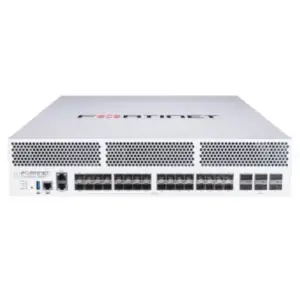
FortiSwitch FS-3032G in Uganda
A 1RU Layer 2/Layer 3 switch built for dense 40GbE and 100GbE data center connectivity, FortiGate-integrated control, and high-capacity enterprise aggregation.
The FS-3032G gives network architects 32 QSFP28/QSFP+ interfaces for 100GE or 40GE links, plus two SFP+/SFP interfaces for 10GE or 1GE connectivity. Its design is aimed at data centers, large campus cores, service-provider environments, and private cloud networks that need very high port bandwidth without expanding into a multi-unit chassis. FourTeck can help Uganda buyers validate the port map, optics, cabling, airflow, management method, and project quantity before quotation.
Dense 100GbE switching for data center and core designs
The Fortinet FS-3032G is a fixed-form-factor data center switch for environments where the network fabric must move large volumes of east-west or north-south traffic with predictable latency. Its primary interface set consists of 32 ports that accept 100GE QSFP28 or 40GE QSFP+ connectivity. Two additional SFP+/SFP interfaces provide 10GE or 1GE connectivity for designs that require lower-speed service, management, or transitional links. Fortinet positions the platform as a Layer 2/Layer 3 switch that can operate with FortiGate switch-controller integration, allowing organizations already invested in the Fortinet Security Fabric to bring switching into a coordinated operational model.
The hardware profile is especially relevant to data center architects who need a large concentration of high-speed optical or direct-attach links in one rack unit. Fortinet publishes a switching capacity of 6,440Gbps for the FS-3032G, packet forwarding performance of 4,000Mpps for 64-byte packets, a 65K MAC address table, a 32MB packet buffer, 8GB DDR4 memory, and sub-microsecond network latency. These figures place the model in a category intended for serious aggregation and fabric workloads rather than general office edge switching.
The switch also supports IPv4 and IPv6 routing, up to 4K VLANs, and link aggregation groups up to the available port count. Such capabilities matter when the unit is used as a leaf, spine, aggregation, or campus-core device because the physical port count alone does not determine suitability. The logical design—routing domains, VLAN scale, redundancy, port channels, failure domains, and management integration—must also match the planned network.
For Uganda buyers, the most important ordering work often happens before the switch itself is quoted. Each 40G or 100G connection may require a specific Fortinet-supported transceiver, direct-attach copper cable, active optical cable, or breakout design. Rack power must accommodate the published maximum consumption, and cooling must match the device’s front-to-back airflow. FourTeck can help translate a topology diagram or port schedule into a practical hardware list, identify configuration-dependent items, and prepare a project quotation without assuming that every deployment uses the same optics or management model.
Why the FS-3032G matters in high-bandwidth networks
Consolidate very high-speed links into one rack unit
Thirty-two 40/100GbE-capable QSFP ports let architects terminate a substantial number of server, storage, leaf, spine, or inter-switch connections without spreading the same port density across several smaller devices. That reduces rack-unit consumption and can simplify the physical topology when the port plan genuinely fits the interface mix.
Build around multi-terabit switching capacity
Fortinet specifies 6.44Tbps switching capacity and sub-microsecond latency. For data-intensive workloads, virtualization clusters, high-throughput storage networks, and backbone aggregation, this headroom helps keep the switching layer aligned with modern 40G and 100G interface speeds rather than creating an avoidable internal bottleneck.
Integrate switching with FortiGate operations
FortiGate switch-controller compatibility is valuable for organizations that want tighter coordination between network access and security operations. The exact management design should be checked against the FortiGate model, FortiOS release, topology, and deployment scale so that centralized control is planned rather than assumed.
Support resilient power architecture
Dual hot-swappable AC power supplies give infrastructure teams a stronger basis for power-path redundancy than a single fixed supply. The benefit is realized only when each PSU is connected to an appropriate and independent rack power path where the site design permits it.
Use Layer 3 capability where the topology requires it
IPv4/IPv6 routing support allows the switch to take a role beyond simple Layer 2 forwarding. This can be useful for routed leaf-spine designs, aggregation boundaries, or campus cores, provided the planned routing protocols, scale, and software capabilities are verified for the intended FortiSwitchOS release.
Create a clearer upgrade path from 40G to 100G
Because the main interfaces support both QSFP+ 40GE and QSFP28 100GE operation, organizations can design migrations that account for existing 40G assets while preparing for 100G uplinks. Compatibility still depends on supported optics, cabling, peer interfaces, and exact breakout requirements.
A fixed 1RU platform focused on bandwidth density, fabric performance, and operational integration.
What distinguishes this model is not a long list of access-edge functions. It is the combination of 32 40/100GbE-capable ports, two additional 1/10GbE SFP interfaces, multi-terabit switching performance, Layer 3 support, dual hot-swappable power, and Fortinet management integration in a compact rack format. For the right data center design, these are practical architectural advantages; for the wrong design, they can become expensive unused capacity. Selection should therefore start with the topology and traffic model.
FortiSwitch 3032G technical profile
| Specification | Confirmed value | Buyer note |
|---|---|---|
| Main network interfaces | 32 × 100GE/40GE QSFP28/QSFP+ | Select compatible optics, DACs, AOCs, or breakouts. |
| Additional interfaces | 2 × 10GE/1GE SFP+/SFP | Useful for lower-speed connectivity requirements. |
| Service port | 1 × 10/100/1000 | Plan management access separately from production links. |
| Console | 1 × RJ-45 serial console | Useful for local setup and recovery workflows. |
| Form factor | 1RU rack mount | Confirm rack depth, airflow, and service clearance. |
| Switching capacity | 6,440Gbps | Vendor-published duplex switching capacity. |
| Packet forwarding | 4,000Mpps at 64-byte packets | Relevant to high packet-rate environments. |
| Network latency | Less than 1µs | Useful in latency-sensitive data center designs. |
| MAC address storage | 65K | Check against expected Layer 2 scale. |
| VLANs supported | 4K | Validate segmentation design and operational limits. |
| Routing | IPv4/IPv6 routing supported | Feature depth can depend on FortiSwitchOS release. |
| Packet buffer | 32MB | Consider traffic burst characteristics and oversubscription. |
| Memory / flash / drive | 8GB DDR4 / 32MB NOR / 128GB SSD | System resources published for this model. |
| Dimensions | 43 × 460 × 438.5mm (H × D × W) | Confirm cabinet depth and cable-management space. |
| Weight | 8.37kg | Useful for rack and logistics planning. |
| Power input | 100–240V AC, 50–60Hz | Confirm PDU connector and local rack-power design. |
| Maximum consumption | 548.94W | Use for conservative capacity and cooling calculations. |
| Power supplies | Dual hot-swappable AC | Separate supply paths where resilience is required. |
| Airflow | Front to back | Match hot-aisle/cold-aisle rack orientation. |
| Operating temperature | 0°C to 40°C | Data center environmental control is important. |
| Published warranty | Fortinet limited lifetime warranty | Terms and regional eligibility should be confirmed for the purchase. |
The specifications that most influence purchase decisions are the interface mix, optics compatibility, switching scale, power and airflow, and management architecture. A 100GbE port on the switch does not by itself guarantee a usable 100GbE link; the transceiver or cable must be supported at both ends, use the correct fiber type or copper reach, and match the peer device’s speed and breakout mode. The same applies when reusing 40GbE QSFP+ assets during a migration.
Power planning deserves equal attention. The maximum consumption figure is useful for conservative rack and UPS sizing, while dual hot-swappable supplies are most valuable when connected to independent protected power paths. Cooling should be designed around the stated front-to-back airflow so that the switch aligns with the rack row’s thermal design. Finally, management method can change licensing and operational requirements. Organizations using FortiGate integration should verify FortiGate and FortiSwitchOS compatibility; organizations considering FortiEdge Cloud should confirm the current cloud-management subscription and support requirements for this product family.
Five questions to settle before requesting a quote
01 What workload and topology will the switch carry?
Define whether the unit will operate as leaf, spine, aggregation, data center core, campus core, or a high-speed interconnect. This changes the required routing behavior, oversubscription ratio, redundancy design, peer devices, and whether every main port truly needs 100GbE operation.
02 How many 40G and 100G links are required now and later?
A port count should include production links, redundant paths, future server or storage growth, inter-switch links, and reserved capacity. This determines whether the 32-port layout is efficient or whether another FortiSwitch platform would better match the actual network scale.
03 Which optics, fibers, DACs, and peer interfaces already exist?
Compatibility is often the largest practical buying risk. Share transceiver models, fiber type, connector type, link distance, switch/server/storage models at the far end, and any breakout requirement. This helps avoid ordering expensive optics that cannot operate in the planned link.
04 How will management, security integration, and growth be handled?
Decide whether the switch will be managed independently, through a compatible FortiGate deployment, or through a relevant cloud-management option. Also document expected routing scale, VLAN growth, link aggregation, and lifecycle expectations so the design is not constrained shortly after deployment.
05 What are the rack, power, delivery, and support expectations?
Confirm rack depth, available RU space, front-to-back airflow alignment, dual power feeds, PDU connectors, UPS capacity, project timeline, quantity, site location, and desired support coverage. These details influence the complete bill of materials and delivery plan.
Where this platform can make operational sense
Private cloud and virtualization fabrics
Organizations consolidating compute into dense virtualization clusters may need multiple 40G or 100G links between servers, storage, and the fabric. The FS-3032G can fit leaf, spine, or aggregation roles when the port count and forwarding design match. The buyer must still verify NIC speeds, transceivers, breakouts, routing protocols, oversubscription targets, and redundancy across separate switches.
High-throughput storage interconnection
Backup platforms, distributed storage, data analytics, and high-performance storage clusters can generate sustained east-west traffic. Dense 100GbE interfaces and sub-microsecond latency make the model relevant to such environments, but storage-protocol requirements and peer-device interoperability must be evaluated. The switch should be part of an end-to-end bandwidth plan rather than treated as an isolated upgrade.
Enterprise aggregation and campus core
A large institution with several distribution blocks may use high-speed fiber aggregation to bring multiple network zones into a central routing layer. The 32 40/100G ports can provide substantial aggregation density. Buyers should map VLANs, Layer 3 boundaries, fiber distances, redundancy, and existing FortiGate architecture before selecting optics and deciding whether the device belongs in the core or data center fabric.
Service-provider or hosting infrastructure
Hosting and managed-service environments often require many high-bandwidth connections between compute racks, security gateways, storage systems, and upstream network equipment. The FS-3032G may suit an internal high-speed fabric when the required features and port density align. Project teams should confirm routing scale, maintenance approach, spares strategy, and support coverage as part of the operational design.
40G/100G port density changes how you design the fabric
Thirty-two QSFP-class interfaces in 1RU create useful architectural possibilities, but high port density only produces value when the topology is planned around it. In a leaf-spine fabric, for example, some ports may connect downward to servers or storage while others form uplinks to spine switches. In an aggregation role, a large proportion of ports may be used for downstream distribution blocks while selected links connect to security, core, or data center resources. The balance between those roles determines the oversubscription ratio and how much spare capacity remains for growth.
QSFP28 and QSFP+ are also physical form-factor families rather than a guarantee that every module will work in every scenario. A 100G link may use single-mode or multimode fiber, direct-attach copper, or active optical cabling depending on distance and equipment. Breakout designs can introduce additional considerations around lane mapping and supported configuration. For an organization migrating from 40G, the ability to operate main interfaces at 40GE can provide a transitional path, but compatibility should be checked rather than inferred from connector shape alone.
FourTeck’s procurement role is most useful when the customer supplies the intended port map and link distances. That information allows the quote to account for the switch plus the real connection method for every critical path. It also reduces the risk of purchasing a high-capacity switch while underestimating the cost, lead time, or compatibility requirements of the optics that make the network functional.
Performance is more than a headline port speed
Fortinet’s published system figures—6.44Tbps switching capacity, 4,000Mpps packet forwarding at 64-byte packets, a 32MB packet buffer, and network latency below one microsecond—help position the switch for demanding data center traffic. These values matter because a high-speed interface needs an internal switching architecture capable of sustaining the intended workload. Still, architects should evaluate real traffic patterns, redundancy, routing features, packet sizes, and oversubscription rather than treating a single capacity number as the whole design.
The operational question is whether the complete network preserves those advantages. Slow server NICs, mismatched optics, constrained upstream firewalls, underpowered storage, oversubscribed links, or incorrect hashing across aggregated links can shift the bottleneck elsewhere. Buyers should therefore evaluate the switch in the context of the end-to-end data path. A FourTeck quote can be prepared around that architecture rather than around the switch SKU alone.
Power, cooling, and management are part of the network design
A data center switch cannot be selected purely by interface count. The FS-3032G is a 1RU device with dual hot-swappable AC power supplies, front-to-back airflow, a published maximum consumption of 548.94W, and an operating range of 0°C to 40°C. Those facts affect rack placement, PDU capacity, UPS planning, thermal design, and maintenance procedures. For resilient deployment, the two power supplies should be mapped to appropriate independent protected feeds where the facility supports that design.
Management decisions are equally important. FortiGate switch-controller compatibility can be valuable for organizations standardizing on Fortinet, while cloud-management options may suit other operational models. The current software, subscription, and support requirements should be confirmed against the intended management path. A switch that is technically capable but operationally awkward to monitor, upgrade, or troubleshoot can add avoidable lifecycle cost.
Buyer decision checklist
- Does rack airflow run front to back in the intended cabinet row?
- Are two suitable AC power paths and protected PDU outlets available?
- Has the UPS and cooling budget included the switch at conservative load?
- Is the planned FortiGate or standalone management model supported?
- Have software version, support coverage, and cloud-management requirements been checked?
- Is there a documented maintenance window and spare strategy for critical deployments?
What buyers should check before purchase
Another important check is whether the FS-3032G is the correct member of the FortiSwitch family for the intended access speed. If the design primarily requires 25GbE server ports with a smaller number of 100GbE uplinks, a platform such as the FortiSwitch 2048F may map more directly to the workload. If the requirement centers on 10GbE access with 100GbE uplinks, a FortiSwitch 1000-series model may be more suitable. The correct choice depends on the actual port matrix, not on choosing the model with the highest headline speed.
Plan the Uganda purchase around the complete network bill of materials
Availability for enterprise data center switches, specific transceivers, support services, and project quantities can vary. FourTeck can prepare a tailored quotation for Uganda buyers after reviewing the required switch quantity, interface speeds, optics, cabling, power accessories, management design, and preferred support coverage. This is particularly important for the FS-3032G because the connection components can represent a significant part of the deployment and may differ for each link type.
For projects in Kampala or other Uganda locations, FourTeck can assist with configuration review, quote preparation, delivery coordination, warranty guidance based on the applicable Fortinet terms, and quantity planning. No availability assumption should be made until the requested hardware and accessory combination is checked for the project.
Uganda location coverage
FourTeck can coordinate business technology enquiries and project quotations for customers in Kampala, Entebbe, Jinja, Mbarara, and Gulu as part of wider Uganda coverage. For a data center switch project, share the destination location together with rack readiness, quantity, transceiver requirements, and project schedule so delivery planning can be considered alongside the technical configuration. Location coverage does not imply immediate local stock; availability and logistics are confirmed against each quotation.
Support for cross-border and regional IT projects
Organizations operating across Uganda and Kenya, or across selected East Africa and Africa markets, may need to standardize a network design while coordinating procurement through multiple project locations. FourTeck can help review a common bill of materials, identify configuration differences between sites, and prepare enquiries through its regional web properties where appropriate. This can be useful for customers who want a consistent Fortinet switching architecture but have different rack, fiber, or delivery requirements from one site to another.
Regional enquiries can also be directed through FourTeck Kenya, FourTeck Africa, FourTeck UAE, or FourTeck Kuwait when those markets are relevant to the project. Branch presence, local stock, delivery time, and warranty handling should not be assumed; each requirement is reviewed against the applicable destination and quotation.
Build the quote around the right Fortinet switching tier
Practical assistance from requirement to quotation
01
02
03
04
05
06
FortiSwitch 3032G buyer questions
01. What is the FortiSwitch 3032G mainly used for?
It is designed for high-capacity data center and enterprise switching where many 40GbE or 100GbE links are required in a compact 1RU platform. Typical roles can include leaf, spine, aggregation, data center core, or high-speed campus core. The correct role depends on topology, routing requirements, traffic patterns, peer equipment, and redundancy design rather than port speed alone.
02. How many 100GbE ports does the FS-3032G provide?
The switch provides 32 QSFP28/QSFP+ ports supporting 100GE or 40GE operation. It also has two SFP+/SFP interfaces supporting 10GE or 1GE. Actual link deployment requires compatible transceivers or cables at both ends, and some architectures may use different speeds or breakout designs depending on the server, storage, and upstream equipment.
03. Does the switch include the QSFP28 transceivers I need?
Transceiver requirements should be treated as configuration dependent. The correct module or cable depends on link speed, distance, fiber type, connector, breakout requirements, and the interface at the far end. Before quotation, provide a port schedule and link distances so FourTeck can help identify the appropriate Fortinet-compatible optics or direct-attach options for the intended deployment.
04. Can the FS-3032G be managed through FortiGate?
Fortinet describes the FS-3032G as FortiGate switch-controller compatible. The specific deployment should still be checked against the intended FortiGate model, FortiOS version, FortiSwitchOS release, topology, and scale. This review is important because centralized management capabilities and supported designs can evolve with software releases and platform combinations.
05. Does it support Layer 3 routing?
Yes. Fortinet lists IPv4 and IPv6 routing support for the model, alongside Layer 2 functions such as VLANs and link aggregation. For a routed leaf-spine, aggregation, or core design, confirm the exact routing protocols, route scale, resiliency features, and software support required by your architecture before finalizing the configuration.
06. What power and cooling considerations should we plan for?
The switch uses dual hot-swappable AC power supplies, accepts 100–240V AC at 50–60Hz, has a published maximum consumption of 548.94W, and uses front-to-back airflow. Rack design should align with that airflow direction, while PDU and UPS capacity should account for the device conservatively. Independent power paths can improve resilience where the facility supports them.
07. Is the FortiSwitch FS-3032G available in Uganda?
FourTeck can prepare Uganda quotations for the FS-3032G and related Fortinet network requirements. Availability can vary by quantity, support option, transceiver type, and project timing, so it is confirmed against the requested configuration rather than assumed. Share your deployment location, quantity, optics list, and required timeframe for a more useful availability and delivery discussion.
08. What information should I send to get an accurate quote?
Provide the number of switches, intended network role, required 40G and 100G connections, link distances, fiber type, desired transceivers or DAC/AOC cables, peer-device models, rack and power details, management method, support expectations, destination, and project schedule. A topology diagram is highly useful because it lets the configuration discussion follow the actual network rather than a generic product list.
09. What alternatives should I consider if I do not need 32 100G ports?
Within the FortiSwitch data center family, a different model may fit better if your access-port speed is mainly 10GbE or 25GbE and only the uplinks require 100GbE. The FortiSwitch 1048G and 2048F are examples of different port mixes. FourTeck can compare these options against your server, storage, and aggregation requirements before quotation.
10. What warranty applies to the FS-3032G?
Fortinet’s current data center switching datasheet lists a limited lifetime warranty for the model. Warranty eligibility, process, regional terms, and any additional FortiCare support services should be reviewed for the actual purchase. For critical infrastructure, buyers may also want to discuss support response expectations and spare strategy rather than relying on the base warranty alone.
Prepare a Fortinet data center switch quote around your real topology
For a useful FS-3032G quotation, start with the network rather than the SKU. Share the planned switch quantity, port speeds, link distances, optics or cabling preference, peer equipment, FortiGate integration, rack power, airflow, destination, and project timing. FourTeck can use those details to review the configuration and prepare a tailored Uganda quotation that includes the components required to make the design deployable.
- Switch quantity and network role
- 40G/100G port schedule
- Optics, DAC/AOC, and fiber details
- FortiGate or cloud-management plan
- Rack power and airflow information
- Delivery location and project timeline
Reviews
There are no reviews yet.