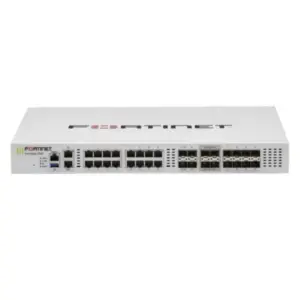
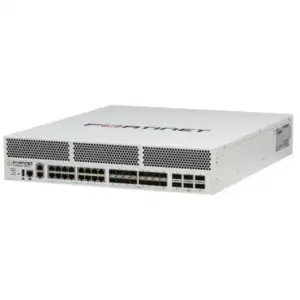
FortiSwitch FS-3032E in Uganda
A dense 32-port 100GbE/40GbE switch for enterprise core, aggregation and data-center architectures.
The FS-3032E is built for network designs where high-speed east-west and north-south traffic must converge through a compact 1RU platform. Fortinet publishes 6.4 Tbps duplex switching capacity, 5,952 Mpps forwarding performance and less than 1 microsecond network latency. FourTeck can assist Uganda buyers with topology review, optics and breakout planning, management choices, redundancy requirements and quotation.
High-density switching for the network core
FortiSwitch FS-3032E is intended for demanding campus-core and data-center roles rather than ordinary edge access. Its defining characteristic is a bank of 32 QSFP28/QSFP+ network interfaces capable of 100 Gigabit Ethernet or 40 Gigabit Ethernet operation. That density allows architects to aggregate many downstream switches or create high-capacity inter-switch links while retaining a compact rack footprint.
Fortinet uses the model in published large-campus and enterprise data-center reference designs. In a FortiLink data-center example, the FS-3032E is selected as a tier-1 switch because its 32 100GbE ports can aggregate tier-2 switches that serve 25GbE and 10GbE server connectivity. In campus reference architecture, Fortinet describes the same platform as a core-layer option where numerous 100GbE aggregation connections and high-speed links toward FortiGate devices are required.
The operational value is not simply raw bandwidth. Core infrastructure must accommodate traffic concentration, resilient paths and future growth without turning every network expansion into a chassis replacement. A 6.4 Tbps duplex switching capacity and high-density 100GbE interface layout give designers room to construct redundant uplinks and aggregation paths appropriate to the workload.
Selection still requires engineering. A QSFP-based switch depends on the correct optical transceivers, direct-attach cables or breakout assemblies. Link distances, fiber type, connector standards, peer-device capabilities and desired speeds must all agree. FourTeck can use those details to help Uganda buyers develop a more accurate bill of materials instead of quoting the switch as an isolated component.
What the platform changes for an enterprise network
Consolidate high-speed aggregation
Thirty-two 100G/40G interfaces provide substantial density for connecting aggregation switches, firewalls and other high-speed infrastructure. The business benefit is a cleaner core design with fewer devices required merely to obtain sufficient uplink ports.
Build around 6.4 Tbps switching capacity
Fortinet specifies 6,400 Gbps duplex switching capacity. For architects, that supports a high-capacity core where bandwidth planning can focus on actual topology and traffic patterns rather than a low switching ceiling.
Use breakout links where the design requires them
Fortinet documents split-port operation that can turn a 100G QSFP28 interface into four 25G links, or a 40G QSFP interface into four 10G links. This provides useful interface flexibility when connecting equipment with different high-speed port types.
Support resilient infrastructure planning
Dual hot-swappable AC power supplies and field-serviceable components help the switch fit redundant network designs. Resilience still depends on complete architecture, including upstream power, dual paths and peer-device configuration.
Keep core capacity in a 1RU footprint
The rack-mount chassis measures approximately 43 × 460 × 438.5 mm. Dense switching in one rack unit can be valuable in data centers and communications rooms where rack allocation is tightly controlled.
Choose a management model that fits the architecture
FortiSwitch platforms can operate standalone or be managed through supported Fortinet approaches including FortiGate/FortiLink, FortiEdge Cloud or FortiSwitch Manager. Confirm current software compatibility and licensing for the intended deployment.
The FS-3032E is most compelling when a design genuinely needs many high-speed links at the core.
It is not an edge switch with ordinary copper access ports. Its value comes from dense QSFP connectivity, high switching capacity, low published latency and the ability to participate in Fortinet enterprise switching architectures.
100GbE/40GbE high-speed network interfaces.
Published duplex packet forwarding performance at 64-byte packets.
Published network latency suited to performance-sensitive core roles.
Supports 4 × 25G from 100G mode or 4 × 10G from 40G mode, subject to documented configuration rules.
FortiSwitch 3032E specification ledger
| Field | Published specification |
|---|---|
| Network interfaces | 32 × 100G/40G QSFP28/QSFP+ ports |
| Service port | 1 × 10/100/1000 service port |
| Console | 1 × RJ-45 serial console port |
| Form factor | 1RU rack mount |
| Switching capacity | 6,400 Gbps duplex |
| Packet forwarding | 5,952 Mpps duplex, 64-byte packets |
| MAC address storage | 72K |
| Network latency | Less than 1 microsecond |
| VLANs supported | 4K |
| IPv4 / IPv6 routing | Supported |
| Queues per port | 8 |
| Packet buffer | 16 MB |
| Memory / flash / drive | 8 GB DDR3 / 128 MB NOR / 128 GB SSD |
| Dimensions | 43 × 460 × 438.5 mm (H × D × W) |
| Weight | 8.77 kg |
| Power input | 100–240V AC, 50–60 Hz |
| Maximum power consumption | Up to 463.8 W |
| Power supplies | Dual hot-swappable AC |
| Airflow | Front to back |
| Operating temperature | 0°C to 40°C |
What matters most when buying: port density alone does not define a usable core. Buyers should map every intended link by speed, media type, distance and peer interface. The 32 physical QSFP interfaces provide excellent 100G/40G density, while documented breakout modes create additional 25G/10G possibilities. However, breakout configuration has platform-specific rules and can affect how ports are allocated, so the final topology should be checked against the current FortiSwitchOS documentation.
Power and cooling deserve equal attention. A maximum consumption figure approaching 464 W, front-to-back airflow and a 1RU chassis mean rack placement should follow the data center’s cold-aisle/hot-aisle plan and available power distribution. Dual hot-swappable AC supplies support resilient designs, but true power redundancy requires the supplies to be connected to appropriately independent upstream sources where the site design permits. Finally, management mode should be decided before commissioning: standalone switching and Fortinet-managed architectures have different operational workflows, integration considerations and software requirements.
Five questions to settle before requesting a bill of materials
01 — What traffic must the core carry?
Estimate current and expected aggregate traffic between access or aggregation layers, server networks, storage, security appliances and upstream services. A design that needs many 100GbE paths is fundamentally different from one whose traffic can be served by a smaller 10/25GbE platform. This answer establishes whether the FS-3032E’s density and switching capacity are proportionate to the workload.
02 — How many 100G, 40G, 25G and 10G links are required?
Count physical links and redundant paths, not just devices. Breakout can increase logical connectivity, but the exact port configuration must follow Fortinet’s supported rules. Document each peer device and required speed so the optical and cable list can be validated.
03 — What must interoperate with the switch?
Record FortiGate models, downstream FortiSwitch units, third-party switches, servers, NICs, optical standards, fiber plant and rack infrastructure. Compatibility problems are frequently caused by optics, media or speed negotiation rather than switching capacity.
04 — What growth and management model is planned?
Decide whether spare 100G interfaces are needed for future aggregation and whether the switch will run standalone or within a supported Fortinet management architecture. Software versions and feature requirements should be checked against current documentation.
05 — What are the installation and support expectations?
Confirm rack depth, airflow direction, AC feeds, transceiver quantities, patching, commissioning responsibilities, required documentation, project schedule and warranty expectations. These practical items influence the completeness of the quote.
Quote preparation: send FourTeck the required quantity, target topology, peer-device models, link speeds, fiber or copper media, approximate link distances, redundancy design, management preference and desired project timeline.
Where the FS-3032E earns its place
Enterprise campus core
A large campus may have several distribution or aggregation blocks feeding a redundant core. Fortinet’s switching reference architecture specifically presents FS-3032E as a core-layer platform because its many 100GbE ports can connect aggregation switches while retaining high-speed connectivity toward core FortiGate devices. The fit is strongest when the campus has enough high-bandwidth uplinks to justify this density. Buyers should calculate redundant links and growth ports, then verify the optical design for every building or data-room connection.
Tier-1 data-center aggregation
Fortinet’s enterprise data-center deployment guidance uses the model at tier 1 to aggregate tier-2 switches. This is a practical fit for environments where server-facing switches provide 25GbE or 10GbE access while the tier-1 fabric needs 100GbE uplinks. The design should consider link redundancy, firewall connectivity and convergence behavior rather than treating the tier-1 switch as a standalone appliance.
High-bandwidth firewall aggregation
Organizations with large FortiGate platforms and substantial internal traffic can use high-speed switch links to avoid constraining the security layer with low-capacity interconnects. The correct topology depends on FortiGate model, interface availability, HA design and whether traffic is routed or switched at particular layers. FourTeck can help translate those architectural details into an equipment and optics list.
Mixed 100G and lower-speed infrastructure
Breakout support can be valuable where the core needs to connect both 100G infrastructure and devices that use 25G or 10G links. This is not a reason to assume every port can be divided arbitrarily. The current Fortinet split-port guidance should be used to build the exact port map before cables are ordered.
100GbE density changes how the core can be designed
At the center of a large network, interface density determines how many aggregation blocks can connect directly and how much bandwidth can be reserved for redundancy. The FS-3032E provides 32 physical 100G/40G QSFP interfaces. In a campus or data-center design, that creates room for numerous high-capacity uplinks without immediately adding another switching layer simply to gain ports.
Fortinet’s reference material illustrates the architectural purpose clearly: in the enterprise data-center example, tier-2 switches use 100GbE uplinks toward FS-3032E units at tier 1. That allows lower layers to serve 25GbE and 10GbE server connections while the backbone between switching tiers runs at a higher speed. In a campus reference design, Fortinet similarly positions the model where many aggregation switches need 100GbE connectivity to the core.
For a buyer, the key calculation is therefore not “32 ports sounds large.” It is the number of active and redundant high-speed paths required on day one, plus sensible headroom for expansion. Count connections to aggregation switches, peer core switches, firewalls and other backbone devices. Then map whether each path is 100G, 40G or a breakout requirement. This produces a defensible port budget and helps avoid both overbuying and under-sizing.
Breakout flexibility can bridge different interface generations
Fortinet documents split-port operation on the FS-3032E. When an interface is configured for 100G QSFP28 operation, it can be split into four 25G links; when configured for 40G QSFP operation, it can be split into four 10G links. This is useful in networks where the backbone is moving toward 100GbE while some downstream equipment remains at 25GbE or 10GbE.
The capability can reduce the need for a separate intermediate switch solely to obtain lower-speed optical ports. It can also help during phased migrations, allowing a high-capacity chassis to connect equipment from more than one interface generation. However, breakout must be planned carefully. A split interface changes the port map, requires the correct breakout cable or optical arrangement and must be supported by the peer equipment. Fortinet also documents platform-specific rules governing the number and arrangement of ports in split configurations.
For procurement, treat every breakout connection as a complete link requirement: parent port, desired child-port speed, cable type, optical specification, fiber type, connector and peer port. That information should be checked before the order is finalized.
Documented split option: 4 × 25G.
Documented split option: 4 × 10G.
Match breakout hardware and peer interfaces before ordering.
Resilience is an architecture, not a checkbox
The FS-3032E includes dual hot-swappable AC power supplies, a useful hardware foundation for redundant deployments. Fortinet’s campus reference material also discusses redundant core switching and highlights the model’s integrated dual AC supplies and field-replaceable fans. Yet hardware redundancy only becomes meaningful when the surrounding design avoids single points of failure.
For power, that can mean connecting each supply to appropriately separate upstream power sources or PDUs according to the site’s electrical design. For networking, it means considering dual core switches, diverse links, cross-links and redundant firewall paths where the availability requirement justifies them. Fortinet’s data-center deployment guidance recommends cross-links in relevant topologies to improve convergence for mission-critical connectivity.
Cooling is another operational dependency. The switch uses front-to-back airflow and Fortinet publishes maximum power consumption of up to 463.8 W and heat dissipation of 1,582.5 BTU/h. Rack placement should therefore align with the room’s airflow plan. These details are especially important when a dense project adds multiple high-performance switches to an existing rack row.
Buyer decision checklist
□ Are two independent AC feeds available where required? □ Does rack airflow run front to back? □ Are redundant switching paths planned? □ Are spare optics and cables part of the support strategy? □ Has the current FortiSwitchOS compatibility matrix been reviewed? □ Is the commissioning responsibility clearly assigned?
What buyers should check before purchase
| Risk | What to confirm | Why it matters | What to share with FourTeck |
|---|---|---|---|
| Wrong speed mix | Required 100G/40G/25G/10G links | Determines port and breakout plan | Port schedule and topology |
| Optics mismatch | Media, distance and peer interface | Incorrect optics can prevent links coming up | Fiber type, distance, device models |
| Incomplete resilience | Dual power and network paths | A redundant PSU alone does not remove other single points of failure | Power and HA design |
| Management mismatch | Standalone or Fortinet-managed operation | Changes deployment workflow and compatibility checks | FortiGate model and software environment |
Additional checks should cover rack space, front-to-back cooling, cable management, available AC capacity, transceiver spares, firmware planning, commissioning ownership, warranty expectations and project quantities. For replacement projects, provide the existing switch model and the reasons for replacement; this helps determine whether a like-for-like high-density core remains appropriate or whether a newer FortiSwitch generation should be considered.
Plan the Uganda order around the complete network design
FourTeck can support Uganda organizations that are evaluating the FS-3032E for campus, data-center or backbone projects. Availability can vary with sourcing, quantity and the required accessories, so quotation should cover the complete deployment rather than assuming the chassis alone is sufficient. A useful request includes switch quantity, QSFP optics or DAC requirements, breakout cables, peer equipment, rack power expectations and the target management architecture.
For Kampala projects, FourTeck can assist with configuration review, quotation and delivery coordination based on the confirmed project scope. Warranty guidance can be provided against the applicable product and supply terms; buyers should request the exact warranty basis on the commercial quotation rather than relying on a generic assumption. Larger rollouts should also identify whether equipment is needed in one phase or across several project stages.
Across Uganda, delivery and project coordination should be discussed against the destination, quantities and procurement schedule. No stock position or delivery time is implied until confirmed in a quotation.
Uganda location coverage
Organizations planning network infrastructure in Kampala, Entebbe, Jinja, Mbarara and Gulu can contact FourTeck with the same technical information: required quantity, topology, port speeds, link distances and deployment schedule. Location affects delivery coordination, while the technical bill of materials remains driven by the network design. For multi-site projects, provide the quantity and configuration required at each destination so the quotation can distinguish common core components from site-specific optics, cabling or accessories.
East Africa and regional project planning
Organizations coordinating infrastructure across Uganda, Kenya or selected East Africa markets can use FourTeck’s regional web presence to discuss multi-country requirements. The practical advantage of a consolidated project brief is consistency: switch models, optics, cable standards, software assumptions and spare strategy can be documented centrally while destination-specific supply arrangements are confirmed separately.
For broader Africa projects, buyers can also consult FourTeck’s Africa presence. Projects connected with the UAE or Kuwait can use the relevant regional FourTeck sites when those markets form part of the procurement scope. Regional availability, delivery arrangements and warranty handling should always be confirmed for each destination rather than inferred from another market.
FourTeck Uganda | FourTeck Kenya | FourTeck Africa | FourTeck UAE | FourTeck Kuwait
Build the surrounding Fortinet switching architecture
FortiSwitch FS-2048F — suited to high-density 25GbE server-facing tiers with 100GbE uplinks in data-center designs. Ask FourTeck to compare it as a tier-2 companion to the FS-3032E.
FortiSwitch FS-1024E — provides 10GbE SFP/SFP+ connectivity with 100GbE uplinks, useful where downstream infrastructure is predominantly optical 10GbE.
FortiSwitch FS-T1024E — relevant where the server or infrastructure layer uses 10GBASE-T copper while the aggregation design requires 100GbE uplinks.
FortiSwitch FS-3032G — a newer high-density 100GbE model that may be worth reviewing for new projects; exact feature and lifecycle requirements should be compared before selection.
Ask FourTeck to compare FortiSwitch core and data-center options
Procurement support that starts with the topology
01 Product selection guidance. Share the workload and topology so the discussion can determine whether this 32-port 100GbE class is appropriate rather than selecting solely by model name.
02 Configuration review. Port speeds, breakout requirements, optics, cables and peer devices can be documented before the quote is finalized.
03 Quote assistance. A project quotation can account for the switch and relevant connectivity components, quantities and destination requirements.
04 Business IT context. Core switching is part of a larger architecture involving firewalls, server access, storage traffic, power and rack infrastructure; those dependencies can be considered during product discussion.
05 Uganda coordination. Delivery planning can be discussed once product sourcing, project quantities and destination details are confirmed.
06 Alternative matching. If the port density, interface generation or project lifecycle points toward another FortiSwitch model, FourTeck can quote suitable alternatives based on the stated requirement.
FortiSwitch 3032E buying questions
01. What is the FortiSwitch FS-3032E primarily used for?
It is a high-density campus-core and data-center switch. Its 32 100G/40G QSFP interfaces make it suitable for aggregating multiple high-speed switches, connecting core security infrastructure and building tier-1 switching layers. It is generally a better fit for backbone roles than for ordinary user access because it does not center on conventional copper edge ports.
02. Does the FS-3032E support 25GbE and 10GbE?
Yes, through documented split-port configurations. Fortinet states that a 100G QSFP28 port can be split into four 25G links and a 40G QSFP port can be split into four 10G links. The exact port allocation rules, breakout hardware and peer-device compatibility should be checked against the current FortiSwitchOS documentation before the bill of materials is ordered.
03. What switching performance does Fortinet publish?
Fortinet specifies 6,400 Gbps duplex switching capacity and 5,952 Mpps duplex packet forwarding performance for 64-byte packets, with published network latency below one microsecond. These figures explain why the platform appears in Fortinet reference architectures for high-capacity core and data-center roles. Actual network results depend on topology, traffic and configuration.
04. Can it be managed by FortiGate?
FortiSwitch products support FortiGate-managed deployment through FortiLink where the relevant platform and software requirements are met, and Fortinet publishes enterprise data-center examples using FS-3032E with FortiGate. Buyers should provide their FortiGate model, FortiOS version and intended topology so current compatibility and deployment guidance can be reviewed.
05. What accessories should be planned with the switch?
The most important accessories are usually the QSFP28/QSFP+ transceivers, direct-attach cables or breakout assemblies required by the topology. Exact parts depend on speed, fiber type, link distance, connector type and peer equipment. Rack power, patching and cable-management requirements should also be included. FourTeck can review these inputs during quote preparation.
06. Does the switch include redundant power?
Fortinet specifies dual hot-swappable AC power supplies for the FS-3032E. That provides a hardware basis for power resilience, but the deployment must still provide suitable upstream power diversity if true redundancy is required. Buyers should also account for the published maximum consumption of up to 463.8 W and front-to-back airflow when planning rack power and cooling.
07. Is the FS-3032E suitable for a large campus core?
Yes, where the campus design genuinely requires numerous 100GbE aggregation links. Fortinet’s switching reference architecture presents the model as a core-layer platform and highlights its 32 100GbE ports, 6.4 Tbps capacity and redundant power characteristics. The final choice should still be based on aggregation count, firewall links, resilience and future growth.
08. How should Uganda buyers prepare for a quotation?
Provide the switch quantity, required port speeds, peer-device models, link distances, fiber or DAC preferences, breakout needs, FortiGate details if applicable, rack power information and destination. For multi-site projects, identify quantities per site. This lets FourTeck discuss a complete configuration rather than supplying a chassis quote that omits essential connectivity components.
09. Should a new project also consider the FS-3032G?
It can be sensible to compare the FS-3032G for a new design because Fortinet currently lists it alongside the FS-3032E in its campus-core and data-center range. The right choice depends on required interfaces, performance, software support, project standards, lifecycle expectations and commercial availability. FourTeck can quote or compare current options after receiving the topology.
Turn the core-switch requirement into a complete quote
Send FourTeck your topology, quantity, required link speeds, peer-device models, link distances, optics or breakout requirements, management preference and project destination. The team can use those details to review the requested configuration and prepare a Uganda quotation subject to current availability and commercial terms.
Share: quantity • 100G/40G/25G/10G port plan • optics and fiber details • FortiGate model • redundancy plan • rack/power constraints • delivery destination.