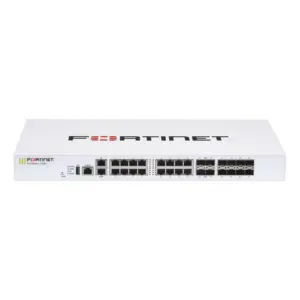
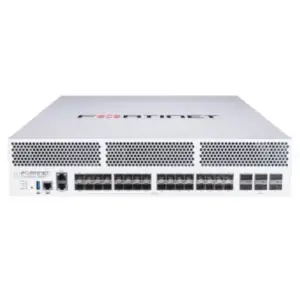
FortiSwitch FS-348G-FPOE in Uganda
A 48-port Layer 2/3 FortiGate-controller-compatible access switch combining 1GE and 2.5GE copper access, 10GE SFP+ uplinks, IEEE 802.3bt PoE and MACsec.
Built for demanding business access layers, the FS-348G-FPOE gives network designers a practical way to connect conventional Gigabit endpoints alongside newer multigigabit devices while supplying substantial PoE capacity. It is especially relevant where wireless access points, cameras, phones and other powered devices share the same switching infrastructure.
A high-density access switch for mixed-speed enterprise edges
The FS-348G-FPOE sits in Fortinet’s FortiSwitch 300 series and addresses a common access-layer transition: organisations still have large numbers of 1GbE endpoints, yet newer Wi-Fi access points and other high-throughput devices can benefit from multigigabit copper. Rather than forcing every access port into one speed tier, this model provides 24 standard 1GE RJ45 ports and 24 2.5GE RJ45 ports. That combination can help an IT team place higher-bandwidth devices where they add value while retaining ample connectivity for conventional clients.
The switch is specified as Layer 2/3 and compatible with FortiGate switch controller operation. Fortinet documentation also supports FortiSwitch deployment in standalone mode or through FortiGate, FortiEdge Cloud or FortiSwitch Manager, depending on the chosen architecture and applicable product capabilities. This management choice matters because the switch should be evaluated as part of the broader network operating model rather than as an isolated port count.
Power delivery is another defining part of the product. IEEE 802.3bt capability and a maximum 1540W PoE output limit make the unit suitable for designs with many powered endpoints, but the actual requirement must be calculated from the devices being connected. A network with phones and basic cameras has a different power profile from one populated with high-performance wireless access points, PTZ cameras or other higher-draw equipment.
Four 10GE SFP+ uplinks provide fibre or compatible high-speed interconnect options. Optics are selected according to media type, distance and the equipment at the other end of the link, so they should be treated as part of the design rather than assumed to be universal accessories. MACsec capability further strengthens the model’s relevance where supported link encryption forms part of the network design.
What the architecture can deliver
Preserve Gigabit capacity while adding multigigabit access
Twenty-four 1GE ports serve ordinary wired endpoints while twenty-four 2.5GE ports can be assigned to devices that need more bandwidth. This supports a staged access-layer refresh without requiring every connected device to justify multigigabit capability.
Power a dense endpoint estate
The published maximum 1540W PoE output limit and 802.3bt support are important where many devices receive data and power through Ethernet. Correct power planning can reduce reliance on individual endpoint power adapters while keeping the switching layer central to the deployment.
Build faster uplinks from the access layer
Four 10GE SFP+ interfaces provide options for connecting upstream switching, fibre runs or other compatible infrastructure. The correct transceivers and fibre type must be selected for the link design.
Align switching with Fortinet operations
FortiGate controller compatibility can be valuable to organisations already building around the Fortinet Security Fabric. Management architecture should be confirmed before procurement so operational ownership and configuration workflows are clear.
Support link-security requirements
MACsec is a confirmed capability of the model. Where encrypted Ethernet links are required, engineers should verify the complete end-to-end compatibility and intended topology rather than treating a single switch feature as sufficient by itself.
Designed around the modern access-layer bottleneck
The strongest reason to shortlist this model is the combination of mixed-speed copper, high PoE capacity and 10GE uplinks in one access switch. It lets buyers address wireless and powered-device growth without abandoning conventional Gigabit endpoints.
48 copper access interfaces: 24 x 1GE RJ45 plus 24 x 2.5GE RJ45 provide deliberate placement of standard and multigigabit clients.
High-power PoE architecture: IEEE 802.3bt support with a maximum published 1540W PoE output limit can serve demanding powered-device projects when correctly sized.
Four 10GE SFP+ uplinks: higher-speed upstream connectivity can be designed around compatible optics and fibre.
Layer 2/3 and FortiGate controller compatibility: supports enterprise switching roles and integration choices within Fortinet environments.
MACsec: provides a link-encryption capability for compatible designs where this control is required.
Confirmed purchasing specifications
| Specification | FS-348G-FPOE | Buyer relevance |
|---|---|---|
| Product class | Layer 2/3 secure access switch | Enterprise access and distribution planning |
| 1GE access | 24 x 1GE RJ45 | Standard wired endpoints |
| Multigigabit access | 24 x 2.5GE RJ45 | Higher-bandwidth copper endpoints |
| Uplinks | 4 x 10GE SFP+ | Fibre/high-speed upstream links; optics selected separately as required |
| PoE standard | IEEE 802.3bt | Supports higher-power PoE device classes subject to endpoint requirements |
| PoE output limit | Maximum 1540W | Requires project-level power-budget calculation |
| Link security | MACsec | Relevant to compatible encrypted-link designs |
| FortiGate controller | Compatible | Useful in Fortinet-managed network architectures |
| Management choices | FortiSwitch supports standalone, FortiGate, FortiEdge Cloud or FortiSwitch Manager approaches; confirm exact deployment requirements | Impacts operations, licensing/support and architecture |
| Support | FortiCare options are separate/configuration dependent | Confirm term and service level in the quote |
The most consequential numbers are the split between 1GE and 2.5GE ports, the PoE ceiling and the 10GE uplink count. A 48-device project is not automatically a perfect match: the endpoint map must show that no more than 24 devices require 2.5GE at the access layer, or the design must account for additional switching. Likewise, the 1540W figure is an aggregate maximum rather than a reason to ignore per-device requirements. Calculate expected and worst-case consumption for each powered endpoint and retain sensible design headroom.
Uplinks deserve equal attention. The presence of SFP+ cages does not define the transceiver, fibre type or distance. Those choices depend on the building and upstream equipment. For Fortinet-managed environments, management topology and FortiCare requirements should be included in procurement planning so the hardware arrives with the correct operational and support assumptions.
Five questions to settle before requesting the final configuration
01 — What devices will connect?
List desktops, phones, cameras, access points, printers, controllers and specialist devices. Mark the required link speed and PoE class for each. This determines whether the 24/24 split between 1GE and 2.5GE matches the real access requirement.
02 — How much PoE must the switch supply?
Record the maximum power requirement of every PoE endpoint and calculate the aggregate. Do not size from device count alone. High-performance access points and specialist cameras can draw materially more power than basic phones.
03 — What must the switch connect to upstream?
Identify upstream switch models, available 10GE interfaces, fibre type, connector requirements and distance. This information drives SFP+ optic and patching selection and helps avoid an installation delay caused by incompatible transceivers.
04 — How will the switch be managed?
Decide whether the intended design uses FortiGate management, another Fortinet management option or standalone operation. Existing Fortinet architecture, administrator workflow and support expectations influence this decision.
05 — What project conditions matter?
Confirm quantity, deployment sites, rack and power environment, support term, required delivery coordination and whether the switch is part of a new build, refresh or phased migration.
Where the FS-348G-FPOE can make operational sense
Campus wireless refresh
A university, large school or corporate campus may retain many 1GE wired devices while upgrading wireless infrastructure. The 2.5GE ports can be allocated to compatible access points, with PoE delivering power through the structured cabling. The remaining 1GE ports can serve conventional endpoints. Engineers should verify each AP’s Ethernet speed and PoE requirement and ensure the planned uplinks can carry the aggregate traffic.
IP surveillance and building technology
Security and facilities projects often concentrate numerous powered devices in wiring closets. The large PoE budget can be useful for cameras and other supported endpoints, but camera resolution, frame rate, recorder architecture and traffic patterns still determine bandwidth design. Where cameras only need 1GE, the standard Gigabit ports preserve multigigabit interfaces for devices that benefit from them.
Hospitality and multi-service access
Hotels and large venues can have wireless APs, phones, cameras, back-office systems and building devices sharing access infrastructure. Mixed-speed ports allow the designer to reserve 2.5GE for bandwidth-intensive access points while connecting less demanding equipment at 1GE. PoE planning should account for the final device schedule rather than a generic room count.
Enterprise floor switching
For office floors undergoing a gradual network refresh, the model can bridge current Gigabit requirements and growing multigigabit demand. Four 10GE uplinks provide options for resilient or higher-capacity upstream design, subject to the chosen topology. FortiGate controller compatibility is particularly relevant where switching policy and security operations are being aligned around Fortinet infrastructure.
The 1GE/2.5GE split is a design tool, not merely a specification
Access networks rarely move to a new speed everywhere at once. Many business devices remain perfectly well served by 1GbE, while newer wireless access points and selected specialist endpoints can exceed that ceiling. The FS-348G-FPOE reflects this reality with an even split: 24 conventional Gigabit RJ45 ports and 24 2.5GbE RJ45 ports.
For procurement, this means the endpoint inventory should be mapped by speed requirement before quantity is approved. If a building has 30 multigigabit APs in one closet, a single unit may not provide the desired number of 2.5GE ports even though it has 48 copper interfaces overall. Conversely, where only a subset needs multigigabit connectivity, buying a mixed-port platform can align capacity with actual demand.
Cabling also matters. Existing structured cabling condition, length and certification should be reviewed against the intended Ethernet rates and powered-device requirements. The switch cannot compensate for an unsuitable physical layer. A sensible project therefore treats switch selection, cabling validation, PoE calculation and uplink design as connected decisions.
PoE planning for dense powered-device deployments
The maximum 1540W PoE output limit is one of the model’s defining characteristics. IEEE 802.3bt support broadens the range of powered endpoints that can be considered, but the correct project approach is still to calculate power rather than assume every port consumes an equal amount.
Capability line 01: Build an endpoint schedule containing device model, PoE standard and maximum draw. This converts a headline PoE budget into an engineering calculation.
Capability line 02: Reserve headroom for realistic operating conditions and future additions. A design that only works when every assumption is exact can become fragile during expansion.
Capability line 03: Check power infrastructure around the switch itself. A high PoE budget means the rack power design, electrical supply and operational environment deserve attention alongside network connectivity.
For Uganda projects involving wireless, surveillance or converged access, FourTeck can use the endpoint schedule to help structure a hardware and accessory quotation. The goal is to ensure the selected switch is appropriate for both data and power requirements.
Management, uplinks and MACsec need end-to-end thinking
A secure access switch is most useful when its operational model fits the rest of the network. FortiGate switch controller compatibility can simplify the design for organisations already using Fortinet, while Fortinet documentation also describes standalone, FortiEdge Cloud and FortiSwitch Manager management approaches across the FortiSwitch family. The selected method should be confirmed for the project, including any support or service implications.
The same principle applies to uplinks. Four 10GE SFP+ ports give useful high-speed options, but the actual link depends on the transceiver, fibre, distance and upstream interface. MACsec capability should also be evaluated end to end: both sides of a link and the desired architecture need to support the intended security function.
Buyer decision checklist
Confirm the FortiGate or other management platform; identify software/support requirements; document upstream port types; specify fibre media and distance; choose compatible SFP+ optics; determine whether MACsec is required; validate peer-device compatibility; and include these items in the implementation plan rather than leaving them until installation day.
What buyers should check before purchase
| Risk | What to confirm | Why it matters | What to share with FourTeck |
|---|---|---|---|
| Wrong port mix | Number of 1GE and 2.5GE endpoints | Only 24 copper ports are 2.5GE | Endpoint inventory and speed needs |
| PoE undersizing | Per-device and aggregate wattage | Powered endpoints vary substantially | Device models, quantities and PoE classes |
| Uplink mismatch | Optics, fibre, distance and peer interfaces | SFP+ cage alone does not define the link | Fibre details and upstream equipment |
| Operational mismatch | Management, support, rack and project requirements | Deployment success depends on more than hardware | Fortinet environment, support term, quantity and destination |
Additional items should include rack space, power provisioning, patching, cable certification, required accessories, support expectations and future growth. Buyers replacing an older switch should compare the actual port and power design rather than assuming a newer model is a drop-in replacement. If the project is part of a wider refresh, share the existing FortiGate, core switch and wireless architecture so compatibility questions can be resolved during quotation.
Plan the switch as a configured project item
FortiSwitch FS-348G-FPOE availability in Uganda can vary with sourcing conditions, quantity, support term and accessory requirements. FourTeck can prepare a quotation after reviewing the required switch quantity, management environment, PoE endpoint schedule and uplink design. This is particularly useful for projects where optics, patching, FortiCare services or related Fortinet infrastructure must be coordinated with the switch hardware.
For Kampala deployments, buyers can request configuration review and delivery coordination as part of the quotation process. FourTeck does not need a project to be large before technical details matter: even a single switch can require careful PoE and optic selection. For multi-site or quantity requirements, provide the planned deployment schedule and destinations so sourcing and project planning can be discussed. Warranty and support guidance should be confirmed against the selected Fortinet support option and quoted terms rather than assumed from the hardware name alone.
Uganda location coverage
FourTeck can discuss product sourcing and delivery coordination for business projects in Kampala and for requirements serving Entebbe, Jinja, Mbarara and Gulu. The practical information to provide is the destination, quantity, required accessories and preferred project timing. Availability and logistics are confirmed during quotation; they should not be inferred from a product page. For distributed organisations, consolidating site quantities and configuration requirements can also help keep switch models, optics and support choices consistent across the deployment.
East Africa and regional requirements
Organisations operating across Uganda and Kenya or managing wider East Africa technology standards can ask FourTeck to review a coordinated requirement. Regional sourcing should still be treated location by location because availability, logistics and project conditions can differ. Buyers with broader Africa, UAE or Kuwait requirements can use FourTeck’s regional web properties to begin the appropriate conversation.
FourTeck Uganda · FourTeck Kenya · FourTeck Africa · FourTeck UAE · FourTeck Kuwait
Related Fortinet switching paths
FortiSwitch FS-348G: consider the non-PoE sibling where the same mixed 1GE/2.5GE access concept is useful but endpoint power does not need to come from the switch. Ask FourTeck to compare the deployment requirement through the Uganda networking quotation desk.
FortiSwitch FS-324G-FPOE: a relevant same-generation path where 24 x 2.5GE access ports are sufficient and the project does not require the FS-348G-FPOE’s 48-port copper layout. The appropriate choice depends on port count and PoE budget.
FortiSwitch 100/200 series: useful to review when a site has more conventional Gigabit access requirements and does not need this model’s particular multigigabit/high-PoE profile.
FortiGate integration: organisations planning FortiGate-managed switching should include the existing or proposed FortiGate model in the design discussion so controller compatibility and scale can be assessed for the complete network.
Use the FourTeck Uganda contact page to request same-brand alternatives, optics, support options and compatible infrastructure rather than selecting accessories from port names alone.
Why business buyers contact FourTeck
01 — Product selection guidance. FourTeck can compare the required port mix, PoE demand and uplink design with the chosen model so procurement starts from the actual endpoint schedule.
02 — Configuration review. Buyers can share their FortiGate environment, fibre distances, endpoint models and management expectations to identify configuration questions before ordering.
03 — Quote assistance. Hardware quantity, applicable support, optics and related requirements can be structured into a project quotation based on current sourcing.
04 — Uganda delivery coordination. Destination and project timing can be discussed during the quotation process without assuming stock or fixed delivery periods.
05 — Alternative matching. If the 24/24 speed split, PoE budget or overall port count does not fit, FourTeck can discuss another FortiSwitch path rather than forcing the project onto the wrong hardware.
FortiSwitch FS-348G-FPOE buyer questions
01. What is the FS-348G-FPOE mainly used for?
It is a Layer 2/3 enterprise access switch for networks that need a combination of standard Gigabit, 2.5GbE multigigabit access, substantial PoE capability and 10GE SFP+ uplinks. Typical designs can include wireless access points, phones, cameras and conventional wired clients. The exact fit depends on how many endpoints require 2.5GE and how much PoE power the device estate consumes.
02. How many 2.5GE ports does the switch provide?
The model provides 24 x 2.5GE RJ45 ports alongside 24 x 1GE RJ45 ports. Buyers should therefore separate endpoint counts by required speed. If more than 24 devices in the same switch location require 2.5GE connectivity, the design may need additional switching or a different architecture even though the total copper port count is 48.
03. What is the maximum PoE output?
Fortinet lists a maximum 1540W PoE output limit and IEEE 802.3bt capability for the FS-348G-FPOE. That headline figure should be paired with a per-device calculation. Record the maximum draw of each access point, camera, phone or other powered endpoint and check the aggregate requirement with suitable design headroom before finalising the switch quantity.
04. Does it have 10GbE uplinks?
Yes. The switch has four 10GE SFP+ uplink interfaces. SFP+ is a form factor, so the correct transceiver still depends on fibre type, link distance and the interface at the upstream device. Provide those details when requesting a quote so compatible optics and patching can be considered rather than assuming one transceiver suits every installation.
05. Can the switch be managed through FortiGate?
The FS-348G-FPOE is specified as FortiGate switch controller compatible. Fortinet also documents standalone, FortiEdge Cloud and FortiSwitch Manager approaches for FortiSwitch. The best management model depends on the network architecture, existing Fortinet equipment and operational requirements. Share the FortiGate model and intended topology with FourTeck when requesting configuration assistance.
06. Does the model support MACsec?
Yes, MACsec is included in the confirmed model description. If link-layer encryption is part of the project requirement, engineers should still validate the complete path, peer-device support and intended configuration. A feature on one switch does not by itself establish end-to-end compatibility, so the requirement should be documented during network design and procurement.
07. Are SFP+ optics included?
Optic requirements should be treated as a separate configuration item unless a specific quoted bundle explicitly states otherwise. The four SFP+ interfaces can support different link designs, and the right optic depends on distance, media and peer equipment. Tell FourTeck whether the link is fibre or another supported medium, the approximate distance and the upstream switch interface.
08. Is the FS-348G-FPOE available in Uganda?
FourTeck can quote the model for Uganda requirements, subject to current sourcing, quantity and configuration. Availability should be confirmed at the time of quotation rather than assumed from the product page. For an accurate request, provide the number of switches, delivery destination, support requirement, PoE endpoint details and any SFP+ optics needed for the deployment.
09. What information should I provide for a project quote?
Provide switch quantity, number of 1GE and 2.5GE endpoints, powered-device models and wattage, uplink fibre type and distance, upstream equipment, FortiGate or management details, desired support term and Uganda delivery location. This gives FourTeck enough context to review the hardware choice and identify related items that may need to appear on the quotation.
Turn the endpoint schedule into the right switch quote
Send FourTeck the planned device count, 1GE versus 2.5GE requirement, PoE loads, uplink distances, management platform, support term and quantity. The team can use those details to review the FS-348G-FPOE configuration and prepare a Uganda quotation with relevant accessories and project considerations.