
FortiWeb 1000F in Uganda
A dedicated 2U web application firewall for protecting enterprise web applications and APIs, with Fortinet-rated WAF throughput of up to 2.5 Gbps.
The appliance combines application-layer inspection, machine-learning-assisted protection, bot defense, API security and hardware SSL/TLS processing for organizations that need stronger controls in front of important HTTP and HTTPS services. FourTeck can help buyers map the appliance to application traffic, interfaces, subscriptions and deployment requirements.
Fortinet
FortiWeb 1000F
Hardware WAF
2.5 Gbps
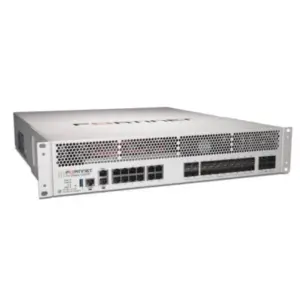
2U rack appliance
Product overview
FortiWeb 1000F is positioned in Fortinet’s FortiWeb hardware-appliance family for organizations that want dedicated web application and API protection on premises or in a controlled data-centre architecture. A WAF operates at the application layer, examining HTTP and HTTPS transactions rather than relying only on network-layer access rules. That distinction matters for public portals, customer applications, transactional systems and APIs because many attacks arrive through traffic that a conventional network firewall is expected to permit.
Fortinet’s current FortiWeb platform addresses threats including the OWASP Top 10, malicious bots, application-layer attacks and unknown or zero-day techniques. The platform uses machine learning and anomaly detection to model application behavior and help identify suspicious patterns while reducing the operational burden associated with manual application learning. API discovery and protection, client-side security and threat analytics broaden the platform beyond basic signature matching.
The 1000F provides a meaningful step in hardware capacity for environments that need up to 2.5 Gbps of rated WAF throughput. Its physical connectivity includes eight bypass-capable Gigabit Ethernet interfaces, four non-bypass SFP Gigabit Ethernet interfaces and two 10G BASE-SR SFP+ ports. Hardware SSL/TLS processing is particularly relevant because modern application estates are heavily encrypted and inspection must account for cryptographic workload as well as raw traffic volume.
Selection should still be based on the actual deployment. Security functions, traffic composition and system configuration can affect real-world performance. Buyers should also decide whether FortiGuard application-security services, support coverage and high-availability requirements are part of the project. FourTeck can assist Uganda organizations with these procurement decisions before a commercial quote is prepared.
Business benefits
01
Protect application-layer services
FortiWeb inspects web traffic for threats aimed at application logic and vulnerabilities. This adds a purpose-built control between public users and protected application servers, helping security teams address risks that cannot be managed simply by opening or closing network ports.
02
Use machine learning to improve detection
Fortinet describes dual-layer machine learning that models applications and identifies malicious patterns. For operations teams, the business value is stronger detection context with less dependence on manually building a rule for every changing application behavior.
03
Protect APIs alongside web applications
Modern mobile, partner and B2B workflows increasingly depend on APIs. FortiWeb’s API discovery and protection capabilities help bring these interfaces into the application-security program instead of treating them as an unrelated infrastructure component.
04
Control malicious automation
Bot mitigation helps distinguish unwanted automated activity from legitimate bots and human users. This is useful for public services that face scraping, automated abuse, credential attacks or other high-volume behavior that consumes resources or increases fraud exposure.
05
Accelerate encrypted traffic processing
The 1000F uses hardware SSL/TLS processing. This is a practical architecture advantage for HTTPS-heavy application environments because decryption and inspection can otherwise become a major sizing consideration.
06
Integrate application security with the Fortinet ecosystem
FortiWeb can integrate with FortiGate and FortiSandbox as part of the Fortinet Security Fabric. Organizations already standardizing on Fortinet can use these integrations to improve coordination between application, network and advanced-threat controls.
What distinguishes this appliance
The 1000F combines dedicated rack hardware, hardware-based encrypted-traffic processing and a FortiWeb security feature set aimed at applications, APIs, bots and client-side risks. Its value is not a single port or headline throughput figure; it is the ability to place application-aware security controls in front of services that the organization depends on.
- 2.5 Gbps WAF throughput: a published maximum for the model; actual performance varies with traffic and configuration.
- Flexible physical interfaces: bypass Gigabit Ethernet, SFP Gigabit Ethernet and 10G SFP+ connectivity support different insertion designs.
- Application and API controls: suitable for estates where browser applications and machine-to-machine APIs need coordinated protection.
- FortiGuard services: annual security subscriptions can be selected individually or as bundles according to requirements.
Technical specifications ledger
| Product | Fortinet FortiWeb 1000F |
| Product type | Web application firewall hardware appliance |
| WAF throughput | Up to 2.5 Gbps |
| 10/100/1000 interfaces | 8 bypass; 4 × SFP GE non-bypass |
| 10G BASE-SR SFP+ ports | 2 |
| SSL/TLS processing | Hardware |
| USB interfaces | 2 |
| Storage | 2 × 480 GB SSD |
| Form factor | 2U |
| Security services | FortiGuard services available by annual subscription; selection depends on requirements |
| Performance note | Actual performance can vary with network traffic and system configuration |
The throughput number is a starting point rather than a complete sizing method. Buyers should document normal and peak protected traffic, HTTPS proportions, expected transaction rates, API usage, enabled inspection functions and future growth. Interface selection also matters: confirm whether the design needs copper bypass links, optical Gigabit Ethernet or 10G SFP+ connections and ensure compatible transceivers and cabling are included where required.
Storage, management, security subscriptions and resilience should be reviewed as one architecture. For business-critical applications, discuss whether a high-availability pair is appropriate rather than treating the appliance as a standalone purchase. FourTeck can use these details to align the requested bill of materials with the intended deployment.
Configuration worksheet
01 What applications and APIs are being protected?
Identify public websites, customer portals, payment services, partner APIs and internal applications exposed through the appliance. Application importance affects policy design, resilience expectations and service selection.
02 What is the real traffic scale?
Provide current and peak protected throughput, transaction patterns and growth expectations. Encrypted traffic and security functions influence sizing, so an internet circuit speed alone is not enough.
03 How will the appliance connect to the existing network?
Confirm switch interfaces, copper or fiber requirements, VLAN design, routing, load balancers, upstream firewalls and server topology. This determines ports, optics and cabling requirements.
04 Which security services and growth path are required?
FortiGuard subscriptions can be purchased a la carte or in bundles. Decide which protections, support level and future capacity expectations belong in the project scope.
05 What are the resilience and operational expectations?
Discuss high availability, rack space, power, change windows, support processes, warranty expectations and delivery planning before finalizing the order.
Ideal business use cases
Customer-facing enterprise portals
Organizations running account portals, booking platforms, self-service applications or transactional websites can place FortiWeb in front of these services to inspect application traffic and enforce WAF policy. The appliance is particularly relevant when availability and encrypted traffic processing are important. Sizing should reflect peak demand and the security functions enabled rather than only average bandwidth.
API-driven digital services
Mobile applications, B2B integrations and modern web architectures often expose APIs that require visibility and protection. FortiWeb provides API discovery and protection functions within the same application-security platform. Buyers should inventory known APIs, authentication methods and expected request volumes during design.
Payment and regulated web environments
FortiWeb includes controls relevant to public-facing applications and client-side security, including monitoring of scripts used on payment pages. Organizations should map product capabilities to their own compliance obligations and security policies rather than assuming appliance deployment alone satisfies a regulation.
Fortinet-centered security architectures
Enterprises already using FortiGate or FortiSandbox may value FortiWeb Security Fabric integration. This can help coordinate application protection with network and advanced-threat defenses. Compatibility, software versions and the intended integration workflow should be reviewed during implementation planning.
Deep dive 01 — encrypted application traffic
HTTPS is now the normal transport for business applications, which means an application firewall must be designed for inspection in an encrypted environment. The FortiWeb 1000F includes hardware SSL/TLS processing, reducing dependence on general-purpose processing for cryptographic work. This is important when applications carry sustained encrypted sessions or when multiple protected services share the same appliance.
Procurement teams should nevertheless avoid treating hardware acceleration as unlimited capacity. Certificate configuration, cipher choices, session behavior, application complexity and enabled protection features can influence actual performance. The practical approach is to build a traffic profile and include growth headroom. For critical deployments, resilience planning should also account for maintenance and failure scenarios.
Interface planning belongs in the same discussion. Two 10G BASE-SR SFP+ ports are available alongside Gigabit Ethernet options. Confirm the physical media used by adjacent switches and ensure optics are compatible with the intended design.
Deep dive 02 — web, API and bot protection
Application exposure is no longer limited to browser pages. APIs serve mobile apps and business integrations, while automated clients can be legitimate, abusive or malicious. FortiWeb brings these traffic types into a common protection platform.
Application security: Fortinet positions FortiWeb to defend against OWASP Top 10 risks and known and unknown application attacks.
API security: discovery and protection capabilities help teams identify and control API exposure rather than relying solely on conventional URL rules.
Bot mitigation: controls are designed to stop malicious automated activity while allowing bots that serve legitimate business needs.
For buyers, the configuration question is which capabilities must be enabled for the actual application estate and which FortiGuard subscriptions belong in the solution. A clear application inventory makes policy planning and quotation more accurate.
Deep dive 03 — deployment and operations
A WAF becomes part of the production application path, so operational design is as important as threat features. The 1000F provides bypass-capable Gigabit interfaces and multiple optical connectivity choices, giving architects options for physical insertion. The exact topology should be selected around routing, switching, server and load-balancing architecture.
Buyer decision checklist
- Confirm whether the WAF will protect one application group or multiple business services.
- Document network topology and required interfaces before ordering transceivers.
- Decide whether high availability is required for production continuity.
- Identify FortiGuard subscriptions and support expectations.
- Plan certificate ownership, change control, monitoring and administrator responsibilities.
- Check rack, power and data-centre requirements for a 2U appliance.
The result should be a deployment plan rather than simply a hardware SKU. FourTeck can help translate the design inputs into a procurement-ready configuration for Uganda projects.
What buyers should check before purchase
These checks help prevent a common procurement problem: choosing a security appliance by model name alone. The right bill of materials may include two appliances for high availability, optical modules, cabling, subscriptions and support coverage. Conversely, a different FortiWeb model or deployment form may be more appropriate if the workload is materially smaller, larger or cloud-native.
Uganda availability and service support
FourTeck can assist organizations in Uganda with product selection, configuration review, quotation and delivery coordination for Fortinet application-security projects. Availability can vary by model, subscription, project quantity and supply conditions, so current supply status should be confirmed at quotation stage rather than assumed from the product page.
For Kampala deployments, buyers can provide their network design, protected application profile and desired project schedule so the quote can account for the appropriate appliance configuration and related items. FourTeck can also help clarify warranty and support options that are available for the selected supply route. For larger projects, sharing expected quantities and rollout phases early helps align procurement planning with implementation needs.
Uganda location coverage
Organizations planning deployments in Kampala, Entebbe, Jinja, Mbarara and Gulu can contact FourTeck for quotation and delivery coordination. The same technical sizing process applies across locations: define application traffic, network connectivity, subscriptions and resilience requirements first, then confirm current commercial availability and logistics for the destination.
East Africa and regional procurement
Organizations with multi-country infrastructure can also discuss coordinated requirements across Uganda, Kenya and selected East Africa markets. For wider regional procurement, FourTeck’s Africa, UAE and Kuwait sites can provide relevant contact paths according to the project. Regional requirements should be scoped carefully because supply, commercial terms, delivery coordination and warranty handling may differ by destination.
For a cross-border application-security rollout, use a consistent technical baseline—protected applications, traffic assumptions, interfaces, subscriptions and resilience—but confirm each country’s procurement and logistics requirements separately. Visit FourTeck Uganda, FourTeck Kenya, FourTeck Africa, FourTeck UAE or FourTeck Kuwait when relevant to the purchasing location.
Related products and solution paths
FortiWeb 600F: a lower-throughput FortiWeb hardware option rated at 1 Gbps WAF throughput, suitable for buyers whose protected traffic does not require the 1000F class.
FortiWeb 2000F: a higher-capacity hardware path rated at 5 Gbps WAF throughput for application estates that exceed the 1000F sizing envelope.
FortiGate next-generation firewalls: consider the Fortinet security range from FourTeck Uganda when network-edge security and Security Fabric integration are part of the wider architecture.
FortiWeb virtual or cloud deployment: organizations that do not require a physical appliance can evaluate FortiWeb virtual machines or FortiWeb Cloud according to infrastructure strategy.
For model matching and current internal product links, contact FourTeck Uganda with the required throughput, deployment form and security-service scope.
Why buyers contact FourTeck
01 / Product selection guidance. A WAF should be chosen around applications and traffic rather than a generic firewall sizing method. FourTeck can help organize the technical inputs needed for model selection.
02 / Configuration review. Interface media, subscriptions, high availability and supporting accessories can materially change the bill of materials.
03 / Quote assistance. Project quantities, subscription terms and destination details can be consolidated into a procurement request.
04 / Business IT context. Application security often intersects with firewalls, switching, servers, virtualization and data-centre design, so related infrastructure can be considered during procurement.
05 / Alternative matching. If the workload does not fit the 1000F, FourTeck can discuss lower- or higher-capacity FortiWeb hardware or another deployment form.
Frequently asked questions
01. What is FortiWeb 1000F used for?
It is a dedicated web application firewall used to protect web applications and APIs by inspecting HTTP and HTTPS traffic at the application layer. FortiWeb capabilities include protection against common web threats, bot mitigation, API security, anomaly detection and machine-learning-assisted detection. The 1000F is a physical 2U appliance rated for up to 2.5 Gbps WAF throughput.
02. How much WAF throughput does the 1000F provide?
Fortinet publishes WAF throughput of up to 2.5 Gbps for this model. That value should not be treated as a guaranteed application throughput under every policy. Fortinet notes that actual performance varies with network traffic and system configuration. Size the deployment using peak protected traffic, encrypted traffic, enabled features and expected growth.
03. Which network interfaces are available?
The appliance has eight bypass-capable 10/100/1000 interfaces, four non-bypass SFP Gigabit Ethernet interfaces and two 10G BASE-SR SFP+ ports. The right connection type depends on the adjacent switches and deployment topology. Buyers should confirm optical modules, fiber type and cabling requirements before ordering.
04. Does FortiWeb protect APIs as well as websites?
Yes. Fortinet lists API discovery and protection among FortiWeb’s use cases and capabilities. This makes the platform relevant for mobile back ends, partner integrations and other machine-to-machine services as well as browser applications. API inventory, authentication design and traffic behavior should be included in the deployment assessment.
05. Are FortiGuard subscriptions required?
Fortinet offers multiple FortiGuard security services for FortiWeb, with annual subscriptions available individually or in bundles. The exact services required depend on the organization’s protection objectives and procurement scope. Ask FourTeck to quote the appliance together with the appropriate service term and support expectations rather than assuming one universal license package.
06. Can the appliance integrate with other Fortinet products?
Fortinet describes Security Fabric integration with products including FortiGate next-generation firewalls and FortiSandbox. This can be useful for organizations seeking coordinated application, network and advanced-threat defenses. The exact integration design should be validated against deployed product versions and the operational workflow required by the security team.
07. Should we deploy one appliance or an HA pair?
The answer depends on the availability objectives of the protected applications. If a WAF is placed directly in a critical production path, resilience and maintenance windows deserve explicit planning. Share uptime requirements, topology and failure tolerance with the solution team so the quote can account for high availability where appropriate.
08. Is the FortiWeb 1000F available in Uganda?
FourTeck can provide current quotation and supply guidance for Uganda, but availability can vary with configuration, subscriptions, quantity and supply conditions. Contact the Uganda team with your project requirements and delivery destination so current options can be checked at quotation stage without assuming ready stock or a fixed delivery time.
09. What information should we provide for a quote?
Provide the number and type of applications, expected peak traffic, HTTPS profile, API requirements, network interfaces, preferred topology, high-availability needs, FortiGuard service requirements, project quantity and delivery location. These details help determine whether the 1000F is appropriately sized and which related items should appear on the bill of materials.
Prepare a FortiWeb configuration that matches your applications
Send FourTeck your protected traffic estimate, application and API profile, interface requirements, subscription needs, HA preference and project quantity. The team can use those details to prepare a configuration-focused Uganda quotation and discuss suitable alternatives if another FortiWeb model better fits the workload.
- Peak protected traffic and growth
- Application and API count
- Copper, SFP or 10G connectivity
- Security-service term
- HA and project quantity
Reviews
There are no reviews yet.