Professional Meeting-Room Audio Processing • Uganda
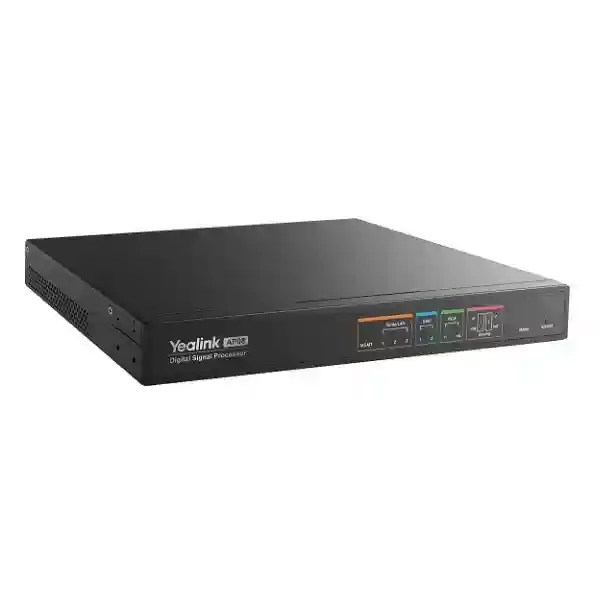
Yealink AP08 Digital Signal Processor for Enterprise Conference Audio
The Yealink AP08 is a professional audio processor designed to sit at the center of sophisticated meeting-room sound systems. It receives, processes, routes and distributes multiple audio signals so microphones, loudspeakers, conferencing computers and control systems can operate as one coordinated environment. For organizations planning boardrooms, executive conference rooms, training facilities, divisible spaces or multi-purpose collaboration rooms, the AP08 addresses a familiar challenge: modern conferencing needs more than a microphone connected to a speaker. It needs predictable echo control, flexible routing, networked audio, physical input and output options, consistent tuning and a practical path from design through commissioning.
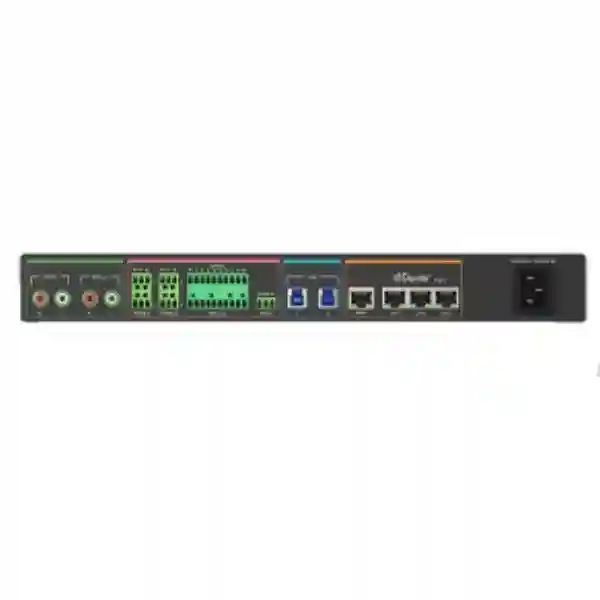
At its core, AP08 provides 16 Dante inputs and 16 Dante outputs, with eight Dante input channels supporting advanced processing including dynamic acoustic echo cancellation. It also provides four analog inputs and four analog outputs, two simultaneous USB device interfaces, management and control connectivity, and three Dante network ports that can provide PoE+ to compatible endpoints. This combination makes the unit useful where an integrator must bridge network audio, conventional analog sources and USB conferencing hosts without building the entire room around separate processors and power components.
The platform is especially relevant to projects using Yealink professional room audio. With Room Designer, integrators can plan audio links, configure processing logic and tune compatible deployments around room conditions. This is valuable in Uganda projects where meeting-room performance must be repeatable across headquarters, branches, campuses or institutional facilities and where commissioning time is a meaningful part of project cost.
Procurement should begin with the room rather than the box. The number of microphones, speaker zones, conferencing hosts, room-combination states, analog sources and control requirements determines whether AP08 is the right processing layer and how it should be configured. FourTeck can review those details before quotation so the proposed bill of materials reflects the actual deployment rather than a generic equipment list.
Instant Specifications & Procurement Fact Rail
Yealink AP08
16 × 16 Dante
8 Dante input channels
4 inputs / 4 outputs
2 × USB device channels
Up to 90 W total PSE
The AP08 is positioned for installed professional AV rather than simple desktop conferencing. Its 360 × 189 × 44 mm chassis weighs approximately 2.2 kg and supports standard rack installation as well as under-table or wall mounting using the supplied mounting hardware. For procurement planning, stock position, Uganda warranty handling, lead time and final project pricing should be confirmed on the formal quotation. Public international listings observed for the AP08 vary materially by seller and channel; a reference market figure around USD 1,700 is reasonable for schema purposes, but it is not a Uganda quotation and excludes project-specific freight, taxes, installation, accessories and services. Buyers should therefore use the FourTeck quotation as the commercial source of record.
Operational Product Architecture & Overview
Professional conferencing audio is a signal-flow problem before it is a device problem. Every microphone creates an input that must be captured at an appropriate level, processed, mixed and delivered to one or more destinations. Remote participants must hear local participants without room echo. Local participants must hear remote speech through loudspeakers without that loudspeaker signal being returned as disruptive echo. In larger spaces, different microphone zones may need different gain structures, speaker feeds or routing rules. Divisible rooms add another layer because the correct signal map changes when partitions open or close. AP08 is designed to provide the processing and routing foundation for these scenarios.
Dante is central to the architecture. Sixteen Dante input channels and sixteen output channels allow digital audio to travel across compatible network infrastructure rather than requiring an individual analog cable for every endpoint. Eight of the Dante input channels support dynamic acoustic echo cancellation processing. The Dante side operates at 48 kHz with 24-bit depth, a frequency response stated at 50 Hz to 20 kHz and dynamic range of 86 dB. For an integrator, this creates a scalable audio fabric in which compatible microphones, loudspeakers and processors can be logically connected while the physical network provides transport.
The analog layer prevents the system from becoming dependent on network audio alone. AP08 provides two RCA inputs, two balanced three-pin analog inputs, two RCA outputs and two balanced three-pin analog outputs. The balanced inputs can provide +48 V phantom power, allowing appropriate professional microphones or interfacing equipment to be incorporated. Analog connectivity matters in retrofit projects, lecture spaces and boardrooms where legacy sources, amplifiers, assistive systems, recording feeds or specialist devices must remain part of the room.
Dual USB device interfaces are another important architectural feature. A conferencing room frequently needs a straightforward USB audio relationship with a room PC or conferencing appliance. Two USB paths make AP08 especially useful in flexible spaces and divisible-room designs. Signal routing can be planned so separate room hosts participate in different room states, reducing the need to redesign the entire audio topology each time a partition changes.
Control connectivity includes a dedicated management RJ-45 port, RS-232 and GPIO. GPIO provides eight inputs and eight outputs, creating opportunities to integrate room states, partition sensors or third-party control logic. RS-232 supports conventional AV control workflows. These interfaces matter because a polished room should not depend on an engineer manually re-routing audio before every meeting. Where the design requires it, room-control events can participate in a broader operational sequence.
Three Dante LAN ports can act as IEEE 802.3at power sourcing interfaces with a maximum combined PSE budget of 90 W. In practical terms, compatible network audio endpoints may receive both connectivity and power through the AP08 network side. This can simplify cable planning, reduce local power adapters and make the rack or furniture installation cleaner. The exact endpoint power calculation must still be completed during design: the aggregate demand of attached devices should remain within the supported budget with sensible engineering margin.
Room Designer adds the configuration layer. It is intended to help designers establish device quantities and placement, configure audio links and processing modules, and adapt the deployment to room acoustics. Yealink also describes automated acoustic adaptation and dynamic output adjustment capabilities within the broader solution. The operational benefit is not that commissioning disappears, but that repeatable workflows can reduce manual design and tuning effort, especially when an organization is rolling out multiple similar spaces.
The main procurement pain points AP08 addresses are therefore predictable: too many independent audio interfaces, echo and reverberation complaints, limited expansion headroom, difficult room-combination logic, inconsistent commissioning, separate endpoint power requirements and the need to integrate network audio with existing analog equipment. A successful project should map each of these issues to a design decision before purchase.
Enterprise Business Outcomes & Value Analysis
1. Performance & Audio Integrity
The most visible business outcome is intelligible speech. Poor conferencing audio wastes meeting time, encourages repetition and reduces confidence in hybrid collaboration. AP08 combines multichannel Dante transport, dedicated AEC-capable channels, noise control, reverberation treatment within supported workflows and flexible mixing. The value is strongest when the room has multiple microphones or speakers and cannot be served reliably by a simple all-in-one device. Performance planning should include microphone coverage, loudspeaker distribution, acoustic conditions and the number of simultaneous talkers rather than treating channel count as the only sizing metric.
2. System Reliability & Operational Continuity
Reliability begins with a coherent architecture. Consolidating signal processing and routing in a purpose-built DSP can reduce ad-hoc adapters and unmanaged signal paths. Networked audio can simplify structured cabling, while analog and USB interfaces provide controlled bridges to other systems. AP08 is not a redundant dual-power enterprise appliance, so continuity planning should include protected mains power, suitable UPS coverage, configuration backups, spare critical endpoints and documented recovery procedures. Institutions with high-impact meeting spaces should treat the processor as part of a complete room continuity plan.
3. Infrastructure Scalability
Sixteen Dante inputs and outputs provide room to build a substantial networked audio design, while analog and USB connections support mixed environments. This gives integrators options when a room grows from a conventional boardroom into a multi-zone collaboration space. Scalability is not unlimited: eight Dante input channels are the stated AEC-optimized set, and physical analog ports remain finite. Future expansion should therefore be discussed at design time, especially if additional ceiling microphones, voice-lift zones or room-combination states are expected.
4. Security & Access Control
AV devices are now network participants and should be handled accordingly. The AP08 management and Dante connections should be deployed according to the organization’s network policy, with appropriate segmentation, controlled administrative access and documented firmware procedures. GPIO and RS-232 integrations should also be documented so facilities and IT teams know which external events can change room behavior. Security is an operational discipline across the complete conferencing environment; no single DSP replaces VLAN planning, switch configuration, credential governance or change management.
5. Centralized Management & Operational Simplicity
Room Designer is significant for integrators managing repeatable room standards. A documented room template, device placement plan, signal map and commissioning baseline can make subsequent deployments easier to validate. One-button deployment and acoustic adaptation capabilities in compatible Yealink environments are intended to reduce manual effort. Organizations should still retain final configuration records, cable schedules and acceptance-test results so support teams are not dependent on undocumented installer knowledge.
6. Total Cost of Ownership & Energy Planning
Acquisition price is only one component of room cost. Engineering hours, cabling, network switch ports, endpoint power, commissioning, future changes and support visits often matter more over the lifecycle. AP08 can consolidate several functions and provide up to 90 W total PoE+ for compatible endpoints, potentially reducing local power hardware. The correct TCO comparison should be made against a complete alternative architecture, not against the price of another processor in isolation.
Key Hardware & Software Highlights
| Component | Capability | Operational Outcome |
|---|---|---|
| Dante processing | 16 inputs / 16 outputs; 8 AEC-capable input channels | Flexible network-audio routing for installed conference systems. |
| Analog audio | 4 inputs and 4 outputs across RCA and three-pin interfaces | Integration with conventional sources, amplifiers and specialist AV equipment. |
| USB | Two USB device paths | Practical connection to conferencing hosts and divisible-room workflows. |
| LAN PSE | Three IEEE 802.3at ports, 90 W combined maximum | Can power compatible network audio endpoints while carrying audio traffic. |
| Control | MGMT, RS-232, GPIO input/output | Supports integration with room automation and partition-state logic. |
| Room Designer | Design, routing and acoustic deployment workflows | Reduces repetitive engineering steps and supports consistent commissioning. |
These capabilities should be interpreted as an integrated architecture. For example, PoE availability is valuable only when the selected microphones or speakers are compatible and the combined power budget is respected. Dual USB is useful only when the room’s conferencing hosts and signal-flow logic have been defined. GPIO becomes valuable when a partition sensor or control platform has a documented use case. The procurement team should therefore request a design narrative alongside the equipment list for complex installations.
Technical Specifications Ledger
| Area | Confirmed Specification | Procurement Note |
|---|---|---|
| Dante input | 16 channels; 8 with AEC processing | Map microphones and required echo-cancelled channels before purchase. |
| Dante output | 16 channels | Plan loudspeaker, recording and downstream destinations. |
| Dante format | 48 kHz, 24-bit; 50 Hz–20 kHz | Validate interoperability with the complete Dante design. |
| Analog input | 2 × RCA plus 2 × 3-pin balanced | Balanced inputs support +48 VDC phantom power, 10 mA max. |
| Analog output | 2 × RCA plus 2 × 3-pin balanced | Confirm amplifier/interface input requirements. |
| Analog frequency response | 20 Hz–20 kHz | Suitable for full-band professional meeting-room audio paths. |
| USB audio | 2 input / 2 output; 48 kHz; 16/24-bit | Confirm host operating mode and room-state design. |
| Management | RJ-45 management interface | Place on an approved management network. |
| Control | RS-232, 8 GPIO inputs, 8 GPIO outputs | Useful for automation, room partitions and external control. |
| Dante LAN | 3 network ports | Network design remains subject to Dante and enterprise LAN best practice. |
| PoE+ | IEEE 802.3at PSE per LAN port; 90 W total maximum | Calculate combined endpoint demand and engineering margin. |
| Dimensions | 360 × 189 × 44 mm | Check rack depth, cable bend radius and service clearance. |
| Weight | Approx. 2.2 kg | Include mounting hardware and cable load in installation planning. |
| Operating environment | 0–40 °C; 0–93% RH | Provide conditioned, dry, ventilated installation space. |
| Storage | -30–70 °C | Warehouse conditions should remain within manufacturer limits. |
| Mounting | 19-inch rack, under-table or wall mounting | Select mounting method during room drawings, not after delivery. |
The ledger above focuses on published, procurement-relevant characteristics. Where a tender requires formal compliance declarations, electrical input details, certification numbers or a specific warranty term, those items should be confirmed against the exact regional datasheet and FourTeck quotation at order time. This prevents a generic international listing from being treated as a contractual regional specification.
Configuration & Sizing Worksheet
Step 1 — Estimate the audio workload
List every microphone feed, loudspeaker feed, conferencing host, recording output, assistive-listening feed, analog source and future expansion point. Mark which microphone paths require acoustic echo cancellation. The AP08 provides sixteen Dante input and output channels but eight Dante input channels are the principal AEC-capable paths. A room with more endpoints than this is not automatically unsuitable, because endpoint architecture varies, but the signal-flow design must demonstrate how channels are allocated.
Step 2 — Define room states
For a fixed boardroom, there may be one operating state. A divisible training suite may require Room A, Room B and Combined A+B states, each with different microphone, loudspeaker and USB-host relationships. More partitions create more combinations. Document every state before configuration so preset logic can be tested methodically.
Step 3 — Check physical installation
The chassis is 44 mm high and can fit a standard 19-inch rack using the supplied ears, but rack-unit height is only one consideration. Allow space for rear connectors, Phoenix blocks, USB cables, network cable bend radius and ventilation. Under-table or wall installation should provide secure mounting, service access and protection from accidental cable strain. Avoid wet, dusty, high-heat or poorly ventilated locations.
Step 4 — Plan network and endpoint power
Identify which compatible endpoints will use AP08-provided PoE+. Sum their maximum expected demand and keep the combined load within the 90 W total PSE limit. Confirm VLAN, addressing, Dante clocking and switch requirements with the network team. Even where AP08 powers endpoints directly, upstream network architecture and management access must still be designed deliberately.
Step 5 — Verify analog and USB compatibility
Record connector type, balanced or unbalanced operation, nominal signal levels and phantom-power needs for each analog device. For USB hosts, confirm the conferencing platform and whether both USB interfaces are needed simultaneously. In divisible spaces, document which host belongs to which room state and how mute or conferencing controls should behave.
Step 6 — Review software and licensing assumptions
Do not assume that every conferencing platform license, Dante-related software entitlement, Microsoft room license or third-party control license is included simply because the hardware is compatible with a workflow. The AP08 hardware quotation should be separated from any room-system software, conferencing account, control platform or professional service requirement. Ask for these commercial dependencies to be identified explicitly.
Step 7 — Prepare the quote request
Send room dimensions, ceiling height, seating layout, partition details, conferencing platform, preferred microphone type, loudspeaker requirements, rack location, available network infrastructure, analog devices, desired control behavior and installation city. For tenders, include required delivery date, warranty expectations, documentation format and acceptance-test criteria. A complete input package allows the supplier to quote a coherent solution instead of an isolated processor.
Deployment Scenarios & Industry Use Cases
Large Enterprise & Multi-Site Networks
A large organization may standardize several room types: executive boardroom, medium conference room, training room and divisible event space. AP08 is most compelling in the higher-complexity tiers where network microphones, distributed speakers, multiple conferencing hosts or control integrations are required. Standardizing the processor and Room Designer workflow can help an AV team establish repeatable drawings, signal maps and commissioning checklists. Multi-site consistency also improves support because technicians encounter familiar routing and device relationships across locations. Procurement teams should maintain a room-standard document showing the approved firmware baseline, cable types, endpoint models and acceptance tests.
Financial & Banking Institutions
Banks and financial institutions often need reliable collaboration between headquarters, branches, operations centers and executive teams. Meeting-room audio must remain clear during long calls and should integrate with disciplined IT policies. AP08 can support boardrooms and training facilities where multiple ceiling microphones and distributed loudspeakers are preferable to tabletop equipment. Network segmentation, administrative access, firmware change procedures and physical rack security should be included in the deployment standard. Where business continuity is critical, the room should also have documented recovery procedures and spare strategy rather than assuming the processor itself provides hardware redundancy.
Educational & Campus Networks
Universities, training centers and larger schools may use divisible lecture rooms, council chambers and hybrid teaching spaces. AP08 can route audio among network microphones, speakers, room computers and analog teaching equipment while GPIO or control integration supports changing room states. Educational procurement should pay particular attention to ease of support after installation. Labelled cables, saved configuration files, simplified operating instructions and training for campus technicians are often more valuable than an overly complex control design that only the original integrator understands.
Government & Public-Sector Procurement
Government meeting facilities commonly require formal bills of materials, documented specifications, warranty procedures and acceptance testing. AP08 can be considered for council rooms, command meeting spaces, training facilities and institutional boardrooms where installed audio is required. The procurement file should distinguish manufacturer specifications from project assumptions, list every accessory, identify regional warranty handling and state whether installation, programming and commissioning are included. Security teams should approve network placement and management access before the room is connected to production infrastructure.
Divisible Conference Facilities
This is one of the AP08’s most interesting applications. A two-part room can operate independently as Room A and Room B, then combine into a single larger space. Microphones and speakers must follow the physical room state; conferencing hosts may need to remain isolated when divided and coordinated when combined. AP08 supports presets and dual USB workflows that can help implement these states. Partition sensors can participate through control logic where the complete system is designed accordingly. The critical success factor is exhaustive testing of every state, including transitions while devices are active.
Technical Deep Dive 1: Processing, Acceleration & Audio Engine Architecture
A conference DSP must perform several tasks at the same time: receive multiple channels, maintain timing, apply processing, mix sources and distribute outputs with low enough latency that conversation remains natural. AP08 uses dedicated processing hardware and exposes its capabilities through a matrix-style audio architecture. The eight AEC-capable Dante inputs are particularly important because acoustic echo is one of the defining problems in far-end conferencing. When remote speech is played through room loudspeakers, microphones inevitably capture some of that energy. AEC processing estimates and removes the loudspeaker contribution from the microphone signal so the remote participant does not hear a delayed version of their own voice.
Noise and reverberation management address different problems. Continuous environmental noise such as ventilation can mask speech, while excessive room reverberation smears consonants and reduces intelligibility. Processing can improve the result, but it cannot compensate indefinitely for poor acoustics. Hard surfaces, very long reverberation times, badly placed microphones or undersized loudspeakers should be corrected at the room-design level. AP08 should therefore be viewed as part of an acoustic system rather than a substitute for acoustic engineering.
The 48 kHz digital audio architecture is appropriate for professional speech and full-band room sound. Network audio allows channels to be assigned logically, making it easier to change routing without repulling point-to-point analog cable. The trade-off is that network discipline becomes part of audio engineering: clocking, multicast behavior where applicable, cabling, switch configuration and addressing must be managed correctly. The best deployments bring AV and network teams together during design rather than handing the completed room to IT after commissioning.
Technical Deep Dive 2: Software Ecosystem, Firmware Security & Operational Control
Room Designer provides the engineering interface around AP08 and compatible Yealink professional audio. It can help produce a room design from physical inputs, establish audio links and configure processing modules. Acoustic adaptation workflows can then tune supported deployments to the actual room. This reduces repetitive configuration work, but organizations should still treat the final configuration as controlled technical documentation. Exported files, screenshots, firmware versions and commissioning measurements should be stored with the project record.
Firmware maintenance should follow a change-management process. A new release may provide improvements or fixes, but production meeting rooms should not be updated casually immediately before an important event. Maintain an inventory of device models and firmware, review release notes, test representative rooms where practical and schedule changes during a maintenance window. Configuration backups should be verified before major changes. The management network should be accessible only to authorized administrators, and physical reset access should be considered in rack-security planning.
Operational control extends beyond software. GPIO inputs and outputs can connect room state information to external systems, while RS-232 supports conventional control integration. In a divisible room, for example, a partition sensor can inform the control system that a wall has opened or closed; the room can then invoke the correct preset and user-interface state. Such automation should always include a documented manual recovery method so a failed sensor does not make the room unusable.
Technical Deep Dive 3: Availability, Redundancy & Disaster Recovery
AP08 should not be described as a high-availability appliance with redundant hot-swappable power supplies. Its availability must be engineered at the room level. Begin with stable mains power and an appropriately sized UPS where meeting criticality justifies it. Protect the rack or mounting location from heat, moisture and accidental disconnection. Use high-quality structured cabling, strain relief and clear labels. Document which ports feed which endpoints so faults can be isolated quickly.
Configuration recovery is equally important. Maintain a known-good configuration, firmware record, network addressing plan and room-state matrix. If the unit must be replaced, technicians should know how to restore the room without reverse-engineering the original installation. For mission-critical facilities, procurement may consider holding a compatible spare or establishing an advance-replacement arrangement, subject to the support contract. The economic decision depends on the cost of room downtime versus the cost of spare inventory.
Disaster recovery also includes alternatives for meetings. A critical boardroom may have a documented fallback path using a portable USB conferencing device if the installed audio chain is unavailable. This is not elegant, but continuity plans should prioritize the meeting objective. The permanent system can then be repaired under controlled conditions rather than encouraging unplanned configuration changes during an executive session.
Pre-Purchase Buyer Gap Checklist
Are there hidden licenses? Separate the hardware processor from the wider solution. Confirm whether Room Designer, Dante-related tools, Microsoft Teams Rooms licensing, conferencing accounts, third-party control software or support subscriptions carry independent commercial terms. Ask for every recurring and one-time software cost to be listed separately on the proposal.
Will it fit the rack? The chassis itself is 360 × 189 × 44 mm and supports 19-inch rack mounting, but a dimension sheet is not a complete rack plan. Rear connectors and cable bend radius need clearance. Power adapters, network switches, amplifiers and conferencing appliances may occupy additional space. Request a rack elevation for complex projects.
How much power is available to endpoints? The three Dante LAN ports support IEEE 802.3at PSE with a combined maximum of 90 W. Do not multiply a theoretical per-port maximum without respecting the aggregate limit. Calculate the actual maximum demand of the selected endpoints and leave sensible headroom.
Does it replace a network switch? Do not make that assumption. AP08 has Dante LAN connectivity and endpoint power capability, but the broader room and enterprise network topology must still be designed according to the number of devices, uplinks, management requirements and Dante architecture. The AV and network drawings should show exactly where switching occurs.
Can it work with non-Yealink equipment? The presence of Dante, analog audio, USB, GPIO and RS-232 creates broad integration possibilities. Compatibility, however, is a system-level question. Confirm connector standards, audio levels, Dante interoperability, USB behavior and control protocol requirements for each third-party device before purchase.
What about future room expansion? Reserve channels and physical interfaces where practical. If a room may gain additional microphones, speaker zones or partitions, include that scenario in the initial signal-flow review. It is less expensive to preserve expansion headroom during design than to replace core equipment later.
What warranty applies in Uganda? International sellers show varying warranty statements, so a web listing should not be treated as the Uganda warranty contract. The formal FourTeck quotation should state the applicable regional warranty, return procedure and support scope for the supplied unit.
What is included in the box? Published documentation shows the processor, USB cable, power adapter, Phoenix connectors, mounting hardware and quick-start material. Exact package contents should still be checked at order time, especially for regional power leads or revised hardware bundles.
Is the lowest online price comparable? Often it is not. Public prices can exclude international freight, import costs, local warranty handling, engineering, installation, commissioning and accessories. Compare complete landed and deployed scope, not just processor unit price.
Uganda Regional Procurement & Delivery Logistics
For Uganda projects, the most efficient procurement process begins with a technical scope. FourTeck can use room information to validate whether AP08 is appropriate, identify compatible microphones and speakers, check port and power requirements and prepare a bill of materials. A quotation can then separate hardware, accessories, delivery, configuration, installation and support so buyers can compare scope accurately.
Order processing depends on stock position, project quantity and sourcing route. Enterprise AV equipment may be available locally, held in regional distribution or ordered against project demand. For this reason, delivery dates should be confirmed at quotation and again when the purchase order is accepted. Public international stock indicators are not a reliable substitute for Uganda availability. Projects tied to board meetings, office openings or training schedules should communicate the required on-site date early enough to allow for sourcing, customs, staging and commissioning.
Pre-configuration can reduce installation risk. Where scope permits, device firmware, addressing conventions, signal-flow logic and baseline configuration can be prepared before dispatch or site commissioning. Final acoustic tuning must still reflect the actual installed room, speaker positions, microphone positions and furnishings. For multi-room rollouts, establishing one approved pilot room before bulk deployment can improve consistency.
Procurement documentation can include model and part references, serial tracking, delivery records and acceptance criteria. Organizations with formal asset processes should state labeling requirements before dispatch. Public-sector and enterprise buyers should also specify whether they require manufacturer documentation, compliance statements, warranty certificates or handover configuration files.
Local Coverage Matrix
Head-office boardrooms, corporate meeting spaces, financial institutions, hotels and training centers can be scoped for supply and deployment.
Suitable for institutional, hospitality, aviation-support and executive collaboration projects requiring installed professional audio.
Enterprise, education and industrial facilities can request project quotation with room dimensions and desired conferencing platform.
Regional offices, universities, healthcare administration and training environments can be supported through planned supply.
Government, NGO, education and enterprise meeting-room requirements can be assessed for suitable audio architecture and delivery.
Coverage does not mean every configuration is held in local stock at all times. Lead time depends on quantity, accessories and project schedule. Providing installation location at the start helps FourTeck account for transport, site access and commissioning logistics in the proposal.
Cross-Border & Regional Supply Chains
Organizations operating across several countries often benefit from using a common room standard and coordinated sourcing model. FourTeck supports regional procurement through Uganda, Kenya, broader African markets, the UAE and Kuwait. A regional rollout can use a common technical baseline while adapting commercial terms, power accessories, logistics and warranty handling to each destination.
For cross-border deployments, create a master bill of materials and then a country-specific annex. The annex should show quantities, local delivery address, required power leads, installation responsibility, tax treatment and target commissioning date. This approach makes it easier to preserve technical consistency without assuming that every market has identical stock or commercial conditions.
Related Products & Solution Paths
AP08 is normally purchased as part of a complete professional room-audio design rather than as a standalone desktop accessory. Buyers can explore Yealink solutions in Uganda and request matching components through the FourTeck project team. Common companion classes include Dante ceiling microphones such as Yealink CM50, network ceiling loudspeakers such as CS10-D, conferencing room systems, control panels and structured network infrastructure.
When comparing related processors or room appliances, start with channel requirements and room topology. A small huddle room may be better served by an all-in-one meeting bar. A conventional medium room may need fewer external audio components. AP08 becomes compelling when flexible signal routing, multiple installed endpoints, analog integration, dual USB or room-combination logic justifies a dedicated DSP. FourTeck can also help source network switches, rack accessories, UPS systems and cabling needed to turn the processor into a deployable solution.
FourTeck Technical Service Capabilities
A professional DSP should arrive with an engineering plan, not just a carton. FourTeck can assist with requirements review, bill-of-materials validation and compatibility checks before procurement. This includes confirming microphone and speaker quantities, mapping Dante and analog channels, checking USB-host requirements, reviewing endpoint PoE demand and identifying missing installation accessories.
For suitable projects, staging can include inventory verification, firmware review, baseline addressing, configuration preparation and labeling. Pre-shipment preparation reduces the amount of work that must be performed in a live meeting room, but it does not eliminate site commissioning. Acoustic conditions, cable routes, endpoint placement and actual network behavior can only be validated after installation.
Post-sales support should be defined in the quotation. Depending on scope, this can include configuration assistance, troubleshooting, warranty coordination and guidance for room changes. Enterprise buyers should request a handover pack containing the final bill of materials, serial information, cable schedule, saved configuration, firmware baseline and administrator notes. That documentation protects the investment when staff or service providers change.
Extended Technical FAQ
1. What is the Yealink AP08 primarily used for?
AP08 is a professional digital signal processor for installed meeting-room audio. It is intended for spaces where multiple microphones, loudspeakers, conferencing hosts or external audio devices need to be processed and routed as a coordinated system. Typical applications include executive boardrooms, training rooms, divisible conference facilities and larger hybrid meeting spaces. Its value comes from combining 16 × 16 Dante audio, eight AEC-capable Dante input channels, 4 × 4 analog audio, dual USB, control interfaces and endpoint power capability. A small room with a single all-in-one video bar may not need this level of processing.
2. How many Dante channels does AP08 support?
The published specification provides sixteen Dante input channels and sixteen Dante output channels. Eight Dante input channels include dynamic acoustic echo cancellation processing. This distinction is important when sizing a conferencing system because not every input should automatically be treated as an independent AEC microphone path. The integrator should prepare a signal-flow diagram showing which sources enter each channel, which channels need echo cancellation and where each output is routed. Future expansion should also be considered so the initial design does not consume every available channel without reserve.
3. Can AP08 connect to analog audio equipment?
Yes. AP08 includes four analog inputs and four analog outputs. The input side consists of two RCA inputs and two three-pin balanced inputs; the output side similarly provides two RCA and two three-pin balanced outputs. The balanced input interfaces support +48 V phantom power within the published current limit. This analog layer is useful for amplifiers, legacy sources, specialist microphones, recording devices and other equipment that is not part of the Dante network. Before connecting third-party devices, confirm signal levels, balanced versus unbalanced wiring, grounding and phantom-power requirements.
4. Does AP08 provide power to network audio devices?
The three Dante LAN ports support IEEE 802.3at power sourcing, with a published combined maximum PSE budget of 90 W. This can simplify installations using compatible powered microphones or loudspeakers because the same network connection can carry audio and power. The 90 W figure is an aggregate budget, so designers must calculate the combined maximum demand of all attached devices rather than assuming unrestricted power on every port. Leave engineering margin and verify endpoint compatibility. If the room requires more powered endpoints than AP08 can support directly, the network design may incorporate suitable external PoE switching.
5. Is AP08 suitable for divisible rooms?
Yes, divisible rooms are a notable use case. AP08 supports flexible routing, presets, dual USB interfaces and control connectivity that can participate in room divide-and-combine workflows. A two-part room may need at least three logical states: Room A, Room B and Combined A+B. More partitions create more possible combinations. Each state should define microphone routing, loudspeaker routing, conferencing host assignment and mute/control behavior. Partition sensors may be integrated through the wider control design. The project should test every state and transition during commissioning rather than validating only the normal combined configuration.
6. What software is used to configure and design the system?
Yealink Room Designer is the principal design and deployment environment associated with AP08 and compatible Yealink professional audio. It can assist with room design, audio-link configuration, processing modules and acoustic adaptation workflows. Buyers should confirm current software requirements and any associated commercial terms at the time of project quotation, especially when the overall room also depends on Microsoft Teams Rooms, another conferencing platform, Dante tools or third-party control software. Keep the final configuration and firmware record as part of the project handover so future support does not depend solely on the original installer.
7. Can AP08 work with Microsoft Teams Rooms?
Yealink positions AP08 for professional conferencing workflows including integration with Yealink Teams room solutions. The processor’s USB and network-audio capabilities make it suitable for room systems where a conferencing host needs processed installed audio. However, compatibility should be evaluated at the complete-room level. Confirm the exact Teams room appliance, microphone and loudspeaker models, control panel, firmware baseline and required Microsoft licensing. A processor being suitable for a Teams environment does not mean that the AP08 purchase itself includes a Teams Rooms license or every component needed for a certified room deployment.
8. What warranty should a Uganda buyer expect?
Warranty statements on international reseller sites vary, so Uganda buyers should rely on the warranty terms written into the FourTeck quotation and order documentation. Before purchase, confirm warranty duration, what constitutes a valid claim, whether advance replacement is available, where defective hardware must be returned and who is responsible for transport. Keep serial numbers, invoices and installation records. For critical meeting rooms, warranty alone may not satisfy continuity requirements; organizations can consider a spare strategy or enhanced support arrangement based on the operational cost of room downtime.
9. What installation options are supported?
The AP08 can be installed in a standard 19-inch rack using mounting ears, or mounted under a table or on a wall with appropriate supplied hardware. The chassis measures approximately 360 × 189 × 44 mm. Installation drawings should allow additional space for connectors, cable bend radius, ventilation and technician access. Avoid locations exposed to water, excessive dust, direct heat or accidental impact. In furniture installations, ensure the processor and power equipment remain serviceable without dismantling the room. In racks, label every network, USB and analog connection to simplify future troubleshooting.
10. What information should be sent when requesting a quote?
For an accurate proposal, provide room dimensions, ceiling height, seating capacity, room photographs or drawings, partition details, conferencing platform, number and type of microphones, speaker requirements, existing analog equipment, rack location, available network infrastructure, preferred control system and installation city. State whether the requirement is supply-only or includes installation, programming, commissioning and training. If the project is a tender, include required documentation, delivery deadline, warranty expectations and acceptance tests. These details allow FourTeck to size the complete solution and identify accessories or services that would otherwise appear as late project variations.
Plan the AP08 Around Your Room, Not Around a Generic Parts List
The Yealink AP08 provides a strong foundation for professional Dante conference audio, but its real value appears when channel allocation, endpoint power, acoustics, conferencing hosts and room-control logic are designed together. Send FourTeck your room dimensions, platform, microphone and speaker requirements, installation city and desired project date. The team can review the architecture, prepare a suitable bill of materials and quote the processor together with compatible accessories and deployment services.
For enterprise rollouts, ask for a repeatable room standard covering firmware, cabling, configuration records and acceptance testing. For divisible rooms, include every divide-and-combine state in the design scope. For formal procurement, request warranty and delivery terms in writing. This approach reduces change orders and gives both IT and facilities teams a clearer basis for long-term support.


Reviews
There are no reviews yet.