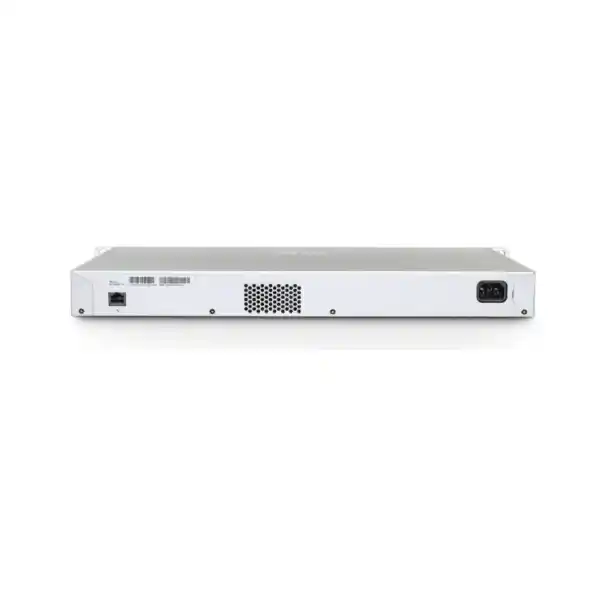
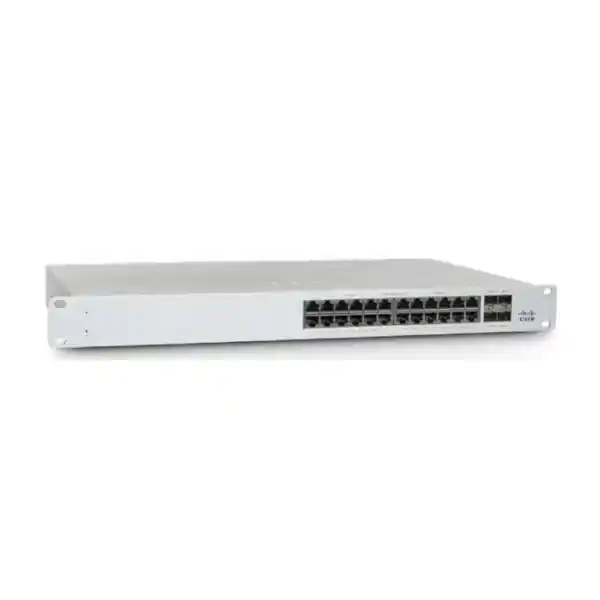
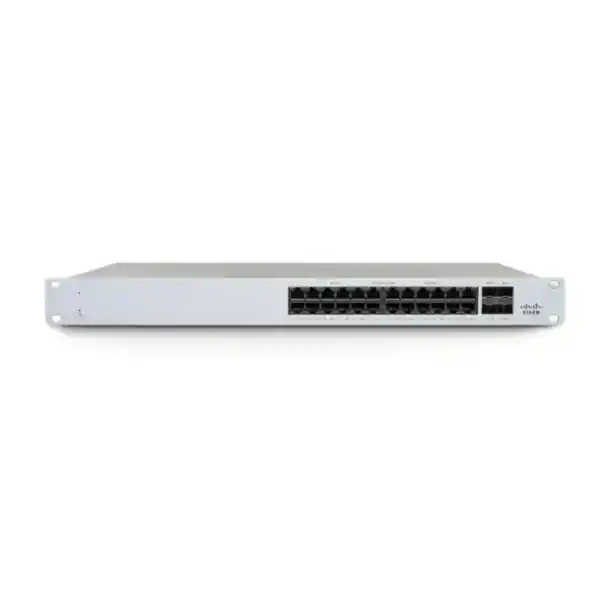
Cisco Meraki MS130-24P Cloud-Managed 24-Port PoE+ Access Switch in Uganda
The MS130-24P is a rack-mount Layer 2 access switch for organizations seeking straightforward Gigabit connectivity and centralized administration. Its 24 copper Gigabit ports and four 1G SFP uplinks support branch and campus access networks, while a 370W shared PoE budget powers suitable endpoints without separate injectors at every desk or ceiling location.
For purchasing teams, the critical decision is not simply whether the switch has enough ports. Confirm total connected-device power demand, uplink speed, subscription or license requirements, rack cooling, fiber transceiver selection and deployment support. The MS130-24P is especially appropriate where remote Meraki Dashboard management and 1G access are priorities.
Procurement facts at a glance
Model: MS130-24P-HW
Network role: Layer 2 access
Access interfaces: 24 × 1GbE RJ45
Uplinks: 4 × 1G SFP
PoE: Up to 30W per port, 370W shared
Management: Meraki Dashboard
Installation: Integrated 1U rack mount
Power: 100–240V AC, 50–60Hz
Availability and warranty: Confirm in quotation
Architecture and deployment fit
The MS130-24P provides Gigabit copper access to office devices and uses four 1G SFP interfaces for fiber or supported modular uplink connections. Network teams can apply VLAN segmentation, access controls, 802.1X authentication and DHCP snooping according to the site design. Its cloud-managed operating model supports centralized inventory, configuration, diagnostics and scheduled firmware maintenance. It should not be confused with the MS130-24X, which offers multigigabit access and 10G SFP+ uplinks.
In a typical branch topology, desktop clients, VoIP phones, cameras and wireless access points connect to the 24 access ports. An uplink connects the switch to the site’s distribution network or gateway. Engineers should evaluate uplink contention and broadcast-domain design before deploying multiple bandwidth-intensive endpoints. Layer 3 gateway and routing responsibilities should be assigned to suitable upstream equipment rather than assuming the access switch replaces a dedicated routing platform.
Enterprise outcomes
- Consistent access: Gigabit edge ports suit conventional office endpoints and many surveillance and telephony workloads.
- Remote administration: Dashboard visibility reduces routine on-site troubleshooting trips.
- Scalable deployment: Standardized configurations can be repeated across branches.
- Access security: VLANs, 802.1X and DHCP snooping help enforce network policy.
- Consolidated power: A shared 370W PoE+ budget simplifies supported endpoint installation.
- Operational planning: Centralized firmware and event visibility support consistent maintenance processes.
Hardware and software highlights
| Capability | Practical significance |
|---|---|
| 24 × 1GbE RJ45 | Wired access for desks and connected devices |
| 4 × 1G SFP | Flexible compatible fiber or modular uplinks |
| 370W PoE+ budget | Centralized power for supported endpoints |
| Meraki Dashboard | Remote provisioning, monitoring and troubleshooting |
| 802.1Q and 802.1X | Traffic segmentation and port access policy |
Verified technical specification ledger
| Product SKU | MS130-24P-HW |
| Switching tier | Layer 2 access |
| RJ45 ports | 24 × 10/100/1000 Mbps |
| Fiber uplinks | 4 × 1G SFP |
| PoE budget | 370W total, up to 30W per supported port |
| Power consumption | 32W idle / 406W maximum (manufacturer figures) |
| Input power | 100–240V AC, 50–60Hz |
| Operating temperature | 0–45°C |
| Operating humidity | 5–95% |
| Mounting | Integrated 1U rack mount |
| Physical stacking | Not supported; virtual management only |
Confirm dimensions, regional approvals and any other installation-critical attributes against the latest manufacturer documentation before issuing a purchase order.
Configuration and sizing worksheet
Step 1: Count currently required copper connections and reserve practical expansion capacity. Step 2: Record each powered endpoint’s maximum expected draw, not merely its typical idle consumption. Step 3: Add the power demands and ensure the total remains within 370W while respecting the 30W individual-port limit. Step 4: Check whether 1G uplinks are adequate for the intended traffic mix. Step 5: Select compatible optics, cabling and rack accessories. Step 6: Confirm the Meraki licensing model, edition and term. Step 7: Document VLANs, authentication policies, management reachability and acceptance testing.
For example, ten access points budgeted at 20W each plus eight phones budgeted at 8W each produce a planning load of 264W, leaving 106W of nominal switch PoE budget. This is an illustrative sizing exercise, not a guaranteed device consumption figure. Recalculate using the actual endpoint datasheets and include operational headroom.
Industry deployment scenarios
Distributed enterprises
Standardize switch configurations across branch offices while maintaining centralized monitoring and a common change process.
Banking and financial services
Separate workstation, telephony and managed-device networks through appropriate VLAN and authentication policies, subject to the institution’s security design.
Education and campus facilities
Connect classroom workstations, access points and administrative endpoints with a documented PoE and uplink capacity plan.
Public sector environments
Support controlled procurement with traceable model numbers, licensing terms, configuration records and documented commissioning tests.
Technical deep dives
Packet forwarding and uplink design
The MS130-24P is an access-layer platform. Its copper interfaces are Gigabit rather than multigigabit, and its four SFP uplinks operate at 1G rather than 10G. Engineers should calculate peak aggregate traffic toward the distribution layer and assess the suitability of the uplink design. Where workloads require multigigabit edge access or 10G aggregation, compare the MS130-24X or another suitable switching family.
Cloud software and operational controls
Meraki Dashboard enables cloud-based configuration, diagnostics and firmware management. Plan secure administrative access, management connectivity, alert routing and scheduled maintenance windows. Confirm feature eligibility under the intended license edition and the organization’s licensing model before ordering.
Resilience and recovery
The switch does not provide physical stacking. Design redundancy at the topology level where needed, with suitable upstream connectivity, backup configurations and documented replacement procedures. UPS sizing should consider the manufacturer-listed maximum power draw and all other equipment connected to the same power circuit.
Questions to resolve before purchase
Does the quotation include the switch license? Which edition and term apply? Is the existing Meraki organization using co-termination, per-device or subscription licensing? Are 1G SFP uplinks sufficient? Are the specified transceivers supported? Is the total endpoint PoE requirement below 370W? Can the rack provide suitable airflow and power? Are firmware and lifecycle requirements compatible with internal standards? Who will claim the device in Dashboard and perform acceptance tests? Written answers to these questions reduce procurement delays and unexpected installation costs.
Uganda procurement and delivery
FourTeck can prepare a quotation based on switch quantity, license requirements, compatible accessories, delivery location and any requested engineering services. Customers should confirm stock, lead time, warranty entitlement, import arrangements and applicable taxes in the final commercial offer rather than treating estimates as guaranteed commitments. For multi-site projects, share a location-by-location equipment schedule to support coordinated purchasing and rollout planning.
Local coverage
Projects in Kampala, Entebbe, Jinja, Mbarara and Gulu may have different delivery and installation constraints. Specify the exact destination, receiving hours, rack readiness and local contact information when requesting a quote. Remote sites may also require additional staging, power protection and transport coordination.
Regional supply coordination
For regional requirements, consult FourTeck Uganda, FourTeck Kenya, FourTeck Africa, FourTeck UAE and FourTeck Kuwait. Cross-border orders should document destination-specific compliance, freight arrangements, licensing and support expectations.
Related equipment and planning resources
Review the Uganda product catalog for compatible enterprise network solutions, compare the Cisco Meraki MS130-24 non-PoE option when endpoint power is unnecessary, and evaluate MS130-24X where multigigabit ports and 10G uplinks are essential. For higher port density, compare MS130-48P. Include supported 1G SFP optics, fiber patching, Cat6 cabling, rack power distribution and UPS capacity in the same bill of materials. Ask FourTeck to validate the complete accessory list rather than purchasing transceivers solely on connector appearance.
Technical services and order validation
Request bill-of-materials review, PoE budget checks, uplink compatibility review, licensing confirmation and pre-deployment planning. Where available and agreed in writing, services may include staging, firmware preparation, labeling, documentation and post-installation assistance. Scope and charges should be confirmed in the quotation.
Frequently asked questions
Does the MS130-24P support PoE+?
Yes. It offers a shared 370W power budget with up to 30W per supported port. Check both individual device demand and total simultaneous consumption.
How many uplinks are available?
There are four 1G SFP uplink interfaces. They are not 10G SFP+ ports.
Does the switch require Meraki licensing?
Yes. Confirm the applicable license model, edition and term as part of the purchase. License compatibility depends on the organization’s licensing arrangement.
Can it provide Layer 3 routing?
The MS130-24P is principally a Layer 2 access switch. Plan the routing design around appropriate upstream equipment and supported functions.
Can it be managed remotely?
Yes. Meraki Dashboard provides centralized cloud management, monitoring and troubleshooting, subject to connectivity and licensing requirements.
Does it have 2.5G access ports?
No. The MS130-24P provides 24 Gigabit copper access ports. Consider the MS130-24X when multigigabit connectivity is required.
Does it support physical stacking?
No. It supports centralized or virtual management, but not physical stacking ports. Design high availability using suitable network topology.
Can it power access points and IP cameras?
It can power compatible PoE endpoints within per-port and total budget limits. Verify each endpoint’s power standard and maximum draw.
What should an Uganda quotation include?
Request hardware model, quantity, license term, supported optics, accessories, delivery costs, tax treatment, warranty terms and any installation services.
How should warranty and replacement be handled?
Confirm the applicable manufacturer entitlement, supplier process, proof-of-purchase requirements and replacement logistics before purchase. Do not assume a particular local replacement timeline without written confirmation.
Request a Cisco Meraki MS130-24P quotation
Send the number of switches, delivery city, required license term, PoE device schedule and uplink requirements. FourTeck can review the purchasing scope and respond with a project-specific commercial proposal, subject to availability and confirmation.

Reviews
There are no reviews yet.