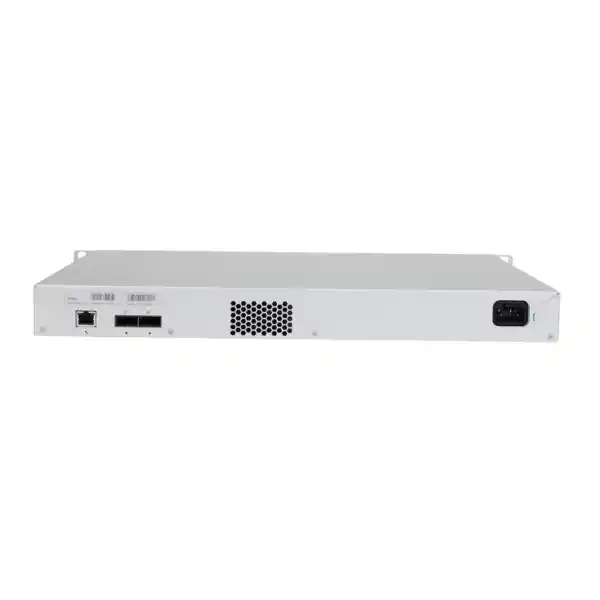
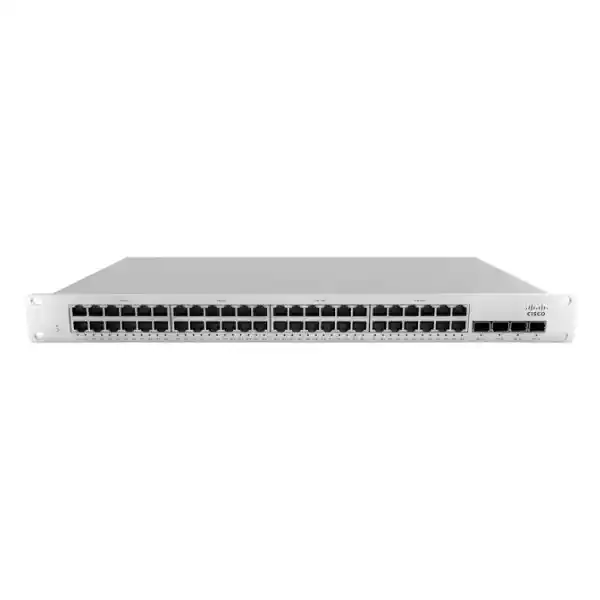
Cisco Meraki MS150-48MP-4X Cloud-Managed Multigigabit PoE++ Access Switch
The Cisco Meraki MS150-48MP-4X combines 48 wired access connections, a 740W shared PoE power budget, four 10 Gigabit SFP+ uplinks and cloud-based administration in a switch suited to business branches and campus wiring closets. It is especially relevant when conventional gigabit-only access switches constrain newer wireless access points or when device power requirements are increasing.
Thirty-two copper ports operate at Gigabit Ethernet speeds, while sixteen multigigabit ports support up to 5 GbE. This arrangement allows organizations to reserve faster copper links for suitable access points and demanding edge devices without paying for multigigabit capability on every connection. The shared PoE budget must be assessed across all attached devices rather than treated as a guarantee of maximum output simultaneously on every port.
Procurement Facts at a Glance
Model: MS150-48MP-4X
Deployment: Cloud-managed campus and branch access switching
Access: 32 × 1 GbE and 16 × up to 5 GbE RJ45
Uplinks: 4 × 10 GbE SFP+
Power: 740W shared PoE budget, PoE++ capability
Stacking: Dedicated stacking interfaces
Stock: Confirm on quotation
Warranty: Confirm manufacturer entitlement and local fulfillment terms
Architecture and Operational Fit
The switch is designed for an access-layer role: connecting endpoint devices to the enterprise network while carrying aggregated traffic toward distribution or core equipment. Four 10 GbE SFP+ interfaces offer flexible optical uplink planning. Optic selection depends on fiber type, distance and compatibility. Physical stacking provides an additional scaling path for sites that require more ports under coordinated administration. Cisco describes the MS150 family as using a non-blocking switching fabric, but deployment design should still consider actual traffic patterns, oversubscription and the capacity of upstream infrastructure.
Cloud management reduces the need for individually maintained device configurations across many sites. Administrators can use Meraki Dashboard for configuration, visibility, firmware management and remote diagnostics, subject to applicable licensing and network reachability. Local forwarding and management-plane behavior during an internet outage should be checked against current Cisco documentation and the organization’s continuity requirements.
Business Outcomes
- Access performance: Allocate multigigabit ports to devices that can exceed standard gigabit throughput.
- Resilience: Design appropriate stacking and upstream path redundancy rather than assuming a single chassis eliminates failure risk.
- Scalability: Plan switch count, stack membership, spare ports and uplink headroom for future expansion.
- Access security: Apply supported segmentation, port policies and identity controls according to the purchased license and software capabilities.
- Centralized operations: Maintain consistent templates and troubleshooting practices across branches.
- Lifecycle cost: Include hardware, cloud licensing, optics, power, support and eventual replacement in the full budget.
Technical Specification Ledger
| Attribute | MS150-48MP-4X |
|---|---|
| Manufacturer / family | Cisco Meraki MS150 |
| Copper access ports | 32 × 1 GbE RJ45 plus 16 × multigigabit RJ45 up to 5 GbE |
| Fiber uplinks | 4 × 10 GbE SFP+ |
| PoE | PoE++ capable; 740W total shared budget |
| Stacking | 2 dedicated 80 GbE physical stacking connections; family supports stacks up to eight switches |
| Management | Meraki cloud dashboard with applicable subscription |
| Routing | Static routing and DHCP relay according to Cisco family documentation |
| Power input, dimensions and acoustics | Verify exact hardware revision in current manufacturer datasheet before rack and electrical approval |
| Licensing | Model-appropriate Meraki license required; quote term separately |
Configuration and Sizing Worksheet
First list all planned connected endpoints, separating conventional gigabit clients from multigigabit wireless access points and other high-bandwidth devices. Add a reasonable spare-port allowance for changes in occupancy. Next record each powered device’s negotiated PoE standard and worst-case demand. Sum the simultaneous loads, allow operational margin and compare the result against the 740W shared budget. A 740W switch does not provide 60W on all 48 ports at once.
Confirm the uplink topology: fiber medium, distance, supported SFP+ optics, link aggregation and redundancy design. Verify rack depth, airflow, circuit capacity, UPS runtime and grounding before purchase. For stacked deployments, include compatible stacking cables and confirm supported stack configurations. Finally specify the licensing term, requested delivery city, installation window and acceptance-test requirements. These details enable a quote that reflects the actual project rather than hardware alone.
Deployment Examples
Enterprise Branches
Use the switch to aggregate desk connections, powered phones and high-density wireless access points in a wiring closet. Connect its 10 GbE uplinks to a suitable distribution switch and maintain clear VLAN assignments and change controls.
Banking and Financial Offices
Segment employee access, voice, surveillance and guest connectivity under approved security policies. Plan redundant uplinks, monitored power and documented incident procedures to meet site continuity expectations.
Schools and Campuses
Place multigigabit access points on the faster ports and use remaining ports for classroom and administrative devices. Assess PoE demand during peak occupancy and consider future wireless refresh cycles.
Government and Regulated Environments
Confirm cloud-management approval, data-handling requirements, procurement eligibility and the applicable security baseline before adopting any cloud-managed networking product.
Three Engineering Considerations
Forwarding and Uplink Design
Access switch selection should be driven by endpoint demand and upstream path capacity. High-speed uplinks can reduce bottlenecks, but they cannot compensate for an undersized aggregation layer or oversubscribed internet circuit. Validate optics and cabling before deployment.
Firmware and Operational Governance
Define who owns the Meraki organization, administrator privileges, maintenance windows and licensing renewals. Record firmware policies and backup documentation so that staff turnover does not compromise operational continuity.
Availability and Recovery
Stacking simplifies some expansion and management tasks, but it does not substitute for redundant electrical feeds, diverse uplinks or documented replacement procedures. Test recovery assumptions with the chosen topology.
Pre-Purchase Questions
Check whether the quote includes the necessary cloud license, whether power cords and mounting hardware match the site, whether uplink optics are supported, and whether the existing fiber plant can carry 10 GbE. Verify the exact hardware generation, current lifecycle notices, rack clearance and maximum power requirements against official documentation. If the switch is intended to serve high-power wireless equipment, request a device-by-device PoE worksheet before committing to the bill of materials.
Uganda Procurement and Delivery
FourTeck can prepare a project-specific quotation for deployment in Kampala, Entebbe, Jinja, Mbarara, Gulu and other locations subject to confirmed serviceability. Provide the quantity, site location, preferred licensing duration and target delivery window. Shipment timing, import arrangements, taxes and any local configuration work should be agreed in the commercial offer rather than assumed from a product listing.
For regional projects, visit FourTeck Uganda, FourTeck Kenya, FourTeck Africa, FourTeck UAE or FourTeck Kuwait to coordinate country-specific requirements. Related procurement requests can cover compatible Meraki access points, fiber transceivers, stacking accessories, rack components, UPS capacity and firewall uplinks; compatibility must be confirmed against the intended deployment.
FourTeck Technical Assistance
Request bill-of-materials review, power-budget validation, uplink planning, licensing alignment, staging requirements and post-delivery handover scope. Availability of preconfiguration, firmware work and on-site assistance depends on the agreed statement of work.
Frequently Asked Questions
How many access ports does this switch provide?
It offers 48 copper access ports: 32 Gigabit Ethernet and 16 multigigabit interfaces supporting up to 5 GbE. It also provides four 10 GbE SFP+ uplink interfaces.
Can it power every connected device at the highest PoE++ level?
No. The total PoE budget is shared and capped at 740W. Calculate simultaneous endpoint demand and leave appropriate margin.
Does it need a Meraki license?
Yes. Specify the applicable license and subscription duration in the procurement request, and verify current licensing rules with Cisco.
Can it connect to another vendor’s core switch?
Standard Ethernet links can interoperate when interface speeds, optics, VLANs and supported protocols match. Validate the exact configuration in advance.
Are SFP+ modules included?
Do not assume they are included. List the required supported transceivers or direct-attach cables explicitly in the quote.
Is stacking supported?
Yes. The MS150 family supports dedicated physical stacking, subject to compatible members, cables and software requirements.
Is it suitable for Wi-Fi 7 access points?
It is designed with multigigabit connectivity and high-power PoE capabilities relevant to modern wireless deployments. Confirm each access point’s Ethernet speed and power requirement.
How is warranty service arranged in Uganda?
Confirm manufacturer entitlement, seller obligations, replacement process and shipping responsibilities in the formal quotation.
What information is needed for an accurate quote?
Provide switch quantity, delivery location, license term, PoE device schedule, uplink medium and speed, stacking requirements and implementation deadline.
Can FourTeck assist with rollout preparation?
Request a defined scope covering technical validation, staging, configuration coordination and handover documentation, with availability confirmed before order acceptance.
Plan Your MS150-48MP-4X Deployment
Send FourTeck your access-port schedule, PoE budget, uplink plan, license duration and Uganda delivery location. A structured request helps clarify the equipment, accessories, service scope and commercial terms required for a successful deployment.

Reviews
There are no reviews yet.