ENTERPRISE NETWORK SECURITY • UGANDA
Cisco Meraki MX95 Cloud-Managed Security and SD-WAN Appliance
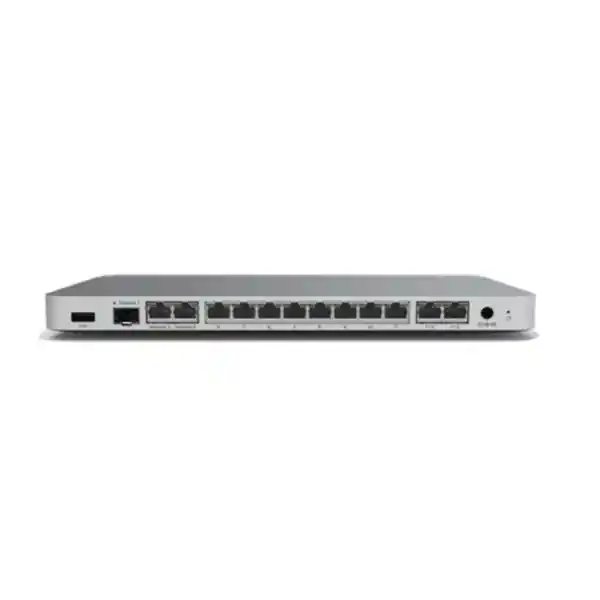
The Cisco Meraki MX95 protects and connects medium-to-large branch networks through an integrated firewall, VPN and software-defined WAN platform administered from the Meraki dashboard. Its combination of multi-gigabit WAN connectivity and 10 Gigabit optical interfaces makes it suitable for businesses modernizing branch connectivity without operating a separate security management server at each location.
Organizations evaluating this model are often replacing aging firewalls, increasing internet bandwidth, introducing branch-to-branch encrypted connectivity or consolidating security policy across geographically dispersed offices. The correct procurement decision must consider more than the appliance name: licensing, traffic inspection, interface types, optics, resiliency and the actual applications crossing the edge all influence the final design.
FourTeck Uganda can prepare a model-specific quotation and discuss delivery, accessories and rollout support. Product availability, commercial terms and warranty eligibility should be confirmed in the issued quotation.
Procurement Facts at a Glance
Cisco Meraki MX95, rack-mounted cloud-managed security appliance.
Medium-to-large branch, distributed enterprise and regional hub.
2 × 10 GbE SFP+ and 2 × 2.5 GbE RJ45 WAN; 4 × GbE RJ45 and 2 × 10 GbE SFP+ LAN.
Internal AC supply, 100–127 V or 200–240 V, 50/60 Hz; approximately 42 W idle and 109 W maximum.
Compatible Meraki subscription required; tier and term selected to match deployment.
Stock, lead time, warranty, tax and freight confirmed individually.
Architecture and Operational Role
The MX95 is deployed at the perimeter between internal branch switching and external service-provider connectivity. Administrators define network, security and VPN policies through a centralized Meraki dashboard. This architecture reduces repetitive site-by-site administration, particularly where a lean network team oversees multiple locations. A branch can be provisioned with its network configuration and monitored remotely once the appliance has appropriate internet access and is correctly enrolled.
Security inspection and application-aware policies should be designed around real traffic profiles. A site with substantial encrypted VPN transfers, many simultaneous sessions or inspection-heavy applications may experience different throughput from an unloaded laboratory test. Confirm the current software release and feature-specific performance guidance before sizing a business-critical circuit.
Physical interface planning is equally important. Two SFP+ WAN sockets provide optical connectivity options and two multigigabit copper WAN ports accommodate suitable Ethernet handoffs. The platform has four physical WAN ports, but Cisco documentation specifies a maximum of two active WAN uplinks under current firmware. This is a material design constraint for sites considering three or four simultaneous internet providers.
On the internal side, four Gigabit Ethernet copper interfaces and two 10 Gigabit SFP+ interfaces allow connection to distribution switches and suitable optical uplinks. The appliance is not a substitute for a high-density access switch, so end-user and wireless access ports should be provided by an appropriately sized switching layer.
Enterprise Outcomes
- Throughput integrity: Select the model against peak traffic, enabled inspection and future bandwidth, not only the nominal ISP circuit speed.
- Resilience: Combine dual-provider connectivity with a separately designed warm-spare appliance when availability targets require equipment failover.
- Scalability: Standardize branch templates and VLAN policy while preserving headroom for new locations and users.
- Security: Apply firewall segmentation, threat protection features available in the selected license tier and appropriate access controls.
- Management: Monitor events, network health and configuration centrally instead of requiring local access for routine changes.
- Ownership cost: Budget for hardware, recurring licensing, optics, power, rack space, support and lifecycle replacement.
- Operational visibility: Review WAN health and application behavior to identify bottlenecks and guide capacity decisions.
Hardware and Software Highlights
The MX95 provides a 1U rack-mount chassis, integrated AC power supply, multigigabit WAN copper ports and 10 Gigabit SFP+ interfaces on both WAN and LAN sides. One supported WAN copper port has PoE+ capability, subject to the documented interface behavior and compatible equipment. Its dashboard-managed software brings routing, firewall, VPN and SD-WAN functions together under an organization-level administrative framework.
The internal processing components and acceleration implementation should not be inferred from throughput figures alone. Procurement teams needing a particular chipset, cryptographic certification or deterministic packet-processing behavior should request the relevant manufacturer technical evidence before specifying such a requirement.
Technical Specifications
| Specification | Cisco Meraki MX95 |
|---|---|
| Form factor | 1U rack mount |
| Firewall throughput | 3 Gbps stateful firewall |
| VPN throughput | Up to 2.5 Gbps per MX95/105 technical reference |
| NGFW detection throughput | 2 Gbps per MX95/105 technical reference |
| WAN ports | 2 × 10 GbE SFP+; 2 × 2.5 GbE RJ45 |
| Simultaneously active WAN uplinks | Maximum two under documented firmware behavior |
| LAN ports | 4 × GbE RJ45; 2 × 10 GbE SFP+ |
| Dimensions | Approximately 484.6 × 285.2 × 44 mm (W × D × H) |
| Weight | Approximately 3.17 kg |
| AC input | 100–127 V / 200–240 V, 50/60 Hz |
| Power consumption | 42 W idle / 109 W maximum |
| Operating temperature | 0–40 °C |
| Humidity | 5–95% |
Published performance figures may change with firmware and test conditions. Validate current Cisco documentation for final engineering acceptance.
Sizing and Configuration Worksheet
1. Establish Traffic Requirements
Record internet circuit capacity, busiest-hour utilization, expected growth, encrypted tunnel traffic, user count and applications requiring low latency. Identify whether threat inspection is mandatory for all traffic or whether policy-specific exclusions are permissible.
2. Confirm Rack and Power
Reserve a suitable 1U rack position with rear cable clearance, ventilation and supported AC supply. Calculate UPS runtime using a realistic load budget rather than idle consumption alone. The MX95 has an internal supply; do not assume it offers the removable dual-supply arrangement available on certain other models.
3. Map Interfaces and Optics
Document every ISP handoff and downstream switch connection. Confirm optical transceiver compatibility, fiber type, connector standard, supported distance and switch-side negotiation before ordering SFP+ modules.
4. Select Licensing
Determine which Meraki security and management features are required, the organization licensing model and the subscription term. Request separate hardware and licensing line items for transparent budgeting.
5. Prepare the Quote
Provide delivery city, quantity, preferred license duration, target installation date, required accessories, warranty expectations and whether professional configuration assistance is required.
Deployment Scenarios
Distributed Enterprise
Place MX95 appliances at significant branches, use encrypted site-to-site connectivity and centrally govern security policies. Assess hub traffic aggregation separately because a heavily utilized headquarters edge can have different requirements from an individual branch.
Financial Services
Use segmented network zones, controlled management privileges and resilient carrier connectivity for banking operations. Validate regulatory controls and security architecture with the institution’s risk and compliance team rather than assuming the appliance alone provides compliance.
Education and Campuses
Support administrative and teaching networks with suitable VLAN segmentation and controlled inter-network access. Design wireless density and campus switching independently of the firewall’s edge throughput.
Public Sector
Document the bill of materials, licensing entitlement, asset serials, acceptance tests and approved configuration baseline. Confirm any tender-specific certification, sourcing and support requirements before award.
Technical Deep Dives
Traffic Processing and Capacity
The appliance evaluates traffic against configured routing and security policy while providing VPN services and traffic steering. Firewall throughput, inspection throughput and VPN throughput describe different workloads; they should not be treated as interchangeable guaranteed application speeds. Test with representative packet sizes, session patterns and the exact protections intended for production.
Cloud Management and Firmware Control
Centralized management helps teams deploy common configurations, inspect events and administer geographically separated sites. Define administrative roles, change approval, firmware maintenance windows and configuration backups in the operational procedure. Verify licensing validity and dashboard organization ownership before transferring or commissioning equipment.
Availability and Recovery
Two active WAN uplinks can help protect against a provider failure, while an appropriately configured second appliance can mitigate hardware failure. Plan heartbeat connectivity, switching topology, power diversity, upstream addressing and failover testing. Redundancy design is a system property, not simply a chassis feature.
Pre-Purchase Buyer Checklist
Subscription cost: Ask for the exact license SKU, term, included services and renewal approach. Lifecycle: Verify current manufacturer lifecycle and support status at order time. Rack fit: Confirm depth, mounting accessories, airflow and cabling clearance. Electricity: Size UPS and distribution equipment for peak rather than idle demand. Interoperability: Confirm provider handoff, optical modules, routing design and downstream switch compatibility. Resilience: Determine whether a second appliance and separate circuits are required. Migration: Plan firewall rule translation, addressing, VPN peer changes, downtime and rollback before cutover.
Uganda Procurement and Delivery
FourTeck Uganda can receive project requirements and issue a tailored commercial response for MX95 hardware and associated components. Quote preparation should establish the intended deployment site, quantity, license duration, required modules, delivery instructions and technical support scope. Actual inventory and delivery timing must be confirmed rather than presumed.
For Kampala headquarters projects, coordinate delivery windows and rack readiness with the on-site network team. Entebbe facilities may require additional access scheduling; Jinja, Mbarara and Gulu deployments should account for regional transport, site access and staging arrangements. Organizations rolling out several branches can benefit from a consolidated shipment plan and standardized configuration checklist.
Cross-border projects involving Uganda, Kenya, the UAE, Kuwait or other African markets should separately validate customs documentation, import responsibilities, regional warranty eligibility and licensing arrangements. Regional contacts: Uganda, Kenya, Africa, UAE and Kuwait.
Related Infrastructure Planning
Review the broader FourTeck Uganda catalog for complementary network equipment and request assistance identifying compatible Meraki switches, access points, SFP+ optics, rack accessories, UPS capacity and spare equipment. A complete design should specify both the security edge and the access infrastructure it protects. Teams comparing the MX95 with MX85 or MX105 should evaluate throughput, interface mix, power resilience and price over the full subscription period rather than relying on model-number progression alone.
Technical Services and Acceptance
Discuss bill-of-materials verification, optics validation, network topology review, staged configuration and cutover planning with FourTeck before purchasing. Where included in the agreed scope, preparation may cover software compatibility checks, initial dashboard onboarding guidance, WAN policy review and documented acceptance tests. Post-sale responsibilities, response times and manufacturer escalation routes should be written into the commercial agreement.
Frequently Asked Questions
Does the MX95 require a Meraki license?
Yes. Budget for the applicable Meraki subscription and verify its entitlement and term before commissioning. License tiers can affect available security capabilities, so the cheapest subscription is not necessarily the right match for a project that requires enhanced threat inspection. Request the precise license part number in the quotation and confirm how it will be assigned to the intended dashboard organization.
Can all four WAN ports be active simultaneously?
No. The chassis has four dedicated WAN interfaces, but Cisco’s MX95/105 documentation states that current firmware supports at most two active WAN uplinks. This distinction matters when planning multiple carriers. If a site needs more than two concurrently active upstream circuits, revisit the WAN design and product selection rather than assuming the physical connector count equals active link capacity.
Is the MX95 appropriate for a 1 Gbps internet connection?
It can be, depending on inspection requirements and aggregate traffic. Its published firewall and VPN figures exceed 1 Gbps under specified tests, but throughput depends on features, firmware, packet patterns and simultaneous workloads. Size against the expected production profile and allow capacity for peak use, future growth and encrypted traffic.
Can it connect to 10 Gigabit switches?
Yes. Two dedicated 10 Gigabit SFP+ LAN interfaces can connect to suitable downstream switching equipment. Verify supported optics, cable length, transceiver type and negotiation behavior on both ends. A 10 Gigabit physical interface does not mean every inspected traffic flow can be forwarded at 10 Gbps.
Does the MX95 have redundant power supplies?
The MX95 is specified with an internal AC power supply, not the removable dual-supply configuration offered by some higher models. Sites with strict power resilience requirements should evaluate a redundant appliance design, protected power distribution and potentially another model with appropriate hardware power redundancy.
How should high availability be designed?
Start with the failure modes the business needs to tolerate: ISP outage, appliance failure, switch failure or utility interruption. Then design suitable WAN diversity, a supported warm-spare configuration, resilient switching and UPS coverage. Test failover in a maintenance window and document recovery behavior, monitoring and operational ownership.
What should be included in a Uganda quotation?
Request a clearly itemized offer for hardware, subscription licensing, compatible optics, rack accessories, delivery, taxes where applicable and any configuration or support services. Specify quantity, delivery location and intended installation date. Confirm the quoted warranty terms and manufacturer support eligibility in writing.
Can an existing firewall configuration be migrated automatically?
Do not assume a direct one-click migration from another vendor. Existing policies, NAT rules, VPN peers, VLANs, static routes and security exceptions need a structured review and may require redesign. Build a validated migration worksheet, stage the target settings, test business-critical services and maintain a rollback plan.
Is the MX95 suitable for banks and government agencies?
It may be appropriate as one component of a wider secure network architecture. Suitability depends on throughput, segmentation, audit requirements, support commitments and applicable procurement or regulatory controls. Security and compliance approval should be based on the institution’s documented requirements and the specific configuration proposed.
How do I confirm current warranty and product lifecycle?
Ask for the hardware part number, manufacturer warranty reference, serial-number eligibility and current lifecycle status before placing an order. Warranty handling and replacement arrangements may differ by region and commercial agreement. Avoid assuming a particular local replacement time unless it is explicitly committed in the quotation or support contract.
Build a Reliable MX95 Deployment in Uganda
Share your branch count, user and device estimates, ISP speeds, required security features, license term and preferred delivery city. FourTeck can use this information to prepare an itemized procurement proposal and identify the design questions that should be resolved before installation. Confirm final stock, warranty and delivery terms with the sales team.


Reviews
There are no reviews yet.