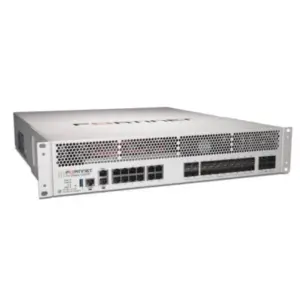
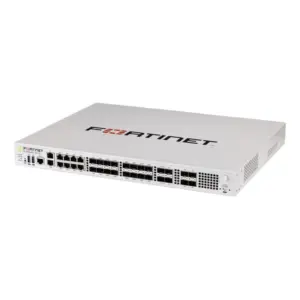
Fortinet FortiNAC CA-700F Control and Application Server for Enterprise Network Access Control in Uganda
FortiNAC CA-700F is a high-capacity physical appliance built for organizations that need centralized visibility, classification and access control across large wired, wireless, operational technology and Internet-connected device estates. In practical terms, it gives infrastructure and security teams a dedicated Control and Application Server platform for discovering what is connected, applying access policies, coordinating enforcement actions and maintaining consistent operational oversight as network scale grows. Fortinet positions the CA-700F as its largest current F-series Control and Application hardware appliance, with capacity for up to 25,000 managed ports per server. That makes it suitable for major campuses, distributed enterprises, banks, universities, public-sector environments, healthcare networks, industrial estates and other organizations where a smaller appliance may not provide enough headroom.
The appliance combines a 32-core AMD EPYC 7543P processor running at a 2.8 GHz base frequency, 96 GB of DDR4 memory, two 960 GB SSDs configured with software RAID1, one GbE RJ45 interface and four 10 GbE SFP+ interfaces. It is delivered in a 1U rack-mount form factor and uses hot-plug 1+1 redundant power supplies. These characteristics matter because network access control is not simply a software checkbox. The platform must continuously receive infrastructure state, maintain endpoint records, evaluate policy context, coordinate with switches and wireless systems, and stay available during maintenance or component faults. A correctly sized CA-700F deployment therefore becomes an operational control point rather than just another server in the rack.
For procurement teams in Uganda, the important question is not merely whether the CA-700F can be ordered. The stronger question is whether the appliance, licenses, transceivers, support coverage, rack environment, high-availability design and deployment assumptions all match the real network. FourTeck supports this evaluation from quotation preparation through bill-of-materials validation, staging and delivery coordination. The goal is to reduce avoidable procurement gaps such as insufficient capacity planning, missing optics, overlooked power-feed requirements, incomplete licensing or a design that leaves no resilience margin.
Instant Specifications and Procurement Fact Rail
FNC-CA-700F
FortiNAC Control and Application Server
Up to 25,000 managed ports per server
1U rack mount
AMD EPYC 7543P, 32 cores, 2.8 GHz base
96 GB DDR4
2 × 960 GB SSD, software RAID1
1 × GbE RJ45, 4 × 10GbE SFP+
375 W input, hot-plug 1+1 redundant PSU
Project quotation and availability confirmation required
This fact rail is designed for fast purchasing review. A buyer can immediately confirm the physical appliance class, scale target, rack requirement and key infrastructure dependencies before moving to a formal bill of materials. The CA-700F should not be evaluated only by the number of ports that it can manage. Procurement should also consider endpoint churn, the number of remote sites, frequency of policy updates, expected monitoring integrations, enforcement methods, redundancy objectives and the operational value of maintaining spare growth capacity. A design built exactly at maximum anticipated load may leave little flexibility for mergers, branch expansion, campus growth or a change in access-control policy. FourTeck can help translate these inputs into a quotation that includes the correct appliance quantity, support, licenses and any required connectivity accessories.
Operational Product Architecture and Platform Overview
FortiNAC is intended to answer a foundational enterprise networking problem: organizations frequently know how many switches, wireless controllers and firewalls they own, yet still struggle to maintain a trustworthy, continuously updated view of every user and device attached to those systems. Laptops, corporate phones, guest devices, printers, cameras, building controllers, point-of-sale terminals, laboratory equipment and operational technology may all share the same physical or logical infrastructure while requiring very different levels of access. The CA-700F provides the physical compute platform for the Control and Application functions that coordinate this visibility and enforcement at large scale.
The hardware architecture gives the platform substantial general-purpose processing resources. Thirty-two CPU cores provide parallel processing headroom for the many services involved in discovery, profiling, policy evaluation and integration activity. Ninety-six gigabytes of DDR4 memory gives the appliance room to maintain active operational state and application services, while the mirrored SSD pair protects against a single-drive failure at the storage layer. Software RAID1 means the two 960 GB SSDs maintain mirrored data rather than acting as independent capacity pools. The resulting usable capacity is lower than the combined raw disk figure, but the arrangement prioritizes continuity over maximum storage volume, which is appropriate for an infrastructure control appliance.
Network connectivity is equally important. The CA-700F includes one GbE RJ45 interface and four 10GbE SFP+ interfaces. These interfaces allow the appliance to be integrated into modern data-centre switching environments where management and service traffic may require physical separation, high bandwidth or resilient upstream connectivity. Exact port assignments should follow the supported FortiNAC deployment model, the selected software version and the customer’s network design. Buyers should validate required SFP+ optics or direct-attach cables because these accessories are often treated as separate line items. A technically correct server can still arrive unusable on day one when the selected optical standard, fibre type or switch-side interface has not been included in the purchase order.
The 1U chassis is 44 mm high, 437 mm wide and 610 mm deep, with a published weight of 18.6 kg. The depth deserves special attention in smaller racks, branch data rooms and wall-mounted enclosures. A rack that is nominally 19-inch compatible can still be unsuitable if there is insufficient rail depth, rear cabling clearance or airflow space. Procurement teams should verify front-to-rear dimensions, PDU placement and service access before shipment. This simple check prevents a common installation problem where an appliance fits the rack width but cannot be safely mounted because power connectors or cable-management arms conflict with the rear door.
Power is delivered through hot-plug 1+1 redundant supplies. The published input power is 375 watts, with input current specified at 3.75 A at 100 V and 1.57 A at 240 V. In a resilient installation, each supply should normally be connected to a different protected power path, for example separate PDUs backed by separate UPS circuits where the site design supports that topology. Plugging both power supplies into the same PDU retains protection against a single PSU failure but does not protect the appliance from PDU failure or an upstream circuit outage. Five system fans support cooling, with published heat dissipation of approximately 1279.55 BTU per hour. Data-centre planning should therefore account for both electrical load and thermal output.
The operating temperature range is 0 to 40°C and the storage range is -20 to 70°C, with 5% to 90% non-condensing humidity. These limits are especially relevant for equipment rooms in warm climates. A device can be correctly specified and still experience reliability problems when installed in a poorly cooled room, beside a heat source or in a rack with obstructed airflow. FourTeck recommends reviewing rack airflow direction, ambient temperature under realistic load, UPS capacity and generator-backed runtime as part of the deployment plan.
From a software perspective, current FortiNAC-F appliances use FortiNAC-OS. Fortinet documentation notes that limited TCP and UDP ports are open by default, with SSH listening on port1 by default and additional access enabled as required through the appliance command-line interface. This reduces unnecessary exposed services compared with platforms that ship with a broad default network surface. During implementation, the operations team should deliberately document which services are enabled, why they are needed and which management networks can reach them.
Enterprise Business Outcomes and Value Analysis
1. Performance and Throughput Integrity
A network access control deployment has to process a continuous stream of infrastructure and endpoint state without becoming the operational bottleneck. The CA-700F’s 32-core processor, 96 GB memory footprint and 10 GbE-capable interfaces give large environments the hardware foundation required to handle a significantly larger management domain than the smaller CA-500F and CA-600F appliances. Fortinet rates each CA-700F server for up to 25,000 network ports. That capacity helps organizations consolidate oversight while retaining sufficient compute resources for device visibility, access-control workflows and supporting services. The business outcome is not simply faster hardware: it is the ability to maintain consistent policy operation as campus, branch or data-centre infrastructure expands.
2. System Reliability and High Availability
The CA-700F includes redundant hot-plug power supplies and mirrored SSDs, reducing exposure to single-component failure. These features should be complemented by an architecture-level resilience plan. For organizations where network admission and enforcement are business critical, appliance redundancy, resilient switch uplinks, dual power feeds, configuration backup and recovery procedures should be planned together. Hardware resilience is most valuable when it forms one layer of a broader availability strategy rather than being treated as a substitute for it. FourTeck can review the proposed topology and identify single points of failure before purchase.
3. Network and Infrastructure Scalability
Large organizations rarely remain static. New buildings, branches, wireless access points, security cameras, printers and industrial devices can push managed-port counts upward faster than forecast. A CA-700F gives procurement teams a high-capacity starting point and can be incorporated into larger FortiNAC designs where additional server capacity is required. Sizing should still be based on verified infrastructure counts rather than assumptions. Current ports, three-year growth, planned acquisitions, temporary project sites and network segmentation changes should all be considered. Building margin into the design can reduce disruptive re-platforming later.
4. Enterprise Security and Access Control
The practical security value of network access control comes from knowing what is connected and translating that context into enforceable policy. FortiNAC can be used to identify and classify devices, support role-based access decisions, isolate systems that do not satisfy policy and coordinate access-state changes with supported infrastructure. This is especially relevant for unmanaged endpoints and embedded devices that cannot host conventional endpoint software. By bringing infrastructure context into one operational system, teams can reduce blind spots and respond more consistently when an unknown or non-compliant device appears on the network.
5. Centralized Management and Operational Simplicity
Without centralized visibility, network teams often spend excessive time moving between switch consoles, controller dashboards, DHCP records, spreadsheets and ticketing systems to answer basic questions about a connected device. A properly integrated FortiNAC deployment provides a more unified control point for endpoint and access information. The result can be faster incident triage, clearer device ownership and more repeatable policy administration. The CA-700F is the appliance layer that provides the processing headroom for this work at a large port count.
6. Total Cost of Ownership and Energy Planning
The largest appliance is not automatically the cheapest solution, but it can reduce operational fragmentation when a high port count would otherwise require several smaller servers. Procurement should compare appliance quantity, support contracts, licenses, rack units, switch ports, optics, power consumption, UPS capacity and administrative overhead. The CA-700F’s published 375 W input figure and 1U form factor provide useful planning anchors. A lifecycle comparison should also include the cost of future growth. Buying too small can trigger an early expansion project, while buying substantially beyond realistic needs can tie up capital unnecessarily.
7. Change Control and Audit Readiness
In regulated environments, consistent access enforcement and documented operational procedures matter as much as the initial deployment. FortiNAC can support repeatable access-control workflows, but buyers should also plan role separation, administrative account management, configuration backup and change approval. The CA-700F’s role in the architecture should be recorded in network diagrams and business-continuity plans. This makes upgrades, audits and handovers easier because teams understand the appliance dependency and its recovery priorities.
Key Hardware and Software Highlights
| Component | CA-700F Detail | Operational Outcome |
|---|---|---|
| Processor | AMD EPYC 7543P, 32 cores, 2.8 GHz base | Substantial compute capacity for a large Control and Application Server workload. |
| Memory | 96 GB DDR4 | Supports large operational state, services and policy-processing requirements. |
| Storage | 2 × 960 GB SSD, software RAID1 | Mirroring protects against a single SSD failure and provides fast local storage. |
| Data Connectivity | 1 × GbE RJ45 plus 4 × 10GbE SFP+ | Flexible integration into contemporary enterprise and data-centre switching environments. |
| Power Resilience | Hot-plug 1+1 redundant PSU | Power-supply maintenance or single-PSU failure can be handled without planned appliance shutdown when both feeds are healthy. |
| Cooling | 5 system fans | Designed for rack operation within the published environmental limits. |
| Operating Platform | FortiNAC-OS on current FortiNAC-F appliances | Purpose-built operating environment with limited services exposed by default. |
The value of this hardware should always be interpreted through the deployment design. For example, four 10 GbE SFP+ interfaces do not mean every installation must populate every cage. Instead, the interfaces create design options for service separation, resilient upstream connectivity and higher-bandwidth integration where needed. Similarly, redundant PSUs only provide full power-path benefit when connected to independent sources. RAID1 improves disk resilience, but it does not replace configuration backup. A strong project connects each appliance feature to a specific operational requirement rather than assuming that redundancy at one layer protects the whole system.
Technical Specifications Ledger
| Specification | Published Detail | Planning Note |
|---|---|---|
| Product | FNC-CA-700F | Control and Application hardware appliance |
| Capacity | Up to 25,000 managed ports per server | Validate current count plus growth and resilience margin |
| CPU | AMD EPYC 7543P, 32 cores, 2.8 GHz base | High-capacity F-series hardware platform |
| Memory | 96 GB DDR4 | Fixed appliance specification |
| Drives | 2 × 960 GB SSD | Configured as mirrored storage |
| RAID | Software RAID1 | Redundancy, not doubled usable capacity |
| Network Interfaces | 1 × GbE RJ45; 4 × 10GbE SFP+ | Confirm optics, fibre and switch-side compatibility |
| Console | RJ45 type COM port for CLI | Plan approved local console method for recovery procedures |
| Form Factor | 1U rack mount | Reserve rail depth and rear cable clearance |
| Dimensions | 44 × 437 × 610 mm | Check usable rack depth, not only rack-unit count |
| Weight | 18.6 kg | Use suitable rails and safe installation practice |
| Power Supply | Hot-plug 1+1 redundant | Prefer independent protected power feeds |
| Input Power | 375 W | Include in UPS and PDU load calculations |
| Input Current | 3.75 A at 100 V; 1.57 A at 240 V | Validate site voltage and circuit headroom |
| Cooling | 5 system fans | Maintain unobstructed airflow |
| Heat Dissipation | Approx. 1279.55 BTU/h | Include in room cooling calculations |
| Operating Temperature | 0°C to 40°C | Monitor real rack inlet temperature |
| Storage Temperature | -20°C to 70°C | Protect equipment during warehousing and transport |
| Humidity | 5% to 90% non-condensing | Avoid condensation and uncontrolled equipment rooms |
| Safety | Applicable global certifications including NRTL, SCC and CE | Confirm tender-specific compliance requirements |
| EMC | Applicable global certifications including FCC, ICES and CE | Useful for enterprise and public procurement documentation |
| Materials | Applicable certifications including EU RoHS and China RoHS | Check project environmental compliance clauses |
The published specification table is the starting point for a procurement decision, not the entire design. FortiNAC licensing, the precise software release, infrastructure integrations and desired enforcement methods affect the final solution. Hardware quantities should therefore be selected together with the logical architecture. Where a tender requires exact line-item evidence, model identifiers and supporting manufacturer documentation should be attached to the technical submission rather than relying on a generic product-family description.
Configuration and Sizing Worksheet
Step 1: Establish the managed network scale
Start with a defensible port inventory. Count active and administratively available access-switch ports, wireless infrastructure where relevant to the FortiNAC design, remote-site infrastructure and any planned expansion. Do not use employee headcount as a substitute for port count. A university with 8,000 users may have many more manageable ports because of classrooms, residences, laboratories, cameras and wireless systems. Likewise, a financial organization with fewer staff may have a dense branch estate and strict segmentation requirements. The CA-700F is rated for up to 25,000 ports per server, so the sizing exercise should show both present demand and forecast headroom.
Step 2: Document endpoint diversity and enforcement goals
Record the device classes the organization expects to manage: corporate computers, mobile devices, printers, IP phones, CCTV, access-control panels, building systems, servers, medical devices, industrial controllers, guest devices and contractor equipment. Then identify the desired response for each class. Some devices may require registration, others profiling and policy assignment, while unknown or non-compliant systems may need quarantine or restricted access. This prevents a quotation from being sized solely around port count while ignoring the complexity of policy and integration requirements.
Step 3: Validate rack, cooling and physical access
Reserve at least one rack unit for each appliance and confirm the rack can accommodate 610 mm chassis depth plus cable and airflow clearance. Check the rail environment, front and rear service access, rack loading and secure mounting procedures. The appliance weighs 18.6 kg, which should be reflected in safe installation planning. Confirm ambient temperatures remain inside the 0 to 40°C operating range during normal and backup-power operation. A room that is adequately cooled during utility power may overheat if air conditioning is not connected to the generator.
Step 4: Plan redundant power correctly
The CA-700F provides hot-plug 1+1 redundant power supplies. For maximum resilience, connect each supply to a separate protected power path when the facility supports it. Record PDU socket type, available capacity, UPS runtime and generator transfer assumptions. Use the 375 W published power figure and approximate 1279.55 BTU/h heat dissipation value in infrastructure calculations. If several appliances are deployed for resilience or additional capacity, calculate aggregate load rather than duplicating a single-appliance estimate informally.
Step 5: Confirm interface media
Map each planned appliance interface to the corresponding switch port and cable type. For SFP+ connectivity, specify whether the design requires multimode fibre, single-mode fibre or direct-attach cable and confirm that both ends support the selected standard. Do not assume transceivers are included unless the quotation explicitly lists them. If an implementation requires only copper connectivity for a particular management path, confirm which interface is intended for that use and how it aligns with the supported FortiNAC architecture.
Step 6: Align subscriptions, support and software
Hardware procurement should be paired with the correct FortiNAC entitlement and support structure. Licensing models and orderable part numbers can change over a product lifecycle, so FourTeck will align the quotation with the current Fortinet ordering framework at the time of purchase. Buyers should provide desired support term, renewal policy, upgrade expectations and whether the organization already holds Fortinet agreements that should be considered. Avoid assuming that the physical appliance alone grants every desired software capability indefinitely.
Step 7: Prepare the quotation checklist
A complete request should include organization name, deployment country, delivery location, estimated managed-port count, site count, switch and wireless vendors, core topology, preferred redundancy level, rack environment, optical requirements, expected license term, support requirement and target implementation date. Government, education and financial-sector buyers should also attach tender compliance schedules or mandatory certification clauses. The more complete this information is at quotation stage, the lower the risk of post-order changes.
Deployment Scenarios and Industry Use Cases
Large Enterprise and Multi-Site Networks
A large enterprise may operate a headquarters campus, several regional offices, warehouses and smaller branches, each with different switch generations and wireless designs. The operational challenge is maintaining consistent endpoint visibility and access policy without requiring administrators to investigate every incident device-by-device. A CA-700F can serve as the high-capacity Control and Application platform for such a deployment, with the overall FortiNAC architecture designed around site count, port quantity, connectivity and resilience requirements. Policy should distinguish corporate endpoints, guests, shared infrastructure, printers and unmanaged equipment. During rollout, teams often gain better results by onboarding sites in controlled phases rather than attempting simultaneous enforcement everywhere. Visibility can be established first, followed by policy validation, exception cleanup and progressively stronger control.
Financial and Banking Institutions
Banks, microfinance organizations and payment environments typically require strong separation between user devices, branch systems, payment infrastructure, surveillance equipment and third-party maintenance endpoints. A large network access control platform can help security teams identify attached assets and coordinate consistent policy across branches and central facilities. Procurement should emphasize availability, change management and audit documentation. Redundant power, mirrored storage and appropriately designed appliance redundancy are relevant because a poorly planned maintenance event should not disrupt normal access workflows. Integration testing should include representative branch switches, wireless infrastructure, authentication services and any critical legacy equipment before broad enforcement.
Educational and Campus Networks
Universities and large schools have unusually diverse endpoint populations. Staff computers, student laptops, phones, residence-hall devices, laboratory equipment, smart displays, access points, research systems and visiting users may all connect to the same campus infrastructure. The challenge is scale combined with high endpoint turnover. The CA-700F’s 25,000-port server capacity makes it relevant to major campus environments where smaller appliances may not provide sufficient room. Policy can be structured around institutional ownership, user role, device category and compliance state. Planning should consider semester peaks, registration periods, residence-network behaviour and the need for clear exception procedures for specialized research devices.
Government and Public-Sector Procurement
Government agencies often have formal purchasing controls, distributed offices and heterogeneous infrastructure acquired through multiple projects. A FortiNAC deployment can create a more consistent view of connected devices and assist with standardized access enforcement, but the procurement package should document product model, hardware specifications, compliance, support term, delivery conditions and acceptance criteria. Where government or defence-related environments have strict isolation or confidentiality requirements, the deployment architecture must be reviewed against applicable internal policy and security procedures. FourTeck can support bill-of-materials validation and pre-shipment coordination, while final policy design remains aligned with the customer’s authorized security architecture.
Healthcare, Industrial and Utility Environments
Hospitals, factories and utilities commonly contain devices that cannot run conventional endpoint agents or be frequently upgraded. Network-level visibility is therefore valuable because it can observe infrastructure relationships without requiring software installation on every endpoint. Before enforcement, teams should identify operationally critical devices, maintenance windows and vendor support constraints. Aggressive quarantine policies that are suitable for office laptops may be inappropriate for a medical or industrial controller. The CA-700F provides the large-scale appliance platform, while the success of the deployment depends on careful classification, exception design and staged policy activation.
Technical Deep Dive 1: Processing, Scale and Hardware Engine Architecture
The CA-700F is built around an AMD EPYC 7543P processor with 32 cores and a 2.8 GHz base frequency. This matters because a network access control server performs many concurrent tasks rather than a single linear workload. It maintains endpoint and infrastructure state, processes events, supports administrative services, evaluates policies and communicates with integrated network systems. A high core count gives the platform substantial parallel processing resources. Ninety-six gigabytes of DDR4 memory complements the CPU by providing workspace for active services and operational data. For a buyer comparing the CA-700F with smaller F-series systems, these hardware differences are a practical indicator of the scale tier the platform is intended to serve.
The appliance is not described as an inline packet-forwarding firewall and should not be evaluated using firewall throughput metrics. Its value lies in control, application and visibility functions. That distinction is important in tenders because buyers sometimes request a single throughput number that does not meaningfully describe the product’s operational role. The more relevant capacity figure published by Fortinet is up to 25,000 managed ports per CA-700F server. Sizing should therefore begin with network infrastructure scale and policy workload rather than trying to translate unrelated security-appliance benchmarks.
Local storage is provided by two 960 GB SSDs in software RAID1. Mirroring provides protection against one drive failing, but it should be combined with regular configuration backup and documented recovery procedures. The appliance also provides four 10 GbE SFP+ interfaces plus one GbE RJ45 port. These interfaces provide the physical foundation for integrating the server into resilient or high-bandwidth network designs. Exact logical use should follow Fortinet deployment guidance for the selected release.
Technical Deep Dive 2: FortiNAC-OS, Service Exposure and Operational Control
Current FortiNAC-F physical appliances use FortiNAC-OS. Fortinet documentation states that a limited set of TCP and UDP ports is open by default, with SSH listening on Ethernet port1 by default. Additional access is enabled through supported command-line configuration as the deployment requires. This creates a useful operational discipline: administrators can keep the appliance’s exposed management surface small and deliberately enable only the services needed for the selected features.
Implementation teams should treat service enablement as a controlled configuration item. Every management port or integration path should have a documented purpose, source network and owner. Upstream firewalls and management ACLs should restrict access to approved administrative networks rather than exposing appliance interfaces broadly. Administrative credentials should follow the organization’s privileged-access policies, and configuration backups should be stored according to business-continuity rules. Firmware and FortiNAC software updates should be evaluated through the vendor’s published release notes and compatibility guidance before production rollout.
Operational control also includes change timing. A network access control system has direct influence over endpoint reachability, so policy changes should be tested with representative devices before broad activation. Mature deployments normally maintain a staging method, exception workflow and rollback plan. The CA-700F supplies the physical resources, but strong governance prevents a technically valid policy from creating unintended business disruption.
Technical Deep Dive 3: High Availability, Redundancy and Disaster Recovery
Availability begins inside the chassis. The CA-700F has two hot-plug power supplies in a 1+1 arrangement and two SSDs configured as RAID1. These features reduce exposure to individual component failures, but true service resilience requires the rest of the deployment to be designed accordingly. Each PSU should ideally be connected to a different PDU and protected electrical path. Network uplinks should avoid a single switch dependency where the architecture supports redundant connectivity. If the FortiNAC deployment requires server-level redundancy, the appropriate additional appliance and configuration should be included in the bill of materials from the beginning rather than treated as an emergency future purchase.
Disaster recovery is different from hardware redundancy. A redundant PSU cannot recover an accidentally deleted configuration, a failed site or a wider environmental event. Buyers should therefore define backup frequency, off-appliance storage, restore responsibility, replacement-hardware process and acceptable recovery time. Data-centre documentation should identify where the appliance is installed, which power feeds and switch ports it uses, what licenses and support contracts apply, and which teams must be involved in restoration. These steps are especially important in organizations with staff rotation or outsourced operations.
A practical resilience review should test several scenarios: loss of one PSU, loss of a PDU, loss of an uplink, appliance reboot, software upgrade, failed SSD, loss of the primary equipment room and the arrival of replacement hardware. If the design cannot describe what happens in each case, high availability has not yet been fully engineered. FourTeck can assist with appliance and accessory validation, while the customer’s infrastructure and security teams retain responsibility for integrating the solution into the broader continuity architecture.
Pre-Purchase Buyer Gap Checklist
Is the hardware appliance the entire solution? No. A FortiNAC project must account for the appropriate software entitlement, support coverage, infrastructure integrations and deployment design. Buyers should request a complete bill of materials rather than comparing only appliance chassis prices.
Are SFP+ optics automatically included? Do not assume so. The CA-700F provides SFP+ interfaces, but the required transceivers or direct-attach cables should be explicitly listed according to fibre type, distance and connected switch hardware. This is one of the most common small omissions that can delay installation.
Can it fit any 19-inch rack? Rack width compatibility does not guarantee physical suitability. The chassis is 610 mm deep before considering cables and service clearance. Validate usable rack depth, rail installation, PDU placement, rear-door clearance and airflow direction.
Does 1+1 power mean the whole deployment is protected? It protects against a single power-supply failure when both PSUs are functional. If both supplies use the same PDU or upstream circuit, that common dependency remains. For higher resilience, use independent protected power feeds where facility design allows.
What happens near the 25,000-port limit? Capacity planning should leave operational headroom instead of treating the published maximum as a normal steady-state target. Include planned expansion, temporary sites, network refresh projects and future acquisitions. Larger environments may require additional server capacity within the FortiNAC architecture.
Is it compatible with a mixed-vendor network? FortiNAC is designed for enterprise network access control and supports a broad ecosystem, but exact switch, wireless controller and software-version compatibility must be verified against current Fortinet documentation before purchase. Provide precise vendor models and software versions during design review.
What should be checked before a firmware or platform update? Review release notes, supported upgrade paths, integration compatibility, backup status, maintenance window and rollback procedure. Network access control affects device admission and segmentation workflows, so updates should not be treated like routine desktop software patches.
How should replacement planning be handled? Record serial numbers, support entitlement, appliance role, software version, interface map, rack position and configuration backup location. Ensure procurement and technical teams know the support escalation path before an incident occurs. This shortens recovery when hardware replacement is required.
Does the published 375 W figure equal actual continuous consumption? It is a published appliance input specification and should be used conservatively for infrastructure planning unless project-specific measurement is available. Actual consumption varies with operating conditions. UPS, PDU and cooling calculations should not rely on an optimistic assumption that the appliance will always draw substantially less.
What lifecycle information should a tender request? Ask for current orderability, support term, warranty/support handling, software entitlement, expected lead time and any replacement or successor guidance relevant at the time of purchase. Enterprise hardware procurement is strongest when lifecycle and support assumptions are documented in the quotation rather than inferred.
Uganda Procurement, Delivery and Project Logistics
FourTeck supports FortiNAC CA-700F procurement for organizations in Uganda through a project-based quotation process. Because enterprise network access control solutions depend on capacity, licensing, support duration and deployment design, a formal quote is normally prepared after reviewing the customer’s requirements. Buyers should provide delivery location, organization details, required quantity, target project date and the technical information listed in the sizing worksheet. This allows the sales and engineering teams to validate that the proposed line items correspond to the requested architecture.
Order processing begins after commercial approval and confirmation of the bill of materials. Lead time can vary according to distributor availability, manufacturer supply, licensing and international logistics, so availability should be confirmed at quotation stage rather than assumed from a generic website status. For scheduled infrastructure projects, procurement teams should allow time for import, local delivery, site readiness and technical staging. Tight go-live dates should be communicated early so that feasible alternatives can be evaluated if a particular item has extended lead time.
Pre-configuration support can include bill-of-materials verification, software-version planning, interface and transceiver checks, rack and power review, and coordination of staging requirements. Where customer policy permits, technical teams can prepare implementation checklists before delivery so that installation begins with confirmed IP addressing, management-network access, DNS/NTP assumptions, switch inventory and administrative responsibilities. This reduces time lost during commissioning.
Warranty and support handling should be tied to the quoted Fortinet support entitlement. Buyers should retain the final invoice, appliance serial information and support contract details in their asset records. For institutions using formal asset-management processes, FourTeck can provide product descriptions and commercial documentation suitable for internal receiving and handover workflows.
Uganda Local Coverage Matrix
Core commercial and public-sector procurement support, data-centre project coordination and delivery planning.
Support for enterprise, hospitality, transport and institutional projects requiring coordinated delivery from Kampala-area logistics routes.
Procurement assistance for industrial, education and multi-site organizations extending controlled network access east of the capital.
Project support for regional branches, universities, healthcare and distributed enterprise environments in western Uganda.
Quotation and delivery coordination for northern Uganda institutions, branch networks and public-sector deployments.
Coverage planning should be based on the actual delivery site and project schedule. For multi-site rollouts, it can be more efficient to stage appliances and accessories centrally, verify serials and configurations, then coordinate controlled dispatch to regional locations. This approach reduces the chance that a branch receives incomplete equipment or an incorrect accessory. Where installation requires local contractors or customer technicians, FourTeck can provide product and bill-of-materials information so each site understands rack, power and connectivity prerequisites before deployment day.
Cross-Border and Regional Supply Chains
Organizations operating across East Africa, the Gulf and wider African markets often prefer consistent hardware standards and centralized procurement controls. FourTeck can support regional quotation coordination through its country and regional sites. Uganda requirements can be handled through FourTeck Uganda, Kenya requirements through FourTeck Kenya, wider African projects through FourTeck Africa, UAE projects through FourTeck UAE and Kuwait requirements through FourTeck Kuwait.
For cross-border rollouts, buyers should standardize the model, licensing assumptions, transceivers, support term and implementation baseline while still accounting for local electrical standards, import requirements, delivery addresses and tax treatment. Serial-number tracking is particularly useful when multiple appliances are shipped to different countries. The commercial documents should clearly match each destination and internal cost centre. Regional standardization can simplify training and spares strategy, but it should not force every site into an identical design if network scale or local infrastructure differs materially.
Related Products and Procurement Paths
The CA-700F sits within a broader FortiNAC hardware and licensing family. Buyers with smaller environments may compare it with the FortiNAC CA-600F, which Fortinet positions for up to 15,000 ports per server, or the CA-500F for up to 5,000 ports per server. Very large or distributed deployments may also require a FortiNAC Management Server component or additional Control and Application servers depending on the architecture. Related project categories can include Fortinet switching, wireless infrastructure, secure management, SFP+ optics, fibre patching, rack PDUs and UPS systems.
Because exact internal category URLs can evolve, FourTeck recommends beginning from the Uganda technology catalogue or using the project enquiry page for a consolidated bill of materials. A single coordinated quotation is preferable when the deployment requires appliance hardware, optics, support, licenses and power accessories. It allows procurement to verify that quantities and interface types align across the solution rather than discovering incompatibilities after separate purchase orders have been raised.
FourTeck Technical Service Capabilities
FourTeck’s role extends beyond identifying a part number. For enterprise appliance purchases, technical validation can begin with the bill of materials. The team can review model selection, quantity, expected port scale, transceiver requirements, rack constraints, support duration and the presence of dependencies that should be quoted together. This reduces the risk of purchasing a high-value appliance while omitting a lower-cost component required for commissioning.
Staging support can include checking shipment contents, recording serials, validating accessory quantities, confirming published firmware or software planning assumptions and preparing handover documentation. Where a project calls for pre-shipment updates, the permitted process can be reviewed against customer change policy and support requirements. Configuration activities should always use customer-approved addressing, credentials and security procedures.
Post-sales support can assist with vendor escalation, hardware replacement coordination and technical clarification within the boundaries of the purchased support entitlement. For complex deployments, customers should plan a formal implementation workstream with named owners for network, security, identity, server infrastructure and change management. FortiNAC projects touch several teams, and clear ownership is often as important as the appliance specification itself.
Extended Technical FAQ
1. How many ports can one FortiNAC CA-700F manage?
Fortinet lists the CA-700F with capacity for up to 25,000 managed ports per server. This is the most useful headline capacity figure when comparing it with the CA-500F and CA-600F. Procurement teams should not plan to operate permanently at the absolute ceiling without considering growth, endpoint churn and architecture-level redundancy. Count current infrastructure accurately, include planned expansions and discuss whether spare capacity is required for branch additions or network refresh projects. If projected demand exceeds the practical design target for one appliance, the FortiNAC architecture can be reviewed for additional server capacity rather than forcing the entire estate onto one unit.
2. Does the CA-700F include redundant power?
Yes. The CA-700F uses hot-plug 1+1 redundant power supplies. This means the appliance is designed to continue operating if one power supply fails, provided the remaining supply and its electrical path remain healthy. For stronger resilience, connect the two power supplies to separate PDUs and, where possible, separate UPS-backed circuits. If both supplies are plugged into the same PDU, the deployment still has PSU redundancy but retains a shared power-path dependency. The data-centre design should also include the appliance’s 375 W published input figure in UPS and PDU calculations.
3. What network interfaces are provided?
The published CA-700F specification includes one GbE RJ45 interface and four 10GbE SFP+ interfaces. The exact logical use of those interfaces depends on the FortiNAC deployment design and software version. Before ordering, map each intended connection to the upstream switch, confirm required link speed and specify the correct optical module or direct-attach cable. SFP+ ports alone do not determine fibre type or distance. Buyers should avoid generic transceiver assumptions, particularly when the data centre contains a mix of single-mode and multimode fibre or when switch platforms enforce vendor-specific optic policies.
4. Is the FortiNAC CA-700F suitable for mixed-vendor switching environments?
FortiNAC is intended for enterprise environments and supports integration with a wide range of network infrastructure, but compatibility must be verified at the exact vendor, model and software-version level. A procurement team should provide the current switch and wireless controller inventory during solution review rather than simply stating that the network is mixed-vendor. This is especially important for older access switches, specialized industrial Ethernet equipment and environments undergoing a network refresh. Validation before purchase helps identify where full enforcement is supported, where only visibility may be practical and whether firmware updates are advisable.
5. Does the appliance require separate licensing?
The physical CA-700F appliance should be treated as one component of the overall FortiNAC solution. The appropriate software entitlement, support and any subscription elements should be included in the commercial design according to Fortinet’s current ordering structure. Licensing can evolve over a product lifecycle, so buyers should rely on the current quotation rather than an older parts list found in previous project documentation. When requesting a quote, state the desired contract duration, expected port count and whether the organization already has Fortinet agreements. FourTeck can align the bill of materials with the current orderable items at the time of purchase.
6. What are the rack and environmental requirements?
The CA-700F is a 1U rack-mount appliance measuring approximately 44 mm high, 437 mm wide and 610 mm deep, with a published weight of 18.6 kg. Its operating temperature range is 0°C to 40°C and humidity is specified at 5% to 90% non-condensing. Rack planning should verify rail depth, rear cabling clearance, PDU position and airflow. The appliance publishes heat dissipation of approximately 1279.55 BTU/h, which should be included in cooling calculations. In Uganda, it is also wise to confirm that cooling remains available during generator-backed operation, not only during normal utility power.
7. How is storage protected?
The appliance contains two 960 GB SSDs configured with software RAID1. RAID1 mirrors data across the two drives, providing protection against the failure of a single SSD. It does not replace backups. A configuration error, logical corruption or wider appliance failure can affect both mirrored copies. Operations teams should therefore maintain supported configuration backups and document how they would restore service onto replacement hardware. Asset records should capture the software release, serial number, interface map and support entitlement. RAID protects one layer of the appliance; recovery planning protects the business service.
8. Can FourTeck assist with staging and deployment preparation?
Yes. FourTeck can assist with bill-of-materials review, accessory validation, serial recording, rack and power checks, interface-media planning and coordination of pre-shipment requirements. The extent of configuration work depends on the agreed service scope and the customer’s security policy. For best results, the customer should nominate technical owners for switching, wireless, identity, firewall policy and system administration before implementation begins. A staging checklist can then confirm addressing, DNS, time synchronization, management access, infrastructure inventory and change-window requirements so that commissioning is not delayed by missing environmental information.
9. How should high availability be planned?
High availability should be treated as an end-to-end design objective. Start with the CA-700F’s redundant internal power supplies, then examine appliance redundancy, switch connectivity, upstream power, virtualization or management dependencies, configuration backup and recovery procedures. If access-control continuity is critical, include the required additional FortiNAC server resources in the initial architecture rather than assuming one appliance can cover every failure scenario. During acceptance testing, verify what happens when a power feed fails, an uplink is interrupted, an appliance is rebooted or a maintenance upgrade is performed. A design is resilient only when these failure modes have defined outcomes and recovery steps.
10. What information should be sent for an accurate Uganda quotation?
Provide the required quantity, delivery city, estimated managed-port count, number of sites, switch and wireless controller vendors, desired redundancy level, support term, target implementation date and any mandatory tender certifications. Include the rack and power environment where known, plus the preferred SFP+ media type and distance to the connected switches. If the project is replacing an existing network access control platform, describe current policy goals and migration constraints. This information helps FourTeck prepare a bill of materials that addresses the whole project rather than quoting only a chassis that may later need additional licenses or accessories.
Request a FortiNAC CA-700F Uganda Procurement Review
For a reliable FortiNAC purchase, start with the network rather than the part number. Share your expected managed-port count, number of sites, switch and wireless platform inventory, redundancy objective, rack environment, delivery city and required support term. FourTeck can use this information to review the CA-700F fit, identify related licensing and accessory requirements and prepare a project quotation for Uganda. This approach is particularly valuable for large enterprises, financial institutions, universities, government agencies and organizations operating mixed-vendor networks where capacity, compatibility and continuity requirements must be documented before purchase.
The CA-700F offers a substantial hardware foundation: a 32-core AMD EPYC processor, 96 GB DDR4, mirrored SSDs, 10 GbE-capable interfaces, redundant hot-plug power and support for up to 25,000 managed ports per server. Converting those specifications into a dependable operational system requires the correct architecture, support entitlement, cabling, power, software planning and implementation process. A structured procurement review helps ensure those elements arrive together.