
Enterprise Application Delivery • Uganda Procurement
Fortinet FortiADC 320F Application Delivery Controller for Uganda
The Fortinet FortiADC 320F is a rack-mount application delivery controller designed to distribute application traffic, maintain service availability, terminate and process encrypted sessions, enforce traffic policies and give infrastructure teams a controlled point between users and application servers. In practical terms, it helps enterprises prevent a single server from becoming a bottleneck, allows failed or overloaded application nodes to be removed from active service automatically, and provides a structured platform for publishing critical applications to internal or external users. The 320F is positioned for organizations that have moved beyond entry-level traffic management and require stronger connection handling, more interface flexibility and room for multiple application services or administrative domains.
For procurement teams in Uganda, the key question is not simply whether the appliance can pass traffic. The larger issue is whether the proposed configuration can support the peak connection rate, encrypted transaction volume, application mix, server pool design, network uplinks, maintenance model and availability target of the business. A banking portal, government citizen service, university registration platform and multi-site enterprise application can all use the same product family, yet each project can require a different combination of interfaces, software services, support coverage, optics, high-availability architecture and implementation effort. FourTeck therefore recommends sizing the FortiADC 320F against real operational measurements rather than relying only on a headline throughput figure.
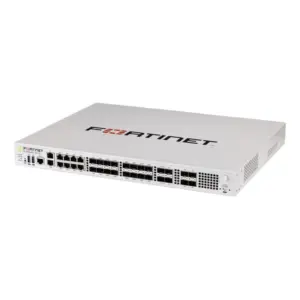
The appliance uses a compact 1U form factor and is designed for standard data-center racks. Published Fortinet specifications for the 320F include up to 10 Gbps L4/L7 throughput in the current data sheet, up to 350,000 Layer 4 connections per second, up to 1.2 million Layer 4 HTTP requests per second, up to 12 million concurrent Layer 4 connections, up to 120,000 Layer 7 connections per second, SSL transaction capability and support for multiple virtual domains. Its interface set combines copper, SFP and 10 GbE SFP+ connectivity, giving designers options for server-side, client-side and upstream network attachment.
Because application delivery is normally deployed on a critical path, the surrounding bill of materials matters as much as the appliance itself. Rack rails, transceivers, patch leads, upstream switch ports, power protection, support entitlement and a secondary appliance for high availability may all be part of the project. FourTeck can prepare a quotation that separates hardware, subscriptions, support, accessories and implementation services so that procurement teams can compare total project cost clearly.
Instant Specifications and Procurement Fact Rail
Fortinet FortiADC 320F / FAD-320F
Enterprise application delivery and data-center traffic management
1U rack appliance
2 × 10GE SFP+, 4 × GE SFP, 4 × GE RJ45
2 × 10/100/1000 management interfaces plus HTTPS, SSH, console and SNMP
100–240V AC, 50–60Hz; single internal power supply
Up to 10 Gbps L4/L7 in current Fortinet data sheet
Price, stock and lead time confirmed at quotation
This fact rail is intended as a fast procurement screen, not as a substitute for design validation. Published performance is measured under vendor test conditions and can change materially when encryption, scripting, application inspection, persistence, security services, logging or complex traffic policies are enabled. Uganda buyers should also confirm whether the project requires an appliance pair, which support bundle is required, whether SFP or SFP+ optics are included in the bill of materials, and whether the destination rack provides appropriate depth, airflow and power protection. FourTeck can align the commercial quotation with the deployment design so that the delivered equipment matches the intended topology rather than leaving critical accessories or service entitlements to be added later.
Operational Product Architecture and Overview
An application delivery controller sits in front of one or more application servers and presents a virtual service address to clients. Instead of every user connecting directly to a particular server, the controller receives the connection, applies health and policy logic, then selects an appropriate backend resource. That seemingly simple change creates a control point where an infrastructure team can improve availability, scale applications horizontally, perform maintenance on servers without taking the service offline and shape how client sessions are handled. The FortiADC 320F provides this function in a dedicated hardware platform sized for mid-range enterprise and data-center workloads.
At Layer 4, the device can distribute traffic according to transport-level information and connection state. This is useful for high-volume services where the primary requirement is efficient connection distribution with low processing overhead. At Layer 7, the controller can make decisions with awareness of application protocol and HTTP attributes. That enables more granular designs such as sending particular paths to dedicated server pools, maintaining session persistence, applying content switching rules or creating separate virtual services for different applications while sharing the same physical platform. The correct design depends on how applications are built and whether state must remain tied to a specific server.
Health checking is a central part of the architecture. A load balancer that distributes connections to a failed server simply moves the outage from one point to another, so backend health must be tested continuously. FortiADC supports health monitors that can validate server responsiveness and remove unhealthy members from active service. In a well-designed environment, this allows maintenance teams to patch or restart individual application nodes while the remaining pool continues to serve users. It also helps isolate partial failures where a server is reachable at the network layer but the application process is not responding correctly.
Encrypted traffic is another major sizing factor. Modern enterprise applications increasingly use TLS for internal as well as public-facing services. Terminating encrypted connections on the application delivery controller can reduce repeated cryptographic work on backend servers and gives the controller visibility required for application-aware policy. The FortiADC 320F publishes SSL bulk encryption throughput and SSL transaction figures, but the actual result depends on cipher choice, key size, protocol version, session reuse and enabled security functions. Buyers should therefore estimate encrypted transactions during peak periods, not just aggregate bandwidth.
The hardware combines 16 GB ECC memory with local SSD storage and a mixed set of copper and fiber interfaces. ECC memory is valuable in infrastructure appliances because it is designed to detect and correct certain memory errors that could otherwise affect long-running systems. Local storage supports system operation, logs and software functions, while the network interfaces allow the appliance to connect into different switching designs. Two 10GE SFP+ interfaces provide higher-speed attachment points, while GE SFP and GE RJ45 interfaces support common access and service networks. Dedicated management interfaces allow administrators to separate management traffic from production flows when the network architecture supports an out-of-band management segment.
The 320F can also support virtual domains, allowing a single physical system to be divided into logical administrative environments. This can be valuable for service providers, shared enterprise data centers, institutions with separate business units or projects that need segregation between production, development and partner-facing services. Virtualization of the control plane does not remove the need to size shared hardware resources; teams should still plan aggregate throughput, concurrent connections and memory usage across all domains.
The operational pain points that typically lead buyers to this class of product are predictable: web applications slow down when traffic spikes; maintenance windows require service outages; individual servers become connection bottlenecks; certificate handling is distributed inconsistently across many systems; failover depends on manual DNS changes; application teams have little visibility into real server health; or multiple departments are asking for independent traffic policies. FortiADC addresses these issues by centralizing traffic distribution and health logic. The result is not automatic resilience by itself; resilience comes from combining the appliance with multiple healthy servers, redundant upstream networks, sound routing and a tested high-availability design.
Enterprise Business Outcomes and Value Analysis
1. Performance and Throughput Integrity
The primary business reason for deploying an application delivery controller is to prevent user demand from overwhelming individual application servers or creating unpredictable response times. The 320F can distribute large numbers of connections across a server pool and gives designers a dedicated platform for handling traffic decisions. This can reduce the need to over-size every backend node simply to absorb occasional peaks. For procurement, the important step is to compare peak transactions, concurrent sessions, encrypted throughput and growth assumptions against realistic enabled-feature performance rather than purchasing against average daily bandwidth.
2. System Reliability and High Availability
Application availability improves when user connections are no longer bound to one server. Health checks allow failed nodes to be withdrawn, while a properly designed appliance pair can reduce the risk of the controller itself becoming a single point of failure. The business outcome is shorter disruption during server maintenance, better continuity when a backend node fails and clearer operational procedures for planned changes. Buyers should distinguish between backend server resilience and appliance resilience; both layers need to be designed and tested.
3. Network and Infrastructure Scalability
Horizontal application scaling becomes easier when new servers can be added to a pool without changing the client-facing service address. This lets organizations add capacity incrementally as demand grows. The mixed interface layout also gives flexibility when connecting to existing switching environments. Capacity planning should include not only present server count but expected growth in applications, interfaces, VLANs, virtual services and virtual domains over the intended hardware life.
4. Enterprise Security and Access Control
Placing an application delivery platform at the service edge creates a location where organizations can standardize TLS handling, restrict service exposure and apply consistent traffic policies. Optional security service bundles can add protections beyond core load balancing, but licensing must be selected to match the threat model and application type. Procurement teams should ask whether the deployment is primarily for availability, for advanced application protection, or for both, because that decision affects subscription selection and recurring cost.
5. Centralized Management and Operational Simplicity
A shared platform can replace inconsistent per-server traffic rules and create a controlled place for application publication, certificate deployment, health monitoring and service policy. This simplifies change management when accompanied by clear naming standards, role-based administration and configuration backups. Teams gain an infrastructure view of application delivery instead of troubleshooting each server independently. Separate management interfaces also support cleaner operational segmentation.
6. Total Cost of Ownership and Energy Efficiency
The acquisition price is only one part of the cost. Buyers should include support contracts, subscriptions, optics, spare units or HA peer hardware, rack space, power protection, implementation and staff time. The 1U form factor helps conserve rack space, and the current data sheet lists modest average and maximum power figures for the platform. A realistic cost comparison should spread hardware and recurring services over the expected deployment term and include the business cost avoided by reducing application downtime.
7. Change Control and Maintenance Flexibility
When backend servers are pooled behind a controller, individual nodes can often be drained, patched and returned to service while users continue to reach the application through remaining members. This can reduce pressure to schedule every maintenance task during overnight outages. The exact result depends on application session design and persistence requirements, but the architecture gives operations teams more options for controlled rolling maintenance.
Key Hardware and Software Highlights
16 GB ECC memory
Supports sustained appliance operation and multiple configuration objects while providing memory error protection appropriate for critical infrastructure.
Mixed copper and fiber connectivity
Four GE RJ45, four GE SFP and two 10GE SFP+ interfaces let architects integrate the platform with common access, aggregation and data-center switch designs.
Dedicated management interfaces
Two management ports support separation of administrative traffic from production service networks in environments that use out-of-band management.
Local SSD storage
Local solid-state storage supports system functions, logs and appliance operation without dependence on an external storage platform.
Layer 4 and Layer 7 load balancing
Allows traffic distribution based on transport connections or application-aware logic, helping designers choose the appropriate method for each service.
Virtual domains
Up to 25 VDOMs on current published guidance allow logical administrative separation for shared data centers, departments or hosted customer environments.
Health monitoring
Backend servers can be tested continuously so failed or unhealthy members are removed from active distribution until service is restored.
Global server load balancing capability
Supports architectures where applications are distributed across multiple sites and traffic must be directed according to site health or delivery policy.
Hardware specifications should always be interpreted together with the selected software release. Fortinet publishes maximum configuration values by software branch, and supported limits can vary by model and firmware. Before final procurement or migration, FourTeck recommends checking the target FortiADC release, supported feature set and any interoperability dependencies with authentication systems, DNS, monitoring tools, certificate authorities, upstream firewalls or cloud services. An appliance that is physically capable of the intended topology still needs software features and configuration limits that match the operational design.
Technical Specifications Ledger
| Category | FortiADC 320F Published Specification | Procurement Meaning |
|---|---|---|
| L4/L7 throughput | Up to 10 Gbps in current Fortinet data sheet | Use as a ceiling under defined test conditions; size lower when advanced processing is enabled. |
| L4 connections per second | Up to 350,000 | Important for connection-heavy services where sessions are short-lived. |
| L4 HTTP requests per second | Up to 1.2 million | Relevant for high request-rate web platforms; application features can reduce practical headroom. |
| Concurrent L4 connections | Up to 12 million | Useful when many clients maintain simultaneous sessions. |
| Layer 7 connections per second | Up to 120,000 | Plan against application-aware workloads, not Layer 4 figures alone. |
| SSL transactions | Up to 6,000 CPS/TPS with published 2K-key test profile | Cipher, key length, protocol and session reuse materially affect results. |
| SSL bulk encryption | Up to 5 Gbps | Compare with expected encrypted peak bandwidth. |
| Compression throughput | Up to 8 Gbps | Applicable where HTTP compression is part of service delivery design. |
| Memory | 16 GB ECC | Supports configuration scale and long-running infrastructure operation. |
| Network interfaces | 2 × 10GE SFP+, 4 × GE SFP, 4 × GE RJ45 | Confirm switch compatibility, transceiver type, media and port speed before ordering. |
| Management interfaces | 2 × 10/100/1000 | Supports dedicated administrative network designs. |
| Storage | 120 GB SSD in current Fortinet data sheet | Confirm exact shipment revision if a tender specifies a storage figure. |
| Virtual domains | 25 | Useful for administrative and service segregation; aggregate resources remain shared. |
| Form factor | 1U appliance | Reserve one rack unit per appliance, two when building an HA pair. |
| Dimensions | 44.45 × 432 × 380 mm | Check rack depth, cable bend radius and front-to-back airflow clearance. |
| Weight | Approx. 5.5 kg | Plan rack support and safe handling during installation. |
| Input voltage | 100–240V AC, 50–60Hz | Compatible with common enterprise AC distribution when properly protected. |
| Power consumption | 40W average / 60W maximum published | Use maximum design figures for UPS and PDU capacity planning. |
| Heat dissipation | 132–163 BTU/h published | Include in cooling calculations for dense racks. |
| Operating temperature | 0°C to 40°C | Maintain conditioned data-center environment and monitor inlet temperature. |
| Airflow | Front to back | Align rack hot-aisle/cold-aisle orientation. |
| Compliance | FCC Part 15 Class A, RCM, VCCI Class A, CE, UL/c; safety listings published by Fortinet | Confirm tender-specific certification requirements before award. |
Specification sources can differ across documentation revisions, channel listings and product generations. The current Fortinet data sheet should be treated as the primary technical reference at quotation time. If a tender document contains a conflicting storage, interface or performance figure, request written confirmation against the exact manufacturer part number before purchase. Performance values are maximum vendor test results and should not be translated directly into guaranteed application throughput. Production sizing should include safety margin for peak traffic, encryption, persistence, logging, scripts, inspection features and future growth.
Configuration and Sizing Worksheet
Step 1: Measure Workload and Scale
Start with peak, not average, traffic. Record total application bandwidth, peak new connections per second, concurrent sessions, HTTP request rate and the percentage of traffic that is encrypted. Identify whether sessions are short and bursty or long-lived. A payment gateway may have modest aggregate bandwidth but high transactional sensitivity, while a media portal may have high bandwidth with fewer connection establishments. List every virtual service that will be published and the number of backend servers in each pool. Then apply a growth allowance that reflects the planned hardware lifecycle. A three- to five-year project should not be sized only for today’s traffic.
Step 2: Define Application Behavior
Document which applications require persistence, source-IP affinity, cookie-based session control, content routing, HTTP rewriting, client certificate authentication, server-side encryption or special health checks. These functions consume different resources and may affect achievable performance. Also identify applications that cannot tolerate session movement between servers because this can influence both load-balancing logic and maintenance procedures.
Step 3: Check Environment and Rack Requirements
Reserve 1U for a single appliance or 2U for a typical two-node HA design. Confirm rack depth beyond the 380 mm chassis length to allow rear cabling and power connectors without excessive bend. Ensure front-to-back airflow aligns with the rack cooling scheme. In Uganda locations where utility stability is a concern, use enterprise UPS protection and conditioned power. Confirm the rack has adequate grounding, controlled temperature and restricted physical access.
Step 4: Plan Power and Redundancy
The 320F uses a single internal power supply according to the current Fortinet data sheet. This makes upstream power design especially important. Connect the appliance to a protected PDU and UPS sized for maximum load, not average draw. Where service availability requirements are strict, deploy two appliances in an HA architecture and place them on independent protected power paths where possible. Appliance redundancy can provide better overall continuity than depending on a single unit with a single internal supply.
Step 5: Validate Cabling and Transceiver Compatibility
List every planned physical connection and identify whether it uses copper, multimode fiber, single-mode fiber or direct-attach cabling. Match SFP and SFP+ transceivers to link speed, wavelength, distance and switch compatibility. Do not assume optics are included with the base appliance. For tender preparation, itemize every optic and patch cable to avoid commissioning delays caused by missing media components.
Step 6: Select Services and Support
Core application delivery functions and optional security services may be packaged differently depending on the selected FortiADC bundle. Fortinet’s current ordering guide lists Network Security and Application Security bundles for the 320F, along with corresponding support and service combinations. Decide whether the project needs core load balancing only, additional network-security services, application-focused protection or extended vendor support. Specify the required term—such as one, three or five years—so quotations can be compared on the same basis.
Step 7: Prepare the Quote Checklist
Send FourTeck the deployment country and city, required quantity, preference for standalone or HA pair, target support duration, expected throughput, SSL transaction estimate, interface requirements, optic types, number of applications, VDOM requirement, desired security services and any installation or staging request. Include the customer organization name and tax or tender documentation needs if applicable. A complete input set reduces the number of quote revisions and makes it easier to verify that the commercial offer matches the technical scope.
Deployment Scenarios and Industry Use Cases
Large Enterprise and Multi-Site Networks
A large enterprise may operate ERP, CRM, intranet, collaboration, API and customer portals from a central data center. Putting these applications behind FortiADC allows the organization to create independent virtual services and server pools while maintaining a common traffic management platform. Headquarters users, branch offices and remote staff can connect to stable virtual service addresses while application servers are scaled or maintained behind the scenes. For multi-site environments, global server load-balancing capabilities can help direct users between primary and secondary sites according to availability policies. The design should be integrated with DNS, routing and disaster-recovery processes rather than treated as an isolated appliance deployment.
Financial and Banking Institutions
Banks and financial services organizations are especially sensitive to connection reliability, certificate handling and transaction latency. Internet banking, internal core-banking front ends, payment APIs and partner gateways may all require predictable application delivery. An ADC can distribute connections across redundant application nodes and remove failed members without exposing backend addresses directly to clients. Procurement should pay close attention to encrypted transaction rates, certificate ownership, logging requirements, segregation between production and test services, change control and HA architecture. Support response expectations should also be documented because application delivery infrastructure sits on a critical transaction path.
Educational and Campus Networks
Universities and large schools experience dramatic traffic peaks during registration, admissions, examination publication and learning-platform deadlines. A system that performs well during ordinary weeks may become overloaded during these short windows. FortiADC can distribute sessions across multiple web and application servers so capacity can be expanded horizontally. Separate virtual domains may help institutions isolate administrative services from student-facing applications or separate departments with different operational teams. The key sizing metric is the peak registration or results-release period, not average semester traffic.
Government and Defense Procurement
Government portals often serve a wide public audience while also supporting secure internal services. Availability can have direct citizen-service impact, and procurement may require clear part numbers, warranty terms, delivery documentation and compliance statements. FortiADC can provide centralized traffic distribution for e-government applications, internal workflow systems, document portals and APIs. For defense or sensitive public-sector deployments, network segmentation, management-plane isolation, controlled firmware maintenance, restricted administrator roles and offline configuration records may be important parts of the implementation. FourTeck can structure the bill of materials so hardware, support, accessories and services are listed separately for review.
Technical Deep Dive 1: Processing, Acceleration and Hardware Architecture
The performance of an application delivery controller is determined by more than interface speed. The system must accept connections, maintain session state, evaluate load-balancing policy, perform health-aware server selection, process application headers when Layer 7 functions are enabled, handle TLS cryptography where required and keep enough memory available for concurrent sessions and configuration objects. The FortiADC 320F combines a dedicated appliance platform with 16 GB ECC memory, solid-state storage and a network layout that includes both 1 GbE and 10 GbE interfaces. This architecture allows it to serve environments where multiple server pools and application services share a single chassis.
Connection rate is often more meaningful than bandwidth for transactional platforms. A service can consume only a few gigabits per second yet create a very high number of new sessions, each requiring state setup and policy evaluation. Conversely, long-lived sessions may consume significant bandwidth while creating relatively few new connections. Published Layer 4 CPS, HTTP RPS and concurrent connection values therefore describe different dimensions of capacity. A good design checks all of them. It also distinguishes between unencrypted Layer 4 forwarding and application-aware encrypted traffic, because the latter adds processing stages.
SSL termination can shift cryptographic work away from backend servers, but the controller then becomes responsible for handshake processing and bulk encryption. Fortinet publishes separate figures for SSL transaction rate and bulk encryption throughput for this reason. When estimating requirements, teams should capture both handshakes per second and encrypted data volume. Certificate key type, cipher suite and TLS policy matter. A design based on older 2K RSA assumptions may behave differently when modern cipher suites or stricter security policy is introduced, so proof-of-concept testing is appropriate for heavily encrypted or latency-sensitive applications.
Technical Deep Dive 2: Software Ecosystem, Firmware Security and Operational Control
The value of the appliance depends heavily on software. FortiADC software defines virtual servers, real-server pools, health checks, persistence rules, SSL profiles, routing, administration and security services. Fortinet publishes supported hardware by software release and maximum configuration values by model family. Before a rollout, teams should select a supported release that satisfies required features while fitting the organization’s change-management policy. Running the newest available build is not always the same as running the most appropriate production build; compatibility, maintenance windows and internal validation should guide the decision.
Administrative access should be treated as a privileged control plane. Use dedicated management interfaces where possible, restrict management source networks, create named administrator accounts, enforce strong authentication practices and integrate logging with existing monitoring processes. Configuration backups should be stored securely and tested for restoration. When certificates and private keys are managed on the controller, access controls and backup handling become even more important because compromise of these assets could affect application confidentiality.
Subscription selection should be deliberate. Some organizations need only traffic-management functions and vendor support, while others want network or application security services delivered through FortiADC. The current Fortinet ordering guide differentiates available bundles. Procurement should align the selected subscription with security architecture rather than choosing the largest bundle automatically. Redundant overlap with an existing dedicated web application firewall, threat-protection stack or upstream security service may increase cost without adding proportional value unless the layers are intentionally designed to complement one another.
Technical Deep Dive 3: High Availability, Redundancy and Disaster Recovery
A load balancer can remove failed application servers from a pool, but a single load balancer can itself become a single point of failure. For production services with strict uptime requirements, the normal design consideration is therefore a redundant pair. The two appliances should be cabled and configured so that a failure of one node does not disconnect the application path. Upstream and downstream switch design is equally important; using two ADCs behind a single switch or on one power feed can leave another single failure domain in place.
Disaster recovery extends beyond local HA. If the primary data center becomes unavailable, users may need to be directed to a secondary site. Global server load balancing and DNS-based service steering can participate in such an architecture, but the application itself must also have synchronized data, compatible capacity and tested recovery procedures at the remote site. An ADC cannot compensate for missing database replication or an application that is not ready to run in the secondary facility. DR tests should validate the full service chain from DNS and routing through the ADC, application tier and database dependencies.
Operational resilience also depends on configuration discipline. Maintain current configuration backups, record certificate expiry dates, document failover procedures and test maintenance scenarios before an emergency. Teams should know how to remove one unit from service, upgrade software, validate application health and return the node to the cluster without creating unexpected session disruption. A written runbook turns redundancy from a hardware purchase into a usable operational capability.
Pre-Purchase Buyer Gap Checklist
Are subscriptions included with the base hardware? Not necessarily. Fortinet offers multiple bundle structures and service terms. Ask for a quotation that clearly identifies the base appliance, support entitlement and any network or application security services. This prevents confusion when comparing a bare hardware price with a bundled multi-year offer.
Does the appliance include the required optics? Do not assume it does. The 320F has SFP and SFP+ interfaces, but the correct transceiver depends on media, distance, wavelength and switch compatibility. List optics as separate bill-of-materials lines when fiber connections are required.
Is one appliance enough? It can operate as a standalone unit, but a single device creates a hardware failure point for applications that depend on it. Critical environments should evaluate a two-node HA architecture and independent upstream switching and power paths.
How much rack space and clearance are required? The appliance is 1U and approximately 380 mm deep. Leave room for rail mounting, rear power cabling and cable bend radius. Confirm that cabinet depth and door clearance are sufficient before shipment, particularly in compact communications racks.
What is the power design? Current Fortinet documentation lists a single power supply and 100–240V AC input. The unit should be connected through protected enterprise power. When resilience is required, use an HA pair on separate protected power paths rather than assuming one chassis provides complete power redundancy.
Can it connect to other vendors’ switches and servers? Yes, application delivery is based on standard Ethernet, IP and application protocols, but physical optics, VLAN configuration, routing, link negotiation and application behavior must still be validated. Cross-vendor interoperability is usually straightforward when standards are followed, yet project testing remains important for advanced features.
Will headline throughput equal production throughput? No vendor headline should be treated as guaranteed workload performance. Encryption, Layer 7 inspection, persistence, scripting, logging and security services all consume resources. Apply engineering margin and test representative traffic for high-risk systems.
Is the 320F still supported by current software? Fortinet documentation for current FortiADC release branches continues to list the 320F as supported hardware. Always confirm the exact target firmware and lifecycle position at the time of purchase because support matrices can change over the life of an infrastructure project.
What hidden project costs are easy to miss? Common omissions include transceivers, fiber patch cords, HA peer hardware, vendor support, security subscriptions, rack accessories, UPS capacity, installation, migration, certificate work, after-hours change support and operator training. A complete quotation should make these visible.
Uganda Procurement and Delivery Logistics
FourTeck supports enterprise sourcing of the Fortinet FortiADC 320F for organizations in Uganda. The procurement workflow normally begins with technical scope confirmation: quantity, standalone or HA design, service bundle, support duration, interfaces, required optics and delivery destination. A formal quotation can then be prepared with clearly separated line items so buyers can review hardware, subscriptions, accessories and professional services independently. For tender-driven projects, the requested manufacturer part number and support term should be stated explicitly to prevent commercial comparisons between different configurations.
Lead time depends on distributor stock, selected bundle, quantity and import route. For this reason, stock should be reconfirmed at the moment of order rather than inferred from an older quotation. Where project deadlines are fixed, identify the required on-site date during the initial request so the sourcing team can evaluate available inventory and transport options. Delivery to Kampala is usually the reference point for national distribution, with onward logistics arranged for other cities and project sites as needed.
Pre-configuration support can reduce installation risk. Depending on project scope, FourTeck technical services can review software version, management addressing, VLAN plan, interface mapping, server pool details and HA requirements before shipment. Sensitive production credentials should not be exchanged casually; a staging plan should define what can be prepared in advance and what must be completed securely by the customer’s administrators on site.
Uganda Coverage Matrix
Kampala
Primary commercial and data-center hub support for enterprise offices, financial institutions, public-sector projects and hosted infrastructure.
Entebbe
Procurement and delivery coordination for enterprises, hospitality, transport, aviation-linked operations and government facilities.
Jinja
Support for manufacturing, education, distributed enterprises and regional business networks requiring reliable application delivery.
Mbarara
Project sourcing for western Uganda institutions, hospitals, universities, branches and private-sector data infrastructure.
Gulu
Coverage for northern Uganda public-sector, education, NGO and enterprise deployments requiring structured IT procurement.
For sites outside these hubs, quotation requests should include the exact delivery district and whether the shipment is destined for a customer warehouse, systems integrator, branch office or controlled data-center facility. This information helps align logistics, documentation and installation planning. Large national projects can be structured as staged deliveries when different sites have separate commissioning dates.
Cross-Border and Regional Supply Chains
FourTeck supports enterprise technology sourcing through multiple regional channels, allowing procurement teams to coordinate projects that span East Africa, the Gulf and wider African markets. Uganda project enquiries can begin at FourTeck Uganda. Organizations with Kenyan deployment sites can coordinate through FourTeck Kenya, while broader continental requirements can be reviewed through FourTeck Africa. Gulf-region sourcing and consolidation may also be supported through FourTeck UAE and FourTeck Kuwait.
Cross-border projects require consistent part-number control. A FortiADC appliance may be commercially quoted with different service durations or bundle codes in different markets, so the project manager should define the exact hardware SKU and service term for every destination. Warranty route, import documentation, local tax, delivery responsibility and regional stock should be confirmed before purchase. Where multiple sites require identical configurations, a master bill of materials can reduce variation and make future spares planning easier.
Related FortiADC Products and Project Components
Organizations evaluating the 320F should also compare adjacent models and supporting infrastructure. Lower-volume environments may consider an entry FortiADC platform, while faster data-center networks or application estates with substantial encrypted traffic may require a higher-capacity model. Rather than selecting by model number alone, map each candidate against connection rate, SSL workload, interface speed and expected growth.
- FortiADC 220F procurement for smaller application delivery workloads and branch or compact data-center use.
- FortiADC 420F procurement when higher performance or additional interface capacity is required.
- FortiADC enterprise platform consultation for larger 1000-series and above application delivery requirements.
- SFP and SFP+ transceiver sourcing for copper, multimode and single-mode network connections.
- Rack, UPS and PDU accessories for protected data-center installation.
- Fortinet support and subscription renewals for aligned service coverage over the hardware lifecycle.
A complete project may also involve upstream firewalls, access or data-center switches, DNS design, certificate services and monitoring integration. FourTeck can review these dependencies as part of the bill-of-materials process so the ADC is not quoted in isolation from the environment in which it will operate.
FourTeck Technical Service Capabilities
Enterprise application delivery projects benefit from technical validation before equipment is shipped. FourTeck can review the proposed model against traffic estimates, interface requirements, topology and support expectations. Bill-of-materials verification checks that the correct appliance quantity, bundle term, transceivers and supporting accessories are represented. This is particularly important for HA designs where two appliances, duplicate optics and independent connectivity may be required.
Staging services can include physical inspection, firmware review, basic management setup, interface labeling and configuration preparation according to an agreed statement of work. Where a pre-shipment firmware update is requested, the target release should be chosen with the customer’s technical team so production compatibility is considered. Configuration information should be handled through an approved secure process, especially when private keys, passwords or production addressing are involved.
Post-sales support can assist with installation planning, policy review, HA validation, health-monitor configuration and troubleshooting during commissioning. For complex migrations, a phased approach is recommended: build the ADC alongside the existing application path, test backend health and certificate behavior, validate persistence, conduct controlled user testing, then schedule production cutover. After deployment, maintain current backups, renewal records, certificate-expiry tracking and firmware maintenance procedures.
Extended Technical FAQ
1. What is the FortiADC 320F designed to do?
The FortiADC 320F is designed to sit between users and application servers so it can distribute traffic, monitor server health, maintain session policies and improve application availability. Instead of clients connecting directly to a specific backend server, they connect to a virtual service on the ADC. The appliance then selects an appropriate real server according to configured load-balancing and health rules. This architecture is commonly used for web applications, enterprise portals, APIs, ERP interfaces, banking applications and other services where multiple backend servers must act as one resilient service. It can also handle encrypted traffic and provide optional security services depending on the selected subscription bundle.
2. Does FortiADC 320F require a license or subscription?
The hardware platform can be purchased as part of different commercial bundles, and the exact entitlement depends on the selected Fortinet offering. Current ordering information lists Network Security and Application Security bundle options for the 320F, commonly combined with FortiCare support for defined terms. Buyers should not assume that every security service is included with a bare hardware SKU. Ask for a quotation that clearly identifies the appliance, support level, subscription name and duration. This makes it possible to compare suppliers fairly and prevents a lower initial price from hiding missing services that would later need to be purchased separately.
3. Can the FortiADC 320F be deployed as a high-availability pair?
Yes, the product is suitable for architectures that use redundant appliances so application delivery does not depend on one physical unit. A good HA design should consider more than the ADC pair itself. Each appliance should have appropriate network paths, switch connectivity and protected power. Upstream and downstream switches may also need redundancy. The application pools must contain enough healthy servers to continue operation when individual nodes fail. During design, define what happens to existing sessions during failover and test the procedure before relying on it in production. Two appliances provide the hardware foundation, while correct network and operational design create actual service resilience.
4. What interfaces are available on the 320F?
Current Fortinet documentation lists two 10GE SFP+ interfaces, four GE SFP interfaces and four GE RJ45 interfaces for production network connectivity, along with two 10/100/1000 management interfaces. This mix allows the platform to connect to copper and fiber switching environments and to separate administrative traffic from service traffic. The interface count does not mean every project should use every port. Architects should map client-side, server-side, HA and management networks deliberately. If fiber is required, the correct SFP or SFP+ modules must be selected for link speed, fiber type, distance and switch compatibility, and these optics should be itemized in the quotation.
5. What throughput should we expect in a real application environment?
Fortinet publishes maximum test figures, including up to 10 Gbps L4/L7 throughput in the current data sheet, but real production results depend on traffic characteristics and enabled functions. TLS termination, Layer 7 inspection, persistence, scripting, compression, security services, logging and the ratio of new to long-lived connections can all influence capacity. The safest approach is to collect peak metrics from the existing environment, add growth margin and map those values to the ADC’s different performance dimensions rather than relying on a single bandwidth figure. For payment, banking or other highly sensitive workloads, representative load testing before final cutover can provide additional confidence.
6. Is the FortiADC 320F compatible with servers and switches from other vendors?
FortiADC operates using standard Ethernet, IP, TCP, HTTP, TLS and related protocols, so it can be integrated with heterogeneous server and switching environments. The details still matter. Network teams should verify VLANs, routing, MTU, link speed, transceiver compatibility and any link aggregation or redundancy method used in the design. Application teams should validate server health-check behavior, persistence requirements and certificate handling. Cross-vendor compatibility is therefore less about brand pairing and more about standards, software features and a correctly documented topology. A pre-deployment design review is recommended when the application path includes several vendors or legacy systems.
7. What warranty and hardware replacement coverage should be specified?
Warranty and replacement expectations should be written into the commercial scope rather than assumed. Fortinet support offerings can include different service levels and replacement options, and the right choice depends on how quickly the organization must recover from hardware failure. A non-critical lab appliance may tolerate standard replacement timing, while a banking or government production service may need stronger coverage and a local spare or HA peer. Ask the quotation to state the FortiCare level, service duration, return or replacement process and whether any priority replacement service is included. Keep serial numbers, proof of purchase and active entitlement records accessible for support cases.
8. Can FourTeck assist with configuration and migration?
Yes. FourTeck can support technical scoping, bill-of-materials validation, staging and deployment planning according to project requirements. Migration support may include reviewing existing VIPs or load-balanced services, mapping server pools, planning health checks, preparing certificates, validating persistence and defining the production cutover sequence. The safest migration is usually staged: build the new platform in parallel, validate each application with test traffic, confirm monitoring and logging, then move production services during an approved window. Complex applications should have rollback criteria. The exact service scope should be agreed before order so engineering effort, site access and after-hours work are included where required.
9. How should we choose between FortiADC 320F and a larger model?
Choose the model by workload and growth rather than by current bandwidth alone. Compare peak new connections per second, concurrent sessions, encrypted traffic volume, SSL transaction rate, number of virtual services, interface speeds, required virtual domains and enabled security features. If the projected workload already consumes a large percentage of the 320F’s practical capacity, a larger model can provide safer operational headroom and a longer useful life. A higher-capacity appliance may also be justified when 10 GbE port count or future architecture matters more than immediate throughput. Conversely, over-sizing without a real requirement can increase acquisition and renewal cost unnecessarily.
10. What information should be sent for a Uganda quotation?
Provide the required quantity, delivery city, whether the deployment is standalone or redundant, preferred support duration, expected application bandwidth, peak connection estimate if available, percentage of encrypted traffic, number of applications, interface and optic requirements, virtual-domain needs and the desired FortiADC service bundle. Also state whether you need rack accessories, installation, staging or migration assistance. For formal tenders, include the required manufacturer SKU and any mandatory warranty or compliance wording. If some metrics are unknown, FourTeck can help translate available server, firewall or monitoring statistics into a sizing discussion before the final commercial offer is prepared.
Plan Your FortiADC 320F Procurement with FourTeck Uganda
A reliable application delivery project starts with accurate sizing and a complete bill of materials. Send FourTeck your application count, peak traffic, encrypted workload, desired HA design, interface requirements, support term and delivery location. We can help align the FortiADC 320F hardware with compatible optics, subscription services, support coverage and deployment requirements so procurement teams receive a clear technical and commercial scope. Organizations in Kampala, Entebbe, Jinja, Mbarara, Gulu and other Uganda locations can request a formal quotation for standalone appliances, redundant pairs or multi-site deployments.
Pricing is quotation-based because bundle duration, support level, stock position and logistics can materially change total cost. Public international channel listings show a wide range of hardware reference prices, so they should be used only as market context, not as a Uganda delivered price. For planning purposes, the structured product data uses an estimated mid-market reference of approximately USD 12,500 for hardware context, while the actual FourTeck price will be confirmed by current quotation.
Reviews
There are no reviews yet.