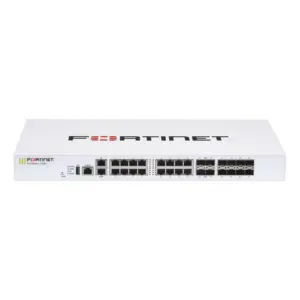
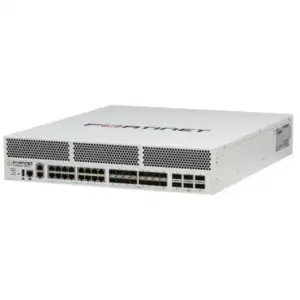
FortiGate 1100E in Uganda
A high-performance 2RU next-generation firewall for data center, campus core, secure WAN and hybrid network protection.
FortiGate 1100E combines purpose-built Fortinet security processing with 1, 10, 25 and 40 Gigabit Ethernet interface options. It is aimed at organizations that need substantial firewall, IPS, VPN and inspection capacity while keeping security and network control on one FortiOS platform. Selection should be based on expected encrypted traffic, security-service use, interface architecture, high-availability requirements and lifecycle planning.
Fortinet
FG-1100E
Next-Generation Firewall
2RU rack mount
FortiOS / Security Fabric
Configuration dependent
Enterprise firewall capacity for dense, high-speed networks
The FortiGate 1100E is designed for organizations whose security gateway has to do far more than basic packet filtering. In a modern enterprise, the same appliance may inspect internet traffic, enforce application controls, terminate site-to-site VPNs, segment internal network zones, support secure SD-WAN decisions and contribute telemetry to a wider security architecture. The 1100E addresses this combination with Fortinet Security Processing Units and a broad port mix that allows it to sit at important aggregation points without forcing every connection through external media converters or additional bridging devices.
Its published firewall throughput reaches 80 Gbps for 1518-byte and 512-byte UDP frames, while IPS throughput is rated up to 12.5 Gbps, NGFW throughput up to 9.8 Gbps and threat protection up to 7.11 Gbps. Those figures are not interchangeable. The right sizing figure depends on which security functions will be enabled, how much traffic is encrypted, the average packet size, the number of users and sessions, and whether the appliance is expected to support several network roles at once.
The platform offers two 40GbE QSFP+ slots, four multi-rate 25GbE SFP28/10GbE SFP+/1GbE SFP slots, four additional 10GbE SFP+/1GbE SFP slots, eight 1GbE SFP slots and sixteen hardware-accelerated Gigabit RJ45 data ports, plus dedicated management/high-availability interfaces. This combination makes the appliance suitable for large enterprise perimeters, data center north-south traffic, core segmentation and high-capacity WAN aggregation where several media and speed classes may coexist.
For Uganda buyers, correct configuration is especially important because optics, cables, FortiGuard services, FortiCare support, rack requirements and high-availability architecture can materially change the final bill of materials. FourTeck can review the intended topology and help prepare a quote based on the selected variant and service term rather than treating the firewall as a single undifferentiated SKU.
Why infrastructure teams shortlist the 1100E class
High-throughput security enforcement
Fortinet publishes distinct figures for firewall, IPS, NGFW, threat protection and SSL inspection. This allows architects to size against a security workload instead of relying solely on raw routing capacity. The practical business value is headroom for inspection as traffic grows, provided the chosen design uses the correct performance metric.
Dense interface flexibility
Support for 40GbE, 25GbE, 10GbE, fiber Gigabit and copper Gigabit gives teams multiple options for connecting carriers, core switches, server zones and management networks. This can simplify transition projects where old and new interface speeds need to coexist.
Large VPN capacity
With IPsec VPN throughput rated up to 48 Gbps, large gateway-to-gateway tunnel capacity and substantial client VPN scale, the appliance can support distributed organizations, cloud connectivity and secure remote-access designs. Actual outcomes depend on encryption settings, policy structure and traffic patterns.
High availability options
Fortinet supports active-active, active-passive and clustering configurations. Dual hot-swappable power supplies are standard on the AC model, giving infrastructure teams a foundation for resilient designs. A full HA deployment still requires two appropriately licensed appliances and compatible network architecture.
Centralized security operations
FortiOS provides the policy, networking and security operating environment, while broader Fortinet tools can extend centralized management, logging and analytics. This helps security teams manage policy consistency and visibility across distributed environments instead of treating the firewall as an isolated box.
Segmentation at enterprise scale
High interface density, virtual-domain support and firewall policy scale make the 1100E relevant to environments separating business units, services, server zones and security domains. The benefit is architectural control: teams can enforce boundaries close to critical resources while maintaining a common security platform.
A performance-focused FortiGate built for core security roles
The defining characteristic of the 1100E is not one headline number; it is the combination of security processing, session scale and multi-speed connectivity needed at busy enterprise aggregation points.
Up to 80 Gbps for larger UDP frame sizes, with performance varying by packet size and configuration.
Enterprise-mix IPS throughput with logging enabled, useful as a more realistic planning figure for inspected traffic.
Fortinet publishes SSL inspection performance separately, important where encrypted traffic dominates the internet edge.
Large concurrent TCP session capacity supports busy environments with many users, applications and east-west flows.
FortiGate 1100E specification ledger
| Firewall throughput | Up to 80 / 80 / 45 Gbps (1518 / 512 / 64 byte UDP) |
| IPS throughput | Up to 12.5 Gbps |
| NGFW throughput | Up to 9.8 Gbps |
| Threat protection | Up to 7.11 Gbps |
| IPsec VPN | Up to 48 Gbps (AES256-SHA256 test basis) |
| SSL VPN | Up to 8.4 Gbps; recommended maximum 10,000 concurrent tunnel-mode users |
| SSL inspection | Up to 10 Gbps |
| Concurrent sessions | 8 million TCP |
| New sessions/second | 500,000 TCP |
| 40GbE | 2 x hardware-accelerated QSFP+ slots |
| 25/10/1GbE | 4 x SFP28 / SFP+ / SFP multi-rate slots |
| 10/1GbE | 4 x SFP+ / SFP slots |
| 1GbE fiber | 8 x SFP slots |
| 1GbE copper | 16 x hardware-accelerated RJ45 data ports; 2 x RJ45 management/HA ports |
| Included transceivers | 2 x 1GbE SX SFP |
| Onboard storage | None on FG-1100E; 960 GB SSD on FG-1101E variant |
| High availability | Active-active, active-passive, clustering |
| Form factor | 2RU rack mount |
| Dimensions | 88.9 x 443 x 447.4 mm |
| Weight | 11.3 kg |
| AC input | 100–240V AC, 50/60 Hz |
| Power consumption | 217 W average / 336 W maximum for FG-1100E AC |
| Power supplies | Dual hot-swappable AC PSUs, 1+1 redundancy; DC variant available as FG-1100E-DC |
For procurement, the most consequential figures are the inspected-throughput values and interface mix. A network that expects 8 Gbps of internet traffic with IPS, application control and malware protection enabled should not be sized from the 80 Gbps stateful firewall headline. Threat-protection throughput, SSL-inspection throughput and expected peak utilization provide a more conservative basis. The same discipline applies to VPN: total tunnel count is not a substitute for measuring encrypted bandwidth, packet profile and branch concurrency.
Interface planning is equally important. The appliance provides high-speed cages, but optics and direct-attach cables must match both ends of the connection. Buyers should document switch models, carrier handoffs, required wavelengths, fiber type and distance before purchasing transceivers. The standard FG-1100E has no onboard SSD, while the related FG-1101E includes 960 GB of local storage; this distinction may influence logging and operational design.
Five questions to answer before requesting a quote
01 — What traffic will actually be inspected?
Document peak and average internet, data-center and inter-site traffic. Then identify which flows require IPS, application control, malware protection, web filtering or SSL inspection. This determines which published performance metric should guide sizing and how much headroom is appropriate.
02 — How many users, sessions and VPN connections are expected?
Large enterprises can generate huge session counts from browsers, cloud applications, mobile devices, servers and IoT endpoints. Remote-access and site-to-site VPN requirements should be captured separately because tunnel scale, encryption choices and authentication design affect capacity planning.
03 — Which interfaces must connect to existing infrastructure?
List every uplink speed and media type: 40GbE QSFP+, 25GbE SFP28, 10GbE SFP+, 1GbE SFP or copper. Include core-switch ports, ISP handoffs, HA links and management networks. This prevents late discovery that an optical module, cable or speed conversion is missing.
04 — Which FortiGuard and support services are required?
The security outcome depends on the selected service bundle and support contract, not just the appliance. Confirm the desired protection capabilities, term length, FortiCare level, centralized management or analytics requirements, and renewal expectations before comparing quotes.
05 — What resilience and lifecycle expectations apply?
If the firewall protects a critical gateway, plan high availability, redundant power feeds, rack placement, spare optics and change procedures. Also review product lifecycle status and the expected deployment horizon so the investment aligns with the organization’s refresh policy.
Share expected inspected throughput, WAN bandwidth, user count, VPN requirements, interface list, high-availability preference, required security services, support term, rack environment, quantities and target deployment date with FourTeck.
Where the platform can make operational sense
Enterprise internet edge
A large organization with several gigabits of internet capacity may need firewalling, IPS, application controls and encrypted-traffic inspection at the same perimeter. The 1100E offers enough interface variety to connect multiple carriers and core networks while maintaining hardware-accelerated security processing. The design should be validated against threat-protection and SSL-inspection figures rather than raw firewall throughput.
Data center segmentation
Organizations separating server tiers, business units, production environments and external services can use a high-capacity firewall as a policy enforcement point between zones. The appliance’s 40/25/10GbE options and large session scale are relevant where internal traffic volume is high. Virtual domains can further support administrative separation when the architecture requires it.
Large secure WAN hub
Enterprises with many branches may terminate large numbers of IPsec tunnels at a central location. Fortinet rates the platform for up to 48 Gbps of IPsec VPN throughput and large tunnel counts. Real deployments should account for encryption parameters, routing, SD-WAN policies, branch bandwidth and failover design.
Campus core security
Universities, public institutions and multi-building enterprises often need to inspect traffic between user networks, server environments and shared services. High port density and large policy scale allow the 1100E to serve as a central security boundary, provided segmentation requirements and switch uplinks are planned carefully.
Security throughput that reflects real policy use
Firewall products can appear deceptively similar when evaluated only by stateful throughput. In practice, an enterprise gateway may perform intrusion prevention, application identification, antivirus scanning, URL filtering, certificate inspection and logging at the same time. Fortinet therefore publishes several workload-specific benchmarks for the 1100E. IPS throughput is rated up to 12.5 Gbps, NGFW throughput up to 9.8 Gbps, threat protection up to 7.11 Gbps and SSL inspection up to 10 Gbps.
The most useful metric is the one that resembles the planned policy set. For a perimeter where most traffic is HTTPS and the organization intends to decrypt a meaningful share of sessions, SSL-inspection capacity and the associated connections-per-second figures deserve close attention. For a data-center segmentation role that uses IPS and application control but does not decrypt every flow, the NGFW benchmark may be more relevant.
Capacity planning should also include growth. A firewall that operates close to its design ceiling on day one leaves little margin for traffic spikes, new applications, added branches or a future increase in inspection depth. FourTeck can help buyers frame the quote around the intended security workload and a sensible reserve instead of selecting from a single headline number.
High-speed connectivity without a one-speed network assumption
The 1100E’s port architecture is useful in mixed-generation environments. Two 40GbE QSFP+ slots can connect high-capacity cores or aggregation layers, while four SFP28 slots support 25GbE and can also operate with 10GbE SFP+ or 1GbE SFP modules. Additional 10GbE, 1GbE fiber and copper interfaces allow the firewall to connect a broad mix of systems.
Optics remain a procurement dependency. Not every transceiver is interchangeable, and link compatibility depends on speed, wavelength, fiber type and the peer device. Buyers should treat the firewall, optics and cabling as one connectivity bill of materials.
Resilience, power and deployment discipline
The FG-1100E AC model ships with dual hot-swappable power supplies intended for 1+1 redundancy. Fortinet also supports active-active, active-passive and clustering HA configurations. These capabilities create building blocks for fault tolerance, but they do not automatically make a deployment resilient. True continuity depends on independent power feeds, switch redundancy, synchronized HA links, correct routing behavior, compatible licenses and tested failover procedures.
Rack planning matters as well. The appliance occupies 2RU and uses front-to-back forced airflow. Fortinet specifies 0°C to 40°C operating temperature and maximum AC power consumption of 336 W for the FG-1100E. Data-center teams should verify rack depth, cooling, power distribution, grounding and cable routing before installation.
Buyer decision checklist
- Will one appliance or an HA pair be deployed?
- Are two independent power circuits available for each unit?
- Do upstream and downstream switches provide redundant paths?
- Are matching transceivers and HA interfaces included?
- Does the rack have adequate depth, airflow and available 2RU space per appliance?
- Has the team documented failover testing and maintenance procedures?
What buyers should check before purchase
| Risk | What to confirm | Why it matters | Share with FourTeck |
|---|---|---|---|
| Wrong performance metric | Security functions and encrypted traffic ratio | Raw firewall throughput can overstate practical inspected capacity | Peak traffic, policies and growth target |
| Interface mismatch | Port speed, optic, wavelength and fiber type | A correct appliance can still be unusable without compatible links | Peer switch models and handoff details |
| Incomplete service bundle | FortiGuard and FortiCare term | Security services and support affect protection and operations | Required protection features and term |
| Lifecycle mismatch | Current lifecycle milestones and deployment horizon | Long projects need support planning that matches asset life | Expected production lifetime and refresh policy |
A sound firewall purchase includes more than the base chassis. Organizations should identify optics, rack accessories, spare components, license bundles, support levels, HA peer requirements and any management or logging platforms needed to operate the solution. Where a project will be delivered in phases, record the intended final topology so that early purchases do not limit later expansion.
Procurement support for Uganda projects
FortiGate 1100E availability in Uganda can vary by hardware variant, service bundle, support term and project quantity. FourTeck can assist procurement teams by reviewing the requested configuration, checking the required accessories and preparing a commercial quote aligned to the intended deployment. The objective is to avoid a chassis-only quote when the project also needs optics, subscriptions, support, high-availability components or other implementation items.
For organizations in Kampala, FourTeck can coordinate quotation and delivery planning based on the confirmed bill of materials. Warranty and support expectations should be discussed at quote stage so the proposed service level matches the organization’s operational requirements. Large projects can also be structured around quantities and phased requirements rather than assuming every unit has the same deployment role.
Uganda location coverage
FourTeck can support business enquiries for firewall projects across Uganda, including Kampala, Entebbe, Jinja, Mbarara and Gulu. Coverage discussions should focus on the actual project requirement: appliance quantity, security-service term, optical interfaces, high-availability design, installation readiness and delivery destination. Availability and delivery arrangements remain subject to the selected configuration and current supply conditions.
East Africa and regional availability
Organizations operating across multiple countries may prefer to standardize firewall platforms, licensing terms and configuration templates. FourTeck can discuss suitable procurement paths for Uganda, Kenya and selected East Africa or Africa markets, with regional resources available through FourTeck Uganda, FourTeck Kenya and FourTeck Africa. For organizations with wider procurement needs, information can also be reviewed through FourTeck UAE and FourTeck Kuwait.
Regional purchasing should still be treated as a configuration exercise. Local network design, ISP handoffs, rack and power environments, security-service terms and support expectations can differ by site. A common hardware model can simplify operations, but only when each location’s physical and logical requirements are confirmed.
Related Fortinet and firewall procurement paths
Best fit when the same performance class is required with 960 GB of onboard SSD storage for additional local logging capability. Ask FourTeck to compare the 1100E and 1101E bill of materials.
Suitable when inspected throughput, interface capacity or future growth exceeds the 1100E design envelope. Use the FourTeck Uganda contact page to request model matching.
Relevant to organizations managing multiple FortiGate appliances and seeking centralized policy and configuration workflows.
Useful where centralized logging, analytics and reporting form part of the operational requirement.
A same-brand switching path for organizations building a broader Fortinet secure-networking architecture.
Practical assistance around a complex firewall purchase
01 — Product selection guidance. FourTeck can help map traffic, inspection and interface requirements to an appropriate FortiGate class instead of assuming the largest firewall number determines suitability.
02 — Configuration review. A quote can be checked for the correct appliance variant, optics, high-availability requirements, security subscriptions and support term.
03 — Quote assistance. Procurement teams can request a consolidated proposal that reflects quantities, deployment scope and required services.
04 — Business IT context. Firewall decisions often depend on switching, WAN, server, cloud and security architecture. Reviewing these dependencies can reduce compatibility mistakes.
05 — Uganda delivery coordination. Delivery planning can be aligned with the final bill of materials and project destination, subject to current supply conditions.
06 — Alternative product matching. When the 1100E is not the best fit for lifecycle, capacity or budget reasons, FourTeck can help identify a more suitable FortiGate path.
FortiGate 1100E buying questions
01. What is the FortiGate 1100E primarily used for?
It is a high-performance enterprise next-generation firewall designed for roles such as data-center security, enterprise internet edge, campus core segmentation, secure WAN aggregation and large VPN environments. Its combination of multi-gigabit interfaces, high session scale and FortiOS security functions makes it more appropriate to substantial networks than to small branch deployments.
02. Which throughput figure should I use for sizing?
Use the figure that most closely matches the intended security workload. Fortinet publishes up to 80 Gbps stateful firewall throughput, but IPS is up to 12.5 Gbps, NGFW up to 9.8 Gbps, threat protection up to 7.11 Gbps and SSL inspection up to 10 Gbps. A design using several security services should not be sized from the firewall figure alone.
03. Does the FG-1100E include local SSD storage?
No onboard SSD is listed for the standard FG-1100E. The closely related FG-1101E includes two 480 GB SSDs for 960 GB total onboard storage. Buyers who need local logging capacity should compare these variants and also consider centralized logging requirements before choosing the chassis.
04. What high-speed ports are available?
The appliance provides two 40GbE QSFP+ slots, four multi-rate 25GbE SFP28/10GbE SFP+/1GbE SFP slots, four additional 10GbE SFP+/1GbE SFP slots, eight 1GbE SFP slots and sixteen 1GbE RJ45 data ports. Optical modules and cables must be selected for the peer equipment, link distance and fiber type.
05. Can the 1100E be deployed in high availability?
Yes. Fortinet lists active-active, active-passive and clustering configurations. The AC appliance includes dual hot-swappable power supplies for 1+1 redundancy. A resilient deployment normally requires two appropriately licensed units, redundant network paths, independent power design and a tested failover plan rather than relying on the appliance feature alone.
06. Which licenses or services should be included?
The appropriate FortiGuard and FortiCare selection depends on the desired security controls and operational support level. Buyers should define whether they need services such as IPS, malware protection, web filtering and other FortiGuard functions, then choose the support and subscription term that fits the deployment. FourTeck can help structure the quote around those requirements.
07. Is the FortiGate 1100E suitable for large VPN deployments?
Fortinet rates IPsec VPN throughput at up to 48 Gbps and publishes large tunnel capacities for the platform. Suitability still depends on encryption settings, tunnel count, branch bandwidth, remote-user requirements and routing design. For a WAN hub, provide these figures during sizing so the proposal reflects realistic encrypted traffic rather than only tunnel quantity.
08. Is the FortiGate 1100E available in Uganda?
Availability is configuration dependent and can vary by appliance variant, service bundle, support term and quantity. FourTeck can review the required bill of materials and provide current quotation and delivery guidance for Uganda. Procurement teams should include optics, HA requirements, support and security subscriptions in the request rather than asking only for the base chassis.
09. What information should I send for a quotation?
Provide peak and average traffic, expected security services, encrypted-traffic share, internet bandwidth, VPN requirements, user or session scale, required port speeds, peer switch models, optics, high-availability preference, support term, quantity and deployment destination. This gives FourTeck enough context to prepare a more complete and technically relevant bill of materials.
Plan the firewall around the traffic you intend to protect
For a useful FortiGate 1100E Uganda quote, share your expected inspected throughput, WAN bandwidth, interface requirements, security-service bundle, HA design, support term and project quantity. FourTeck can use those details to review the configuration and prepare a procurement proposal suited to the deployment.
- Traffic and inspection requirements
- VPN and remote-access scale
- Required 1/10/25/40GbE connections
- FortiGuard and FortiCare term
- HA, power and rack requirements