FortiGate 3200F in Uganda
A 2RU data-center firewall engineered for very high traffic volumes, high-speed segmentation, encrypted traffic inspection and large-scale hybrid network security.
For organizations planning a core firewall refresh, data-center segmentation project, high-capacity internet edge or secure interconnection between large network zones, the FortiGate 3200F combines Fortinet SPU acceleration, FortiOS security and networking functions, high-density 400/200/100/50/25/10GE connectivity, and large session capacity. FourTeck can help Uganda buyers map the appliance to real traffic patterns, security subscriptions, optics, rack power, high-availability requirements and implementation constraints before a purchase decision.
Product overview: high-capacity security for the data-center edge and core
The FortiGate 3200F is built for organizations whose security architecture must process large traffic volumes without turning the firewall into a bottleneck. It sits in Fortinet’s high-end data-center range and is appropriate when a design calls for dense high-speed interfaces, very large session tables, substantial IPsec capacity, segmentation between important network zones, or consolidated inspection at a major internet or inter-site edge.
Its role is broader than simple packet filtering. FortiOS brings firewall policy, application control, intrusion prevention, VPN, segmentation, secure SD-WAN functions, zero-trust network access enforcement and integration with Fortinet Security Fabric components into a common operating environment. FortiGuard security services can extend the platform with threat intelligence and inspection services, while FortiManager can provide centralized policy and configuration management for organizations operating multiple FortiGate systems.
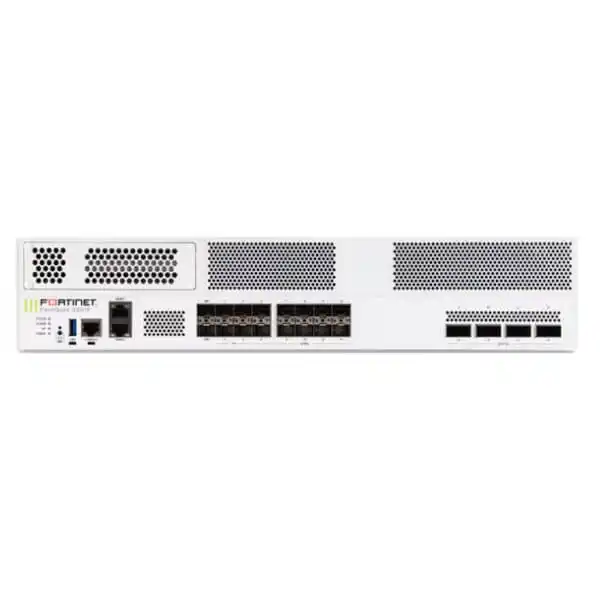
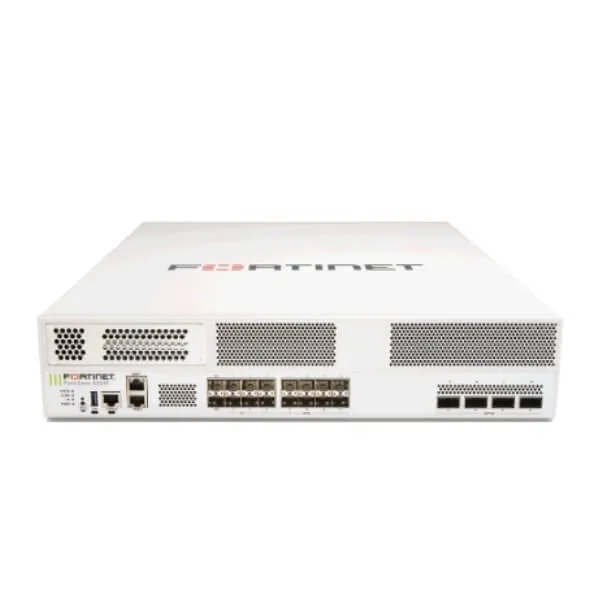
Hardware design is a major reason to consider this model. The appliance uses Fortinet purpose-built security processing, including NP7 network processors and CP9 content processors. Fortinet specifies four hardware-accelerated 400GE QSFP-DD slots that can also support lower interface modes, ten 50GE SFP56-class slots supporting multiple lower speeds, four ultra-low-latency 25GE SFP28 slots, and two HA-capable high-speed slots. This interface mix makes the platform suitable for modern data-center fabrics where 100GE and 400GE uplinks coexist with 10GE, 25GE and 50GE server or aggregation connections.
Selection still requires careful engineering. Firewall throughput, IPS throughput, NGFW throughput, SSL inspection, IPsec VPN and connection rates represent different workloads. An organization expecting intensive TLS inspection, large numbers of short-lived application connections or a high proportion of security-inspected traffic should size against those functions rather than raw Layer-3 forwarding. Likewise, optics, cabling, power feeds, rack depth, cooling and the correct FortiGuard and FortiCare service package should be included in the project bill of materials.
FourTeck can support Uganda procurement teams by turning these variables into a quote-ready configuration. That includes identifying the correct appliance variant, expected subscription term, required transceivers, HA strategy and delivery requirements. For enterprise and public-sector buyers, this planning step helps reduce the risk of receiving an appliance that is technically powerful but incomplete for the intended deployment.
Business benefits that matter in a 3200F deployment
Protect high-bandwidth links without redesigning around a small firewall
Fortinet rates the platform at up to 387 Gbps IPv4 firewall throughput and 63 Gbps IPS throughput. The practical value is headroom for large data-center and enterprise traffic flows, especially where several high-speed interfaces converge on a common security control point.
Use 400GE-class connectivity directly at the security layer
Four QSFP-DD interfaces support 400/200/100/40GE modes. This can reduce the need to insert additional intermediary devices simply to bridge between high-speed network segments and the firewall, helping simplify architecture and preserve interface flexibility.
Handle large connection populations
A published capacity of up to 70 million concurrent TCP sessions and 800,000 new TCP sessions per second makes the appliance relevant for environments with dense user, application, cloud or service traffic where session scale is a first-order sizing criterion.
Consolidate networking and security policy
FortiOS combines firewalling, VPN, segmentation, SD-WAN and security controls in one platform. For operations teams, a shared policy environment can make change management and troubleshooting more consistent than operating separate appliances for each network function.
Scale encrypted connectivity
Fortinet specifies up to 105 Gbps IPsec VPN throughput, 40,000 gateway-to-gateway tunnels and 200,000 client-to-gateway tunnels. These figures support designs where encrypted site interconnects, cloud connectivity or remote access are substantial parts of the security workload.
Design for resilient operation
The platform supports active-active, active-passive and clustering high-availability configurations and ships with dual hot-swappable AC power supplies for 1+1 redundancy. That gives infrastructure teams multiple ways to align firewall resilience with data-center availability goals.
Product highlights: performance is useful only when the architecture can use it
What distinguishes this platform is the combination of high security throughput, 400GE-class interfaces, large session scale and purpose-built acceleration in a 2RU appliance.
| Product class | High-end next-generation firewall / security appliance |
| IPv4 firewall throughput | 387 / 385 / 178.5 Gbps (1518 / 512 / 64-byte UDP) |
| IPS throughput | 63 Gbps |
| NGFW throughput | 47 Gbps |
| Threat protection throughput | 45 Gbps |
| IPsec VPN throughput | 105 Gbps |
| SSL inspection throughput | 29 Gbps (IPS, average HTTPS) |
| Concurrent TCP sessions | 70 million |
| New TCP sessions / second | 800,000 |
| 400GE-class interfaces | 4 × hardware-accelerated 400GE QSFP-DD / 200GE QSFP56 / 100GE QSFP28 / 40GE QSFP+ ports |
| High-speed SFP slots | 10 × 50GE SFP56 / 25GE SFP28 / 10GE SFP+ / GE SFP slots |
| Ultra-low-latency slots | 4 × 25GE SFP28 / 10GE SFP+ / GE SFP ULL slots |
| HA slots | 2 × 50GE SFP56 / 25GE SFP28 / 10GE SFP+ HA1/HA2 slots |
| Management ports | 2 × 10GE / GE RJ45 management ports |
| Included transceivers | 2 × SFP+ SR 10GE |
| Onboard storage | None on FG-3200F; FG-3201F variant includes 2 × 960GB SSD |
| VDOMs | 10 default / 500 maximum |
| High availability | Active-active, active-passive, clustering |
| Form factor | Rack mount, 2RU |
| Dimensions | 88.9 × 443 × 607.1 mm |
| Weight | 20 kg |
| AC input | 100–240VAC, 50/60 Hz |
| Power consumption | 520W average / 865W maximum |
| Power redundancy | Dual hot-swappable AC power supplies, 1+1 redundancy |
| Operating temperature | 0°C to 40°C |
How to read these figures: The firewall, IPS, NGFW, threat-protection and SSL-inspection measurements represent different test profiles. A project expecting encrypted application traffic, intrusion prevention and application-control enforcement should not size solely on the 387 Gbps firewall result. The 47 Gbps NGFW and 45 Gbps threat-protection figures are often more relevant starting points for heavily inspected enterprise traffic.
Interface planning is equally important. The appliance can terminate very high-speed links, but the optical transceiver type, fiber plant, breakout strategy and upstream switch support must match the chosen interface mode. Buyers should also account for rack depth, airflow, dual power feeds and maximum power draw. The FG-3200F itself does not include onboard SSD storage; organizations needing local log storage should evaluate the FG-3201F or an external logging platform such as FortiAnalyzer, depending on the wider design.
Configuration worksheet for procurement teams
A high-end firewall quote is most accurate when the buyer provides architectural information instead of only a model number. Use the following five questions to turn the project into a configuration that can be checked for capacity, compatibility and completeness.
01 — What workload must the firewall inspect?
Describe whether the system will operate at an internet edge, between data-center zones, as a VPN headend, for east-west segmentation, or in a mixed role. State expected average and peak throughput and identify whether IPS, application control, antivirus, web filtering, SSL inspection or other FortiGuard services will be enabled. The security profile changes which published throughput metric matters most.
02 — What is the connection and user scale?
Provide estimated concurrent sessions, new connections per second, remote-access users, site-to-site tunnels, network segments and VDOM requirements. Very high-throughput networks can still be constrained by session behavior, policy scale or tunnel count, so these numbers help validate that the 3200F is correctly positioned.
03 — What must connect to the appliance?
List upstream routers, core switches, fabric speeds, optic types and cabling standards. Specify the number of 400GE, 100GE, 50GE, 25GE and 10GE links required. This directly affects transceiver selection and prevents a common project issue: ordering the firewall but not the correct optical components.
04 — What growth, security subscription and management model is planned?
State the intended service term, required FortiGuard bundle, FortiCare support level and whether centralized FortiManager or FortiAnalyzer components are already in use. For multi-year projects, expected traffic growth and future interfaces can justify additional headroom today.
05 — What installation, delivery and resilience expectations apply?
Confirm rack space, power feeds, airflow, HA topology, maintenance-window requirements, installation responsibilities and project delivery location. These details help determine whether two appliances are required for resilience and whether additional rack, optic or power accessories belong on the bill of materials.
Ideal business use cases
Large enterprise data-center perimeter
A large organization may have multiple high-speed internet or private-cloud links feeding centralized applications, SaaS access, remote users and inter-site traffic. The operational requirement is not simply to pass packets but to inspect large traffic volumes while maintaining policy visibility. The 3200F fits when the required inspected throughput aligns with its 63 Gbps IPS, 47 Gbps NGFW or 45 Gbps threat-protection envelope. Design work should validate TLS inspection rates, optics, upstream 100/400GE connectivity and HA requirements before procurement.
Core segmentation for critical systems
Data centers increasingly need controls between application tiers, server zones, shared services and sensitive systems. Fortinet’s high-speed interfaces and NP7 acceleration can support segmentation without forcing all protected paths through low-speed links. The design should identify east-west traffic peaks, required policies, routing architecture, virtual domains and whether ultra-low-latency interfaces are needed for selected paths. Proper segmentation planning is essential because policy count and traffic symmetry can be just as important as aggregate throughput.
High-scale VPN and hybrid-cloud interconnection
Organizations connecting large numbers of sites, cloud networks or remote users can use the platform as a substantial VPN termination point. Fortinet publishes 105 Gbps IPsec VPN throughput, up to 40,000 gateway-to-gateway tunnels and up to 200,000 client-to-gateway tunnels. Buyers should distinguish between site VPNs and user remote access, identify encryption parameters, confirm authentication integrations and estimate peak concurrent use. The correct support and security subscriptions should also be aligned with the operational model.
Service-provider or large multi-tenant security edge
Large session scale, VDOM support and diverse high-speed interfaces make the platform relevant to designs where multiple logical domains, customers or service zones must share physical infrastructure while retaining policy separation. Fortinet specifies up to 500 VDOMs, subject to licensing and configuration considerations. A multi-tenant deployment should be engineered around per-domain throughput, administrative boundaries, routing, logging, automation and failure domains rather than treating the appliance only as a single shared firewall.
Purpose-built acceleration for security traffic at scale
Fortinet’s architecture uses dedicated security processing units to offload and accelerate functions that can consume substantial general-purpose CPU resources. In the 3200F series, NP7 network processors accelerate network functions and high-volume packet handling, while the CP9 content processor helps accelerate SSL decryption, pattern matching and other content inspection tasks. The practical point for a buyer is not the processor name itself; it is the ability to sustain high security throughput while keeping latency and resource use within a range suitable for a data-center firewall.
This matters particularly when the firewall is placed inline between large switching domains or at an internet edge carrying tens or hundreds of gigabits of aggregate traffic. Encryption has become common across business applications, so a design that ignores SSL inspection can overestimate useful security capacity. Fortinet publishes 29 Gbps SSL inspection throughput under its stated test method, alongside 63 Gbps IPS and 47 Gbps NGFW figures. Those values give architects more realistic reference points for different inspection profiles.
FourTeck recommends defining which traffic will be decrypted, which services will be bypassed for privacy or technical reasons, and what peak inspection load is expected. That design exercise makes it easier to select the correct model and avoids paying for raw interface speed that cannot be translated into the intended security policy.
400GE-class connectivity changes the network design conversation
The firewall includes four hardware-accelerated QSFP-DD ports that support 400GE, 200GE, 100GE and 40GE modes. For modern data-center buyers, this creates the option to connect the security layer directly to very high-speed core or spine infrastructure rather than inserting lower-speed aggregation solely because the firewall lacks suitable interfaces.
That flexibility does not eliminate physical-layer planning. The chosen mode must match switch capabilities, optical modules, fiber type, reach and breakout requirements. Some deployments may use the 400GE ports as 100GE uplinks while using the 50/25/10GE SFP-family slots for distribution or specialized security zones. Others may reserve the ultra-low-latency ports for paths where predictable packet handling is especially important.
400/200/100/40GE interface options.
Support for 50/25/10GE and GE modes.
25/10GE-capable interfaces for low-latency paths.
High availability, power and operational readiness
High-end firewall deployments frequently protect systems whose outage impact is much greater than the firewall purchase cost. The 3200F supports active-active, active-passive and clustering high-availability options, and it includes dual hot-swappable AC power supplies configured for 1+1 redundancy. These features provide building blocks for resilient design, but the appliance alone does not create end-to-end availability.
A proper HA project should examine upstream and downstream switch redundancy, routing convergence, interface distribution, state synchronization, dual power circuits, rack location and maintenance procedures. If both firewall nodes depend on the same switch, power feed or fiber path, the architecture may still contain a critical single point of failure. The appliance is 2RU and up to 607.1 mm deep, so rack fit and cable routing should be checked before delivery. Maximum power consumption is specified at 865W for the FG-3200F, which should be included in UPS and cooling calculations.
Buyer decision checklist
□ One appliance or an HA pair? □ Active-passive, active-active or cluster? □ Separate A/B power feeds? □ Correct rack depth and airflow? □ Redundant upstream/downstream switching? □ Adequate optics for each HA and data path? □ Centralized logging and management plan? □ Maintenance and failover testing procedure?
What buyers should check before purchase
High-capacity firewall projects are often delayed not because the appliance is wrong, but because one dependency was discovered after the hardware was ordered. The following risk register highlights items that should be confirmed while the quote is being prepared.
| Risk | What to confirm | Why it matters | What to share with FourTeck |
|---|---|---|---|
| Wrong variant | FG-3200F versus FG-3201F | The 3201F includes 2 × 960GB SSD; the 3200F does not. | Local logging/storage requirement. |
| Undersized security workload | IPS, NGFW, threat protection and SSL inspection load | Raw firewall throughput can overstate capacity for inspected traffic. | Peak traffic and enabled services. |
| Optic mismatch | Speed, module type, fiber and reach | A high-speed port is unusable without compatible physical connectivity. | Switch models, distances and required port counts. |
| Incomplete subscription | FortiGuard bundle and FortiCare term | Security services and support entitlement affect functionality and lifecycle planning. | Required features and desired term. |
| Power or rack issue | 2RU space, depth, airflow, A/B feeds | The appliance must fit the physical environment and resilience plan. | Rack and facility constraints. |
| Project quantity and lead time | Number of appliances, HA pairs and deployment schedule | Availability can vary by configuration and quantity. | Required-by date and delivery locations. |
Uganda availability and service support
FourTeck can assist organizations sourcing the FortiGate 3200F Uganda deployment with configuration review, quotation, delivery coordination and project planning. Availability can vary according to appliance quantity, security bundle, support term and required optics, so lead time should be confirmed against the exact bill of materials rather than assumed from the base model.
For buyers in Kampala, the useful starting point is a technical requirement: expected inspected throughput, internet and inter-site link speeds, interface count, HA requirement, desired FortiGuard services and FortiCare term. FourTeck can use this information to prepare a configuration-focused quote and identify missing accessories before the order is finalized. Warranty and support guidance should be tied to the selected FortiCare entitlement and the commercial terms supplied with the quote.
Project buyers should also state whether they need one appliance, an HA pair or multiple systems for separate sites or security zones. Quantity affects planning, as do transceiver requirements and any centralized FortiManager or FortiAnalyzer components that belong to the wider design.
Uganda location coverage
FourTeck can coordinate product enquiries and project requirements for organizations in Kampala and across Uganda. Buyers planning deployments in Entebbe, Jinja, Mbarara or Gulu can submit the same technical requirement through the Uganda contact channel, including the destination, quantity and implementation timetable. Delivery feasibility and timing should be confirmed on the formal quote because high-end security appliances, optics and subscription bundles may have different sourcing timelines.
East Africa and regional availability
Organizations operating across multiple countries can also discuss coordinated Fortinet requirements with FourTeck for Uganda, Kenya and selected East Africa or Africa markets. A regional project should define whether the same firewall configuration, subscription term and support model will be standardized at every location or whether individual sites have different throughput and interface needs.
FourTeck’s regional web properties can support enquiries through FourTeck Uganda, FourTeck Kenya, FourTeck Africa, FourTeck UAE and FourTeck Kuwait where relevant. Regional availability, delivery timing, local commercial terms and warranty handling should always be verified for the actual destination and quoted configuration.
Related products and decision paths
Why buyers contact FourTeck for a high-end firewall project
Frequently asked questions
01. What is the FortiGate 3200F mainly used for?
It is a high-end next-generation firewall intended for large data-center, enterprise, service-provider and hybrid-network security roles. Its strengths are high inspected throughput, large session capacity, dense high-speed interfaces and FortiOS security functionality. It can be used at a major internet edge, for segmentation, high-scale VPN termination or other security boundaries where lower-tier firewalls would not provide enough capacity.
02. How fast is the 3200F with security inspection enabled?
Fortinet publishes 63 Gbps IPS throughput, 47 Gbps NGFW throughput and 45 Gbps threat-protection throughput under its documented enterprise traffic tests. It also publishes 29 Gbps SSL inspection throughput. These are more useful for many real security designs than the higher raw firewall throughput figure, because enabled inspection functions materially affect the workload placed on the appliance.
03. Does the FG-3200F include local SSD storage?
No. Fortinet lists onboard storage as not available on the FG-3200F. The related FG-3201F includes two 960GB SSDs. If the project requires local storage for logs or other functions, discuss whether the 3201F or a centralized logging design such as FortiAnalyzer is more appropriate. Storage requirements should be established before quotation.
04. Which high-speed interfaces are available?
The appliance includes four hardware-accelerated QSFP-DD slots supporting 400GE, 200GE, 100GE and 40GE modes, ten SFP56-family slots supporting 50GE, 25GE, 10GE and GE, four 25GE-class ultra-low-latency slots, plus two high-speed HA slots and two RJ45 management ports. Exact optics and fiber must be selected for the intended switch and distance.
05. Can the 3200F be deployed as a high-availability pair?
Yes. Fortinet lists active-active, active-passive and clustering HA configurations. The appliance also has dedicated HA-capable high-speed interfaces and dual hot-swappable AC power supplies. A resilient project should still include redundant switching, separate power feeds, suitable cabling and a tested failover design; purchasing two firewalls alone does not remove every infrastructure single point of failure.
06. Which licenses or subscriptions are required?
The appropriate entitlement depends on the security services and support level the organization needs. FortiGuard services can provide functions such as IPS, web/DNS security, malware protection and other security capabilities, while FortiCare covers support options. Bundles and terms vary, so the quote should state the required service package and duration rather than assuming a generic subscription.
07. What information should I provide for an Uganda quote?
Provide average and peak throughput, enabled security functions, internet and private-link speeds, port counts and optical requirements, IPsec or remote-access scale, HA needs, desired subscription term, centralized management or logging requirements, project quantity and delivery destination. These inputs allow FourTeck to review whether the base appliance, licenses and accessories form a complete configuration.
08. Is the FortiGate 3200F suitable for SSL inspection?
Yes, SSL inspection is a supported use case, and Fortinet publishes 29 Gbps SSL inspection throughput using an average HTTPS test profile. Actual results depend on cipher suites, traffic mix, policy design and other enabled security functions. Organizations planning broad TLS decryption should model peak encrypted traffic and privacy or compliance exclusions before deciding the required capacity.
09. Can FourTeck supply related Fortinet products for the project?
FourTeck can review a wider requirement that may include FortiManager for centralized management, FortiAnalyzer for logging and analytics, suitable FortiGuard and FortiCare subscriptions, optical transceivers and adjacent FortiGate models. Availability and exact compatibility should be confirmed against the final design, particularly where interface standards, software versions or subscription bundles vary.
10. How do I decide between the 3200F and another FortiGate model?
Start with the security workload rather than the model name. Compare inspected throughput, SSL inspection, session rates, VPN scale, port speeds, HA needs, storage and expected growth. A lower model may be more economical if the 3200F offers excessive headroom; a higher model may be appropriate if projected inspection traffic exceeds its design point. FourTeck can help map those requirements to an appropriate option.
Prepare the firewall around your traffic, interfaces and resilience plan
For a useful FortiGate 3200F quotation, send FourTeck the expected inspected throughput, security services, interface speeds, HA requirement, subscription term, logging approach, quantity and delivery location. We can use those details to review the configuration and identify the appliance, service and accessory items that belong in the project.
Share: traffic profile • port/optic needs • VPN scale • HA topology • FortiGuard/FortiCare term • management/logging needs • rack and power constraints • quantity and destination.

Reviews
There are no reviews yet.