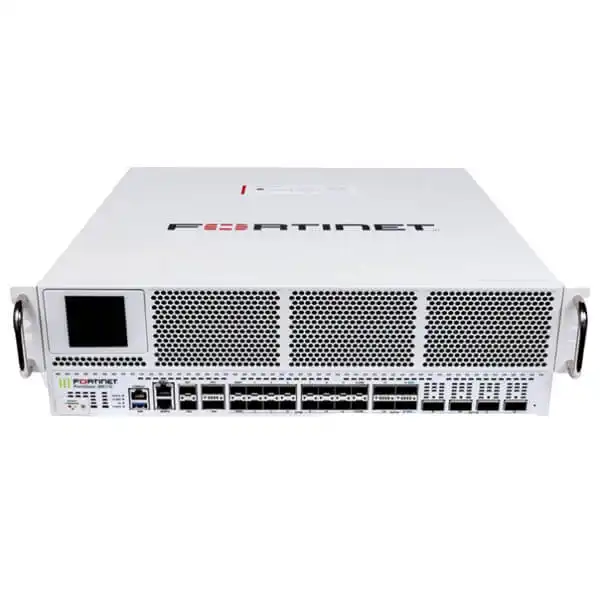
FortiGate 3800G in Uganda
A high-throughput next-generation firewall platform for large data centers, hyperscale networks and security-intensive enterprise infrastructure.
Fortinet built the 3800G for environments where security inspection, segmentation, encrypted traffic handling and very high-speed east-west or north-south connectivity must coexist without forcing the network team to design around a small firewall edge. Uganda buyers should treat it as a project appliance rather than a simple branch firewall: interface optics, security subscriptions, AC or DC power, storage choice, rack design, high availability and traffic profile all influence the correct bill of materials.
Security capacity for networks that cannot afford a narrow inspection point
The FortiGate 3800G is a high-end Fortinet next-generation firewall aimed at data-center and hyperscale use. Its role is broader than basic packet filtering. In a modern enterprise core, the firewall may have to inspect application traffic, apply intrusion-prevention policies, enforce segmentation, terminate encrypted VPNs, examine SSL traffic, route high-bandwidth flows and participate in a larger security fabric. The 3800G is engineered for that combination at a scale that is relevant to very large organizations, cloud-connected environments and infrastructure supporting intensive digital workloads.
For a Uganda enterprise, the practical value of this class of platform appears when security becomes part of the data-center architecture instead of an appliance placed only at the internet boundary. A bank, telecom operator, government platform, large service provider, research institution or organization building AI and high-performance computing infrastructure may need hundreds of gigabits of inspected throughput, large session counts and 100/200/400-gigabit connectivity. The 3800G gives architects room to place inspection where it is needed while retaining high-density interfaces for resilient network designs.
The appliance should nevertheless be selected from measured requirements. Published headline firewall throughput is not the same as threat-protection throughput, and real traffic can include encrypted sessions, small packets, complex application identification, logging and security services. Fortinet publishes 200 Gbps threat-protection throughput for the 3800G series and also specifies substantial IPS, NGFW and VPN capabilities. Those figures make the model relevant to high-scale projects, but the buying team still needs to map them to its own packet profile, peak utilization, east-west flows and required security features.
Configuration also matters. The 3800G base model has no onboard storage, while the 3801G variant includes local SSD capacity. AC and DC variants are available. Security services and support are selected separately or through bundles, and transceivers must match the chosen link speeds and fiber plant. FourTeck can help Uganda buyers translate the architecture into an orderable configuration, review subscription terms, identify optics and accessories, and prepare a quotation that reflects the intended deployment rather than a generic hardware-only line item.
Outcomes that matter in a high-scale firewall project
Keep inspection capacity aligned with fast data-center links
High-density 400GE-, 200GE- and 50GE-class connectivity allows architects to connect the firewall to modern spine-leaf, core and interconnect designs without reducing every security zone to legacy interface speeds. That can simplify physical design and preserve expansion options as data volumes increase.
Apply advanced protection at meaningful throughput
Fortinet lists up to 200 Gbps threat-protection throughput for the platform. For buyers, this is the more useful planning figure than raw firewall forwarding when the design includes IPS, application control, malware protection and logging. It provides a clearer starting point for security capacity planning.
Support large session populations and demanding applications
Large data centers can create enormous numbers of concurrent sessions, particularly with microservices, API-heavy systems, distributed applications and AI pipelines. The 3800G is designed for that scale, helping security teams avoid session capacity becoming the hidden limitation in an otherwise fast network.
Consolidate routing and security policy
FortiOS combines firewalling with security services, VPN, segmentation and management functions. In appropriate designs, this can reduce the number of separate policy enforcement points and give operations teams one consistent framework for network and security control.
Design resilience at the platform level
A 3RU chassis, multiple power supplies and FortiGate high-availability options make the platform suitable for redundant data-center architectures. Procurement should still include the second appliance, optics, cabling and switching capacity required by the chosen HA topology.
Plan security as infrastructure grows
The interface density and performance envelope provide room for substantial network growth, but license terms, VDOM use, logging architecture and the 3800G versus 3801G storage decision should be chosen deliberately so the operational model grows with the traffic.
The distinguishing factor is not one isolated speed figure; it is the combination of high-speed interfaces, security acceleration and enterprise-scale control.
400GE-class connectivity
Four hardware-accelerated ports support 400GE QSFP-DD and lower-speed modes, giving core architects high-bandwidth uplink options.
Optics and breakout requirements are configuration dependent.
200GE expansion
Six additional QSFP56 slots support 200GE and compatible lower-speed operation for flexible high-capacity topologies.
Validate transceiver type and link design before ordering.
Dense 50GE access
Eighteen SFP56 slots provide 50GE/25GE/10GE/GE options for multiple security zones and aggregation links.
Selected optics determine the operational speed.
Storage choice
The 3800G has no onboard storage; the 3801G variant adds two 1.92TB SSDs.
Choose based on logging and local-storage requirements.
FortiGate 3800G technical reference
| Specification | Published / applicable value |
|---|---|
| Product class | High-end data-center next-generation firewall |
| Threat protection throughput | Up to 200 Gbps |
| IPS throughput | Up to 250 Gbps, enterprise traffic mix |
| NGFW throughput | Up to 210 Gbps, enterprise traffic mix |
| IPv4 firewall throughput | 795 / 793 / 453 Gbps for 1518 / 512 / 64-byte UDP |
| IPsec VPN throughput | Up to 210 Gbps in current series datasheet figures; test methodology applies |
| 400GE-class ports | 4 × hardware-accelerated QSFP-DD / QSFP56 / QSFP28 / QSFP+ capable ports |
| 200GE-class slots | 6 × QSFP56 / QSFP28 / QSFP+ capable slots |
| 50GE-class slots | 18 × SFP56 / SFP28 / SFP+ / GE SFP capable slots |
| Management interfaces | 2 × 10GE/GE RJ45 management, 1 × USB, 1 × console |
| Onboard storage | FG-3800G: none; FG-3801G: 2 × 1.92TB SSD |
| Virtual domains | 10 default / up to 500, licensing and configuration dependent |
| Managed FortiSwitch scale | Up to 300 |
| Managed FortiAP scale | Up to 8,192 total / 4,096 tunnel in published matrix |
| Power | AC platform with four power supplies; DC variant available |
| Form factor | 3RU rack mount |
| Security services | FortiGuard services based on selected bundle or subscriptions |
| Management ecosystem | FortiOS with optional FortiManager and FortiAnalyzer integration |
The buying decision should focus on the specification that matches the intended security policy. Raw firewall throughput shows packet-forwarding capacity, but threat-protection and NGFW figures better reflect deployments that enable inspection services. SSL inspection, application mix, packet size, logging, VPN use and HA design can change observed performance, so a project should include headroom rather than sizing to a single lab value. Interface counts are equally important: a 400GE link may need a specific QSFP-DD optic or breakout plan, while 200GE and 50GE designs use different transceiver types and fiber standards.
The 3800G versus 3801G distinction should also be resolved early. Local SSD storage can matter for on-box logging or operational requirements, but organizations using centralized FortiAnalyzer or other logging architectures may make a different decision. Power and rack planning should account for the full 3RU appliance, airflow, redundant feeds and the selected AC or DC model. FourTeck can prepare a configuration checklist before quotation so hardware, subscriptions, optics and support terms are evaluated as one system.
Five questions to answer before requesting the final bill of materials
01 — What traffic and security workload must be inspected?
Document peak and average traffic, north-south and east-west flows, internet breakout, application categories, encrypted traffic share and the security services that must remain enabled. This changes the recommended capacity because IPS, application control, malware prevention and SSL inspection have different performance characteristics from simple firewall forwarding. A design intended for a data-center edge may also behave differently from a segmentation firewall protecting multiple high-speed internal zones.
02 — What scale must the platform support?
Capture concurrent sessions, new connection rates, VPN users or tunnels, number of VLANs or VDOMs, managed devices and expected growth. Large application estates can produce huge session populations even when average bandwidth appears moderate. Capacity planning should leave room for failover, maintenance and traffic growth rather than using the appliance at the edge of its tested envelope.
03 — How will the appliance connect to the existing network?
List every required interface speed, optic type, cable standard, switch model, port-channel requirement and HA link. The 3800G provides flexible 400GE, 200GE and 50GE-class interfaces, but compatibility depends on the chosen transceivers and the peer equipment. Procurement should not assume that a physical port automatically includes the required optic for the production topology.
04 — Which subscriptions, management tools and expansion path are required?
Decide whether the deployment needs FortiGuard Enterprise Protection, UTP, ATP or another service mix, and whether centralized management or analytics will use FortiManager and FortiAnalyzer. Confirm subscription duration and support level. For logging, decide whether local SSD capacity is necessary, which can influence the choice between 3800G and 3801G.
05 — What are the installation, resilience and commercial expectations?
Confirm AC or DC power, rack space, airflow, redundant power feeds, HA mode, installation scope, project schedule, support expectations and delivery destination. These points influence accessories and quantities. For a redundant pair, budget for duplicate appliances and the connectivity required to fail over without creating a bottleneck.
Where the 3800G can make architectural sense
High-capacity enterprise data-center edge
A large organization connecting multiple high-speed upstream networks may need security inspection without stepping traffic down to lower interface speeds. The 3800G can sit at the data-center perimeter with high-speed uplinks while enforcing application-aware policy, IPS and threat protection. The configuration should be based on inspected peak traffic, expected growth and the resilience design. Optics, external routing and subscription services must be matched to the architecture.
AI and accelerated computing environments
AI infrastructure can generate extremely large east-west data flows and can contain sensitive model, training and customer data. Fortinet introduced the 3800G as part of its Secure AI Data Center approach, positioning the platform for high-throughput security around AI workloads. Buyers should determine where inspection is required, which applications and protocols are in scope, and whether segmentation can be applied without creating unnecessary latency or oversizing the design.
Service-provider or large shared infrastructure
Networks serving many tenants or business units can benefit from high session capacity, virtual domains and dense high-speed connectivity. A design may use VDOMs to separate administrative or security contexts, but the maximum required VDOM count and associated licensing should be confirmed before purchase. Centralized policy and logging may also be important where operational teams need clear separation and consistent governance across a complex environment.
Large-scale segmentation inside the data center
Organizations can use a high-end firewall internally to separate critical application zones, regulated data, management networks and shared services. Here, east-west traffic matters more than internet bandwidth. The interface plan must connect cleanly into the core fabric, while policy design must account for application dependencies so security controls do not disrupt legitimate service-to-service communication.
High-speed security depends on the inspected workload, not the cable label
One of the most important distinctions in a data-center firewall procurement is the difference between physical interface bandwidth and security-services throughput. The 3800G can connect to 400GE-class interfaces, but that does not mean every combination of full security services processes 400 Gbps in every traffic profile. Fortinet therefore publishes separate metrics for raw firewall throughput, IPS, NGFW and threat protection. Those numbers help architects understand what the platform can do under different test conditions.
For a real deployment, the most useful exercise is to classify traffic. Internet-facing applications may require IPS, malware prevention, application control and SSL inspection. Internal replication traffic may need segmentation with a different inspection profile. VPN traffic has its own throughput metric, while tiny packets can stress packet-per-second capacity differently from large data transfers. If all these flows are combined into one generic bandwidth estimate, the result can be misleading.
FourTeck recommends providing a workload map with peak utilization and the policy expected on each major zone. That makes it easier to choose the correct model, determine whether a redundant pair provides sufficient failover headroom, and avoid spending heavily on link capacity that the security policy will not use. It also exposes where future growth could change the design.
Interface density gives architects options—if optics and peer compatibility are planned correctly
The 3800G offers four 400GE-capable ports, six 200GE-capable slots and eighteen 50GE-capable SFP56 slots, together with dedicated 10GE management connectivity. This mix can support a variety of topologies: high-capacity core uplinks, separate security zones, redundant links to spine switches, and multiple lower-speed connections using supported interface modes. The density can reduce the need for external aggregation in some designs, but the physical layer still has to be engineered carefully.
Capability line 01
400GE QSFP-DD class ports support very high-bandwidth core or interconnect designs, with lower-speed modes where supported.
Capability line 02
200GE QSFP56 slots give additional capacity for modern data-center fabrics without consuming every 400GE port.
Capability line 03
50GE SFP56 slots provide dense connectivity for zones, aggregation, HA-related paths and scalable attachment to switching.
The procurement risk is assuming that the interface count completes the design. Transceivers, fiber type, breakout cables, supported reach and switch-side compatibility should be verified per link. The bill of materials should specify each optic rather than leaving it as an installation-stage decision. This is especially important for Uganda projects where replacing a wrong high-speed optic after delivery can create avoidable delays and cost.
Subscriptions, storage and management determine the operating model
The hardware is only one part of a FortiGate deployment. Advanced inspection capabilities depend on the selected FortiGuard services, while support is provided through the chosen FortiCare level and term. Buyers can purchase different bundles or individual services, so procurement should align the subscription with the controls the security team actually intends to operate. A bundle that looks attractive commercially can still be the wrong choice if it omits a required service or includes capabilities that will not be used.
Storage is another practical distinction. The 3800G has no onboard storage, whereas the 3801G adds two 1.92TB SSDs. Organizations using centralized analytics and logging may not need the same on-box storage strategy as a deployment that wants local log retention. The choice should therefore be based on the logging architecture rather than on the assumption that the higher-numbered variant is always preferable.
Management can be extended with FortiManager for centralized policy and FortiAnalyzer for logging, analytics and reporting. These tools are particularly relevant in estates with multiple FortiGate appliances, many VDOMs or formal operational workflows. They introduce their own sizing and licensing decisions, so they should be planned alongside the firewall instead of being treated as an afterthought.
Buyer decision checklist:
- Confirm the exact FortiGuard security bundle and subscription term.
- Select FortiCare support based on project support expectations.
- Decide whether local SSD storage is required.
- Confirm centralized management and analytics requirements.
- Include licenses for VDOM, logging or additional services where applicable.
What buyers should check before purchase
| Risk | What to confirm | Why it matters | What to share with FourTeck |
|---|---|---|---|
| Wrong performance basis | Inspected traffic, not only raw link speed | Security services reduce the relevance of raw forwarding figures | Traffic mix, peak Gbps, SSL share, services enabled |
| Interface mismatch | Optics, reach, fiber and peer-port support | High-speed ports require compatible transceivers and cabling | Switch models, link speeds and cable distances |
| Incomplete license | Security bundle, support term and management tools | Required protections may depend on active services | Required security controls and desired term |
| Infrastructure gap | Rack, power, HA and logging design | A 3RU high-end appliance needs appropriate facilities and resilience | AC/DC, rack details, HA topology, storage preference |
A correct order should also account for the exact model suffix, project quantity, replacement or migration requirements, support expectations and delivery planning. When the firewall is replacing an existing high-end platform, provide current interface utilization, policy count, VPN scale and any special routing functions. This allows the selection process to identify migration issues before hardware reaches the rack.
Project-based procurement support for Uganda
FortiGate 3800G availability in Uganda can vary by exact hardware variant, subscription bundle, term, optics and project quantity. FourTeck can prepare a quote after reviewing the required configuration rather than assuming a single universal package. This is particularly important with a high-end firewall because the value of the hardware depends on the surrounding design: transceivers must match the network, security services must match policy requirements, and support terms should fit the organization’s operational expectations.
For Kampala-based data centers and enterprise projects, FourTeck can assist with configuration review, quote preparation, delivery coordination and guidance on the documentation needed for the intended support and warranty path. Buyers should provide project timelines early, especially where multiple appliances, high-speed optics or multi-year security subscriptions are required. Availability is not presented as guaranteed stock; the confirmed quotation is the appropriate source for current supply conditions and commercial terms.
Uganda location coverage
FourTeck can coordinate enterprise technology enquiries and project quotations for organizations in Kampala as well as deployments serving Entebbe, Jinja, Mbarara and Gulu. For a high-end firewall project, the delivery destination is only one part of planning; share rack location, installation schedule, project quantity and whether the equipment will be installed centrally or distributed across multiple facilities so the quote can reflect the actual procurement requirement.
Support for multi-country infrastructure planning
Organizations operating across East Africa sometimes prefer to standardize security platforms, subscription terms and management practices across multiple countries. FourTeck can discuss regional procurement requirements for Uganda, Kenya and selected East Africa or Africa markets, subject to the exact project, commercial availability and destination. This can be useful for businesses that want a consistent FortiGate architecture while still accounting for different data-center designs and local delivery arrangements.
Regional enquiries can begin through FourTeck Uganda, FourTeck Kenya, FourTeck Africa, FourTeck UAE or FourTeck Kuwait where relevant. These links provide regional contact routes; they should not be interpreted as a promise of local stock, a specific delivery time or identical warranty handling in every market.
Catalogue paths to compare before final selection
Fortinet solutions
Best for buyers standardizing on the Fortinet ecosystem and Security Fabric.
Enterprise firewalls
Compare lower or adjacent capacity options when the 3800G exceeds the required workload.
Networking infrastructure
Review switching and connectivity needed around high-speed firewall interfaces.
Configuration assistance
Use this route when the required model, bundle, optics or subscription term is not yet fixed.
Practical assistance for a complex firewall purchase
01 — Product selection guidance.
FourTeck can compare the requested 3800G capacity against the project workload so buyers do not select a model solely from a headline throughput figure.
02 — Configuration review.
The team can help organize hardware variant, AC/DC power, storage, optics, HA quantity and interface requirements into a coherent bill of materials.
03 — Licensing and subscription clarity.
Security bundles and support terms can be aligned with the controls the customer plans to deploy, reducing the risk of ordering an incomplete package.
04 — Uganda quote and delivery coordination.
Project quantities, destination and timing can be incorporated into the quotation process without making unsupported stock or delivery promises.
05 — Alternative matching.
If measured requirements show that another FortiGate capacity level is more appropriate, FourTeck can help review that path before the order is finalized.
FortiGate 3800G buying questions
01. What is the FortiGate 3800G primarily designed for?
The platform is designed for high-end data-center, hyperscale and large enterprise firewall requirements. It combines very high-speed interfaces with next-generation firewall, intrusion prevention, VPN and threat-protection capabilities. It is most relevant where security inspection must operate at substantial throughput and session scale. Smaller environments should still size from their actual workload rather than selecting the largest model by default.
02. What threat-protection throughput does Fortinet publish?
Fortinet publishes up to 200 Gbps threat-protection throughput for the 3800G series under its stated enterprise traffic-mix methodology. Threat-protection performance is more relevant than raw firewall throughput when a design enables IPS, application control, malware protection and logging. Actual production performance depends on traffic characteristics, enabled services, encryption, packet sizes and the overall configuration.
03. Which high-speed interfaces are available?
The appliance provides four 400GE-capable hardware-accelerated ports, six additional 200GE-capable QSFP56-class slots and eighteen 50GE-capable SFP56-class slots, plus dedicated management and console connectivity. Supported lower-speed modes provide flexibility, but the exact optical modules, cabling, reach and peer-switch compatibility must be validated for each link before ordering.
04. What is the difference between FortiGate 3800G and 3801G?
The key published hardware difference is local storage. The 3800G base model has no onboard SSD storage, while the 3801G includes two 1.92TB SSDs. This can affect local logging or operational design. Buyers should decide whether centralized analytics and logging are sufficient or whether on-box storage is required, then request the correct model suffix and power variant.
05. Are FortiGuard security subscriptions required?
The base appliance provides FortiOS capabilities, while many advanced security services are delivered through selected FortiGuard subscriptions or bundles. The correct package depends on the required protections, such as IPS, malware prevention, web or DNS controls and other services. Subscription term and FortiCare support should be specified in the quote so the complete operating requirement is covered.
06. Can the 3800G be deployed as a high-availability pair?
FortiGate platforms support high-availability architectures, and a high-end data-center deployment will often evaluate redundant appliances. The final design should confirm HA mode, failover capacity, duplicate licensing or service implications, interconnects, redundant switching paths and power feeds. A pair should be sized so that the surviving unit can carry the required security workload during maintenance or failure conditions.
07. Is an AC or DC version available?
Yes. Fortinet lists AC and DC variants for the 3800G series. The choice should match the facility’s power architecture and resilience design. Before quotation, provide the intended data-center power standard, rack location and feed arrangement. This prevents an otherwise correct firewall from arriving with a power configuration that does not fit the deployment environment.
08. What information should a Uganda buyer provide for a quote?
Share the required inspected throughput, peak traffic, VPN demand, session scale, interface speeds, switch models, optics, AC or DC preference, local-storage requirement, desired FortiGuard bundle, support term, HA design, delivery destination and quantity. This gives FourTeck enough context to prepare a configuration-led quotation rather than a hardware-only estimate that may omit important components.
09. Can FourTeck help if the 3800G is larger than the project needs?
Yes. The procurement process can include a capacity review to determine whether the requested platform matches the actual workload. If a lower or adjacent FortiGate model provides sufficient inspected throughput, interfaces and session scale, FourTeck can discuss that alternative path. The objective is to match the firewall to the architecture, security policy, expansion plan and budget rather than force a predetermined model.
Build the 3800G quote around your actual data-center architecture
Send FourTeck your traffic profile, required security services, interface speeds, optics, AC/DC preference, storage requirement, high-availability design, subscription term and project quantity. We can use those details to prepare a configuration-focused Uganda quotation and flag decisions that should be resolved before purchase.
- Peak and inspected throughput
- 400GE, 200GE and 50GE link requirements
- 3800G or 3801G storage preference
- FortiGuard and FortiCare term
- HA, power and delivery requirements

Reviews
There are no reviews yet.