FortiGate 7121F in Uganda
A modular 16U next-generation firewall platform engineered for extremely high-throughput enterprise, carrier and data-center security.
The FG-7121F sits at the top end of Fortinet’s physical firewall portfolio, where interface density, encrypted-traffic inspection, session scale, modular redundancy and long-term expansion matter as much as raw firewall speed. FourTeck helps Uganda buyers turn those requirements into a workable configuration, license plan and procurement brief.
A chassis firewall for networks where scale and inspection must coexist
Fortinet designed the 7121F as a high-end, modular platform for environments in which a conventional fixed-port firewall can become a bottleneck. That distinction is important for procurement teams. A branch appliance is normally selected by user count, WAN speed and a small number of ports. A platform in this class is selected by examining aggregate east-west and north-south traffic, encrypted flows, virtual domains, high-availability architecture, interface density, rack and power constraints, and the growth path expected over several years.
The published performance figures help define the ceiling of the platform. Fortinet lists firewall throughput of up to 1.89 Tbps, IPS throughput of 675 Gbps, NGFW throughput of 550 Gbps, threat protection throughput of 520 Gbps, IPsec VPN throughput of 630 Gbps and SSL inspection throughput of 540 Gbps under the vendor’s stated test methodology. Those figures make the platform relevant to large data centers, service-provider cores, internet gateways, heavily segmented enterprise environments and other networks where inspection must be performed at very high speed.
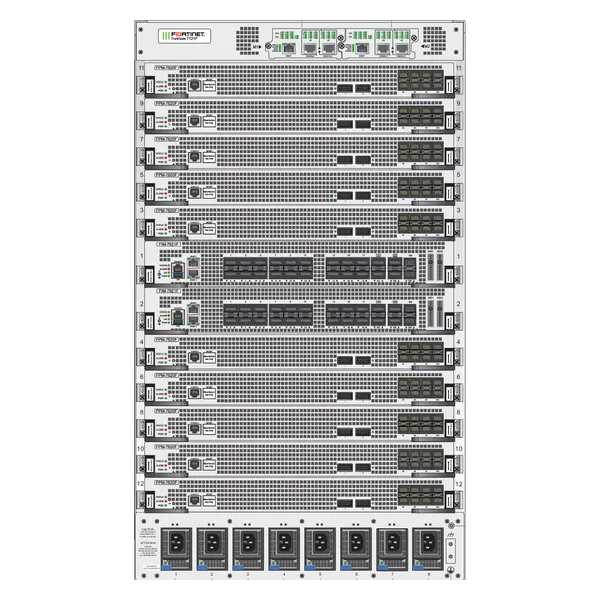
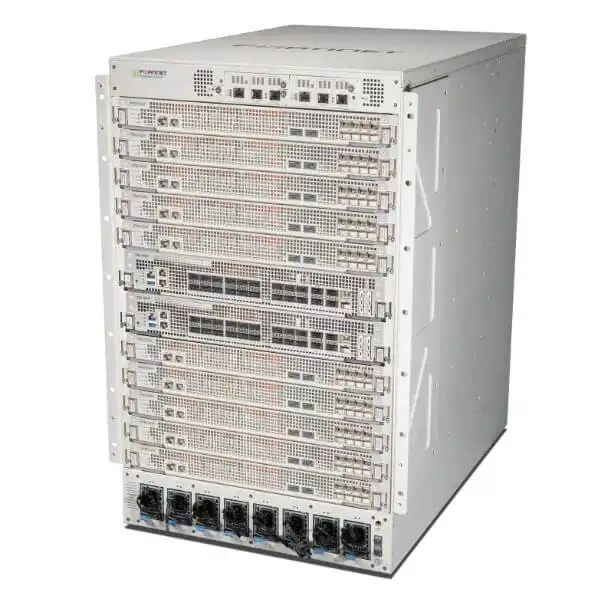
The 16U chassis architecture is equally important. It provides a modular foundation using processor, interface and management modules rather than treating the firewall as a sealed appliance. This allows a design team to match the chassis to the required interface mix and resilience strategy. The base FG-7121F configuration is commonly specified with two FPM-7620F processor modules, two FIM-7921F interface modules, two management modules and eight hot-swappable redundant power supplies, while other variants and module combinations are configuration dependent.
For Uganda buyers, the practical question is rarely whether the platform is powerful enough. The more important question is whether the planned security architecture justifies a chassis of this scale and whether the correct optical, power, licensing and redundancy components have been included. FourTeck can assist with that evaluation before a purchase order is raised.
Why a modular high-end firewall changes infrastructure planning
01
High inspection headroom
High published NGFW, threat-protection and SSL-inspection figures allow architects to design security controls around very large traffic flows. The business value is reduced pressure to bypass inspection simply because encrypted or application-rich traffic has grown beyond the capacity of smaller platforms.
02
Modular expansion rather than fixed-port compromise
A chassis can be configured around interface requirements instead of forcing the network design around a fixed collection of ports. That is especially useful where 400 GE, 100 GE, 40 GE, 25 GE and 10 GE connectivity must coexist across core, aggregation, peering or data-center fabrics.
03
Session scale for demanding environments
Fortinet publishes support for up to one billion concurrent sessions and nine million new sessions per second. This level of scale is relevant to large internet-facing services, service providers and heavily consolidated security zones where connection volume is a fundamental sizing factor.
04
Security and networking on one operating platform
FortiOS provides the operating environment for firewall policy, routing, segmentation, VPN, application control and supported FortiGuard services. A consistent platform can simplify policy operations when an organization already uses Fortinet elsewhere in its network.
05
Resilience for infrastructure that cannot rely on a single component
Hot-swappable power supplies and modular architecture support resilient design. The actual availability outcome still depends on correct HA topology, power feeds, software configuration, support coverage and operational processes, so redundancy should be treated as a complete system design rather than a chassis feature alone.
06
Consolidation potential
Very high throughput can make it possible to consolidate multiple security zones or older appliances onto a smaller number of powerful platforms, provided the risk model, segmentation policy and failure-domain design support that approach. Consolidation can reduce operational complexity but should never be pursued without capacity and resilience analysis.
The defining characteristic is not one speed number; it is the combination of throughput, session scale and modular I/O.
FortiGate 7121F is distinguished by a chassis design that brings high-capacity security processing together with dense, hardware-accelerated interfaces. That matters to architects because a firewall can only serve a high-speed core effectively when its security pipeline and network connectivity are sized together.
1.89 Tbps firewall
Vendor-published maximum firewall throughput.
520 Gbps threat protection
Enterprise-mix threat-protection figure from Fortinet.
540 Gbps SSL inspection
Published SSL-inspection throughput under Fortinet test conditions.
Up to 400 GE connectivity
Module-dependent interface options for high-capacity fabrics.
Published FG-7121F specifications that most influence design
| Specification | Published value / guidance |
|---|---|
| Product type | High-end modular next-generation firewall |
| Form factor | 16U, 12-slot chassis |
| Firewall throughput | Up to 1.89 Tbps depending on packet size and test profile |
| IPS throughput | 675 Gbps enterprise mix |
| NGFW throughput | 550 Gbps enterprise mix |
| Threat protection throughput | 520 Gbps enterprise mix |
| SSL inspection throughput | 540 Gbps |
| IPsec VPN throughput | 630 Gbps, 512-byte packets |
| Application control throughput | 1.5 Tbps, HTTP 64K |
| Concurrent sessions | Up to 1 billion TCP sessions |
| New sessions per second | Up to 9 million |
| Virtual domains | 10 default / up to 500 maximum |
| 400/100/40 GE slots | Up to 24 hardware-accelerated slots, module dependent |
| 100/40 GE slots | Up to 36 hardware-accelerated slots, module dependent |
| 25/10 GE slots | Up to 80 hardware-accelerated slots, module dependent |
| Management ports | GE RJ45 management interfaces available on chassis management architecture |
| Processor modules | Base FG-7121F commonly specified with 2 × FPM-7620F |
| Interface modules | Base FG-7121F commonly specified with 2 × FIM-7921F; other variants are configuration dependent |
| Power | AC and DC variants are available; power architecture depends on selected model |
| Security services | FortiGuard services and FortiCare coverage based on selected subscription or bundle |
The most important numbers in this ledger should be read together. A design requiring 400 GE connectivity but only modest inspection traffic has a different bill of materials from a design that must inspect hundreds of gigabits of TLS-encrypted application traffic. Likewise, the maximum session figure may be decisive for a service provider but far less important for a private data center with a smaller number of long-lived east-west flows.
Fortinet performance metrics are produced under defined laboratory conditions, so architecture teams should apply realistic utilization factors and account for enabled security profiles, traffic composition, logging, VPN use, application behavior and future growth. The firewall should be sized for the expected protected workload, not for a theoretical peak that bears little resemblance to the organization’s network.
Five questions to settle before requesting a final configuration
01 — What traffic must actually be inspected?
Document current and forecast north-south internet traffic, east-west data-center flows, inter-site VPN volumes and any traffic that will bypass or receive lighter inspection. This determines whether the published NGFW, IPS, SSL inspection or VPN figures are the most relevant sizing references. It also prevents a common procurement mistake: buying for raw firewall throughput while ignoring the security services that will be enabled in production.
02 — What scale of sessions, connections and interfaces is required?
Service-provider, hosting and large public-facing platforms may create very high connection churn even when aggregate bandwidth is manageable. Capture concurrent sessions, connections per second, link speeds, port counts and optic types. These inputs directly affect processor and interface selection and help determine whether the 7121F is appropriate or unnecessarily large.
03 — What must integrate with the existing network?
Confirm routing protocols, VLAN and segmentation design, HA expectations, upstream and downstream switching, optical standards, logging platforms, FortiManager or FortiAnalyzer use, authentication systems and any existing Fortinet Security Fabric components. Compatibility errors at this layer can be more expensive than selecting the wrong throughput tier.
04 — What growth and licensing horizon is planned?
Define the expected lifespan of the design, traffic growth, new data-center zones, additional tenants or virtual domains, future encryption requirements and preferred support term. FortiGuard and FortiCare choices affect both capabilities and recurring cost. High-availability members generally require aligned support and security-service coverage, so subscriptions should be planned as part of the architecture rather than added later.
05 — What installation and operational constraints exist?
A 16U chassis requires serious rack, power and cooling planning. Confirm available rack units, cabinet depth, AC or DC power design, redundant feeds, environmental conditions, cable routing, optics, change windows, migration method and support expectations. Delivery and installation logistics should also be understood before finalizing a project schedule.
Where the platform makes operational sense
Large enterprise data-center edge
A financial institution, telecom operator, government platform or large corporate data center may need to inspect several high-capacity uplinks while maintaining segmentation between internet, application, database and partner zones. The 7121F fits when protected traffic is large enough to justify high-throughput SSL inspection and NGFW services. Interface modules and optics must match the data-center fabric, and HA should be designed so maintenance or a component event does not create an unacceptable outage.
Service-provider or carrier security gateway
Operators with large numbers of concurrent sessions and rapid new-session creation can benefit from the platform’s published session scale. This use case is not just about bandwidth. Engineers should model subscriber behavior, NAT requirements, logging volume, virtual-domain design and maintenance practices. DC power variants may be relevant in carrier environments, but the selected chassis and power architecture should be confirmed against the facility standard.
High-capacity segmentation firewall
Organizations increasingly inspect east-west traffic between sensitive zones rather than protecting only the external perimeter. A modular chassis can serve as a segmentation layer between data-center fabrics, private-cloud zones or high-value application environments. The key design issue is to ensure enough high-speed interfaces and inspection capacity without creating an oversized failure domain. Virtual-domain planning and policy ownership should be established before deployment.
Consolidation of multiple older security appliances
A large enterprise may consider consolidating several aging firewalls onto fewer high-capacity systems to simplify policy, operations and support. The 7121F can provide the throughput headroom for such a project, but consolidation needs careful mapping of interfaces, security zones, change windows and organizational ownership. The goal should be controlled simplification, not merely fewer boxes.
Encrypted traffic inspection at data-center scale
Modern network traffic is predominantly encrypted, which means a high-end firewall is frequently asked to make security decisions on TLS sessions that it cannot evaluate properly unless those sessions are decrypted and inspected. This is why the Fortinet-published SSL inspection throughput of 540 Gbps is a more meaningful planning number than raw firewall speed for many security-heavy deployments.
However, no architect should simply assume that every production flow will reach the laboratory figure. Cipher suites, object sizes, connection rates, policy complexity, enabled services and traffic mix all influence real performance. A sensible design begins by classifying which flows genuinely need inspection, which must be exempt for technical or policy reasons, and where certificate and privacy requirements affect deployment.
For procurement, this changes the conversation. The buyer needs to know not only the internet circuit size but also the percentage of encrypted traffic, the number of concurrent SSL sessions, the application mix, and whether inspection occurs on north-south traffic, east-west traffic or both. These inputs help determine whether two processor modules are sufficient, whether additional capacity is expected later and how much operating headroom should be reserved.
Modular I/O is a design tool, not a checklist item
At this scale, interface planning deserves its own workstream. The platform can support high-speed 400 GE, 100 GE, 40 GE, 25 GE and 10 GE connectivity depending on the installed modules. That allows the firewall to sit naturally between modern core, aggregation and data-center switching layers rather than forcing traffic through lower-speed bottlenecks.
Capability line 01: Up to 24 hardware-accelerated 400 GE QSFP-DD / 100 GE QSFP28 / 40 GE QSFP+ slots are listed for the series, configuration dependent.
Capability line 02: Up to 36 additional hardware-accelerated 100 GE / 40 GE slots support dense high-capacity connectivity where the selected modules provide them.
Capability line 03: Up to 80 hardware-accelerated 25 GE / 10 GE slots allow finer-grained connections to aggregation or service zones.
The operational benefit is flexibility, but the procurement risk is significant if optics and port requirements are vague. Every interface should be mapped to speed, media, connector, transceiver type, redundancy path and peer device before the bill of materials is approved.
Resilience depends on architecture, licensing and operations together
The chassis includes redundancy-oriented hardware such as hot-swappable power supplies and management architecture, but high availability should not be reduced to a statement that the hardware is redundant. A resilient firewall service requires independent power feeds where possible, an appropriate HA topology, synchronized configurations, validated failover behavior, matching interface capacity on both paths, aligned subscriptions, operational monitoring and documented maintenance procedures.
Fortinet guidance for HA environments also makes licensing an important planning topic: cluster members need appropriate support contracts and FortiGuard service licensing for the services they use. Procurement teams should therefore budget HA as a complete pair or cluster rather than pricing only the active unit and assuming services transfer automatically.
□ Are redundant power feeds and rack capacity available?
□ Will both HA members have equivalent processor, interface and optics capability?
□ Are support and security subscriptions aligned across all members?
□ Has failover been tested against the actual routing and switching design?
□ Are maintenance windows, firmware upgrades and rollback procedures documented?
What buyers should check before purchase
| Risk | What to confirm | Why it matters | What to share with FourTeck |
|---|---|---|---|
| Wrong chassis variant | AC vs DC, module mix and exact order code | Power and interface differences affect deployability | Facility power standard and required ports |
| Under-sized inspection | NGFW, IPS and SSL traffic profile | Raw firewall throughput can hide inspection bottlenecks | Measured traffic and enabled services |
| Missing optics or cabling | Transceiver types, fiber, connector and distance | A chassis cannot be commissioned without compatible links | Peer switches and link matrix |
| Subscription mismatch | FortiCare term and FortiGuard bundle | Security services and support depend on selected coverage | Required services and support period |
A final quote should be treated as an engineered bill of materials, not a single appliance line item. Include rack accessories, optics, cables, licensing, support, HA peer requirements, management tools and any migration services that the project requires. This is particularly important for a chassis platform because the wrong module or transceiver can delay a deployment even when the core firewall hardware has arrived.
Plan availability around the complete configuration
Uganda availability for a high-end chassis firewall can vary by exact hardware variant, modules, support term, FortiGuard subscription, optical components and project quantity. FourTeck can help Kampala-based IT teams and other Uganda buyers prepare a complete request that separates required components from optional additions, reducing the chance of receiving a quote that looks complete but omits a critical deployment item.
Support can include configuration review, quote preparation, delivery coordination, license-term guidance, project quantity planning and discussion of warranty coverage available for the selected supply path. FourTeck does not treat availability as guaranteed until the requested configuration is confirmed. For a project of this scale, buyers should allow time for technical validation, sourcing and change-control preparation.
One procurement process for multi-site Uganda projects
FourTeck can coordinate enquiries from organizations operating in Kampala, Entebbe, Jinja, Mbarara and Gulu through one project brief. For a chassis firewall, location planning may involve more than delivery: rack readiness, power standards, fiber paths, remote-site dependencies and implementation windows can differ by facility. Consolidating these details before quotation gives the project team a clearer view of what is required at each site without repeating separate city-specific purchasing processes.
Regional planning for cross-border infrastructure teams
Organizations managing infrastructure across Uganda, Kenya and selected East Africa markets may want one technical configuration approach even when sourcing, delivery and support arrangements differ by country. FourTeck can help document model, module, optic and licensing requirements consistently so regional teams compare like-for-like proposals. For projects that extend into selected Africa markets, the UAE or Kuwait, regional FourTeck websites can provide a starting point for country-specific enquiries, but local stock, delivery schedules, support handling and warranty conditions should always be confirmed for the destination.
Regional resources include FourTeck Uganda, FourTeck Kenya, FourTeck Africa, FourTeck UAE and FourTeck Kuwait.
Useful reference points within the Fortinet range
These links show the breadth of Fortinet deployments rather than direct performance equivalents. Buyers considering the 7121F should compare primarily against current high-end FortiGate platforms and should not infer that compact branch models can replace a chassis design. FourTeck can help identify a credible alternative path if traffic measurements show that a smaller fixed-form-factor platform would meet the requirement more economically.
Useful assistance before a complex firewall order is placed
01. Product selection guidance helps determine whether the 7121F is proportionate to the actual traffic, interface and resilience requirements.
02. Configuration review helps align processor modules, interface modules, optics, power variant and accessories with the planned topology.
03. Quote assistance can separate hardware, FortiCare, FortiGuard subscriptions and project services so procurement teams understand recurring and one-time costs.
04. Business IT understanding helps connect technical figures to practical requirements such as maintenance windows, growth, compliance and support expectations.
05. Uganda delivery coordination helps project teams plan around configuration-dependent availability rather than relying on assumptions about stock.
06. Alternative product matching can identify a smaller or newer platform when the measured requirement does not justify this chassis.
Procurement and deployment questions about the FG-7121F
01. What type of organization is the FortiGate 7121F designed for?
It is designed for very large enterprise, data-center, carrier and service-provider environments that need exceptionally high security throughput, dense high-speed connectivity and modular expansion. It is generally more platform than a normal office or branch requires. Buyers should have measured traffic, interface and redundancy requirements before selecting it so the chassis is justified by real operational demand.
02. What are the most important published performance figures?
Fortinet publishes up to 1.89 Tbps firewall throughput, 675 Gbps IPS throughput, 550 Gbps NGFW throughput, 520 Gbps threat-protection throughput, 630 Gbps IPsec VPN throughput and 540 Gbps SSL inspection throughput. These figures come from vendor test conditions and should be translated into production sizing using realistic traffic profiles, enabled services and growth headroom.
03. Does the chassis support 400 Gigabit Ethernet?
Yes. Fortinet lists hardware-accelerated 400 GE QSFP-DD connectivity for the 7121F series, along with 100 GE, 40 GE, 25 GE and 10 GE options depending on installed interface modules. The exact port count is configuration dependent, so the final interface requirement and optical transceiver list should be documented before quotation.
04. Are FortiGuard and FortiCare included automatically?
Not necessarily. Hardware-only, support and security-service bundles can be quoted differently. FortiGuard services provide subscription-based security capabilities, while FortiCare provides support coverage according to the selected plan. Buyers should specify the desired services and support term. High-availability deployments also need licensing and support planning for each member rather than assuming one subscription covers the whole cluster.
05. Is there an AC and DC version?
Yes. Fortinet lists AC and DC variants in the 7121F family. The correct choice depends on the facility’s power architecture, redundancy model and deployment environment. A data center using traditional AC feeds and a carrier facility using DC power may require different order codes, so the power design should be confirmed before the bill of materials is finalized.
06. What information should we provide to request a quote in Uganda?
Provide expected inspected throughput, number and speed of links, required interface types, HA design, AC or DC preference, FortiGuard services, FortiCare term, optics, rack and power details, planned deployment date and quantity. A network diagram is very useful. These details help FourTeck prepare a more complete configuration instead of pricing only a chassis without required components.
07. Can the 7121F be used as a segmentation firewall?
Yes, it can be deployed to inspect and enforce policy between high-capacity network zones, including data-center or private-cloud segments. The platform’s high throughput and interface density are relevant where east-west traffic is substantial. However, segmentation design should also consider failure domains, routing, virtual domains, policy ownership and whether consolidation onto one chassis creates too much shared operational risk.
08. How should we size SSL inspection?
Start with measured TLS traffic, concurrent encrypted sessions, connection creation rates and the policies that will decrypt traffic. Compare those values against Fortinet’s published SSL inspection metrics while keeping operational headroom. Some traffic may require exemptions for technical or policy reasons, so SSL inspection should be planned as a security architecture decision rather than applying a blanket percentage to total internet bandwidth.
09. Is the FortiGate 7121F available in Kampala?
Availability is configuration dependent and can vary by chassis variant, modules, licenses, optics and project quantity. FourTeck can review the required bill of materials and provide current quote and delivery guidance for Uganda. Buyers should avoid planning a deployment around assumed stock until the exact configuration and sourcing status have been confirmed.
10. What if our requirement is smaller than this platform?
A smaller FortiGate may be a better commercial and operational choice. The right decision depends on inspected throughput, interface speed, session scale, growth and resilience needs. FourTeck can compare the requirement against other current FortiGate models and propose an alternative path when a 16U modular chassis would add unnecessary cost, power use or operational complexity.
Build the bill of materials before you price the chassis
For a platform of this scale, the best quote starts with a clear network design. Share the traffic profile, interface matrix, HA topology, preferred power variant, subscription term, optics and project quantity so FourTeck can help organize a configuration that is technically coherent and easier for procurement to evaluate.
- Measured inspected throughput and traffic growth
- Port speeds, optic types and peer-device details
- AC or DC power requirement and HA design
- FortiGuard services and FortiCare term
- Project quantity and target deployment window

Reviews
There are no reviews yet.