
Fortinet FortiMail 200F Secure Email Gateway for Uganda
Fortinet FortiMail 200F is a dedicated 1U secure email gateway for organizations that want to place a purpose-built security layer around business mail flow. It is positioned for small businesses, branch offices and organizations and combines message routing, antispam, malware protection, authentication and content controls in an appliance that can sit between the internet and an organization’s mail environment. For Ugandan companies evaluating protection for Microsoft Exchange, hybrid mail architectures or other SMTP-based systems, the appliance provides a clear physical security boundary with locally controlled configuration and storage.
The procurement decision should be based on more than mailbox count. Buyers should document protected domains, peak messages per hour, inbound-to-outbound traffic ratios, attachment sizes, quarantine expectations, retention needs, security subscriptions and the operational impact of a single-power-supply platform. FortiMail 200F supports 20 protected email domains, 150 server-mode local mailboxes and a defined set of recipient-based and security profiles. Fortinet publishes email-routing performance of up to 50,000 messages per hour using 100 KB messages without queuing; enabled inspection services reduce the rated figure according to the security stack selected.
FourTeck Uganda supports commercial quotation, bill-of-materials review, subscription alignment, staging requirements and deployment planning. This is particularly useful when the appliance must be introduced into a live mail environment where DNS, MX records, relay permissions, TLS certificates, directory integration and firewall policies must be coordinated carefully.
Instant Specifications & Procurement Facts
FortiMail 200F
Small business, branch and organizational email security
4 × 10/100/1000 RJ45
1 × 1 TB
1U rack mount
Single, 100–240V AC
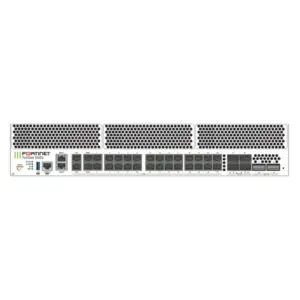
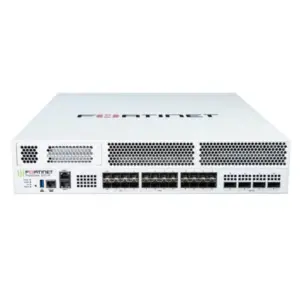
The 200F is deliberately compact. It has no SFP or SFP+ interfaces and no redundant hot-swappable power supplies. This matters when the appliance is being specified for a data center standard that requires dual feeds or optical connectivity. Its 1 TB local disk provides appliance storage, while 4 GB of memory supports the platform workload. Buyers should treat published throughput as a sizing reference rather than a guaranteed production result because message composition, attachment size, policy complexity, scanning depth and concurrent activity affect real-world performance.
Operational Product Architecture & Overview
FortiMail 200F is built around the secure email gateway role rather than general-purpose network firewalling. Mail is accepted, evaluated against configured domains and policies, inspected using the enabled FortiGuard services and then relayed according to administrator-defined routing. This architectural separation gives administrators a dedicated control point for email-specific threats and policy enforcement without placing the workload directly on a general mail server.
Organizations typically investigate this model after encountering persistent spam, phishing, impersonation, malware attachments, malicious links or operational pressure caused by managing email security directly on a mail platform. A gateway approach can reduce exposure by rejecting or quarantining undesirable traffic before it reaches user inboxes. Authentication and content profiles can be applied by domain, while recipient policies provide differentiated treatment for departments, users or mail flows.
The hardware is suitable where Gigabit copper connectivity is adequate and where a single power supply is acceptable. Four network interfaces allow management and mail-flow designs to be separated according to the chosen topology. The 1U chassis measures approximately 44 × 438 × 422 mm and weighs about 5.4 kg, making it straightforward to place in a standard rack with suitable front-to-back airflow.
Fortinet publishes three useful performance reference points. Email routing is rated at 50,000 messages per hour; FortiGuard Antispam plus Virus Outbreak processing is rated at 40,000 messages per hour; and FortiGuard Enterprise ATP processing is rated at 30,000 messages per hour, based on 100 KB messages without queuing. These figures demonstrate why sizing must use the inspection mode expected in production rather than raw routing alone. Cloud API figures are lower and should likewise be assessed separately where applicable.
A key procurement boundary is functionality. The 200F does not include the DLP capability identified on larger FortiMail hardware such as the 400F. It also does not provide centralized quarantine in the published model matrix. A buyer whose compliance policy specifically requires those functions should evaluate the next platform tier instead of assuming they can be enabled later on the same appliance.
Enterprise Business Outcomes & Value Analysis
1. Performance & Throughput Integrity
Dedicated email-processing capacity keeps the security gateway role separate from mailbox servers. Sizing against inspected-message throughput helps maintain predictable mail delivery during ordinary business peaks and reduces the risk of choosing hardware solely from mailbox totals.
2. System Reliability
A physical appliance provides a controlled platform with dedicated storage and interfaces. Because the 200F has a single power supply, resilient designs should consider UPS protection, spare strategy, mail-server queuing behavior and, where business continuity requires it, a second appliance or a higher model with stronger hardware redundancy.
3. Infrastructure Scalability
Twenty protected domains cover many smaller multi-domain environments. Procurement teams expecting mergers, customer-hosted domains or rapid domain growth should model the future requirement before purchase. Advanced management licensing can affect protected-domain limits, so commercial configuration should be verified in the quotation.
4. Security & Access Control
Antispam, antivirus, authentication and content profiles let administrators establish layered controls for inbound and outbound mail. The goal is to stop unwanted content early while preserving legitimate business communications and maintaining auditable policy administration.
5. Centralized Operations
A dedicated console concentrates email-security policy, message handling and operational monitoring. This can simplify troubleshooting compared with fragmented controls distributed across endpoints and mail servers, particularly where a small infrastructure team supports multiple departments.
6. Cost & Energy Planning
The appliance averages about 51 W and has a published maximum requirement of 62 W. That modest load helps with UPS and rack power planning. Buyers should still budget separately for the appropriate security subscriptions, support term, deployment work and any spare or resilience strategy.
Key Hardware & Software Highlights
The FortiMail 200F combines four copper Gigabit Ethernet ports, a 1 TB drive, 4 GB memory, TPM support and a compact 1U enclosure. The absence of optical interfaces simplifies the platform for copper-connected environments but requires planning where rack standards depend on fiber. Likewise, the single power supply makes the appliance cost-effective for its intended tier while placing more responsibility on external UPS protection and service-continuity planning.
On the software side, the platform supports protected email domains, recipient-based policies, server-mode local mailboxes, and antispam, antivirus, authentication and content profiles. FortiGuard services add continuously maintained threat-protection capabilities according to the purchased subscription. FortiMail can be used in on-premises and hybrid email designs, while Fortinet’s broader portfolio also provides cloud-oriented email security options for organizations whose architecture does not require a physical gateway.
For buyers, the practical advantage is policy specialization. Email security has different operational requirements from general perimeter security: SMTP reputation, sender authentication, message inspection, attachment handling, quarantine, relay rules and domain controls all need dedicated treatment. The 200F gives these functions their own appliance boundary.
Technical Specifications Ledger
| Specification | FortiMail 200F |
|---|---|
| RJ45 Interfaces | 4 × 10/100/1000 |
| Storage | 1 × 1 TB |
| Memory | 4 GB |
| Form Factor | Rack mount, 1U |
| Protected Email Domains | 20 |
| Server Mode Local Mailboxes | 150 |
| Email Routing | 50,000 messages/hour |
| Antispam + Virus Outbreak | 40,000 messages/hour |
| Enterprise ATP | 30,000 messages/hour |
| Dimensions | 44 × 438 × 422 mm |
| Weight | 5.4 kg |
| Power Source | 100–240V AC, 50–60 Hz |
| Maximum Power | 62 W |
| Average Consumption | 51 W |
| Operating Temperature | 0°C to 40°C |
| Humidity | 5%–90% non-condensing |
| Compliance | FCC Part 15 Class A, RCM, VCCI, CE, UL/cUL, CB, RoHS |
Published performance values are laboratory reference figures and should be interpreted with the associated test conditions. Production traffic can include much larger messages, encrypted connections, multiple attachments, complex policies and bursts that materially change effective capacity. A responsible sizing exercise therefore applies headroom and validates the inspection services that will actually be enabled.
Configuration & Sizing Worksheet
1. Estimate workload
Record the number of active users, protected domains, average daily inbound and outbound messages, peak-hour volume, average attachment size and anticipated annual growth. Do not size only from the number of employees. Automated systems, alerts, scanners, ERP applications and customer-facing services can generate substantial mail volume even in a modest organization.
2. Confirm environment and rack space
Reserve one rack unit and verify the 422 mm chassis depth plus clearance for cabling and front-to-back airflow. The operating range is 0°C to 40°C, so the rack should have stable cooling and controlled humidity. Confirm grounding and UPS capacity before installation.
3. Validate power and cabling
The appliance uses a single power supply. Procurement teams requiring dual-feed resilience should account for this explicitly. Four copper Gigabit ports are available; there are no SFP interfaces. Verify switch port type, VLAN design and patch leads before dispatch to avoid discovering a physical connectivity mismatch during cutover.
4. Select subscriptions and support
The hardware purchase and security-service entitlement are separate commercial considerations. Determine the required FortiGuard protection level, support duration and renewal plan. Confirm whether advanced management capabilities or other options are required. A multi-year quote can simplify budgeting and avoid an unexpected service gap after the first term.
5. Prepare the quote request
Provide legal company name, delivery location, tax requirements, desired support term, number of domains, user/mailbox estimate, current email platform, expected go-live date and whether installation is required. Include any requirement for staging, firmware preparation, DNS planning, certificate work or remote assistance.
Deployment Scenarios & Industry Use Cases
Multi-Site Organizations
A company with several Ugandan branches can centralize inbound and outbound email inspection through a FortiMail 200F placed at the primary data center or mail hub. Branch users continue to use their normal mail clients while security policies are administered centrally. The design works best when all relevant mail paths are documented so that backup internet links, remote applications and disaster-recovery mail routes do not bypass the gateway.
Financial Services
Banks, microfinance organizations and other financial institutions face phishing, impersonation and malicious-attachment risks. FortiMail can add a dedicated inspection layer, but compliance teams should pay close attention to the 200F feature boundary: published specifications show no DLP on this model. If data-loss controls are mandatory, a larger FortiMail appliance or another suitable architecture should be specified from the outset.
Education & Campus Networks
Schools, universities and training organizations often manage diverse user populations and high volumes of unsolicited email. Domain-based controls and security profiles can help protect administrative and academic mail systems. Sizing should include automated learning platforms, admissions systems and notification services rather than counting staff alone.
Government Procurement
Public-sector buyers commonly require documented hardware specifications, support terms, compliance information, warranty handling and implementation scope. The 200F’s compact rack format and defined performance figures make technical comparison straightforward, while procurement documentation should clearly state subscriptions, service duration, power architecture and whether installation or knowledge transfer is included.
Technical Deep Dive: Message Processing Architecture
Email security performance is not simply network bandwidth. SMTP traffic arrives as discrete messages whose sender reputation, headers, recipients, body content, URLs and attachments may require different checks. FortiMail applies configured controls before deciding whether to reject, quarantine, modify or relay a message. The published performance progression from 50,000 messages per hour for routing to 40,000 with antispam and Virus Outbreak services and 30,000 with Enterprise ATP illustrates the processing cost of deeper inspection.
This distinction is critical during sizing. An organization that processes large PDF files, office documents and compressed archives should not assume the routing figure represents its secured production throughput. Administrators should also leave headroom for temporary spikes, marketing campaigns, automated notifications and queued traffic after upstream outages.
Technical Deep Dive: Software Ecosystem & Operational Control
FortiMail is part of Fortinet’s wider security ecosystem and can be deployed alongside other Fortinet controls while retaining a specialized email-security role. Operationally, administrators define protected domains, recipient policies, authentication controls and content/security profiles. FortiGuard subscriptions provide maintained threat intelligence and inspection services according to the purchased package.
Change control is especially important for mail infrastructure. Firmware upgrades, certificate replacement, DNS modifications and policy changes should be staged with rollback procedures. Before a major upgrade, export configuration backups, review release documentation, verify compatibility and schedule a maintenance window that accounts for queued mail behavior.
Technical Deep Dive: Availability & Recovery
The FortiMail 200F does not have redundant hot-swappable power supplies, so availability must be designed at the solution level. A UPS protects against short utility interruptions, but it does not eliminate appliance hardware failure. Organizations with strict recovery objectives should evaluate redundant gateway architecture, spare hardware, upstream mail queuing, secondary MX behavior and whether a higher appliance model better matches the service requirement.
Disaster recovery planning should include configuration backups, documented DNS records, certificate inventory, administrator access recovery and a tested procedure for redirecting mail flow. Mail systems are store-and-forward by nature, which can provide useful tolerance during short outages, but the exact behavior depends on sender retry policies and the organization’s architecture. Recovery assumptions should therefore be tested rather than left implicit.
Pre-Purchase Buyer Gap Checklist
Licensing: Confirm which FortiGuard security services and support are included in the commercial offer, their duration and renewal cost. The appliance should not be evaluated as hardware alone.
Feature boundary: The 200F does not provide the DLP capability listed for larger models. If outbound sensitive-data control is a formal requirement, address that before purchase.
Power resilience: There is one power supply. Determine whether a UPS is sufficient for the business requirement or whether the solution needs appliance redundancy or a different model.
Physical connectivity: All four network interfaces are copper Gigabit Ethernet. There are no SFP or 10GbE ports. Check the data-center switch standard.
Rack clearance: Allow for the 422 mm chassis depth, power lead and network cable bend radius, plus unobstructed front-to-back airflow.
Capacity growth: Model at least the expected contract or refresh period. A solution that is comfortable today may become constrained after domain consolidation, acquisitions or growth in automated messaging.
Cross-vendor compatibility: Document the SMTP topology, DNS, TLS requirements, mail server, identity sources and firewall rules. Compatibility depends on standards and configuration, not merely the vendor name of the existing mail server.
Operational ownership: Decide who will monitor queues, release quarantined messages, manage policies, renew certificates, update firmware and respond to incidents. A technically suitable appliance still needs clear operational responsibility.
Uganda Procurement & Delivery Logistics
FourTeck supports FortiMail 200F procurement for Uganda through a quote-led process suitable for enterprise and institutional purchasing. A complete request should identify the exact model, required FortiGuard subscription, support duration, delivery destination and any implementation services. Where the customer is replacing an existing gateway, sharing the current topology and message-volume information helps validate that the proposed hardware tier is appropriate.
Order processing may include commercial confirmation, sourcing, import and local delivery steps. Delivery timing therefore depends on stock position, distributor availability, shipment routing and customs processing at the time of order. Buyers with a fixed project deadline should request a current lead-time confirmation rather than relying on a generic estimate.
Pre-configuration can reduce work during the production cutover. Depending on agreed scope, preparation may cover firmware alignment, baseline interface settings, administrative access, domain planning and configuration review. DNS and mail-flow changes should normally be coordinated with the customer’s mail administrator so that MX changes, relay settings and rollback steps are controlled.
Uganda Coverage Matrix
Customers in Kampala can request supply and deployment planning for head offices, data centers and branch aggregation sites. Entebbe organizations can procure for corporate, hospitality, logistics and institutional networks. Jinja deployments can support industrial, education and commercial environments, while Mbarara buyers can plan secure mail gateways for regional offices, healthcare, education and growing businesses. Gulu organizations can similarly request equipment supply and remote or planned technical assistance. For every location, final delivery commitments should be confirmed against current stock and logistics conditions at quotation stage.
Cross-Border & Regional Supply
Organizations operating across East Africa and the Gulf can coordinate related infrastructure sourcing through FourTeck regional sites. Visit FourTeck Uganda, FourTeck Kenya, FourTeck Africa, FourTeck UAE and FourTeck Kuwait. Cross-border projects should align model numbers, support entitlement, power accessories, delivery terms and local import requirements so that equipment arriving at different sites remains operationally consistent.
Related Infrastructure & Product Planning
A secure email gateway is usually one element of a broader security architecture. Buyers can review enterprise security solutions in Uganda and request compatible Fortinet firewall, switching, wireless, management and support options through the same procurement channel. When a project includes rack deployment, the bill of materials should also account for UPS capacity, patch leads, rack space, console access and any spare components required by internal standards.
Organizations that outgrow the 200F should compare larger FortiMail models rather than forcing a smaller appliance into a workload beyond its intended tier. The FortiMail 400F is particularly relevant where greater domain capacity, higher throughput, software RAID options, centralized quarantine or DLP are required. Larger enterprise environments can assess higher-capacity FortiMail appliances based on message volume, storage, redundancy and interface needs.
FourTeck Technical Service Capabilities
FourTeck can support the procurement lifecycle with engineering validation before an order is finalized. This includes checking that the requested model matches protected-domain counts, expected message throughput, interface requirements, rack constraints and resilience objectives. Bill-of-materials verification is valuable because FortiGuard subscriptions, support coverage and deployment services may be as important to the finished solution as the appliance itself.
Staging can be planned where customers want a controlled baseline before shipment. Firmware version, management addressing and agreed initial settings can be reviewed against the implementation plan. For live cutovers, the customer should retain ownership of authoritative DNS and mail-server changes while technical teams coordinate gateway settings and validation tests.
Post-sales assistance can include configuration guidance, troubleshooting coordination, firmware planning and warranty or support-case facilitation according to the purchased service scope. Keeping serial numbers, entitlement information, configuration backups and a change log simplifies future support.
FortiMail 200F Technical FAQ
Is FortiMail 200F suitable for a small or branch-office deployment?
Yes. Fortinet positions the 200F for small businesses, branch offices and organizations. Suitability still depends on traffic rather than company labels. The appliance supports 20 protected email domains and Fortinet publishes up to 50,000 routed messages per hour under its stated test conditions. A buyer should compare that capacity with peak secured traffic, growth expectations and the inspection services that will be enabled.
Does the FortiMail 200F support DLP?
No, the current Fortinet model specification identifies DLP as unavailable on the 200F while it is available on larger models such as the 400F. This distinction matters for organizations whose compliance policy requires dedicated outbound sensitive-data controls. Such customers should evaluate a model that explicitly includes the required function rather than purchasing the 200F on the assumption that every FortiMail feature is common to every hardware tier.
How many network ports does it provide?
The appliance provides four 10/100/1000 copper RJ45 interfaces. It does not provide SFP Gigabit or SFP+ 10 Gigabit Ethernet interfaces. Before ordering, verify that the rack switch has suitable copper ports and that the intended topology does not require optical handoff. If the data center standard mandates fiber at the appliance edge, the design or appliance selection should be revisited.
Does it have redundant power supplies?
No. FortiMail 200F uses a single power supply and does not have redundant hot-swappable PSUs. A UPS can protect against short utility disturbances, but it does not provide redundancy for an internal PSU or appliance failure. Businesses with strict uptime objectives should consider a resilient gateway architecture, spare strategy or a higher model whose hardware design better aligns with the required availability level.
What power and cooling should be planned?
Fortinet specifies 100–240V AC at 50–60 Hz, average consumption of approximately 51 W and maximum required power of 62 W. Published heat dissipation is 245 BTU per hour, with front-to-back forced airflow. The operating temperature range is 0°C to 40°C and humidity is 5% to 90% non-condensing. Provide stable conditioned rack space, suitable UPS capacity and unobstructed airflow.
What are the appliance dimensions?
The 1U chassis is approximately 44 mm high, 438 mm wide and 422 mm deep, with a published weight of about 5.4 kg. Rack planners should account for more than chassis depth: rear power and Ethernet cabling needs bend clearance, while front and rear ventilation must remain open. Confirm cabinet usable depth and rail or shelf arrangements before delivery, particularly in shallow communications cabinets.
Are FortiGuard services included automatically with the hardware?
Security-service and support entitlements should be explicitly listed on the commercial quotation rather than assumed from the appliance purchase. Fortinet’s FortiMail portfolio uses licensing and annual subscription options for security services. Ask for the precise service bundle, support level, term length, renewal basis and start date so that the appliance arrives with the protection and support coverage expected by the project team.
Can FourTeck help with configuration?
Configuration assistance can be scoped as part of the project. Typical preparation includes reviewing the mail topology, protected domains, interface addressing, relay requirements, security profiles, DNS/MX changes and cutover plan. The safest approach is collaborative: the email administrator controls mail-server and DNS authority while the security engineer prepares and validates the FortiMail policies. The quotation should state whether staging, remote implementation or onsite services are included.
What information is needed for an accurate quotation?
Provide the model requested, number of protected domains, user or mailbox count, estimated daily and peak-hour message volumes, current mail platform, desired security subscription, support duration, delivery city and target implementation date. Also identify whether the organization needs DLP, dual-power hardware, optical interfaces or high-availability architecture. These requirements can change the appropriate model and should be resolved before the purchase order is issued.
How should an organization plan for future growth?
Estimate growth over the intended service life rather than sizing only for today’s mail volume. Consider new branches, acquisitions, additional protected domains, automated application mail, larger attachments and stricter inspection policies. Leave capacity headroom for peaks and outages. If projected requirements approach the 200F’s domain, performance, storage, feature or resilience boundaries, moving to a larger model at the initial procurement stage can avoid an early replacement.
Request a FortiMail 200F Uganda Procurement Quote
Send FourTeck your protected-domain count, mailbox estimate, peak message volume, existing mail platform, preferred FortiGuard service term, delivery location and implementation requirements. The team can prepare a commercial offer and help verify whether the FortiMail 200F matches the intended workload or whether a larger platform is more appropriate. For projects with fixed deployment dates, request current stock and lead-time confirmation when the quotation is prepared.
Reviews
There are no reviews yet.