
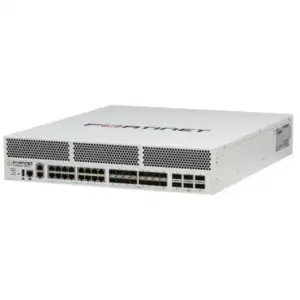
Fortinet FortiNAC M-550F Network Access Control Management Server
The Fortinet FortiNAC M-550F is the dedicated management-server appliance for organizations building or expanding a FortiNAC network access control environment. Rather than acting as the Control and Application Server that directly provides the operational capacity for managed network ports, the M-550F provides the management tier used to centralize administration across a larger deployment. This distinction matters during procurement: the appliance should be specified as part of an overall FortiNAC architecture that includes correctly sized Control and Application resources, endpoint licensing, network interfaces, support coverage and implementation planning.
For Ugandan enterprises, banks, universities, government institutions, healthcare organizations, telecom environments and distributed businesses, centralized network access control management can reduce the operational complexity created by growing numbers of users, corporate endpoints, guest devices, unmanaged systems and connected equipment. The M-550F supplies a purpose-built physical platform with a 24-core AMD EPYC processor, 32GB DDR4 memory, mirrored SSD storage, high-speed SFP/SFP+ connectivity and redundant hot-plug power. These characteristics make it suitable for data-centre installation where reliability, rack discipline and predictable hardware specifications are procurement priorities.
FourTeck can prepare a Uganda-specific quotation around the appliance and the wider deployment requirements. A useful request should identify the approximate number of concurrent endpoints, number of sites, switching and wireless vendors, expected growth, preferred license capability, high-availability expectations and any staging or configuration assistance required. This enables the bill of materials to be reviewed as a system rather than treating the management appliance as a standalone purchase.
Instant Specifications & Procurement Fact Rail
FNC-M-550F
FortiNAC Management Server
1U rack mount
AMD EPYC 7413, 24 cores, 2.65GHz base
32GB DDR4
2 × 960GB SSD, software RAID1
1 × GbE RJ45 + 4 × 1GbE SFP / 10GbE SFP+
Hot-plug 1+1 redundant PSU, 225W
Fortinet lists management capacity for the M-550F as unlimited. That statement describes its management-server role and should not be confused with endpoint-license entitlement or the capacity of Control and Application Servers. A complete FortiNAC deployment requires both Control and Application Server functionality, and larger installations can add server resources for additional capacity. Buyers should therefore validate architecture and licensing together. Stock, lead time, warranty entitlement and support term should be confirmed on the commercial quotation because these can vary with sourcing, contract choice and project timing.
Operational Product Architecture & Overview
Network access control projects frequently begin with a visibility problem. An organization may know how many switch ports it owns, but not have a reliable operational picture of every device connecting through wired, wireless and remote-access infrastructure. Corporate laptops may coexist with employee phones, printers, cameras, building systems, laboratory devices, guest equipment and specialist operational technology. Security teams need consistent policy while network teams need an approach that does not require replacing the entire switching estate. FortiNAC is designed around visibility, control and response capabilities, with licensing levels selected according to required functionality.
Within that architecture, the M-550F is a management server. Its value becomes most apparent when administration must be consolidated across multiple FortiNAC servers or a geographically distributed deployment. The hardware uses an AMD EPYC 7413 processor with 24 cores at a 2.65GHz base frequency and 32GB DDR4 memory. Two 960GB SSDs provide local storage, with software RAID1 supplying disk mirroring. This does not eliminate the need for backups, operational recovery procedures or appropriate high-availability design, but it provides local storage resilience against a single-drive failure scenario.
The network interface arrangement provides one Gigabit Ethernet RJ45 port and four interfaces that support 1GbE SFP or 10GbE SFP+ connectivity. This gives infrastructure teams flexibility when integrating the appliance into management networks or data-centre switching. Optics and cables should be selected to match the switch-side interface, fibre type, distance and approved transceiver policy. The server occupies one rack unit and measures approximately 44 × 437 × 610mm. Its 610mm depth is an important practical detail: procurement teams should confirm cabinet depth, rail clearance, rear-door clearance and cable bend radius before delivery rather than assuming every nominal 19-inch rack is equally suitable.
Power architecture is equally important. The appliance uses hot-plug 1+1 redundant power supplies and is specified at 225 watts input power, with published current figures of 2.3A at 100V and 0.94A at 240V. In a resilient rack design, each PSU should normally be connected to an appropriately engineered independent power path where available, such as separate rack PDUs backed by the facility UPS architecture. Five system fans provide cooling, and the published heat dissipation is approximately 767.73 BTU/h. Data-centre teams can use these values during rack power and cooling planning.
FortiNAC F-series appliances use FortiNAC-OS. Fortinet documents a restrictive default network posture in which limited TCP/UDP services are open initially; additional access is enabled through appliance configuration as required by deployed features. This supports a disciplined management-plane design in which administrators expose only the services necessary for operations. During implementation, firewall rules, management VLANs, routing, DNS, NTP, directory integration, authentication systems and monitoring should be documented before the appliance is introduced into production.
Enterprise Business Outcomes & Value Analysis
1. Performance & Processing Integrity
The 24-core AMD EPYC platform gives the management tier substantial compute resources for enterprise administration. Procurement teams should still size the complete FortiNAC environment around endpoint counts, site topology and Control/Application Server capacity rather than interpreting CPU specifications as an endpoint-capacity promise.
2. System Reliability & Availability
Dual SSDs in software RAID1, redundant hot-plug power and five system fans provide practical hardware resilience. These features reduce exposure to individual component faults but do not replace architecture-level availability, backup, support and recovery planning.
3. Infrastructure Scalability
Fortinet positions the M-550F as a management server with unlimited management capacity, while Control and Application appliances are sized by managed network-port capacity. This separation supports designs that can grow by adding appropriately sized operational servers as the estate expands.
4. Network Access Governance
FortiNAC can be licensed for endpoint visibility and provisioning, visibility plus control, or visibility, control and response. The correct level should be chosen against policy objectives rather than simply purchasing the highest tier without a use-case review.
5. Centralized Operational Control
A dedicated management tier can simplify administration in multi-server environments by providing a structured place for centralized operational oversight. This is particularly relevant to distributed enterprises where network teams support several campuses, branches or data-centre locations.
6. Total Cost Discipline
A defensible TCO calculation includes hardware, licensing, support, optics, rack space, power, implementation effort, training and lifecycle operations. The 1U footprint and 225W specification allow those facility costs to be estimated before purchase.
7. Vendor-Aware Integration
NAC value depends on integration with the actual wired, wireless, authentication and security environment. A pre-sales compatibility review reduces risk where organizations operate mixed switch generations or multiple infrastructure vendors.
Key Hardware & Software Highlights
| Component | Implementation | Operational Relevance |
|---|---|---|
| Compute | AMD EPYC 7413, 24 core | Enterprise-class compute foundation for the FortiNAC management role. |
| Memory | 32GB DDR4 | Supports the appliance software and centralized management workload. |
| Storage | 2 × 960GB SSD | Mirrored using software RAID1 for local disk resilience. |
| Interfaces | 1 × GbE RJ45; 4 × SFP/SFP+ | Copper management connectivity plus flexible 1/10GbE optical/DAC options. |
| Power | Hot-plug 1+1 redundant PSU | Supports resilient power-path planning and serviceability. |
| Platform | FortiNAC-OS | Purpose-built operating environment with restricted services by default. |
The important procurement lesson is that these components work together as an appliance platform; they should not be evaluated like a generic server intended for arbitrary workloads. Firmware, FortiNAC software, licensing and support compatibility must be maintained as part of the product lifecycle. Before upgrades, administrators should review release documentation, supported upgrade paths, backup requirements and interoperability implications.
Technical Specifications Ledger
| Specification | FortiNAC M-550F |
|---|---|
| Part / Model | FNC-M-550F |
| Function | Management Server |
| Management Capacity | Unlimited, as published for the management-server role |
| CPU | AMD EPYC 7413, 24 cores, 2.65GHz base frequency |
| Memory | 32GB DDR4 |
| Disk | 2 × 960GB SSD |
| RAID | Software RAID1 |
| Network Interfaces | 1 × GbE RJ45 and 4 × 1GbE SFP or 10GbE SFP+ |
| Console | RJ45-type COM port for CLI / service access |
| Form Factor | 1U rack mount |
| Dimensions | 44 × 437 × 610mm (1.73 × 17.20 × 24in) |
| Weight | 18.6kg / 41lb |
| Power Supply | Hot-plug 1+1 redundant PSU |
| Input Power | 225W |
| Input Current | 2.3A @ 100V; 0.94A @ 240V |
| Cooling | 5 system fans |
| Heat Dissipation | Approx. 767.73 BTU/h |
| Operating Temperature | 0°C to 40°C (32°F to 104°F) |
| Storage Temperature | -20°C to 70°C (-4°F to 158°F) |
| Humidity | 5% to 90%, non-condensing |
| Safety | Applicable worldwide certifications including NRTL, SCC and CE |
| EMC | Applicable certifications including FCC, ICES and CE |
| Materials | Applicable materials certifications including EU RoHS and China RoHS |
Specifications should be interpreted in the context of the current Fortinet documentation and the exact hardware revision supplied. For project acceptance, record the ordered SKU, support contract, software release target and serial-number information. The appliance’s environmental limits also assume a properly controlled equipment room. Uganda deployments in offices without dedicated data-centre cooling should pay particular attention to ambient temperature, dust management, stable power, UPS runtime and ventilation. A 0–40°C operating specification is not a substitute for maintaining a controlled rack environment, especially where room temperatures can rise quickly during utility or air-conditioning interruptions.
Configuration & Sizing Worksheet
1. Establish Workload and Scale
Document concurrent endpoint estimates rather than relying only on employee headcount. Include employee computers, mobile devices, printers, IP phones, cameras, access-control systems, IoT equipment, laboratory or production devices and guests. Then record the number of network ports and sites. Fortinet publishes Control and Application Server capacities by model, while the M-550F itself is the management server. This distinction determines the server count and topology required around it.
2. Validate Rack and Environmental Requirements
Reserve one rack unit and confirm at least the appliance’s 610mm chassis depth plus space for rails, power connectors, fibre/DAC bend radius and service access. Check rack loading for the 18.6kg chassis. Confirm room cooling against the published heat load and keep ambient conditions inside the specified temperature and humidity ranges.
3. Design Power and Cabling
Plan both hot-plug power supplies. Where the facility design permits, connect each PSU to a separate PDU or protected power path. Verify plug type and PDU outlet compatibility before shipping. For network connectivity, specify RJ45 copper, SFP, SFP+ optics or DACs according to the switch interface and distance. Do not assume transceivers are included unless the quotation explicitly lists them.
4. Select FortiNAC Licensing
FortiNAC license families include Base, Plus and Pro capabilities. Base addresses endpoint visibility and automatic provisioning; Plus adds control; Pro extends the platform toward visibility, control and response. Both perpetual and subscription options exist in published Fortinet offerings. The final choice should be tied to concurrent endpoint quantities and the actual security controls required. Support services should be quoted separately where applicable so the commercial scope is transparent.
5. Prepare the Quote Package
Provide organization name, delivery city, endpoint count, number of sites, current network vendors, preferred license tier, required support duration, planned implementation date, high-availability requirement and whether installation or remote engineering is needed. Include desired optics, rack accessories and any requirement for pre-shipment firmware validation. This reduces revisions and helps align hardware, licenses and services in a single bill of materials.
Deployment Scenarios & Industry Use Cases
Large Enterprise and Multi-Site Networks
A company operating headquarters, branches, warehouses and data-centre resources may need consistent endpoint visibility and access policy across networks administered by several local teams. The M-550F can occupy the centralized management layer while appropriately sized Control and Application Servers serve the operational design. Before procurement, map WAN dependencies and decide which functions must remain available if a remote site loses connectivity. Document switch management reachability, authentication dependencies, DNS and time services, and any firewall paths required between components.
Financial and Banking Institutions
Banks and financial organizations typically place strong emphasis on segmentation, controlled administrative access, auditability and infrastructure resilience. NAC planning should identify employee endpoints, branch systems, ATMs or specialist devices where relevant, guest networks and third-party access. The physical appliance’s redundant PSU and mirrored SSDs support data-centre resilience, while the wider design should address backups, server redundancy, change control and documented recovery procedures. Compatibility should be tested against the exact switch, wireless and authentication environment before broad rollout.
Educational and Campus Networks
Universities can have unusually diverse endpoint populations: staff systems, student devices, laboratory equipment, printers, cameras, classroom technology and guest devices may all appear on the same campus infrastructure. A FortiNAC deployment can help administrators establish visibility and differentiated access policies. Sizing should account for seasonal peaks and simultaneous device counts rather than enrollment numbers alone. Campus rollouts are usually easier to govern when buildings or network zones are phased, baselines are collected first and enforcement is introduced after device profiling and exception processes are understood.
Government and Public-Sector Procurement
Government projects often require a clearly documented bill of materials, warranty and support evidence, serial tracking, delivery acceptance and implementation scope. The M-550F’s published safety, electromagnetic and materials certifications can be referenced during technical evaluation where applicable. Procurement documentation should distinguish manufacturer specifications from supplier services and should state whether licenses, support, optics, installation, configuration, training and travel are included. Sensitive environments should also establish administrative-access policy, management-network segmentation and controlled update procedures before commissioning.
Technical Deep Dive: Compute, Storage and Interface Architecture
The M-550F combines a server-class AMD EPYC 7413 processor with 24 cores and 32GB DDR4 memory. For a management appliance, this provides a strong general-purpose compute foundation without requiring the customer to select and certify third-party server hardware. Appliance procurement simplifies hardware standardization because processor, memory, storage, interface layout and environmental characteristics are defined as a tested platform. Two 960GB SSDs are configured in software RAID1. RAID1 mirrors data between disks and can improve resilience against a single drive failure, but administrators should never treat RAID as backup. Configuration exports, system backups and documented recovery procedures remain essential.
The interface mix is useful in modern data centres because it combines a copper Gigabit connection with four SFP/SFP+ interfaces capable of 1GbE or 10GbE. That flexibility lets the network team align connectivity with the management switching design. The commercial bill of materials must nevertheless account for optics or DAC cables. Fibre type, wavelength, connector, distance and switch-side compatibility must be checked. Where change windows are strict, spare optics and labelled patching plans can prevent avoidable delays during commissioning.
Technical Deep Dive: FortiNAC-OS and Operational Control
FortiNAC F-series physical appliances use FortiNAC-OS. Fortinet’s installation guidance describes a restricted default service posture, with TCP 22 listening on Ethernet port1 by default and additional access enabled through appliance CLI configuration as needed. This approach supports management-plane hardening by encouraging administrators to expose only required services. Implementation teams should maintain an explicit matrix of source networks, destination interfaces, ports and operational purpose. Unnecessary services should remain closed, and administrative access should be restricted to authorized management paths.
Software lifecycle control should form part of the procurement plan. Confirm the target FortiNAC release, required licenses, support entitlement and compatibility with surrounding infrastructure. Before upgrading, review release notes and supported paths, capture backups and define rollback or recovery actions. A technically correct appliance purchase can still create project risk when software assumptions are not documented, so hardware acceptance and software acceptance should be treated as related but distinct project gates.
Technical Deep Dive: Availability, Redundancy and Recovery
The M-550F includes 1+1 hot-plug redundant power supplies and software RAID1 storage. These features address common component-level failure domains. To benefit from redundant PSUs, the rack and facility should provide appropriately separated power paths; plugging both supplies into the same unprotected strip does not provide meaningful upstream redundancy. Similarly, RAID1 protects against a class of disk failure but does not protect against configuration mistakes, software corruption, site loss or every hardware failure.
A mature FortiNAC design therefore layers hardware resilience with system architecture, backups, support coverage and tested recovery procedures. Define recovery-time expectations before selecting the topology. Identify who can restore configuration, where backups are held, how replacement hardware is obtained and how administrators regain management access during a network incident. Organizations with strict continuity requirements should have FourTeck or their chosen integration team validate the complete high-availability design rather than inferring it from redundant components inside a single chassis.
Pre-Purchase Buyer Gap Checklist
Is the M-550F a complete FortiNAC deployment by itself? No. It is the management-server appliance. Fortinet states that FortiNAC deployments require Control and Application Server functionality, and those resources are sized separately. The management appliance should therefore be ordered only after the deployment topology is defined.
Are endpoint licenses included? Do not assume so. FortiNAC licenses are available in capability tiers and quantities. The quotation should explicitly state the license SKU, endpoint quantity, perpetual or subscription basis, and support term where applicable.
Will it fit an existing rack? It is 1U, but depth matters. The chassis is approximately 610mm deep before allowing for rails, connectors and cabling. Check cabinet usable depth and rear clearance.
What about full-load power and cooling? Fortinet publishes 225W input power and about 767.73 BTU/h heat dissipation for the M-550F. Facility engineers should use manufacturer values for planning while retaining appropriate rack and UPS headroom.
Are SFP+ modules included? Treat optics and DAC cables as separate line items unless the supplier quote explicitly includes them. Validate switch-side compatibility and fibre plant before ordering.
Can it work in a mixed-vendor network? FortiNAC is intended for network access control across enterprise infrastructure, but exact interoperability depends on supported devices, software versions and required functions. Validate the deployed switch, wireless, directory and authentication environment during solution design.
What lifecycle information should be recorded? Capture the exact SKU, serial numbers, purchased support entitlement, software release, license ownership, installation date and configuration backup location. This simplifies future renewal, replacement and audit activity.
What hidden project costs should be anticipated? Common omissions include optics, patch leads, rack accessories, redundant PDU connections, UPS capacity, licenses, support, professional services, travel, training and change-window effort. A complete quote checklist helps expose these before approval.
Uganda Procurement, Delivery and Project Logistics
FourTeck Uganda can structure procurement around the technical bill of materials rather than quoting only the base appliance. The commercial process should begin with confirmation of the FortiNAC topology, license requirement and installation location. Once the scope is established, the quotation can identify appliance hardware, FortiNAC licenses, support services, optics or cabling, implementation assistance and any requested staging. Availability and delivery timing should be confirmed at quotation stage because enterprise appliance lead times can vary with distributor stock, import logistics and project quantity.
For projects requiring pre-configuration, agree the boundary of staging work in advance. Typical preparation can include inventory verification, software-version review, basic management addressing where securely provided, labeling and configuration planning. Sensitive credentials should be handled through an agreed secure process and should not be embedded in general procurement correspondence. On arrival, customers should verify packaging condition, model, serial numbers and included components before rack installation.
Uganda deployments should also plan for stable conditioned power and suitable cooling. Where utility reliability is a concern, coordinate UPS sizing and generator transition requirements with facilities teams. For remote sites, consider whether replacement logistics, local technical access and spare connectivity components justify holding additional accessories. The objective is a procurement package that can be commissioned without discovering missing optics, unsuitable rack depth or unlicensed endpoint capacity at the implementation stage.
Coverage Across Uganda
Organizations in Kampala can request FortiNAC M-550F quotations for data-centre, head-office and multi-branch management projects, including assistance with bill-of-materials review. Entebbe customers can plan centralized security management for hospitality, logistics, aviation-adjacent and corporate environments while accounting for delivery and implementation scheduling. Jinja organizations can specify the appliance for industrial, education and distributed enterprise networks where endpoint visibility and access governance are growing priorities. Mbarara deployments can be designed for regional enterprises, universities, healthcare environments and branch aggregation. Gulu customers can likewise request hardware, licensing and technical planning for northern Uganda projects. Coverage is not limited to these hubs; delivery feasibility, timing and onsite service scope for other locations should be established in the project quotation. For every city, the recommended approach is to confirm the exact deployment architecture before hardware dispatch so the correct licenses, Control/Application capacity, optics and support services arrive as a coordinated solution.
Cross-Border and Regional Supply Coordination
Organizations with regional operations can coordinate requirements across multiple markets while retaining country-specific commercial and logistics planning. For Uganda requirements, visit FourTeck Uganda. Kenyan projects can be coordinated through FourTeck Kenya, while broader continental requirements can use FourTeck Africa. UAE sourcing and project coordination are available through FourTeck UAE, and Kuwait requirements through FourTeck Kuwait.
Cross-border projects should standardize the technical design while allowing for differences in import process, delivery address, support contracting, tax treatment, power accessories and local implementation. A regional bill of materials can define common FortiNAC appliance and licensing standards, but each destination should still receive a confirmed commercial schedule. For multi-country rollouts, record software versions and configuration baselines centrally so deployments remain consistent and support teams can identify deviations quickly.
Related FortiNAC Components and Procurement Paths
The M-550F should normally be evaluated alongside the Control and Application Server layer. Review FortiNAC Control and Application Server options when sizing managed network ports. Organizations requiring a smaller operational server can ask about the FNC-CA-500F, while larger environments can evaluate FNC-CA-600F and FNC-CA-700F capacity as appropriate. Virtualized designs can also ask about FortiNAC VM server options where the supported hypervisor or cloud architecture is preferred.
Licensing is another required workstream. Request guidance for FortiNAC Base licensing, FortiNAC Plus licensing or FortiNAC Pro licensing according to required visibility, control and response capabilities. Infrastructure teams should also include compatible SFP/SFP+ connectivity and rack and power accessories in the procurement discussion. These supporting items are small compared with the appliance but can determine whether installation proceeds on schedule.
FourTeck Technical Service Capabilities
Enterprise NAC procurement benefits from engineering review before a purchase order is placed. FourTeck can help validate the proposed bill of materials against endpoint scale, site topology and the intended FortiNAC capability level. This review can identify common mismatches such as purchasing a management appliance without sufficient Control/Application capacity, omitting endpoint licenses, overlooking optics or failing to account for redundant power connectivity.
Staging requirements can be agreed as part of the project. Depending on the commercial scope, preparation may include hardware inventory checks, software-version validation, labeling, basic configuration planning and pre-shipment review. Firmware or platform updates should only be applied against an agreed target version and compatibility plan. Customers with strict change-management procedures can specify documentation requirements so that received hardware, serials and software baselines are recorded before deployment.
Post-sales technical assistance can focus on installation planning, management connectivity, integration validation and troubleshooting within the purchased service scope. Complex NAC projects should include an implementation plan covering discovery, visibility baselining, policy definition, staged enforcement, exception handling and operational handover. This reduces the risk of treating access control as a single maintenance-window change rather than a controlled infrastructure program.
FortiNAC M-550F Technical FAQ
What is the Fortinet FortiNAC M-550F used for?
The FortiNAC M-550F is a dedicated management-server appliance for FortiNAC. Its role is to provide the management tier for larger or multi-server FortiNAC deployments. It should not be confused with the FNC-CA family, which supplies Control and Application Server functionality and is sized according to managed network-port capacity. When requesting a quote, buyers should provide endpoint and network scale information so the management appliance, Control/Application resources and licenses can be assembled into a complete architecture rather than purchasing the M-550F in isolation.
Does the M-550F include all licenses needed to operate FortiNAC?
Licensing should be treated as a separate, explicit element of the bill of materials unless the quotation states otherwise. Fortinet publishes Base, Plus and Pro FortiNAC license levels, with different functional scopes and endpoint quantities. Base centers on visibility and automatic provisioning, Plus adds control, and Pro adds broader response capabilities. Perpetual and subscription license options are published. The right choice depends on concurrent endpoint counts and operational requirements. Ask for each license SKU, quantity, term and support entitlement to be clearly listed on the quote.
How much rack space does the appliance require?
The FortiNAC M-550F occupies 1U in a standard rack and measures approximately 44mm high, 437mm wide and 610mm deep. The depth deserves attention because a chassis can nominally fit a 19-inch rack while still encountering rear-clearance problems. Allow room for rails, power cords, fibre or DAC bend radius and service access. The appliance weighs approximately 18.6kg. Before delivery, the data-centre team should confirm rack depth, rail compatibility, remaining rack load, PDU outlet availability and airflow conditions.
What network interfaces are available?
Fortinet specifies one Gigabit Ethernet RJ45 interface and four interfaces supporting 1GbE SFP or 10GbE SFP+. This provides options for copper management connectivity and higher-speed fibre or direct-attach integration. Transceiver and cable requirements depend on the connected switch, distance and fibre plant. Buyers should not assume that every optic needed for deployment is automatically bundled with the appliance. Include the required SFP/SFP+ modules or DACs in the quote and verify compatibility with both ends of each planned link before shipment.
What redundancy is built into the M-550F?
At the hardware level, the appliance provides hot-plug 1+1 redundant power supplies and two 960GB SSDs configured with software RAID1. These features reduce exposure to certain individual component failures. They do not, however, create complete service continuity by themselves. Both PSUs should be connected to appropriately resilient power paths where possible, and backups must still be maintained because RAID is not a backup mechanism. Organizations with strict availability targets should design the wider FortiNAC topology, recovery procedures and support coverage around their required recovery objectives.
What power and cooling should be planned?
The published input power for the M-550F is 225 watts, with current figures of 2.3A at 100V and 0.94A at 240V. Fortinet publishes heat dissipation of approximately 767.73 BTU per hour and specifies five system fans. Operating temperature is 0°C to 40°C with 5% to 90% non-condensing humidity. In Uganda, facilities teams should consider UPS capacity, generator transition, air-conditioning resilience and dust control. Power planning should also preserve capacity headroom rather than allocating rack circuits exactly to nominal equipment figures.
Can FortiNAC be deployed in a network with equipment from different vendors?
FortiNAC is designed for enterprise network access control and can be considered for heterogeneous environments, but procurement should be based on confirmed compatibility rather than a generic assumption. The exact switch models, wireless platforms, authentication services, directory systems and software versions in the customer environment should be documented. Required functions also matter: basic visibility may have different dependencies from enforcement or automated response. A pre-sales integration review can identify unsupported versions, configuration prerequisites or operational limitations before a purchase is finalized.
What should be checked before upgrading FortiNAC software?
Treat software upgrades as controlled infrastructure changes. Review Fortinet release documentation and supported upgrade paths, verify the target version against the surrounding FortiNAC components and integrations, and take appropriate backups before the maintenance window. Record the current appliance version and license/support status. If the deployment uses multiple servers, plan sequencing and dependencies rather than upgrading systems independently. Where the customer relies on specialist integrations, test or validate those functions before broad production rollout. FourTeck can include version review or staging assistance when this is defined in the service scope.
How are warranty and replacement requirements handled?
Warranty, support and replacement terms depend on the exact Fortinet entitlement purchased and the commercial terms on the quotation. Buyers should request the support SKU and duration to be stated clearly rather than assuming a specific replacement service from the hardware model alone. Keep serial numbers, proof of purchase, support registration information and installed location records accessible to authorized administrators. If a fault occurs, diagnostic information may be required before replacement authorization. Organizations with strict recovery targets should align the purchased support level and any spare strategy with their business continuity requirements.
Can FourTeck assist with configuration and deployment in Uganda?
Configuration and deployment assistance can be scoped alongside the hardware purchase. A typical engagement may cover architecture review, bill-of-materials verification, management addressing, rack and connectivity planning, software-version checks, integration preparation and implementation guidance. Larger NAC projects benefit from phased deployment: first establish visibility, confirm device classification and exceptions, then introduce control according to an approved policy. Customers should specify whether they need remote assistance, onsite work, documentation, knowledge transfer or post-deployment support so these services can be included accurately in the quotation.
Build the FortiNAC M-550F Procurement Package for Uganda
Request a project-specific quotation for the Fortinet FortiNAC M-550F with the supporting architecture needed for a deployable solution. Include your approximate concurrent endpoint count, number of network sites, switch and wireless vendors, preferred FortiNAC capability tier, target support period, delivery city and desired implementation date. FourTeck can use these details to review Control and Application Server requirements, licensing quantities, high-availability expectations, optics, rack and power dependencies, staging and technical services. A complete bill of materials makes technical evaluation easier and reduces the likelihood of discovering missing licenses or accessories during commissioning.
For Kampala, Entebbe, Jinja, Mbarara, Gulu or other Uganda locations, delivery timing and service scope should be confirmed on the formal quotation. If the project is part of a regional rollout, identify the additional countries so technical standards can be coordinated while logistics remain country-specific.
Reviews
There are no reviews yet.