
Fortinet FortiWeb 600F in Uganda
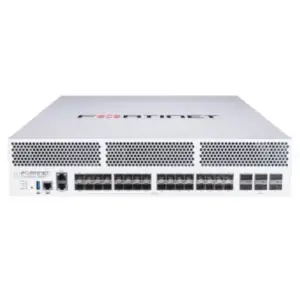
A 1U web application firewall appliance built to protect business web applications and APIs, with up to 1 Gbps HTTP/HTTPS throughput and hardware SSL/TLS processing.
For organizations exposing portals, web services, e-commerce applications, APIs, or other internet-facing systems, the application layer needs controls that understand web requests rather than relying only on perimeter network filtering. The FortiWeb 600F provides that dedicated layer in a rack-mount appliance suitable for data-centre and enterprise environments. Selection should be based on real encrypted traffic, application count, security services, availability design, interfaces, and support requirements.
Dedicated protection for the web application layer
FortiWeb is Fortinet’s web application firewall and API protection platform. The 600F is a physical appliance in the family, positioned above entry models where a business needs more protected traffic capacity and enterprise appliance characteristics. Its role is different from a general network firewall: it sits in the application delivery path and evaluates HTTP and HTTPS traffic so policies can focus on the behavior and risk of web applications.
That distinction matters for organizations whose critical services are delivered through browsers, mobile back ends, partner portals, APIs, online transaction systems, education portals, government services, or internal web applications. Network firewalls remain important, but application attacks can arrive through permitted web ports. A WAF adds controls designed around the application protocol and the requests reaching protected servers.
The 600F combines up to 1 Gbps protected throughput with hardware SSL/TLS processing, 480 GB SSD storage, multiple copper and fiber interfaces, high-availability options, and redundant hot-swappable power. Fortinet also supports unlimited application licenses on the appliance, although security subscriptions and service bundles are separate procurement considerations. This makes the model relevant where a buyer wants a dedicated appliance rather than a small entry platform, while not requiring the throughput of the larger FortiWeb models.
Deployment planning should begin with the applications themselves. Buyers should document peak and normal HTTP/HTTPS traffic, TLS use, the number and importance of protected services, availability objectives, existing load-balancing or reverse-proxy architecture, interface media, and whether the organization needs advanced FortiWeb services. FourTeck can use that information to help structure a Uganda quotation around the appliance and the appropriate service term rather than treating the hardware as an isolated line item.
Operational outcomes that matter to application owners
01
Application-aware security control
FortiWeb is designed to inspect and protect web application and API traffic. This gives security teams a control point focused on requests reaching business applications, helping reduce exposure to application-layer attacks while keeping policy administration tied to the services being protected.
02
Hardware-assisted encrypted traffic processing
The 600F uses hardware SSL/TLS processing. For buyers protecting HTTPS-heavy services, this is a defining hardware characteristic because application inspection increasingly happens inside encrypted sessions. Capacity still depends on configuration, but the platform is designed with encrypted application traffic in mind.
03
Resilient appliance design
Dual hot-swappable power supplies reduce dependence on a single appliance PSU, while FortiWeb supports active/passive and active/active clustering. Organizations with uptime requirements can therefore design redundancy at both power and appliance levels, subject to correct topology and configuration.
04
Flexible data-centre connectivity
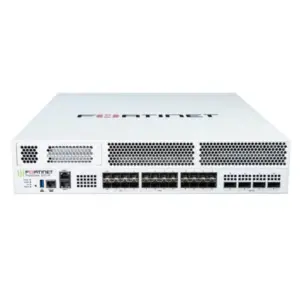
Four GE RJ45 interfaces, including two bypass ports, and four SFP GE interfaces provide copper and fiber choices for integrating the appliance into existing network designs. Interface planning should be completed before purchase so required transceivers and cabling are included.
05
Multi-application consolidation
Fortinet lists unlimited application licenses for the appliance. This supports consolidation of multiple protected applications on one platform, provided total performance, policy complexity, administrative boundaries, and availability requirements remain within the selected design.
06
Growth path within one FortiWeb family
The 600F sits in a wider appliance range. If measured traffic or future demand exceeds its capacity, larger FortiWeb models provide higher throughput. This gives procurement teams a practical way to evaluate the 600F against current demand and a credible scale-up path.
A mid-range FortiWeb appliance with enterprise deployment characteristics
The key distinction is the combination of 1 Gbps application-protection throughput, hardware SSL/TLS processing, redundant power, rack form factor, multiple copper/fiber interfaces, and FortiWeb’s dedicated web application security capabilities.
1 Gbps HTTP/HTTPS
Fortinet-published maximum throughput; actual results vary with configuration and enabled features.
Hardware SSL/TLS
Purpose-built encrypted traffic processing for HTTPS application protection.
480 GB SSD
Integrated storage in the physical appliance for platform operation and local functions.
HA clustering
Supports active/passive and active/active clustering for resilient designs.
FortiWeb 600F specification ledger
| Specification | Published detail | Buyer relevance |
|---|---|---|
| HTTP throughput | Up to 1 Gbps | Baseline for application traffic sizing |
| HTTPS throughput | Up to 1 Gbps | Important for TLS-heavy applications |
| Latency | Under 5 ms | Published platform latency figure |
| GE RJ45 | 4 ports, 2 bypass | Copper connectivity and bypass design |
| SFP GE | 4 ports | Fiber integration; optics should be confirmed |
| SSL/TLS processing | Hardware | Supports encrypted traffic inspection workload |
| Storage | 480 GB SSD | Integrated appliance storage |
| Form factor | 1U rack mount | Plan rack space and airflow |
| Power | Dual hot-swappable; 100–240V AC, 50–60 Hz | Supports redundant power design |
| Average power consumption | 138.74 W | Useful for rack power planning |
| High availability | Active/Passive; Active/Active clustering | Relevant to continuity architecture |
| Application licenses | Unlimited | Capacity remains performance-dependent |
| Administrative domains | Up to 64 on FortiWeb 8.0.5 for 600F | Relevant to administrative separation; software-version dependent |
| Dimensions | 44 × 438 × 420 mm | Rack-depth planning |
| Weight | 6.8 kg | Physical installation planning |
What affects the purchase most: throughput is only the starting point. A buyer should determine the amount of traffic that actually traverses protected applications, the proportion using HTTPS, expected growth, high-availability requirements, and which FortiWeb security services are needed. Interface requirements can also change the bill of materials because SFP optics and cabling may need to be ordered separately. The 1U form factor and redundant power supplies suit data-centre deployment, but rack power, cooling, and available network connections should be checked before installation.
Software version matters as well. Fortinet documentation for FortiWeb 8.0.5 increases the 600F administrative-domain limit to 64, whereas older datasheet material lists 32. Treat this as software-version dependent and verify the intended FortiWeb release during deployment planning. Performance figures are published as maximum values and can vary with system configuration and security processing.
Five questions to answer before requesting a quote
01 — What applications and APIs will be protected?
List public websites, portals, API endpoints, internal applications, and business-critical services. Different applications may require different policies, authentication flows, certificates, and protection profiles. Knowing the application inventory helps determine whether consolidation on one appliance is operationally sensible.
02 — What is the real protected traffic scale?
Provide normal and peak HTTP/HTTPS traffic rather than only the ISP circuit speed. The 600F is rated up to 1 Gbps, but enabled security functions and traffic characteristics affect real-world performance. Growth assumptions should be included so the appliance is not sized only for today’s average.
03 — How will FortiWeb connect to the existing environment?
Document switching, routing, load balancers, server networks, VLANs, copper or fiber connections, certificate ownership, and any reverse-proxy architecture. This identifies interface, transceiver, cabling, and change-window requirements before the equipment arrives.
04 — Which services and support term are required?
FortiWeb is available with service bundles and FortiCare options. The right selection depends on the security functions required by the organization and the desired support term. A hardware-only comparison can therefore be misleading if the operational requirement assumes subscription services.
05 — What are the continuity and deployment expectations?
If the application must remain available during appliance or power failures, discuss clustering, redundant power feeds, maintenance strategy, rack space, and network path design. High availability generally changes quantity, topology, licensing considerations, and implementation effort.
Where the 600F can make practical sense
Customer-facing portals and transaction applications
A business running online account services, transaction portals, booking systems, or customer self-service applications may need a dedicated security layer in front of application servers. The 600F fits where aggregate protected traffic falls within its capacity and the organization wants a physical rack appliance. The design should account for HTTPS volume, certificate handling, application dependencies, and availability expectations.
Enterprise API and web-service protection
Organizations increasingly connect mobile applications, partners, internal systems, and cloud services through APIs. FortiWeb’s application and API protection role can provide a dedicated policy enforcement point. Buyers should inventory API endpoints and expected request patterns, then confirm which FortiWeb services are needed for their threat model rather than assuming every capability is included with hardware alone.
Government and education web platforms
Institutions operating multiple web applications may value the ability to protect many services on a single appliance while separating administration where appropriate. The 600F’s rack form factor, redundant power, clustering support, and application capacity make it relevant to centrally managed environments. Traffic sizing, procurement terms, maintenance windows, and the selected FortiWeb software version should be documented before deployment.
Data-centre hosted business applications
Managed infrastructure teams and enterprises hosting applications in a private data centre can insert FortiWeb into an established network design using copper or SFP GE connectivity. The presence of bypass-capable ports and HA clustering options supports several architecture choices, but topology must be designed deliberately. FourTeck can help translate the intended path into a hardware and accessory list for quotation.
Encrypted application traffic is the sizing conversation
Modern business applications commonly use HTTPS throughout the user journey. That means a WAF must process encrypted sessions before it can evaluate application requests. The FortiWeb 600F addresses this with hardware SSL/TLS processing and a published HTTPS throughput of up to 1 Gbps using Fortinet’s stated test basis.
Procurement teams should not interpret that figure as a guaranteed production rate under every policy combination. Fortinet explicitly notes that performance values are maximums and vary with system configuration. The practical exercise is to establish peak protected traffic, TLS characteristics, expected growth, and the security functions that will be active. If the current environment already approaches the appliance’s maximum, a larger model may provide a safer operating margin.
This is also why internet bandwidth is an incomplete sizing metric. A 2 Gbps internet connection does not mean a WAF necessarily sees 2 Gbps, while a smaller WAN circuit may still carry bursty or compute-intensive application traffic. Measure the flows that will actually traverse the appliance.
Resilience is more than a redundant power supply
The 600F includes dual hot-swappable AC power supplies and supports active/passive and active/active clustering. These are useful building blocks for applications that cannot depend on a single appliance or a single power feed. A resilient deployment, however, requires the surrounding design to remove other single points of failure.
Dual power
Connect redundant supplies to appropriately separated power sources where the facility design supports it.
HA clustering
Choose active/passive or active/active based on architecture, capacity, operational model, and Fortinet deployment guidance.
Network path
Switching, upstream connectivity, server-side paths, and load-balancing dependencies must also be considered in continuity planning.
Licensing and service bundles shape the final solution
FortiWeb procurement is not only a hardware choice. Fortinet’s ordering guidance separates the appliance from Standard, Advanced, and Enterprise bundle options and individual services. The Standard bundle combines FortiCare Premium with core FortiWeb security services identified in Fortinet ordering material; higher bundles add further capabilities. Exact inclusions can change over product lifecycle, so the current ordering guide and quote should control the final bill of materials.
For a buyer, the decision should start with required security outcomes rather than the bundle name. Determine whether the environment needs capabilities related to credential abuse, threat analytics, bot protection, data loss prevention, or other FortiWeb services, then map those needs to the current bundle. Also choose an appropriate term and renewal approach.
Buyer decision checklist
- Confirm whether the quotation is hardware-only or includes a FortiWeb service bundle.
- Confirm the exact bundle name, term, and FortiCare level.
- Match advanced services to documented application risks.
- Include HA quantity and service coverage when designing a cluster.
- Record renewal dates and ownership for future operational planning.
What buyers should check before purchase
| Risk | What to confirm | Why it matters | Share with FourTeck |
|---|---|---|---|
| Undersizing | Peak protected HTTP/HTTPS traffic and growth | Security processing and TLS load affect capacity | Traffic measurements and forecast |
| Incomplete license scope | Bundle, service term and support level | Required protections may depend on services | Security requirements and preferred term |
| Connectivity mismatch | RJ45/SFP use, optics, cabling and topology | Missing accessories can delay deployment | Switch ports, fiber type and network diagram |
| Availability design gap | HA mode, power feeds and maintenance strategy | A single appliance remains a service dependency | Uptime target, rack and power design |
Plan the appliance, services and deployment as one purchase
FourTeck can assist Uganda organizations with product selection, configuration review, quotation preparation, delivery coordination, and guidance around the commercial scope of FortiWeb support and security services. Availability can vary by appliance, bundle, support term, and project quantity, so current supply and lead-time information should be confirmed at quotation stage rather than assumed from a catalogue listing.
For Kampala projects, buyers can provide the intended application environment, traffic scale, network topology, high-availability requirement, rack and power information, and preferred service duration. FourTeck can then help identify the appropriate bill of materials and clarify configuration-dependent items. Warranty and support conditions should be checked against the exact Fortinet SKU and service package included in the final quotation.
Uganda project coverage
FourTeck can coordinate product enquiries and project requirements for organizations in Kampala and for deployments serving Entebbe, Jinja, Mbarara, and Gulu. The practical scope depends on the order, destination, implementation responsibility, and requested support. For multi-site projects, share quantities and destination details together so delivery planning and configuration consistency can be addressed in one quotation.
Support for regional procurement planning
Organizations coordinating technology procurement across Uganda, Kenya, selected East Africa markets, or wider Africa can discuss regional requirements with FourTeck. Regional supply should be planned around the exact Fortinet SKU, licensing geography, delivery destination, project schedule, and support expectations. Buyers with UAE or Kuwait procurement requirements can also use FourTeck’s regional sites to discuss separate market needs.
FourTeck Uganda · FourTeck Kenya · FourTeck Africa · FourTeck UAE · FourTeck Kuwait
FortiWeb capacity paths and procurement links
Procurement help before the order is placed
01 — Product selection guidance. FourTeck can compare the protected-traffic requirement with FortiWeb appliance capacities so buyers can discuss whether the 600F is appropriately sized.
02 — Configuration review. Interfaces, SFP requirements, HA design, rack environment, power, certificates, service bundles, and support terms can be reviewed as part of quote preparation.
03 — Quote assistance. A structured requirement makes it easier to quote the appliance, subscriptions, support, and relevant accessories as a coherent bill of materials.
04 — Uganda delivery coordination. Delivery requirements can be discussed based on destination, project quantity, and current availability without assuming stock or fixed lead times.
05 — Alternative product matching. If measured demand indicates that a smaller or larger FortiWeb platform is more suitable, FourTeck can help review that alternative path.
FortiWeb 600F buyer questions
01. What is the FortiWeb 600F used for?
It is a physical web application firewall appliance for protecting web applications and APIs. It inspects application traffic and applies FortiWeb security controls in front of protected services. It is relevant to organizations operating public portals, online business applications, API services, and other HTTP/HTTPS workloads that need a dedicated application-security layer.
02. What throughput does the 600F provide?
Fortinet publishes up to 1 Gbps HTTP and up to 1 Gbps HTTPS throughput for the 600F. These are maximum performance values and can vary with system configuration and enabled protections. Buyers should therefore size the appliance using measured protected traffic, TLS use, policy requirements, and growth rather than treating 1 Gbps as a guaranteed production result.
03. Does it support high availability?
Yes. Fortinet lists active/passive and active/active clustering support for the model. The appliance also has dual hot-swappable power supplies. A resilient deployment still requires appropriate network paths, power feeds, switching, rack design, and operational procedures. Discuss the required uptime target before deciding whether a single appliance or an HA pair is appropriate.
04. Which interfaces are included?
The current Fortinet datasheet lists four GE RJ45 interfaces, including two bypass ports, plus four SFP GE interfaces. This gives buyers copper and fiber connectivity options. Confirm the exact topology, fiber type, transceivers, and cabling before ordering because optics and other accessories may need to be included separately in the project bill of materials.
05. Are FortiWeb security subscriptions required?
The appliance can be purchased in different commercial configurations, and Fortinet publishes Standard, Advanced, and Enterprise bundle paths as well as individual services. The right choice depends on the security capabilities and support required. Ask for the exact SKU, included services, term, and renewal scope to be stated clearly in the quotation.
06. How many applications can it protect?
Fortinet lists unlimited application licenses for the 600F, but that does not mean capacity is unlimited. Total traffic, TLS processing, policy complexity, administrative design, enabled services, and availability requirements still determine practical scale. Buyers consolidating many applications should provide an application inventory and traffic profile during sizing.
07. Is the 600F suitable for rack installation?
Yes. It is a 1U rack-mount appliance measuring approximately 44 × 438 × 420 mm and weighing about 6.8 kg according to Fortinet’s datasheet. Plan front-to-back airflow, power feeds, rack depth, cable management, and adjacent equipment. The published operating temperature range is 0°C to 40°C.
08. Is the FortiWeb 600F available in Uganda?
Availability can vary with hardware, service bundle, support term, and project quantity. FourTeck can prepare a current Uganda quotation and coordinate delivery requirements after reviewing the exact configuration. Share the destination, quantity, desired service term, application traffic, and HA requirements so the quote can reflect the intended deployment rather than only the base appliance.
09. What should I send FourTeck for an accurate quote?
Provide the number of protected applications, normal and peak HTTP/HTTPS traffic, expected growth, required security services, support duration, HA requirement, network interface media, rack and power information, delivery destination, and quantity. If available, include a simple network diagram. These details help identify the correct appliance, subscriptions, and accessories.
10. What if 1 Gbps is not enough for future growth?
Fortinet offers larger FortiWeb appliances with higher published throughput, including the 1000F at up to 2.5 Gbps. If the 600F would operate too close to its capacity after security processing and growth are considered, reviewing a larger model can provide more headroom. FourTeck can help compare the relevant FortiWeb capacity tiers.
Build the FortiWeb quote around your applications
Send FourTeck your protected application count, peak HTTPS traffic, preferred service term, high-availability requirement, interface needs, delivery location, and quantity. The team can use those details to prepare a configuration-focused Uganda quotation and discuss whether the 600F or another FortiWeb capacity tier better fits the project.
Reviews
There are no reviews yet.