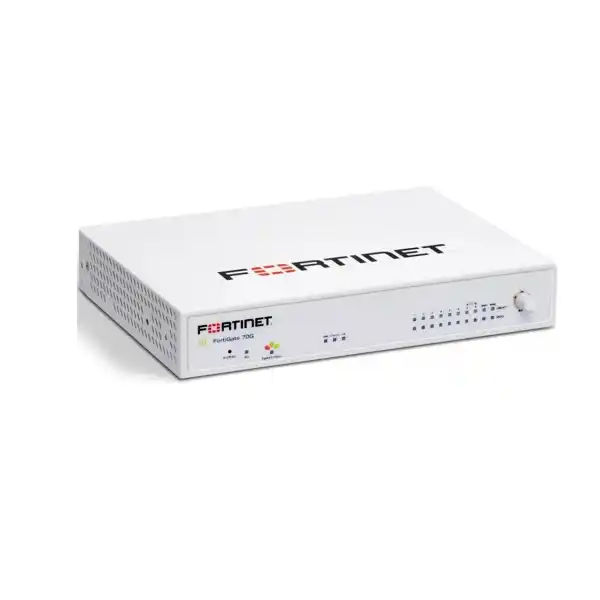
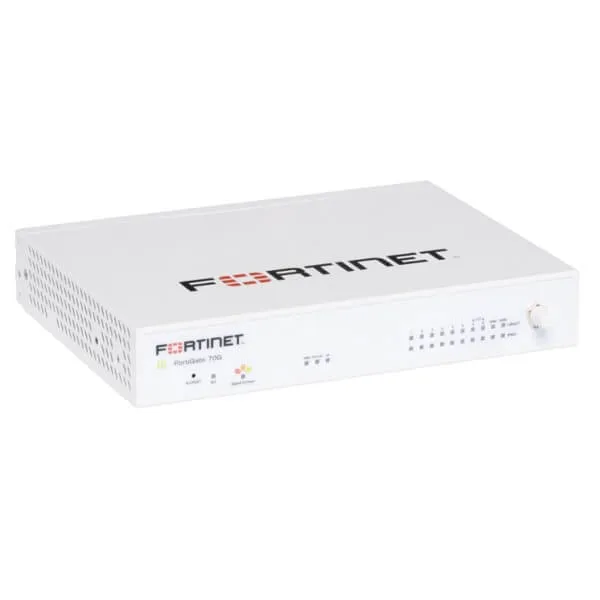
FortiWiFi 70G-POE Uganda
A compact Fortinet security gateway that combines next-generation firewalling, secure SD-WAN, integrated Wi-Fi 6 and PoE-capable Ethernet for distributed business locations.
The 70G family is designed for branch environments where security and networking need to operate as one system. The PoE wireless model is particularly relevant when a site wants to reduce the number of separate branch devices while still retaining policy control, VPN connectivity, wireless access and the ability to power selected network endpoints. FourTeck can help Uganda buyers review the appliance, licensing, port use, wireless requirements and rollout scope before quotation.
A branch security platform with fewer separate boxes to manage
FortiWiFi 70G-POE is built for organizations that want a branch firewall to do more than route internet traffic. It combines Fortinet’s next-generation firewall and secure SD-WAN capabilities with integrated wireless networking and PoE-capable Ethernet. That combination can be valuable in a branch office, retail location, clinic, school administration site or professional workspace where the IT team wants one policy platform for internet security, private connectivity, wireless access and selected powered edge devices.
The 70G family runs FortiOS, Fortinet’s unified networking and security operating system. In practical terms, this means routing, firewall policy, secure SD-WAN, VPN functions, security inspection, wireless control and broader Security Fabric integration can be managed within the same Fortinet operating environment. For buyers already operating Fortinet infrastructure, this can reduce the operational gap between branch security and the rest of the network. For first-time buyers, it provides a path to a more structured security architecture than a basic internet router and stand-alone access point combination.
The integrated wireless function matters most where the physical site is compact enough for the appliance’s radio placement to make sense. Wi-Fi 6 capability supports contemporary client environments, but wireless design still depends on walls, floor plan, interference, user density and the location of the firewall itself. A branch that needs wider coverage may still require separate FortiAP access points. The appliance should therefore be viewed as a security gateway with useful integrated wireless capability, not as a guarantee that one radio position will cover every workspace.
The PoE capability also changes the buying conversation. Four Gigabit Ethernet PoE ports can reduce the need for a small external PoE switch when the branch has only a limited number of powered devices. Typical examples can include a small number of compatible access points, IP phones or other standards-based endpoints. The published aggregate PoE budget is finite, so the connected devices and their actual power draw must be checked. A four-port count does not automatically mean four high-power devices can be run simultaneously at their maximum demand.
Security services are another major configuration variable. FortiGuard subscriptions can extend the appliance beyond stateful firewalling into functions such as intrusion prevention, application control, web and DNS security, malware protection and other services, depending on the selected bundle. Procurement teams should compare the business security requirement with the subscription term and support level instead of purchasing hardware first and deciding the service scope later. FourTeck can assist Uganda organizations with that selection process, including hardware, service term, rollout quantity and deployment planning.
Benefits that matter when the branch has to stay simple, secure and manageable
Consolidate key branch functions
Firewalling, SD-WAN, wireless and selected PoE connections can sit around one FortiOS appliance rather than being treated as four unrelated purchases. The business value is not just fewer boxes; it is a clearer configuration model and fewer handoffs between separate management interfaces.
Apply security policy closer to branch users
A next-generation firewall at the site edge lets the IT team control traffic before it simply exits to the internet. When appropriate FortiGuard services are licensed, the branch can use additional inspection and threat-protection functions aligned to the organization’s policy rather than relying only on network address translation and basic access rules.
Use multiple links more intelligently
Fortinet secure SD-WAN can help organizations steer applications across available WAN paths according to policy and link health. The exact design depends on ISP services and business requirements, but the capability is useful for branches that need more control than static primary-and-backup internet routing.
Reduce small-site PoE hardware
Four PoE-capable Gigabit Ethernet ports can be enough for a branch with a modest powered-device requirement. When the endpoint count and wattage fit the appliance budget, the organization may avoid deploying a separate PoE switch solely for a few devices.
Keep wired and wireless branch policy aligned
Integrated Wi-Fi 6 gives compact sites a direct wireless option, while FortiOS provides a common policy context for the branch. This can make it easier to plan employee, guest and operational networks when compared with completely separate firewall and wireless systems.
Build a repeatable branch standard
Distributed organizations often need a consistent architecture across multiple locations. A repeatable model around FortiOS, security subscriptions, VLANs, VPN design and defined PoE use can simplify documentation and support. The value rises when each branch is planned from the same template but sized for its real traffic and site conditions.
The distinguishing point is convergence at the branch edge, not a single headline specification.
Fortinet positions the 70G series as a converged next-generation firewall and SD-WAN platform for distributed enterprise locations. The FortiWiFi PoE variant adds two capabilities that matter for compact sites: integrated wireless networking and direct PoE delivery to selected endpoints. Together, these features allow a procurement team to evaluate one appliance as the center of a branch design rather than buying a firewall, basic router, wireless access layer and small PoE device independently.
FortiWiFi 70G-POE technical reference
| Field | Published / practical reference | Buyer note |
|---|---|---|
| Product type | Converged next-generation firewall and secure SD-WAN appliance with integrated wireless | Designed for distributed business and branch deployments |
| Operating system | FortiOS | Software release and enabled services affect available functions |
| Ethernet interfaces | 10 x Gigabit Ethernet RJ45 on commonly listed FWF-70G-POE configurations | Confirm regional SKU before order |
| WAN ports | 2 x GE RJ45 WAN | Suitable for dual-link designs subject to ISP handoff requirements |
| Internal ports | 4 x GE RJ45 internal | Plan VLANs and physical device attachment before installation |
| PoE ports | 4 x GE RJ45 PoE | Endpoint standards and total wattage must be checked |
| PoE power budget | 60 W aggregate reference for commonly listed configuration | Do not size by port count alone |
| Wireless | Wi-Fi 6 / 802.11ax dual-radio; 2.4 GHz and 5 GHz operation | Regional radio code, antenna placement and coverage plan matter |
| Wireless antennas | External detachable antennas on commonly listed configuration | Final placement should consider physical security and signal path |
| Security services | FortiGuard service options available by selected subscription | License scope and term are configuration dependent |
| SD-WAN | Included FortiOS secure SD-WAN capability | Policy design and monitoring services may vary by deployment |
| Form factor | Desktop branch appliance | Confirm mounting, ventilation and cable access at the site |
| FortiAP controller capability | Wireless controller capability is part of the FortiGate/FortiWiFi platform | Access-point count and topology should be checked against current FortiOS support guidance |
The specifications that most affect a purchase are not necessarily the largest numbers in a datasheet. For this model, the most important questions are how many users and inspected sessions the branch will generate, whether the integrated wireless placement is suitable, how much PoE power the endpoints require, and which security services the business expects to keep active. A branch may have modest internet bandwidth yet still need a stronger security profile because it uses multiple VPN tunnels, content inspection and application controls. Another branch may have a simple security policy but require broader wireless coverage than an integrated radio can provide.
PoE sizing deserves particular attention. The appliance offers a convenient way to power a limited number of endpoints, but the available wattage is shared. A deployment with several devices drawing near their peak consumption may require a dedicated PoE switch even though there are physically enough ports. Wireless is similar: Wi-Fi 6 capability is useful, but the final experience is governed by RF conditions, floor layout and client density. FourTeck can review these variables with Uganda buyers so the quote reflects the branch as a system rather than a list of components.
Five questions that should be answered before the model is ordered
01 — What must the branch protect and connect?
List the internet-facing applications, local users, remote-access requirement, site-to-site VPNs, cloud services and any guest or operational networks. This changes the security policy and therefore the amount of inspection the appliance must perform. A simple office browsing profile is different from a branch carrying multiple encrypted business applications, voice services and private tunnels.
02 — What is the real scale?
Provide current and expected user count, WAN bandwidth, concurrent client volume, VPN usage, number of VLANs and peak traffic periods. Sizing by employee count alone can mislead because a smaller office with heavy cloud use may generate more security workload than a larger office with limited application traffic.
03 — What must work with the existing network?
Confirm ISP handoffs, existing switches, FortiAP or third-party access points, VLAN plan, directory services, VPN peers, monitoring systems and endpoint types. The integrated wireless and PoE functions may reduce hardware only when they fit the existing topology. If another switch or wireless layer remains in place, the design should define exactly which device performs each function.
04 — What security and growth plan applies?
Choose the FortiGuard service level and support term based on business policy, not only initial cost. Also account for future branches, more users, faster ISP links, additional VPNs, new wireless clients and extra PoE endpoints. A good configuration leaves sensible headroom without turning a compact branch purchase into an unnecessarily large platform.
05 — What installation and service expectations must be met?
State the rollout date, project quantity, branch locations, whether policy migration is required, who will manage the firewall after go-live, and what level of support the organization expects. Delivery planning and subscription activation should be coordinated with installation so the site does not receive hardware that cannot yet be placed into its intended service state.
Where the appliance can make practical sense
Distributed corporate branch
A regional office that connects to head office, SaaS applications and cloud platforms can use the appliance as the local security and SD-WAN edge. Integrated wireless can serve a compact workspace, while PoE can support a few branch endpoints. The key design question is whether the security inspection load and wireless coverage remain appropriate as the branch grows.
Retail or service location
A shop or service counter may need employee access, guest connectivity, payment-related network separation, VPN to central systems and reliable internet policy. The appliance can provide a structured edge platform while PoE helps with a small number of devices. Segmentation should be planned carefully so guest, staff and operational traffic do not share unnecessary trust.
Clinic or professional practice
A compact clinic, legal practice or consulting office often needs secure browsing, cloud application access, Wi-Fi for staff, a segregated guest network and encrypted connectivity to another site. The model can centralize those controls. Buyers should decide how logs, security subscriptions and administrative access will be managed because these operational details matter as much as the initial firewall rule set.
School administration or satellite campus office
A small education site can use the appliance to separate administration, staff and guest traffic while connecting to central systems through VPN or SD-WAN. Integrated wireless is suitable only where the coverage area and user density are modest. Larger teaching spaces should normally be planned with additional access points and switching rather than expecting one integrated radio to serve the whole campus.
NGO or project office
Project sites frequently need a consistent firewall standard, secure tunnels, centrally defined policy and a compact hardware footprint. A repeatable FortiOS design can make rollout more manageable across multiple locations. The procurement team should align license terms and project duration so security services and support remain valid for the intended operating period.
These use cases share one characteristic: they are small enough for a compact edge appliance, but important enough that business connectivity and security cannot be left to a consumer router. The FortiWiFi 70G-POE is most convincing when its integrated functions match the branch. When a site needs dozens of powered endpoints, dense wireless coverage or much larger switching capacity, FourTeck can help keep the firewall role while adding the right FortiSwitch or FortiAP architecture around it.
FortiOS convergence turns the firewall into the branch policy point
FortiOS is central to the value of the 70G family because it brings networking and security controls into one operating environment. Instead of treating WAN routing, security policy, VPN, application control, wireless functions and device visibility as isolated tools, the platform allows the branch to be managed as a connected security system. This does not eliminate the need for good network design; it makes the design easier to express consistently.
For a Uganda business operating several branches, consistency can matter more than any single benchmark. A repeatable FortiOS policy structure helps the IT team define how internet traffic exits, which users or VLANs can reach particular services, how branch-to-branch or branch-to-head-office tunnels are configured, and which security services inspect traffic. Secure SD-WAN can then use available links according to business rules and measured path conditions rather than simply forwarding everything through one default route.
Fortinet also positions the 70G family as part of the Security Fabric. That becomes useful when the organization already uses other Fortinet products or wants a broader management and security architecture. The purchasing decision should still begin with the branch requirement. A feature has value only when the organization has a plan to configure, monitor and maintain it. FourTeck can help translate requirements such as “keep voice stable during ISP degradation” or “separate guest traffic from finance systems” into a clearer configuration scope for quotation and deployment planning.
Integrated Wi-Fi 6 is useful when placement and scale are right
Integrated wireless is one of the defining differences between FortiWiFi and a comparable wired-only firewall. The 70G-POE variant supports modern dual-radio Wi-Fi operation, allowing a compact branch to provide local wireless service without automatically adding a separate access point. That can simplify a reception office, small retail site, professional practice or temporary project location where the firewall can be installed in a position that also makes sense for radio coverage.
The important limitation is physical reality. Firewalls are often installed where internet circuits enter the building, where cables terminate or where equipment can be secured. That position may be excellent for networking but poor for wireless propagation. Reinforced walls, metal shelving, multiple floors, crowded channels and a large number of client devices can all reduce the effectiveness of an integrated radio. Procurement teams should therefore treat Wi-Fi 6 as a capable built-in function, not as proof that no other access point will be needed.
For buyers, the decision is straightforward: use the integrated wireless when the appliance can be physically placed where coverage works, and add dedicated access points when the site demands broader or denser service. FourTeck can use a floor-plan discussion, approximate client count and building description to determine whether the built-in radio is likely to be enough or should be part of a larger wireless design.
PoE can remove a small switch, but only after the power math is checked
The PoE ports are valuable because they allow the appliance to power a limited number of compatible Ethernet devices directly. In a small branch, that can reduce cabling complexity and eliminate a separate low-port-count PoE switch. The typical temptation is to count endpoints and stop there: four ports, four devices. Correct design must go one step further and calculate the combined power draw.
The commonly published aggregate PoE budget for the FortiWiFi 70G-POE configuration is 60 watts. The actual draw of each endpoint depends on the device and operating conditions. An access point, IP phone and camera do not necessarily consume the same power, and some equipment has higher peak requirements than its average usage suggests. A deployment that looks comfortable by port count can exceed the available power budget when all devices are active. In that case a dedicated FortiSwitch or another properly specified PoE switch is the safer architecture.
This is a good example of why FourTeck asks for a device list before quoting an all-in-one branch solution. The PoE function can create a very clean deployment when it matches the site. When it does not, the right answer is not to force the design but to separate firewall and switching roles in a controlled way.
What buyers should check before purchase
| Risk | What to confirm | Why it matters | What to share with FourTeck |
|---|---|---|---|
| Wrong regional SKU | Wireless region code, power accessories and exact part number | Wireless regulatory configuration and included items can vary by market | Deployment country and requested quantity |
| Under-sized security service scope | FortiGuard bundle and term | Advanced protection functions depend on the selected service package | Required controls, compliance needs and desired term |
| PoE overload | Endpoint count and maximum wattage | The shared power budget can be exceeded even if free ports remain | Device models and power requirements |
| Poor wireless placement | Firewall location, walls, floor size and client density | Integrated Wi-Fi works best when the appliance can be located sensibly for RF coverage | Floor plan or approximate dimensions and user count |
| Insufficient future headroom | Expected ISP upgrade, more users, VPN growth and new services | A branch platform should remain appropriate through the planned lifecycle | 12- to 36-month growth expectations |
| Migration surprises | Existing policies, VPN peers, addressing, VLANs and authentication dependencies | A hardware replacement can affect services if configuration dependencies are missed | Current firewall model and migration scope |
The most common selection errors happen when the product is treated as a sealed appliance instead of a component in a larger network. The correct model must fit the ISP circuits, wired topology, wireless plan, endpoint power needs, VPN design and security-service requirement. Buyers should also define support expectations early. FortiCare terms, service bundles and renewal planning can affect the lifetime cost and operating model much more than a small difference in initial hardware pricing.
For project purchases, quantity creates another layer of risk. A multi-branch deployment should use consistent part numbers and subscription terms where possible so activation, documentation and renewal dates remain manageable. If branches have different site sizes, it may be better to use a small number of approved models rather than force one appliance into every location. FourTeck can help structure that discussion before purchase.
Procurement support for Uganda organizations
FortiWiFi 70G-POE availability in Uganda can vary according to regional SKU, security bundle, support term, quantity and current supply conditions. FourTeck can prepare a quote after reviewing the deployment rather than assuming that the lowest hardware-only configuration is appropriate. For Kampala buyers, the process can include product selection, license matching, delivery coordination and discussion of installation requirements. Organizations elsewhere in Uganda can use the same process for branch, replacement and project purchases.
FourTeck can also help identify whether the built-in wireless and PoE capabilities are enough for the intended site or whether the design should include dedicated access points or switching. Warranty handling and support expectations should be confirmed as part of the quotation so the buyer understands the applicable manufacturer service path and purchased support term. Project teams should share required quantity and target rollout timing early, particularly when several branches need the same hardware and synchronized subscriptions.
One configuration process for branches across Uganda
Businesses planning deployment in Kampala, Entebbe, Jinja, Mbarara and Gulu can request the same FourTeck configuration and quotation support. The practical questions remain consistent across locations: identify the ISP handoff, user and device count, required VPNs, wireless floor area, PoE endpoints, security bundle and installation responsibilities. For multi-site organizations, documenting these inputs per branch creates a cleaner bill of materials and helps determine whether every location should use the same appliance or whether a tiered branch standard is more appropriate.
Regional planning for organizations with more than one market
Organizations that operate in Uganda and Kenya, or across selected East Africa markets, may prefer to standardize firewall models, subscription terms and configuration templates across branches. FourTeck can support regional procurement discussions through its country and regional channels while keeping each site’s local requirements visible. This is especially useful when the same corporate security policy must be implemented in several offices but internet services, branch sizes and rollout dates differ.
Regional availability should always be confirmed per destination. FourTeck does not need to assume identical stock, delivery time or service arrangements across markets. Buyers can explore the FourTeck Kenya site, the FourTeck Africa portal, and, where procurement involves Gulf operations, the FourTeck UAE site or FourTeck Kuwait site. The objective is coordinated product selection and project planning, not an assumption that every location has the same commercial conditions.
Fortinet options worth comparing before the quote is finalized
Practical help between the datasheet and the deployed branch
Questions procurement and IT teams often need answered
01. What is FortiWiFi 70G-POE mainly used for?
It is a compact business security appliance for branch locations that need next-generation firewalling, secure SD-WAN, VPN connectivity, integrated Wi-Fi 6 and a small number of PoE-powered Ethernet endpoints. It is most useful where these functions can be combined without exceeding the site’s wireless, switching or power requirements. Larger sites may still use the appliance as the firewall while adding dedicated FortiAP and FortiSwitch infrastructure.
02. Does the appliance include wireless networking?
Yes. FortiWiFi models include integrated wireless, and the 70G-POE configuration is commonly listed with dual-radio Wi-Fi 6 support across 2.4 GHz and 5 GHz bands. Wireless performance depends on regional radio settings, antenna placement, building materials, interference and the number of active clients. A site that needs broad or high-density coverage should plan additional access points rather than relying only on the built-in radio.
03. How many PoE devices can it power?
The commonly listed configuration provides four Gigabit Ethernet PoE ports with a 60 W aggregate power budget. The practical number of powered devices depends on each endpoint’s maximum draw, so four ports do not always mean four devices can operate at full power simultaneously. Share the make, model and wattage of planned access points, phones, cameras or other endpoints so the power budget can be checked before purchase.
04. Do I need a FortiGuard subscription?
The appliance can provide core firewall and networking functions through FortiOS, while many advanced threat-protection services depend on the selected FortiGuard subscription. The right bundle should be based on the organization’s security policy, required inspection services and support expectations. FourTeck can help compare service options and terms so the quote states clearly what is included rather than leaving licensing assumptions to the deployment stage.
05. Can it be used for a branch with two internet connections?
Yes, the platform supports secure SD-WAN and commonly listed configurations include two Gigabit Ethernet WAN interfaces. A dual-link design can use policies and link measurements to decide how traffic should use the available circuits. The correct configuration depends on ISP handoffs, addressing, application priorities and failover requirements. FourTeck can review the intended WAN services before installation planning.
06. Is the integrated Wi-Fi enough for an entire office?
It can be enough for a compact office when the firewall is located in a sensible RF position and the client count is moderate. It may not be enough for multiple floors, dense seating, large classrooms, warehouses or buildings with difficult walls. In those cases, the better design is to keep the firewall at the edge and add dedicated FortiAP access points positioned for coverage and capacity.
07. What should I send FourTeck for an accurate quote?
Send the number of users, internet link speeds, ISP handoff types, VPN requirements, VLANs, security-service needs, approximate wireless floor area, expected Wi-Fi clients, PoE device list, project quantity, support term and delivery location. If this is a replacement, include the current firewall model and any migration constraints. These details allow the quotation to reflect the whole branch design rather than hardware alone.
08. Can FourTeck support multi-branch projects in Uganda?
FourTeck can assist with product and license planning for multiple Uganda locations, including quantity review, configuration consistency and delivery coordination. A multi-branch project should identify which sites have the same user profile and which require a larger or smaller model. Standardizing FortiOS policy templates and subscription terms where practical can make rollout, support and renewals easier to manage.
09. What if the PoE or wireless requirement is larger than this model can handle?
The firewall can still remain part of the solution. When the branch needs more powered ports, add a correctly sized PoE switch. When it needs wider or denser wireless coverage, add dedicated access points. The important point is to separate roles cleanly instead of forcing all edge functions through the integrated resources. FourTeck can help prepare a bill of materials that keeps the firewall, switching and wireless design balanced.
10. How should warranty and support be handled?
Warranty and technical support expectations should be confirmed in the quotation together with the applicable FortiCare term and the exact regional SKU. The appropriate service path can depend on the purchased package and market. Buyers should avoid assuming a support level from the hardware name alone. FourTeck can document the quoted support arrangement and help align it with the organization’s replacement and escalation expectations.
Plan the branch before you lock the Fortinet part number
Share the branch size, WAN links, required security services, wireless coverage, PoE endpoints and rollout quantity. FourTeck can use those details to review the FortiWiFi 70G-POE configuration, identify any required licenses or supporting network hardware, and prepare a Uganda quotation based on the actual deployment.
- User and device count
- ISP speed and number of WAN links
- VPN and security-service requirements
- Wi-Fi coverage and client density
- PoE endpoint models and wattage
- Quantity, support term and delivery location

Reviews
There are no reviews yet.